What is a
TQM
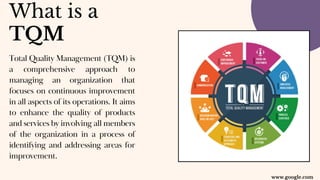
TotalQuality Management (TQM) is
a comprehensive approach to
managing an organization that
focuses on continuous improvement
in all aspects of its operations. It aims
to enhance the quality of products
and services by involving all members
of the organization in a process of
identifying and addressing areas for
improvement.
www.google.com
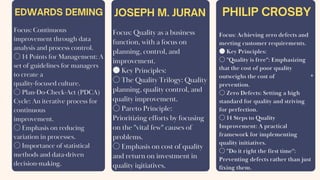
Focus: Continuous
improvement throughdata
analysis and process control.
○ 14 Points for Management: A
set of guidelines for managers
to create a
quality-focused culture.
○ Plan-Do-Check-Act (PDCA)
Cycle: An iterative process for
continuous
improvement.
○ Emphasis on reducing
variation in processes.
○ Importance of statistical
methods and data-driven
decision-making.
Focus: Quality as a business
function, with a focus on
planning, control, and
improvement.
● Key Principles:
○ The Quality Trilogy: Quality
planning, quality control, and
quality improvement.
○ Pareto Principle:
Prioritizing efforts by focusing
on the "vital few" causes of
problems.
○ Emphasis on cost of quality
and return on investment in
quality initiatives.
Focus: Achieving zero defects and
meeting customer requirements.
● Key Principles:
○ "Quality is free": Emphasizing
that the cost of poor quality
outweighs the cost of
prevention.
○ Zero Defects: Setting a high
standard for quality and striving
for perfection.
○ 14 Steps to Quality
Improvement: A practical
framework for implementing
quality initiatives.
○ "Do it right the first time":
Preventing defects rather than just
fixing them.
EDWARDS DEMING JOSEPH M. JURAN PHILIP CROSBY
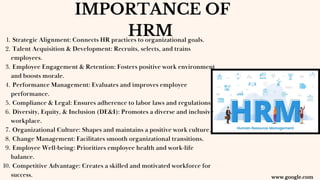
IMPORTANCE OF
HRM
Strategic Alignment:Connects HR practices to organizational goals.
1.
Talent Acquisition & Development: Recruits, selects, and trains
employees.
2.
Employee Engagement & Retention: Fosters positive work environment
and boosts morale.
3.
Performance Management: Evaluates and improves employee
performance.
4.
Compliance & Legal: Ensures adherence to labor laws and regulations.
5.
Diversity, Equity, & Inclusion (DE&I): Promotes a diverse and inclusive
workplace.
6.
Organizational Culture: Shapes and maintains a positive work culture.
7.
Change Management: Facilitates smooth organizational transitions.
8.
Employee Well-being: Prioritizes employee health and work-life
balance.
9.
Competitive Advantage: Creates a skilled and motivated workforce for
success.
10.
www.google.com
8.
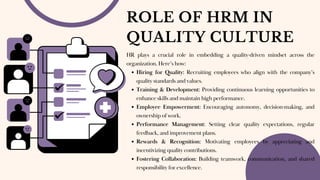
ROLE OF HRMIN
QUALITY CULTURE
HR plays a crucial role in embedding a quality-driven mindset across the
organization. Here’s how:
Hiring for Quality: Recruiting employees who align with the company’s
quality standards and values.
Training & Development: Providing continuous learning opportunities to
enhance skills and maintain high performance.
Employee Empowerment: Encouraging autonomy, decision-making, and
ownership of work.
Performance Management: Setting clear quality expectations, regular
feedback, and improvement plans.
Rewards & Recognition: Motivating employees by appreciating and
incentivizing quality contributions.
Fostering Collaboration: Building teamwork, communication, and shared
responsibility for excellence.
9.
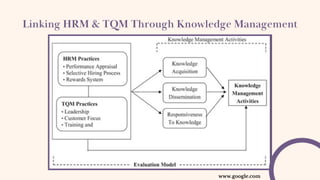
Linking HRM &TQM Through Knowledge Management
www.google.com
10.
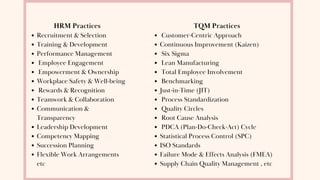
HRM Practices
Recruitment &Selection
Training & Development
Performance Management
Employee Engagement
Empowerment & Ownership
Workplace Safety & Well-being
Rewards & Recognition
Teamwork & Collaboration
Communication &
Transparency
Leadership Development
Competency Mapping
Succession Planning
Flexible Work Arrangements
etc
TQM Practices
Customer-Centric Approach
Continuous Improvement (Kaizen)
Six Sigma
Lean Manufacturing
Total Employee Involvement
Benchmarking
Just-in-Time (JIT)
Process Standardization
Quality Circles
Root Cause Analysis
PDCA (Plan-Do-Check-Act) Cycle
Statistical Process Control (SPC)
ISO Standards
Failure Mode & Effects Analysis (FMEA)
Supply Chain Quality Management , etc
11.
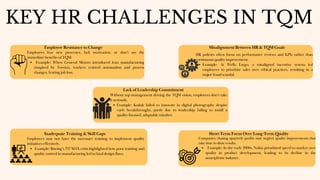
KEY HR CHALLENGESIN TQM
Employees fear new processes, lack motivation, or don’t see the
immediate benefits of TQM.
Example: When General Motors introduced lean manufacturing
(inspired by Toyota), workers resisted automation and process
changes, fearing job loss.
Employee Resistance to Change
Inadequate Training & Skill Gaps
Lack of Leadership Commitment
Short-Term Focus Over Long-Term Quality
Misalignment Between HR & TQM Goals
HR policies often focus on performance reviews and KPIs rather than
continuous quality improvement.
Example: At Wells Fargo, a misaligned incentive system led
employees to prioritize sales over ethical practices, resulting in a
major fraud scandal.
Employees may not have the necessary training to implement quality
initiatives effectively.
Example: Boeing’s 737 MAX crisis highlighted how poor training and
quality control in manufacturing led to fatal design flaws.
Companies chasing quarterly profits may neglect quality improvements that
take time to show results.
Example: In the early 2000s, Nokia prioritized speed to market over
quality in product development, leading to its decline in the
smartphone industry.
Without top management driving the TQM vision, employees don’t take
it seriously.
Example: Kodak failed to innovate in digital photography despite
early breakthroughs, partly due to leadership failing to instill a
quality-focused, adaptable mindset.
12.
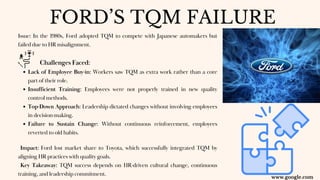
Issue: In the1980s, Ford adopted TQM to compete with Japanese automakers but
failed due to HR misalignment.
Challenges Faced:
Lack of Employee Buy-in: Workers saw TQM as extra work rather than a core
part of their role.
Insufficient Training: Employees were not properly trained in new quality
control methods.
Top-Down Approach: Leadership dictated changes without involving employees
in decision-making.
Failure to Sustain Change: Without continuous reinforcement, employees
reverted to old habits.
Impact: Ford lost market share to Toyota, which successfully integrated TQM by
aligning HR practices with quality goals.
Key Takeaway: TQM success depends on HR-driven cultural change, continuous
training, and leadership commitment.
FORD’S TQM FAILURE
www.google.com
13.
Overcoming HR challengesin
TQM
Strong Leadership Commitment
Leaders must actively promote quality as a core value.
Integrate TQM into company strategy and decision-making.
Clear & Transparent Communication
Educate employees on why TQM matters and how it benefits them.
Use regular meetings, feedback sessions, and internal campaigns.
Employee Involvement & Empowerment
Encourage participation in quality decisions and problem-solving.
Foster a culture of ownership where employees feel accountable for quality.
Comprehensive Training & Skill Development
Implement structured training on TQM principles and tools.
Provide continuous learning opportunities through workshops and mentorship.
Recognition & Reward Systems
Motivate employees with incentives for quality contributions.
Align performance metrics with quality objectives.
14.
Tata Steel becamethe first non-Japanese company to win the Deming Prize (2008) by
embedding TQM into its HR strategy.
Employee-Driven Quality Culture: HR fosters ownership through quality circles
and cross-functional teams.
Continuous Training & Development: Over 100,000 training man-days per year
ensure Six Sigma, Lean, and Kaizen expertise.
Employee Empowerment: Programs like "Suggest a Change" drive innovation
and efficiency.
Safety & Sustainability Focus: Achieved 90% reduction in workplace injuries
through strict quality and safety standards.
Global Recognition: Enhanced productivity, reduced defects, and world-class
steel quality.
Takeaway: Tata Steel proves that HR-powered TQM creates a globally competitive,
high-quality enterprise.
Tata Steel: A TQM & HR Success
Story
www.google.com
15.
Core Principles
The ToyotaProduction System (TPS): This is the foundation of Toyota's quality management. It
focuses on eliminating waste (muda) in all aspects of production, emphasizing efficiency and
continuous improvement.
Kaizen: This philosophy of continuous improvement encourages all employees to identify and
implement small changes that can lead to significant overall improvements.
Genchi Genbutsu: This principle emphasizes the importance of going to the source to understand a
situation firsthand. It encourages hands-on problem-solving and ensures decisions are based on a
deep understanding of the situation.
Toyota's success with Total Quality Management (TQM) is a widely studied and admired
example in the business world.
A breakdown of why their approach has been so effective:
Respect for People: Toyota values its employees and recognizes that their knowledge and experience
are valuable assets. This fosters a culture of collaboration and empowerment.
16.
Key Practices:
Jidoka: Thisprinciple allows machines to stop automatically when a problem occurs, preventing
the production of defective products.
Kanban: This system uses visual signals to manage inventory and ensure a smooth flow of
materials throughout the production process.
Poka-yoke: This technique focuses on mistake-proofing processes to prevent errors from
occurring in the first place.
5 Whys: This problem-solving technique involves asking "why" repeatedly to drill down to the
root cause of a problem.
Quality Circles: These are small groups of workers who come together to discuss and solve
problems related to their work.
17.
Benefits of Toyota'sTQM Approach:
Improved Product Quality: Toyota vehicles are known for their reliability and
durability, leading to high levels of customer satisfaction and loyalty.
Increased Efficiency: By eliminating waste and streamlining processes, Toyota has
achieved significant cost savings and increased productivity.
Enhanced Innovation: The company's culture of continuous improvement and
employee empowerment has fostered a spirit of innovation, allowing Toyota to
remain at the forefront of the automotive industry.
Strong Brand Reputation: Toyota's commitment to quality has earned it a strong
reputation for excellence, which has translated into a loyal customer base and a
competitive advantage.
18.
Lessons for OtherBusinesses:
Toyota's success with TQM offers valuable lessons for other businesses looking to improve
their quality and efficiency.
Some key takeaways include:
Focus on continuous improvement: Quality is not a destination but a journey.
Businesses should constantly strive to identify and eliminate waste, improve processes,
and enhance their products and services.
Empower employees: Employees are a valuable source of knowledge and ideas.
Businesses should create a culture where employees are encouraged to contribute to
quality improvement efforts.
Emphasize prevention over detection: It is more efficient and cost-effective to prevent
problems from occurring in the first place than to detect and fix them later.
Build a culture of quality: Quality should be ingrained in the DNA of the organization.
This requires strong leadership, clear communication, and a commitment to continuous
improvement at all levels.