Business Systems Analysis
Overview Part II
by Vinil Gupta
Vinil Gupta Business Systems Analysis Part II2
Two aspect of UML
 Static Structure
 Dynamic Behaviour
Vinil Gupta Business Systems Analysis Part II3
UML Diagrams Overview
Vinil Gupta Business Systems Analysis Part II4
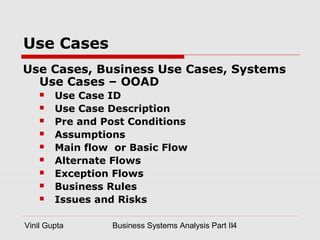
Use Cases
Use Cases, Business Use Cases, Systems
Use Cases – OOAD
 Use Case ID
 Use Case Description
 Pre and Post Conditions
 Assumptions
 Main flow or Basic Flow
 Alternate Flows
 Exception Flows
 Business Rules
 Issues and Risks
Vinil Gupta Business Systems Analysis Part II5
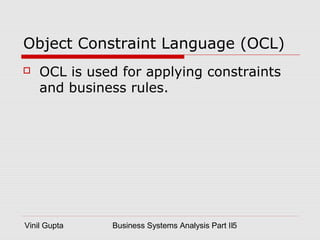
Object Constraint Language (OCL)
 OCL is used for applying constraints
and business rules.
Vinil Gupta Business Systems Analysis Part II6
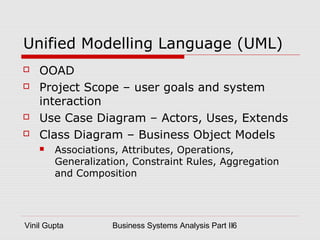
Unified Modelling Language (UML)
 OOAD
 Project Scope – user goals and system
interaction
 Use Case Diagram – Actors, Uses, Extends
 Class Diagram – Business Object Models
 Associations, Attributes, Operations,
Generalization, Constraint Rules, Aggregation
and Composition
Vinil Gupta Business Systems Analysis Part II7
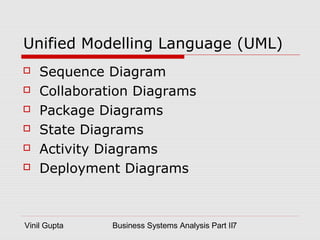
Unified Modelling Language (UML)
 Sequence Diagram
 Collaboration Diagrams
 Package Diagrams
 State Diagrams
 Activity Diagrams
 Deployment Diagrams
Vinil Gupta Business Systems Analysis Part II8
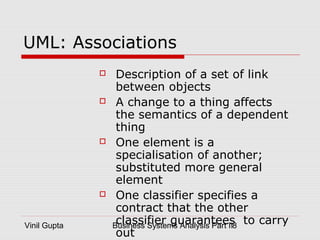
UML: Associations
 Description of a set of link
between objects
 A change to a thing affects
the semantics of a dependent
thing
 One element is a
specialisation of another;
substituted more general
element
 One classifier specifies a
contract that the other
classifier guarantees to carry
out
Vinil Gupta Business Systems Analysis Part II9
Vinil Gupta Business Systems Analysis Part II10
Vinil Gupta Business Systems Analysis Part II11
Vinil Gupta Business Systems Analysis Part II12
Vinil Gupta Business Systems Analysis Part II13
Vinil Gupta Business Systems Analysis Part II14
Vinil Gupta Business Systems Analysis Part II15
Vinil Gupta Business Systems Analysis Part II16
Vinil Gupta Business Systems Analysis Part II17
Vinil Gupta Business Systems Analysis Part II18
Vinil Gupta Business Systems Analysis Part II19
Vinil Gupta Business Systems Analysis Part II20
Vinil Gupta Business Systems Analysis Part II21
UML Common Mechanism
UML has four common mechanism
1. Specifications
2. Adornments
3. Common divisions
4. Extensibility mechanism
Vinil Gupta Business Systems Analysis Part II22
1.Specification
Specifications are the meat of the UML model.
They provide the semantic backplane of
the model. UML model has at least two
dimensions
1. Graphic dimensions – diagram
2. Textural dimensions – specifications
textual descriptions of the semantics of an
element
Vinil Gupta Business Systems Analysis Part II23
1.Specification
UML models may be:
 Elided – some elements from diagrams to
simplify the view
 Incomplete – some elements may be
missing entirely
 Inconsistent – model may contain
contradictions
Vinil Gupta Business Systems Analysis Part II24
Questions and Answers

Business Systems Analysis - Part II

  • 1.
    Business Systems Analysis OverviewPart II by Vinil Gupta
  • 2.
    Vinil Gupta BusinessSystems Analysis Part II2 Two aspect of UML  Static Structure  Dynamic Behaviour
  • 3.
    Vinil Gupta BusinessSystems Analysis Part II3 UML Diagrams Overview
  • 4.
    Vinil Gupta BusinessSystems Analysis Part II4 Use Cases Use Cases, Business Use Cases, Systems Use Cases – OOAD  Use Case ID  Use Case Description  Pre and Post Conditions  Assumptions  Main flow or Basic Flow  Alternate Flows  Exception Flows  Business Rules  Issues and Risks
  • 5.
    Vinil Gupta BusinessSystems Analysis Part II5 Object Constraint Language (OCL)  OCL is used for applying constraints and business rules.
  • 6.
    Vinil Gupta BusinessSystems Analysis Part II6 Unified Modelling Language (UML)  OOAD  Project Scope – user goals and system interaction  Use Case Diagram – Actors, Uses, Extends  Class Diagram – Business Object Models  Associations, Attributes, Operations, Generalization, Constraint Rules, Aggregation and Composition
  • 7.
    Vinil Gupta BusinessSystems Analysis Part II7 Unified Modelling Language (UML)  Sequence Diagram  Collaboration Diagrams  Package Diagrams  State Diagrams  Activity Diagrams  Deployment Diagrams
  • 8.
    Vinil Gupta BusinessSystems Analysis Part II8 UML: Associations  Description of a set of link between objects  A change to a thing affects the semantics of a dependent thing  One element is a specialisation of another; substituted more general element  One classifier specifies a contract that the other classifier guarantees to carry out
  • 9.
    Vinil Gupta BusinessSystems Analysis Part II9
  • 10.
    Vinil Gupta BusinessSystems Analysis Part II10
  • 11.
    Vinil Gupta BusinessSystems Analysis Part II11
  • 12.
    Vinil Gupta BusinessSystems Analysis Part II12
  • 13.
    Vinil Gupta BusinessSystems Analysis Part II13
  • 14.
    Vinil Gupta BusinessSystems Analysis Part II14
  • 15.
    Vinil Gupta BusinessSystems Analysis Part II15
  • 16.
    Vinil Gupta BusinessSystems Analysis Part II16
  • 17.
    Vinil Gupta BusinessSystems Analysis Part II17
  • 18.
    Vinil Gupta BusinessSystems Analysis Part II18
  • 19.
    Vinil Gupta BusinessSystems Analysis Part II19
  • 20.
    Vinil Gupta BusinessSystems Analysis Part II20
  • 21.
    Vinil Gupta BusinessSystems Analysis Part II21 UML Common Mechanism UML has four common mechanism 1. Specifications 2. Adornments 3. Common divisions 4. Extensibility mechanism
  • 22.
    Vinil Gupta BusinessSystems Analysis Part II22 1.Specification Specifications are the meat of the UML model. They provide the semantic backplane of the model. UML model has at least two dimensions 1. Graphic dimensions – diagram 2. Textural dimensions – specifications textual descriptions of the semantics of an element
  • 23.
    Vinil Gupta BusinessSystems Analysis Part II23 1.Specification UML models may be:  Elided – some elements from diagrams to simplify the view  Incomplete – some elements may be missing entirely  Inconsistent – model may contain contradictions
  • 24.
    Vinil Gupta BusinessSystems Analysis Part II24 Questions and Answers