The history and
development of
   tourism
By Bálint Zsuzsanna
20th November 2003
Tourist
 Travel to a country other than that in which
  s/he is domiciledhas her/his usual residence
 but outside his/her usual environment
 for a period of at least one day
 but not more than one year
 whose main purpose of visit is other than
  the exercise of an activity remunerated from
  within the country visited
Travelling for
 leisure
 recreation and holidays
 visiting friends and relatives
 business and professional
 health treatment
 religion
 other purposes
Tourism
 people travelling to and staying in places
 a) inbound: entering a country from their
  own country of origin
 b) outbound: leave their country of origin to
  travel to another country
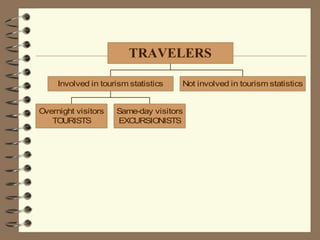
TRAVELERS

     Involved in tourism statistics   Not involved in tourism statistics


Overnight visitors   Same-day visitors
   TOURISTS          EXCURSIONISTS
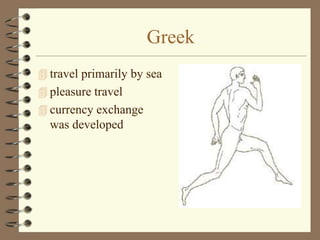
Greek
 travel primarily by sea
 pleasure travel
 currency exchange
  was developed
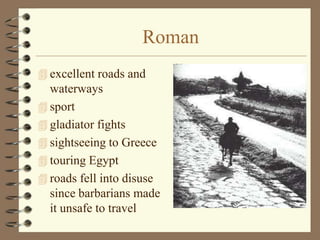
Roman
 excellent roads and
  waterways
 sport
 gladiator fights
 sightseeing to Greece
 touring Egypt
 roads fell into disuse
  since barbarians made
  it unsafe to travel
The Middle Ages
 members of the ruling classes travelled to their
  distant estates
 knights went to hunt or seek new adventure
 apprentices were seeking work or went to study at
  famous workshops
 students travelled to study with famous scientists
 actors went from inn to inn reciting poetry
 pilgrims appeared as the Crusade to the Holy Land
  began
The Modern Age
 17th century: Grand Tours
 18th century: travel for health
 The Industrial Revolution:
 accelerated the movement from rural to urban
  areas
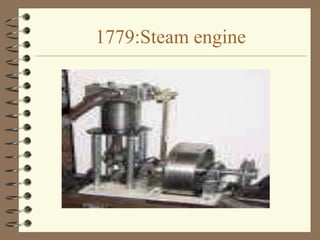
1779:Steam engine
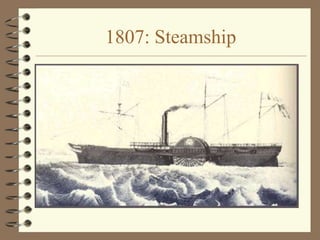
1807: Steamship
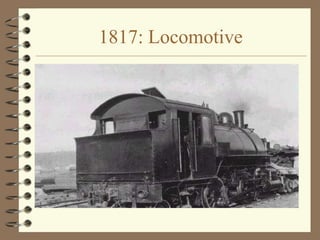
1817: Locomotive
Thomas Cook
 1841: railway
  excursion using
  chartered trains
 1862: cheaper fares
  for crossing English
  Channel
 1870:first round-the-
  world trip
The     20 th    century
 Introduction of motor
  car
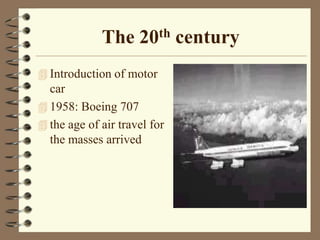
 1958: Boeing 707
 the age of air travel for
  the masses arrived
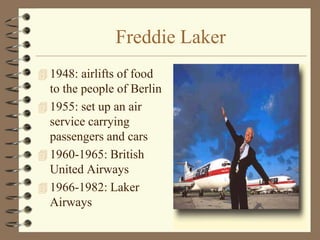
Freddie Laker
 1948: airlifts of food
  to the people of Berlin
 1955: set up an air
  service carrying
  passengers and cars
 1960-1965: British
  United Airways
 1966-1982: Laker
  Airways
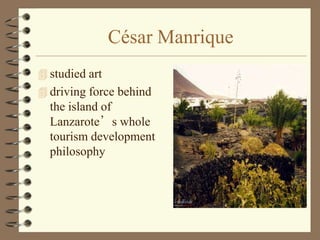
César Manrique
 studied art
 driving force behind
  the island of
  Lanzarote’s whole
  tourism development
  philosophy
The Future
 world tourism will continue to grow
 fastest rates of growth will be achieved by
  the countries in East Asia and the Pacific,
  Middle East, Asia and Africa
Thank you for attention