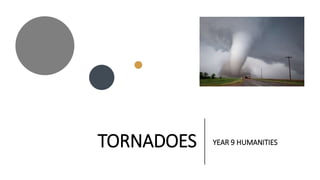
TORNADOES YEAR 9 HUMANITIES
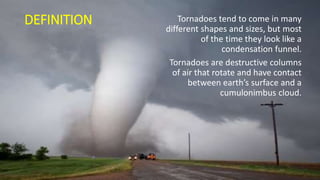
DEFINITION Tornadoes tend to come in many
different shapes and sizes, but most
of the time they look like a
condensation funnel.
Tornadoes are destructive columns
of air that rotate and have contact
between earth’s surface and a
cumulonimbus cloud.
WIND SPEED
Most tornadoes usually have a wind speed of 180 km per hour.
The worst tornadoes can exceed wind speeds of 480 km per hour and
move for more than 100 kilometres before dissipating.
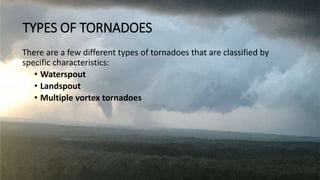
TYPES OF TORNADOES
There are a few different types of tornadoes that are classified by
specific characteristics:
• Waterspout
• Landspout
• Multiple vortex tornadoes
WATERSPOUT TORNADOES
Form from the bases of certain types of clouds over tropical and
subtropical bodies of water and have rather weak winds with smooth
walls that usually travel quite slowly.
LANDSPOUT TORNADOES These types of tornadoes
are typically weaker than
traditional tornadoes,
but can still cause
destruction because they
can create strong winds.
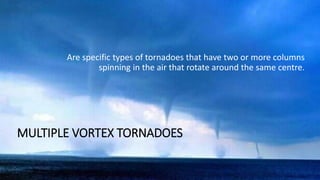
MULTIPLE VORTEX TORNADOES
Are specific types of tornadoes that have two or more columns
spinning in the air that rotate around the same centre.
POPULAR MISCONCEPTIONS
People believe that they are protected from tornadoes or that tornadoes
won’t affect their area if it’s not a flat, farm or desert-like surface.
Some people believe that if you open the windows to your house, it will
prevent a tornado from doing maximum damage because there is a large
drop in atmospheric pressure.
AWAY FROM THE WINDOWS
And remember, always stay away from windows!

HUMANITIES YEAR 9: TORNADOES

  • 1.
    TORNADOES YEAR 9HUMANITIES
  • 2.
    DEFINITION Tornadoes tendto come in many different shapes and sizes, but most of the time they look like a condensation funnel. Tornadoes are destructive columns of air that rotate and have contact between earth’s surface and a cumulonimbus cloud.
  • 3.
    WIND SPEED Most tornadoesusually have a wind speed of 180 km per hour. The worst tornadoes can exceed wind speeds of 480 km per hour and move for more than 100 kilometres before dissipating.
  • 4.
    TYPES OF TORNADOES Thereare a few different types of tornadoes that are classified by specific characteristics: • Waterspout • Landspout • Multiple vortex tornadoes
  • 5.
    WATERSPOUT TORNADOES Form fromthe bases of certain types of clouds over tropical and subtropical bodies of water and have rather weak winds with smooth walls that usually travel quite slowly.
  • 6.
    LANDSPOUT TORNADOES Thesetypes of tornadoes are typically weaker than traditional tornadoes, but can still cause destruction because they can create strong winds.
  • 7.
    MULTIPLE VORTEX TORNADOES Arespecific types of tornadoes that have two or more columns spinning in the air that rotate around the same centre.
  • 8.
    POPULAR MISCONCEPTIONS People believethat they are protected from tornadoes or that tornadoes won’t affect their area if it’s not a flat, farm or desert-like surface. Some people believe that if you open the windows to your house, it will prevent a tornado from doing maximum damage because there is a large drop in atmospheric pressure.
  • 9.
    AWAY FROM THEWINDOWS And remember, always stay away from windows!