
DR.SABHA TALIB
NEAZEE
To elicit an immune response by
challenging already sensiitized
person to defined amount of
allergen and assessing the degree of
response.
 Stop all anti immunosuppressants if feasible.
 Systemic agents before 3 months.
 Biologics before 6 months.
 Topical corticosteroids before 2 weeks.
 Prednisolone < 15mg according to ROOK’S
TEXTBOOK OF DERMATOLOGY and
prednisolone < 10mg according to BRITISH
ASSOCIATION OF DERMATOLOGISTS can be
continued.
 Discontinuation of antihistamines is desirable
before 48 hours.
 Prohibition of wetting the back.
 Prohibition of performing activities that
increase sweating.
 Probable local symptoms such as itching .
 Prohibition of exposing themselves to UVR
upto fifteen days prior to testing.
 Prohibition of wetting the back.
 Prohibition of performing activities that
increase sweating.
 Probable local symptoms such as itching .
 Prohibition of exposing themselves to UVR
upto fifteen days prior to testing.
 Test site-Back
Lateral aspect of upper arm
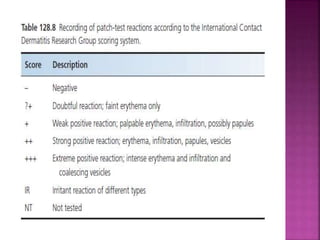
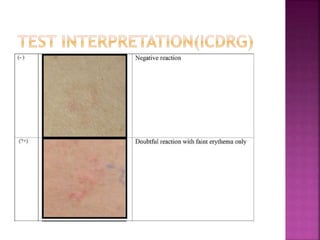
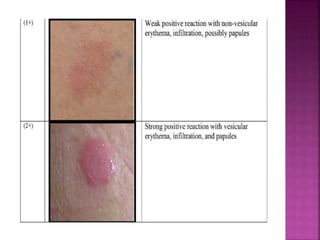
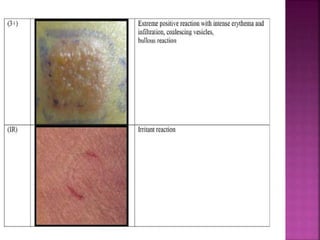
 Exposure time- 48 hour application time with
readings taken 1 hour after removal and then
48 hours later. Day 2 and day 4.
 If only 1 patch test reading- day 4.
 3rd reading- 5 to 7 days if possible.
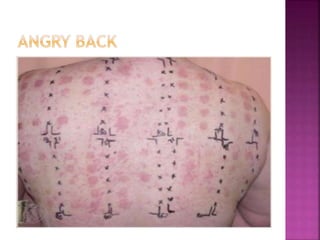
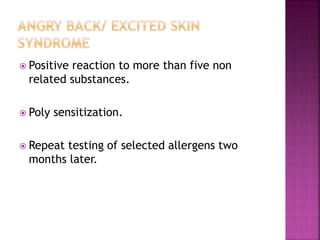
 Positive reaction to more than five non
related substances.
 Poly sensitization.
 Repeat testing of selected allergens two
months later.
 Compound allergy-Positive allergic patch test
is seen to a finished product but tests with
ingredients are negative.
 Quenching – inhibition of response.
 European environmental and contact
dermtitis research group,EECDRG- 28
allergens.
 British society for cutaneous allergy, BSCA-
39 allergens
 North american contact dermatitis group,
NACDG- 65 allergens.
 Indian standard series- 20 allergens.
 The allergens are tested in duplicate on back
and irradiated with UV light( most often UV-A
5j/cm2
 1st reading- immediately post irradiation.
 2nd reading- 2 days post irradiation.
 Open- allergen is applied uncovered on the
upperarm or upperback twicedaily for 2 days
 Semiopen- direct application of liquid with a
cotton tip applicator. 1 cm2. after complete
evaporation, test site is covered with acrylic
tape.
 Reading day 2 AND DAY 4.
 0.1ml of test material is applied twice daily
to flexor aspect of forearm. 25 cm2.
 1st reading – after 1 week.
 May be performed for upto 21 days.
Patch test in dermatology

Patch test in dermatology

  • 1.
  • 2.
    To elicit animmune response by challenging already sensiitized person to defined amount of allergen and assessing the degree of response.
  • 4.
     Stop allanti immunosuppressants if feasible.  Systemic agents before 3 months.  Biologics before 6 months.  Topical corticosteroids before 2 weeks.  Prednisolone < 15mg according to ROOK’S TEXTBOOK OF DERMATOLOGY and prednisolone < 10mg according to BRITISH ASSOCIATION OF DERMATOLOGISTS can be continued.  Discontinuation of antihistamines is desirable before 48 hours.
  • 5.
     Prohibition ofwetting the back.  Prohibition of performing activities that increase sweating.  Probable local symptoms such as itching .  Prohibition of exposing themselves to UVR upto fifteen days prior to testing.
  • 6.
     Prohibition ofwetting the back.  Prohibition of performing activities that increase sweating.  Probable local symptoms such as itching .  Prohibition of exposing themselves to UVR upto fifteen days prior to testing.
  • 7.
     Test site-Back Lateralaspect of upper arm  Exposure time- 48 hour application time with readings taken 1 hour after removal and then 48 hours later. Day 2 and day 4.  If only 1 patch test reading- day 4.  3rd reading- 5 to 7 days if possible.
  • 14.
     Positive reactionto more than five non related substances.  Poly sensitization.  Repeat testing of selected allergens two months later.
  • 16.
     Compound allergy-Positiveallergic patch test is seen to a finished product but tests with ingredients are negative.  Quenching – inhibition of response.
  • 17.
     European environmentaland contact dermtitis research group,EECDRG- 28 allergens.  British society for cutaneous allergy, BSCA- 39 allergens  North american contact dermatitis group, NACDG- 65 allergens.  Indian standard series- 20 allergens.
  • 18.
     The allergensare tested in duplicate on back and irradiated with UV light( most often UV-A 5j/cm2  1st reading- immediately post irradiation.  2nd reading- 2 days post irradiation.
  • 19.
     Open- allergenis applied uncovered on the upperarm or upperback twicedaily for 2 days  Semiopen- direct application of liquid with a cotton tip applicator. 1 cm2. after complete evaporation, test site is covered with acrylic tape.  Reading day 2 AND DAY 4.
  • 20.
     0.1ml oftest material is applied twice daily to flexor aspect of forearm. 25 cm2.  1st reading – after 1 week.  May be performed for upto 21 days.