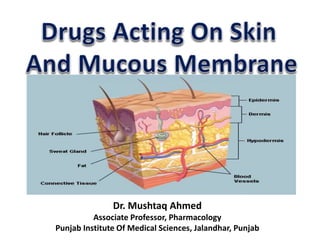
Dr. Mushtaq Ahmed
Associate Professor, Pharmacology
Punjab Institute Of Medical Sciences, Jalandhar, Punjab
Interesting Facts about SKIN
 The largest organ of the body
 Very important protective layer of the body
 Also important for:
- Thermoregulation
- Immunity
- Biochemical synthesis &
- Sensory functions
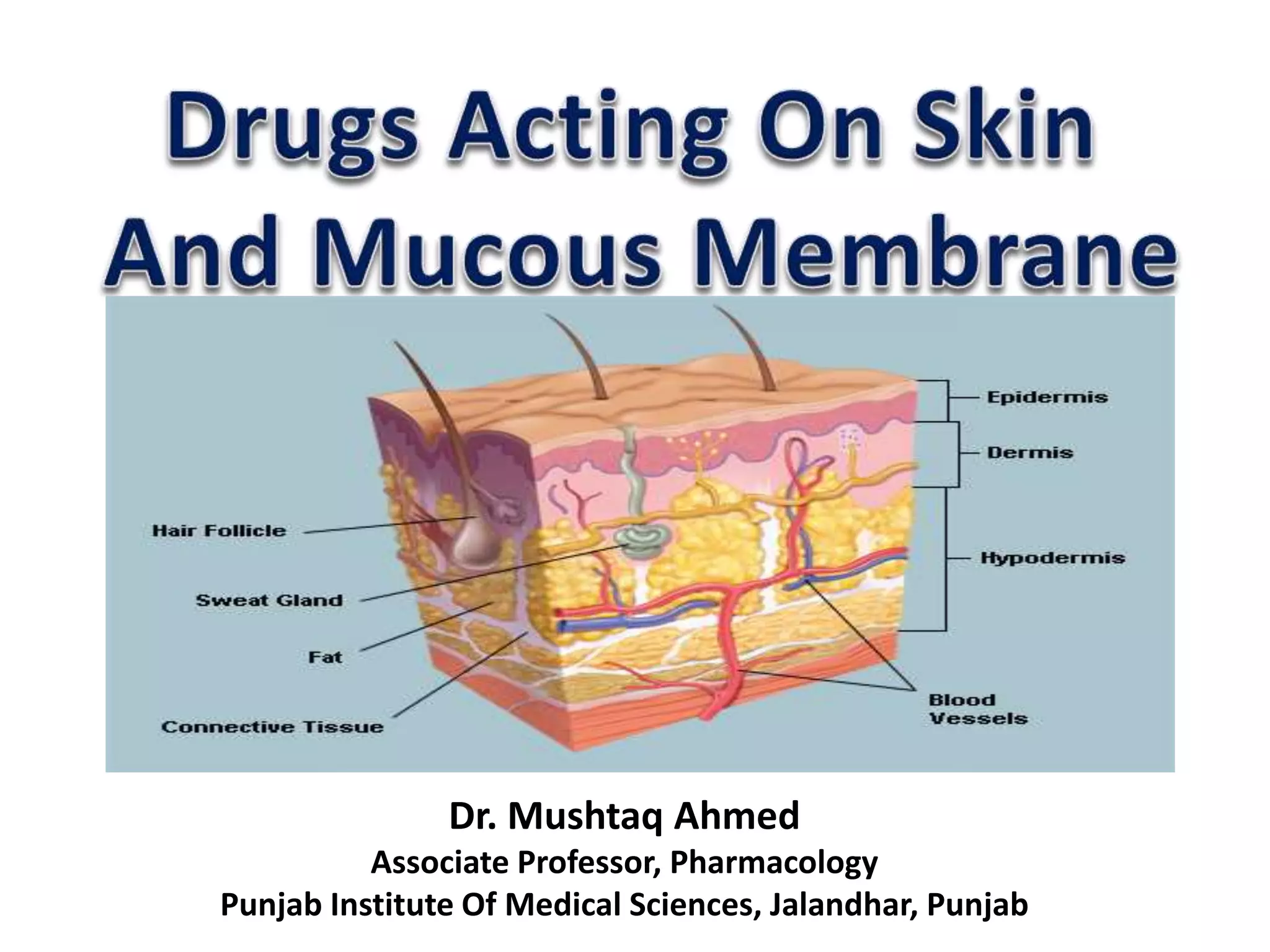
Structure & function of skin
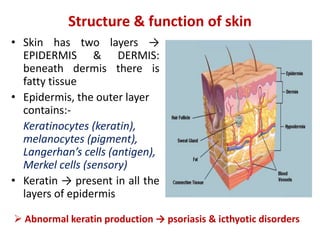
• Skin has two layers →
EPIDERMIS & DERMIS:
beneath dermis there is
fatty tissue
• Epidermis, the outer layer
contains:-
Keratinocytes (keratin),
melanocytes (pigment),
Langerhan’s cells (antigen),
Merkel cells (sensory)
• Keratin → present in all the
layers of epidermis
 Abnormal keratin production → psoriasis & icthyotic disorders
• Superficial keratin layer → stratum corneum
• Main function of epidermis → to form stratum
corneum
• Stratum corneum (horny layer) is important →
reducing water loss and prevention of absorption
of noxious substances
 Stratum corneum main barrier for absorption of drugs
by topical route
Structure & function of skin contd.
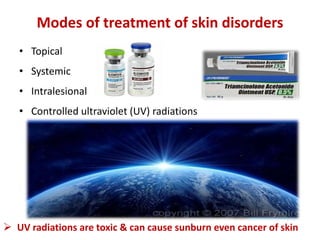
Modes of treatment of skin disorders
• Topical
• Systemic
• Intralesional
• Controlled ultraviolet (UV) radiations
 UV radiations are toxic & can cause sunburn even cancer of skin
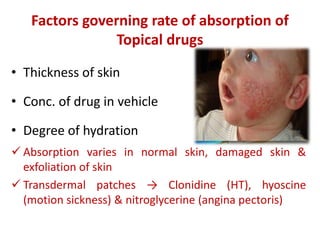
Factors governing rate of absorption of
Topical drugs
• Thickness of skin
• Conc. of drug in vehicle
• Degree of hydration
 Absorption varies in normal skin, damaged skin &
exfoliation of skin
 Transdermal patches → Clonidine (HT), hyoscine
(motion sickness) & nitroglycerine (angina pectoris)
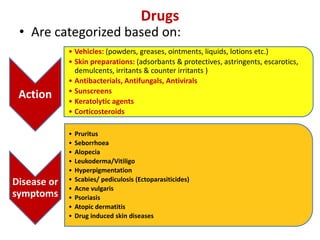
Drugs
• Are categorized based on:
Action
• Vehicles: (powders, greases, ointments, liquids, lotions etc.)
• Skin preparations: (adsorbants & protectives, astringents, escarotics,
demulcents, irritants & counter irritants )
• Antibacterials, Antifungals, Antivirals
• Sunscreens
• Keratolytic agents
• Corticosteroids
Disease or
symptoms
• Pruritus
• Seborrhoea
• Alopecia
• Leukoderma/Vitiligo
• Hyperpigmentation
• Scabies/ pediculosis (Ectoparasiticides)
• Acne vulgaris
• Psoriasis
• Atopic dermatitis
• Drug induced skin diseases
Drugs Based On
Action
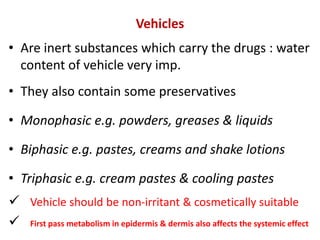
Vehicles
• Are inert substances which carry the drugs : water
content of vehicle very imp.
• They also contain some preservatives
• Monophasic e.g. powders, greases & liquids
• Biphasic e.g. pastes, creams and shake lotions
• Triphasic e.g. cream pastes & cooling pastes
 Vehicle should be non-irritant & cosmetically suitable
 First pass metabolism in epidermis & dermis also affects the systemic effect
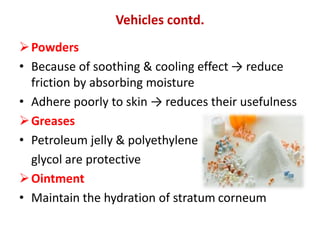
Powders
• Because of soothing & cooling effect → reduce
friction by absorbing moisture
• Adhere poorly to skin → reduces their usefulness
Greases
• Petroleum jelly & polyethylene
glycol are protective
Ointment
• Maintain the hydration of stratum corneum
Vehicles contd.
Liquids
• Clean and keep the lesion/skin cool
• High water content of lotions are also called wet
dressings e.g. KMNO4, normal saline
Gel & jellies
• They are semisolid due to addition of polymers
despite containing liquid phase
Creams
• Oil in water (o/w) type eg. Vanishing/aqueous cream
• Water in oil (w/o) type eg. Cold cream
Vehicles contd.
 Shake lotions (lotion +powder)
• Cause cooling of skin due to evaporation of
water
 Newer Vehicles
• Collodions
• Liposomes
• Microparticle
• Transferosomes
Vehicles contd.
Skin Preparations
Topical preparations are used for local effect
However, TD patches are used for systemic effects
 Adsorbants and protectives
• Bind to noxious and irritant substances on their
surface – adsorbant action
- Dusting powder, Zinc oxide,
Calamine, Talc, Boric acid,
polyvinyl polymer, Sucralfate
 Astringents
• Tannic Acid
- Present in tea, catechu, nutmeg etc. → denaturation
of proteins & forms coating
- Can be used for bleeding gums (with glycerin) & bleeding piles (as suppository)
• Ethanol & methanol
- Cause precipitation of proteins and are applied locally for prevention of bed
sores and after shave lotion
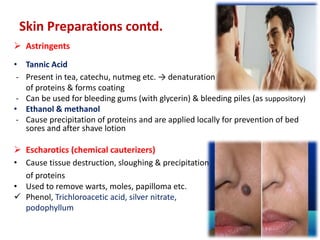
 Escharotics (chemical cauterizers)
• Cause tissue destruction, sloughing & precipitation
of proteins
• Used to remove warts, moles, papilloma etc.
 Phenol, Trichloroacetic acid, silver nitrate,
podophyllum
Skin Preparations contd.
 Demulcents: Glycerine & propylene glycol
• When applied topically they produce soothing effect on
denuded mucosa or inflammed skin
• Protect the mucous membrane and skin from air and irritant
substances
 Emollients: (wax – hard & soft, paraffin, olive oil etc.)
• They produce soothing effect & hydrate
the skin
• Useful for dry scaly skin
Skin Preparations contd.
 Irritants and counterirritants (Nicotinate, salicylate,
menthol, camphor, capsaicin)
• Irritant substances produce local
inflammation, tingling, numbness, cooling
or feeling of warmth, hyperaesthesia and vasodilatation
• Counterirritants also produce local irritation and relieve pain
& inflammation arising from deeper structures
• Used for headache, myalgia, neuralgia, joint pain etc.
Skin Preparations contd.
 Antibacterial Agents
• Common bacterial infections affecting skin:
- Furuncle, boil, folluculitis, pyoderma, impetigo,
cellulitis etc
 Antifungal Agents (Benzoic acid)
• Common fungal infections- ring worm, oral
thrush, dandruff, athlete’s foot
 Antiviral Agents
• Herpes simplex, herpes zoster
Chemotherapeutic Agents
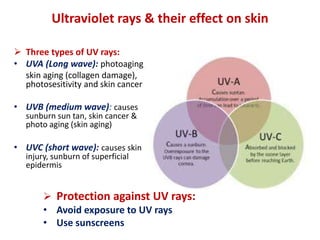
 Three types of UV rays:
• UVA (Long wave): photoaging/
skin aging (collagen damage),
photosesitivity and skin cancer
• UVB (medium wave): causes
sunburn sun tan, skin cancer &
photo aging (skin aging)
• UVC (short wave): causes skin
injury, sunburn of superficial
epidermis
Ultraviolet rays & their effect on skin
 Protection against UV rays:
• Avoid exposure to UV rays
• Use sunscreens
Sunscreens
• Required to prevent sun burn, aging and skin cancer
Classification of sunscreens based on:
1. Physical Action: Titanium dioxide, zinc oxide &
calamine
They are opaque to all wavelength and reflect them
2. Chemical structure:
- PABA & its esters eg. Padimate O
- Benzophenones: Avobenzone, oxybenzone,
mexenone (highly effective against UVA)
- Cinnamates eg. Octyl methoxycinnamate
- Salicylates eg. Octisalate
- Octocrylene
Sunscreens contd.
3. Effectiveness against radiation:
• Sunscreens for UVA:
- Benzophenones eg. Avobenzone, oxybenzone
• Sunscreens for UVB:
- PABA & its esters eg. Padimate O
- Cinnamates eg. Octyl methoxycinnamate
- Salicylates eg. Octisalate
- Octocrylene
Regular use of Sunscreens: reduce risk of actinic keratoses,
premature aging and squamous cell carcinoma of skin
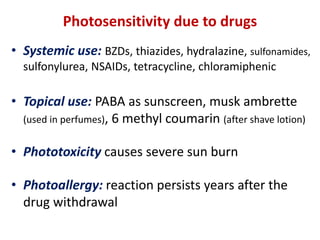
Photosensitivity due to drugs
• Systemic use: BZDs, thiazides, hydralazine, sulfonamides,
sulfonylurea, NSAIDs, tetracycline, chloramiphenic
• Topical use: PABA as sunscreen, musk ambrette
(used in perfumes), 6 methyl coumarin (after shave lotion)
• Phototoxicity causes severe sun burn
• Photoallergy: reaction persists years after the
drug withdrawal
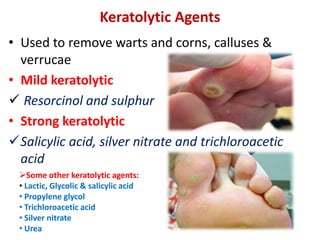
Keratolytic Agents
• Used to remove warts and corns, calluses &
verrucae
• Mild keratolytic
 Resorcinol and sulphur
• Strong keratolytic
Salicylic acid, silver nitrate and trichloroacetic
acid
Some other keratolytic agents:
• Lactic, Glycolic & salicylic acid
• Propylene glycol
• Trichloroacetic acid
• Silver nitrate
• Urea
Keratolytic Agents Contd.
 Salicylic acid
• Corneocyte adhesion is reduced by solubilization of
intracellular cement
• Removes stratum corneum layer by layer
 Whitfields ointment (salicylic acid 3% & Benzoic acid 6%)
 Lactic and glycolic acid
• Corneocyte adhesion is reduced by disrupting ionic
bonds at lowest layer of stratum corneum
• Used for xerosis & ichthyosis
Corticosteroids
• Used by both systemic & topical route depending upon
disease and severity
• Have anti-infammatory and immunosuppressant action
• Reduce proliferation of keratocytes, fibroblasts and
lymphocytes – antimitotic action
• Inhibit migration of inflammatory cells and substances
released due to inflammation
Topical steroids
 Highest efficacy
• Clobetasol propionate 0.05%
• Helobetasol propionate 0.05%
 High efficacy
• Betamethasone dipropionate 0.05%
• Diflorasone diacetate 0.05%
• Fluocinolone acetonide 0.2% &
others
 Intermediate efficiacy
• Clobetasol butyrate 0.05%
• Hydrocortisone acetate 2.5%
• Fluocortolone 0.025% & others
 Low efficacy
• Hydrocortisone butyrate 0.001%
• Hydrocortisone acetate 0.1%
• Methylprednisolone acetate 0.1%
Systemic Agents: Mainly used for serious conditions not responding to other Rx
e.g. pemphigus & exfoliative dermatitis
Use of Topical Steroids: allergic conditions, infections (bacterial/ viral/fungal), pigment
disorders, Psoriasis, Eczematous disorders, drug induced disorders etc
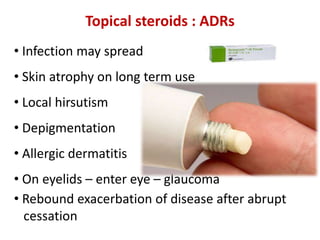
Topical steroids : ADRs
• Infection may spread
• Skin atrophy on long term use
• Local hirsutism
• Depigmentation
• Allergic dermatitis
• On eyelids – enter eye – glaucoma
• Rebound exacerbation of disease after abrupt
cessation
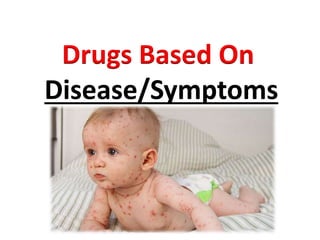
Drugs Based On
Disease/Symptoms
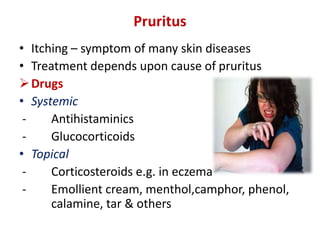
Pruritus
• Itching – symptom of many skin diseases
• Treatment depends upon cause of pruritus
Drugs
• Systemic
- Antihistaminics
- Glucocorticoids
• Topical
- Corticosteroids e.g. in eczema
- Emollient cream, menthol,camphor, phenol,
calamine, tar & others
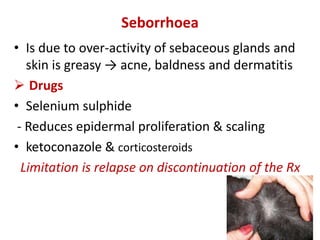
Seborrhoea
• Is due to over-activity of sebaceous glands and
skin is greasy → acne, baldness and dermatitis
 Drugs
• Selenium sulphide
- Reduces epidermal proliferation & scaling
• ketoconazole & corticosteroids
Limitation is relapse on discontinuation of the Rx
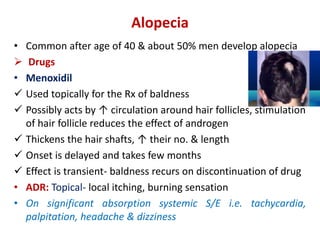
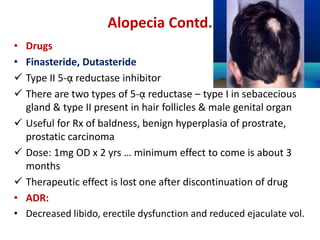
Alopecia
• Common after age of 40 & about 50% men develop alopecia
 Drugs
• Menoxidil
 Used topically for the Rx of baldness
 Possibly acts by ↑ circulation around hair follicles, stimulation
of hair follicle reduces the effect of androgen
 Thickens the hair shafts, ↑ their no. & length
 Onset is delayed and takes few months
 Effect is transient- baldness recurs on discontinuation of drug
• ADR: Topical- local itching, burning sensation
• On significant absorption systemic S/E i.e. tachycardia,
palpitation, headache & dizziness
Alopecia Contd.
• Drugs
• Finasteride, Dutasteride
 Type II 5-ᾳ reductase inhibitor
 There are two types of 5-ᾳ reductase – type I in sebacecious
gland & type II present in hair follicles & male genital organ
 Useful for Rx of baldness, benign hyperplasia of prostrate,
prostatic carcinoma
 Dose: 1mg OD x 2 yrs … minimum effect to come is about 3
months
 Therapeutic effect is lost one after discontinuation of drug
• ADR:
• Decreased libido, erectile dysfunction and reduced ejaculate vol.
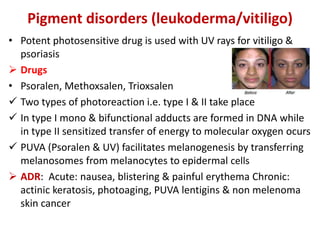
Pigment disorders (leukoderma/vitiligo)
• Potent photosensitive drug is used with UV rays for vitiligo &
psoriasis
 Drugs
• Psoralen, Methoxsalen, Trioxsalen
 Two types of photoreaction i.e. type I & II take place
 In type I mono & bifunctional adducts are formed in DNA while
in type II sensitized transfer of energy to molecular oxygen ocurs
 PUVA (Psoralen & UV) facilitates melanogenesis by transferring
melanosomes from melanocytes to epidermal cells
 ADR: Acute: nausea, blistering & painful erythema Chronic:
actinic keratosis, photoaging, PUVA lentigins & non melenoma
skin cancer
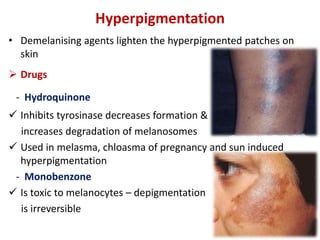
Hyperpigmentation
• Demelanising agents lighten the hyperpigmented patches on
skin
 Drugs
- Hydroquinone
 Inhibits tyrosinase decreases formation &
increases degradation of melanosomes
 Used in melasma, chloasma of pregnancy and sun induced
hyperpigmentation
- Monobenzone
 Is toxic to melanocytes – depigmentation
is irreversible
Ectoparaciticides
(Scabies & Pediculosis)
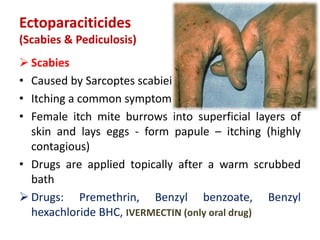
 Scabies
• Caused by Sarcoptes scabiei
• Itching a common symptom
• Female itch mite burrows into superficial layers of
skin and lays eggs - form papule – itching (highly
contagious)
• Drugs are applied topically after a warm scrubbed
bath
 Drugs: Premethrin, Benzyl benzoate, Benzyl
hexachloride BHC, IVERMECTIN (only oral drug)
Ectoparaciticides
Scabies & Pediculosis
 Premethrin
• Delays depolarization – neurological paralysis
• Effective against scabies (5% cream) & pediculosis (1%)
• Absorption – minimal through skin, rapidly metabolized
to inactive products
• Is safest drug – provides 100% cure
 For scabies
 Apply premethrin 5% cream below chin all over the body
& left there for 12 h
• For pediculosis
 Apply premethrin 1% cream or lotion for 10 min & then
rinse
Pediculosis
• Caused by pediculus captitis (head)
• Itching a common symptom
 Drugs: Premethrin, malathion & DDT
• Premethrin is preferred drug
• Malathion used in cases not responding to premethrin
• DDT
- In powder form or solution in kerosine – widely
used as insecticide
- Not killing ova – disadvantage
- Use declined b/o dev. of resistance
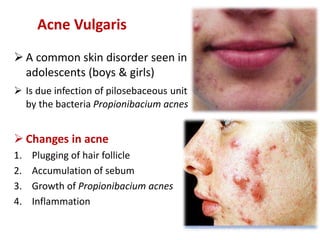
Acne Vulgaris
 A common skin disorder seen in
adolescents (boys & girls)
 Is due infection of pilosebaceous unit
by the bacteria Propionibacium acnes
 Changes in acne
1. Plugging of hair follicle
2. Accumulation of sebum
3. Growth of Propionibacium acnes
4. Inflammation
Acne Vulgaris contd.
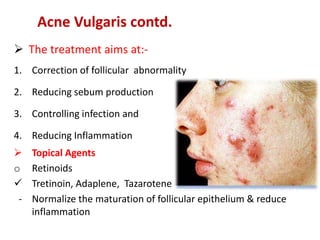
 The treatment aims at:-
1. Correction of follicular abnormality
2. Reducing sebum production
3. Controlling infection and
4. Reducing Inflammation
 Topical Agents
o Retinoids
 Tretinoin, Adaplene, Tazarotene
- Normalize the maturation of follicular epithelium & reduce
inflammation
Acne Vulgaris contd.
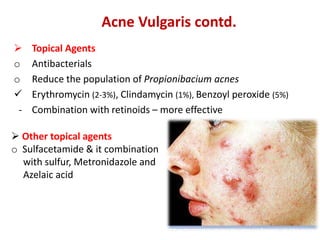
 Topical Agents
o Antibacterials
o Reduce the population of Propionibacium acnes
 Erythromycin (2-3%), Clindamycin (1%), Benzoyl peroxide (5%)
- Combination with retinoids – more effective
 Other topical agents
o Sulfacetamide & it combination
with sulfur, Metronidazole and
Azelaic acid
Acne Vulgaris contd.
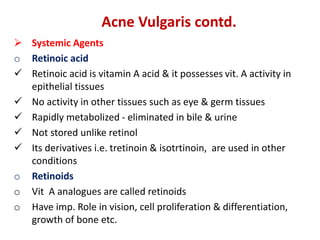
 Systemic Agents
o Retinoic acid
 Retinoic acid is vitamin A acid & it possesses vit. A activity in
epithelial tissues
 No activity in other tissues such as eye & germ tissues
 Rapidly metabolized - eliminated in bile & urine
 Not stored unlike retinol
 Its derivatives i.e. tretinoin & isotrtinoin, are used in other
conditions
o Retinoids
o Vit A analogues are called retinoids
o Have imp. Role in vision, cell proliferation & differentiation,
growth of bone etc.
Acne Vulgaris contd.
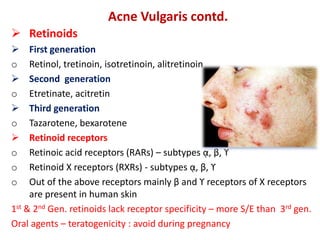
 Retinoids
 First generation
o Retinol, tretinoin, isotretinoin, alitretinoin
 Second generation
o Etretinate, acitretin
 Third generation
o Tazarotene, bexarotene
 Retinoid receptors
o Retinoic acid receptors (RARs) – subtypes ᾳ, β, ϒ
o Retinoid X receptors (RXRs) - subtypes ᾳ, β, ϒ
o Out of the above receptors mainly β and ϒ receptors of X receptors
are present in human skin
1st & 2nd Gen. retinoids lack receptor specificity – more S/E than 3rd gen.
Oral agents – teratogenicity : avoid during pregnancy
Acne Vulgaris contd.
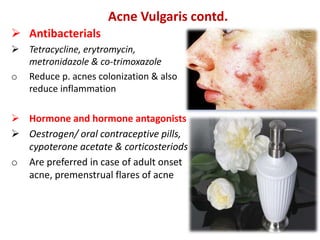
 Antibacterials
 Tetracycline, erytromycin,
metronidazole & co-trimoxazole
o Reduce p. acnes colonization & also
reduce inflammation
 Hormone and hormone antagonists
 Oestrogen/ oral contraceptive pills,
cypoterone acetate & corticosteriods
o Are preferred in case of adult onset
acne, premenstrual flares of acne
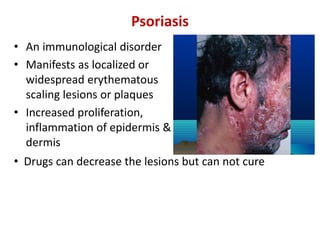
Psoriasis
• An immunological disorder
• Manifests as localized or
widespread erythematous
scaling lesions or plaques
• Increased proliferation,
inflammation of epidermis &
dermis
• Drugs can decrease the lesions but can not cure
Psoriasis
 Aim of treatment
• To dissolve the keratin & inhibit the further
proliferation of cells
 Topical Agents
o Coal tar
• Mainly used with UVB – antimitotic effect
• Used as solution, gel & shampoo
• ADR: folliculitis, irritation, allergic reaction
o Calcipotriol (active vit D)
• By acting on keratinocytes – causes decrease
in proliferation of cultured keratinocytes
• By the same mechanism, it produces
antipsoriatic effect
• Vit D – effective orally & topically
 Other drugs ; Anthralin, Tazarotene
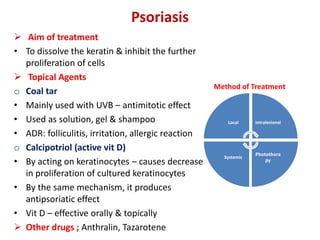
Local Intralesional
Photothera
py
Systemic
Method of Treatment
 Systemic Agents
• Is required in extensive and severe disease
• Cytotoxic & immunosupressants are used
 Methotrexate
• Is a DHFR inhibitor & suppressing immune component
cells (mainly T-cells) in Skin
• Epidermal inflammation & hyperproliferation are
retarded
• S/E: bone marrow depression, hepatotoxicity
• Other drugs: Hydroxurea, Cyclosporine, Efalizumab,
• Liarozole & rambazole- newer agents
Psoriasis Contd.
Atopic Dermatitis
• Is an inflammatory condition of skin – starts
during infancy & childhood – may persist upto
adult age
• Allergens & environmental pollutants may
cause the disease
• Itchy papules & plaques – characteristics of
this condition
• Treatment : Glucocorticoids, antihistaminics,
immunosupressive agents
Drugs acting on skin

Drugs acting on skin

  • 1.
    Dr. Mushtaq Ahmed AssociateProfessor, Pharmacology Punjab Institute Of Medical Sciences, Jalandhar, Punjab
  • 3.
    Interesting Facts aboutSKIN  The largest organ of the body  Very important protective layer of the body  Also important for: - Thermoregulation - Immunity - Biochemical synthesis & - Sensory functions
  • 4.
    Structure & functionof skin • Skin has two layers → EPIDERMIS & DERMIS: beneath dermis there is fatty tissue • Epidermis, the outer layer contains:- Keratinocytes (keratin), melanocytes (pigment), Langerhan’s cells (antigen), Merkel cells (sensory) • Keratin → present in all the layers of epidermis  Abnormal keratin production → psoriasis & icthyotic disorders
  • 5.
    • Superficial keratinlayer → stratum corneum • Main function of epidermis → to form stratum corneum • Stratum corneum (horny layer) is important → reducing water loss and prevention of absorption of noxious substances  Stratum corneum main barrier for absorption of drugs by topical route Structure & function of skin contd.
  • 6.
    Modes of treatmentof skin disorders • Topical • Systemic • Intralesional • Controlled ultraviolet (UV) radiations  UV radiations are toxic & can cause sunburn even cancer of skin
  • 7.
    Factors governing rateof absorption of Topical drugs • Thickness of skin • Conc. of drug in vehicle • Degree of hydration  Absorption varies in normal skin, damaged skin & exfoliation of skin  Transdermal patches → Clonidine (HT), hyoscine (motion sickness) & nitroglycerine (angina pectoris)
  • 8.
    Drugs • Are categorizedbased on: Action • Vehicles: (powders, greases, ointments, liquids, lotions etc.) • Skin preparations: (adsorbants & protectives, astringents, escarotics, demulcents, irritants & counter irritants ) • Antibacterials, Antifungals, Antivirals • Sunscreens • Keratolytic agents • Corticosteroids Disease or symptoms • Pruritus • Seborrhoea • Alopecia • Leukoderma/Vitiligo • Hyperpigmentation • Scabies/ pediculosis (Ectoparasiticides) • Acne vulgaris • Psoriasis • Atopic dermatitis • Drug induced skin diseases
  • 9.
  • 10.
    Vehicles • Are inertsubstances which carry the drugs : water content of vehicle very imp. • They also contain some preservatives • Monophasic e.g. powders, greases & liquids • Biphasic e.g. pastes, creams and shake lotions • Triphasic e.g. cream pastes & cooling pastes  Vehicle should be non-irritant & cosmetically suitable  First pass metabolism in epidermis & dermis also affects the systemic effect
  • 11.
    Powders • Because ofsoothing & cooling effect → reduce friction by absorbing moisture • Adhere poorly to skin → reduces their usefulness Greases • Petroleum jelly & polyethylene glycol are protective Ointment • Maintain the hydration of stratum corneum Vehicles contd.
  • 12.
    Liquids • Clean andkeep the lesion/skin cool • High water content of lotions are also called wet dressings e.g. KMNO4, normal saline Gel & jellies • They are semisolid due to addition of polymers despite containing liquid phase Creams • Oil in water (o/w) type eg. Vanishing/aqueous cream • Water in oil (w/o) type eg. Cold cream Vehicles contd.
  • 13.
     Shake lotions(lotion +powder) • Cause cooling of skin due to evaporation of water  Newer Vehicles • Collodions • Liposomes • Microparticle • Transferosomes Vehicles contd.
  • 14.
    Skin Preparations Topical preparationsare used for local effect However, TD patches are used for systemic effects  Adsorbants and protectives • Bind to noxious and irritant substances on their surface – adsorbant action - Dusting powder, Zinc oxide, Calamine, Talc, Boric acid, polyvinyl polymer, Sucralfate
  • 15.
     Astringents • TannicAcid - Present in tea, catechu, nutmeg etc. → denaturation of proteins & forms coating - Can be used for bleeding gums (with glycerin) & bleeding piles (as suppository) • Ethanol & methanol - Cause precipitation of proteins and are applied locally for prevention of bed sores and after shave lotion  Escharotics (chemical cauterizers) • Cause tissue destruction, sloughing & precipitation of proteins • Used to remove warts, moles, papilloma etc.  Phenol, Trichloroacetic acid, silver nitrate, podophyllum Skin Preparations contd.
  • 16.
     Demulcents: Glycerine& propylene glycol • When applied topically they produce soothing effect on denuded mucosa or inflammed skin • Protect the mucous membrane and skin from air and irritant substances  Emollients: (wax – hard & soft, paraffin, olive oil etc.) • They produce soothing effect & hydrate the skin • Useful for dry scaly skin Skin Preparations contd.
  • 17.
     Irritants andcounterirritants (Nicotinate, salicylate, menthol, camphor, capsaicin) • Irritant substances produce local inflammation, tingling, numbness, cooling or feeling of warmth, hyperaesthesia and vasodilatation • Counterirritants also produce local irritation and relieve pain & inflammation arising from deeper structures • Used for headache, myalgia, neuralgia, joint pain etc. Skin Preparations contd.
  • 18.
     Antibacterial Agents •Common bacterial infections affecting skin: - Furuncle, boil, folluculitis, pyoderma, impetigo, cellulitis etc  Antifungal Agents (Benzoic acid) • Common fungal infections- ring worm, oral thrush, dandruff, athlete’s foot  Antiviral Agents • Herpes simplex, herpes zoster Chemotherapeutic Agents
  • 19.
     Three typesof UV rays: • UVA (Long wave): photoaging/ skin aging (collagen damage), photosesitivity and skin cancer • UVB (medium wave): causes sunburn sun tan, skin cancer & photo aging (skin aging) • UVC (short wave): causes skin injury, sunburn of superficial epidermis Ultraviolet rays & their effect on skin  Protection against UV rays: • Avoid exposure to UV rays • Use sunscreens
  • 20.
    Sunscreens • Required toprevent sun burn, aging and skin cancer Classification of sunscreens based on: 1. Physical Action: Titanium dioxide, zinc oxide & calamine They are opaque to all wavelength and reflect them 2. Chemical structure: - PABA & its esters eg. Padimate O - Benzophenones: Avobenzone, oxybenzone, mexenone (highly effective against UVA) - Cinnamates eg. Octyl methoxycinnamate - Salicylates eg. Octisalate - Octocrylene
  • 21.
    Sunscreens contd. 3. Effectivenessagainst radiation: • Sunscreens for UVA: - Benzophenones eg. Avobenzone, oxybenzone • Sunscreens for UVB: - PABA & its esters eg. Padimate O - Cinnamates eg. Octyl methoxycinnamate - Salicylates eg. Octisalate - Octocrylene Regular use of Sunscreens: reduce risk of actinic keratoses, premature aging and squamous cell carcinoma of skin
  • 22.
    Photosensitivity due todrugs • Systemic use: BZDs, thiazides, hydralazine, sulfonamides, sulfonylurea, NSAIDs, tetracycline, chloramiphenic • Topical use: PABA as sunscreen, musk ambrette (used in perfumes), 6 methyl coumarin (after shave lotion) • Phototoxicity causes severe sun burn • Photoallergy: reaction persists years after the drug withdrawal
  • 23.
    Keratolytic Agents • Usedto remove warts and corns, calluses & verrucae • Mild keratolytic  Resorcinol and sulphur • Strong keratolytic Salicylic acid, silver nitrate and trichloroacetic acid Some other keratolytic agents: • Lactic, Glycolic & salicylic acid • Propylene glycol • Trichloroacetic acid • Silver nitrate • Urea
  • 24.
    Keratolytic Agents Contd. Salicylic acid • Corneocyte adhesion is reduced by solubilization of intracellular cement • Removes stratum corneum layer by layer  Whitfields ointment (salicylic acid 3% & Benzoic acid 6%)  Lactic and glycolic acid • Corneocyte adhesion is reduced by disrupting ionic bonds at lowest layer of stratum corneum • Used for xerosis & ichthyosis
  • 25.
    Corticosteroids • Used byboth systemic & topical route depending upon disease and severity • Have anti-infammatory and immunosuppressant action • Reduce proliferation of keratocytes, fibroblasts and lymphocytes – antimitotic action • Inhibit migration of inflammatory cells and substances released due to inflammation
  • 26.
    Topical steroids  Highestefficacy • Clobetasol propionate 0.05% • Helobetasol propionate 0.05%  High efficacy • Betamethasone dipropionate 0.05% • Diflorasone diacetate 0.05% • Fluocinolone acetonide 0.2% & others  Intermediate efficiacy • Clobetasol butyrate 0.05% • Hydrocortisone acetate 2.5% • Fluocortolone 0.025% & others  Low efficacy • Hydrocortisone butyrate 0.001% • Hydrocortisone acetate 0.1% • Methylprednisolone acetate 0.1% Systemic Agents: Mainly used for serious conditions not responding to other Rx e.g. pemphigus & exfoliative dermatitis Use of Topical Steroids: allergic conditions, infections (bacterial/ viral/fungal), pigment disorders, Psoriasis, Eczematous disorders, drug induced disorders etc
  • 27.
    Topical steroids :ADRs • Infection may spread • Skin atrophy on long term use • Local hirsutism • Depigmentation • Allergic dermatitis • On eyelids – enter eye – glaucoma • Rebound exacerbation of disease after abrupt cessation
  • 28.
  • 29.
    Pruritus • Itching –symptom of many skin diseases • Treatment depends upon cause of pruritus Drugs • Systemic - Antihistaminics - Glucocorticoids • Topical - Corticosteroids e.g. in eczema - Emollient cream, menthol,camphor, phenol, calamine, tar & others
  • 30.
    Seborrhoea • Is dueto over-activity of sebaceous glands and skin is greasy → acne, baldness and dermatitis  Drugs • Selenium sulphide - Reduces epidermal proliferation & scaling • ketoconazole & corticosteroids Limitation is relapse on discontinuation of the Rx
  • 31.
    Alopecia • Common afterage of 40 & about 50% men develop alopecia  Drugs • Menoxidil  Used topically for the Rx of baldness  Possibly acts by ↑ circulation around hair follicles, stimulation of hair follicle reduces the effect of androgen  Thickens the hair shafts, ↑ their no. & length  Onset is delayed and takes few months  Effect is transient- baldness recurs on discontinuation of drug • ADR: Topical- local itching, burning sensation • On significant absorption systemic S/E i.e. tachycardia, palpitation, headache & dizziness
  • 32.
    Alopecia Contd. • Drugs •Finasteride, Dutasteride  Type II 5-ᾳ reductase inhibitor  There are two types of 5-ᾳ reductase – type I in sebacecious gland & type II present in hair follicles & male genital organ  Useful for Rx of baldness, benign hyperplasia of prostrate, prostatic carcinoma  Dose: 1mg OD x 2 yrs … minimum effect to come is about 3 months  Therapeutic effect is lost one after discontinuation of drug • ADR: • Decreased libido, erectile dysfunction and reduced ejaculate vol.
  • 33.
    Pigment disorders (leukoderma/vitiligo) •Potent photosensitive drug is used with UV rays for vitiligo & psoriasis  Drugs • Psoralen, Methoxsalen, Trioxsalen  Two types of photoreaction i.e. type I & II take place  In type I mono & bifunctional adducts are formed in DNA while in type II sensitized transfer of energy to molecular oxygen ocurs  PUVA (Psoralen & UV) facilitates melanogenesis by transferring melanosomes from melanocytes to epidermal cells  ADR: Acute: nausea, blistering & painful erythema Chronic: actinic keratosis, photoaging, PUVA lentigins & non melenoma skin cancer
  • 34.
    Hyperpigmentation • Demelanising agentslighten the hyperpigmented patches on skin  Drugs - Hydroquinone  Inhibits tyrosinase decreases formation & increases degradation of melanosomes  Used in melasma, chloasma of pregnancy and sun induced hyperpigmentation - Monobenzone  Is toxic to melanocytes – depigmentation is irreversible
  • 35.
    Ectoparaciticides (Scabies & Pediculosis) Scabies • Caused by Sarcoptes scabiei • Itching a common symptom • Female itch mite burrows into superficial layers of skin and lays eggs - form papule – itching (highly contagious) • Drugs are applied topically after a warm scrubbed bath  Drugs: Premethrin, Benzyl benzoate, Benzyl hexachloride BHC, IVERMECTIN (only oral drug)
  • 36.
    Ectoparaciticides Scabies & Pediculosis Premethrin • Delays depolarization – neurological paralysis • Effective against scabies (5% cream) & pediculosis (1%) • Absorption – minimal through skin, rapidly metabolized to inactive products • Is safest drug – provides 100% cure  For scabies  Apply premethrin 5% cream below chin all over the body & left there for 12 h • For pediculosis  Apply premethrin 1% cream or lotion for 10 min & then rinse
  • 37.
    Pediculosis • Caused bypediculus captitis (head) • Itching a common symptom  Drugs: Premethrin, malathion & DDT • Premethrin is preferred drug • Malathion used in cases not responding to premethrin • DDT - In powder form or solution in kerosine – widely used as insecticide - Not killing ova – disadvantage - Use declined b/o dev. of resistance
  • 38.
    Acne Vulgaris  Acommon skin disorder seen in adolescents (boys & girls)  Is due infection of pilosebaceous unit by the bacteria Propionibacium acnes  Changes in acne 1. Plugging of hair follicle 2. Accumulation of sebum 3. Growth of Propionibacium acnes 4. Inflammation
  • 39.
    Acne Vulgaris contd. The treatment aims at:- 1. Correction of follicular abnormality 2. Reducing sebum production 3. Controlling infection and 4. Reducing Inflammation  Topical Agents o Retinoids  Tretinoin, Adaplene, Tazarotene - Normalize the maturation of follicular epithelium & reduce inflammation
  • 40.
    Acne Vulgaris contd. Topical Agents o Antibacterials o Reduce the population of Propionibacium acnes  Erythromycin (2-3%), Clindamycin (1%), Benzoyl peroxide (5%) - Combination with retinoids – more effective  Other topical agents o Sulfacetamide & it combination with sulfur, Metronidazole and Azelaic acid
  • 41.
    Acne Vulgaris contd. Systemic Agents o Retinoic acid  Retinoic acid is vitamin A acid & it possesses vit. A activity in epithelial tissues  No activity in other tissues such as eye & germ tissues  Rapidly metabolized - eliminated in bile & urine  Not stored unlike retinol  Its derivatives i.e. tretinoin & isotrtinoin, are used in other conditions o Retinoids o Vit A analogues are called retinoids o Have imp. Role in vision, cell proliferation & differentiation, growth of bone etc.
  • 42.
    Acne Vulgaris contd. Retinoids  First generation o Retinol, tretinoin, isotretinoin, alitretinoin  Second generation o Etretinate, acitretin  Third generation o Tazarotene, bexarotene  Retinoid receptors o Retinoic acid receptors (RARs) – subtypes ᾳ, β, ϒ o Retinoid X receptors (RXRs) - subtypes ᾳ, β, ϒ o Out of the above receptors mainly β and ϒ receptors of X receptors are present in human skin 1st & 2nd Gen. retinoids lack receptor specificity – more S/E than 3rd gen. Oral agents – teratogenicity : avoid during pregnancy
  • 43.
    Acne Vulgaris contd. Antibacterials  Tetracycline, erytromycin, metronidazole & co-trimoxazole o Reduce p. acnes colonization & also reduce inflammation  Hormone and hormone antagonists  Oestrogen/ oral contraceptive pills, cypoterone acetate & corticosteriods o Are preferred in case of adult onset acne, premenstrual flares of acne
  • 44.
    Psoriasis • An immunologicaldisorder • Manifests as localized or widespread erythematous scaling lesions or plaques • Increased proliferation, inflammation of epidermis & dermis • Drugs can decrease the lesions but can not cure
  • 45.
    Psoriasis  Aim oftreatment • To dissolve the keratin & inhibit the further proliferation of cells  Topical Agents o Coal tar • Mainly used with UVB – antimitotic effect • Used as solution, gel & shampoo • ADR: folliculitis, irritation, allergic reaction o Calcipotriol (active vit D) • By acting on keratinocytes – causes decrease in proliferation of cultured keratinocytes • By the same mechanism, it produces antipsoriatic effect • Vit D – effective orally & topically  Other drugs ; Anthralin, Tazarotene Local Intralesional Photothera py Systemic Method of Treatment
  • 46.
     Systemic Agents •Is required in extensive and severe disease • Cytotoxic & immunosupressants are used  Methotrexate • Is a DHFR inhibitor & suppressing immune component cells (mainly T-cells) in Skin • Epidermal inflammation & hyperproliferation are retarded • S/E: bone marrow depression, hepatotoxicity • Other drugs: Hydroxurea, Cyclosporine, Efalizumab, • Liarozole & rambazole- newer agents Psoriasis Contd.
  • 47.
    Atopic Dermatitis • Isan inflammatory condition of skin – starts during infancy & childhood – may persist upto adult age • Allergens & environmental pollutants may cause the disease • Itchy papules & plaques – characteristics of this condition • Treatment : Glucocorticoids, antihistaminics, immunosupressive agents

Editor's Notes

  • #16 Trichloroacetic acid, silver nitrate, podophyllum : are also keratolytic agents