2nd Industrial
Revolution: 1860-1920
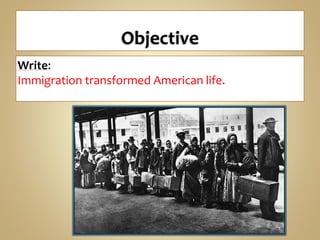
Write:
Immigration transformed American life.
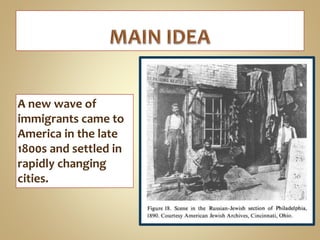
A new wave of
immigrants came to
America in the late
1800s and settled in
rapidly changing
cities.
Write:
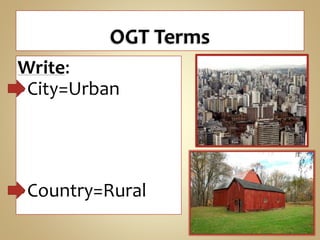
ď‚—City=Urban
ď‚—Country=Rural
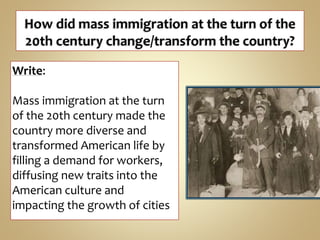
Write:
Mass immigration at the turn
of the 20th century made the
country more diverse and
transformed American life by
filling a demand for workers,
diffusing new traits into the
American culture and
impacting the growth of cities
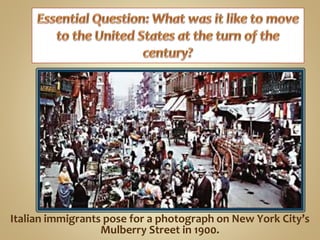
Italian immigrants pose for a photograph on New York City’s
Mulberry Street in 1900.
Write:
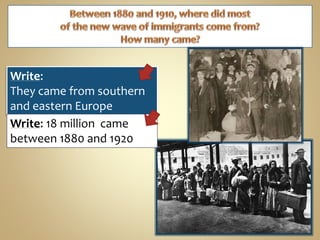
They came from southern
and eastern Europe
Write: 18 million came
between 1880 and 1920
Write:
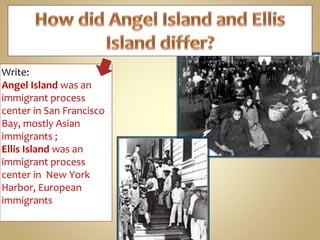
Angel Island was an
immigrant process
center in San Francisco
Bay, mostly Asian
immigrants ;
Ellis Island was an
immigrant process
center in New York
Harbor, European
immigrants
Write:
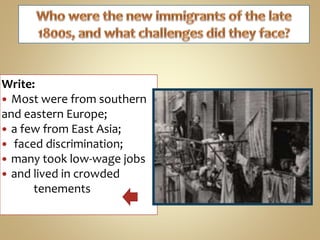
ď‚— Most were from southern
and eastern Europe;
ď‚— a few from East Asia;
ď‚— faced discrimination;
ď‚— many took low-wage jobs
ď‚— and lived in crowded
tenements
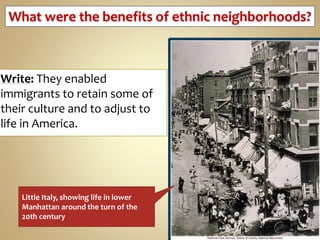
Write: They enabled
immigrants to retain some of
their culture and to adjust to
life in America.
What were the benefits of ethnic neighborhoods?
Little Italy, showing life in lower
Manhattan around the turn of the
20th century
ď‚— He emigrated from
Russia to the United
States.
He immigrated to the
United States from Russia.
ď‚— In Russia, he's an
emigrant.
In the United States, he's
an immigrant.
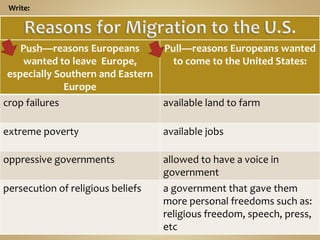
Push—reasons Europeans
wanted to leave Europe,
especially Southern and Eastern
Europe
Pull—reasons Europeans wanted
to come to the United States:
crop failures available land to farm
extreme poverty available jobs
oppressive governments allowed to have a voice in
government
persecution of religious beliefs a government that gave them
more personal freedoms such as:
religious freedom, speech, press,
etc
Write:
Write:
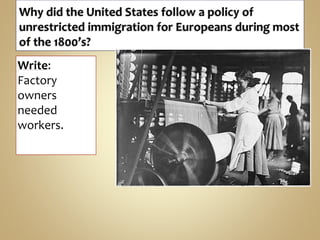
Factory
owners
needed
workers.
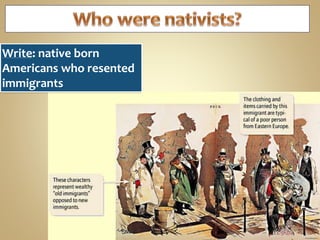
Write: native born
Americans who resented
immigrants
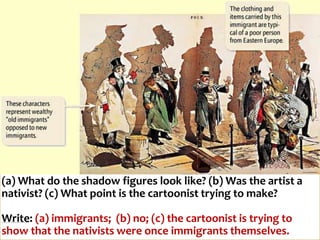
(a) What do the shadow figures look like? (b) Was the artist a
nativist? (c) What point is the cartoonist trying to make?
Write: (a) immigrants; (b) no; (c) the cartoonist is trying to
show that the nativists were once immigrants themselves.
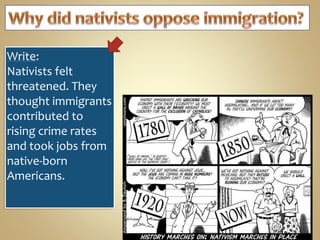
Write:
Nativists felt
threatened. They
thought immigrants
contributed to
rising crime rates
and took jobs from
native-born
Americans.
Some native born Americans wanted to help immigrants
assimilate into the American culture. What did they do to help
immigrants?
Recent immigrants often attended
Americanization classes held in
the factory after their work shifts
were completed. [YMCA Industrial
Service.]
Write:
Schools and volunteer
organizations taught
immigrants English
literacy skills and subjects
needed for citizenship,
such as American history
and government.
This process is called
Americanization.
Write:
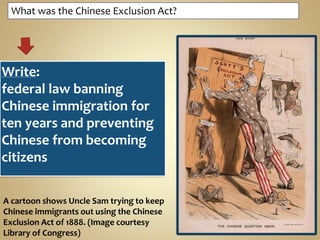
federal law banning
Chinese immigration for
ten years and preventing
Chinese from becoming
citizens
A cartoon shows Uncle Sam trying to keep
Chinese immigrants out using the Chinese
Exclusion Act of 1888. (Image courtesy
Library of Congress)
What was the Chinese Exclusion Act?

Topic 7 immigration Industrial Revolution

  • 1.
  • 2.
  • 3.
    A new waveof immigrants came to America in the late 1800s and settled in rapidly changing cities.
  • 4.
  • 5.
    Write: Mass immigration atthe turn of the 20th century made the country more diverse and transformed American life by filling a demand for workers, diffusing new traits into the American culture and impacting the growth of cities
  • 6.
    Italian immigrants posefor a photograph on New York City’s Mulberry Street in 1900.
  • 7.
    Write: They came fromsouthern and eastern Europe Write: 18 million came between 1880 and 1920
  • 8.
    Write: Angel Island wasan immigrant process center in San Francisco Bay, mostly Asian immigrants ; Ellis Island was an immigrant process center in New York Harbor, European immigrants
  • 9.
    Write: ď‚— Most werefrom southern and eastern Europe; ď‚— a few from East Asia; ď‚— faced discrimination; ď‚— many took low-wage jobs ď‚— and lived in crowded tenements
  • 10.
    Write: They enabled immigrantsto retain some of their culture and to adjust to life in America. What were the benefits of ethnic neighborhoods? Little Italy, showing life in lower Manhattan around the turn of the 20th century
  • 11.
    ď‚— He emigratedfrom Russia to the United States. He immigrated to the United States from Russia. ď‚— In Russia, he's an emigrant. In the United States, he's an immigrant.
  • 12.
    Push—reasons Europeans wanted toleave Europe, especially Southern and Eastern Europe Pull—reasons Europeans wanted to come to the United States: crop failures available land to farm extreme poverty available jobs oppressive governments allowed to have a voice in government persecution of religious beliefs a government that gave them more personal freedoms such as: religious freedom, speech, press, etc Write:
  • 13.
  • 14.
    Write: native born Americanswho resented immigrants
  • 15.
    (a) What dothe shadow figures look like? (b) Was the artist a nativist? (c) What point is the cartoonist trying to make? Write: (a) immigrants; (b) no; (c) the cartoonist is trying to show that the nativists were once immigrants themselves.
  • 16.
    Write: Nativists felt threatened. They thoughtimmigrants contributed to rising crime rates and took jobs from native-born Americans.
  • 17.
    Some native bornAmericans wanted to help immigrants assimilate into the American culture. What did they do to help immigrants? Recent immigrants often attended Americanization classes held in the factory after their work shifts were completed. [YMCA Industrial Service.] Write: Schools and volunteer organizations taught immigrants English literacy skills and subjects needed for citizenship, such as American history and government. This process is called Americanization.
  • 18.
    Write: federal law banning Chineseimmigration for ten years and preventing Chinese from becoming citizens A cartoon shows Uncle Sam trying to keep Chinese immigrants out using the Chinese Exclusion Act of 1888. (Image courtesy Library of Congress) What was the Chinese Exclusion Act?