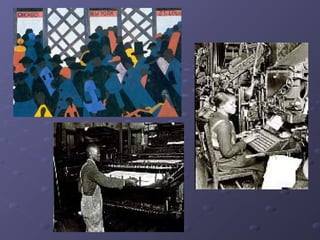
IMMIGRANTS &IMMIGRANTS &
URBANIZATIONURBANIZATION
Chapter 7Chapter 7
THE NEWTHE NEW
IMMIGRANTSIMMIGRANTS
Section 1Section 1
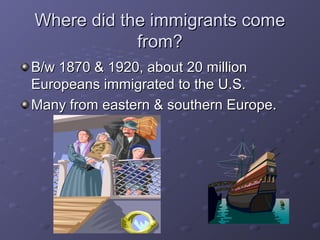
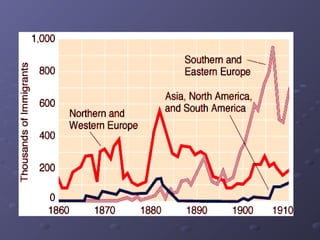
Where did the immigrants comeWhere did the immigrants come
from?from?
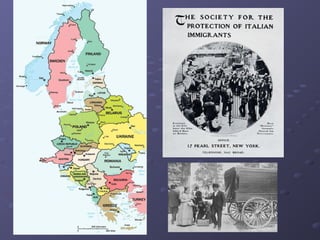
B/w 1870 & 1920, about 20 millionB/w 1870 & 1920, about 20 million
Europeans immigrated to the U.S.Europeans immigrated to the U.S.
Many from eastern & southern Europe.Many from eastern & southern Europe.
Why did immigrants come here?Why did immigrants come here?
Escape religious persecutionEscape religious persecution
Improve their economic situationImprove their economic situation
Experience greater freedom in the U.S.Experience greater freedom in the U.S.
Most European immigrants arrived on theMost European immigrants arrived on the
East Coast.East Coast.
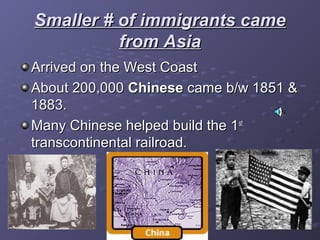
Smaller # of immigrants cameSmaller # of immigrants came
from Asiafrom Asia
Arrived on the West CoastArrived on the West Coast
About 200,000About 200,000 ChineseChinese came b/w 1851 &came b/w 1851 &
1883.1883.
Many Chinese helped build the 1Many Chinese helped build the 1stst
transcontinental railroad.transcontinental railroad.
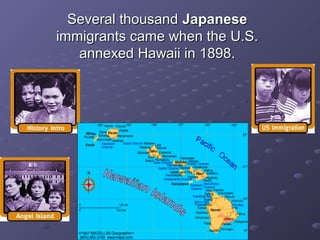
Several thousandSeveral thousand JapaneseJapanese
immigrants came when the U.S.immigrants came when the U.S.
annexed Hawaii in 1898.annexed Hawaii in 1898.
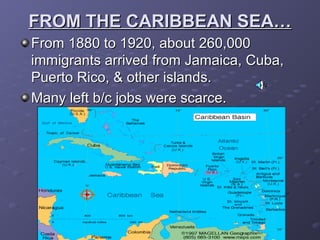
FROM THE CARIBBEAN SEA…FROM THE CARIBBEAN SEA…
From 1880 to 1920, about 260,000From 1880 to 1920, about 260,000
immigrants arrived from Jamaica, Cuba,immigrants arrived from Jamaica, Cuba,
Puerto Rico, & other islands.Puerto Rico, & other islands.
Many left b/c jobs were scarce.Many left b/c jobs were scarce.
MEXICANS COME TO U.S. TOOMEXICANS COME TO U.S. TOO
Some became U.S. citizens when theSome became U.S. citizens when the
nation acquired Mexican territory in 1848nation acquired Mexican territory in 1848
as a result of the Mexican War.as a result of the Mexican War.
About 1 million Mexicans arrived b/w 1910About 1 million Mexicans arrived b/w 1910
to 1930 to escape turmoil in their country.to 1930 to escape turmoil in their country.
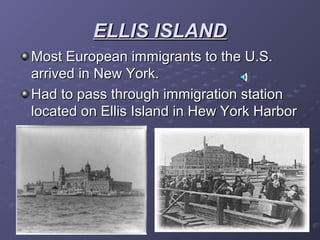
ELLIS ISLANDELLIS ISLAND
Most European immigrants to the U.S.Most European immigrants to the U.S.
arrived in New York.arrived in New York.
Had to pass through immigration stationHad to pass through immigration station
located on Ellis Island in Hew York Harborlocated on Ellis Island in Hew York Harbor
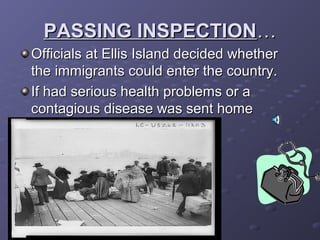
PASSING INSPECTIONPASSING INSPECTION……
Officials at Ellis Island decided whetherOfficials at Ellis Island decided whether
the immigrants could enter the country.the immigrants could enter the country.
If had serious health problems or aIf had serious health problems or a
contagious disease was sent homecontagious disease was sent home
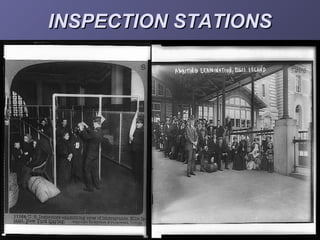
INSPECTION STATIONSINSPECTION STATIONS
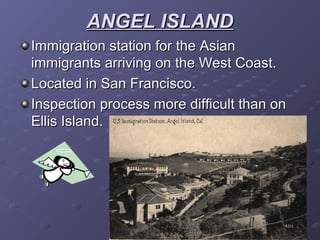
ANGEL ISLANDANGEL ISLAND
Immigration station for the AsianImmigration station for the Asian
immigrants arriving on the West Coast.immigrants arriving on the West Coast.
Located in San Francisco.Located in San Francisco.
Inspection process more difficult than onInspection process more difficult than on
Ellis Island.Ellis Island.
Many immigrants settled inMany immigrants settled in
communities w/othercommunities w/other
immigrants from sameimmigrants from same
country.country.
They also formed organizations toThey also formed organizations to
help each other.help each other.
IMMIGRATION RESTRICTIONSIMMIGRATION RESTRICTIONS
America called a MELTING POT…. FactAmerica called a MELTING POT…. Fact
that many cultures & races had blended .that many cultures & races had blended .
But, many immigrants refused to give upBut, many immigrants refused to give up
their culture….their culture….
Some Americans didn’t like soSome Americans didn’t like so
many immigrants living in themany immigrants living in the
U.S.U.S.
NATIVISMNATIVISM- Obvious preference for- Obvious preference for
native-born Americans.native-born Americans.
NativismNativism gave rise to anti-immigrantgave rise to anti-immigrant
groups. Also led to a demand forgroups. Also led to a demand for
immigration restrictions.immigration restrictions.
CHINESE EXCLUSION ACTCHINESE EXCLUSION ACT
18821882
Chinese immigrants worked for lowChinese immigrants worked for low
wages.wages.
Labor groups pressured politicians toLabor groups pressured politicians to
restrict Asian immigration.restrict Asian immigration.
Banned all but a few Chinese immigrants.Banned all but a few Chinese immigrants.
Not lifted until 1943.Not lifted until 1943.
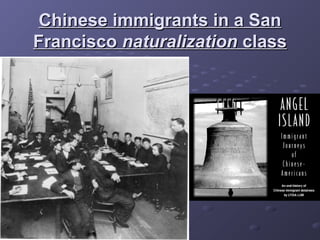
Chinese immigrants in a SanChinese immigrants in a San
FranciscoFrancisco naturalizationnaturalization classclass
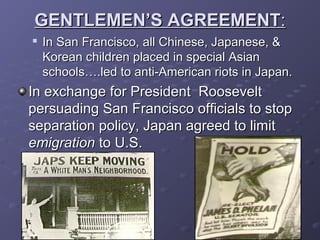
GENTLEMEN’S AGREEMENTGENTLEMEN’S AGREEMENT::

In San Francisco, all Chinese, Japanese, &In San Francisco, all Chinese, Japanese, &
Korean children placed in special AsianKorean children placed in special Asian
schools….led to anti-American riots in Japan.schools….led to anti-American riots in Japan.
In exchange for President RooseveltIn exchange for President Roosevelt
persuading San Francisco officials to stoppersuading San Francisco officials to stop
separation policy, Japan agreed to limitseparation policy, Japan agreed to limit
emigrationemigration to U.S.to U.S.
CHALLENGES OFCHALLENGES OF
URBANIZATIONURBANIZATION
Section 2Section 2
URBANIZATIONURBANIZATION
UrbanizationUrbanization is the rapid growth of cities.is the rapid growth of cities.
Many immigrants settled in cities in theMany immigrants settled in cities in the
early 1900’s.early 1900’s.
Settled mostly in Northeast & MidwestSettled mostly in Northeast & Midwest
cities to find jobs in the factories &cities to find jobs in the factories &
businesses.businesses.
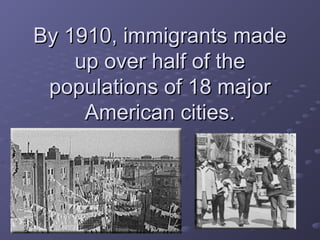
By 1910, immigrants madeBy 1910, immigrants made
up over half of theup over half of the
populations of 18 majorpopulations of 18 major
American cities.American cities.
AMERICANIZATION MOVEMENTAMERICANIZATION MOVEMENT
Way for immigrants to learn about U.S.Way for immigrants to learn about U.S.
Schools taught them English, AmericanSchools taught them English, American
history & government…helped themhistory & government…helped them
become citizens.become citizens.
"Many Peoples, One Nation"
--slogan of the Committee for Immigrants in America, 1915
OTHERS ALSO MOVED TOOTHERS ALSO MOVED TO
CITIES…CITIES…
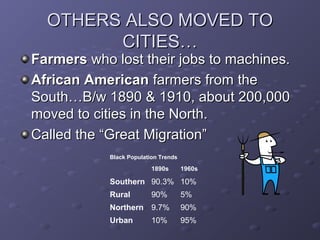
FarmersFarmers who lost their jobs to machines.who lost their jobs to machines.
African AmericanAfrican American farmers from thefarmers from the
South…B/w 1890 & 1910, about 200,000South…B/w 1890 & 1910, about 200,000
moved to cities in the North.moved to cities in the North.
Called the “Great Migration”Called the “Great Migration”
Black Population Trends
1890s 1960s
Southern 90.3% 10%
Rural 90% 5%
Northern 9.7% 90%
Urban 10% 95%
URBAN PROBLEMS…URBAN PROBLEMS…
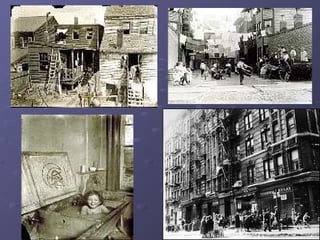
Shortage in housing.Shortage in housing.
New types of housing so people could liveNew types of housing so people could live
in a small amount of space.in a small amount of space.
1)1)Row houseRow house – Single family dwelling that– Single family dwelling that
shared side walls w/other houses.shared side walls w/other houses.
2)2)TenementTenement – Multifamily urban houses– Multifamily urban houses
often overcrowded & unsanitary.often overcrowded & unsanitary.
MASS TRANSITMASS TRANSIT
Cities developedCities developed mass transitmass transit ––
transportation systems designed to movetransportation systems designed to move
large # of people along fixed routes.large # of people along fixed routes.
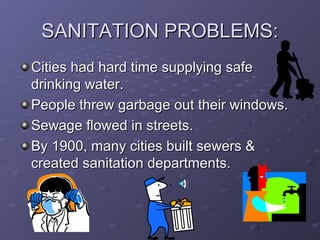
SANITATION PROBLEMS:SANITATION PROBLEMS:
Cities had hard time supplying safeCities had hard time supplying safe
drinking water.drinking water.
People threw garbage out their windows.People threw garbage out their windows.
Sewage flowed in streets.Sewage flowed in streets.
By 1900, many cities built sewers &By 1900, many cities built sewers &
created sanitation departments.created sanitation departments.
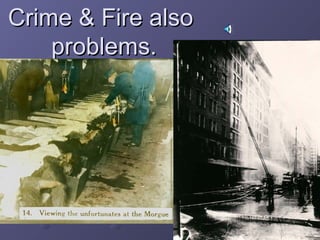
Crime & Fire alsoCrime & Fire also
problems.problems.
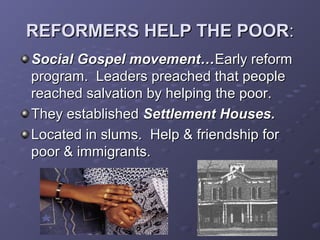
REFORMERS HELP THE POORREFORMERS HELP THE POOR::
Social Gospel movement…Social Gospel movement…Early reformEarly reform
program. Leaders preached that peopleprogram. Leaders preached that people
reached salvation by helping the poor.reached salvation by helping the poor.
They establishedThey established Settlement Houses.Settlement Houses.
Located in slums.Located in slums. Help &Help & friendship forfriendship for
poor & immigrants.poor & immigrants.
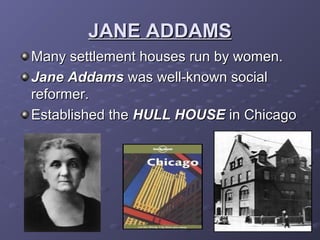
JANE ADDAMSJANE ADDAMS
Many settlement houses run by women.Many settlement houses run by women.
Jane AddamsJane Addams was well-known socialwas well-known social
reformer.reformer.
Established theEstablished the HULL HOUSEHULL HOUSE in Chicagoin Chicago
POLITICS IN THEPOLITICS IN THE
GILDED AGEGILDED AGE
Section 3Section 3
POLITICAL MACHINESPOLITICAL MACHINES
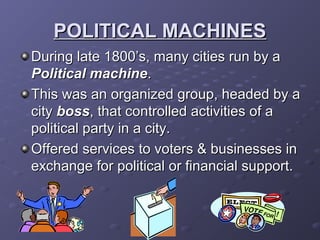
During late 1800’s, many cities run by aDuring late 1800’s, many cities run by a
Political machinePolitical machine..
This was an organized group, headed by aThis was an organized group, headed by a
citycity bossboss, that controlled activities of a, that controlled activities of a
political party in a city.political party in a city.
Offered services to voters & businesses inOffered services to voters & businesses in
exchange for political or financial support.exchange for political or financial support.
Many Political BossesMany Political Bosses
were Corrupt…were Corrupt…
HOW?HOW?
GRAFTGRAFT
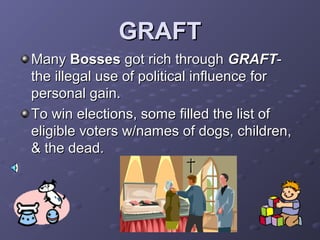
ManyMany BossesBosses got rich throughgot rich through GRAFTGRAFT--
the illegal use of political influence forthe illegal use of political influence for
personal gain.personal gain.
To win elections, some filled the list ofTo win elections, some filled the list of
eligible voters w/names of dogs, children,eligible voters w/names of dogs, children,
& the dead.& the dead.
KICKBACKSKICKBACKS
Workers on city construction projectsWorkers on city construction projects
would charge a higher price & then “would charge a higher price & then “kickkick
back”back” part of the fee to the bosses.part of the fee to the bosses.
Bosses also takingBosses also taking bribesbribes fromfrom
businesses in return for allowing illegal orbusinesses in return for allowing illegal or
unsafe activities.unsafe activities.
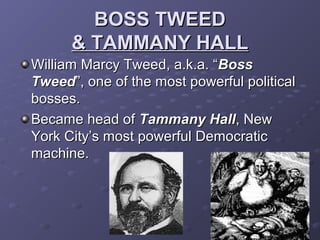
BOSS TWEEDBOSS TWEED
& TAMMANY HALL& TAMMANY HALL
William Marcy Tweed, a.k.a. “William Marcy Tweed, a.k.a. “BossBoss
TweedTweed”, one of the most powerful political”, one of the most powerful political
bosses.bosses.
Became head ofBecame head of Tammany HallTammany Hall, New, New
York City’s most powerful DemocraticYork City’s most powerful Democratic
machine.machine.
TWEED RINGTWEED RING
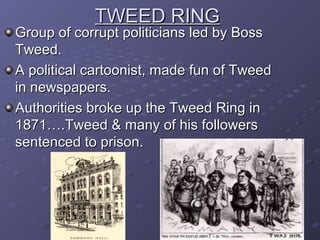
Group of corrupt politicians led by BossGroup of corrupt politicians led by Boss
Tweed.Tweed.
A political cartoonist, made fun of TweedA political cartoonist, made fun of Tweed
in newspapers.in newspapers.
Authorities broke up the Tweed Ring inAuthorities broke up the Tweed Ring in
1871….Tweed & many of his followers1871….Tweed & many of his followers
sentenced to prison.sentenced to prison.
CIVIL SERVICECIVIL SERVICE VS.VS.
PATRONAGEPATRONAGE
Patronage-Patronage- Giving of government jobs toGiving of government jobs to
people of the same party who had helpedpeople of the same party who had helped
a candidate get elected.a candidate get elected.
Civil Service-Civil Service- Government jobs.Government jobs.
Reformers called for aReformers called for a merit systemmerit system. Civil. Civil
service jobs would go to the mostservice jobs would go to the most
qualified, regardless of political views.qualified, regardless of political views.
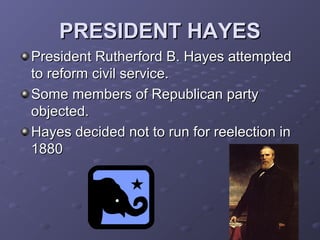
PRESIDENT HAYESPRESIDENT HAYES
President Rutherford B. Hayes attemptedPresident Rutherford B. Hayes attempted
to reform civil service.to reform civil service.
Some members of Republican partySome members of Republican party
objected.objected.
Hayes decided not to run for reelection inHayes decided not to run for reelection in
18801880
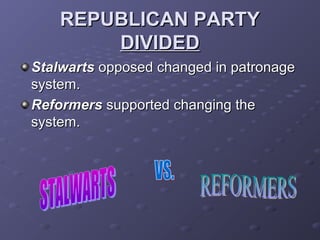
REPUBLICAN PARTYREPUBLICAN PARTY
DIVIDEDDIVIDED
StalwartsStalwarts opposed changed in patronageopposed changed in patronage
system.system.
ReformersReformers supported changing thesupported changing the
system.system.
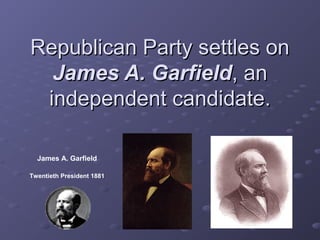
Republican Party settles onRepublican Party settles on
James A. GarfieldJames A. Garfield, an, an
independent candidate.independent candidate.
James A. Garfield
Twentieth President 1881
President GarfieldPresident Garfield
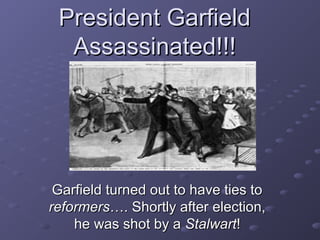
Assassinated!!!Assassinated!!!
Garfield turned out to have ties toGarfield turned out to have ties to
reformersreformers…. Shortly after election,…. Shortly after election,
he was shot by ahe was shot by a StalwartStalwart!!
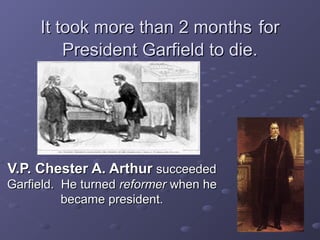
It took more than 2 monthsIt took more than 2 months forfor
President Garfield to die.President Garfield to die.
V.P. Chester A. ArthurV.P. Chester A. Arthur succeededsucceeded
Garfield. He turnedGarfield. He turned reformerreformer when hewhen he
became president.became president.
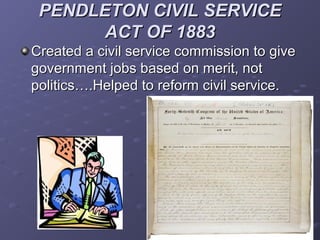
PENDLETON CIVIL SERVICEPENDLETON CIVIL SERVICE
ACT OF 1883ACT OF 1883
Created a civil service commission to giveCreated a civil service commission to give
government jobs based on merit, notgovernment jobs based on merit, not
politics….Helped to reform civil service.politics….Helped to reform civil service.
Business Buys InfluenceBusiness Buys Influence
Politicians no longer had jobs to offer.Politicians no longer had jobs to offer.
Had trouble seeking $ from supporters.Had trouble seeking $ from supporters.
Many turned to wealthy businessMany turned to wealthy business
leaders for support.leaders for support.
TARIFFSTARIFFS
TariffTariff is a tax placed on goods comingis a tax placed on goods coming
into or going out of a country.into or going out of a country.
Most Americans believed tariffs wereMost Americans believed tariffs were
necessary to protect U.S. industries fromnecessary to protect U.S. industries from
foreign competition.foreign competition.
Tariffs did cause prices to rise.Tariffs did cause prices to rise.
For 12 years,For 12 years, TariffsTariffs were awere a
key issue in presidentialkey issue in presidential
elections.elections.
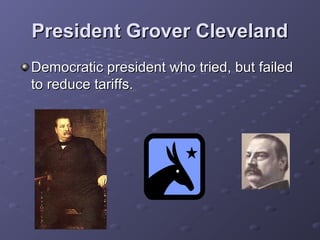
President Grover ClevelandPresident Grover Cleveland
Democratic president who tried, but failedDemocratic president who tried, but failed
to reduce tariffs.to reduce tariffs.
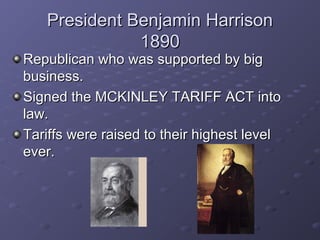
President Benjamin HarrisonPresident Benjamin Harrison
18901890
Republican who was supported by bigRepublican who was supported by big
business.business.
Signed the MCKINLEY TARIFF ACT intoSigned the MCKINLEY TARIFF ACT into
law.law.
Tariffs were raised to their highest levelTariffs were raised to their highest level
ever.ever.
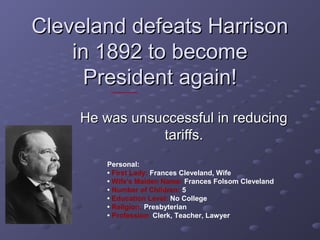
Cleveland defeats HarrisonCleveland defeats Harrison
in 1892 to becomein 1892 to become
President again!President again!
He was unsuccessful in reducingHe was unsuccessful in reducing
tariffs.tariffs.
Personal:
• First Lady: Frances Cleveland, Wife
• Wife's Maiden Name: Frances Folsom Cleveland
• Number of Children: 5
• Education Level: No College
• Religion: Presbyterian
• Profession: Clerk, Teacher, Lawyer
COMING NEXTCOMING NEXT….….
LIFELIFE at the Turn of the 20at the Turn of the 20thth
Century!!Century!!
Immigrants and urbanization

Immigrants and urbanization

  • 1.
  • 2.
  • 3.
    Where did theimmigrants comeWhere did the immigrants come from?from? B/w 1870 & 1920, about 20 millionB/w 1870 & 1920, about 20 million Europeans immigrated to the U.S.Europeans immigrated to the U.S. Many from eastern & southern Europe.Many from eastern & southern Europe.
  • 5.
    Why did immigrantscome here?Why did immigrants come here? Escape religious persecutionEscape religious persecution Improve their economic situationImprove their economic situation Experience greater freedom in the U.S.Experience greater freedom in the U.S. Most European immigrants arrived on theMost European immigrants arrived on the East Coast.East Coast.
  • 6.
    Smaller # ofimmigrants cameSmaller # of immigrants came from Asiafrom Asia Arrived on the West CoastArrived on the West Coast About 200,000About 200,000 ChineseChinese came b/w 1851 &came b/w 1851 & 1883.1883. Many Chinese helped build the 1Many Chinese helped build the 1stst transcontinental railroad.transcontinental railroad.
  • 7.
    Several thousandSeveral thousandJapaneseJapanese immigrants came when the U.S.immigrants came when the U.S. annexed Hawaii in 1898.annexed Hawaii in 1898.
  • 8.
    FROM THE CARIBBEANSEA…FROM THE CARIBBEAN SEA… From 1880 to 1920, about 260,000From 1880 to 1920, about 260,000 immigrants arrived from Jamaica, Cuba,immigrants arrived from Jamaica, Cuba, Puerto Rico, & other islands.Puerto Rico, & other islands. Many left b/c jobs were scarce.Many left b/c jobs were scarce.
  • 9.
    MEXICANS COME TOU.S. TOOMEXICANS COME TO U.S. TOO Some became U.S. citizens when theSome became U.S. citizens when the nation acquired Mexican territory in 1848nation acquired Mexican territory in 1848 as a result of the Mexican War.as a result of the Mexican War. About 1 million Mexicans arrived b/w 1910About 1 million Mexicans arrived b/w 1910 to 1930 to escape turmoil in their country.to 1930 to escape turmoil in their country.
  • 11.
    ELLIS ISLANDELLIS ISLAND MostEuropean immigrants to the U.S.Most European immigrants to the U.S. arrived in New York.arrived in New York. Had to pass through immigration stationHad to pass through immigration station located on Ellis Island in Hew York Harborlocated on Ellis Island in Hew York Harbor
  • 12.
    PASSING INSPECTIONPASSING INSPECTION…… Officialsat Ellis Island decided whetherOfficials at Ellis Island decided whether the immigrants could enter the country.the immigrants could enter the country. If had serious health problems or aIf had serious health problems or a contagious disease was sent homecontagious disease was sent home
  • 13.
  • 14.
    ANGEL ISLANDANGEL ISLAND Immigrationstation for the AsianImmigration station for the Asian immigrants arriving on the West Coast.immigrants arriving on the West Coast. Located in San Francisco.Located in San Francisco. Inspection process more difficult than onInspection process more difficult than on Ellis Island.Ellis Island.
  • 15.
    Many immigrants settledinMany immigrants settled in communities w/othercommunities w/other immigrants from sameimmigrants from same country.country. They also formed organizations toThey also formed organizations to help each other.help each other.
  • 16.
    IMMIGRATION RESTRICTIONSIMMIGRATION RESTRICTIONS Americacalled a MELTING POT…. FactAmerica called a MELTING POT…. Fact that many cultures & races had blended .that many cultures & races had blended . But, many immigrants refused to give upBut, many immigrants refused to give up their culture….their culture….
  • 17.
    Some Americans didn’tlike soSome Americans didn’t like so many immigrants living in themany immigrants living in the U.S.U.S. NATIVISMNATIVISM- Obvious preference for- Obvious preference for native-born Americans.native-born Americans. NativismNativism gave rise to anti-immigrantgave rise to anti-immigrant groups. Also led to a demand forgroups. Also led to a demand for immigration restrictions.immigration restrictions.
  • 18.
    CHINESE EXCLUSION ACTCHINESEEXCLUSION ACT 18821882 Chinese immigrants worked for lowChinese immigrants worked for low wages.wages. Labor groups pressured politicians toLabor groups pressured politicians to restrict Asian immigration.restrict Asian immigration. Banned all but a few Chinese immigrants.Banned all but a few Chinese immigrants. Not lifted until 1943.Not lifted until 1943.
  • 19.
    Chinese immigrants ina SanChinese immigrants in a San FranciscoFrancisco naturalizationnaturalization classclass
  • 20.
    GENTLEMEN’S AGREEMENTGENTLEMEN’S AGREEMENT::  InSan Francisco, all Chinese, Japanese, &In San Francisco, all Chinese, Japanese, & Korean children placed in special AsianKorean children placed in special Asian schools….led to anti-American riots in Japan.schools….led to anti-American riots in Japan. In exchange for President RooseveltIn exchange for President Roosevelt persuading San Francisco officials to stoppersuading San Francisco officials to stop separation policy, Japan agreed to limitseparation policy, Japan agreed to limit emigrationemigration to U.S.to U.S.
  • 21.
  • 22.
    URBANIZATIONURBANIZATION UrbanizationUrbanization is therapid growth of cities.is the rapid growth of cities. Many immigrants settled in cities in theMany immigrants settled in cities in the early 1900’s.early 1900’s. Settled mostly in Northeast & MidwestSettled mostly in Northeast & Midwest cities to find jobs in the factories &cities to find jobs in the factories & businesses.businesses.
  • 23.
    By 1910, immigrantsmadeBy 1910, immigrants made up over half of theup over half of the populations of 18 majorpopulations of 18 major American cities.American cities.
  • 24.
    AMERICANIZATION MOVEMENTAMERICANIZATION MOVEMENT Wayfor immigrants to learn about U.S.Way for immigrants to learn about U.S. Schools taught them English, AmericanSchools taught them English, American history & government…helped themhistory & government…helped them become citizens.become citizens. "Many Peoples, One Nation" --slogan of the Committee for Immigrants in America, 1915
  • 25.
    OTHERS ALSO MOVEDTOOTHERS ALSO MOVED TO CITIES…CITIES… FarmersFarmers who lost their jobs to machines.who lost their jobs to machines. African AmericanAfrican American farmers from thefarmers from the South…B/w 1890 & 1910, about 200,000South…B/w 1890 & 1910, about 200,000 moved to cities in the North.moved to cities in the North. Called the “Great Migration”Called the “Great Migration” Black Population Trends 1890s 1960s Southern 90.3% 10% Rural 90% 5% Northern 9.7% 90% Urban 10% 95%
  • 27.
    URBAN PROBLEMS…URBAN PROBLEMS… Shortagein housing.Shortage in housing. New types of housing so people could liveNew types of housing so people could live in a small amount of space.in a small amount of space. 1)1)Row houseRow house – Single family dwelling that– Single family dwelling that shared side walls w/other houses.shared side walls w/other houses. 2)2)TenementTenement – Multifamily urban houses– Multifamily urban houses often overcrowded & unsanitary.often overcrowded & unsanitary.
  • 29.
    MASS TRANSITMASS TRANSIT CitiesdevelopedCities developed mass transitmass transit –– transportation systems designed to movetransportation systems designed to move large # of people along fixed routes.large # of people along fixed routes.
  • 30.
    SANITATION PROBLEMS:SANITATION PROBLEMS: Citieshad hard time supplying safeCities had hard time supplying safe drinking water.drinking water. People threw garbage out their windows.People threw garbage out their windows. Sewage flowed in streets.Sewage flowed in streets. By 1900, many cities built sewers &By 1900, many cities built sewers & created sanitation departments.created sanitation departments.
  • 31.
    Crime & FirealsoCrime & Fire also problems.problems.
  • 32.
    REFORMERS HELP THEPOORREFORMERS HELP THE POOR:: Social Gospel movement…Social Gospel movement…Early reformEarly reform program. Leaders preached that peopleprogram. Leaders preached that people reached salvation by helping the poor.reached salvation by helping the poor. They establishedThey established Settlement Houses.Settlement Houses. Located in slums.Located in slums. Help &Help & friendship forfriendship for poor & immigrants.poor & immigrants.
  • 33.
    JANE ADDAMSJANE ADDAMS Manysettlement houses run by women.Many settlement houses run by women. Jane AddamsJane Addams was well-known socialwas well-known social reformer.reformer. Established theEstablished the HULL HOUSEHULL HOUSE in Chicagoin Chicago
  • 34.
    POLITICS IN THEPOLITICSIN THE GILDED AGEGILDED AGE Section 3Section 3
  • 35.
    POLITICAL MACHINESPOLITICAL MACHINES Duringlate 1800’s, many cities run by aDuring late 1800’s, many cities run by a Political machinePolitical machine.. This was an organized group, headed by aThis was an organized group, headed by a citycity bossboss, that controlled activities of a, that controlled activities of a political party in a city.political party in a city. Offered services to voters & businesses inOffered services to voters & businesses in exchange for political or financial support.exchange for political or financial support.
  • 36.
    Many Political BossesManyPolitical Bosses were Corrupt…were Corrupt… HOW?HOW?
  • 37.
    GRAFTGRAFT ManyMany BossesBosses gotrich throughgot rich through GRAFTGRAFT-- the illegal use of political influence forthe illegal use of political influence for personal gain.personal gain. To win elections, some filled the list ofTo win elections, some filled the list of eligible voters w/names of dogs, children,eligible voters w/names of dogs, children, & the dead.& the dead.
  • 38.
    KICKBACKSKICKBACKS Workers on cityconstruction projectsWorkers on city construction projects would charge a higher price & then “would charge a higher price & then “kickkick back”back” part of the fee to the bosses.part of the fee to the bosses. Bosses also takingBosses also taking bribesbribes fromfrom businesses in return for allowing illegal orbusinesses in return for allowing illegal or unsafe activities.unsafe activities.
  • 39.
    BOSS TWEEDBOSS TWEED &TAMMANY HALL& TAMMANY HALL William Marcy Tweed, a.k.a. “William Marcy Tweed, a.k.a. “BossBoss TweedTweed”, one of the most powerful political”, one of the most powerful political bosses.bosses. Became head ofBecame head of Tammany HallTammany Hall, New, New York City’s most powerful DemocraticYork City’s most powerful Democratic machine.machine.
  • 40.
    TWEED RINGTWEED RING Groupof corrupt politicians led by BossGroup of corrupt politicians led by Boss Tweed.Tweed. A political cartoonist, made fun of TweedA political cartoonist, made fun of Tweed in newspapers.in newspapers. Authorities broke up the Tweed Ring inAuthorities broke up the Tweed Ring in 1871….Tweed & many of his followers1871….Tweed & many of his followers sentenced to prison.sentenced to prison.
  • 41.
    CIVIL SERVICECIVIL SERVICEVS.VS. PATRONAGEPATRONAGE Patronage-Patronage- Giving of government jobs toGiving of government jobs to people of the same party who had helpedpeople of the same party who had helped a candidate get elected.a candidate get elected. Civil Service-Civil Service- Government jobs.Government jobs. Reformers called for aReformers called for a merit systemmerit system. Civil. Civil service jobs would go to the mostservice jobs would go to the most qualified, regardless of political views.qualified, regardless of political views.
  • 42.
    PRESIDENT HAYESPRESIDENT HAYES PresidentRutherford B. Hayes attemptedPresident Rutherford B. Hayes attempted to reform civil service.to reform civil service. Some members of Republican partySome members of Republican party objected.objected. Hayes decided not to run for reelection inHayes decided not to run for reelection in 18801880
  • 43.
    REPUBLICAN PARTYREPUBLICAN PARTY DIVIDEDDIVIDED StalwartsStalwartsopposed changed in patronageopposed changed in patronage system.system. ReformersReformers supported changing thesupported changing the system.system.
  • 44.
    Republican Party settlesonRepublican Party settles on James A. GarfieldJames A. Garfield, an, an independent candidate.independent candidate. James A. Garfield Twentieth President 1881
  • 45.
    President GarfieldPresident Garfield Assassinated!!!Assassinated!!! Garfieldturned out to have ties toGarfield turned out to have ties to reformersreformers…. Shortly after election,…. Shortly after election, he was shot by ahe was shot by a StalwartStalwart!!
  • 46.
    It took morethan 2 monthsIt took more than 2 months forfor President Garfield to die.President Garfield to die. V.P. Chester A. ArthurV.P. Chester A. Arthur succeededsucceeded Garfield. He turnedGarfield. He turned reformerreformer when hewhen he became president.became president.
  • 47.
    PENDLETON CIVIL SERVICEPENDLETONCIVIL SERVICE ACT OF 1883ACT OF 1883 Created a civil service commission to giveCreated a civil service commission to give government jobs based on merit, notgovernment jobs based on merit, not politics….Helped to reform civil service.politics….Helped to reform civil service.
  • 48.
    Business Buys InfluenceBusinessBuys Influence Politicians no longer had jobs to offer.Politicians no longer had jobs to offer. Had trouble seeking $ from supporters.Had trouble seeking $ from supporters. Many turned to wealthy businessMany turned to wealthy business leaders for support.leaders for support.
  • 49.
    TARIFFSTARIFFS TariffTariff is atax placed on goods comingis a tax placed on goods coming into or going out of a country.into or going out of a country. Most Americans believed tariffs wereMost Americans believed tariffs were necessary to protect U.S. industries fromnecessary to protect U.S. industries from foreign competition.foreign competition. Tariffs did cause prices to rise.Tariffs did cause prices to rise.
  • 50.
    For 12 years,For12 years, TariffsTariffs were awere a key issue in presidentialkey issue in presidential elections.elections.
  • 51.
    President Grover ClevelandPresidentGrover Cleveland Democratic president who tried, but failedDemocratic president who tried, but failed to reduce tariffs.to reduce tariffs.
  • 52.
    President Benjamin HarrisonPresidentBenjamin Harrison 18901890 Republican who was supported by bigRepublican who was supported by big business.business. Signed the MCKINLEY TARIFF ACT intoSigned the MCKINLEY TARIFF ACT into law.law. Tariffs were raised to their highest levelTariffs were raised to their highest level ever.ever.
  • 53.
    Cleveland defeats HarrisonClevelanddefeats Harrison in 1892 to becomein 1892 to become President again!President again! He was unsuccessful in reducingHe was unsuccessful in reducing tariffs.tariffs. Personal: • First Lady: Frances Cleveland, Wife • Wife's Maiden Name: Frances Folsom Cleveland • Number of Children: 5 • Education Level: No College • Religion: Presbyterian • Profession: Clerk, Teacher, Lawyer
  • 54.
    COMING NEXTCOMING NEXT….…. LIFELIFEat the Turn of the 20at the Turn of the 20thth Century!!Century!!