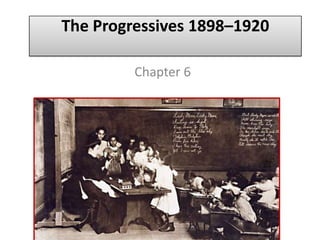
The Progressives 1898–1920
Chapter 6
The Progressives

Introduction
Read
Reform
Read
Read

Chapter 6 The Big Picture:

• As the 1900s dawned, activists called Progressives
fought to make America’s economic and political
systems fairer.
• Others attacked a wide range of societal ills.

• The Progressive movement involved countless
individuals and groups at all levels of government.
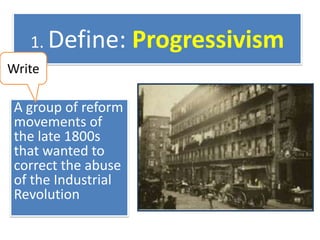
1. Define:
Write

A group of reform
movements of
the late 1800s
that wanted to
correct the abuse
of the Industrial
Revolution

Progressivism
2. Who were the Progressives?

Reformers
who
focused
on three
areas of
reform

Write
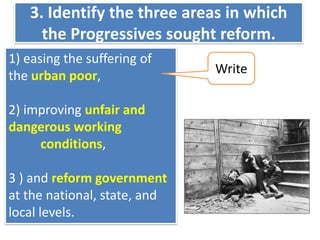
3. Identify the three areas in which
the Progressives sought reform.
1) easing the suffering of
the urban poor,
2) improving unfair and
dangerous working
conditions,
3 ) and reform government
at the national, state, and
local levels.

Write
4. IDENTIFY TWO PROGRESSIVE
GOALS
Write

to improve the lives of the working
class
and to regulate the unchecked power of
business
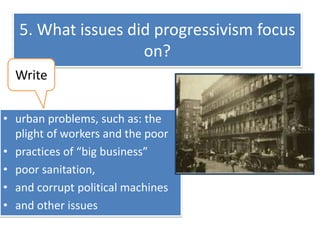
5. What issues did progressivism focus
on?
Write
• urban problems, such as: the
plight of workers and the poor
• practices of “big business”
• poor sanitation,
• and corrupt political machines
• and other issues
Topic 2: Muckrakers
6. What is the Objective
of this lesson?

Write

Analyze how
journalists, called
muckrakers, exposed
political
corruption, corporate
and industrial
practices, social
injustice and life in
urban America.
Write

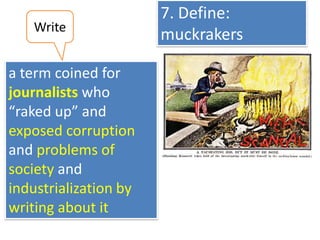
a term coined for
journalists who
“raked up” and
exposed corruption
and problems of
society and
industrialization by
writing about it

7. Define:
muckrakers
8. How did muckrakers
prepare the way for
political reforms?
Write

Their writing
energized the
Progressive
movement –they
paved the way for
political reform
9. Who were the muckrakers? What
were their occupations?
Journalists and
authors who
reported on
business and
political
corruption and
how it affected
the working
poor, small
businesses, etc
.

Write
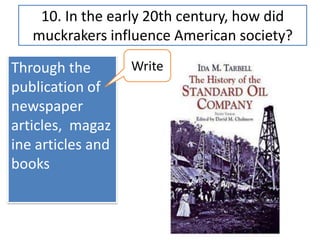
10. In the early 20th century, how did
muckrakers influence American society?
Through the
publication of
newspaper
articles, magaz
ine articles and
books

Write
What issues did Progressives focus on?
Read

• ISSUES:
• practices of big
businesses
• helping urban poor
• working conditions
• reforming
government

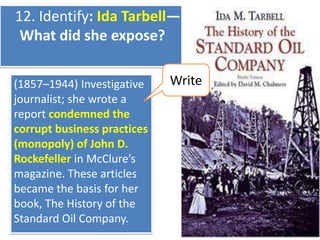
• Ida M. Tarbell grew up near oil derricks in Western Pennsylvania and later
investigated the practices of the Standard Oil Company for McClure’s
Magazine in November 1902. Photo courtesy of Library of Congress.
11. WHAT HELPED TO ENERGIZE PROGRESSIVE
CAUSES?
Write

Newspapers
gave
publicity to
their causes
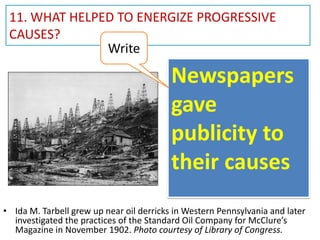
• Ida M. Tarbell grew up near oil derricks in Western Pennsylvania and later
investigated the practices of the Standard Oil Company for McClure’s
Magazine in November 1902. Photo courtesy of Library of Congress.
12. Identify: Ida Tarbell—
What did she expose?
(1857–1944) Investigative
journalist; she wrote a
report condemned the
corrupt business practices
(monopoly) of John D.
Rockefeller in McClure’s
magazine. These articles
became the basis for her
book, The History of the
Standard Oil Company.

Write
Read

OGT

• WHAT KNOWLEDGE DO STUDENTS NEED TO
UNDERSTAND THIS CONCEPT? Students need to
know the economic effects of industrialization.
Students can define the terms “monopoly” and
“laissez-faire economics” to increase their
understanding of the economic conditions and
effects of industrialization.
• Also, students can make a list of the positive and
negative aspects of monopolies and look at a
specific example, Standard Oil, from that time
period.
A. WHAT WAS PROGRESSIVEISM?

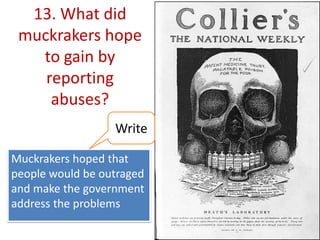
What is this political cartoon implying?

“IN DANGER” What are
you going to do about it?
Muckrakers

Ida Tarbill, exposed abuses of Standard Oil’s Monopoly
13. What did
muckrakers hope
to gain by
reporting
abuses?
Write
Muckrakers hoped that
people would be outraged
and make the government
address the problems
1887--Uncle Sam states:
“Don’t bother me. I am
engrossed in my
friend here to attend
to you!”
What is this political
cartoon implying?
Uncle Sam too
engrossed in
baseball to bother
with other news
14. Identify: Lincoln Steffens. What
did he expose?
(1866–1936) Muckraker
and managing editor of
McClure’s magazine; he
exposed city government
corruption in his 1904
book, The Shame of the
Cities.

Write
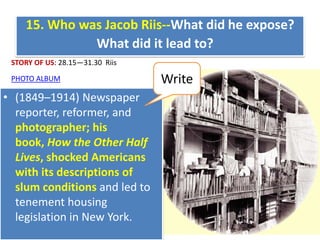
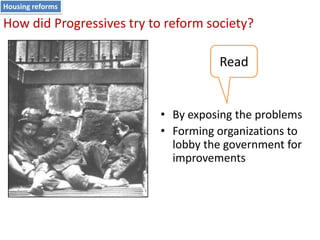
An east wing tenement block, New York City.

REFORMING SOCIETY
15. Who was Jacob Riis--What did he expose?
What did it lead to?
STORY OF US: 28.15—31.30 Riis

PHOTO ALBUM

• (1849–1914) Newspaper
reporter, reformer, and
photographer; his
book, How the Other Half
Lives, shocked Americans
with its descriptions of
slum conditions and led to
tenement housing
legislation in New York.

Write
16. What were the major social
problems facing the urban poor?
Write
• poor housing
conditions
• lack of
healthcare
• discrimination
17. How was Jacob Riis’s book, How the Other Half
Lives, so significant in the reform movement?

Write
• Riis’s book
shocked
Americans
• It made
government
leaders
aware of the
severity of
poverty of
the urban
working poor
Housing reforms

How did Progressives try to reform society?
Read

• By exposing the problems
• Forming organizations to
lobby the government for
improvements
18. What was the Tenement Act of 1901?
What effect did it have on people’s health?
Write
Housing reforms

Tenement Act of 1901 was
legislation (a law) that forced
landlords to install lighting in public
hallways, the law required at least
one toilet for every two families.
Outhouses were eventually banned
from New York City slums.
Within 15 years, the death rate in
New York dropped dramatically
19. What caused improvements within meat-packing
and drug industries?
Protecting consumers
Upton Sinclair

• Muckraker’s
exposure of
abuses.
• Example: The
novel, The
Jungle, led to
reports from
Secretary of
Agriculture that
would lead to
improvements.
From Upton Sinclair’s The Jungle

“There would be meat that had tumbled out on
the floor, in the dirt and sawdust, where the
workers had trampled and spit uncounted
billions of germs. There would be meat stored in
rooms and thousands of rats would race about
it..A man could run his hand over these piles of
meat and sweep handfuls of dried rat dung.
These rats were nuisances, and packers would put
poisoned bread out for them; they would die, and
then the rats, bread, and meat would go into the
hoppers together…
20. In 1906 Sinclair’s novel The Jungle drew outrage against the
Chicago meatpacking industry for its arrogant disregard of basic health
standards. What government regulation resulted from the writing of
this book?

Write

The Jungle led to government regulation of food and drugs (Meat
Inspection Act).
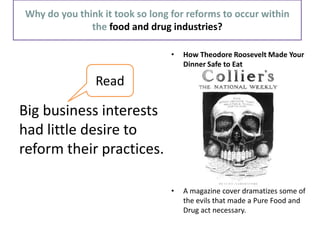
Why do you think it took so long for reforms to occur within
the food and drug industries?
•

How Theodore Roosevelt Made Your
Dinner Safe to Eat

•

A magazine cover dramatizes some of
the evils that made a Pure Food and
Drug act necessary.

Read

Big business interests
had little desire to
reform their practices.

Topic 2-muckrakers

  • 1.
  • 2.
  • 3.
  • 4.
  • 5.
    Read Chapter 6 TheBig Picture: • As the 1900s dawned, activists called Progressives fought to make America’s economic and political systems fairer. • Others attacked a wide range of societal ills. • The Progressive movement involved countless individuals and groups at all levels of government.
  • 6.
    1. Define: Write A groupof reform movements of the late 1800s that wanted to correct the abuse of the Industrial Revolution Progressivism
  • 7.
    2. Who werethe Progressives? Reformers who focused on three areas of reform Write
  • 8.
    3. Identify thethree areas in which the Progressives sought reform. 1) easing the suffering of the urban poor, 2) improving unfair and dangerous working conditions, 3 ) and reform government at the national, state, and local levels. Write
  • 9.
    4. IDENTIFY TWOPROGRESSIVE GOALS Write to improve the lives of the working class and to regulate the unchecked power of business
  • 10.
    5. What issuesdid progressivism focus on? Write • urban problems, such as: the plight of workers and the poor • practices of “big business” • poor sanitation, • and corrupt political machines • and other issues
  • 11.
    Topic 2: Muckrakers 6.What is the Objective of this lesson? Write Analyze how journalists, called muckrakers, exposed political corruption, corporate and industrial practices, social injustice and life in urban America.
  • 12.
    Write a term coinedfor journalists who “raked up” and exposed corruption and problems of society and industrialization by writing about it 7. Define: muckrakers
  • 13.
    8. How didmuckrakers prepare the way for political reforms? Write Their writing energized the Progressive movement –they paved the way for political reform
  • 14.
    9. Who werethe muckrakers? What were their occupations? Journalists and authors who reported on business and political corruption and how it affected the working poor, small businesses, etc . Write
  • 15.
    10. In theearly 20th century, how did muckrakers influence American society? Through the publication of newspaper articles, magaz ine articles and books Write
  • 16.
    What issues didProgressives focus on? Read • ISSUES: • practices of big businesses • helping urban poor • working conditions • reforming government • Ida M. Tarbell grew up near oil derricks in Western Pennsylvania and later investigated the practices of the Standard Oil Company for McClure’s Magazine in November 1902. Photo courtesy of Library of Congress.
  • 17.
    11. WHAT HELPEDTO ENERGIZE PROGRESSIVE CAUSES? Write Newspapers gave publicity to their causes • Ida M. Tarbell grew up near oil derricks in Western Pennsylvania and later investigated the practices of the Standard Oil Company for McClure’s Magazine in November 1902. Photo courtesy of Library of Congress.
  • 18.
    12. Identify: IdaTarbell— What did she expose? (1857–1944) Investigative journalist; she wrote a report condemned the corrupt business practices (monopoly) of John D. Rockefeller in McClure’s magazine. These articles became the basis for her book, The History of the Standard Oil Company. Write
  • 19.
    Read OGT • WHAT KNOWLEDGEDO STUDENTS NEED TO UNDERSTAND THIS CONCEPT? Students need to know the economic effects of industrialization. Students can define the terms “monopoly” and “laissez-faire economics” to increase their understanding of the economic conditions and effects of industrialization. • Also, students can make a list of the positive and negative aspects of monopolies and look at a specific example, Standard Oil, from that time period.
  • 20.
    A. WHAT WASPROGRESSIVEISM? What is this political cartoon implying? “IN DANGER” What are you going to do about it?
  • 21.
    Muckrakers Ida Tarbill, exposedabuses of Standard Oil’s Monopoly
  • 22.
    13. What did muckrakershope to gain by reporting abuses? Write Muckrakers hoped that people would be outraged and make the government address the problems
  • 23.
    1887--Uncle Sam states: “Don’tbother me. I am engrossed in my friend here to attend to you!” What is this political cartoon implying? Uncle Sam too engrossed in baseball to bother with other news
  • 24.
    14. Identify: LincolnSteffens. What did he expose? (1866–1936) Muckraker and managing editor of McClure’s magazine; he exposed city government corruption in his 1904 book, The Shame of the Cities. Write
  • 25.
    An east wingtenement block, New York City. REFORMING SOCIETY
  • 26.
    15. Who wasJacob Riis--What did he expose? What did it lead to? STORY OF US: 28.15—31.30 Riis PHOTO ALBUM • (1849–1914) Newspaper reporter, reformer, and photographer; his book, How the Other Half Lives, shocked Americans with its descriptions of slum conditions and led to tenement housing legislation in New York. Write
  • 27.
    16. What werethe major social problems facing the urban poor? Write • poor housing conditions • lack of healthcare • discrimination
  • 28.
    17. How wasJacob Riis’s book, How the Other Half Lives, so significant in the reform movement? Write • Riis’s book shocked Americans • It made government leaders aware of the severity of poverty of the urban working poor
  • 29.
    Housing reforms How didProgressives try to reform society? Read • By exposing the problems • Forming organizations to lobby the government for improvements
  • 30.
    18. What wasthe Tenement Act of 1901? What effect did it have on people’s health? Write Housing reforms Tenement Act of 1901 was legislation (a law) that forced landlords to install lighting in public hallways, the law required at least one toilet for every two families. Outhouses were eventually banned from New York City slums. Within 15 years, the death rate in New York dropped dramatically
  • 31.
    19. What causedimprovements within meat-packing and drug industries? Protecting consumers Upton Sinclair • Muckraker’s exposure of abuses. • Example: The novel, The Jungle, led to reports from Secretary of Agriculture that would lead to improvements.
  • 32.
    From Upton Sinclair’sThe Jungle “There would be meat that had tumbled out on the floor, in the dirt and sawdust, where the workers had trampled and spit uncounted billions of germs. There would be meat stored in rooms and thousands of rats would race about it..A man could run his hand over these piles of meat and sweep handfuls of dried rat dung. These rats were nuisances, and packers would put poisoned bread out for them; they would die, and then the rats, bread, and meat would go into the hoppers together…
  • 33.
    20. In 1906Sinclair’s novel The Jungle drew outrage against the Chicago meatpacking industry for its arrogant disregard of basic health standards. What government regulation resulted from the writing of this book? Write The Jungle led to government regulation of food and drugs (Meat Inspection Act).
  • 34.
    Why do youthink it took so long for reforms to occur within the food and drug industries? • How Theodore Roosevelt Made Your Dinner Safe to Eat • A magazine cover dramatizes some of the evils that made a Pure Food and Drug act necessary. Read Big business interests had little desire to reform their practices.