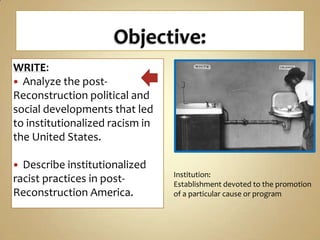
WRITE:
 Analyze the postReconstruction political and
social developments that led
to institutionalized racism in
the United States.
Describe institutionalized
racist practices in postReconstruction America.


Institution:
Establishment devoted to the promotion
of a particular cause or program
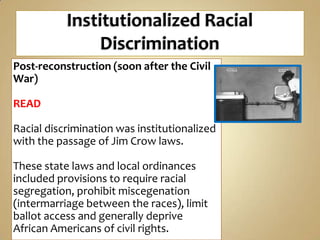
Post-reconstruction (soon after the Civil
War)
READ
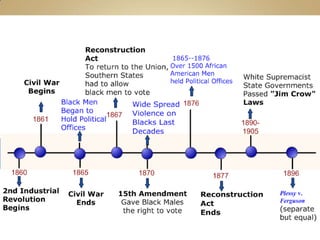
Racial discrimination was institutionalized
with the passage of Jim Crow laws.
These state laws and local ordinances
included provisions to require racial
segregation, prohibit miscegenation
(intermarriage between the races), limit
ballot access and generally deprive
African Americans of civil rights.
Segregation and Discrimination
---Legalized discrimination
READ
Some white southerners were determined to prevent
African Americans from using the right to vote. Tactics
included making voters pay a poll tax and pass a literacy test.


Most African Americans were too poor to pay the tax and
had been denied the education to pass a literacy test.


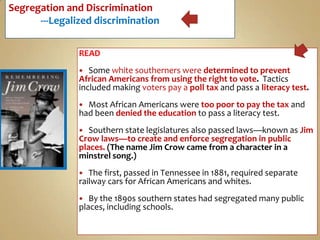
Southern state legislatures also passed laws—known as Jim
Crow laws—to create and enforce segregation in public
places. (The name Jim Crow came from a character in a
minstrel song.)


The first, passed in Tennessee in 1881, required separate
railway cars for African Americans and whites.


By the 1890s southern states had segregated many public
places, including schools.

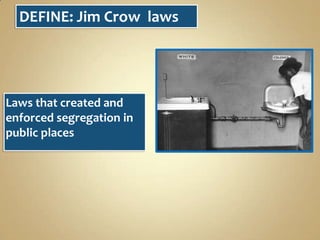
DEFINE: Jim Crow laws

Laws that created and
enforced segregation in
public places
Who was Homer Plessy?

Write:

The “separate
but equal”
doctrine was
applied to the
14th
Amendment.
14th amendment
provides a
broad definition
of citizenship

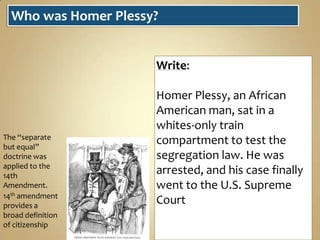
Homer Plessy, an African
American man, sat in a
whites-only train
compartment to test the
segregation law. He was
arrested, and his case finally
went to the U.S. Supreme
Court
Explain the Supreme Court ruling, Plessy v.
Ferguson

The “separate
but equal”
doctrine was
applied to the
14th
Amendment.
14th amendment
provides a
broad definition
of citizenship

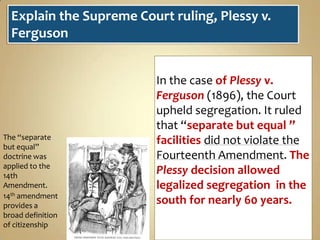
In the case of Plessy v.
Ferguson (1896), the Court
upheld segregation. It ruled
that “separate but equal ”
facilities did not violate the
Fourteenth Amendment. The
Plessy decision allowed
legalized segregation in the
south for nearly 60 years.
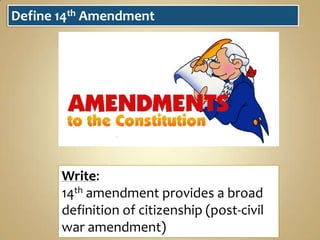
Define 14th Amendment

Write:
14th amendment provides a broad
definition of citizenship (post-civil
war amendment)
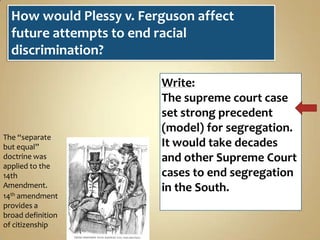
How would Plessy v. Ferguson affect
future attempts to end racial
discrimination?

The “separate
but equal”
doctrine was
applied to the
14th
Amendment.
14th amendment
provides a
broad definition
of citizenship

Write:
The supreme court case
set strong precedent
(model) for segregation.
It would take decades
and other Supreme Court
cases to end segregation
in the South.
The “separate
but equal”
doctrine was
applied to the
14th
Amendment.
14th amendment
provides a
broad definition
of citizenship

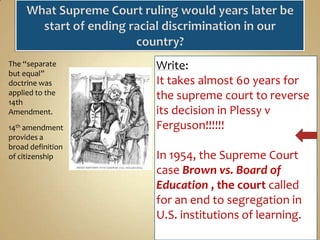
Write:
It takes almost 60 years for
the supreme court to reverse
its decision in Plessy v
Ferguson!!!!!!
In 1954, the Supreme Court
case Brown vs. Board of
Education , the court called
for an end to segregation in
U.S. institutions of learning.
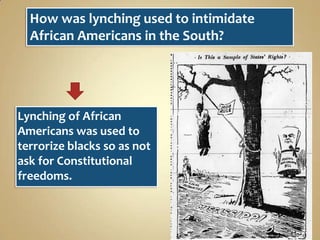
How was lynching used to intimidate
African Americans in the South?

Lynching of African
Americans was used to
terrorize blacks so as not
ask for Constitutional
freedoms.
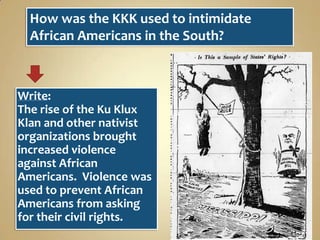
How was the KKK used to intimidate
African Americans in the South?

Write:
The rise of the Ku Klux
Klan and other nativist
organizations brought
increased violence
against African
Americans. Violence was
used to prevent African
Americans from asking
for their civil rights.
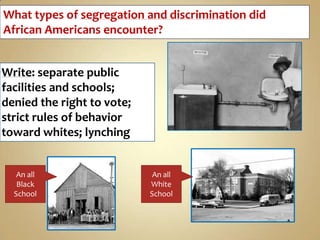
What types of segregation and discrimination did
African Americans encounter?
Write: separate public
facilities and schools;
denied the right to vote;
strict rules of behavior
toward whites; lynching

An all
Black
School

An all
White
School
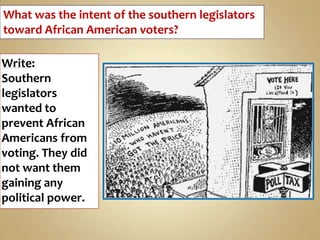
What was the intent of the southern legislators
toward African American voters?
Write:
Southern
legislators
wanted to
prevent African
Americans from
voting. They did
not want them
gaining any
political power.
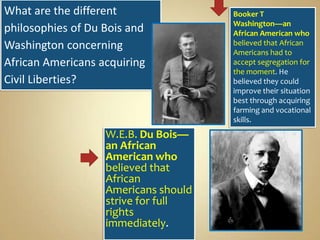
What are the different
philosophies of Du Bois and
Washington concerning
African Americans acquiring
Civil Liberties?

W.E.B. Du Bois—
an African
American who
believed that
African
Americans should
strive for full
rights
immediately.

Booker T
Washington—an
African American who
believed that African
Americans had to
accept segregation for
the moment. He
believed they could
improve their situation
best through acquiring
farming and vocational
skills.
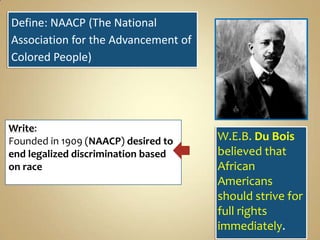
Define: NAACP (The National
Association for the Advancement of
Colored People)

Write:
Founded in 1909 (NAACP) desired to
end legalized discrimination based
on race

W.E.B. Du Bois
believed that
African
Americans
should strive for
full rights
immediately.
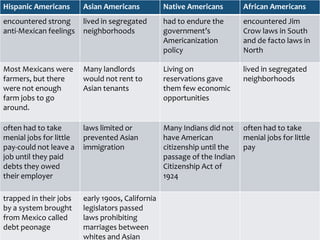
Hispanic Americans

Asian Americans

Native Americans

African Americans

encountered strong
anti-Mexican feelings

lived in segregated
neighborhoods

had to endure the
government’s
Americanization
policy

encountered Jim
Crow laws in South
and de facto laws in
North

Most Mexicans were
farmers, but there
were not enough
farm jobs to go
around.

Many landlords
would not rent to
Asian tenants

Living on
reservations gave
them few economic
opportunities

lived in segregated
neighborhoods

often had to take
menial jobs for little
pay-could not leave a
job until they paid
debts they owed
their employer

laws limited or
prevented Asian
immigration

Many Indians did not
have American
citizenship until the
passage of the Indian
Citizenship Act of
1924

often had to take
menial jobs for little
pay

trapped in their jobs
by a system brought
from Mexico called
debt peonage

early 1900s, California
legislators passed
laws prohibiting
marriages between
whites and Asian
Credible
means
believable
Credible (credibility)--credible evidence to support
an idea takes more than one source of information—
to be credible. It has at least two sources of
information that are very similar in their findings


 Ex.
 Journal of Medicine states that it is 4-5 times more likely that
one gets into an accident while driving and using a cell phone .
 State Highway Patrol study finds that accidents are more severe
when using the cell phone while driving.


Characteristics that affect the credibility of sources

 Bias: being one sided and Bias is prejudice toward or unfair
characterization of the members of a particular group

 Consistency of arguments: Do all the supports of
the main idea agree?


Credibility
 primary sources are most always viewed are more credible than
secondary source documents
 Primary sources: pictures taken of the event; letters,
newspapers, diaries written at the time of the event
 Secondary sources: text books written about the event,
newspapers articles, books, etc. written about the event at a
later time


Reliability
 Is it true—factual?
 Can you back it up with facts?

Topic 9 racial discrimination Industrial Era

  • 2.
    WRITE:  Analyze thepostReconstruction political and social developments that led to institutionalized racism in the United States. Describe institutionalized racist practices in postReconstruction America.  Institution: Establishment devoted to the promotion of a particular cause or program
  • 3.
    Post-reconstruction (soon afterthe Civil War) READ Racial discrimination was institutionalized with the passage of Jim Crow laws. These state laws and local ordinances included provisions to require racial segregation, prohibit miscegenation (intermarriage between the races), limit ballot access and generally deprive African Americans of civil rights.
  • 4.
    Segregation and Discrimination ---Legalizeddiscrimination READ Some white southerners were determined to prevent African Americans from using the right to vote. Tactics included making voters pay a poll tax and pass a literacy test.  Most African Americans were too poor to pay the tax and had been denied the education to pass a literacy test.  Southern state legislatures also passed laws—known as Jim Crow laws—to create and enforce segregation in public places. (The name Jim Crow came from a character in a minstrel song.)  The first, passed in Tennessee in 1881, required separate railway cars for African Americans and whites.  By the 1890s southern states had segregated many public places, including schools. 
  • 5.
    DEFINE: Jim Crowlaws Laws that created and enforced segregation in public places
  • 7.
    Who was HomerPlessy? Write: The “separate but equal” doctrine was applied to the 14th Amendment. 14th amendment provides a broad definition of citizenship Homer Plessy, an African American man, sat in a whites-only train compartment to test the segregation law. He was arrested, and his case finally went to the U.S. Supreme Court
  • 8.
    Explain the SupremeCourt ruling, Plessy v. Ferguson The “separate but equal” doctrine was applied to the 14th Amendment. 14th amendment provides a broad definition of citizenship In the case of Plessy v. Ferguson (1896), the Court upheld segregation. It ruled that “separate but equal ” facilities did not violate the Fourteenth Amendment. The Plessy decision allowed legalized segregation in the south for nearly 60 years.
  • 9.
    Define 14th Amendment Write: 14thamendment provides a broad definition of citizenship (post-civil war amendment)
  • 10.
    How would Plessyv. Ferguson affect future attempts to end racial discrimination? The “separate but equal” doctrine was applied to the 14th Amendment. 14th amendment provides a broad definition of citizenship Write: The supreme court case set strong precedent (model) for segregation. It would take decades and other Supreme Court cases to end segregation in the South.
  • 11.
    The “separate but equal” doctrinewas applied to the 14th Amendment. 14th amendment provides a broad definition of citizenship Write: It takes almost 60 years for the supreme court to reverse its decision in Plessy v Ferguson!!!!!! In 1954, the Supreme Court case Brown vs. Board of Education , the court called for an end to segregation in U.S. institutions of learning.
  • 12.
    How was lynchingused to intimidate African Americans in the South? Lynching of African Americans was used to terrorize blacks so as not ask for Constitutional freedoms.
  • 13.
    How was theKKK used to intimidate African Americans in the South? Write: The rise of the Ku Klux Klan and other nativist organizations brought increased violence against African Americans. Violence was used to prevent African Americans from asking for their civil rights.
  • 14.
    What types ofsegregation and discrimination did African Americans encounter? Write: separate public facilities and schools; denied the right to vote; strict rules of behavior toward whites; lynching An all Black School An all White School
  • 15.
    What was theintent of the southern legislators toward African American voters? Write: Southern legislators wanted to prevent African Americans from voting. They did not want them gaining any political power.
  • 16.
    What are thedifferent philosophies of Du Bois and Washington concerning African Americans acquiring Civil Liberties? W.E.B. Du Bois— an African American who believed that African Americans should strive for full rights immediately. Booker T Washington—an African American who believed that African Americans had to accept segregation for the moment. He believed they could improve their situation best through acquiring farming and vocational skills.
  • 17.
    Define: NAACP (TheNational Association for the Advancement of Colored People) Write: Founded in 1909 (NAACP) desired to end legalized discrimination based on race W.E.B. Du Bois believed that African Americans should strive for full rights immediately.
  • 18.
    Hispanic Americans Asian Americans NativeAmericans African Americans encountered strong anti-Mexican feelings lived in segregated neighborhoods had to endure the government’s Americanization policy encountered Jim Crow laws in South and de facto laws in North Most Mexicans were farmers, but there were not enough farm jobs to go around. Many landlords would not rent to Asian tenants Living on reservations gave them few economic opportunities lived in segregated neighborhoods often had to take menial jobs for little pay-could not leave a job until they paid debts they owed their employer laws limited or prevented Asian immigration Many Indians did not have American citizenship until the passage of the Indian Citizenship Act of 1924 often had to take menial jobs for little pay trapped in their jobs by a system brought from Mexico called debt peonage early 1900s, California legislators passed laws prohibiting marriages between whites and Asian
  • 19.
  • 20.
    Credible (credibility)--credible evidenceto support an idea takes more than one source of information— to be credible. It has at least two sources of information that are very similar in their findings   Ex.  Journal of Medicine states that it is 4-5 times more likely that one gets into an accident while driving and using a cell phone .  State Highway Patrol study finds that accidents are more severe when using the cell phone while driving.
  • 21.
     Characteristics that affectthe credibility of sources  Bias: being one sided and Bias is prejudice toward or unfair characterization of the members of a particular group  Consistency of arguments: Do all the supports of the main idea agree?
  • 22.
     Credibility  primary sourcesare most always viewed are more credible than secondary source documents  Primary sources: pictures taken of the event; letters, newspapers, diaries written at the time of the event  Secondary sources: text books written about the event, newspapers articles, books, etc. written about the event at a later time
  • 23.
     Reliability  Is ittrue—factual?  Can you back it up with facts?