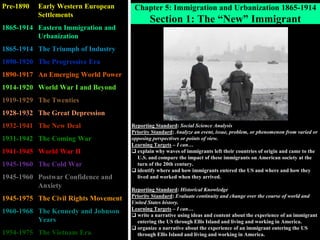
The Rising
Tide of
Immigration
Quote Set 1
• “We hold these truths to be self-evident, that all men
are created equal.”
• Thomas Jefferson, in the Declaration of Independence, 1776
•“Four score and seven years ago our fathers
brought forth…a new nation conceived in liberty
and dedicated to the proposition that all men are
created equal.”
•Abraham Lincoln, in the Gettysburg Address, 1863
Quote Set 2
• “America is a land of wonders, in which everything is in
constant motion and every change seems an
improvement.”
• Alexis de Tocqueville, 1835
•“We are the pioneers of the world; the advance guard
sent through the wilderness of untried things to break
a new path in the New World that is ours.”
•Herman Melville, 1852
Quote Set 3
• “America is a land of unlimited possibilities.”
• Ludwig Max Goldberger, 1903
• “What then is the American…here individuals of all
nations are melted into a new race of men, whose
labors and posterity will one day cause great changes in
the world.”
• J. Hector St. john Crevecoeur, 1782
Quote Set 4
• “The preservation of the sacred fire of liberty…is
entrusted to the hands of the American people.”
• George Washington, 1789
• “My country ‘tis of thee;
Sweet land of liberty;
Of thee I sing. Land where my Fathers died;
Land of the Pilgrim’s pride;
From every mountainside, let freedom ring.”
• Lyrics to “my Country ‘Tis of Thee” by Samuel Francis Smith,
circa 1900
Name______________________
Date______________Block____
*The two pie charts are of immigration
in 1880 and 1910.
*By 1910 immigration from E. and S.
Europe increased dramatically from 27%
to 73%. Why start coming?
*At the same time W. European
immigration declined from 49% to 16%.
Why stop coming?
*Immigration from other places was cut
in half from 24% to 11%.
*No Chinese…Chinese Exclusion Act
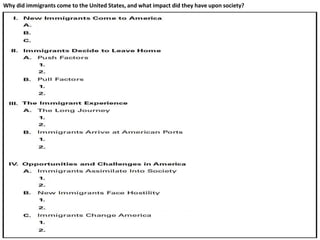
The Immigration Experience 1890-1920:
Notes and Journaling
What’s it like to have to say goodbye? Who are you leaving behind? Will you see them again?
Will you send for them? Will you send money? Are you more happy? Sad? Scared? Anxious?
Who is with you? What are you bringing? Instrument? Cards? Juggle? Do you sing? Do you
have any talents? What can you do? You are probably unskilled from a rural farm.
Name______________________
Date______________Block____
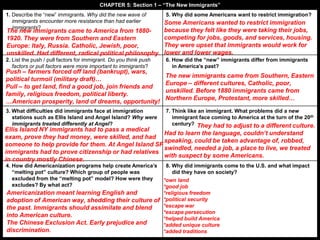
PUSH
*failing farms
*bad businesses
*no jobs
*high rents
*natural disasters
(volcano in Italy)
*diseases
*escape military
PULL
*land
*businesses
*jobs $
*education
*freedom
*Jews (pogroms in
Russia)
Kaiser – German King
Tsar – Russia King
The Immigration Experience 1890-1920:
Notes and Journaling
What’s it like on
the ship?
 packed
 1200-2000
 people from
different
countries
 different
languages,
culture, dress
 steerage class
(located by
boiler room)
 2 to 2 ½ week
voyage
 dirty, filthy,
stinking… etc.
 seasick (vomit)
 suffocating
 food, bring
some
 water (beer,
wine, schnapps,
vodka)
 Who do you
meet?
 adults,
children?
 What do you do
to pass the
time?
 talk about
dreams, make
plans…
What’s it like on the ship?
packed, 1200-2000, people from different
countries, different languages, culture, dress,
steerage class (located by boiler room), 2 to 2 ½
week voyage… dirty, filthy, stinking… etc. -
seasick (vomit), suffocating, food, bring some,
water (beer, wine, schnapps, vodka), Who do you
meet? adults, children? What do you do to pass
the time? talk about dreams, make plans…
Is it a palace or a prison? Imposing? Looks like a castle! Describe seeing the Statue of
Liberty! Peace, freedom…opportunity…relief…escape from past…a new beginning…
starting over… a chance at a brighter future… better life…
securing a future for your children…
The Isle of Hope, the Isle of Tears
Historically, called Gibbet Island. Pirate hide-out,
until it became a place to hang pirates!
Is it a palace or a prison? Imposing? Looks
like a castle! Describe seeing the Statue of
Liberty! Peace, freedom…
opportunity…relief…escape from past…a
new beginning… starting over… a chance at
a brighter future… better life…securing a
future for your children… Isle of Hope, Isle of
Tears”
The dreaded Medical
Examination:
In America they wanted
to make sure you were
fit to enter U.S.
The immigrants came
from all over the world
to Ellis Island, the port
of New York. Ellis
Island was legendary,
talked about…letters!
Most immigrants were
from rural areas and
not used to doctors.
The medical exam
more than anything
else scared them. It
was the thing that
could get you sent
back.
Many would rather die
than go back.
“With this chalk, he
would brand you”
• look for difficult
breathing
• strange
expressions
• silly responses
• scalp – favus,
• eye disease –
trachoma (pink eye)
• mental illness
• lameness
• senility,
• family could be
separated
The Dreaded Medical Examination:
In America they wanted to make sure you were fit to
enter U.S.? The immigrants came from all over the
world to Ellis Island, the port of New York. Ellis
Island was legendary. Most immigrants were from
rural areas and not used doctors. The Medical Exam
more than anything else scared them. It was the
thing that could get you sent back. Many would
rather die than go back.
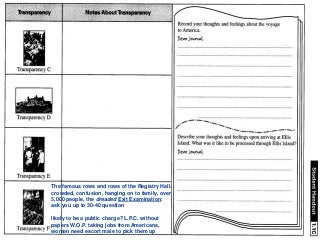
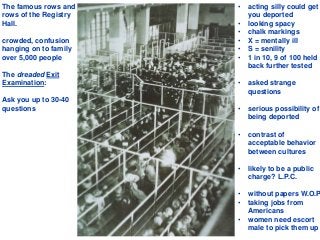
The famous rows and
rows of the Registry
Hall.
crowded, confusion
hanging on to family
over 5,000 people
The dreaded Exit
Examination:
Ask you up to 30-40
questions
• acting silly could get
you deported
• looking spacy
• chalk markings
• X = mentally ill
• S = senility
• 1 in 10, 9 of 100 held
back further tested
• asked strange
questions
• serious possibility of
being deported
• contrast of
acceptable behavior
between cultures
• likely to be a public
charge? L.P.C.
• without papers W.O.P
• taking jobs from
Americans
• women need escort
male to pick them up
The famous rows and rows of the Registry Hall.
crowded, confusion, hanging on to family, over
5,000 people, the dreaded Exit Examination:
ask you up to 30-40 question
likely to be a public charge? L.P.C. without
papers W.O.P. taking jobs from Americans,
women need escort male to pick them up
“America beckons, but Americans repel” America needs workers but Americans are afraid of
disease, costs, losing jobs… after Ellis Island immigrants would then be released into New
York or take trains to other parts of U.S.A. many would find their way into Ethnic Enclaves
(crowded areas of same ethnic groups).
The “kissing post” at Ellis Island – passed the stairs that lead you to meet loved ones or to
be detained… the immigrants find servicing centers: railway tickets, concessions, telegraph,
money exchange – go into New York, backbreaking jobs, subsistence wages, railroads to be
built, cows to slaughter, steel to be shaped, work 80hrs, $10 a week, but they had freedom
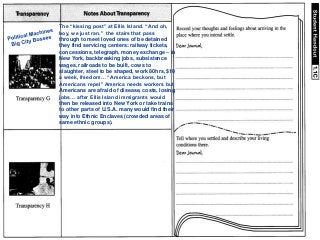
The “kissing post” at Ellis Island. “And oh,
boy, we just ran.” the stairs that pass
through to meet loved ones of be detained
they find servicing centers: railway tickets,
concessions, telegraph, money exchange – in
New York, backbreaking jobs, subsistence
wages, railroads to be built, cows to
slaughter, steel to be shaped, work 80hrs, $10
a week, freedom… “America beckons, but
Americans repel” America needs workers but
Americans are afraid of disease, costs, losing
jobs… after Ellis Island immigrants would
then be released into New York or take trains
to other parts of U.S.A. many would find their
way into Ethnic Enclaves (crowded areas of
same ethnic groups).
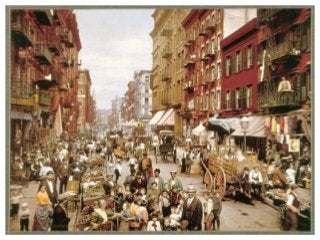
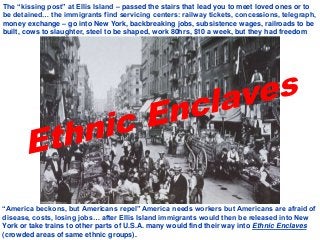
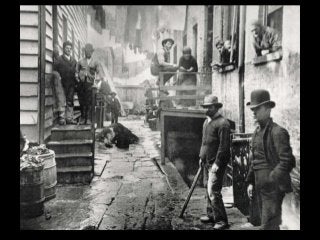
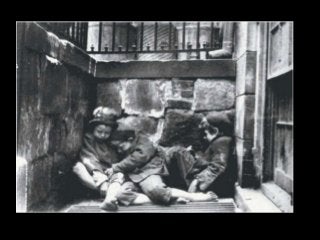
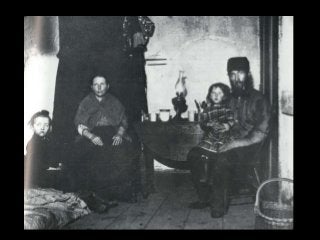
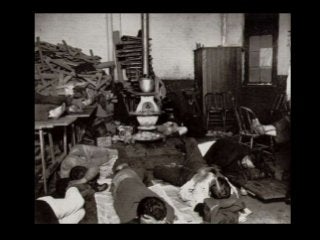
Once through Ellis Island many immigrants found themselves in Ethnic Enclaves: crowded,
filthy, disease ridden, rat infested. 60% of babies died in first year. Lived in city-tenement
buildings, run-down, unsafe – as much as $5 a night at first. Find a place to live in tenements
with 6-7 floors fire hazards and 8 to 10 people living in a single room.
Urban experience – flooded streets with garbage, human wastes, lunge disease,
tuberculosis. Month rents might be $10 to $20 dollars. Estimated 1300 people in 120 rooms.
Build shanties – extra wood and whatever in alleyway.
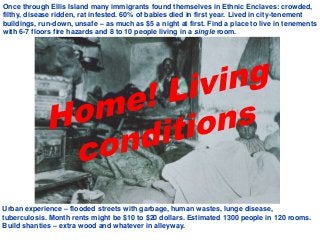
Once through Ellis Island many immigrants
found themselves in Ethnic Enclaves:
crowded, filthy, disease ridden, rat infested.
60% of babies died in first year. Lived in
city-tenement buildings, run-down, unsafe
– as much as $5 a night at first. Find a
place to live in tenements with 6-7 floors
fire hazards and 8 to 10 people living in a
single room. Urban experience – flooded
streets with garbage, human wastes, lunge
disease, tuberculosis. Month rents might
be $10 to $20 dollars. Estimated 1300
people in 120 rooms. Build shanties – extra
wood and whatever in alleyway.
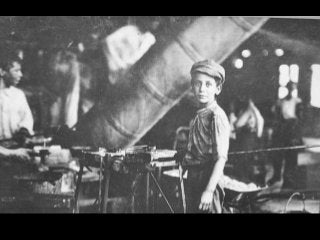
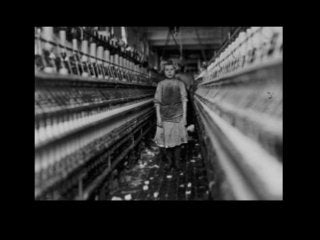
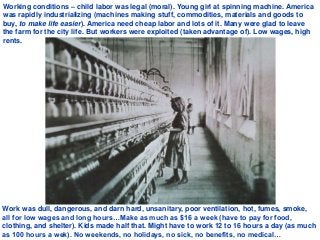
Working conditions – child labor was legal (moral). Young girl at spinning machine. America
was rapidly industrializing (machines making stuff, commodities, materials and goods to
buy, to make life easier). America need cheap labor and lots of it. Many were glad to leave
the farm for the city life. But workers were exploited (taken advantage of). Low wages, high
rents.
Work was dull, dangerous, and darn hard, unsanitary, poor ventilation, hot, fumes, smoke,
all for low wages and long hours…Make as much as $16 a week (have to pay for food,
clothing, and shelter). Kids made half that. Might have to work 12 to 16 hours a day (as much
as 100 hours a wek). No weekends, no holidays, no sick, no benefits, no medical…
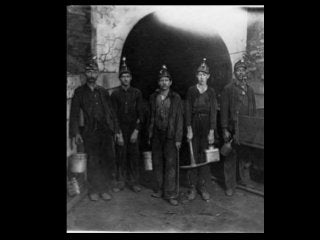
Working conditions – child labor was legal
(moral). Young girl at spinning machine.
America was rapidly industrializing (machines
making stuff, commodities, materials and
goods to buy, to make life easier). America
need cheap labor and lots of it. Many were glad
to leave the farm for the city life. But workers
were exploited (taken advantage of). Low
wages, high rents. Work was dull, dangerous,
and darn hard, unsanitary, poor ventilation, hot,
fumes, smoke, all for low wages and long
hours…Make as much as $16 a week (have to
pay for food, clothing, and shelter). Kids made
half that. Might have to work 12 to 16 hours a
day (as much as 100 hours a week). No
weekends, no holidays, no sick, no benefits, no
medical…boys in coal mines
JOBS / CARREERS
athlete
logger
chef
auto mechanic
doctor
lawyers
professor/teacher
server
firemen
detective
writer
reporter
soldier
politicians
dancer
singer
homemaker
secretary
clergy
garbage man
postal worker
translator
police officer
EMPLOYMENT
Work would have been relatively
readily available: factories make
most of what we have now!
spindle factory
coal mines
steel worker
skyscraper builder
subway system
cereal
cola
cigars / cigarettes
clothes
hat (rare bird feathers West)
shoes / boots
furniture maker
olive oil
fruit stand
grocer
candy store
jeweler (goldsmith, silver)
INVENTIONS
Immigrants would have
been amazed, mystified
at American ingenuity:
electricity
lightbulb
x-ray
phonograph
fans
car (automobile,
horseless carriage)
washing machines
motion pictures
refrigerators
hot plates
vacuums
threshing machine
Work in America at the Turn of the 20th Century!
JOBS / CARREERS
engineer
Vaudeville talent
(manager, worker,
stagehand, etc.)
military / soldier
SYMBOLS
Quilt
Sculpture/painting
Cross/star of David
Ring/jewelry
Writing
Parado
Statue of liberty
Lockit
Watch
Knives
Animal skins
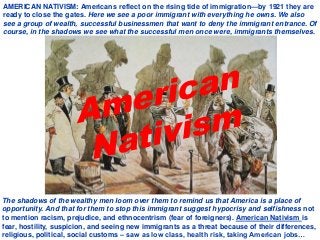
AMERICAN NATIVISM: Americans reflect on the rising tide of immigration—by 1921 they are
ready to close the gates. Here we see a poor immigrant with everything he owns. We also
see a group of wealth, successful businessmen that want to deny the immigrant entrance. Of
course, in the shadows we see what the successful men once were, immigrants themselves.
The shadows of the wealthy men loom over them to remind us that America is a place of
opportunity. And that for them to stop this immigrant suggest hypocrisy and selfishness not
to mention racism, prejudice, and ethnocentrism (fear of foreigners). American Nativism is
fear, hostility, suspicion, and seeing new immigrants as a threat because of their differences,
religious, political, social customs – saw as low class, health risk, taking American jobs…
AMERICAN NATIVISM: Americans reflect on the
rising tide of immigration—by 1921 they are ready to
close the gates. Here we see a poor immigrant with
everything he owns. We also see a group of wealth,
successful businessmen that want to deny the
immigrant entrance. Of course, in the shadows we
see what the successful men once were, immigrants
themselves. The shadows of the wealthy men loom
over them to remind us that America is a place of
opportunity. And that for them to stop this immigrant
suggest hypocrisy and selfishness not to mention
racism, prejudice, and ethnocentrism (fear of
foreigners). American Nativism is fear, hostility,
suspicion, and seeing new immigrants as a threat
because of their differences, religious, political,
social customs – saw as low class, health risk,
taking American jobs…

Chapter 5 Immigration Transparencies

  • 1.
  • 2.
    Quote Set 1 •“We hold these truths to be self-evident, that all men are created equal.” • Thomas Jefferson, in the Declaration of Independence, 1776 •“Four score and seven years ago our fathers brought forth…a new nation conceived in liberty and dedicated to the proposition that all men are created equal.” •Abraham Lincoln, in the Gettysburg Address, 1863
  • 3.
    Quote Set 2 •“America is a land of wonders, in which everything is in constant motion and every change seems an improvement.” • Alexis de Tocqueville, 1835 •“We are the pioneers of the world; the advance guard sent through the wilderness of untried things to break a new path in the New World that is ours.” •Herman Melville, 1852
  • 4.
    Quote Set 3 •“America is a land of unlimited possibilities.” • Ludwig Max Goldberger, 1903 • “What then is the American…here individuals of all nations are melted into a new race of men, whose labors and posterity will one day cause great changes in the world.” • J. Hector St. john Crevecoeur, 1782
  • 5.
    Quote Set 4 •“The preservation of the sacred fire of liberty…is entrusted to the hands of the American people.” • George Washington, 1789 • “My country ‘tis of thee; Sweet land of liberty; Of thee I sing. Land where my Fathers died; Land of the Pilgrim’s pride; From every mountainside, let freedom ring.” • Lyrics to “my Country ‘Tis of Thee” by Samuel Francis Smith, circa 1900
  • 7.
    Name______________________ Date______________Block____ *The two piecharts are of immigration in 1880 and 1910. *By 1910 immigration from E. and S. Europe increased dramatically from 27% to 73%. Why start coming? *At the same time W. European immigration declined from 49% to 16%. Why stop coming? *Immigration from other places was cut in half from 24% to 11%. *No Chinese…Chinese Exclusion Act The Immigration Experience 1890-1920: Notes and Journaling
  • 8.
    What’s it liketo have to say goodbye? Who are you leaving behind? Will you see them again? Will you send for them? Will you send money? Are you more happy? Sad? Scared? Anxious? Who is with you? What are you bringing? Instrument? Cards? Juggle? Do you sing? Do you have any talents? What can you do? You are probably unskilled from a rural farm.
  • 9.
    Name______________________ Date______________Block____ PUSH *failing farms *bad businesses *nojobs *high rents *natural disasters (volcano in Italy) *diseases *escape military PULL *land *businesses *jobs $ *education *freedom *Jews (pogroms in Russia) Kaiser – German King Tsar – Russia King The Immigration Experience 1890-1920: Notes and Journaling
  • 10.
    What’s it likeon the ship?  packed  1200-2000  people from different countries  different languages, culture, dress  steerage class (located by boiler room)  2 to 2 ½ week voyage  dirty, filthy, stinking… etc.  seasick (vomit)  suffocating  food, bring some  water (beer, wine, schnapps, vodka)  Who do you meet?  adults, children?  What do you do to pass the time?  talk about dreams, make plans…
  • 11.
    What’s it likeon the ship? packed, 1200-2000, people from different countries, different languages, culture, dress, steerage class (located by boiler room), 2 to 2 ½ week voyage… dirty, filthy, stinking… etc. - seasick (vomit), suffocating, food, bring some, water (beer, wine, schnapps, vodka), Who do you meet? adults, children? What do you do to pass the time? talk about dreams, make plans…
  • 12.
    Is it apalace or a prison? Imposing? Looks like a castle! Describe seeing the Statue of Liberty! Peace, freedom…opportunity…relief…escape from past…a new beginning… starting over… a chance at a brighter future… better life… securing a future for your children… The Isle of Hope, the Isle of Tears Historically, called Gibbet Island. Pirate hide-out, until it became a place to hang pirates!
  • 13.
    Is it apalace or a prison? Imposing? Looks like a castle! Describe seeing the Statue of Liberty! Peace, freedom… opportunity…relief…escape from past…a new beginning… starting over… a chance at a brighter future… better life…securing a future for your children… Isle of Hope, Isle of Tears”
  • 15.
    The dreaded Medical Examination: InAmerica they wanted to make sure you were fit to enter U.S. The immigrants came from all over the world to Ellis Island, the port of New York. Ellis Island was legendary, talked about…letters! Most immigrants were from rural areas and not used to doctors. The medical exam more than anything else scared them. It was the thing that could get you sent back. Many would rather die than go back. “With this chalk, he would brand you” • look for difficult breathing • strange expressions • silly responses • scalp – favus, • eye disease – trachoma (pink eye) • mental illness • lameness • senility, • family could be separated
  • 16.
    The Dreaded MedicalExamination: In America they wanted to make sure you were fit to enter U.S.? The immigrants came from all over the world to Ellis Island, the port of New York. Ellis Island was legendary. Most immigrants were from rural areas and not used doctors. The Medical Exam more than anything else scared them. It was the thing that could get you sent back. Many would rather die than go back.
  • 18.
    The famous rowsand rows of the Registry Hall. crowded, confusion hanging on to family over 5,000 people The dreaded Exit Examination: Ask you up to 30-40 questions • acting silly could get you deported • looking spacy • chalk markings • X = mentally ill • S = senility • 1 in 10, 9 of 100 held back further tested • asked strange questions • serious possibility of being deported • contrast of acceptable behavior between cultures • likely to be a public charge? L.P.C. • without papers W.O.P • taking jobs from Americans • women need escort male to pick them up
  • 19.
    The famous rowsand rows of the Registry Hall. crowded, confusion, hanging on to family, over 5,000 people, the dreaded Exit Examination: ask you up to 30-40 question likely to be a public charge? L.P.C. without papers W.O.P. taking jobs from Americans, women need escort male to pick them up
  • 21.
    “America beckons, butAmericans repel” America needs workers but Americans are afraid of disease, costs, losing jobs… after Ellis Island immigrants would then be released into New York or take trains to other parts of U.S.A. many would find their way into Ethnic Enclaves (crowded areas of same ethnic groups). The “kissing post” at Ellis Island – passed the stairs that lead you to meet loved ones or to be detained… the immigrants find servicing centers: railway tickets, concessions, telegraph, money exchange – go into New York, backbreaking jobs, subsistence wages, railroads to be built, cows to slaughter, steel to be shaped, work 80hrs, $10 a week, but they had freedom
  • 22.
    The “kissing post”at Ellis Island. “And oh, boy, we just ran.” the stairs that pass through to meet loved ones of be detained they find servicing centers: railway tickets, concessions, telegraph, money exchange – in New York, backbreaking jobs, subsistence wages, railroads to be built, cows to slaughter, steel to be shaped, work 80hrs, $10 a week, freedom… “America beckons, but Americans repel” America needs workers but Americans are afraid of disease, costs, losing jobs… after Ellis Island immigrants would then be released into New York or take trains to other parts of U.S.A. many would find their way into Ethnic Enclaves (crowded areas of same ethnic groups).
  • 27.
    Once through EllisIsland many immigrants found themselves in Ethnic Enclaves: crowded, filthy, disease ridden, rat infested. 60% of babies died in first year. Lived in city-tenement buildings, run-down, unsafe – as much as $5 a night at first. Find a place to live in tenements with 6-7 floors fire hazards and 8 to 10 people living in a single room. Urban experience – flooded streets with garbage, human wastes, lunge disease, tuberculosis. Month rents might be $10 to $20 dollars. Estimated 1300 people in 120 rooms. Build shanties – extra wood and whatever in alleyway.
  • 28.
    Once through EllisIsland many immigrants found themselves in Ethnic Enclaves: crowded, filthy, disease ridden, rat infested. 60% of babies died in first year. Lived in city-tenement buildings, run-down, unsafe – as much as $5 a night at first. Find a place to live in tenements with 6-7 floors fire hazards and 8 to 10 people living in a single room. Urban experience – flooded streets with garbage, human wastes, lunge disease, tuberculosis. Month rents might be $10 to $20 dollars. Estimated 1300 people in 120 rooms. Build shanties – extra wood and whatever in alleyway.
  • 32.
    Working conditions –child labor was legal (moral). Young girl at spinning machine. America was rapidly industrializing (machines making stuff, commodities, materials and goods to buy, to make life easier). America need cheap labor and lots of it. Many were glad to leave the farm for the city life. But workers were exploited (taken advantage of). Low wages, high rents. Work was dull, dangerous, and darn hard, unsanitary, poor ventilation, hot, fumes, smoke, all for low wages and long hours…Make as much as $16 a week (have to pay for food, clothing, and shelter). Kids made half that. Might have to work 12 to 16 hours a day (as much as 100 hours a wek). No weekends, no holidays, no sick, no benefits, no medical…
  • 33.
    Working conditions –child labor was legal (moral). Young girl at spinning machine. America was rapidly industrializing (machines making stuff, commodities, materials and goods to buy, to make life easier). America need cheap labor and lots of it. Many were glad to leave the farm for the city life. But workers were exploited (taken advantage of). Low wages, high rents. Work was dull, dangerous, and darn hard, unsanitary, poor ventilation, hot, fumes, smoke, all for low wages and long hours…Make as much as $16 a week (have to pay for food, clothing, and shelter). Kids made half that. Might have to work 12 to 16 hours a day (as much as 100 hours a week). No weekends, no holidays, no sick, no benefits, no medical…boys in coal mines
  • 34.
    JOBS / CARREERS athlete logger chef automechanic doctor lawyers professor/teacher server firemen detective writer reporter soldier politicians dancer singer homemaker secretary clergy garbage man postal worker translator police officer EMPLOYMENT Work would have been relatively readily available: factories make most of what we have now! spindle factory coal mines steel worker skyscraper builder subway system cereal cola cigars / cigarettes clothes hat (rare bird feathers West) shoes / boots furniture maker olive oil fruit stand grocer candy store jeweler (goldsmith, silver) INVENTIONS Immigrants would have been amazed, mystified at American ingenuity: electricity lightbulb x-ray phonograph fans car (automobile, horseless carriage) washing machines motion pictures refrigerators hot plates vacuums threshing machine Work in America at the Turn of the 20th Century! JOBS / CARREERS engineer Vaudeville talent (manager, worker, stagehand, etc.) military / soldier SYMBOLS Quilt Sculpture/painting Cross/star of David Ring/jewelry Writing Parado Statue of liberty Lockit Watch Knives Animal skins
  • 35.
    AMERICAN NATIVISM: Americansreflect on the rising tide of immigration—by 1921 they are ready to close the gates. Here we see a poor immigrant with everything he owns. We also see a group of wealth, successful businessmen that want to deny the immigrant entrance. Of course, in the shadows we see what the successful men once were, immigrants themselves. The shadows of the wealthy men loom over them to remind us that America is a place of opportunity. And that for them to stop this immigrant suggest hypocrisy and selfishness not to mention racism, prejudice, and ethnocentrism (fear of foreigners). American Nativism is fear, hostility, suspicion, and seeing new immigrants as a threat because of their differences, religious, political, social customs – saw as low class, health risk, taking American jobs…
  • 36.
    AMERICAN NATIVISM: Americansreflect on the rising tide of immigration—by 1921 they are ready to close the gates. Here we see a poor immigrant with everything he owns. We also see a group of wealth, successful businessmen that want to deny the immigrant entrance. Of course, in the shadows we see what the successful men once were, immigrants themselves. The shadows of the wealthy men loom over them to remind us that America is a place of opportunity. And that for them to stop this immigrant suggest hypocrisy and selfishness not to mention racism, prejudice, and ethnocentrism (fear of foreigners). American Nativism is fear, hostility, suspicion, and seeing new immigrants as a threat because of their differences, religious, political, social customs – saw as low class, health risk, taking American jobs…