PSCI 1500:
Introduction to Economics
Macroeconomic Goal:
Economics Growth
IMPORTANT TERMS
i. Production - refers to the creation of goods and
services.
ii. Full Production - occurs when an economy is
producing at its maximum capacity, or when it is
experiencing full employment.
iii. Economic Growth - increase in economy’s full
production output level over time.
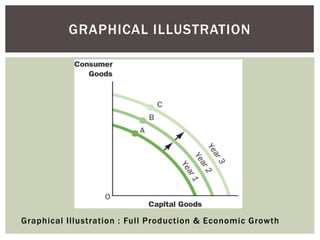
GRAPHICAL ILLUSTRATION
Graphical Illustration : Full Production & Economic Growth
A nation’s standard of living is determined
by the productivity of its workers.
Productivity refers to the quantity of goods
and services that a worker can produce
from each hour of work.
Thus, to understand the large differences
in living standards across countries, the
focus lies on the production of goods and
services.
WHY PRODUCTIVITY IS SO
IMPORTANT?
THE CONCEPT OF PRODUCTIVITY
Productivity
Concept of assessing the amount of output
produced by economy’s resources,
increase when resources increases
(advancement, capability, quantity etc.)
Often measures specifically by output per
worker.
HOW PRODUCTIVITY IS DETERMINED
 The resources or inputs used to
produce goods and services are called
the factors of production.
 These factors of production directly
determine productivity.
Measures of Production
 Gross Domestic Product (GDP) - Dollar figure that
measure the values of all finished goods & services
produced in an economy in a year; excluding
products in progress, secondhand sales, stocks or
bonds.
MEASURES OF PRODUCTION
Measures of Production
 2 types of GDP
i. Nominal GDP (Money GDP)
• Measures the value of production in terms of
prices at the time of production.
• Affected by changes in price and production.
ii. Real GDP (Constant GDP)
• Money GDP adjusted to eliminate inflation.
• Shows how the actual production change without
influence of price change.
MEASURES OF PRODUCTION
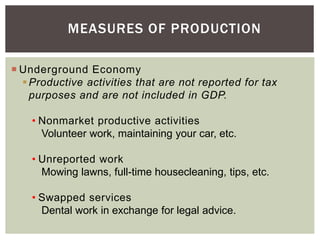
 Underground Economy
Productive activities that are not reported for tax
purposes and are not included in GDP.
• Nonmarket productive activities
Volunteer work, maintaining your car, etc.
• Unreported work
Mowing lawns, full-time housecleaning, tips, etc.
• Swapped services
Dental work in exchange for legal advice.
MEASURES OF PRODUCTION
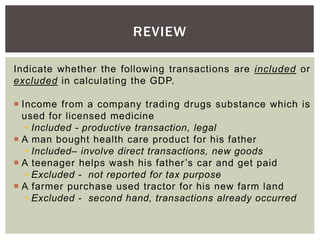
Indicate whether the following transactions are included or
excluded in calculating the GDP.
 Income from a company trading drugs substance which is
used for licensed medicine
• Included - productive transaction, legal
 A man bought health care product for his father
• Included– involve direct transactions, new goods
 A teenager helps wash his father’s car and get paid
• Excluded - not reported for tax purpose
 A farmer purchase used tractor for his new farm land
• Excluded - second hand, transactions already occurred
REVIEW
THE GDP GAP
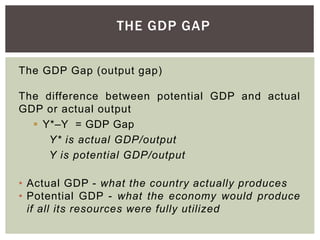
The GDP Gap (output gap)
The difference between potential GDP and actual
GDP or actual output
 Y*–Y = GDP Gap
Y* is actual GDP/output
Y is potential GDP/output
• Actual GDP - what the country actually produces
• Potential GDP - what the economy would produce
if all its resources were fully utilized
THE GDP GAP
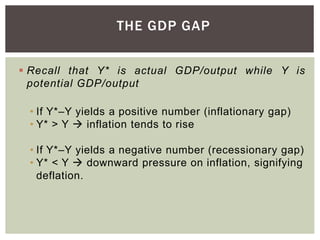
 Recall that Y* is actual GDP/output while Y is
potential GDP/output
• If Y*–Y yields a positive number (inflationary gap)
• Y* > Y  inflation tends to rise
• If Y*–Y yields a negative number (recessionary gap)
• Y* < Y  downward pressure on inflation, signifying
deflation.
THE FACTORS OF PRODUCTION
 Physical capital
 Human capital
 Natural resources
 Technological knowledge
THE FACTORS OF PRODUCTION
 Capital is a produced factor of production.
 It is an input into the production process that in
the past was an output from the production
process.
PHYSICAL CAPITAL
 Physical capital is the stock of equipment
and structures that are used to produce
goods and services.
 Tools used to build or repair automobiles.
 Tools used to build furniture.
 Office buildings, schools, etc.
HUMAN CAPITAL
 Human capital is the economist’s term for
the knowledge and skills that workers
acquire through education, training, and
experience.
• Like physical capital, human capital raises a
nation’s ability to produce goods and services.
 Natural resources are inputs used in
production that are provided by nature,
such as land, rivers, and mineral deposits.
• Renewable resources include trees and forests.
• Nonrenewable resources include petroleum and
coal.
• Natural resources can be important but are not
necessary for an economy to be highly
productive in producing goods and services.
NATURAL RESOURCES
TECHNOLOGICAL KNOWLEDGE
 Technological knowledge is the
understanding of the best ways to
produce goods and services.
 Human capital refers to the resources
expended transmitting this
understanding to the labor force.
Governments can do many things to raise
productivity and living standards.
 Encourage saving and investment.
 Encourage investment from abroad
 Encourage education and training.
 Secure property rights and maintain political
stability.
 Promote free trade.
 Control population growth.
 Promote research and development.
ECONOMIC GROWTH AND
PUBLIC POLICY
SAVING AND INVESTMENT
 One way to raise future productivity is to invest
more current resources in the production of
capital.
 Governments can increase capital accumulation
and long-term economic growth by encouraging
investment from foreign sources.
 Governments can increase capital accumulation
and long-term economic growth by encouraging
investment from foreign sources.
EDUCATION
• For a country’s long-run growth, education is at least as
important as investment in physical capital.
• Study shows that in the US, each year of schooling raises
a person’s wage on average by about 10%.
• Thus, the government can enhance the standard of living
is to provide schools and encourage the population to take
advantage of them.
• An educated person might generate new ideas about how
best to produce goods and services, which in turn, enter
society’s pool of knowledge and provide an external
benefit to others.
• However, one problem facing some poor countries is the
brain drain i.e. the emigration of many of the most highly
educated workers to rich countries.
PROPERTY RIGHTS AND
POLITICAL STABILITY
 Property rights refer to the ability of
people to exercise authority over the
resources they own.
• An economy-wide respect for property rights is
an important prerequisite for the price system to
work.
• It is necessary for investors to feel that their
investments are secure.
FREE TRADE
 Trade is, in some ways, a type of technology.
 A country that eliminates trade restrictions will
experience the same kind of economic growth
that would occur after a major technological
advance.
CONTROL OF POPULATION GROWTH
 Population is a key determinant of a country’s
labor force.
• Large populations tend to produce greater total
GDP.
• However, GDP per person is a better measure
of economic well-being, and high population
growth reduces GDP per person.
RESEARCH AND DEVELOPMENT
 The advance of technological knowledge
has led to higher standards of living.
• Most technological advance comes from private
research by firms and individual inventors.
• Government can encourage development of new
technologies through research grants, tax breaks,
and the patent system.
1. Identify among the government policies to promote
economic growth.
2. How do you think the influx of more women in the
universities may influence the economy?
REVIEW

Topic 7 - Economic Growth

  • 1.
    PSCI 1500: Introduction toEconomics Macroeconomic Goal: Economics Growth
  • 2.
    IMPORTANT TERMS i. Production- refers to the creation of goods and services. ii. Full Production - occurs when an economy is producing at its maximum capacity, or when it is experiencing full employment. iii. Economic Growth - increase in economy’s full production output level over time.
  • 3.
    GRAPHICAL ILLUSTRATION Graphical Illustration: Full Production & Economic Growth
  • 4.
    A nation’s standardof living is determined by the productivity of its workers. Productivity refers to the quantity of goods and services that a worker can produce from each hour of work. Thus, to understand the large differences in living standards across countries, the focus lies on the production of goods and services. WHY PRODUCTIVITY IS SO IMPORTANT?
  • 5.
    THE CONCEPT OFPRODUCTIVITY Productivity Concept of assessing the amount of output produced by economy’s resources, increase when resources increases (advancement, capability, quantity etc.) Often measures specifically by output per worker.
  • 6.
    HOW PRODUCTIVITY ISDETERMINED  The resources or inputs used to produce goods and services are called the factors of production.  These factors of production directly determine productivity.
  • 7.
    Measures of Production Gross Domestic Product (GDP) - Dollar figure that measure the values of all finished goods & services produced in an economy in a year; excluding products in progress, secondhand sales, stocks or bonds. MEASURES OF PRODUCTION
  • 8.
    Measures of Production 2 types of GDP i. Nominal GDP (Money GDP) • Measures the value of production in terms of prices at the time of production. • Affected by changes in price and production. ii. Real GDP (Constant GDP) • Money GDP adjusted to eliminate inflation. • Shows how the actual production change without influence of price change. MEASURES OF PRODUCTION
  • 9.
     Underground Economy Productiveactivities that are not reported for tax purposes and are not included in GDP. • Nonmarket productive activities Volunteer work, maintaining your car, etc. • Unreported work Mowing lawns, full-time housecleaning, tips, etc. • Swapped services Dental work in exchange for legal advice. MEASURES OF PRODUCTION
  • 10.
    Indicate whether thefollowing transactions are included or excluded in calculating the GDP.  Income from a company trading drugs substance which is used for licensed medicine • Included - productive transaction, legal  A man bought health care product for his father • Included– involve direct transactions, new goods  A teenager helps wash his father’s car and get paid • Excluded - not reported for tax purpose  A farmer purchase used tractor for his new farm land • Excluded - second hand, transactions already occurred REVIEW
  • 11.
    THE GDP GAP TheGDP Gap (output gap) The difference between potential GDP and actual GDP or actual output  Y*–Y = GDP Gap Y* is actual GDP/output Y is potential GDP/output • Actual GDP - what the country actually produces • Potential GDP - what the economy would produce if all its resources were fully utilized
  • 12.
    THE GDP GAP Recall that Y* is actual GDP/output while Y is potential GDP/output • If Y*–Y yields a positive number (inflationary gap) • Y* > Y  inflation tends to rise • If Y*–Y yields a negative number (recessionary gap) • Y* < Y  downward pressure on inflation, signifying deflation.
  • 13.
    THE FACTORS OFPRODUCTION  Physical capital  Human capital  Natural resources  Technological knowledge
  • 14.
    THE FACTORS OFPRODUCTION  Capital is a produced factor of production.  It is an input into the production process that in the past was an output from the production process.
  • 15.
    PHYSICAL CAPITAL  Physicalcapital is the stock of equipment and structures that are used to produce goods and services.  Tools used to build or repair automobiles.  Tools used to build furniture.  Office buildings, schools, etc.
  • 16.
    HUMAN CAPITAL  Humancapital is the economist’s term for the knowledge and skills that workers acquire through education, training, and experience. • Like physical capital, human capital raises a nation’s ability to produce goods and services.
  • 17.
     Natural resourcesare inputs used in production that are provided by nature, such as land, rivers, and mineral deposits. • Renewable resources include trees and forests. • Nonrenewable resources include petroleum and coal. • Natural resources can be important but are not necessary for an economy to be highly productive in producing goods and services. NATURAL RESOURCES
  • 18.
    TECHNOLOGICAL KNOWLEDGE  Technologicalknowledge is the understanding of the best ways to produce goods and services.  Human capital refers to the resources expended transmitting this understanding to the labor force.
  • 19.
    Governments can domany things to raise productivity and living standards.  Encourage saving and investment.  Encourage investment from abroad  Encourage education and training.  Secure property rights and maintain political stability.  Promote free trade.  Control population growth.  Promote research and development. ECONOMIC GROWTH AND PUBLIC POLICY
  • 20.
    SAVING AND INVESTMENT One way to raise future productivity is to invest more current resources in the production of capital.  Governments can increase capital accumulation and long-term economic growth by encouraging investment from foreign sources.  Governments can increase capital accumulation and long-term economic growth by encouraging investment from foreign sources.
  • 21.
    EDUCATION • For acountry’s long-run growth, education is at least as important as investment in physical capital. • Study shows that in the US, each year of schooling raises a person’s wage on average by about 10%. • Thus, the government can enhance the standard of living is to provide schools and encourage the population to take advantage of them. • An educated person might generate new ideas about how best to produce goods and services, which in turn, enter society’s pool of knowledge and provide an external benefit to others. • However, one problem facing some poor countries is the brain drain i.e. the emigration of many of the most highly educated workers to rich countries.
  • 22.
    PROPERTY RIGHTS AND POLITICALSTABILITY  Property rights refer to the ability of people to exercise authority over the resources they own. • An economy-wide respect for property rights is an important prerequisite for the price system to work. • It is necessary for investors to feel that their investments are secure.
  • 23.
    FREE TRADE  Tradeis, in some ways, a type of technology.  A country that eliminates trade restrictions will experience the same kind of economic growth that would occur after a major technological advance.
  • 24.
    CONTROL OF POPULATIONGROWTH  Population is a key determinant of a country’s labor force. • Large populations tend to produce greater total GDP. • However, GDP per person is a better measure of economic well-being, and high population growth reduces GDP per person.
  • 25.
    RESEARCH AND DEVELOPMENT The advance of technological knowledge has led to higher standards of living. • Most technological advance comes from private research by firms and individual inventors. • Government can encourage development of new technologies through research grants, tax breaks, and the patent system.
  • 26.
    1. Identify amongthe government policies to promote economic growth. 2. How do you think the influx of more women in the universities may influence the economy? REVIEW