WHAT IS ECONOMICGROWTH?
The term economic growth refers to the
percentage change in the nation’s per
capita GDP—the money value of all goods
and services produced over a long period
of time. Many economists would suggest
that economic growth is the key indicator
of a country’s power and accomplishment.
4.
WHAT IS ECONOMICGROWTH?
Economic growth is often associated with the standard of living in a
country for a relevant time horizon. Standard of living as defined by
the PSA is the level of consumption that people enjoy, on the
average, and is measured by the average income per person. There is
also what we call cost of living which means the amount of money it
takes to buy goods and services that a family typically consumes. A
rising cost of living is called inflation and deflation as otherwise.
5.
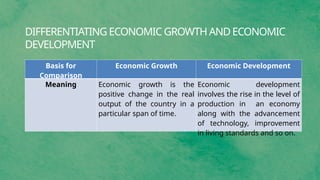
DIFFERENTIATING ECONOMIC GROWTHAND ECONOMIC
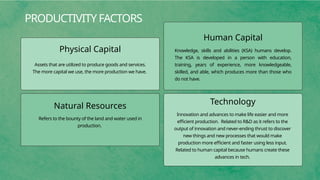
DEVELOPMENT
Basis for
Comparison
Economic Growth Economic Development
Meaning Economic growth is the
positive change in the real
output of the country in a
particular span of time.
Economic development
involves the rise in the level of
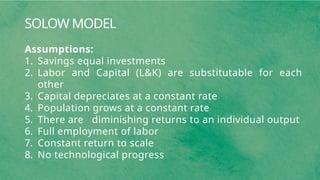
production in an economy
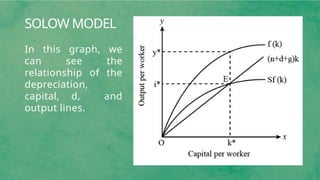
along with the advancement
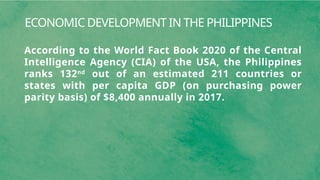
of technology, improvement
in living standards and so on.
6.
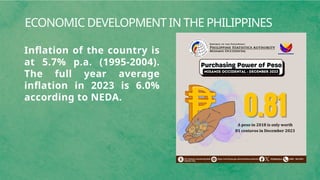
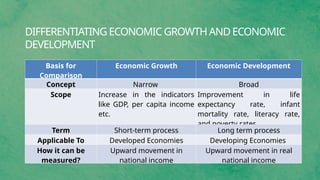
DIFFERENTIATING ECONOMIC GROWTHAND ECONOMIC
DEVELOPMENT
Basis for
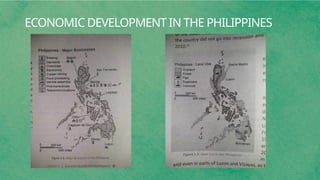
Comparison
Economic Growth Economic Development
Concept Narrow Broad
Scope Increase in the indicators
like GDP, per capita income
etc.
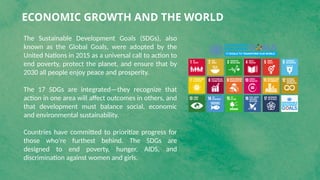
Improvement in life
expectancy rate, infant
mortality rate, literacy rate,
and poverty rates
Term Short-term process Long term process
Applicable To Developed Economies Developing Economies
How it can be
measured?
Upward movement in
national income
Upward movement in real
national income
7.
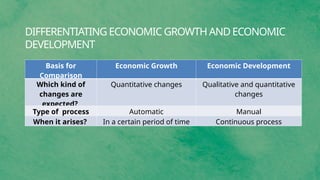
DIFFERENTIATING ECONOMIC GROWTHAND ECONOMIC
DEVELOPMENT
Basis for
Comparison
Economic Growth Economic Development
Which kind of
changes are
expected?
Quantitative changes Qualitative and quantitative
changes
Type of process Automatic Manual
When it arises? In a certain period of time Continuous process
8.
DIFFERENTIATING ECONOMIC GROWTHAND ECONOMIC
DEVELOPMENT
Economic growth boosts the national output, the total
money value of all goods and services produced by one
country, whereas, economic development means
advancement of standard of living, e.g. education,
healthcare, innovation, environment, to name a few.
Growth directly boosts development; ceteris paribus,
as higher GDP would mean more to spend on factors
that are considered development.
9.
Governments around theworld are face
with issues concerning productivity and
living standards. In 2013, the World Bank
Group adopted the twin goals to guide
its work: ending extreme poverty and
boosting shared prosperity.
10.
FACTORS CONSIDERED INBUILDING AN ECONOMY
Saving and Investment
In order to produce more, we have to invest in capital assets
to enable us to have the capacity to yield more goods and
services. However, it is to be noted that capital investment
would mean sacrifice to consume more. There is a need for a
country to promote both domestic and foreign
investments in order to reduce unemployment. Ideally, a
reduction in unemployment will reduce poverty levels, and
hence, the government’s social burden, which will ultimately
allow for increased in public savings.
11.
FACTORS CONSIDERED INBUILDING AN ECONOMY
Diminishing Returns and Catch-Up Effect
As the stock of capital increases, the extra output produced
from an additional unit of capital decreases. Productivity is
considerably affected minimally when workers with a large
quantity of capital they use in the production process are
given extra units of capital. In the long run, a higher saving
rate leads to a great level of productivity and income but
not greater growth in these variables.
12.
FACTORS CONSIDERED INBUILDING AN ECONOMY
Investment from Abroad
An investment that is sponsored with foreign money and
operated domestically is called foreign portfolio investment. It
is expected that the use of the foreign money would mean
more opportunities to produce where the money is capitalized,
but of course, a certain interest in that money is foreseen as
well. The World Bank (WB) and the International Monetary
Fund (IMF) were established to ensure there is economic
prosperity around the world by financing public goods and
services with funds accumulated from more advance
economies like the USA.
13.
FACTORS CONSIDERED INBUILDING AN ECONOMY
Education
Human capital theory attributes differential investments in
human capital to inequalities in income, such as those found
to exist between women and men or minorities and whites.
This theory emphasizes human capital as a set of economic
assets. Education benefits human capital that is as important
as physical capital. In fact, the largest chunk of the annual
budget is dedicated to the education sector. More quality
educated people produced in a country would mean an
opportunity to generate more and better ideas to produce
goods and services.
14.
FACTORS CONSIDERED INBUILDING AN ECONOMY
Health and Nutrition
A healthy population would also mean human capital, just like
education, hence, are capable to produce more goods and
services because they can maximize employment as compared
to an unhealthy population. Other things remain fixed,
healthier individuals are more productive. Policies that
lead to economic growth would consider having healthy
workers to promote greater productivity.
15.
FACTORS CONSIDERED INBUILDING AN ECONOMY
Property Rights and Political Stability
Property rights ensure the exercise of rights over one’s
property and these guarantee more production of goods
and services. In addition, when there is less uncertainty in
government decisions and policies, especially in terms of
market trading, there is opportunity to improve production
processes and distribute products in the country. A stable
political environment is considered to have efficient executive,
legislative, and judiciary systems, working together for the
country’s economic development.
16.
FACTORS CONSIDERED INBUILDING AN ECONOMY
Free Trade
A competitive economy that reduces or eliminates trade
restrictions experiences economic growth after benefiting
from more products to be used as an input to production.
Outward-oriented policies give way to developing countries’
opportunity to interact with other countries and trade freely,
thus creating more prospects to improve production.
17.
FACTORS CONSIDERED INBUILDING AN ECONOMY
Research and Development
The product of research and development (R&D) are new
ideas, goods, and services that people consume. Government
institutions allocate a part of their yearly budget to research
to continue improving the ways things are done, in a more
efficient or totally distinctive way. To protect the idea, a
patent is awarded to an innovator for a certain number of
years to encourage more researchers to discover beneficial
things. Essentially, R&D turning money into knowledge and
innovation is a process of creating a business out of this
knowledge.
18.
FACTORS CONSIDERED INBUILDING AN ECONOMY
Population Growth
There are two schools of thought regarding population
growth. On one hand, a relatively large population means
more human resources working and contributing to the
production of the country, but on the other hand, it also
means more people to consume those goods and services.
It is to be noted, however, that there are countries with a few
population and slow population growth rate but are
considered developed like Germany, having an annual growth
rate of 0.2%, and Singapore, -0.3% in the 2020 study of the
World Bank.
19.
PRODUCTIVITY FACTORS
Assets thatare utilized to produce goods and services.
The more capital we use, the more production we have.
Physical Capital Knowledge, skills and abilities (KSA) humans develop.
The KSA is developed in a person with education,
training, years of experience, more knowledgeable,
skilled, and able, which produces more than those who
do not have.
Human Capital
Innovation and advances to make life easier and more
efficient production. Related to R&D as it refers to the
output of innovation and never-ending thrust to discover
new things and new processes that would make
production more efficient and faster using less input.
Related to human capital because humans create these
advances in tech.
Technology
Refers to the bounty of the land and water used in
production.
Natural Resources
20.
PRODUCTIVITY
In production, weconsider the factors such as quantity of
labor (L), quantity of human capital (H), quantity of natural
resources (N), and technological advances (T). This can be
summarized by writing: production (Y) = Tf{L, H, N}. In the
advent of technology, as it develops, so is the production of
goods and services. The production function shows that all
other things remain constant; output increases as physical
capital, human capital, labor, and natural resources
increase.
It is obvious that the key factor in defining the standard of living is
the advances in productivity.
21.
O-RING THEORY OFDEVELOPMENT
O-Ring Theory of economic development was proposed by
economists Michael Kremer in 1993
O-Ring was derived from the devastating destruction of the
Challenger space shuttle in 1986, resulting from a faulty
little gasket or O-Ring
It explains that production is composed of a set of tasks,
and each task must be carried our proficiently for each
one of the task
It explains the discrepancy of the developed and
underdeveloped countries in terms of the complexity of
their production, product intricacies, and the level of
skilled workers that they have.
22.
O-RING THEORY OFDEVELOPMENT
The theory tells us that a weak link in the production
process may cause surmountable quality failure of the final
output.
The quality of input is given more value that its quantity.
Assume N tasks, one worker per task
Let qi [0,1] be the quality level of worker I
E.g. qi = .9 means:
- 90% chance of completing task perfectly and 10% chance of
complete failure or, say,
- 50% probability of completing task perfectly and 50% chance
of reducing value by 20%, i.e. qi = ½ x 1 + ½ x 0.8 = 0.9
23.
O-RING THEORY OFDEVELOPMENT
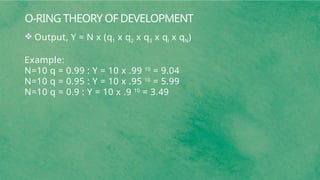
Output, Y = N x (q1 x q2 x q3 x qi x qN)
Example:
N=10 q = 0.99 : Y = 10 x .99 10
= 9.04
N=10 q = 0.95 : Y = 10 x .95 10
= 5.99
N=10 q = 0.9 : Y = 10 x .9 10
= 3.49
24.
O-RING THEORY OFDEVELOPMENT
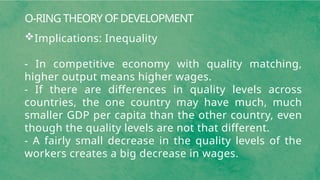
Implications: Inequality
- In competitive economy with quality matching,
higher output means higher wages.
- If there are differences in quality levels across
countries, the one country may have much, much
smaller GDP per capita than the other country, even
though the quality levels are not that different.
- A fairly small decrease in the quality levels of the
workers creates a big decrease in wages.
25.
O-RING THEORY OFDEVELOPMENT
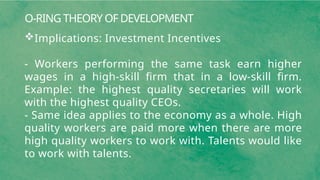
Implications: Investment Incentives
- Workers performing the same task earn higher
wages in a high-skill firm that in a low-skill firm.
Example: the highest quality secretaries will work
with the highest quality CEOs.
- Same idea applies to the economy as a whole. High
quality workers are paid more when there are more
high quality workers to work with. Talents would like
to work with talents.
26.
O-RING THEORY OFDEVELOPMENT
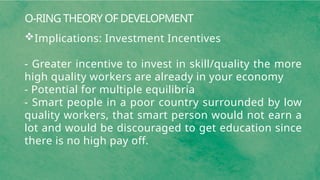
Implications: Investment Incentives
- Greater incentive to invest in skill/quality the more
high quality workers are already in your economy
- Potential for multiple equilibria
- Smart people in a poor country surrounded by low
quality workers, that smart person would not earn a
lot and would be discouraged to get education since
there is no high pay off.
27.
O-RING THEORY OFDEVELOPMENT
Implications: Investment Incentives
- In an O-ring model, capital also wants to work with high
quality workers
- Match the best workers with the most expensive
machines
- Poor countries will have more workers in less capital
intensive, primary production (e.g. agriculture).
- Capital is going to fly away from countries which have
low-skilled workers and will go to countries with high-
skilled workers.
28.
SOLOW MODEL
Inneoclassical economics, one of the most popular
models that is used to understand long-term growth is
the use of the Solow Model.
The model was developed by Robert Solow in 1956, an
American economist and a Nobel Prize winner in
Economic Science.
Standard Solow-model predicts that in the long-run,
economies converge to the steady-state equilibrium.
29.
SOLOW MODEL
Assumptions:
1. Savingsequal investments
2. Labor and Capital (L&K) are substitutable for each
other
3. Capital depreciates at a constant rate
4. Population grows at a constant rate
5. There are diminishing returns to an individual output
6. Full employment of labor
7. Constant return to scale
8. No technological progress
30.
SOLOW MODEL
In thisgraph, we
can see the
relationship of the
depreciation,
capital, d, and
output lines.
31.
ECONOMIC DEVELOPMENT INTHE PHILIPPINES
According to the World Fact Book 2020 of the Central
Intelligence Agency (CIA) of the USA, the Philippines
ranks 132nd
out of an estimated 211 countries or
states with per capita GDP (on purchasing power
parity basis) of $8,400 annually in 2017.
ECONOMIC DEVELOPMENT INTHE PHILIPPINES
Inflation is commonly known as the quantitative
measure of the price rate increase of goods and
services over a period of time.
Strong coconut, pineapple, and banana export
industries and remittances of OFWs fully open
outside investment and development of business
process outsourcing center.
34.
ECONOMIC DEVELOPMENT INTHE PHILIPPINES
Inflation of the country is
at 5.7% p.a. (1995-2004).
The full year average
inflation in 2023 is 6.0%
according to NEDA.
35.
ECONOMIC DEVELOPMENT INTHE PHILIPPINES
A shortfall in budget, diminishing investor
confidence, and outrageous political sandal were
eminent during the time of former President ERAP,
while former President GMA acted a lot of
deregulations and privatizations of public
corporations and tax reforms thus, redeeming the
country’s status in the IMF and the international
community.
36.
ECONOMIC DEVELOPMENT INTHE PHILIPPINES
There was an annual growth rate of 5% because of
the Asian Financial Crisis of 2008. The country’s
export begam to plunge. Despite this, the country
did not go into recession and was even
strengthened by former Pres Noynoy Aquino in
2010.
37.
ECONOMIC DEVELOPMENT INTHE PHILIPPINES
The country’s geographical setup of economic
activities is considered a drawback, intensifying
underemployment, instability, and even
corruption. Power breakdowns limit the room for
development.
38.
ECONOMIC DEVELOPMENT INTHE PHILIPPINES
Another factor that is considered in the country’s
economic development is how the government
deals with the leftists and separatists like the
MILF, Abu Sayyaf, NPA, and such.
39.
ECONOMIC DEVELOPMENT INTHE PHILIPPINES
The Build, Build, Build program of former Pres
Duterte aimed to significantly expand
infrastructure and boost employment but sadly it
was hampered by the Covid-19 pandemic. It should
also be noted that the deadly war on drugs has
scared off investors. Currently, the ICC is looking
into the offenses of the previous admin.
40.
ECONOMIC DEVELOPMENT INTHE PHILIPPINES
Approximately 1/3 of the country’s GDP went to
exportation after the revival of the Asia-Pacific
region. Electronic products continued to be the
top export followed by agro-based minerals,
forest, and petroleum products.
41.
ECONOMIC DEVELOPMENT INTHE PHILIPPINES
Covid-19 has hit the tourism industry greatly. All
the umbrella orgs suffered. Plus the strict
restrictions, the many lockdown names (ECQ,
MEQC, hard lockdown, soft lockdown), and the
ever changing and confusing protocols.
42.
ECONOMIC DEVELOPMENT INTHE PHILIPPINES
Covid-19 has hit the tourism industry greatly. All
the umbrella orgs suffered. Plus the strict
restrictions, the many lockdown names (ECQ,
MEQC, hard lockdown, soft lockdown), and the
ever changing and confusing protocols.
43.
ECONOMIC GROWTH ANDTHE WORLD
The Sustainable Development Goals (SDGs), also
known as the Global Goals, were adopted by the
United Nations in 2015 as a universal call to action to
end poverty, protect the planet, and ensure that by
2030 all people enjoy peace and prosperity.
The 17 SDGs are integrated—they recognize that
action in one area will affect outcomes in others, and
that development must balance social, economic
and environmental sustainability.
Countries have committed to prioritize progress for
those who're furthest behind. The SDGs are
designed to end poverty, hunger, AIDS, and
discrimination against women and girls.
44.
References:
Balisacan, A.M., &Hill, H. (2003). The Philippine Economy: Development, Policies, and Challenges. Oxford
University Press on Demand.
Batalla, E. V. C. (2016). Divided politics and economic growth in the Philippines. Journal of Current Southeast
Asian Affairs, 35(3), 161–186. https://doi.org/10.1177/186810341603500308
Cabudol, E.G. (2022). Economic Development (First). Rex Book Store, Inc.
IBON Foundation. (2023, August 10). Latest growth figures confirm economy in decline under Marcos
Jr. https://www.ibon.org/latest-growth-figures-confirm-economy-in-decline-under-marcos-jr/
Sustainable development goals. (n.d.). UNDP. https://www.undp.org/sustainable-development-goals

![O-RING THEORY OF DEVELOPMENT
The theory tells us that a weak link in the production
process may cause surmountable quality failure of the final
output.
The quality of input is given more value that its quantity.
Assume N tasks, one worker per task
Let qi [0,1] be the quality level of worker I
E.g. qi = .9 means:
- 90% chance of completing task perfectly and 10% chance of
complete failure or, say,
- 50% probability of completing task perfectly and 50% chance
of reducing value by 20%, i.e. qi = ½ x 1 + ½ x 0.8 = 0.9](https://image.slidesharecdn.com/ed-lec-1-250309053550-2071c974/85/ECONOMICS-DEVELOPMENTS-LECTURE-1-pptx-22-320.jpg)