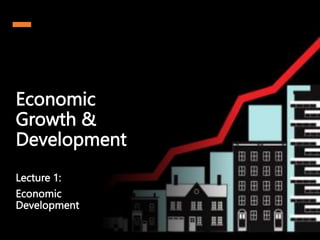
Economic
Growth &
Development
Lecture 1:
Economic
Development
Looking Back:
Economics
Looking Back: Economics
Economics is a social
science that deals with
efficient management of
limited or scarce resources.
Looking Back: Economics
It depends on the concept of
human nature, strongly on
the assumptions of
behaviors, motives, meanings
of individuals and
interactions with other
people, and groups and
diverse institutions.
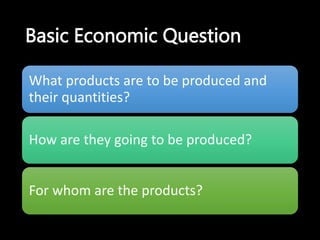
Basic Economic Question
What products are to be produced and
their quantities?
How are they going to be produced?
For whom are the products?
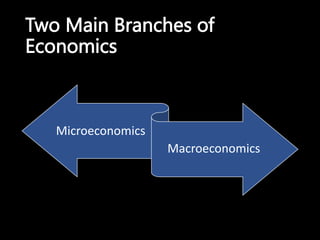
Two Main Branches of
Economics
Microeconomics
Macroeconomics
Microeconomics
Also known as the economics of individual
activities and entities, discusses the various laws
in supply, demand, equilibrium and diminishing
marginal utility, and the factors affecting the
products’ supply and demand.
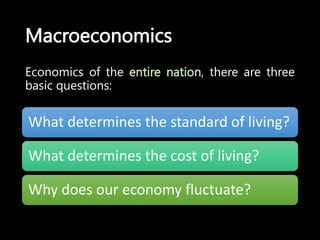
Macroeconomics
Economics of the entire nation, there are three
basic questions:
What determines the standard of living?
What determines the cost of living?
Why does our economy fluctuate?
Introduction:
Economic Growth
Economic Growth: an
Introduction
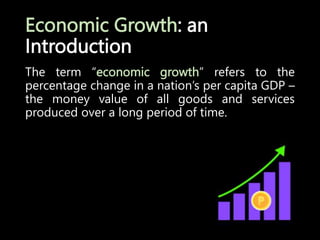
The term “economic growth” refers to the
percentage change in a nation’s per capita GDP –
the money value of all goods and services
produced over a long period of time.
Economic Growth: an
Introduction
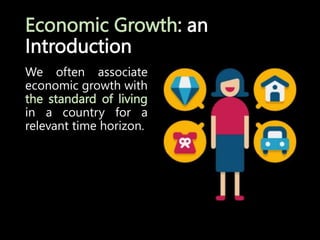
We often associate
economic growth with
the standard of living
in a country for a
relevant time horizon.
Economic Growth: an
Introduction
Many economists would
suggest that economic
growth is the key
indicator of a country’s
power and
accomplishment.
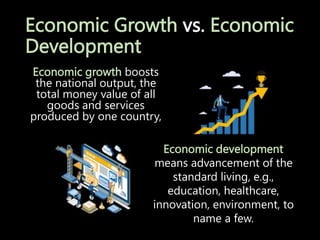
Economic Growth vs. Economic
Development
Economic growth boosts
the national output, the
total money value of all
goods and services
produced by one country,
Economic development
means advancement of the
standard living, e.g.,
education, healthcare,
innovation, environment, to
name a few.
Economic Growth vs. Economic
Development
Growth directly boosts development; all other
things remain constant, as higher GDP would
mean more to spend on factors that are
considered development.
Standard of Living vs. Cost of
Living
According to the Philippines Statistics Authority
(PSA), “standard of living” is the level of
consumption that people enjoy, on the average,
and is measured by the average income per
person, while ”cost of living” is the amount of
money it takes to buy goods and services that a
typical family consumes.
Economic Growth
Governments around the world are faced with
issues concerning productivity and living
standards.
In 2013, the World Bank Group adopted the twin
goals to guide its work: ending extreme poverty
and boosting shared prosperity.
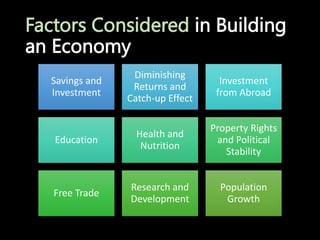
Factors Considered in Building
an Economy
Savings and
Investment
Diminishing
Returns and
Catch-up Effect
Investment
from Abroad
Education
Health and
Nutrition
Property Rights
and Political
Stability
Free Trade
Research and
Development
Population
Growth
Savings and Investment
To produce more, we must
invest in capital assets to
enable us to have the capacity
to yield more goods and
services.
However, it is to be noted that
capital investment would
mean sacrifice to consume
more.
Savings and Investment
There is a need for a country to
promote both domestic and
foreign investments to reduce
unemployment.
Ideally, a reduction in
unemployment will reduce
poverty levels, and hence, the
government’s social burden,
which will ultimately allow for
increased public savings.
Diminishing Returns and
Catch-up Effect
As the stock capital increases,
the extra output produced from
an additional unit of capital
decreases.
Productivity is considerably
affected minimally when the
workers with a large quantity of
capital they use in the
production process are given
extra units of capital.
Diminishing Returns and
Catch-up Effect
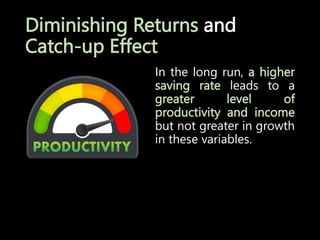
In the long run, a higher
saving rate leads to a
greater level of
productivity and income
but not greater in growth
in these variables.
Investment from Abroad
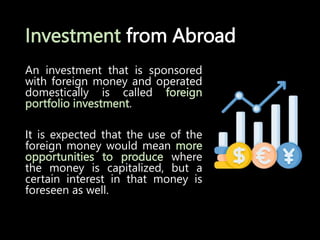
An investment that is sponsored
with foreign money and operated
domestically is called foreign
portfolio investment.
It is expected that the use of the
foreign money would mean more
opportunities to produce where
the money is capitalized, but a
certain interest in that money is
foreseen as well.
Investment from Abroad
The World Bank (WB) and the
International Monetary Fund
(IMF) were established to
ensure that there is economic
prosperity around the world by
financing public goods and
services with funds
accumulated from more
advanced economies like the
United States of America (USA).
Education
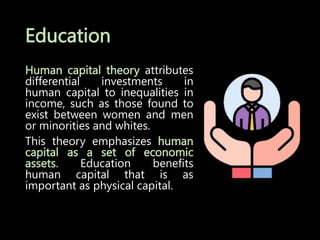
Human capital theory attributes
differential investments in
human capital to inequalities in
income, such as those found to
exist between women and men
or minorities and whites.
This theory emphasizes human
capital as a set of economic
assets. Education benefits
human capital that is as
important as physical capital.
Education
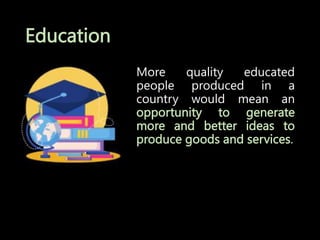
More quality educated
people produced in a
country would mean an
opportunity to generate
more and better ideas to
produce goods and services.
Education
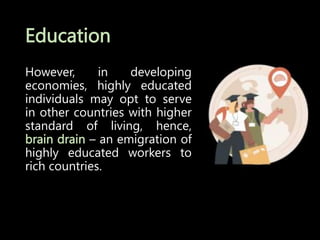
However, in developing
economies, highly educated
individuals may opt to serve
in other countries with higher
standard of living, hence,
brain drain – an emigration of
highly educated workers to
rich countries.
Health and Nutrition
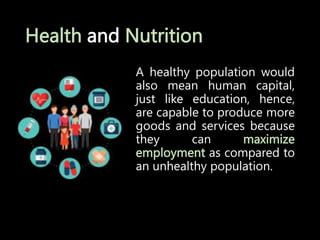
A healthy population would
also mean human capital,
just like education, hence,
are capable to produce more
goods and services because
they can maximize
employment as compared to
an unhealthy population.
Health and Nutrition
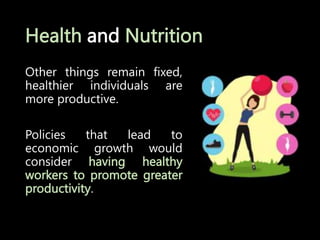
Other things remain fixed,
healthier individuals are
more productive.
Policies that lead to
economic growth would
consider having healthy
workers to promote greater
productivity.
Property Rights and Political
Stability
Property rights ensure the
exercise of rights over
one’s property and these
guarantee more
production of goods and
services.
Property Rights and Political
Stability
In addition, when there is less
uncertainty in government
decisions and policies,
especially in terms of market
trading, there is an
opportunity to improve
production processes and
distribute products in the
country.
Property Rights and Political
Stability
A stable political
environment is
considered to have
efficient executive,
legislative, and judiciary
systems, working together
for the country’s
economic development.
Free Trade
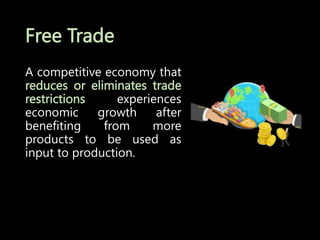
A competitive economy that
reduces or eliminates trade
restrictions experiences
economic growth after
benefiting from more
products to be used as
input to production.
Free Trade
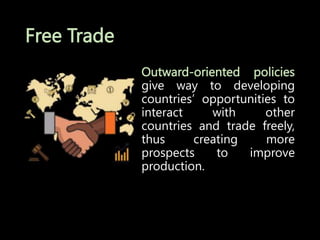
Outward-oriented policies
give way to developing
countries’ opportunities to
interact with other
countries and trade freely,
thus creating more
prospects to improve
production.
Research and Development
The products of research and
development (R & D) are new
ideas, goods, and services that
people consume.
Government institutions allocate
a part of their yearly budget to
research to continue improving
the ways things are done, in a
more efficient or totally
distinctive way.
Research and Development
To protect the idea, a patent is
awarded to an innovator for a
certain number of years to
encourage more researchers to
discover beneficial things.
Essentially, R&D turning money
into knowledge and innovation
is a process of creating a
business out of this knowledge.
Population Growth
There are two schools of thought
regarding population growth.
On one hand, a relatively large
population means more human
resources working and
contributing to the production of
the country, but on the other
hand, it also means more people
to consume those goods and
services.
Population Growth
It is to be noted, however, that
there are countries with a few
population and slow population
growth rate but are considered
developed liked Germany,
having an annual growth rate of
0.2%, and Singapore, -0.3% in
2020 study of the World Bank.
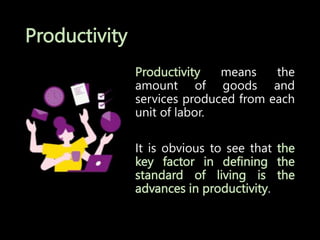
Productivity
Productivity means the
amount of goods and
services produced from each
unit of labor.
It is obvious to see that the
key factor in defining the
standard of living is the
advances in productivity.
Productivity
Remember that the Gross
Domestic Product (GDP) may
be seen in two ways, the
total cost of expenses that a
country spends on goods
and services and the
economy’s income as an
output.
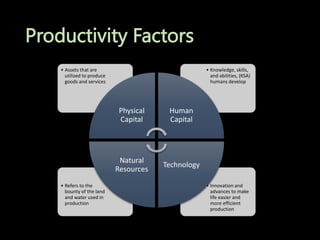
Productivity Factors
• Innovation and
advances to make
life easier and
more efficient
production
• Refers to the
bounty of the land
and water used in
production
• Knowledge, skills,
and abilities, (KSA)
humans develop
• Assets that are
utilized to produce
goods and services
Physical
Capital
Human
Capital
Technology
Natural
Resources
Any Questions?
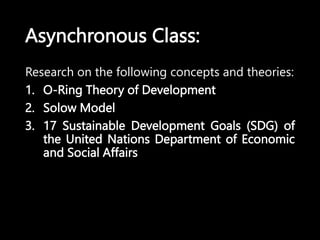
Asynchronous Class:
Research on the following concepts and theories:
1. O-Ring Theory of Development
2. Solow Model
3. 17 Sustainable Development Goals (SDG) of
the United Nations Department of Economic
and Social Affairs
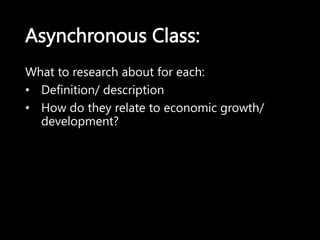
Asynchronous Class:
What to research about for each:
• Definition/ description
• How do they relate to economic growth/
development?

Econ-Development-Lesson-1 - Economic Concepts

  • 1.
  • 2.
  • 3.
    Looking Back: Economics Economicsis a social science that deals with efficient management of limited or scarce resources.
  • 4.
    Looking Back: Economics Itdepends on the concept of human nature, strongly on the assumptions of behaviors, motives, meanings of individuals and interactions with other people, and groups and diverse institutions.
  • 5.
    Basic Economic Question Whatproducts are to be produced and their quantities? How are they going to be produced? For whom are the products?
  • 6.
    Two Main Branchesof Economics Microeconomics Macroeconomics
  • 7.
    Microeconomics Also known asthe economics of individual activities and entities, discusses the various laws in supply, demand, equilibrium and diminishing marginal utility, and the factors affecting the products’ supply and demand.
  • 8.
    Macroeconomics Economics of theentire nation, there are three basic questions: What determines the standard of living? What determines the cost of living? Why does our economy fluctuate?
  • 9.
  • 10.
    Economic Growth: an Introduction Theterm “economic growth” refers to the percentage change in a nation’s per capita GDP – the money value of all goods and services produced over a long period of time.
  • 11.
    Economic Growth: an Introduction Weoften associate economic growth with the standard of living in a country for a relevant time horizon.
  • 12.
    Economic Growth: an Introduction Manyeconomists would suggest that economic growth is the key indicator of a country’s power and accomplishment.
  • 13.
    Economic Growth vs.Economic Development Economic growth boosts the national output, the total money value of all goods and services produced by one country, Economic development means advancement of the standard living, e.g., education, healthcare, innovation, environment, to name a few.
  • 14.
    Economic Growth vs.Economic Development Growth directly boosts development; all other things remain constant, as higher GDP would mean more to spend on factors that are considered development.
  • 15.
    Standard of Livingvs. Cost of Living According to the Philippines Statistics Authority (PSA), “standard of living” is the level of consumption that people enjoy, on the average, and is measured by the average income per person, while ”cost of living” is the amount of money it takes to buy goods and services that a typical family consumes.
  • 16.
    Economic Growth Governments aroundthe world are faced with issues concerning productivity and living standards. In 2013, the World Bank Group adopted the twin goals to guide its work: ending extreme poverty and boosting shared prosperity.
  • 17.
    Factors Considered inBuilding an Economy Savings and Investment Diminishing Returns and Catch-up Effect Investment from Abroad Education Health and Nutrition Property Rights and Political Stability Free Trade Research and Development Population Growth
  • 18.
    Savings and Investment Toproduce more, we must invest in capital assets to enable us to have the capacity to yield more goods and services. However, it is to be noted that capital investment would mean sacrifice to consume more.
  • 19.
    Savings and Investment Thereis a need for a country to promote both domestic and foreign investments to reduce unemployment. Ideally, a reduction in unemployment will reduce poverty levels, and hence, the government’s social burden, which will ultimately allow for increased public savings.
  • 20.
    Diminishing Returns and Catch-upEffect As the stock capital increases, the extra output produced from an additional unit of capital decreases. Productivity is considerably affected minimally when the workers with a large quantity of capital they use in the production process are given extra units of capital.
  • 21.
    Diminishing Returns and Catch-upEffect In the long run, a higher saving rate leads to a greater level of productivity and income but not greater in growth in these variables.
  • 22.
    Investment from Abroad Aninvestment that is sponsored with foreign money and operated domestically is called foreign portfolio investment. It is expected that the use of the foreign money would mean more opportunities to produce where the money is capitalized, but a certain interest in that money is foreseen as well.
  • 23.
    Investment from Abroad TheWorld Bank (WB) and the International Monetary Fund (IMF) were established to ensure that there is economic prosperity around the world by financing public goods and services with funds accumulated from more advanced economies like the United States of America (USA).
  • 24.
    Education Human capital theoryattributes differential investments in human capital to inequalities in income, such as those found to exist between women and men or minorities and whites. This theory emphasizes human capital as a set of economic assets. Education benefits human capital that is as important as physical capital.
  • 25.
    Education More quality educated peopleproduced in a country would mean an opportunity to generate more and better ideas to produce goods and services.
  • 26.
    Education However, in developing economies,highly educated individuals may opt to serve in other countries with higher standard of living, hence, brain drain – an emigration of highly educated workers to rich countries.
  • 27.
    Health and Nutrition Ahealthy population would also mean human capital, just like education, hence, are capable to produce more goods and services because they can maximize employment as compared to an unhealthy population.
  • 28.
    Health and Nutrition Otherthings remain fixed, healthier individuals are more productive. Policies that lead to economic growth would consider having healthy workers to promote greater productivity.
  • 29.
    Property Rights andPolitical Stability Property rights ensure the exercise of rights over one’s property and these guarantee more production of goods and services.
  • 30.
    Property Rights andPolitical Stability In addition, when there is less uncertainty in government decisions and policies, especially in terms of market trading, there is an opportunity to improve production processes and distribute products in the country.
  • 31.
    Property Rights andPolitical Stability A stable political environment is considered to have efficient executive, legislative, and judiciary systems, working together for the country’s economic development.
  • 32.
    Free Trade A competitiveeconomy that reduces or eliminates trade restrictions experiences economic growth after benefiting from more products to be used as input to production.
  • 33.
    Free Trade Outward-oriented policies giveway to developing countries’ opportunities to interact with other countries and trade freely, thus creating more prospects to improve production.
  • 34.
    Research and Development Theproducts of research and development (R & D) are new ideas, goods, and services that people consume. Government institutions allocate a part of their yearly budget to research to continue improving the ways things are done, in a more efficient or totally distinctive way.
  • 35.
    Research and Development Toprotect the idea, a patent is awarded to an innovator for a certain number of years to encourage more researchers to discover beneficial things. Essentially, R&D turning money into knowledge and innovation is a process of creating a business out of this knowledge.
  • 36.
    Population Growth There aretwo schools of thought regarding population growth. On one hand, a relatively large population means more human resources working and contributing to the production of the country, but on the other hand, it also means more people to consume those goods and services.
  • 37.
    Population Growth It isto be noted, however, that there are countries with a few population and slow population growth rate but are considered developed liked Germany, having an annual growth rate of 0.2%, and Singapore, -0.3% in 2020 study of the World Bank.
  • 38.
    Productivity Productivity means the amountof goods and services produced from each unit of labor. It is obvious to see that the key factor in defining the standard of living is the advances in productivity.
  • 39.
    Productivity Remember that theGross Domestic Product (GDP) may be seen in two ways, the total cost of expenses that a country spends on goods and services and the economy’s income as an output.
  • 40.
    Productivity Factors • Innovationand advances to make life easier and more efficient production • Refers to the bounty of the land and water used in production • Knowledge, skills, and abilities, (KSA) humans develop • Assets that are utilized to produce goods and services Physical Capital Human Capital Technology Natural Resources
  • 41.
  • 42.
    Asynchronous Class: Research onthe following concepts and theories: 1. O-Ring Theory of Development 2. Solow Model 3. 17 Sustainable Development Goals (SDG) of the United Nations Department of Economic and Social Affairs
  • 43.
    Asynchronous Class: What toresearch about for each: • Definition/ description • How do they relate to economic growth/ development?