Jelliarko Palgunadi

a Research Proposal
presented in Dept. of Chemistry,
Freiburg University, Germany
Introduction1
•     Direct fluorination reaction of organic compound is
      difficult associated with the safety of elemental
      fluorine and the reaction is extremely exothermic.
•     Microreactor in principle is a reactor which is designed
      and fabricated to perform a micro-scale reaction
      mimicking a large-scale conventional reaction.
•     Microreactor is found to have more benefits than
      conventional large reactor, i.e. large surface-to-
      volume ratio, comfortable to handle dangerous
      reactions (i.e. exothermic), scale-up by multiple
      apparatus, easy to control the reaction parameters
      etc.


1. Green chemistry, 5(2003)240
Direct fluorination reaction in
microreactors (gas-liquid contact)


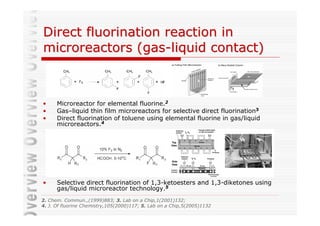
•     Microreactor for elemental fluorine.2
•     Gas–liquid thin film microreactors for selective direct fluorination3
•     Direct fluorination of toluene using elemental fluorine in gas/liquid
      microreactors.4


•     Selective direct fluorination of 1,3-ketoesters and 1,3-diketones using
      gas/liquid microreactor technology.5
2. Chem. Commun.,(1999)883; 3. Lab on a Chip,1(2001)132;
4. J. Of fluorine Chemistry,105(2000)117; 5. Lab on a Chip,5(2005)1132
Direct fluorination of alcohols, facts
 & figures
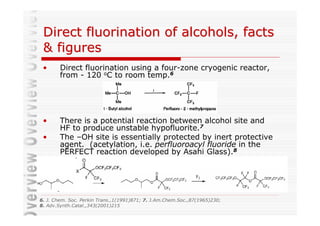
 •      Direct fluorination using a four-zone cryogenic reactor,
        from - 120 oC to room temp.6


 •      There is a potential reaction between alcohol site and
        HF to produce unstable hypofluorite.7
 •      The –OH site is essentially protected by inert protective
        agent. (acetylation, i.e. perfluoroacyl fluoride in the
        PERFECT reaction developed by Asahi Glass).8


6. J. Chem. Soc. Perkin Trans.,1(1991)871; 7. J.Am.Chem.Soc.,87(1965)230;
8. Adv.Synth.Catal.,343(2001)215
Attempts on the direct fluorination
 of alcohols
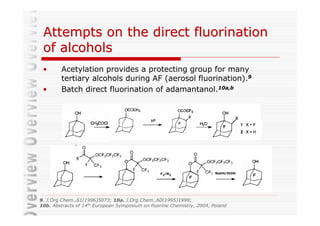
 •      Acetylation provides a protecting group for many
        tertiary alcohols during AF (aerosol fluorination).9
 •      Batch direct fluorination of adamantanol.10a,b


                                                 F2/N2                  NaOH/EtOH


9. J.Org.Chem.,61(1996)5073; 10a. J.Org.Chem.,60(1995)1999;
10b. Abstracts of 14th European Symposium on fluorine Chemistry, 2004, Poland
Proposed acetylation
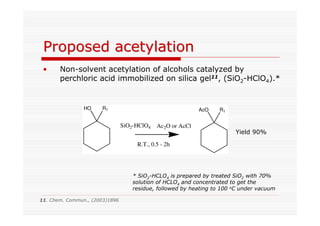
 •     Non-solvent acetylation of alcohols catalyzed by
       perchloric acid immobilized on silica gel11, (SiO2-HClO4).*


                HO     R1                                   AcO    R1


                                SiO2-HClO4   Ac2O or AcCl
                                                                        Yield 90%
                                     R.T., 0.5 - 2h


                                    * SiO2-HCLO4 is prepared by treated SiO2 with 70%
                                    solution of HCLO4 and concentrated to get the
                                    residue, followed by heating to 100 oC under vacuum

11. Chem. Commun., (2003)1896
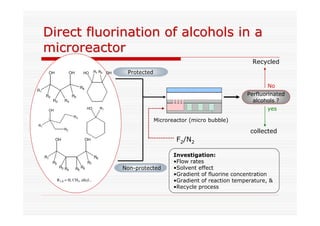
Direct fluorination of alcohols in a
     microreactor
                                                                                                                      Recycled
          OH             OH       HO       R1 R2 OH    Protected

                                R6                                           wodniw noitavresbO                            No
R1
     R2                   R5                                                                                        Perfluorinated
           R3       R4                                                                                                alcohols ?
          OH
                                      HO        R1
                                                                                                  gimröfsag ,deeF
                                                                                                                           yes
                          R3
      *
                                                                   Microreactor (micro bubble)
R1
                    R2
                                                                                                                     collected
               OH                    OH                                    F2/N2

     R1                                    R8                             Investigation:
           R2                         R7                                  •Flow rates
                 R3 R
                     4        R5 R6                   Non-protected       •Solvent effect
                                                                          •Gradient of fluorine concentration
                R1-8 = H, CH3, alkyl...                                   •Gradient of reaction temperature, &
                                                                          •Recycle process
Synthesis of
 dodecahydrododecaborate
 Scheme 1.12
 •    Na[B3H8] in diglyme, reflux under nitrogen until colorless, then
                                     diglyme
                 NaBH4 + I2                          Na[B3H8] + NaI + H2
                                   Reflux 100   oC

                                     under N2


 Scheme 2.13
 •    Na[B3H8] treated with concentrated (CH3)3NHCl in water and
      cooled to R.T. The solid is separated, dried, and recrystallized
      from water-ethyl alcohol to give (Me3NH)2B12H12.
                                         diglyme
        NaB3H8 + [HNMe3]Cl                            [HNMe3]2B12H12 + NaCl
                                     100 oC, under N2


12. Yingyong Huaxue, Chem. Abstr., 15(1998)111.; 13. J. Am. Chem. Soc., 85(1963)3885
Attempts on the fluorination of
 dodecahydrododecaborate
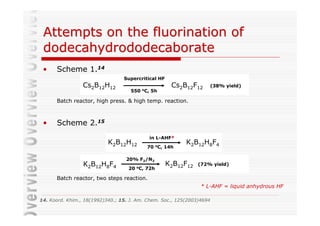
 •    Scheme 1.14
                                 Supercritical HF
                 Cs2B12H12                           Cs2B12F12         (38% yield)
                                    550 oC, 5h

      Batch reactor, high press. & high temp. reaction.


 •    Scheme 2.15
                                           in L-AHF*
                           K2B12H12                       K2B12H8F4
                                          70 oC, 14h

                                  20% F2/N2
                 K2B12H8F4                          K2B12F12   (72% yield)
                                   20 oC, 72h

      Batch reactor, two steps reaction.
                                                                * L-AHF = liquid anhydrous HF

14. Koord. Khim., 18(1992)340.; 15. J. Am. Chem. Soc., 125(2003)4694
Direct fluorination of polyhedral
  borane

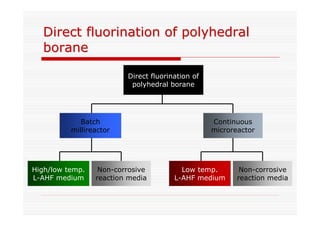
                         Direct fluorination of
                          polyhedral borane


             Batch                                Continuous
          millireactor                            microreactor


High/low temp.    Non-corrosive          Low temp.        Non-corrosive
L-AHF medium     reaction media        L-AHF medium      reaction media
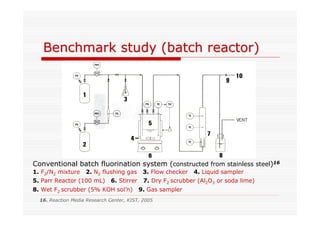
Benchmark study (batch reactor)


Conventional batch fluorination system (constructed from stainless steel)16
1. F2/N2 mixture    2. N2 flushing gas      3. Flow checker   4. Liquid sampler
5. Parr Reactor (100 mL)      6. Stirrer    7. Dry F2 scrubber (Al2O3 or soda lime)
8. Wet F2 scrubber (5% KOH sol’n)          9. Gas sampler
  16. Reaction Media Research Center, KIST, 2005
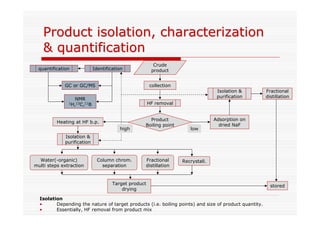
Product isolation, characterization
    & quantification
                                                        Crude
 quantification             Identification             product


             GC or GC/MS                              collection
                                                                                  Isolation &          Fractional
                                                                                  purification         distillation
                  NMR
               1H,13C,11B                             HF removal


                                                    Product                      Adsorption on
          Heating at HF b.p.
                                                  Boiling point                    dried NaF
                                        high                          low
             Isolation &
             purification


  Water(-organic)             Column chrom.       Fractional       Recrystall.
multi steps extraction          separation        distillation


                                     Target product                                                      stored
                                         drying

  Isolation
  •      Depending the nature of target products (i.e. boiling points) and size of product quantity.
  •      Essentially, HF removal from product mix

Microreactor fluorination-freiburg

  • 1.
    Jelliarko Palgunadi a ResearchProposal presented in Dept. of Chemistry, Freiburg University, Germany
  • 2.
    Introduction1 • Direct fluorination reaction of organic compound is difficult associated with the safety of elemental fluorine and the reaction is extremely exothermic. • Microreactor in principle is a reactor which is designed and fabricated to perform a micro-scale reaction mimicking a large-scale conventional reaction. • Microreactor is found to have more benefits than conventional large reactor, i.e. large surface-to- volume ratio, comfortable to handle dangerous reactions (i.e. exothermic), scale-up by multiple apparatus, easy to control the reaction parameters etc. 1. Green chemistry, 5(2003)240
  • 3.
    Direct fluorination reactionin microreactors (gas-liquid contact) • Microreactor for elemental fluorine.2 • Gas–liquid thin film microreactors for selective direct fluorination3 • Direct fluorination of toluene using elemental fluorine in gas/liquid microreactors.4 • Selective direct fluorination of 1,3-ketoesters and 1,3-diketones using gas/liquid microreactor technology.5 2. Chem. Commun.,(1999)883; 3. Lab on a Chip,1(2001)132; 4. J. Of fluorine Chemistry,105(2000)117; 5. Lab on a Chip,5(2005)1132
  • 4.
    Direct fluorination ofalcohols, facts & figures • Direct fluorination using a four-zone cryogenic reactor, from - 120 oC to room temp.6 • There is a potential reaction between alcohol site and HF to produce unstable hypofluorite.7 • The –OH site is essentially protected by inert protective agent. (acetylation, i.e. perfluoroacyl fluoride in the PERFECT reaction developed by Asahi Glass).8 6. J. Chem. Soc. Perkin Trans.,1(1991)871; 7. J.Am.Chem.Soc.,87(1965)230; 8. Adv.Synth.Catal.,343(2001)215
  • 5.
    Attempts on thedirect fluorination of alcohols • Acetylation provides a protecting group for many tertiary alcohols during AF (aerosol fluorination).9 • Batch direct fluorination of adamantanol.10a,b F2/N2 NaOH/EtOH 9. J.Org.Chem.,61(1996)5073; 10a. J.Org.Chem.,60(1995)1999; 10b. Abstracts of 14th European Symposium on fluorine Chemistry, 2004, Poland
  • 6.
    Proposed acetylation • Non-solvent acetylation of alcohols catalyzed by perchloric acid immobilized on silica gel11, (SiO2-HClO4).* HO R1 AcO R1 SiO2-HClO4 Ac2O or AcCl Yield 90% R.T., 0.5 - 2h * SiO2-HCLO4 is prepared by treated SiO2 with 70% solution of HCLO4 and concentrated to get the residue, followed by heating to 100 oC under vacuum 11. Chem. Commun., (2003)1896
  • 7.
    Direct fluorination ofalcohols in a microreactor Recycled OH OH HO R1 R2 OH Protected R6 wodniw noitavresbO No R1 R2 R5 Perfluorinated R3 R4 alcohols ? OH HO R1 gimröfsag ,deeF yes R3 * Microreactor (micro bubble) R1 R2 collected OH OH F2/N2 R1 R8 Investigation: R2 R7 •Flow rates R3 R 4 R5 R6 Non-protected •Solvent effect •Gradient of fluorine concentration R1-8 = H, CH3, alkyl... •Gradient of reaction temperature, & •Recycle process
  • 8.
    Synthesis of dodecahydrododecaborate Scheme 1.12 • Na[B3H8] in diglyme, reflux under nitrogen until colorless, then diglyme NaBH4 + I2 Na[B3H8] + NaI + H2 Reflux 100 oC under N2 Scheme 2.13 • Na[B3H8] treated with concentrated (CH3)3NHCl in water and cooled to R.T. The solid is separated, dried, and recrystallized from water-ethyl alcohol to give (Me3NH)2B12H12. diglyme NaB3H8 + [HNMe3]Cl [HNMe3]2B12H12 + NaCl 100 oC, under N2 12. Yingyong Huaxue, Chem. Abstr., 15(1998)111.; 13. J. Am. Chem. Soc., 85(1963)3885
  • 9.
    Attempts on thefluorination of dodecahydrododecaborate • Scheme 1.14 Supercritical HF Cs2B12H12 Cs2B12F12 (38% yield) 550 oC, 5h Batch reactor, high press. & high temp. reaction. • Scheme 2.15 in L-AHF* K2B12H12 K2B12H8F4 70 oC, 14h 20% F2/N2 K2B12H8F4 K2B12F12 (72% yield) 20 oC, 72h Batch reactor, two steps reaction. * L-AHF = liquid anhydrous HF 14. Koord. Khim., 18(1992)340.; 15. J. Am. Chem. Soc., 125(2003)4694
  • 10.
    Direct fluorination ofpolyhedral borane Direct fluorination of polyhedral borane Batch Continuous millireactor microreactor High/low temp. Non-corrosive Low temp. Non-corrosive L-AHF medium reaction media L-AHF medium reaction media
  • 11.
    Benchmark study (batchreactor) Conventional batch fluorination system (constructed from stainless steel)16 1. F2/N2 mixture 2. N2 flushing gas 3. Flow checker 4. Liquid sampler 5. Parr Reactor (100 mL) 6. Stirrer 7. Dry F2 scrubber (Al2O3 or soda lime) 8. Wet F2 scrubber (5% KOH sol’n) 9. Gas sampler 16. Reaction Media Research Center, KIST, 2005
  • 12.
    Product isolation, characterization & quantification Crude quantification Identification product GC or GC/MS collection Isolation & Fractional purification distillation NMR 1H,13C,11B HF removal Product Adsorption on Heating at HF b.p. Boiling point dried NaF high low Isolation & purification Water(-organic) Column chrom. Fractional Recrystall. multi steps extraction separation distillation Target product stored drying Isolation • Depending the nature of target products (i.e. boiling points) and size of product quantity. • Essentially, HF removal from product mix