Education
Research Ideas
Dhaka
May 26, 2015
Bangladesh Priorities
WORKING WITH 30-50 economists including Nobel Laureates, 100+
sector experts engaging major development organizations, NGOs,
government, businesses, youths, rural and urban Bangladeshis to
identify, analyze and prioritize interventions that will deliver greater
benefit per taka spent, helping move Bangladesh towards Vision 2021
and a more prosperous long term future.
In cooperation with the Research
and Evaluation Division of BRAC,
Copenhagen Consensus Center
organized roundtable discussions
with an aim to figure out smarter
solutions to the most problematic
issues facing Bangladesh.
These roundtables are
one of several sources
for research ideas.
Sourcing ideas and solutions
Smarter solutions for Bangladesh
Complete set of papers
on 30-50 solutions
PRIORITIZATION
Government NGOs
Academia Pvt sector
Think tanks
Development
organizations
Eminent Panel
Assessment
Government and
donor seminars
Rural polls
Newspaper polls
among readers
Youth forums
across the country
Private sector
meetings
Social, economic and
environmental benefit-cost
research by top Bangladeshi,
and international economists
Extensive peer review by sector
experts and academics
100+ ideas on
policies & investments
20162015 Continuous
engagement with
the public via
electronic, print
and social media
Working with
civil society,
government and
sector experts
Widely
advocating
results of
prioritization
exercises
OUTREACH
Research ideas
Education;
(1 of 9)
• Eliminate rote memorization practices by limiting use
of exam guidebooks.
• Increase teacher-student contact hours to global
standards.
• Prioritize technical, mathematical and scientific
education.
• Conduct annual primary school census and biennial
national assessment of G-3 and G-5 students.
• Support Teach for Bangladesh initiative.
• Opportunities for public sector teachers for upward
mobility to other government departments.
Education;
(2 of 9)
• Increase teachers’ wages to match South Asian/global
standards.
• Using the national Poverty Map, introduce targeted
school feeding programs and health checkup facilities
in poverty-stricken areas.
• Introduce TVET in madrasas.
• Update and modify madrasa text materials on Islamic
and Arabic subjects.
• Mainstreaming of madrasa education to the national
curriculum.
• Protect children from drowning - a major cause of high
dropout rate.
Education;
(3 of 9)
• Co-locate schools with RMG factories.
• Stipends at the secondary level to poor families’ male
members.
• Scale up pre-primary education facilities under the
PEDP-III.
• Provide stipends to 80% of primary school children.
• Increase the number of sub-district level supervisors by
25-30%.
• Decentralize monthly pay order (MPO) to cover all
schools.
Education;
(4 of 9)
• Establish three new women’s Polytechnic Institutes at
Barisal, Sylhet and Rangpur divisional headquarters.
• Stipends and other financial support for female
members in training programs.
• Establish 100 Technical Schools (TSs) at Upazila level.
• Training for less-skilled migrant workers through 22
new District Employment and Manpower Offices
(DEMO).
• Create GPA (grade point average) maps to pinpoint
underperforming areas.
• Support “second chance schooling” for workers in the
garments sector.
Education;
(5 of 9)
• Playground should be a mandatory condition for
primary and secondary schools.
• Provide female-friendly accommodation and sanitary
facilities in madrasas.
• Enhance teachers training through Teachers Portal.
• Targeted scholarships for children of extreme poor
families.
• Construction of charter / private schools.
• Continue the government and ADB supported Primary
Education Development Project (PEDP-III).
Education;
(6 of 9)
• Establishment of more universities in science and
technology fields, more planetariums, libraries,
laboratories, and scientific equipment.
• Establish multi-media classrooms (MMC) across all
primary and secondary schools.
• Introduce ICT courses in all post-graduate colleges of
Bangladesh.
• Fully implement Bangladesh Research Network (Bdren).
• Link national curriculum to global standards like PISA.
• Use of multimedia classroom (MMC) Dashboard for
monitoring teachers.
Education;
(7 of 9)
• Review education quality in terms of learning and relevance
to markets.
• Expand National Technical and Vocational Qualifications
Framework (NTVQF).
• Introduce TVET courses in secondary and higher secondary
levels.
• Implement the National Skills Development Policy (NSDP
2011).
• Design and implement a ‘Life Skills Program’.
• A ‘Catering Institute’ to provide market-oriented skill
training for less-skilled, overseas, migrant workers.
• Raise awareness about the importance of female education.
Education;
(8 of 9)
• Provide special financial support to female students.
• More pre-primary schools for early childhood care and
development.
• Teach mothers how to build cognitive skills in 0-4 year
old children.
• Strengthen the National University and Bangladesh
Open University (BOU).
• Implement more initiatives under Higher Education
Quality Enhancement Project (HEQEP) (2009-2018).
Education;
(9 of 9)
• Assign education experts for director posts at the
Ministry of Education and Ministry of Financial.
• Administrative scrutiny of universities’ activities by the
University Grants Commission (UGC) and relevant
Parliamentary Committees.
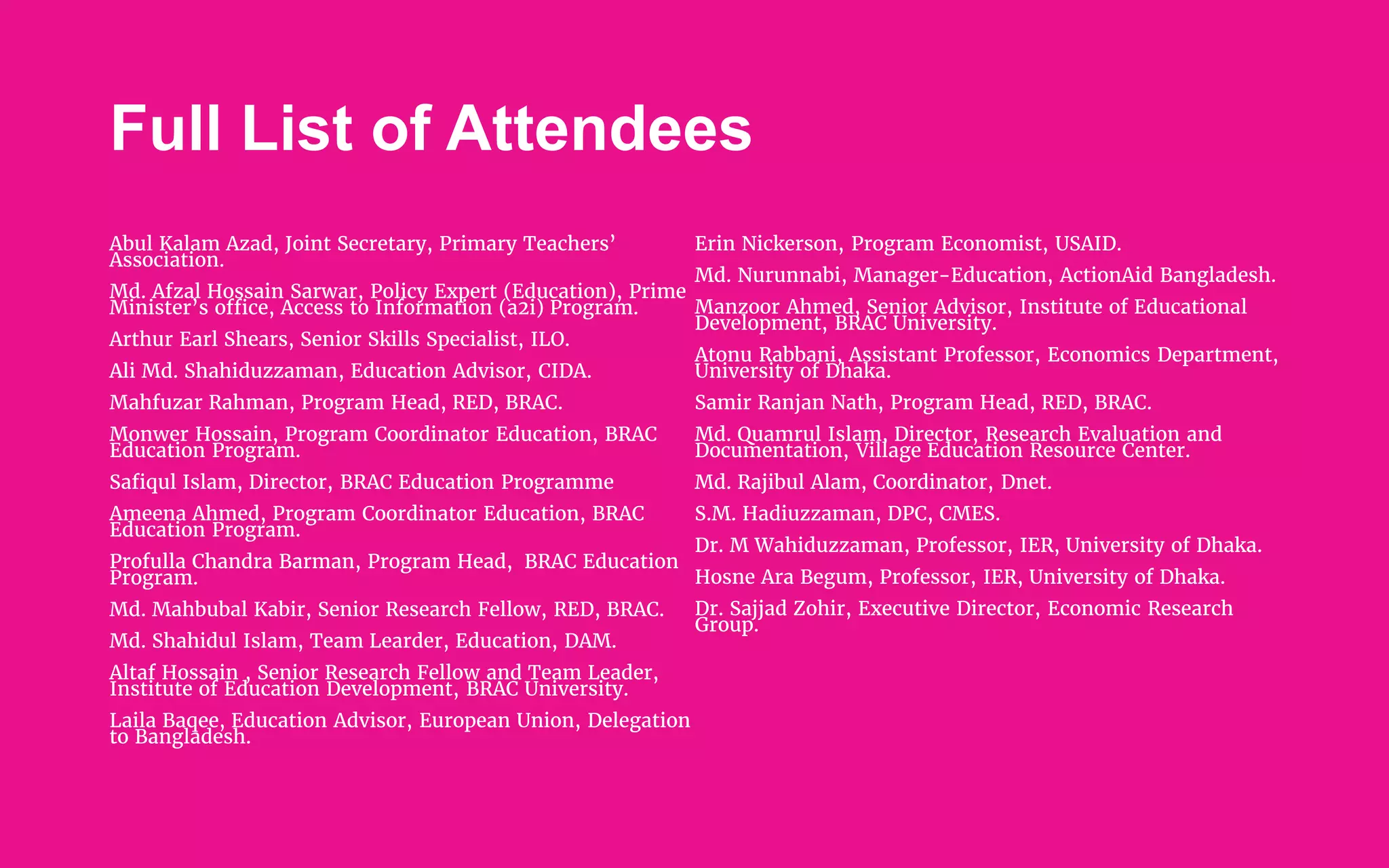
Full List of Attendees and
Interviewees
Abul Kalam Azad, Joint Secretary, Primary Teachers’
Association.
Md. Afzal Hossain Sarwar, Policy Expert (Education), Prime
Minister’s office, Access to Information (a2i) Program.
Arthur Earl Shears, Senior Skills Specialist, ILO.
Ali Md. Shahiduzzaman, Education Advisor, CIDA.
Mahfuzar Rahman, Program Head, RED, BRAC.
Monwer Hossain, Program Coordinator Education, BRAC
Education Program.
Safiqul Islam, Director, BRAC Education Programme
Ameena Ahmed, Program Coordinator Education, BRAC
Education Program.
Profulla Chandra Barman, Program Head, BRAC Education
Program.
Md. Mahbubal Kabir, Senior Research Fellow, RED, BRAC.
Md. Shahidul Islam, Team Learder, Education, DAM.
Altaf Hossain , Senior Research Fellow and Team Leader,
Institute of Education Development, BRAC University.
Laila Baqee, Education Advisor, European Union, Delegation
to Bangladesh.
Erin Nickerson, Program Economist, USAID.
Md. Nurunnabi, Manager-Education, ActionAid Bangladesh.
Manzoor Ahmed, Senior Advisor, Institute of Educational
Development, BRAC University.
Atonu Rabbani, Assistant Professor, Economics Department,
University of Dhaka.
Samir Ranjan Nath, Program Head, RED, BRAC.
Md. Quamrul Islam, Director, Research Evaluation and
Documentation, Village Education Resource Center.
Md. Rajibul Alam, Coordinator, Dnet.
S.M. Hadiuzzaman, DPC, CMES.
Dr. M Wahiduzzaman, Professor, IER, University of Dhaka.
Hosne Ara Begum, Professor, IER, University of Dhaka.
Dr. Sajjad Zohir, Executive Director, Economic Research
Group.

Top ideas for Education

  • 1.
  • 2.
    Bangladesh Priorities WORKING WITH30-50 economists including Nobel Laureates, 100+ sector experts engaging major development organizations, NGOs, government, businesses, youths, rural and urban Bangladeshis to identify, analyze and prioritize interventions that will deliver greater benefit per taka spent, helping move Bangladesh towards Vision 2021 and a more prosperous long term future.
  • 3.
    In cooperation withthe Research and Evaluation Division of BRAC, Copenhagen Consensus Center organized roundtable discussions with an aim to figure out smarter solutions to the most problematic issues facing Bangladesh. These roundtables are one of several sources for research ideas. Sourcing ideas and solutions Smarter solutions for Bangladesh Complete set of papers on 30-50 solutions PRIORITIZATION Government NGOs Academia Pvt sector Think tanks Development organizations Eminent Panel Assessment Government and donor seminars Rural polls Newspaper polls among readers Youth forums across the country Private sector meetings Social, economic and environmental benefit-cost research by top Bangladeshi, and international economists Extensive peer review by sector experts and academics 100+ ideas on policies & investments 20162015 Continuous engagement with the public via electronic, print and social media Working with civil society, government and sector experts Widely advocating results of prioritization exercises OUTREACH
  • 4.
  • 5.
    Education; (1 of 9) •Eliminate rote memorization practices by limiting use of exam guidebooks. • Increase teacher-student contact hours to global standards. • Prioritize technical, mathematical and scientific education. • Conduct annual primary school census and biennial national assessment of G-3 and G-5 students. • Support Teach for Bangladesh initiative. • Opportunities for public sector teachers for upward mobility to other government departments.
  • 6.
    Education; (2 of 9) •Increase teachers’ wages to match South Asian/global standards. • Using the national Poverty Map, introduce targeted school feeding programs and health checkup facilities in poverty-stricken areas. • Introduce TVET in madrasas. • Update and modify madrasa text materials on Islamic and Arabic subjects. • Mainstreaming of madrasa education to the national curriculum. • Protect children from drowning - a major cause of high dropout rate.
  • 7.
    Education; (3 of 9) •Co-locate schools with RMG factories. • Stipends at the secondary level to poor families’ male members. • Scale up pre-primary education facilities under the PEDP-III. • Provide stipends to 80% of primary school children. • Increase the number of sub-district level supervisors by 25-30%. • Decentralize monthly pay order (MPO) to cover all schools.
  • 8.
    Education; (4 of 9) •Establish three new women’s Polytechnic Institutes at Barisal, Sylhet and Rangpur divisional headquarters. • Stipends and other financial support for female members in training programs. • Establish 100 Technical Schools (TSs) at Upazila level. • Training for less-skilled migrant workers through 22 new District Employment and Manpower Offices (DEMO). • Create GPA (grade point average) maps to pinpoint underperforming areas. • Support “second chance schooling” for workers in the garments sector.
  • 9.
    Education; (5 of 9) •Playground should be a mandatory condition for primary and secondary schools. • Provide female-friendly accommodation and sanitary facilities in madrasas. • Enhance teachers training through Teachers Portal. • Targeted scholarships for children of extreme poor families. • Construction of charter / private schools. • Continue the government and ADB supported Primary Education Development Project (PEDP-III).
  • 10.
    Education; (6 of 9) •Establishment of more universities in science and technology fields, more planetariums, libraries, laboratories, and scientific equipment. • Establish multi-media classrooms (MMC) across all primary and secondary schools. • Introduce ICT courses in all post-graduate colleges of Bangladesh. • Fully implement Bangladesh Research Network (Bdren). • Link national curriculum to global standards like PISA. • Use of multimedia classroom (MMC) Dashboard for monitoring teachers.
  • 11.
    Education; (7 of 9) •Review education quality in terms of learning and relevance to markets. • Expand National Technical and Vocational Qualifications Framework (NTVQF). • Introduce TVET courses in secondary and higher secondary levels. • Implement the National Skills Development Policy (NSDP 2011). • Design and implement a ‘Life Skills Program’. • A ‘Catering Institute’ to provide market-oriented skill training for less-skilled, overseas, migrant workers. • Raise awareness about the importance of female education.
  • 12.
    Education; (8 of 9) •Provide special financial support to female students. • More pre-primary schools for early childhood care and development. • Teach mothers how to build cognitive skills in 0-4 year old children. • Strengthen the National University and Bangladesh Open University (BOU). • Implement more initiatives under Higher Education Quality Enhancement Project (HEQEP) (2009-2018).
  • 13.
    Education; (9 of 9) •Assign education experts for director posts at the Ministry of Education and Ministry of Financial. • Administrative scrutiny of universities’ activities by the University Grants Commission (UGC) and relevant Parliamentary Committees.
  • 14.
    Full List ofAttendees and Interviewees Abul Kalam Azad, Joint Secretary, Primary Teachers’ Association. Md. Afzal Hossain Sarwar, Policy Expert (Education), Prime Minister’s office, Access to Information (a2i) Program. Arthur Earl Shears, Senior Skills Specialist, ILO. Ali Md. Shahiduzzaman, Education Advisor, CIDA. Mahfuzar Rahman, Program Head, RED, BRAC. Monwer Hossain, Program Coordinator Education, BRAC Education Program. Safiqul Islam, Director, BRAC Education Programme Ameena Ahmed, Program Coordinator Education, BRAC Education Program. Profulla Chandra Barman, Program Head, BRAC Education Program. Md. Mahbubal Kabir, Senior Research Fellow, RED, BRAC. Md. Shahidul Islam, Team Learder, Education, DAM. Altaf Hossain , Senior Research Fellow and Team Leader, Institute of Education Development, BRAC University. Laila Baqee, Education Advisor, European Union, Delegation to Bangladesh. Erin Nickerson, Program Economist, USAID. Md. Nurunnabi, Manager-Education, ActionAid Bangladesh. Manzoor Ahmed, Senior Advisor, Institute of Educational Development, BRAC University. Atonu Rabbani, Assistant Professor, Economics Department, University of Dhaka. Samir Ranjan Nath, Program Head, RED, BRAC. Md. Quamrul Islam, Director, Research Evaluation and Documentation, Village Education Resource Center. Md. Rajibul Alam, Coordinator, Dnet. S.M. Hadiuzzaman, DPC, CMES. Dr. M Wahiduzzaman, Professor, IER, University of Dhaka. Hosne Ara Begum, Professor, IER, University of Dhaka. Dr. Sajjad Zohir, Executive Director, Economic Research Group.