Using Schedule MD™ for
Schedule Reliability
Presented by:
Mike Brown, PMP
Presentation Agenda
Problem statement1
Top 5 metrics revealed5The importance of metrics2
Schedule MD overview3
2
Pillars and traits4
Speaker Bio
3
Mike Brown, PMP
Managing Director
Denver, Colorado
mbrown@pmaconsultants.com
About the Presenter
Mike has extensive experience in program
and project management, quality
management, engineering, and program
and project controls. Mike has managed
responsibilities that include strategic
planning, engineering, construction,
regulatory permitting and compliance,
resource planning and management, quality
audits and reviews, closeout, and other
related administrative oversight functions.
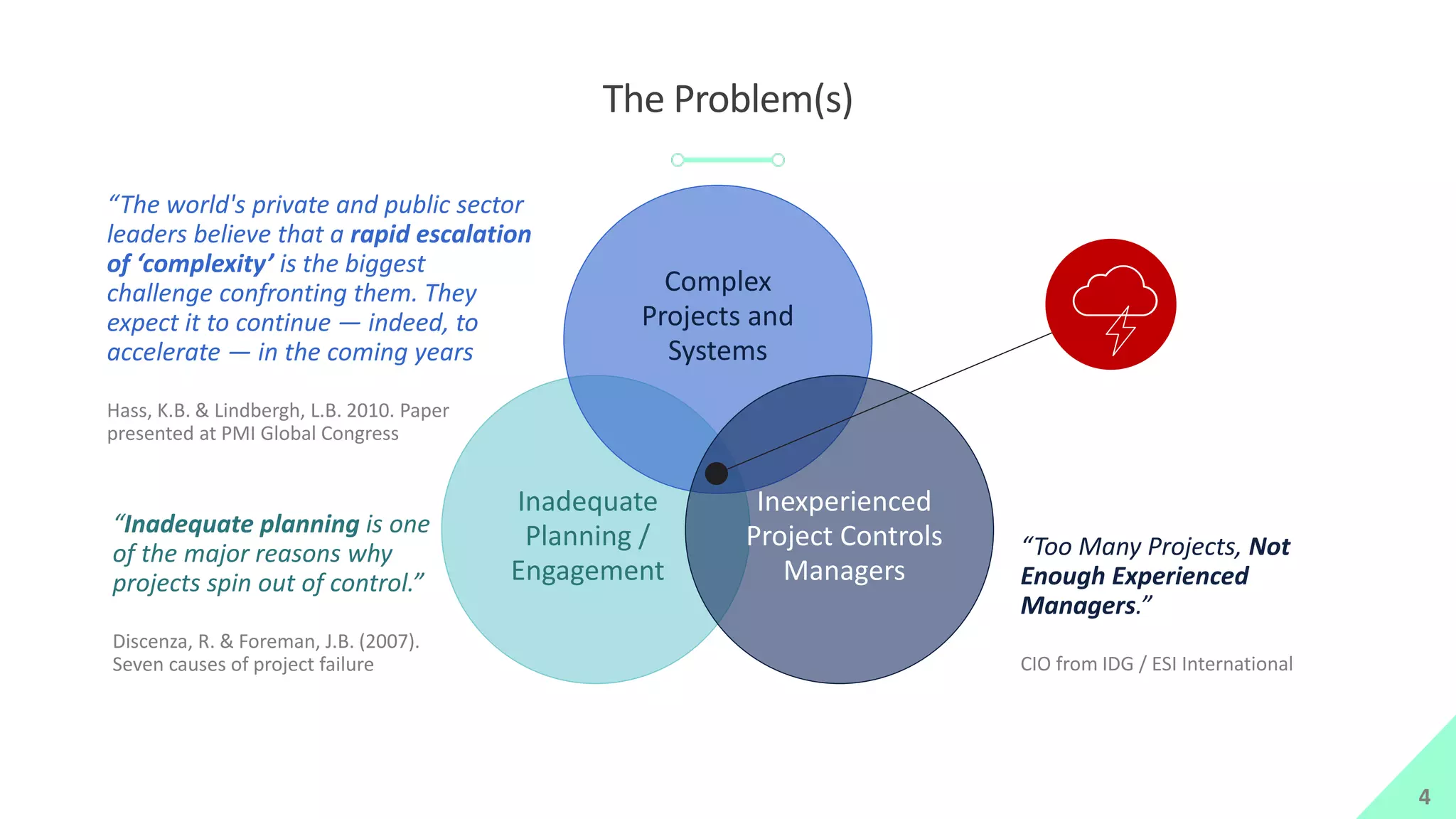
The Problem(s)
Inadequate
Planning /
Engagement
Complex
Projects and
Systems
Inexperienced
Project Controls
Managers
“Inadequate planning is one
of the major reasons why
projects spin out of control.”
Discenza, R. & Foreman, J.B. (2007).
Seven causes of project failure
4
“The world's private and public sector
leaders believe that a rapid escalation
of ‘complexity’ is the biggest
challenge confronting them. They
expect it to continue — indeed, to
accelerate — in the coming years
Hass, K.B. & Lindbergh, L.B. 2010. Paper
presented at PMI Global Congress
“Too Many Projects, Not
Enough Experienced
Managers.”
CIO from IDG / ESI International
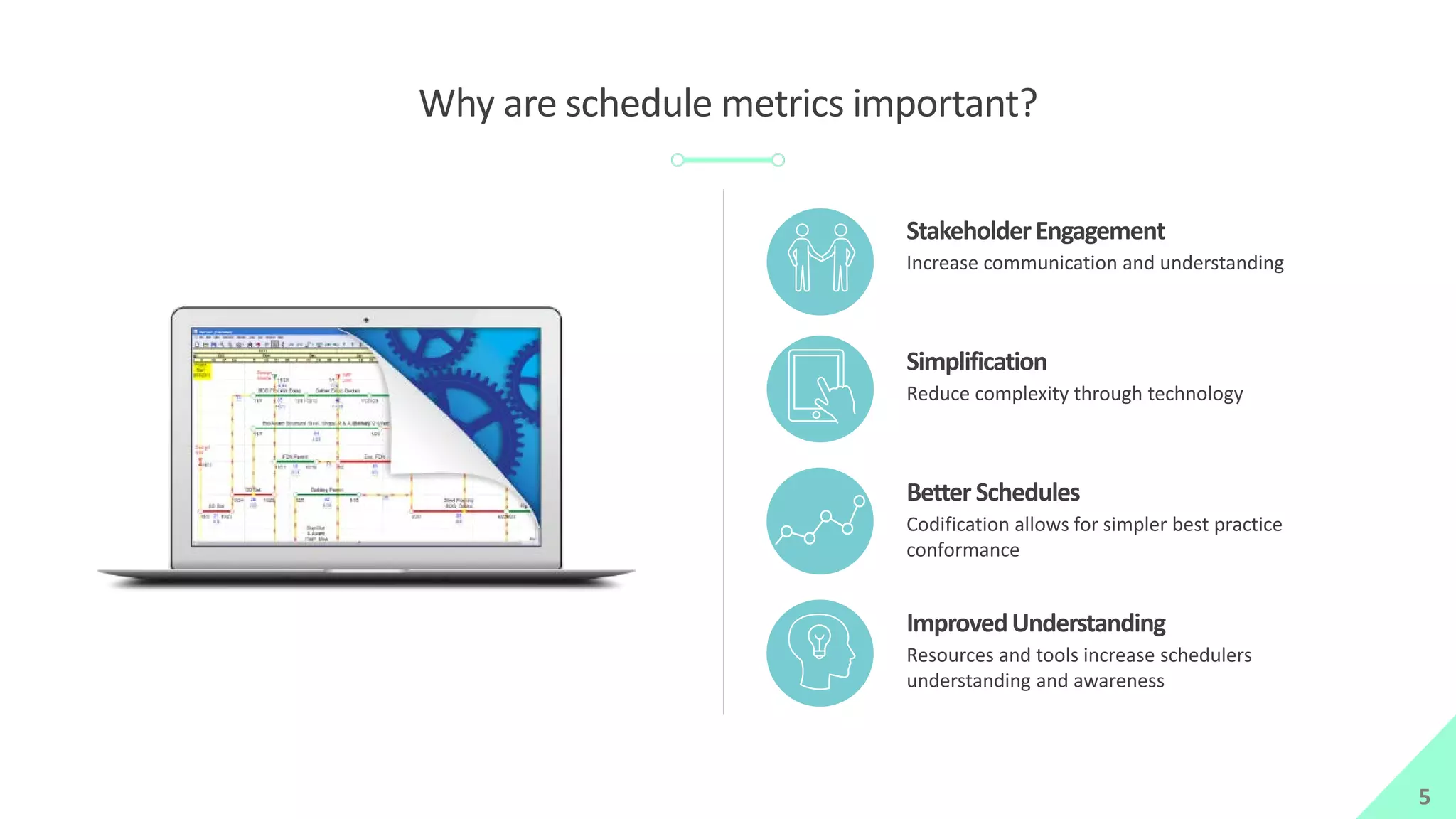
Why are schedule metrics important?
StakeholderEngagement
Increase communication and understanding
Simplification
Reduce complexity through technology
ImprovedUnderstanding
Resources and tools increase schedulers
understanding and awareness
Better Schedules
Codification allows for simpler best practice
conformance
5
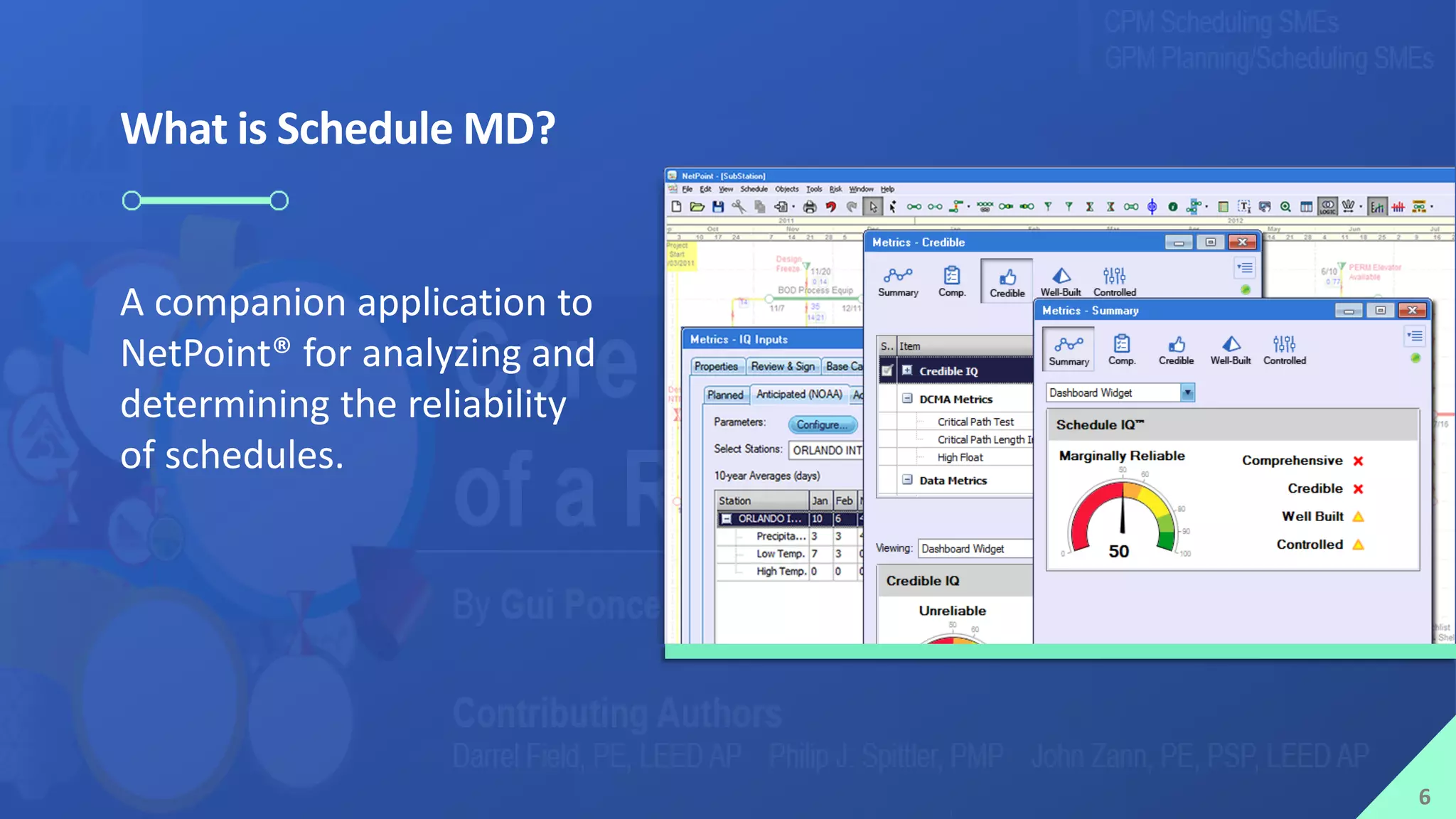
What is Schedule MD?
A companion application to
NetPoint® for analyzing and
determining the reliability
of schedules.
6
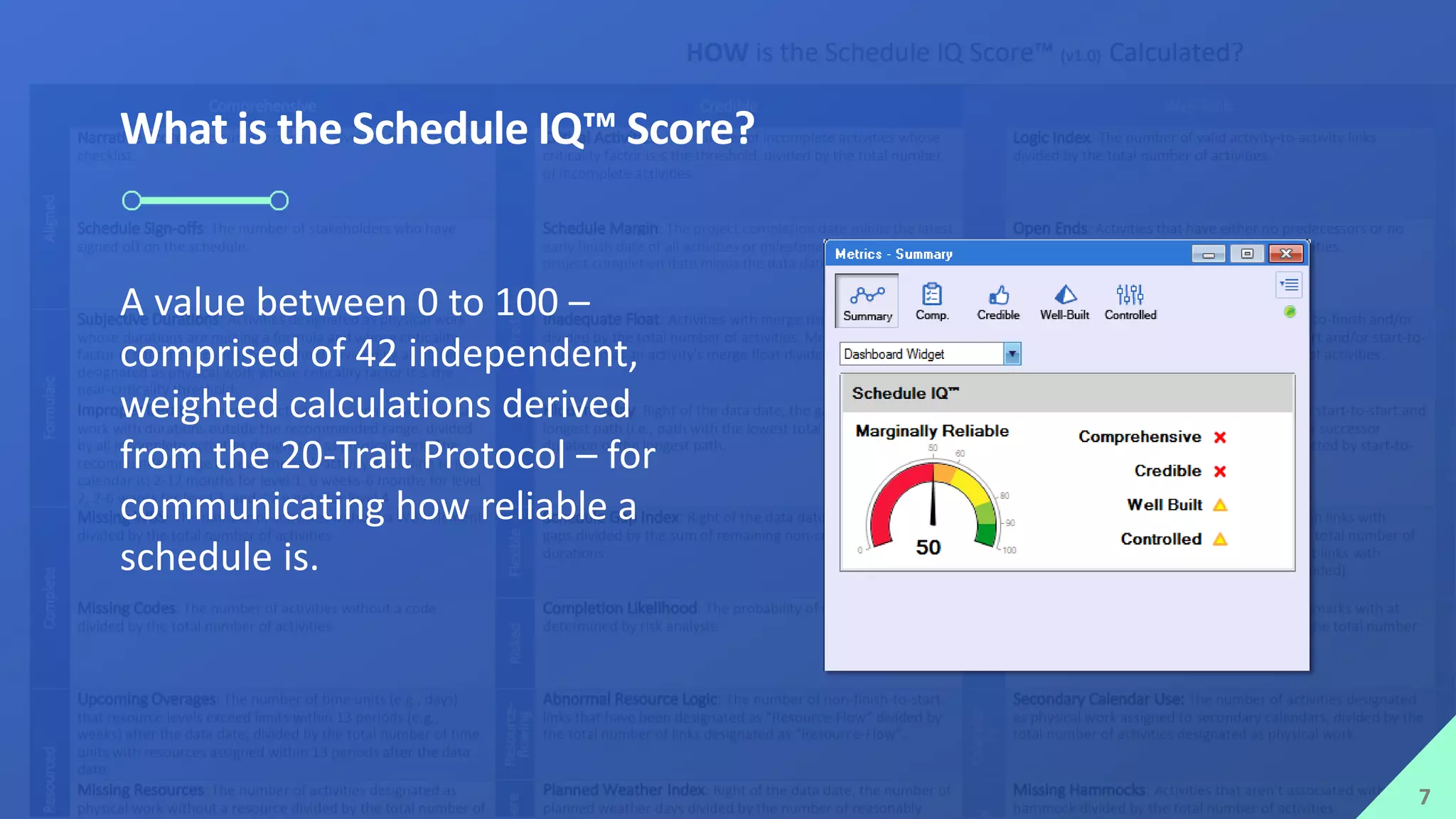
What is the Schedule IQ™ Score?
A value between 0 to 100 –
comprised of 42 independent,
weighted calculations derived
from the 20-Trait Protocol – for
communicating how reliable a
schedule is.
7
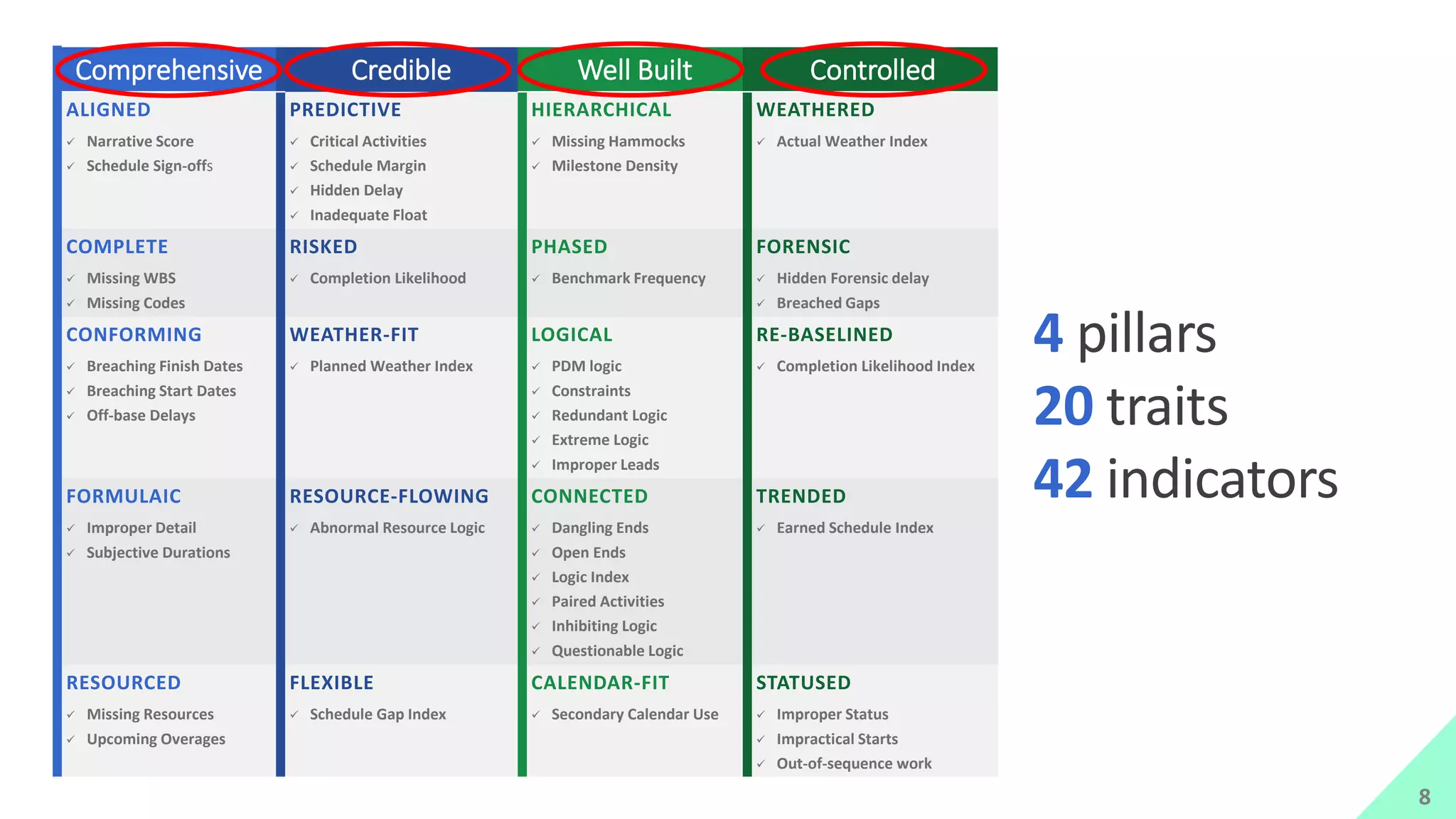
Comprehensive Credible Well Built Controlled
ALIGNED PREDICTIVE HIERARCHICAL WEATHERED
 Narrative Score
 Schedule Sign-offs
 Critical Activities
 Schedule Margin
 Hidden Delay
 Inadequate Float
 Missing Hammocks
 Milestone Density
 Actual Weather Index
COMPLETE RISKED PHASED FORENSIC
 Missing WBS
 Missing Codes
 Completion Likelihood  Benchmark Frequency  Hidden Forensic delay
 Breached Gaps
CONFORMING WEATHER-FIT LOGICAL RE-BASELINED
 Breaching Finish Dates
 Breaching Start Dates
 Off-base Delays
 Planned Weather Index  PDM logic
 Constraints
 Redundant Logic
 Extreme Logic
 Improper Leads
 Completion Likelihood Index
FORMULAIC RESOURCE-FLOWING CONNECTED TRENDED
 Improper Detail
 Subjective Durations
 Abnormal Resource Logic  Dangling Ends
 Open Ends
 Logic Index
 Paired Activities
 Inhibiting Logic
 Questionable Logic
 Earned Schedule Index
RESOURCED FLEXIBLE CALENDAR-FIT STATUSED
 Missing Resources
 Upcoming Overages
 Schedule Gap Index  Secondary Calendar Use  Improper Status
 Impractical Starts
 Out-of-sequence work
4 pillars
20 traits
42 indicators
8
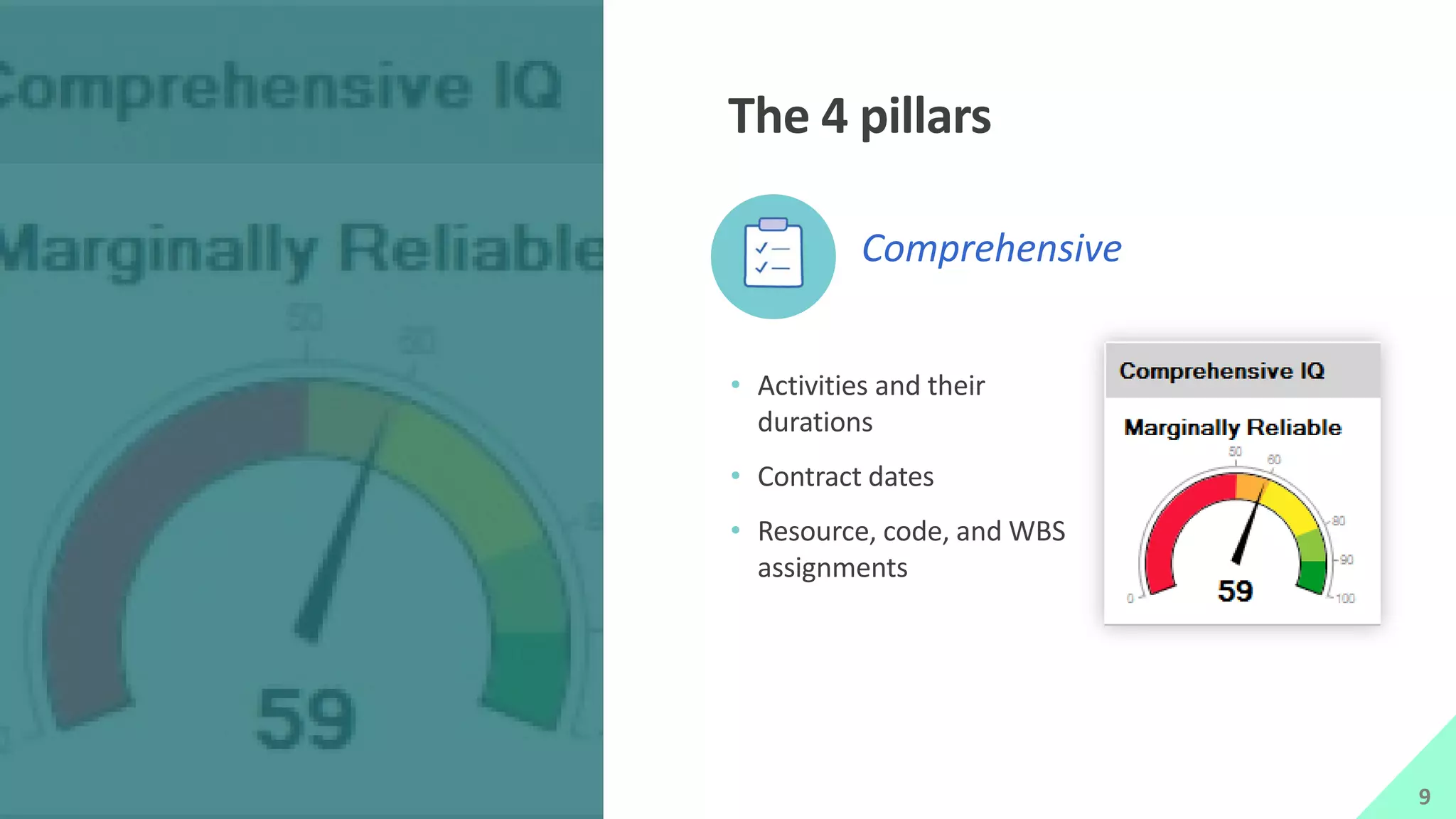
The 4 pillars
• Activities and their
durations
• Contract dates
• Resource, code, and WBS
assignments
Comprehensive
9
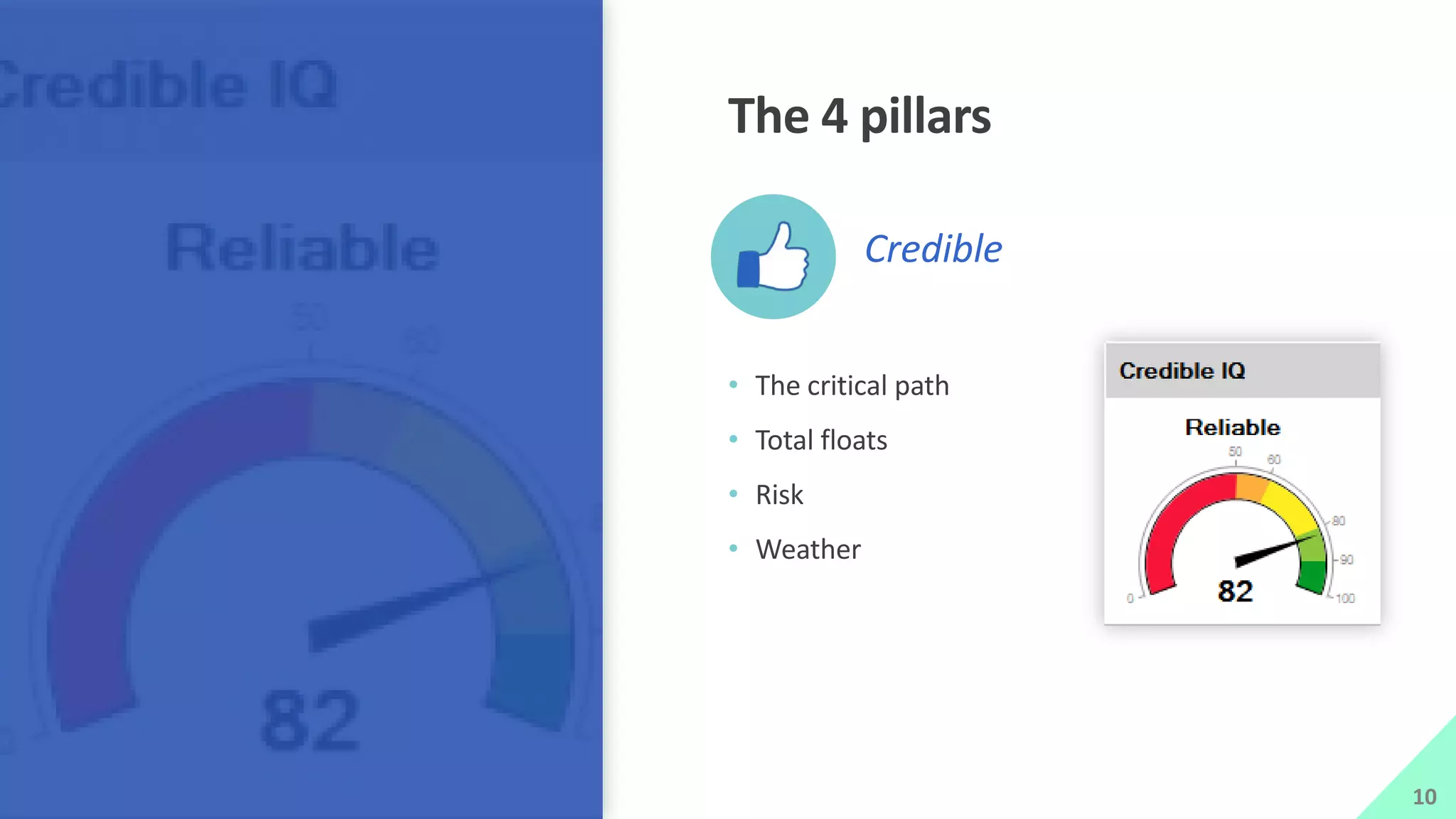
The 4 pillars
• The critical path
• Total floats
• Risk
• Weather
Credible
10
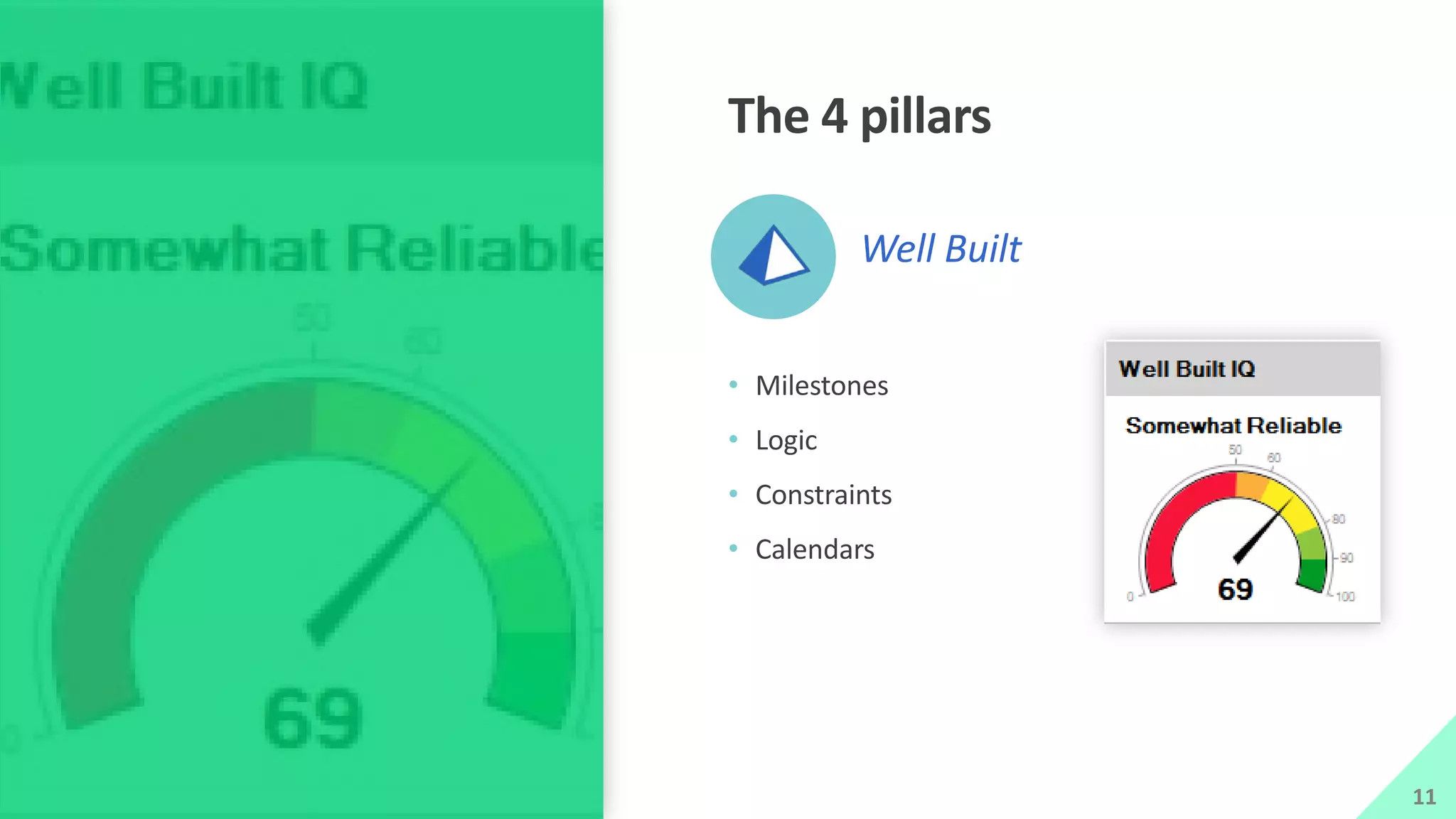
The 4 pillars
• Milestones
• Logic
• Constraints
• Calendars
Well Built
11
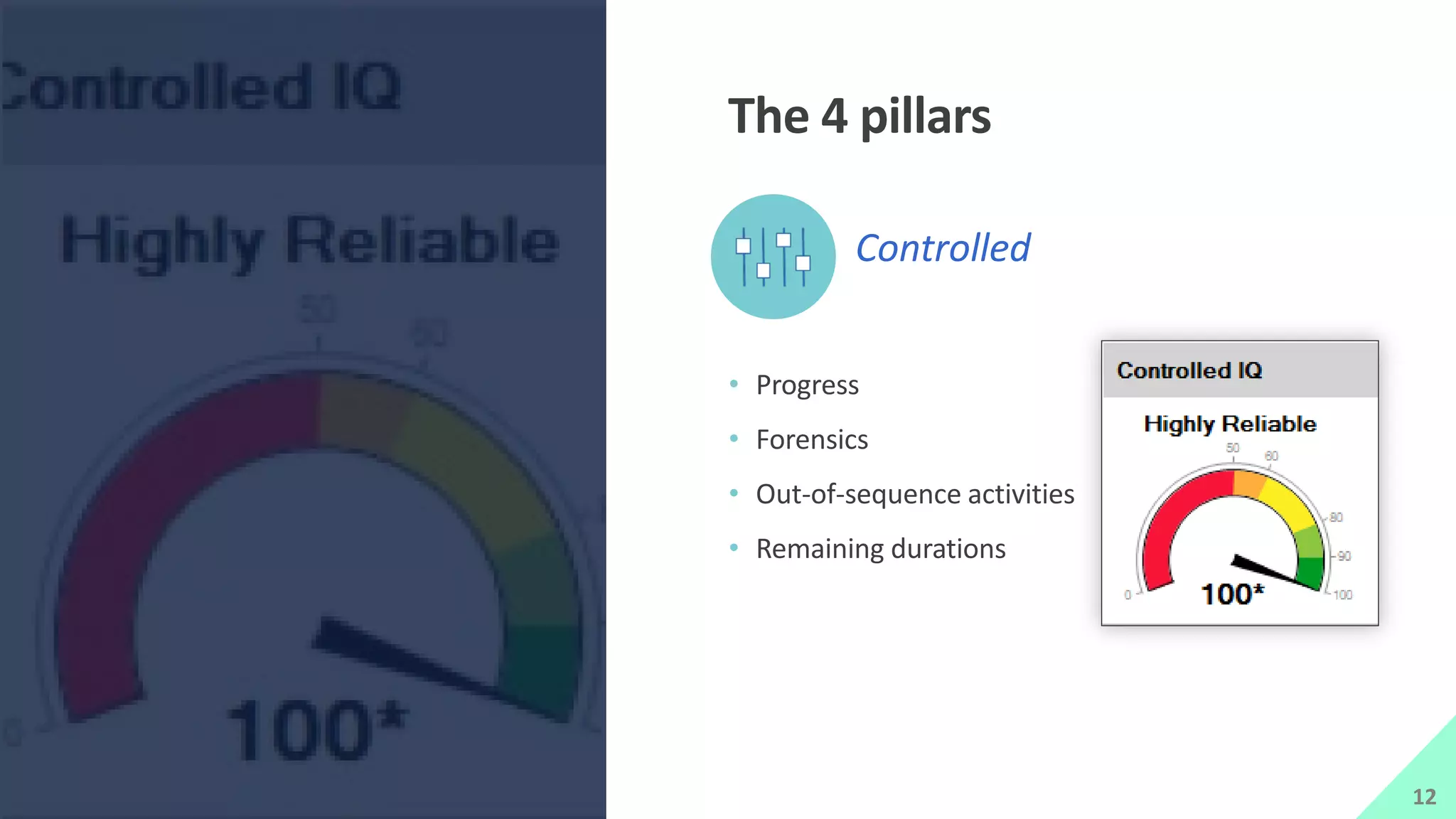
The 4 pillars
• Progress
• Forensics
• Out-of-sequence activities
• Remaining durations
Controlled
12
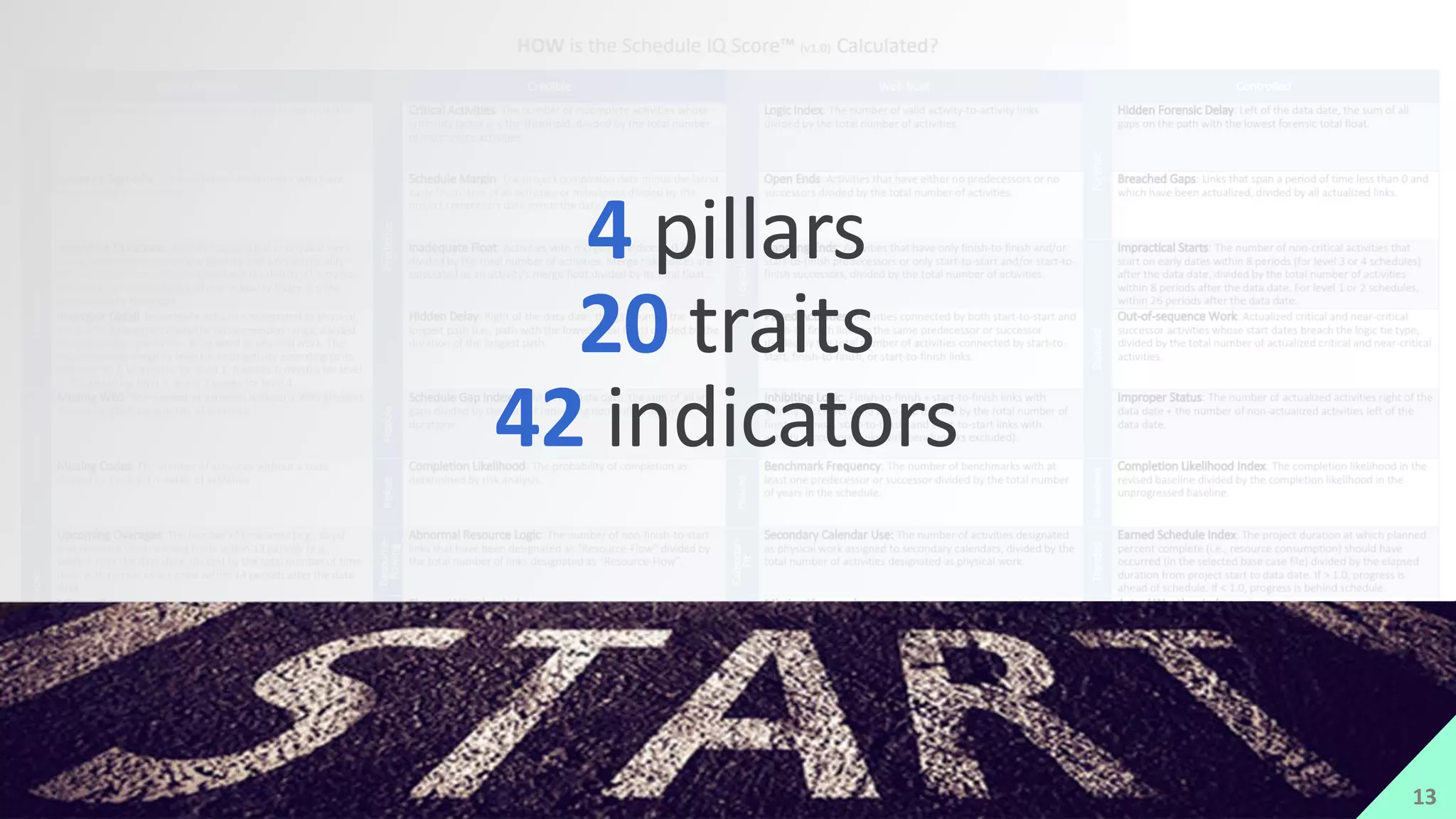
4 pillars
20 traits
42 indicators
13
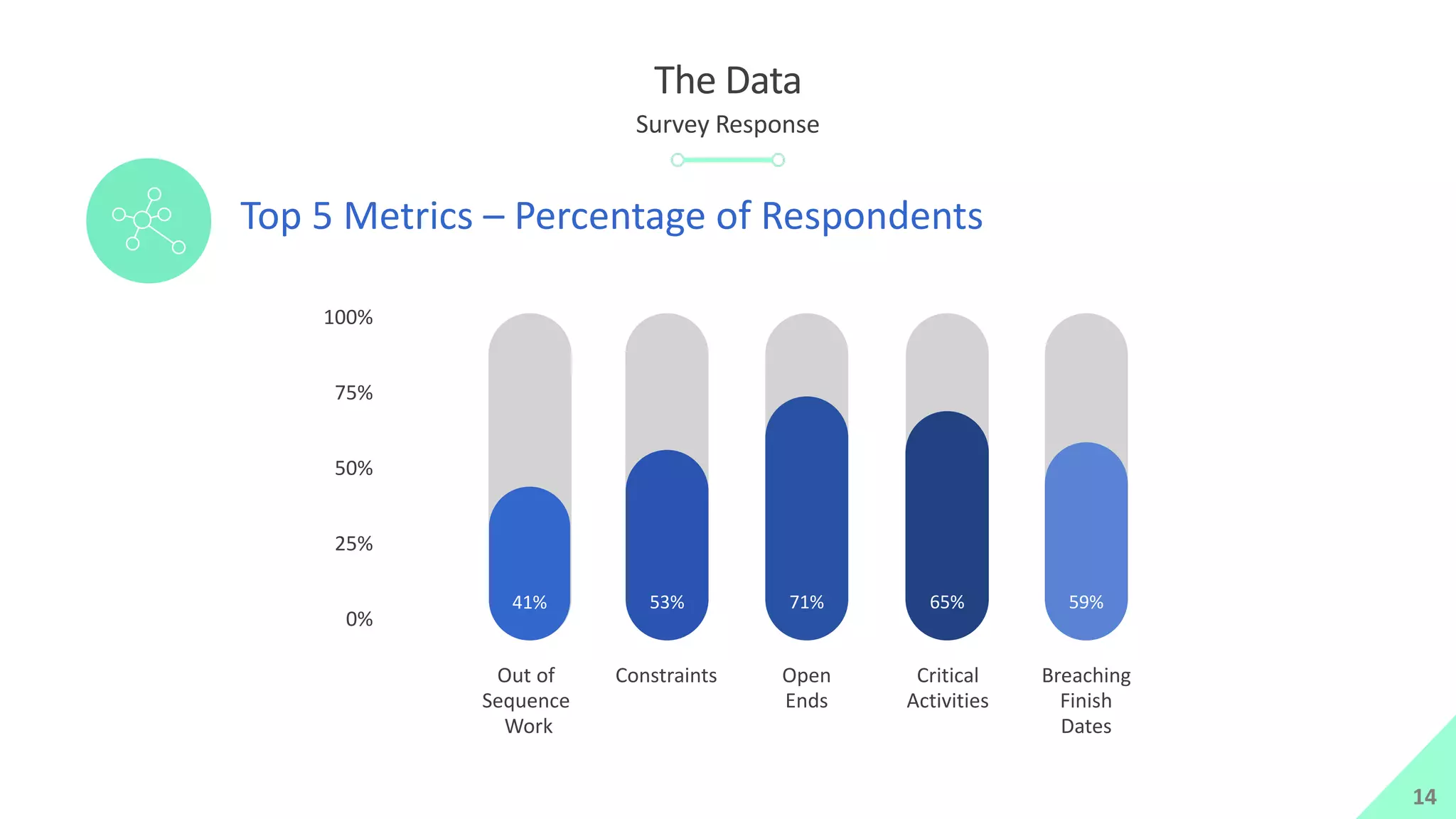
The Data
Survey Response
41% 53% 71% 65% 59%
Breaching
Finish
Dates
Critical
Activities
Open
Ends
ConstraintsOut of
Sequence
Work
100%
75%
50%
0%
25%
Top 5 Metrics – Percentage of Respondents
14
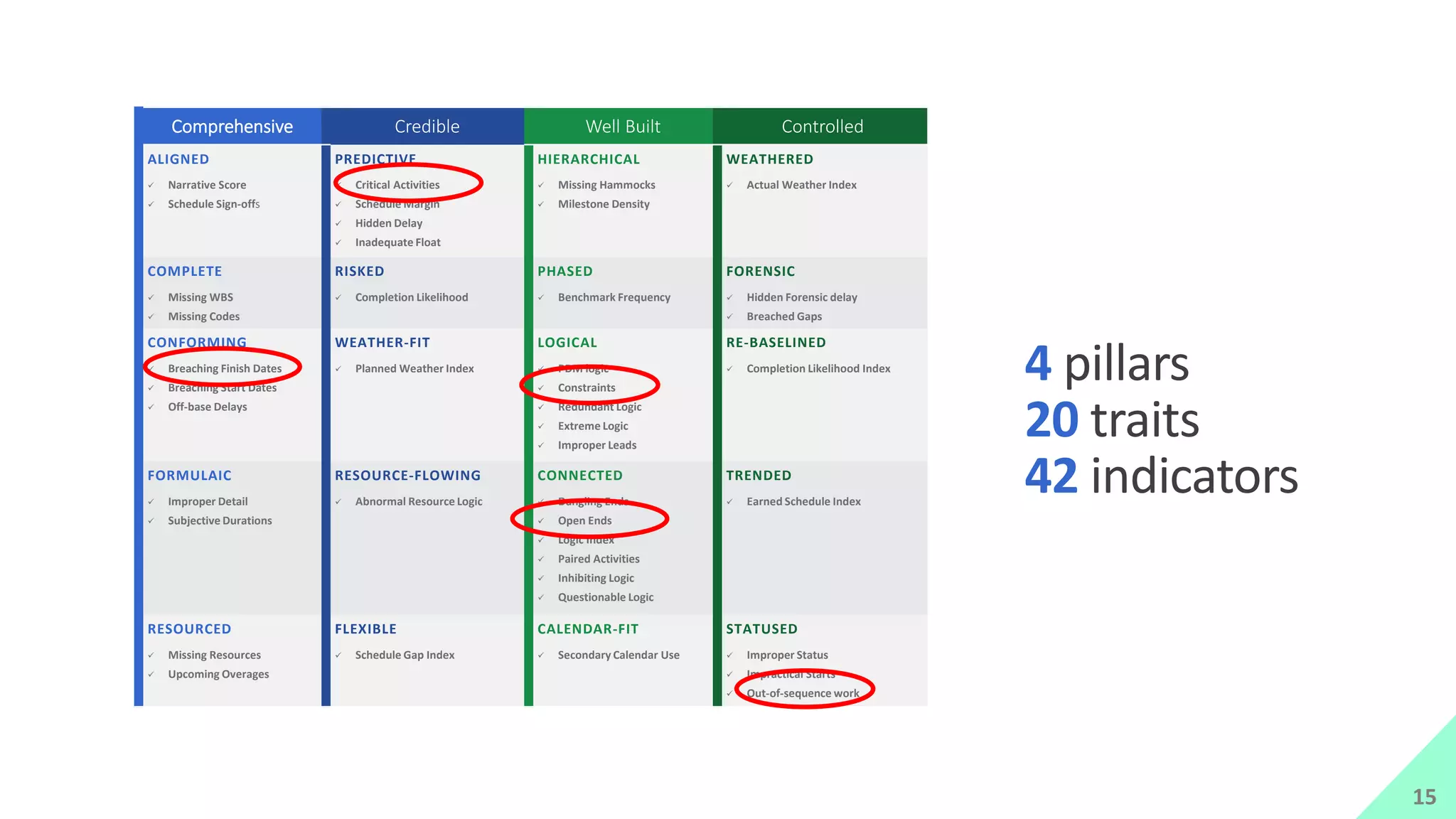
Comprehensive Credible Well Built Controlled
ALIGNED PREDICTIVE HIERARCHICAL WEATHERED
 Narrative Score
 Schedule Sign-offs
 Critical Activities
 Schedule Margin
 Hidden Delay
 Inadequate Float
 Missing Hammocks
 Milestone Density
 Actual Weather Index
COMPLETE RISKED PHASED FORENSIC
 Missing WBS
 Missing Codes
 Completion Likelihood  Benchmark Frequency  Hidden Forensic delay
 Breached Gaps
CONFORMING WEATHER-FIT LOGICAL RE-BASELINED
 Breaching Finish Dates
 Breaching Start Dates
 Off-base Delays
 Planned Weather Index  PDM logic
 Constraints
 Redundant Logic
 Extreme Logic
 Improper Leads
 Completion Likelihood Index
FORMULAIC RESOURCE-FLOWING CONNECTED TRENDED
 Improper Detail
 Subjective Durations
 Abnormal Resource Logic  Dangling Ends
 Open Ends
 Logic Index
 Paired Activities
 Inhibiting Logic
 Questionable Logic
 Earned Schedule Index
RESOURCED FLEXIBLE CALENDAR-FIT STATUSED
 Missing Resources
 Upcoming Overages
 Schedule Gap Index  Secondary Calendar Use  Improper Status
 Impractical Starts
 Out-of-sequence work
4 pillars
20 traits
42 indicators
15
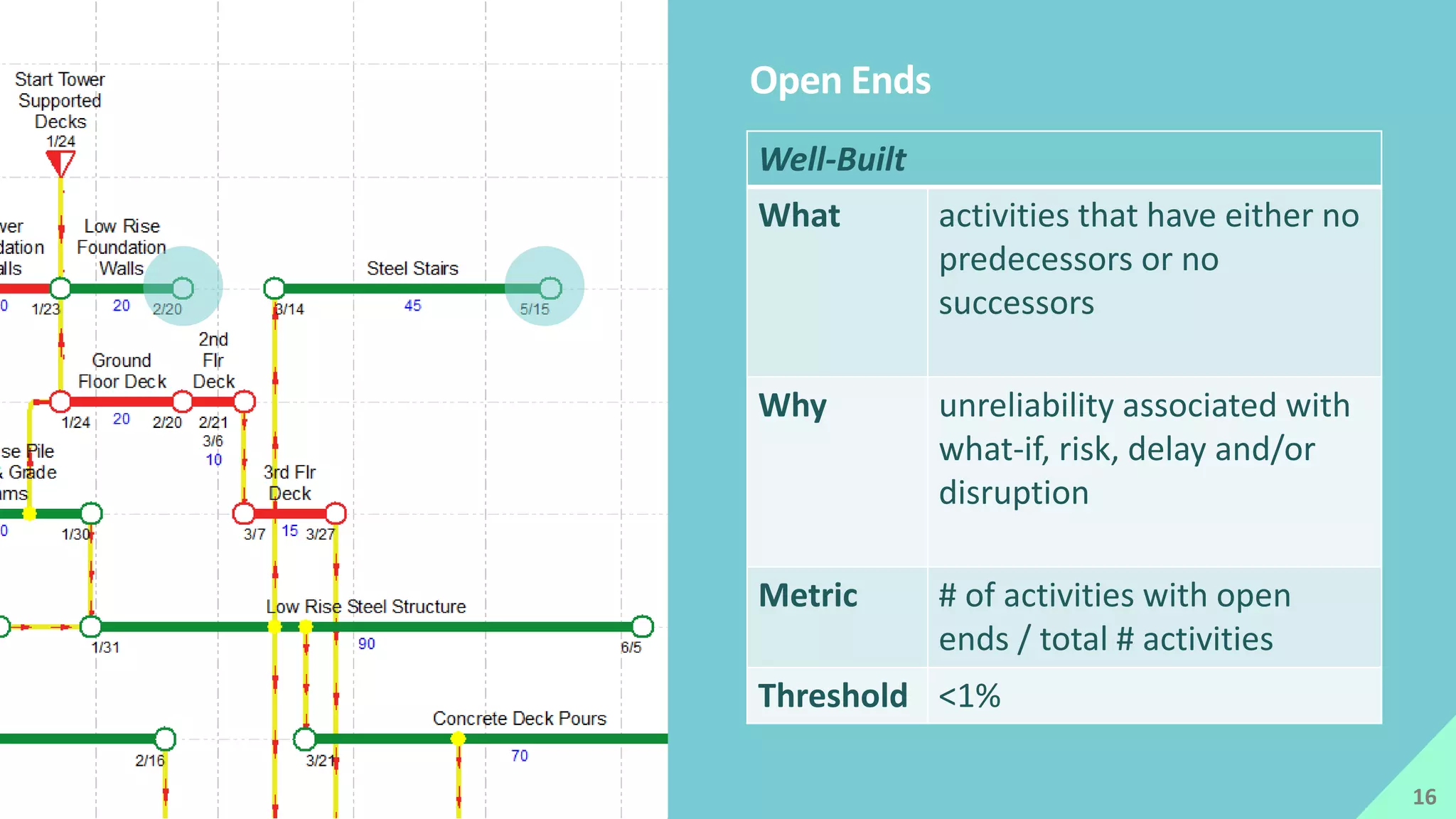
Open Ends
16
Well-Built
What activities that have either no
predecessors or no
successors
Why unreliability associated with
what-if, risk, delay and/or
disruption
Metric # of activities with open
ends / total # activities
Threshold <1%
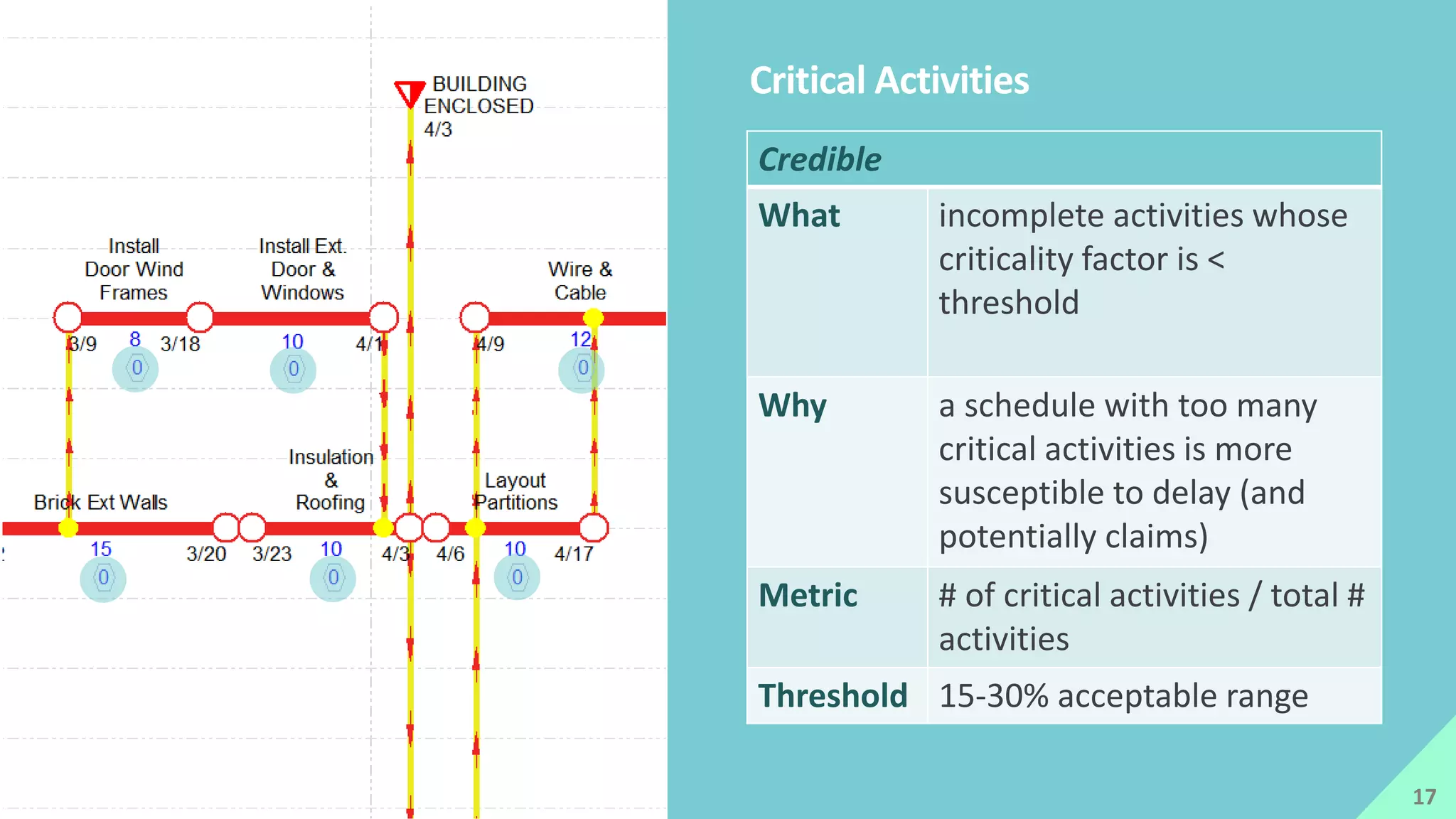
Credible
What incomplete activities whose
criticality factor is <
threshold
Why a schedule with too many
critical activities is more
susceptible to delay (and
potentially claims)
Metric # of critical activities / total #
activities
Threshold 15-30% acceptable range
Critical Activities
17
Comprehensive
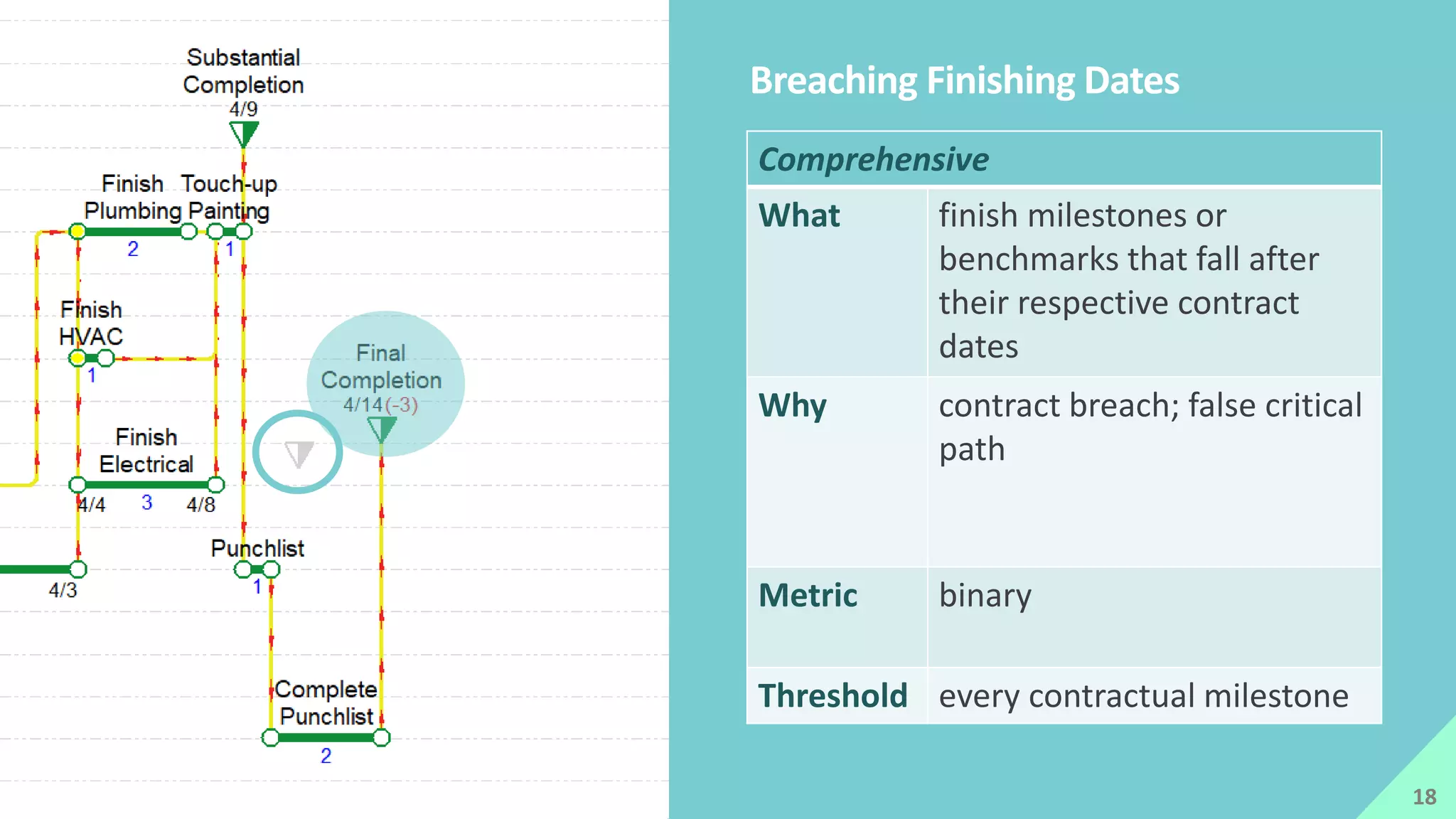
What finish milestones or
benchmarks that fall after
their respective contract
dates
Why contract breach; false critical
path
Metric binary
Threshold every contractual milestone
Breaching Finishing Dates
18
Well-Built
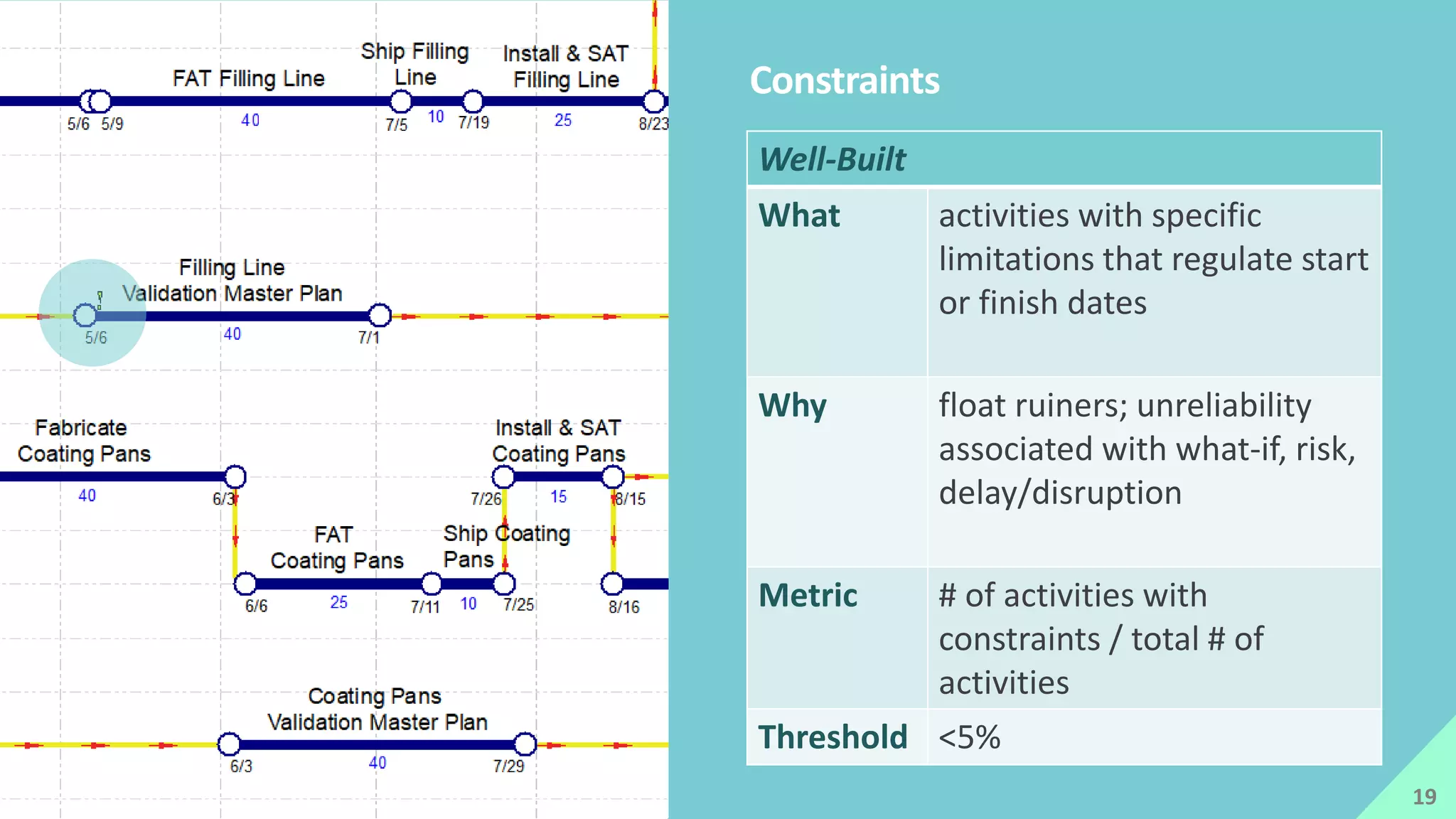
What activities with specific
limitations that regulate start
or finish dates
Why float ruiners; unreliability
associated with what-if, risk,
delay/disruption
Metric # of activities with
constraints / total # of
activities
Threshold <5%
Constraints
19
Controlled
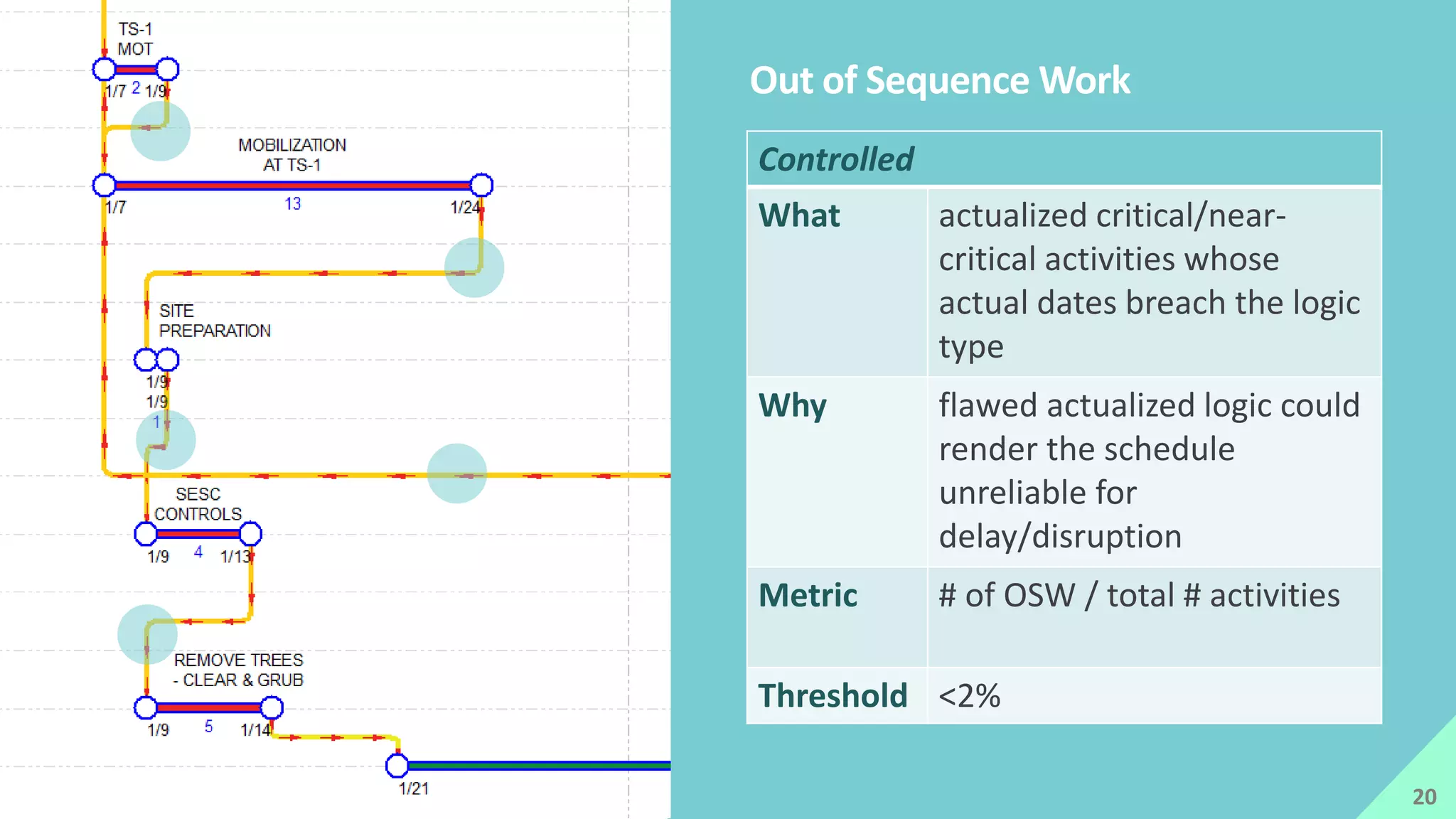
What actualized critical/near-
critical activities whose
actual dates breach the logic
type
Why flawed actualized logic could
render the schedule
unreliable for
delay/disruption
Metric # of OSW / total # activities
Threshold <2%
Out of Sequence Work
20
Q & A Time
Thank you – Any Questions?
21
Mike Brown, PMP
Managing Director, PMA Consultants
720-624-2401
mbrown@pmaconsultants.com

Top Five Metrics for Measuring Schedule Reliability

  • 1.
    Using Schedule MD™for Schedule Reliability Presented by: Mike Brown, PMP
  • 2.
    Presentation Agenda Problem statement1 Top5 metrics revealed5The importance of metrics2 Schedule MD overview3 2 Pillars and traits4
  • 3.
    Speaker Bio 3 Mike Brown,PMP Managing Director Denver, Colorado mbrown@pmaconsultants.com About the Presenter Mike has extensive experience in program and project management, quality management, engineering, and program and project controls. Mike has managed responsibilities that include strategic planning, engineering, construction, regulatory permitting and compliance, resource planning and management, quality audits and reviews, closeout, and other related administrative oversight functions.
  • 4.
    The Problem(s) Inadequate Planning / Engagement Complex Projectsand Systems Inexperienced Project Controls Managers “Inadequate planning is one of the major reasons why projects spin out of control.” Discenza, R. & Foreman, J.B. (2007). Seven causes of project failure 4 “The world's private and public sector leaders believe that a rapid escalation of ‘complexity’ is the biggest challenge confronting them. They expect it to continue — indeed, to accelerate — in the coming years Hass, K.B. & Lindbergh, L.B. 2010. Paper presented at PMI Global Congress “Too Many Projects, Not Enough Experienced Managers.” CIO from IDG / ESI International
  • 5.
    Why are schedulemetrics important? StakeholderEngagement Increase communication and understanding Simplification Reduce complexity through technology ImprovedUnderstanding Resources and tools increase schedulers understanding and awareness Better Schedules Codification allows for simpler best practice conformance 5
  • 6.
    What is ScheduleMD? A companion application to NetPoint® for analyzing and determining the reliability of schedules. 6
  • 7.
    What is theSchedule IQ™ Score? A value between 0 to 100 – comprised of 42 independent, weighted calculations derived from the 20-Trait Protocol – for communicating how reliable a schedule is. 7
  • 8.
    Comprehensive Credible WellBuilt Controlled ALIGNED PREDICTIVE HIERARCHICAL WEATHERED  Narrative Score  Schedule Sign-offs  Critical Activities  Schedule Margin  Hidden Delay  Inadequate Float  Missing Hammocks  Milestone Density  Actual Weather Index COMPLETE RISKED PHASED FORENSIC  Missing WBS  Missing Codes  Completion Likelihood  Benchmark Frequency  Hidden Forensic delay  Breached Gaps CONFORMING WEATHER-FIT LOGICAL RE-BASELINED  Breaching Finish Dates  Breaching Start Dates  Off-base Delays  Planned Weather Index  PDM logic  Constraints  Redundant Logic  Extreme Logic  Improper Leads  Completion Likelihood Index FORMULAIC RESOURCE-FLOWING CONNECTED TRENDED  Improper Detail  Subjective Durations  Abnormal Resource Logic  Dangling Ends  Open Ends  Logic Index  Paired Activities  Inhibiting Logic  Questionable Logic  Earned Schedule Index RESOURCED FLEXIBLE CALENDAR-FIT STATUSED  Missing Resources  Upcoming Overages  Schedule Gap Index  Secondary Calendar Use  Improper Status  Impractical Starts  Out-of-sequence work 4 pillars 20 traits 42 indicators 8
  • 9.
    The 4 pillars •Activities and their durations • Contract dates • Resource, code, and WBS assignments Comprehensive 9
  • 10.
    The 4 pillars •The critical path • Total floats • Risk • Weather Credible 10
  • 11.
    The 4 pillars •Milestones • Logic • Constraints • Calendars Well Built 11
  • 12.
    The 4 pillars •Progress • Forensics • Out-of-sequence activities • Remaining durations Controlled 12
  • 13.
  • 14.
    The Data Survey Response 41%53% 71% 65% 59% Breaching Finish Dates Critical Activities Open Ends ConstraintsOut of Sequence Work 100% 75% 50% 0% 25% Top 5 Metrics – Percentage of Respondents 14
  • 15.
    Comprehensive Credible WellBuilt Controlled ALIGNED PREDICTIVE HIERARCHICAL WEATHERED  Narrative Score  Schedule Sign-offs  Critical Activities  Schedule Margin  Hidden Delay  Inadequate Float  Missing Hammocks  Milestone Density  Actual Weather Index COMPLETE RISKED PHASED FORENSIC  Missing WBS  Missing Codes  Completion Likelihood  Benchmark Frequency  Hidden Forensic delay  Breached Gaps CONFORMING WEATHER-FIT LOGICAL RE-BASELINED  Breaching Finish Dates  Breaching Start Dates  Off-base Delays  Planned Weather Index  PDM logic  Constraints  Redundant Logic  Extreme Logic  Improper Leads  Completion Likelihood Index FORMULAIC RESOURCE-FLOWING CONNECTED TRENDED  Improper Detail  Subjective Durations  Abnormal Resource Logic  Dangling Ends  Open Ends  Logic Index  Paired Activities  Inhibiting Logic  Questionable Logic  Earned Schedule Index RESOURCED FLEXIBLE CALENDAR-FIT STATUSED  Missing Resources  Upcoming Overages  Schedule Gap Index  Secondary Calendar Use  Improper Status  Impractical Starts  Out-of-sequence work 4 pillars 20 traits 42 indicators 15
  • 16.
    Open Ends 16 Well-Built What activitiesthat have either no predecessors or no successors Why unreliability associated with what-if, risk, delay and/or disruption Metric # of activities with open ends / total # activities Threshold <1%
  • 17.
    Credible What incomplete activitieswhose criticality factor is < threshold Why a schedule with too many critical activities is more susceptible to delay (and potentially claims) Metric # of critical activities / total # activities Threshold 15-30% acceptable range Critical Activities 17
  • 18.
    Comprehensive What finish milestonesor benchmarks that fall after their respective contract dates Why contract breach; false critical path Metric binary Threshold every contractual milestone Breaching Finishing Dates 18
  • 19.
    Well-Built What activities withspecific limitations that regulate start or finish dates Why float ruiners; unreliability associated with what-if, risk, delay/disruption Metric # of activities with constraints / total # of activities Threshold <5% Constraints 19
  • 20.
    Controlled What actualized critical/near- criticalactivities whose actual dates breach the logic type Why flawed actualized logic could render the schedule unreliable for delay/disruption Metric # of OSW / total # activities Threshold <2% Out of Sequence Work 20
  • 21.
    Q & ATime Thank you – Any Questions? 21
  • 22.
    Mike Brown, PMP ManagingDirector, PMA Consultants 720-624-2401 mbrown@pmaconsultants.com