Dr. SONI BISTA
1ST YEAR PG STUDENT
PERIODONTOLOGY AND ORA
IMPLANTOLOGY
UNDER THE GUIDANCE:
Assoc.Prof.Dr.MANDEEP SINGH
DINGRA
Asst.Prof.Dr.BIKASH KUMAR
DEFINITION
OVERVIEW OF DEVELOPMENT OF
TOOTH
ROOT FORMATION
STAGES IN TOOTH GROWTH
SIGNALING IN TOOTH DEVELOPMENT
CEMENTOGENESIS
PDL FORMATION
ALVEOLAR BONE FORMATION
DENTINOGINGIVAL JUNCTION
FORMATION
CLINICAL CONSIDERATION
CONCLUSION
REFERENCES
PERIODONTIUM
GREEK MEANING: “PERI”_AROUND
“ODONT”_TOOTH
“Tissue investing and supporting the
teeth consists of Cementum, PDL, bone
lining the alveolus and that part of the
gingiva facing the tooth”_Tencate 5th edi.
“Tissue supporting the tooth are developmentally derived from the
dental follicle proper, whereas those investing the tooth, that is
gingiva, are an adaptation of oral mucosa”
_Richard ten Cate
OVERVIEWOF DEVELOPMENT OF
TOOTH
NEURAL CREST DEVELOPMENT
3 germ layer..
Neural plate within ectoderm..
Neural tubes…
Neural crest cells…
D
E
R
I
V
A
T
I
V
E
S
PRIMARY EPITHELIAL BAND
After 37 days of development
A continuous band of thickened epithelium forms around the
mouth in upper and lower jaws
This band are roughly horseshoe shaped
Corresponds in position to the future dental arches of upper and
lower jaws
Each band of epithelium called as primary epithelial band
(Gives rise to)
DENTAL LAMINA VESTIBULAR LAMINA
(At about 7th
week)
• First evidence of tooth development.
• Continued and localized proliferative activity lead to formation of a
series of epithelial ingrowth into the ectomesenchyme at the sites
corresponding to the position of the future deciduous teeth.
FATE: Total activity is about 5 years
Eventually, the dental lamina disintegrates into small clusters of epithelium and is
resorbed. In situations when the clusters are not resorbed, (this remnant of
the dental lamina is sometimes known as the cell rest of Serres) eruption
cysts are formed over the developing tooth and delay its eruption into the oral
cavity.
• From this, tooth development proceeds
in 3 stages: bud stage,
cap stage,
bell stage.
DENTAL LAMINA
VESTIBULAR LAMINA:
The vestibule forms as a
result of proliferation of
vestibular lamina into the
ectomesenchyme
BUD STAGE
8TH
WEEK
Represented by 1st
epithelial incursion into the
ectomesenchyme of the
jaw.
Supporting
ectomesenchymal cells are
closely packed beneath and
around the epithelial bud…
CAP STAGE
9-10
WEEKS
CONDENSATION
OF
ECTOMESENCHYM
E
DENTAL ORGAN
DENTAL PAPILLA
DENTAL FOLLICLE
Proliferative
stage
Epithelial bud_proliferate into
ectomesenchyme
BELL
STAGE
11-12TH
WEEK
OUTER
DENTAL
EPITHEL
IUM
STRATU
M
RECTIC
ULUM
STRATU
M
INTERM
EDIUM
INNER
DENTAL
EPITHELI
UM
Histodifferentiati
on and
morphodifferent
ion
glycosaminog
lycans
CERVI
CAL
LOOP
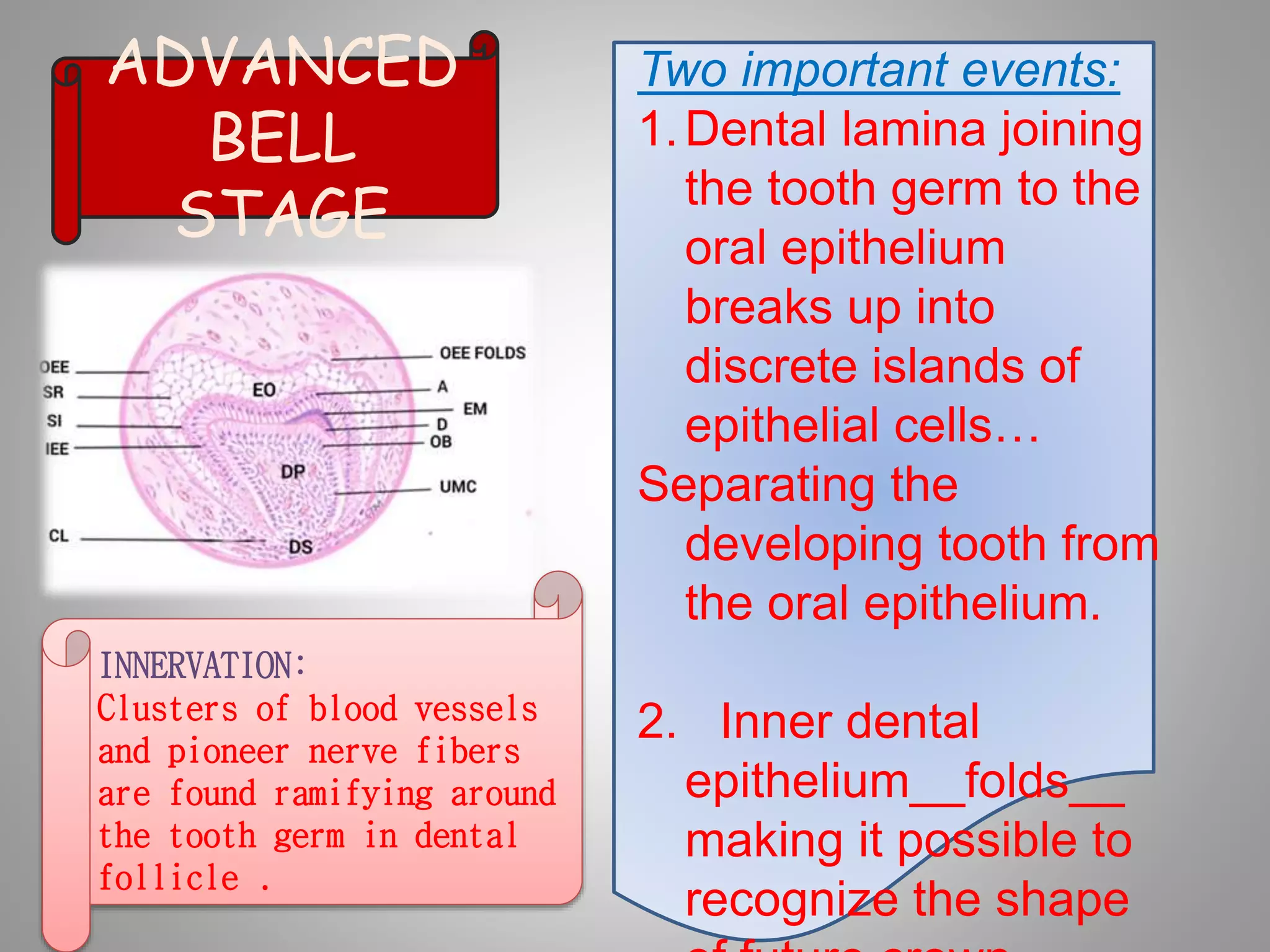
ADVANCED
BELL
STAGE
Two important events:
1.Dental lamina joining
the tooth germ to the
oral epithelium
breaks up into
discrete islands of
epithelial cells…
Separating the
developing tooth from
the oral epithelium.
2. Inner dental
epithelium__folds__
making it possible to
recognize the shape
INNERVATION:
Clusters of blood vessels
and pioneer nerve fibers
are found ramifying around
the tooth germ in dental
follicle .
ROOT
FORMATION
Major function of HERS(Schour and Massler)
Induce and regulate root formation including
the size, shape, number of root.
HERS characters:
1. Consists of inner and outer enamel epithelium
only.
Inner
cells(short in size) cells in coronal
root
region
Differentiation of radicular differentiation of
Papilla cells dental follicle
Odontoblasts cementoblasts
First layer of acellular
cementum
radicular dentin.
Hertwig’ epithelial
root sheath
 Cementum is the calcified, avascular
mesenchymal tissue that forms
the outer covering of the anatomic root.
 Latin: “Caementum”:quarried stone[i.e. Chips
of stone used in making mortar]
 It was first demonstrated microscopically in
1835 by two pupils of purkinje.
 It is a specialized connective tissue that
shares some physical, chemical & structural
characteristics with compact bone.
cEmEnTum
CEMENTOGENESIS
 Cementum is deposited on the surface of root dentin
 HERS Hyaline layer of Hopewell-Smith/Intermediate Cementum
(after basement supporting root sheath breaks up)
• Secrete distinct class of enamel protein in the gap between collagen
fibers(from mantle dentin) and basement membrane.
This layer contains product of epithelial cell activity/form of enameloid
Thus the dentin of the root surface is covered by an epithelial product
of the root sheath cells that is more mineralized than other dentin.
+
Functions to “cement” cementum into dentin as well as
provide the initial attachment of ligament fibrils to the tooth.
[Hertwig’s epithelial root sheath is broken up &
separated from root, and differentiation of
cementoblasts lead to formation of cementum]
Cementogenesis….
• Root sheath fragments into network that allows:
follicular cells to pass through it + it comes into
apposition with newly formed root surface.
differentiate into cememtoblasts
deposit
organic matrix against root surface and around forming
ligament fiber bundles/extrinsic fibers.
mineralization of this matrix is called cementoid

occurs with deposition of apatite crystals
initially is matrix vesicles
followed by mineralization of collagen fibrils.
Growth factor families involved in the differentiation
of cemetoblasts from dental follicle....
TGFβ 1-5
BMP2-8
EGF & IGF
PGE2 & PGF2α enhance
differentiation by activating
protein kinase cell signalling
pathway
Fibroblast growth factor
promotes proliferation, migration
& angiogenesis
CAP, BSP and osteopontine helps
in attachment of differentiated
cells to newly forming tissue
PRIMARY CEMENTUM
 First formed cementum is acellular
 Develops slowly as tooth is erupting
 Covers coronal two third of the root
 Highly calcified.
 Its collagenous component may be derived entirely
from extrinsic fibers of the PDL(Sharpey’ fiber)
 Also contain intrinsic fibers that are calcified and
irregularly arranged or parallel to the surface.
SECONDARY CEMENTUM
 Develops after tooth is in occlusion.
 Rapidly formed and less mineralized
 Deposited around apical two third of the root.
 Cellular as cementoblasts gets trapped in lacunae within
matrix they form.
 Its Organic matrix contains collagen fibers derived from
2 sources extrinsic fibers of PDL_are arranged obliquely
as
they enter cementum.
intinsic fibers(formed as a result of
cementoblastic activity)__are parallel to root.
 Secondary cementum formation is a continuous process
Thus thickness of cementum on root surface increases with
age.
FATE OF HERS…
Fragmentation of root sheath
disruption of its basal lamina
some cell are lost Most cells persists as
strands/clusters
(transform into mesenchymal cells) (where collagen are
trapped)
called as epithelial
rests of malassez
-dark staining nuclei and little
PDL formation
• After root formation_dental follicle PDL
• In front of forming PDL increase rate of cell division
fibroblasts
collagen fibrils of PDL
(oblique orientation)
+
ground substancesof PDL
•Rearrangement of fiber ends in the
plexus is supposed to accommodate tooth
eruption without necessitating the
embedding of new fibers into tooth and
the bone.
BEFORE TOOTH
ERUPTION:
•Crests of alveolar bone
is above CEJ
•Developing fiber
bundles of PDL are all
directed obliquely.
•More apical orientation
DURING TOOTH ERUPTION:
•Level of alveolar crest comes to
coincide with CEJ
•Oblique fibers below the free
gingival fibers becomes horizontally
aligned called as alveolar crest
fibers.
•More coronal orientation.
TEETH IN
FUNCTION:
•Fiber bundles of
PDL thickens and
are constantly
remodeled by
fibroblasts
PDL homeostasis
 A remarkable capacity of PDL is that it maintains its width more or less,
despite the fact, it is squeezed in between two hard tissues.
 Various molecules have been proposed, which play a role in maintaining
an unmineralized PDL.
Msx2
Bone sialoprotein
Matrix Gla protein
(Inhibitors of
mineralization)
• Inhibit mineralized bone tissue
• Prevents osteogening
differentiation of PDL fibroblasts
by repressing cbfa1 activity
• osteopontin
Prostaglandins
ALVEOLAR PROCESS
 It is the portion of maxilla and mandible that forms and
support the tooth socket(alveoli)
 It develops and undergoes remodeling with tooth
formation and eruption; they are dependent bony
structure.
 It forms when the tooth erupts to provide the osseous
attachment to the forming PDL & it disappears
gradually after the tooth is lost.
As PDL is
forming;
new bone
deposition
takes place
around developing
Ligament fiber
bundles against
crypt walls
Cells migrate into PDL from bone
marrow
(by way of vascular channels)
Occupy perivascular location
within PDL
Reinforce the resident
perivascular cells
To provide daughter cells
Migrate to bone and cementum
Differentiate into osteoblast and
cementoblast and also PDL
fibroblast.
Intramembranous
ossification
Formation of
bone matrix
Formation of
woven bone
Appositional growth
& formation of
harvesian system
(osteon)
Endochondral
bone formation
Formation of
cartiagenous
model
Stages of Intramembranous Ossification
Formation
of bone
collar
around
hyaline
cartilage
model.
1
2
3
4
Invasion of
internal cavities
by the
periosteal bud
and spongy
bone formation.
5Formation of the
medullary cavity as
ossification continues;
appearance of
secondary ossification
centers in the epiphyses
in preparation for stage
5.
Hyaline
cartilage
Primary
ossification
center
Bone
collar
Deteriorating
cartilage matrix
Spongy
bone
formation
Blood
vessel of
periosteal
bud
Secondary
ossification
center
Epiphyseal
blood vessel
Medullary
cavity
Epiphyseal
plate
cartilage
Spongy bone
Articular
cartilage
Stages of Endochondral Ossification
Cavitation
of the
hyaline
cartilage
within the
cartilage
model.
Ossification of the
epiphyses; when
completed, hyaline
cartilage remains only
in the epiphyseal plates
and articular cartilages
GINGIVA
Gingiva is the part of the oral
mucosa that covers the alveolar
processes of the jaws and tooth root
to a level just coronal to CEJ_McCall
DENTOGINGIVAL
JUNCTION
• The epithelium of the gingiva which gets attached
to the tooth is called as junctional or attachment
epithelium.
• Consists of collarlike band of stratified squamous
nonkeratinizing epithelium.
• Forms an epithelial barrier against bacteria.
JUNCTIONAL EPITHELIUM
DEVELOPMENT OF JUNCTIONAL
EPITHELIUM AND GINGIVAL
SULCUS
STAGES OF PASSIVE
ERUPTION
The teeth reach the
line of occlusion.
J.E and base of
gingival sulcus are on
the enamel
Stage 1
STAGES OF PASSIVE
ERUPTION
J.E proliferates so that
part is on cementum
and part is on enamel.
Stage 2
STAGES OF PASSIVE
ERUPTION
 Entire J.E is on
cementum and base of
the sulcus is at CEJ.
As J.E proliferates
from the crown into the
root,it doesnot remain
at CEJ any longer than
at any other area of the
tooth.
Stage 3
STAGES OF PASSIVE
ERUPTION
 J.E has
proliferated farther
on the cementum.
the base of the sulcus is on
the cementum, a portion of
which is exposed.
Proliferation of the J.E onto
the root is accompained by
degeneration of gingival and
PDL fibers and their
detachment from the tooth.
Stage 4
DURINGINITIATION
DURINGMORPHODIFFERENTIATION
CLINICAL
SIGNIFICANCE
CONCLUSION
The widespread occurrence of
periodontal disease and the realization
that periodontal tissue lost to the
disease can be repaired has resulted
in considerable effort to understand the
factors and cells regulating the
formation,maintenance and
REFERENCES
• Carranza’s clinical
periodontology,11th edition
• Orban’s oral histology and
embryology,12th edition.
• Oral
histology:development,structure
and function,A.R Tencate,4th
edition.
• Oral development and
Development of tooth and periodontium

Development of tooth and periodontium

  • 2.
    Dr. SONI BISTA 1STYEAR PG STUDENT PERIODONTOLOGY AND ORA IMPLANTOLOGY UNDER THE GUIDANCE: Assoc.Prof.Dr.MANDEEP SINGH DINGRA Asst.Prof.Dr.BIKASH KUMAR
  • 4.
    DEFINITION OVERVIEW OF DEVELOPMENTOF TOOTH ROOT FORMATION STAGES IN TOOTH GROWTH SIGNALING IN TOOTH DEVELOPMENT CEMENTOGENESIS PDL FORMATION ALVEOLAR BONE FORMATION DENTINOGINGIVAL JUNCTION FORMATION CLINICAL CONSIDERATION CONCLUSION REFERENCES
  • 6.
    PERIODONTIUM GREEK MEANING: “PERI”_AROUND “ODONT”_TOOTH “Tissueinvesting and supporting the teeth consists of Cementum, PDL, bone lining the alveolus and that part of the gingiva facing the tooth”_Tencate 5th edi. “Tissue supporting the tooth are developmentally derived from the dental follicle proper, whereas those investing the tooth, that is gingiva, are an adaptation of oral mucosa” _Richard ten Cate
  • 7.
  • 8.
    NEURAL CREST DEVELOPMENT 3germ layer.. Neural plate within ectoderm.. Neural tubes… Neural crest cells…
  • 9.
  • 10.
    PRIMARY EPITHELIAL BAND After37 days of development A continuous band of thickened epithelium forms around the mouth in upper and lower jaws This band are roughly horseshoe shaped Corresponds in position to the future dental arches of upper and lower jaws Each band of epithelium called as primary epithelial band (Gives rise to) DENTAL LAMINA VESTIBULAR LAMINA (At about 7th week)
  • 13.
    • First evidenceof tooth development. • Continued and localized proliferative activity lead to formation of a series of epithelial ingrowth into the ectomesenchyme at the sites corresponding to the position of the future deciduous teeth. FATE: Total activity is about 5 years Eventually, the dental lamina disintegrates into small clusters of epithelium and is resorbed. In situations when the clusters are not resorbed, (this remnant of the dental lamina is sometimes known as the cell rest of Serres) eruption cysts are formed over the developing tooth and delay its eruption into the oral cavity. • From this, tooth development proceeds in 3 stages: bud stage, cap stage, bell stage. DENTAL LAMINA VESTIBULAR LAMINA: The vestibule forms as a result of proliferation of vestibular lamina into the ectomesenchyme
  • 14.
    BUD STAGE 8TH WEEK Represented by1st epithelial incursion into the ectomesenchyme of the jaw. Supporting ectomesenchymal cells are closely packed beneath and around the epithelial bud…
  • 15.
    CAP STAGE 9-10 WEEKS CONDENSATION OF ECTOMESENCHYM E DENTAL ORGAN DENTALPAPILLA DENTAL FOLLICLE Proliferative stage Epithelial bud_proliferate into ectomesenchyme
  • 16.
  • 17.
    ADVANCED BELL STAGE Two important events: 1.Dentallamina joining the tooth germ to the oral epithelium breaks up into discrete islands of epithelial cells… Separating the developing tooth from the oral epithelium. 2. Inner dental epithelium__folds__ making it possible to recognize the shape INNERVATION: Clusters of blood vessels and pioneer nerve fibers are found ramifying around the tooth germ in dental follicle .
  • 19.
    ROOT FORMATION Major function ofHERS(Schour and Massler) Induce and regulate root formation including the size, shape, number of root. HERS characters: 1. Consists of inner and outer enamel epithelium only. Inner cells(short in size) cells in coronal root region Differentiation of radicular differentiation of Papilla cells dental follicle Odontoblasts cementoblasts First layer of acellular cementum radicular dentin. Hertwig’ epithelial root sheath
  • 23.
     Cementum isthe calcified, avascular mesenchymal tissue that forms the outer covering of the anatomic root.  Latin: “Caementum”:quarried stone[i.e. Chips of stone used in making mortar]  It was first demonstrated microscopically in 1835 by two pupils of purkinje.  It is a specialized connective tissue that shares some physical, chemical & structural characteristics with compact bone. cEmEnTum
  • 24.
    CEMENTOGENESIS  Cementum isdeposited on the surface of root dentin  HERS Hyaline layer of Hopewell-Smith/Intermediate Cementum (after basement supporting root sheath breaks up) • Secrete distinct class of enamel protein in the gap between collagen fibers(from mantle dentin) and basement membrane. This layer contains product of epithelial cell activity/form of enameloid Thus the dentin of the root surface is covered by an epithelial product of the root sheath cells that is more mineralized than other dentin. + Functions to “cement” cementum into dentin as well as provide the initial attachment of ligament fibrils to the tooth.
  • 26.
    [Hertwig’s epithelial rootsheath is broken up & separated from root, and differentiation of cementoblasts lead to formation of cementum]
  • 27.
    Cementogenesis…. • Root sheathfragments into network that allows: follicular cells to pass through it + it comes into apposition with newly formed root surface. differentiate into cememtoblasts deposit organic matrix against root surface and around forming ligament fiber bundles/extrinsic fibers. mineralization of this matrix is called cementoid  occurs with deposition of apatite crystals initially is matrix vesicles followed by mineralization of collagen fibrils.
  • 28.
    Growth factor familiesinvolved in the differentiation of cemetoblasts from dental follicle.... TGFβ 1-5 BMP2-8 EGF & IGF PGE2 & PGF2α enhance differentiation by activating protein kinase cell signalling pathway Fibroblast growth factor promotes proliferation, migration & angiogenesis CAP, BSP and osteopontine helps in attachment of differentiated cells to newly forming tissue
  • 29.
    PRIMARY CEMENTUM  Firstformed cementum is acellular  Develops slowly as tooth is erupting  Covers coronal two third of the root  Highly calcified.  Its collagenous component may be derived entirely from extrinsic fibers of the PDL(Sharpey’ fiber)  Also contain intrinsic fibers that are calcified and irregularly arranged or parallel to the surface.
  • 30.
    SECONDARY CEMENTUM  Developsafter tooth is in occlusion.  Rapidly formed and less mineralized  Deposited around apical two third of the root.  Cellular as cementoblasts gets trapped in lacunae within matrix they form.  Its Organic matrix contains collagen fibers derived from 2 sources extrinsic fibers of PDL_are arranged obliquely as they enter cementum. intinsic fibers(formed as a result of cementoblastic activity)__are parallel to root.  Secondary cementum formation is a continuous process Thus thickness of cementum on root surface increases with age.
  • 31.
    FATE OF HERS… Fragmentationof root sheath disruption of its basal lamina some cell are lost Most cells persists as strands/clusters (transform into mesenchymal cells) (where collagen are trapped) called as epithelial rests of malassez -dark staining nuclei and little
  • 33.
    PDL formation • Afterroot formation_dental follicle PDL • In front of forming PDL increase rate of cell division fibroblasts collagen fibrils of PDL (oblique orientation) + ground substancesof PDL
  • 35.
    •Rearrangement of fiberends in the plexus is supposed to accommodate tooth eruption without necessitating the embedding of new fibers into tooth and the bone.
  • 36.
    BEFORE TOOTH ERUPTION: •Crests ofalveolar bone is above CEJ •Developing fiber bundles of PDL are all directed obliquely. •More apical orientation DURING TOOTH ERUPTION: •Level of alveolar crest comes to coincide with CEJ •Oblique fibers below the free gingival fibers becomes horizontally aligned called as alveolar crest fibers. •More coronal orientation. TEETH IN FUNCTION: •Fiber bundles of PDL thickens and are constantly remodeled by fibroblasts
  • 37.
    PDL homeostasis  Aremarkable capacity of PDL is that it maintains its width more or less, despite the fact, it is squeezed in between two hard tissues.  Various molecules have been proposed, which play a role in maintaining an unmineralized PDL. Msx2 Bone sialoprotein Matrix Gla protein (Inhibitors of mineralization) • Inhibit mineralized bone tissue • Prevents osteogening differentiation of PDL fibroblasts by repressing cbfa1 activity • osteopontin Prostaglandins
  • 39.
    ALVEOLAR PROCESS  Itis the portion of maxilla and mandible that forms and support the tooth socket(alveoli)  It develops and undergoes remodeling with tooth formation and eruption; they are dependent bony structure.  It forms when the tooth erupts to provide the osseous attachment to the forming PDL & it disappears gradually after the tooth is lost.
  • 40.
    As PDL is forming; newbone deposition takes place around developing Ligament fiber bundles against crypt walls Cells migrate into PDL from bone marrow (by way of vascular channels) Occupy perivascular location within PDL Reinforce the resident perivascular cells To provide daughter cells Migrate to bone and cementum Differentiate into osteoblast and cementoblast and also PDL fibroblast.
  • 41.
    Intramembranous ossification Formation of bone matrix Formationof woven bone Appositional growth & formation of harvesian system (osteon) Endochondral bone formation Formation of cartiagenous model
  • 42.
  • 43.
  • 44.
  • 45.
  • 46.
    Formation of bone collar around hyaline cartilage model. 1 2 3 4 Invasion of internalcavities by the periosteal bud and spongy bone formation. 5Formation of the medullary cavity as ossification continues; appearance of secondary ossification centers in the epiphyses in preparation for stage 5. Hyaline cartilage Primary ossification center Bone collar Deteriorating cartilage matrix Spongy bone formation Blood vessel of periosteal bud Secondary ossification center Epiphyseal blood vessel Medullary cavity Epiphyseal plate cartilage Spongy bone Articular cartilage Stages of Endochondral Ossification Cavitation of the hyaline cartilage within the cartilage model. Ossification of the epiphyses; when completed, hyaline cartilage remains only in the epiphyseal plates and articular cartilages
  • 48.
    GINGIVA Gingiva is thepart of the oral mucosa that covers the alveolar processes of the jaws and tooth root to a level just coronal to CEJ_McCall
  • 49.
    DENTOGINGIVAL JUNCTION • The epitheliumof the gingiva which gets attached to the tooth is called as junctional or attachment epithelium. • Consists of collarlike band of stratified squamous nonkeratinizing epithelium. • Forms an epithelial barrier against bacteria. JUNCTIONAL EPITHELIUM
  • 50.
  • 52.
    STAGES OF PASSIVE ERUPTION Theteeth reach the line of occlusion. J.E and base of gingival sulcus are on the enamel Stage 1
  • 53.
    STAGES OF PASSIVE ERUPTION J.Eproliferates so that part is on cementum and part is on enamel. Stage 2
  • 54.
    STAGES OF PASSIVE ERUPTION Entire J.E is on cementum and base of the sulcus is at CEJ. As J.E proliferates from the crown into the root,it doesnot remain at CEJ any longer than at any other area of the tooth. Stage 3
  • 55.
    STAGES OF PASSIVE ERUPTION J.E has proliferated farther on the cementum. the base of the sulcus is on the cementum, a portion of which is exposed. Proliferation of the J.E onto the root is accompained by degeneration of gingival and PDL fibers and their detachment from the tooth. Stage 4
  • 57.
  • 58.
  • 59.
  • 60.
    CONCLUSION The widespread occurrenceof periodontal disease and the realization that periodontal tissue lost to the disease can be repaired has resulted in considerable effort to understand the factors and cells regulating the formation,maintenance and
  • 61.
    REFERENCES • Carranza’s clinical periodontology,11thedition • Orban’s oral histology and embryology,12th edition. • Oral histology:development,structure and function,A.R Tencate,4th edition. • Oral development and

Editor's Notes

  • #16 At this early stage of tooth development.It is already possible to identify the formative elements of the tooth and its supporting tissues. Cellular density increases from local grouping of cells that have failed to produce extracellular substance and have thus not sepaarted from each other..