Origin of Teeth
Odontogenesis
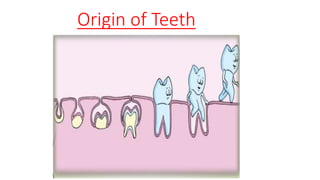
•It is a process by which tooth
moves within the jaw bones,
comes out into the oral cavity
•Primitive mouth of five week
old embryo
•Odontogenic epithelium -
primary epithelium band
divides into
• dental lamina
• vestibular lamina
Development of tooth
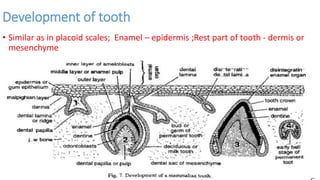
• Similar as in placoid scales; Enamel – epidermis ;Rest part of tooth - dermis or
mesenchyme
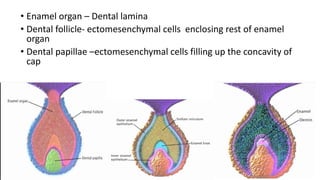
• Enamel organ – Dental lamina
• Dental follicle- ectomesenchymal cells enclosing rest of enamel
organ
• Dental papillae –ectomesenchymal cells filling up the concavity of
cap
• Thickening of ectoderm along the margin of the jaw bone
• Basal layer of ectoderm, the malphigian layer forms
continuous solid ridge like vertical invagination into
underlying dermis
Development of tooth
• This forms dental lamina which retains its connection with
the outer epidermis
• Mesodermal cells multiply rapidly beneath the ectodermal in
growth or dental lamina forming a series of solid bud-like
outgrowths at intervals called tooth germs
Development of tooth
• Their number is as many as no of milk teeth
• Each tooth germ, the inverted cup like epithelial cap will
secrete the enamel, hence termed enamel organ
• Mesodermal aggregation beneath enamel organ is termed
dermal or dental papilla
Development of tooth
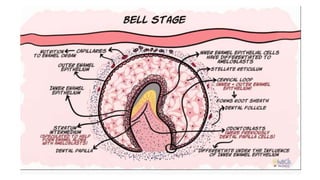
• Its outer columnar cells become differentiated into
odontoblasts which secrete a layer of dentine on their outer
surface
• Cells of inner epithelial layer of enamel organ similarly
becomes ameloblasts which form a cap of hard enamel
around the top and sides of dentine
Development of tooth
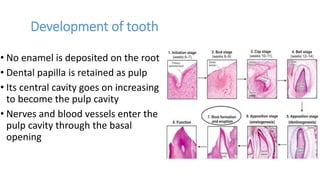
• No enamel is deposited on the root
• Dental papilla is retained as pulp
• Its central cavity goes on increasing
to become the pulp cavity
• Nerves and blood vessels enter the
pulp cavity through the basal
opening
Development of tooth
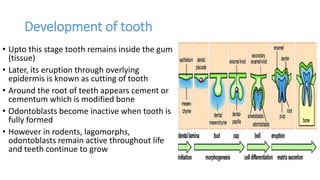
• Upto this stage tooth remains inside the gum
(tissue)
• Later, its eruption through overlying
epidermis is known as cutting of tooth
• Around the root of teeth appears cement or
cementum which is modified bone
• Odontoblasts become inactive when tooth is
fully formed
• However in rodents, lagomorphs,
odontoblasts remain active throughout life
and teeth continue to grow
Development of tooth
Origin of teeth

Origin of teeth

  • 1.
  • 2.
    Odontogenesis •It is aprocess by which tooth moves within the jaw bones, comes out into the oral cavity •Primitive mouth of five week old embryo •Odontogenic epithelium - primary epithelium band divides into • dental lamina • vestibular lamina
  • 6.
    Development of tooth •Similar as in placoid scales; Enamel – epidermis ;Rest part of tooth - dermis or mesenchyme
  • 7.
    • Enamel organ– Dental lamina • Dental follicle- ectomesenchymal cells enclosing rest of enamel organ • Dental papillae –ectomesenchymal cells filling up the concavity of cap
  • 8.
    • Thickening ofectoderm along the margin of the jaw bone • Basal layer of ectoderm, the malphigian layer forms continuous solid ridge like vertical invagination into underlying dermis Development of tooth
  • 9.
    • This formsdental lamina which retains its connection with the outer epidermis • Mesodermal cells multiply rapidly beneath the ectodermal in growth or dental lamina forming a series of solid bud-like outgrowths at intervals called tooth germs Development of tooth
  • 10.
    • Their numberis as many as no of milk teeth • Each tooth germ, the inverted cup like epithelial cap will secrete the enamel, hence termed enamel organ • Mesodermal aggregation beneath enamel organ is termed dermal or dental papilla Development of tooth
  • 11.
    • Its outercolumnar cells become differentiated into odontoblasts which secrete a layer of dentine on their outer surface • Cells of inner epithelial layer of enamel organ similarly becomes ameloblasts which form a cap of hard enamel around the top and sides of dentine Development of tooth
  • 12.
    • No enamelis deposited on the root • Dental papilla is retained as pulp • Its central cavity goes on increasing to become the pulp cavity • Nerves and blood vessels enter the pulp cavity through the basal opening Development of tooth
  • 13.
    • Upto thisstage tooth remains inside the gum (tissue) • Later, its eruption through overlying epidermis is known as cutting of tooth • Around the root of teeth appears cement or cementum which is modified bone • Odontoblasts become inactive when tooth is fully formed • However in rodents, lagomorphs, odontoblasts remain active throughout life and teeth continue to grow Development of tooth