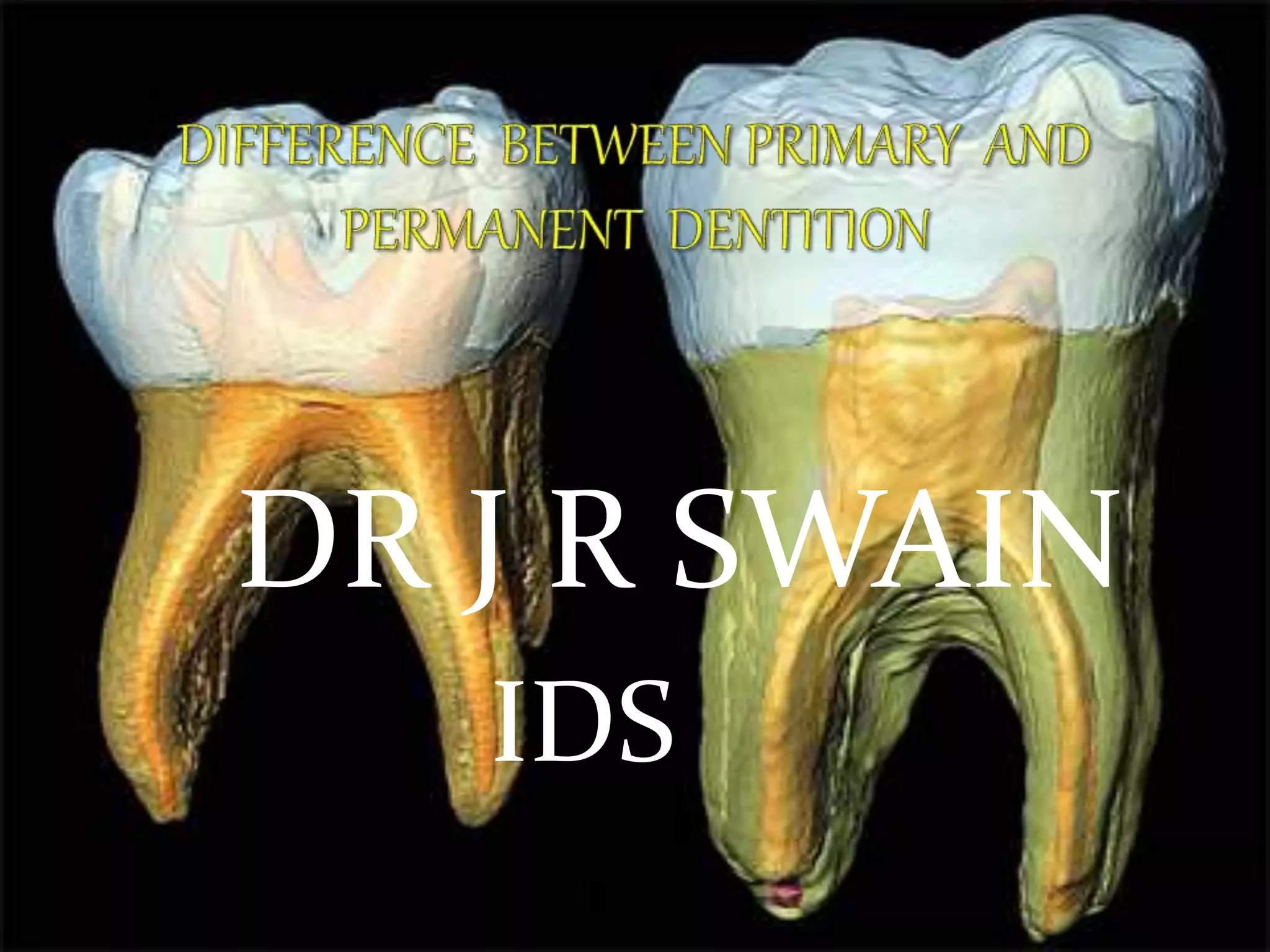
DR J R SWAIN
IDS
OBJECTIVES
INTRODUCTION
ANATOMICAL FEATURES
MORPHOLOGICAL FEATURES
HISTOLOGICAL FEATURES
APPLIED ASPECTS
----------
INTRODUCTION
 The human dentition are usually categorized as being
primary and permanent dentition .
 The primary dentition is first set of teeth and also
called deciduous teeth, Baby teeth, temporary
teeth, milk teeth .
 Primary teeth start to form during the embryo phase
of pregnancy that is from 6th week of intra uterine life .
 The permanent dentition are the second set of teeth
and also known as adult teeth .
 The first permanent tooth usually appears in mouth at
around six years of age .
MORPHOLOGICAL FEATURES
PRIMARY TOOTH PERMANENT TOOTH
 DURATION :-
6 month – 51/2 year
 NUMBER :-
20 (2 incisors, 1 canine,
2 molars)
 ENAMEL :-
thinner(about 1 mm)
 OCCLUSAL PLANE :-
relatively flat
 MAMMELEONS :-
absent
 DURATION :-
61/2 year onward
 NUMBER :-
32 (2 incisors, 1 canine
2 premolars, 3 molars)
 ENAMEL :-
thicker (about 2-3 mm)
 OCCLUSAL PLANE :-
more curved contour
 MAMMELEONS ;-
present
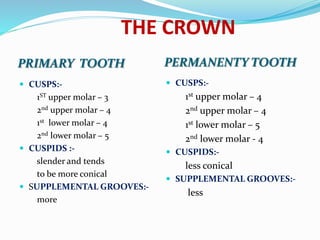
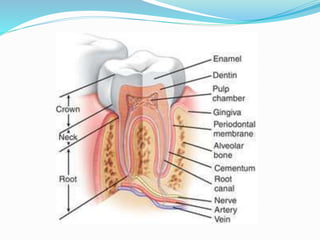
THE CROWN
PRIMARY TOOTH PERMANENTY TOOTH
 CUSPS:-
1ST upper molar – 3
2nd upper molar – 4
1st lower molar – 4
2nd lower molar – 5
 CUSPIDS :-
slender and tends
to be more conical
 SUPPLEMENTAL GROOVES:-
more
 CUSPS:-
1st upper molar – 4
2nd upper molar – 4
1st lower molar – 5
2nd lower molar - 4
 CUSPIDS:-
less conical
 SUPPLEMENTAL GROOVES:-
less
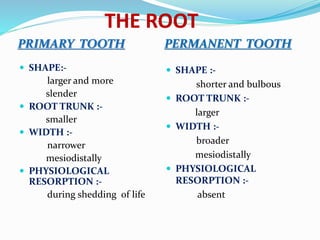
PRIMARY TOOTH PERMANENT TOOTH
 SHAPE:-
larger and more
slender
 ROOT TRUNK :-
smaller
 WIDTH :-
narrower
mesiodistally
 PHYSIOLOGICAL
RESORPTION :-
during shedding of life
 SHAPE :-
shorter and bulbous
 ROOT TRUNK :-
larger
 WIDTH :-
broader
mesiodistally
 PHYSIOLOGICAL
RESORPTION :-
absent
THE ROOT
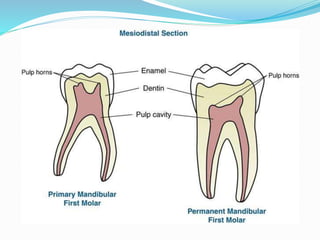
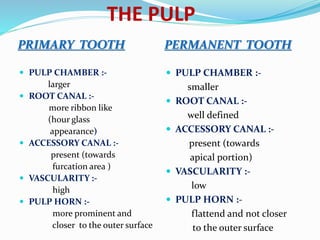
THE PULP
PRIMARY TOOTH PERMANENT TOOTH
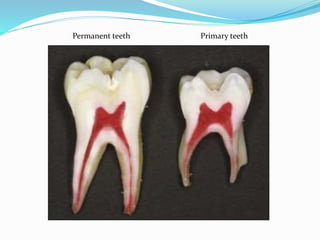
 PULP CHAMBER :-
larger
 ROOT CANAL :-
more ribbon like
(hour glass
appearance)
 ACCESSORY CANAL :-
present (towards
furcation area )
 VASCULARITY :-
high
 PULP HORN :-
more prominent and
closer to the outer surface
 PULP CHAMBER :-
smaller
 ROOT CANAL :-
well defined
 ACCESSORY CANAL :-
present (towards
apical portion)
 VASCULARITY :-
low
 PULP HORN :-
flattend and not closer
to the outer surface
Permanent teeth Primary teeth
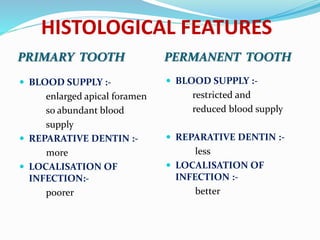
HISTOLOGICAL FEATURES
PRIMARY TOOTH PERMANENT TOOTH
 BLOOD SUPPLY :-
enlarged apical foramen
so abundant blood
supply
 REPARATIVE DENTIN :-
more
 LOCALISATION OF
INFECTION:-
poorer
 BLOOD SUPPLY :-
restricted and
reduced blood supply
 REPARATIVE DENTIN :-
less
 LOCALISATION OF
INFECTION :-
better
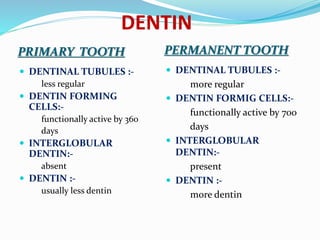
DENTIN
PRIMARY TOOTH PERMANENT TOOTH
 DENTINAL TUBULES :-
less regular
 DENTIN FORMING
CELLS:-
functionally active by 360
days
 INTERGLOBULAR
DENTIN:-
absent
 DENTIN :-
usually less dentin
 DENTINAL TUBULES :-
more regular
 DENTIN FORMIG CELLS:-
functionally active by 700
days
 INTERGLOBULAR
DENTIN:-
present
 DENTIN :-
more dentin
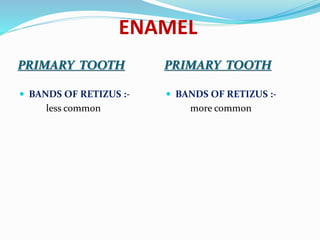
ENAMEL
PRIMARY TOOTH PRIMARY TOOTH
 BANDS OF RETIZUS :-
less common
 BANDS OF RETIZUS :-
more common
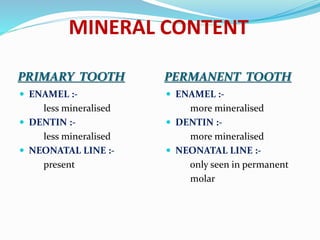
MINERAL CONTENT
PRIMARY TOOTH PERMANENT TOOTH
 ENAMEL :-
less mineralised
 DENTIN :-
less mineralised
 NEONATAL LINE :-
present
 ENAMEL :-
more mineralised
 DENTIN :-
more mineralised
 NEONATAL LINE :-
only seen in permanent
molar
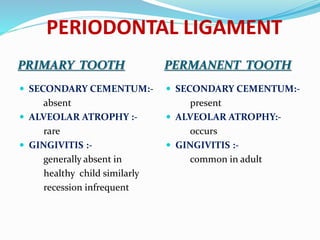
PERIODONTAL LIGAMENT
PRIMARY TOOTH PERMANENT TOOTH
 SECONDARY CEMENTUM:-
absent
 ALVEOLAR ATROPHY :-
rare
 GINGIVITIS :-
generally absent in
healthy child similarly
recession infrequent
 SECONDARY CEMENTUM:-
present
 ALVEOLAR ATROPHY:-
occurs
 GINGIVITIS :-
common in adult
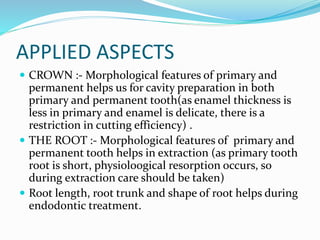
APPLIED ASPECTS
 CROWN :- Morphological features of primary and
permanent helps us for cavity preparation in both
primary and permanent tooth(as enamel thickness is
less in primary and enamel is delicate, there is a
restriction in cutting efficiency) .
 THE ROOT :- Morphological features of primary and
permanent tooth helps in extraction (as primary tooth
root is short, physiolo0gical resorption occurs, so
during extraction care should be taken)
 Root length, root trunk and shape of root helps during
endodontic treatment.
 Size, shape, color, mammelons and number of tooth are
helps in identification of tooth .
 CONTACT AREA :- as contact area is broad in primary
tooth, so its more prone to carries .
 PULP CHAMBER:- Structures of pulp chamber is used for
pulp therapy
 ACCESSORY CANAL:- In primary tooth accessory canals
found near furcation area, so infections mainly seen near
furcation area . But in permanent teeth furcation present
toward apex, so infection occours in root apex .
 DENTIN :-as dentin is more dense in permanent tooth, its
difficult to cut during cavity preparation .
Difference between primary and permanent dentition

Difference between primary and permanent dentition

  • 1.
    DR J RSWAIN IDS
  • 2.
  • 3.
    INTRODUCTION  The humandentition are usually categorized as being primary and permanent dentition .  The primary dentition is first set of teeth and also called deciduous teeth, Baby teeth, temporary teeth, milk teeth .  Primary teeth start to form during the embryo phase of pregnancy that is from 6th week of intra uterine life .  The permanent dentition are the second set of teeth and also known as adult teeth .  The first permanent tooth usually appears in mouth at around six years of age .
  • 4.
    MORPHOLOGICAL FEATURES PRIMARY TOOTHPERMANENT TOOTH  DURATION :- 6 month – 51/2 year  NUMBER :- 20 (2 incisors, 1 canine, 2 molars)  ENAMEL :- thinner(about 1 mm)  OCCLUSAL PLANE :- relatively flat  MAMMELEONS :- absent  DURATION :- 61/2 year onward  NUMBER :- 32 (2 incisors, 1 canine 2 premolars, 3 molars)  ENAMEL :- thicker (about 2-3 mm)  OCCLUSAL PLANE :- more curved contour  MAMMELEONS ;- present
  • 5.
    THE CROWN PRIMARY TOOTHPERMANENTY TOOTH  CUSPS:- 1ST upper molar – 3 2nd upper molar – 4 1st lower molar – 4 2nd lower molar – 5  CUSPIDS :- slender and tends to be more conical  SUPPLEMENTAL GROOVES:- more  CUSPS:- 1st upper molar – 4 2nd upper molar – 4 1st lower molar – 5 2nd lower molar - 4  CUSPIDS:- less conical  SUPPLEMENTAL GROOVES:- less
  • 7.
    PRIMARY TOOTH PERMANENTTOOTH  SHAPE:- larger and more slender  ROOT TRUNK :- smaller  WIDTH :- narrower mesiodistally  PHYSIOLOGICAL RESORPTION :- during shedding of life  SHAPE :- shorter and bulbous  ROOT TRUNK :- larger  WIDTH :- broader mesiodistally  PHYSIOLOGICAL RESORPTION :- absent THE ROOT
  • 9.
    THE PULP PRIMARY TOOTHPERMANENT TOOTH  PULP CHAMBER :- larger  ROOT CANAL :- more ribbon like (hour glass appearance)  ACCESSORY CANAL :- present (towards furcation area )  VASCULARITY :- high  PULP HORN :- more prominent and closer to the outer surface  PULP CHAMBER :- smaller  ROOT CANAL :- well defined  ACCESSORY CANAL :- present (towards apical portion)  VASCULARITY :- low  PULP HORN :- flattend and not closer to the outer surface
  • 10.
  • 11.
    HISTOLOGICAL FEATURES PRIMARY TOOTHPERMANENT TOOTH  BLOOD SUPPLY :- enlarged apical foramen so abundant blood supply  REPARATIVE DENTIN :- more  LOCALISATION OF INFECTION:- poorer  BLOOD SUPPLY :- restricted and reduced blood supply  REPARATIVE DENTIN :- less  LOCALISATION OF INFECTION :- better
  • 12.
    DENTIN PRIMARY TOOTH PERMANENTTOOTH  DENTINAL TUBULES :- less regular  DENTIN FORMING CELLS:- functionally active by 360 days  INTERGLOBULAR DENTIN:- absent  DENTIN :- usually less dentin  DENTINAL TUBULES :- more regular  DENTIN FORMIG CELLS:- functionally active by 700 days  INTERGLOBULAR DENTIN:- present  DENTIN :- more dentin
  • 13.
    ENAMEL PRIMARY TOOTH PRIMARYTOOTH  BANDS OF RETIZUS :- less common  BANDS OF RETIZUS :- more common
  • 14.
    MINERAL CONTENT PRIMARY TOOTHPERMANENT TOOTH  ENAMEL :- less mineralised  DENTIN :- less mineralised  NEONATAL LINE :- present  ENAMEL :- more mineralised  DENTIN :- more mineralised  NEONATAL LINE :- only seen in permanent molar
  • 15.
    PERIODONTAL LIGAMENT PRIMARY TOOTHPERMANENT TOOTH  SECONDARY CEMENTUM:- absent  ALVEOLAR ATROPHY :- rare  GINGIVITIS :- generally absent in healthy child similarly recession infrequent  SECONDARY CEMENTUM:- present  ALVEOLAR ATROPHY:- occurs  GINGIVITIS :- common in adult
  • 16.
    APPLIED ASPECTS  CROWN:- Morphological features of primary and permanent helps us for cavity preparation in both primary and permanent tooth(as enamel thickness is less in primary and enamel is delicate, there is a restriction in cutting efficiency) .  THE ROOT :- Morphological features of primary and permanent tooth helps in extraction (as primary tooth root is short, physiolo0gical resorption occurs, so during extraction care should be taken)  Root length, root trunk and shape of root helps during endodontic treatment.
  • 17.
     Size, shape,color, mammelons and number of tooth are helps in identification of tooth .  CONTACT AREA :- as contact area is broad in primary tooth, so its more prone to carries .  PULP CHAMBER:- Structures of pulp chamber is used for pulp therapy  ACCESSORY CANAL:- In primary tooth accessory canals found near furcation area, so infections mainly seen near furcation area . But in permanent teeth furcation present toward apex, so infection occours in root apex .  DENTIN :-as dentin is more dense in permanent tooth, its difficult to cut during cavity preparation .