Presentation by-
What is structured analysis?
 Structured analysis is a set of techniques and
graphical tools that allow the analyst to develop
a new kind of system specifications that are
easily understandable to the user.
 Goals:
○ use graphics wherever possible to help communicate
better with the user.
○ Differentiate between logical and physical systems
○ Build a logical system model to familiarize the user with
the system characteristics.
Kunal
Attributes of structured analysis
 It is graphic.
 The process is partitioned
 It is logical rather than physical
 It calls for a rigorous study of the user area.
 Certain tasks that are normally carried out late
in the SDLC.
Kunal
Tools of structured analysis
The tools of structured analysis are:
○ Data flow diagram(DFD)
○ Data dictionary
○ Structured English
○ Decision tree
○ Decision table
○ Pseudocode
Kunal
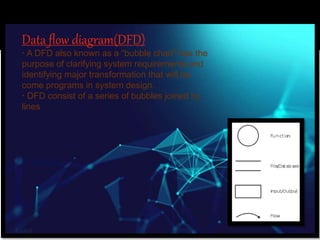
Data flow diagram(DFD)
 A DFD also known as a “bubble chart” has the
purpose of clarifying system requirements and
identifying major transformation that will be
come programs in system design.
 DFD consist of a series of bubbles joined by
lines
Kunal
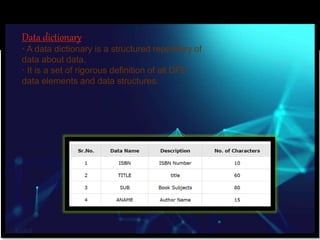
Data dictionary
 A data dictionary is a structured repository of
data about data.
 It is a set of rigorous definition of all DFD
data elements and data structures.
Kunal
Advantages of data Dictionary
The most obvious is documentation
 It is valuable reference of any organization
 Improving analyst/user communication by
establishing consistent definitions of various
elements.
 Control information
 Important step in building data base.
Kunal
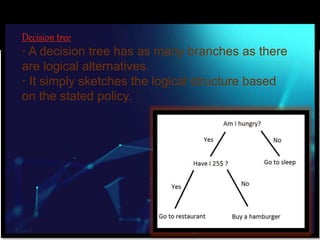
Decision tree
 A decision tree has as many branches as there
are logical alternatives.
 It simply sketches the logical structure based
on the stated policy.
Kunal
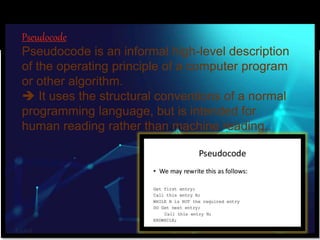
Pseudocode
Pseudocode is an informal high-level description
of the operating principle of a computer program
or other algorithm.
 It uses the structural conventions of a normal
programming language, but is intended for
human reading rather than machine reading..
Kunal
Example
 Consider following discount policy:
 Bookstores get a trade discount of 25%; for
orders
from libraries and individuals, 5%allowed on
orders
of 6-19 copies per book title;10% on orders for
20-
49 copies per book title;15% on orders for 50
copies or more per book title.
Kunal
Thank you
Kunal

Tools of structured analysis presentation

  • 1.
  • 2.
    What is structuredanalysis?  Structured analysis is a set of techniques and graphical tools that allow the analyst to develop a new kind of system specifications that are easily understandable to the user.  Goals: ○ use graphics wherever possible to help communicate better with the user. ○ Differentiate between logical and physical systems ○ Build a logical system model to familiarize the user with the system characteristics. Kunal
  • 3.
    Attributes of structuredanalysis  It is graphic.  The process is partitioned  It is logical rather than physical  It calls for a rigorous study of the user area.  Certain tasks that are normally carried out late in the SDLC. Kunal
  • 4.
    Tools of structuredanalysis The tools of structured analysis are: ○ Data flow diagram(DFD) ○ Data dictionary ○ Structured English ○ Decision tree ○ Decision table ○ Pseudocode Kunal
  • 5.
    Data flow diagram(DFD) A DFD also known as a “bubble chart” has the purpose of clarifying system requirements and identifying major transformation that will be come programs in system design.  DFD consist of a series of bubbles joined by lines Kunal
  • 6.
    Data dictionary  Adata dictionary is a structured repository of data about data.  It is a set of rigorous definition of all DFD data elements and data structures. Kunal
  • 7.
    Advantages of dataDictionary The most obvious is documentation  It is valuable reference of any organization  Improving analyst/user communication by establishing consistent definitions of various elements.  Control information  Important step in building data base. Kunal
  • 8.
    Decision tree  Adecision tree has as many branches as there are logical alternatives.  It simply sketches the logical structure based on the stated policy. Kunal
  • 9.
    Pseudocode Pseudocode is aninformal high-level description of the operating principle of a computer program or other algorithm.  It uses the structural conventions of a normal programming language, but is intended for human reading rather than machine reading.. Kunal
  • 10.
    Example  Consider followingdiscount policy:  Bookstores get a trade discount of 25%; for orders from libraries and individuals, 5%allowed on orders of 6-19 copies per book title;10% on orders for 20- 49 copies per book title;15% on orders for 50 copies or more per book title. Kunal
  • 11.