Presentation by-
KUNAL KISHORE
042
 Orderly grouping of interdependent
components.
 Linked together according to a plan.
 To achieve a specific objective.
 Computer system.
 Hotel system.
 Business system .
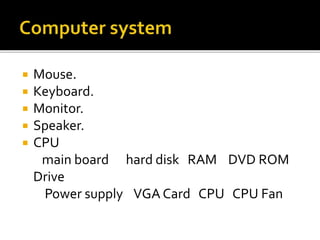
 Mouse.
 Keyboard.
 Monitor.
 Speaker.
 CPU
main board hard disk RAM DVD ROM
Drive
Power supply VGA Card CPU CPU Fan
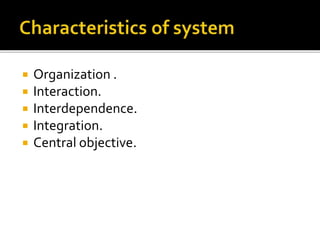
 Organization .
 Interaction.
 Interdependence.
 Integration.
 Central objective.
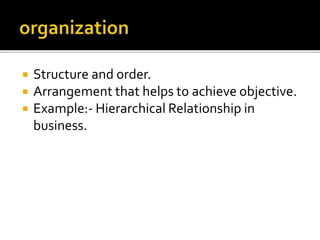
 Structure and order.
 Arrangement that helps to achieve objective.
 Example:- Hierarchical Relationship in
business.
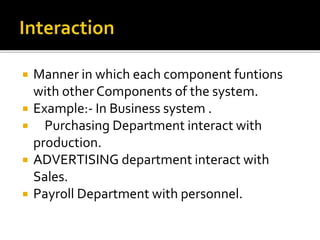
 Manner in which each component funtions
with other Components of the system.
 Example:- In Business system .
 Purchasing Department interact with
production.
 ADVERTISING department interact with
Sales.
 Payroll Department with personnel.
 Parts of the system depend on one another.
 Output of one subsystem is the required
input for another subsystem.
 Holism of system .
 How a system is tied together.
 Achieving central goal has more importance
than individual parts outputs.
 Predetermined goals.
 Examples:
 Business system has the goal of earning
profit.
 College system has objective of converting
young students into graduates.
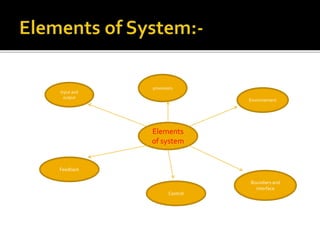
Elements
of system
Input and
output
processors
Environement
Feedback
Control
Boundiers and
interface
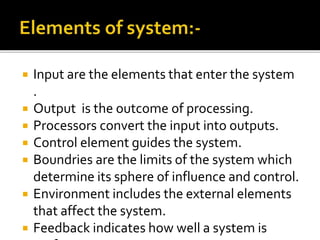
 Input are the elements that enter the system
.
 Output is the outcome of processing.
 Processors convert the input into outputs.
 Control element guides the system.
 Boundries are the limits of the system which
determine its sphere of influence and control.
 Environment includes the external elements
that affect the system.
 Feedback indicates how well a system is

Elements of system ppt

  • 1.
  • 2.
     Orderly groupingof interdependent components.  Linked together according to a plan.  To achieve a specific objective.
  • 3.
     Computer system. Hotel system.  Business system .
  • 4.
     Mouse.  Keyboard. Monitor.  Speaker.  CPU main board hard disk RAM DVD ROM Drive Power supply VGA Card CPU CPU Fan
  • 5.
     Organization . Interaction.  Interdependence.  Integration.  Central objective.
  • 6.
     Structure andorder.  Arrangement that helps to achieve objective.  Example:- Hierarchical Relationship in business.
  • 7.
     Manner inwhich each component funtions with other Components of the system.  Example:- In Business system .  Purchasing Department interact with production.  ADVERTISING department interact with Sales.  Payroll Department with personnel.
  • 8.
     Parts ofthe system depend on one another.  Output of one subsystem is the required input for another subsystem.
  • 9.
     Holism ofsystem .  How a system is tied together.  Achieving central goal has more importance than individual parts outputs.
  • 10.
     Predetermined goals. Examples:  Business system has the goal of earning profit.  College system has objective of converting young students into graduates.
  • 11.
  • 12.
     Input arethe elements that enter the system .  Output is the outcome of processing.  Processors convert the input into outputs.  Control element guides the system.  Boundries are the limits of the system which determine its sphere of influence and control.  Environment includes the external elements that affect the system.  Feedback indicates how well a system is