Toolkit for
Inclusivity in Higher Education
Presented on December 3, International Day
of People with Disabilities
Sheryl Burgstahler, Ph. D.
sherylb@uw.edu
2 Units in Accessible Technology Services
IT Accessibility Team
 1984–
 Funded by UW
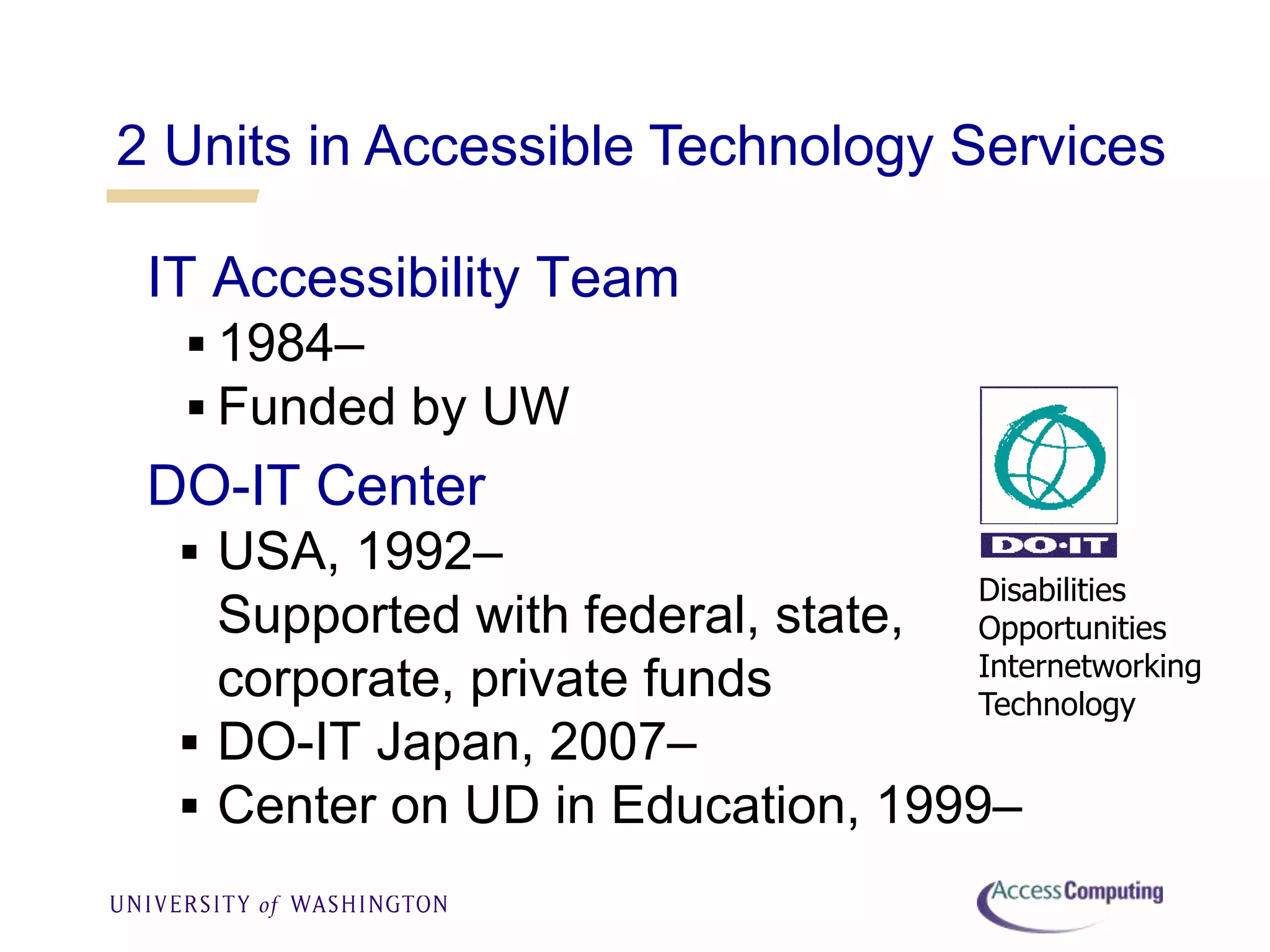
DO-IT Center
 USA, 1992–
Supported with federal, state,
corporate, private funds
 DO-IT Japan, 2007–
 Center on UD in Education, 1999–
Disabilities
Opportunities
Internetworking
Technology
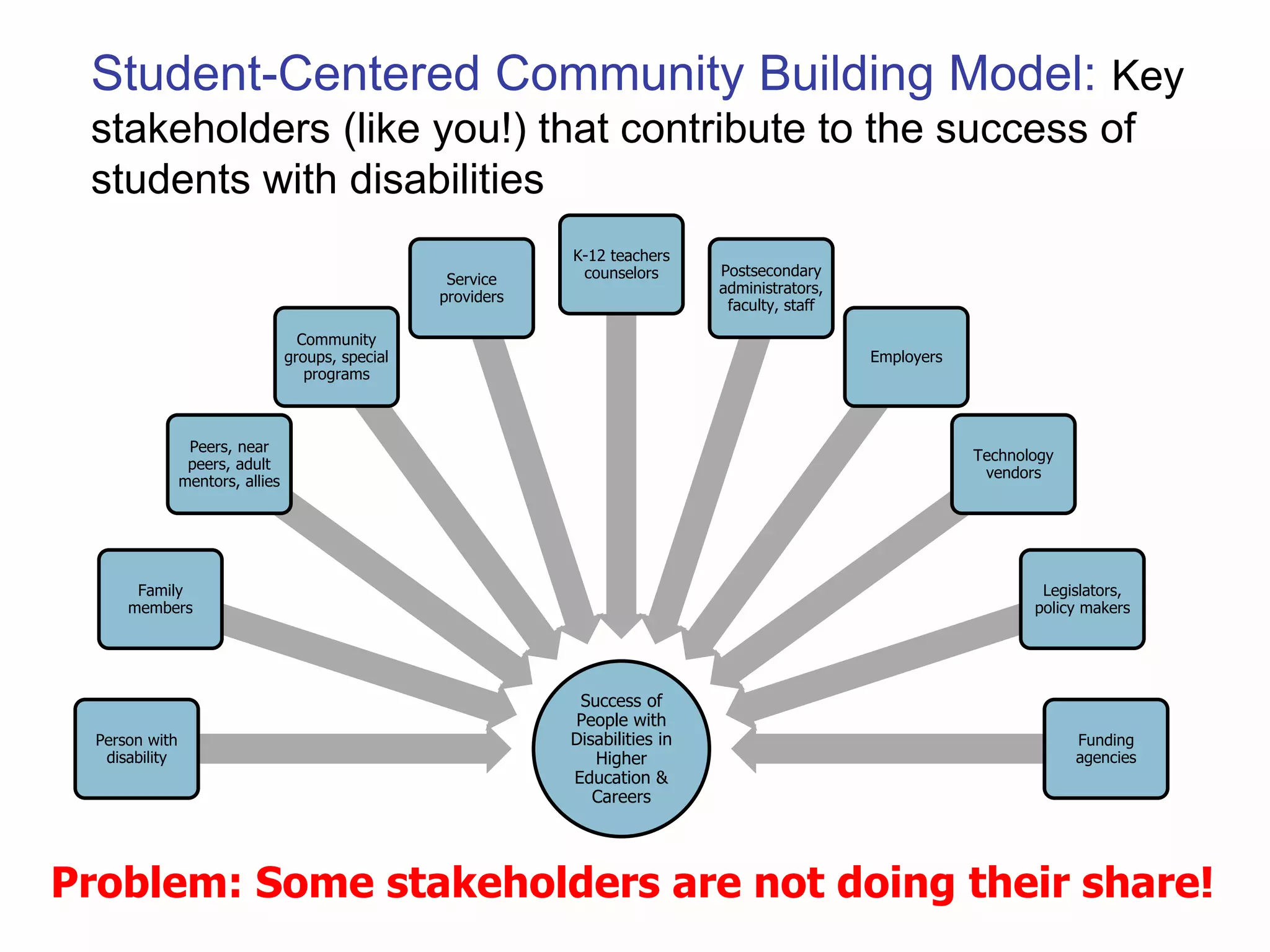
Student-Centered Community Building Model: Key
stakeholders (like you!) that contribute to the success of
students with disabilities
Success of
People with
Disabilities in
Higher
Education &
Careers
Person with
disability
Family
members
Peers, near
peers, adult
mentors, allies
Community
groups, special
programs
Service
providers
K-12 teachers
counselors Postsecondary
administrators,
faculty, staff
Employers
Technology
vendors
Legislators,
policy makers
Funding
agencies
Problem: Some stakeholders are not doing their share!
Basic approaches
 When we are working with students, we
promote
SELF DETERMINATION
 When we are working with faculty, staff,
institutions, technology companies, we
promote
UNIVERSAL DESIGN (UD)
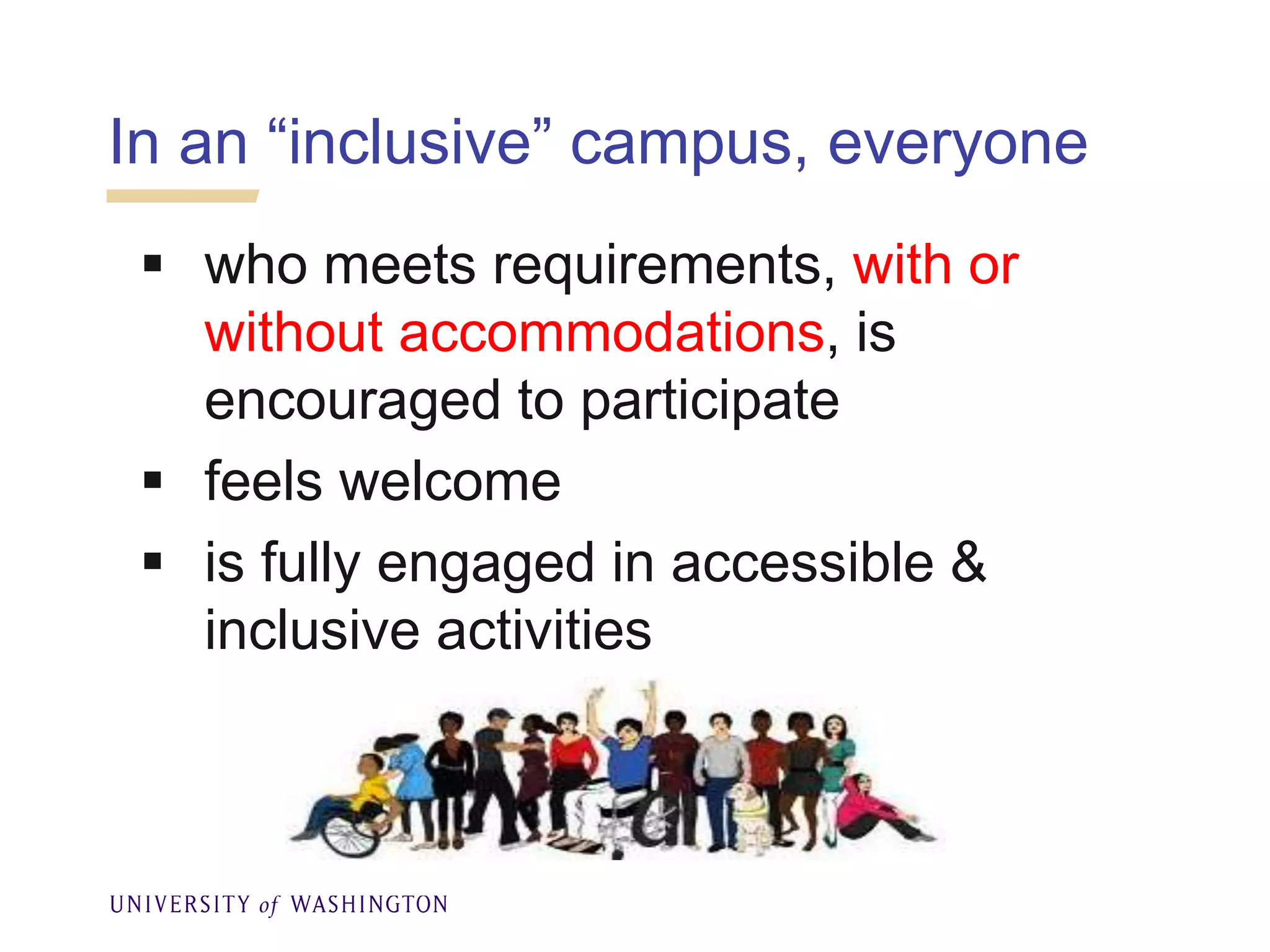
 who meets requirements, with or
without accommodations, is
encouraged to participate
 feels welcome
 is fully engaged in accessible &
inclusive activities
In an “inclusive” campus, everyone
 “paradigm” = a theory or a group of ideas
about how something should be done,
made, or thought about”
 “dominant paradigm” = a collection of
values or a system of thought in a society
or organization that is widely held at a
given time. It provides an almost
unconscious, internalized framework that
affects the way people think things should
work & often goes without question.
Goal: a paradigm shift to a more
broadly defined inclusive campus
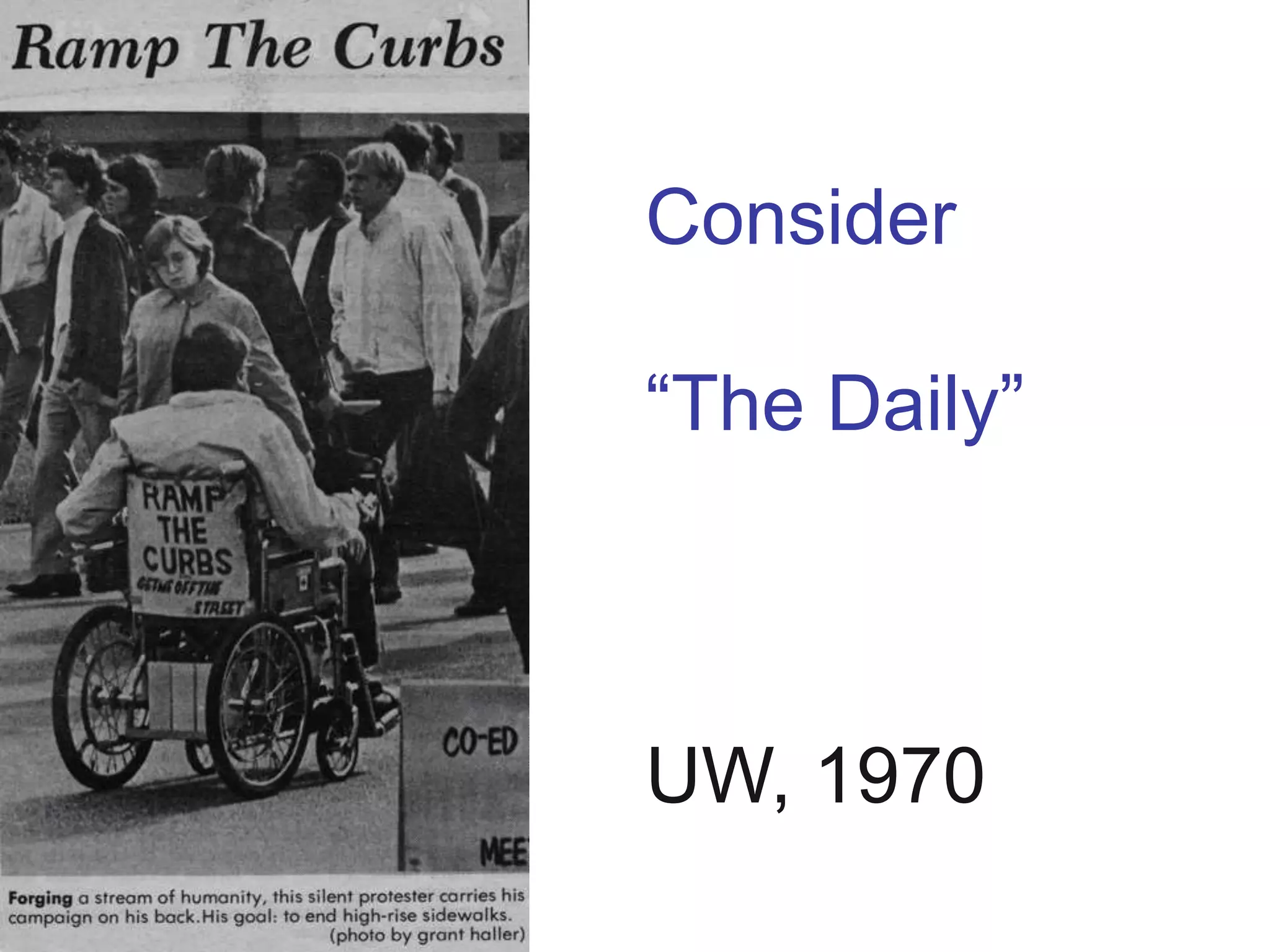
Consider
“The Daily”
UW, 1970
References:
 NEW BOOK: Creating Inclusive
Learning Opportunities in Higher
Education: A Universal Design
Toolkit (2020).
20% discount with code INLEHE
when ordered from Harvard Education Press
 RESOURCE: The Center on Universal Design in
Education at uw.edu/doit/cude
 ENGAGE: Email sherylb@uw.edu to join the UDHE
online community of practice
 Eliminate, exclude,
segregate
 Cure, rehabilitate,
accommodate
 Social justice:
Inclusion & universal design
One-minute history of the evolution
of responses to human differences
Framework
for
Universal
Design in
Higher
Education
(UDHE)
Scope
Definition
Principles
Guidelines
Practices
Process
 Instruction
 Services
 Technology
 Physical spaces
 Project, conference exhibits, presentations,
and professional organizations
Scope: All applications in HE
 race, ethnicity, cultural background,
 sexual identity,
 socioeconomic level,
 age, marital status,
 religious beliefs, values,
 academic interests,
 work experiences,
 specific abilities, …
Scope: Students diverse wrt
Consider ability on a continuum
understand English, social norms
see
hear
walk
read print
write with pen or pencil
communicate verbally
tune out distraction
learn
manage physical/mental health
For UD consider who might be in
a course, using IT, a service or
facility, including
Anthony Jesse
Adrian
Nicole
Definition: Universal Design (UD) =
“the design of products &
environments to be
usable by all people, to
the greatest extent
possible, without the
need for adaptation or
specialized design.”
The Center for Universal Design
www.design.ncsu.edu/cud
Proactive design terminology
 Accessible design
 Usable design
 Inclusive design
 Universal design
 Barrier-free design
 Design for all
UD provides inclusive access
More UD = fewer accommodations
UD
Accommodations
UD
Accommodations
UDHE
Framework
Scope
Definition
Principles
Guidelines
Practices
Process
Principles: 3 sets underpin UD of all
aspects of higher education
7 Universal Design
3 Universal Design for
Learning
4 Web Content Accessibility
Guidelines
UD
UDLWCAG
(1) Principles of UD
 Flexibility in use
 Equitable use
 Simple & intuitive use
 Perceptible
information
 Tolerance for error
 Low physical effort
 Size & space
for approach & use
- Center for Universal Design
(2) Principles for UD for Learning (UDL)
> Offer:
 Multiple means of
representation
 Multiple means of
engagement
 Multiple means of action & expression
- Center for Applied Special Technology (CAST)
Alternatively, UDL requires
the provision of multiple ways to:
 Learn
 Interact
 Demonstrate learning
- DO-IT Center
“When you plant lettuce,
if it does not grow well, you don't blame the
lettuce. You look for reasons it is not doing well.
It may need fertilizer,
or more water,
or less sun...”
-Thích Nhất Hạnh,
Vietnamese
Buddhist Monk
(3) Principles for UD of IT
Underpinning of Web Content Accessibility
Guidelines to ensure that digital tools/content is
 Perceivable
 Operable
 Understandable
 Robust
- Web Accessibility Initiative (W3C)
Summary: principles that underpin
UD Framework
UD 1 Equitable use
UD 2 Flexibility in use
UD 3 Simple and intuitive
UD 4 Perceptible information
UD 5 Tolerance for error
UD 6 Low physical effort
UD 7 Size and space for approach and use
UDL 1 Multiple means of engagement
UDL 2 Multiple means of representation
UDL 3 Multiple means of action and expression
WCAG 1 Perceivable
WCAG 2 Operable
WCAG 3 Understandable
WCAG 4 Robust
The good news: In a nutshell,
1. Provide multiple ways for participants to
learn & to demonstrate what they have
learned.
2. Provide multiple ways to engage.
3. Ensure all technologies, facilities,
services, resources, & strategies are
accessible to individuals with a wide
variety of disabilities.
Practices supported by UD, UDL, WCAG
principles, with checklists at uw.edu/doit/cude
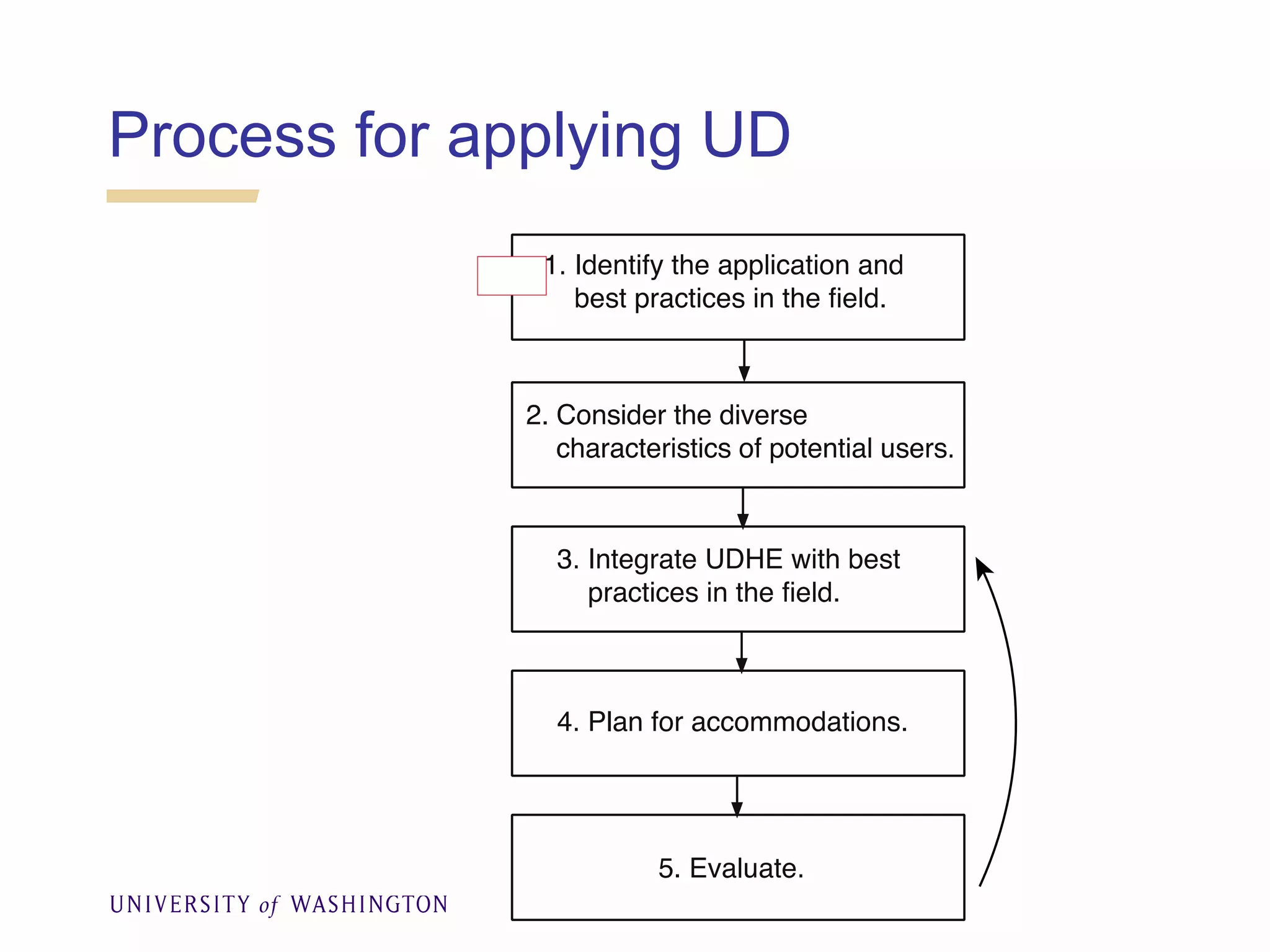
Process for applying UD
If this is the
UDHE
Framework,
what is the
UDHE
“Toolkit”?
Scope
Definition
Principles
Guidelines
Practices
Process
• Supports social justice
• Values diversity, equity, & inclusion
• Promotes best practices & does not lower
standards
• Is proactive
• Can be implemented incrementally
• Benefits everyone
• Minimizes the need for accommodations
An attitude, a framework, a goal,
a process—UDHE:
Inclusive Campus Model
underpinned by the UDHE Framework
Apply the Model to accessible IT
 Vision: IT procured, developed, used is accessible
 Values: Diversity, equity, inclusion, compliance
 Framework: UDHE’s scope, definition, principles,
guidelines, practices, processes
 Current & new practices: Stakeholder roles,
funding, policies, guidelines, procedures, training,
support
 Outputs & outcomes: Measures, benchmarks, data,
analysis, reports
 Impacts: Increased alignment with vision & values
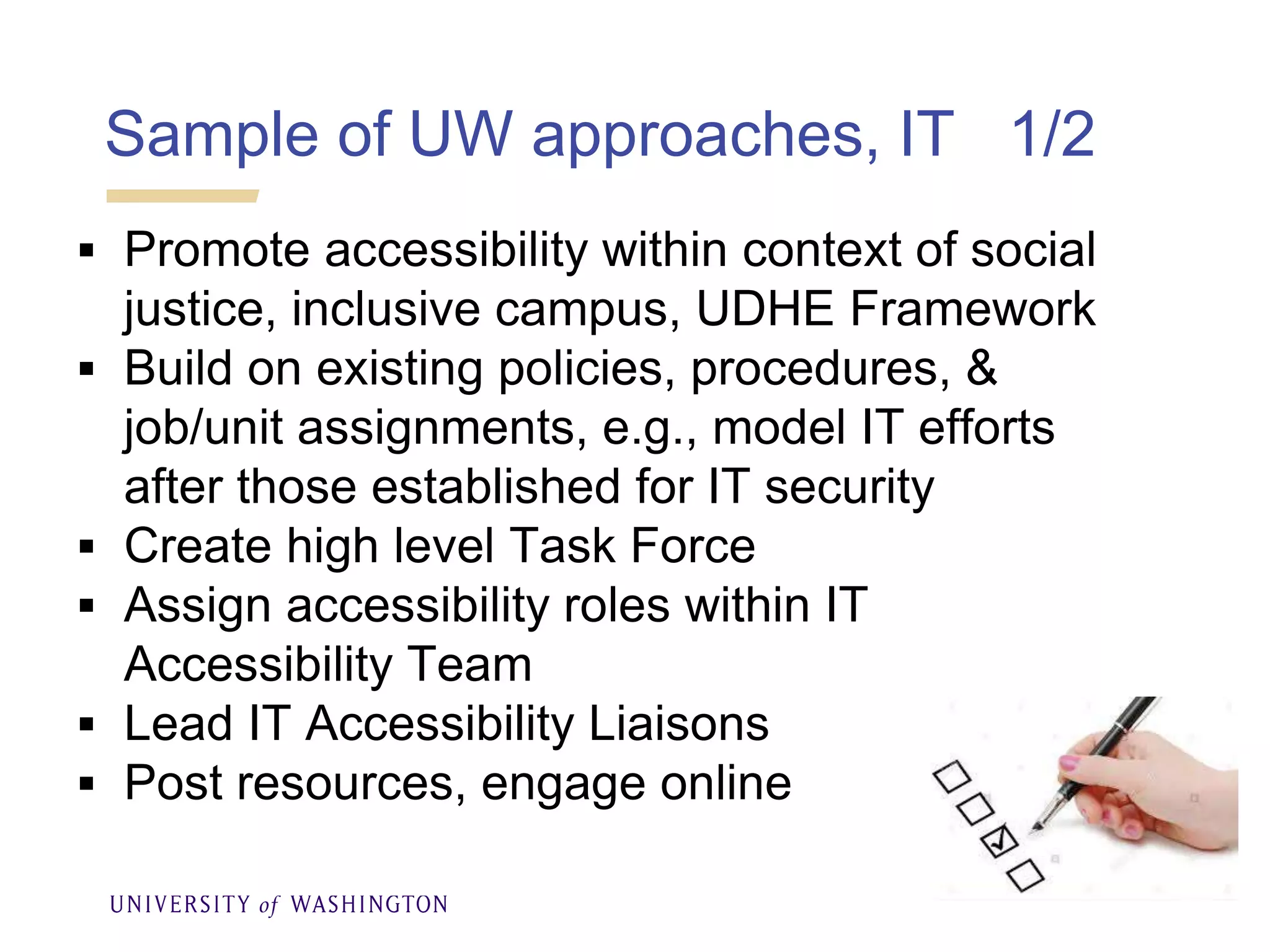
Sample of UW approaches, IT 1/2
 Promote accessibility within context of social
justice, inclusive campus, UDHE Framework
 Build on existing policies, procedures, &
job/unit assignments, e.g., model IT efforts
after those established for IT security
 Create high level Task Force
 Assign accessibility roles within IT
Accessibility Team
 Lead IT Accessibility Liaisons
 Post resources, engage online
Sample of UW approaches 2/2
 Undertake efforts that are both
– reactive & proactive
– top-down, bottom-up, & middle-out
 Integrate training/activities within those
sponsored by other campus units
 Search for internal funds to:
– offer incentives (e.g., videos, PDFs)
– purchase tools (e.g., Site Improve, Ally,
SensusAccess)
 Give Capacity Building Awards
 Conduct IT Accessibility Challenge
Reminders:
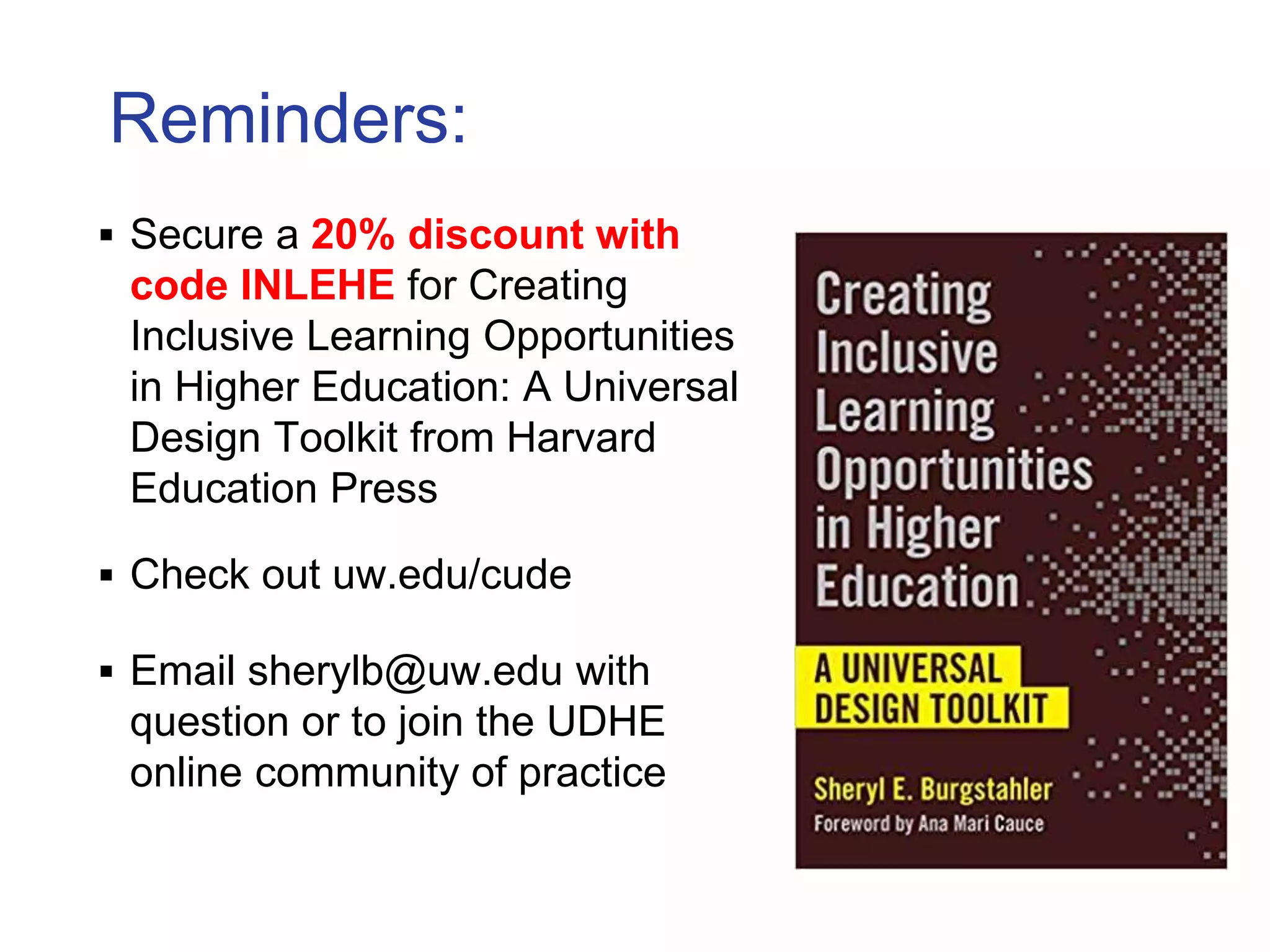
 Secure a 20% discount with
code INLEHE for Creating
Inclusive Learning Opportunities
in Higher Education: A Universal
Design Toolkit from Harvard
Education Press
 Check out uw.edu/cude
 Email sherylb@uw.edu with
question or to join the UDHE
online community of practice

Toolkit for Inclusivity in Higher Education

  • 1.
    Toolkit for Inclusivity inHigher Education Presented on December 3, International Day of People with Disabilities Sheryl Burgstahler, Ph. D. sherylb@uw.edu
  • 2.
    2 Units inAccessible Technology Services IT Accessibility Team  1984–  Funded by UW DO-IT Center  USA, 1992– Supported with federal, state, corporate, private funds  DO-IT Japan, 2007–  Center on UD in Education, 1999– Disabilities Opportunities Internetworking Technology
  • 3.
    Student-Centered Community BuildingModel: Key stakeholders (like you!) that contribute to the success of students with disabilities Success of People with Disabilities in Higher Education & Careers Person with disability Family members Peers, near peers, adult mentors, allies Community groups, special programs Service providers K-12 teachers counselors Postsecondary administrators, faculty, staff Employers Technology vendors Legislators, policy makers Funding agencies Problem: Some stakeholders are not doing their share!
  • 4.
    Basic approaches  Whenwe are working with students, we promote SELF DETERMINATION  When we are working with faculty, staff, institutions, technology companies, we promote UNIVERSAL DESIGN (UD)
  • 5.
     who meetsrequirements, with or without accommodations, is encouraged to participate  feels welcome  is fully engaged in accessible & inclusive activities In an “inclusive” campus, everyone
  • 6.
     “paradigm” =a theory or a group of ideas about how something should be done, made, or thought about”  “dominant paradigm” = a collection of values or a system of thought in a society or organization that is widely held at a given time. It provides an almost unconscious, internalized framework that affects the way people think things should work & often goes without question. Goal: a paradigm shift to a more broadly defined inclusive campus
  • 7.
  • 8.
    References:  NEW BOOK:Creating Inclusive Learning Opportunities in Higher Education: A Universal Design Toolkit (2020). 20% discount with code INLEHE when ordered from Harvard Education Press  RESOURCE: The Center on Universal Design in Education at uw.edu/doit/cude  ENGAGE: Email sherylb@uw.edu to join the UDHE online community of practice
  • 9.
     Eliminate, exclude, segregate Cure, rehabilitate, accommodate  Social justice: Inclusion & universal design One-minute history of the evolution of responses to human differences
  • 10.
  • 11.
     Instruction  Services Technology  Physical spaces  Project, conference exhibits, presentations, and professional organizations Scope: All applications in HE
  • 12.
     race, ethnicity,cultural background,  sexual identity,  socioeconomic level,  age, marital status,  religious beliefs, values,  academic interests,  work experiences,  specific abilities, … Scope: Students diverse wrt
  • 13.
    Consider ability ona continuum understand English, social norms see hear walk read print write with pen or pencil communicate verbally tune out distraction learn manage physical/mental health
  • 14.
    For UD considerwho might be in a course, using IT, a service or facility, including Anthony Jesse Adrian Nicole
  • 15.
    Definition: Universal Design(UD) = “the design of products & environments to be usable by all people, to the greatest extent possible, without the need for adaptation or specialized design.” The Center for Universal Design www.design.ncsu.edu/cud
  • 16.
    Proactive design terminology Accessible design  Usable design  Inclusive design  Universal design  Barrier-free design  Design for all
  • 17.
  • 18.
    More UD =fewer accommodations UD Accommodations UD Accommodations
  • 19.
  • 20.
    Principles: 3 setsunderpin UD of all aspects of higher education 7 Universal Design 3 Universal Design for Learning 4 Web Content Accessibility Guidelines UD UDLWCAG
  • 21.
    (1) Principles ofUD  Flexibility in use  Equitable use  Simple & intuitive use  Perceptible information  Tolerance for error  Low physical effort  Size & space for approach & use - Center for Universal Design
  • 22.
    (2) Principles forUD for Learning (UDL) > Offer:  Multiple means of representation  Multiple means of engagement  Multiple means of action & expression - Center for Applied Special Technology (CAST)
  • 23.
    Alternatively, UDL requires theprovision of multiple ways to:  Learn  Interact  Demonstrate learning - DO-IT Center
  • 24.
    “When you plantlettuce, if it does not grow well, you don't blame the lettuce. You look for reasons it is not doing well. It may need fertilizer, or more water, or less sun...” -Thích Nhất Hạnh, Vietnamese Buddhist Monk
  • 25.
    (3) Principles forUD of IT Underpinning of Web Content Accessibility Guidelines to ensure that digital tools/content is  Perceivable  Operable  Understandable  Robust - Web Accessibility Initiative (W3C)
  • 26.
    Summary: principles thatunderpin UD Framework UD 1 Equitable use UD 2 Flexibility in use UD 3 Simple and intuitive UD 4 Perceptible information UD 5 Tolerance for error UD 6 Low physical effort UD 7 Size and space for approach and use UDL 1 Multiple means of engagement UDL 2 Multiple means of representation UDL 3 Multiple means of action and expression WCAG 1 Perceivable WCAG 2 Operable WCAG 3 Understandable WCAG 4 Robust
  • 27.
    The good news:In a nutshell, 1. Provide multiple ways for participants to learn & to demonstrate what they have learned. 2. Provide multiple ways to engage. 3. Ensure all technologies, facilities, services, resources, & strategies are accessible to individuals with a wide variety of disabilities.
  • 28.
    Practices supported byUD, UDL, WCAG principles, with checklists at uw.edu/doit/cude
  • 29.
  • 30.
    If this isthe UDHE Framework, what is the UDHE “Toolkit”? Scope Definition Principles Guidelines Practices Process
  • 31.
    • Supports socialjustice • Values diversity, equity, & inclusion • Promotes best practices & does not lower standards • Is proactive • Can be implemented incrementally • Benefits everyone • Minimizes the need for accommodations An attitude, a framework, a goal, a process—UDHE:
  • 32.
  • 33.
    Apply the Modelto accessible IT  Vision: IT procured, developed, used is accessible  Values: Diversity, equity, inclusion, compliance  Framework: UDHE’s scope, definition, principles, guidelines, practices, processes  Current & new practices: Stakeholder roles, funding, policies, guidelines, procedures, training, support  Outputs & outcomes: Measures, benchmarks, data, analysis, reports  Impacts: Increased alignment with vision & values
  • 34.
    Sample of UWapproaches, IT 1/2  Promote accessibility within context of social justice, inclusive campus, UDHE Framework  Build on existing policies, procedures, & job/unit assignments, e.g., model IT efforts after those established for IT security  Create high level Task Force  Assign accessibility roles within IT Accessibility Team  Lead IT Accessibility Liaisons  Post resources, engage online
  • 35.
    Sample of UWapproaches 2/2  Undertake efforts that are both – reactive & proactive – top-down, bottom-up, & middle-out  Integrate training/activities within those sponsored by other campus units  Search for internal funds to: – offer incentives (e.g., videos, PDFs) – purchase tools (e.g., Site Improve, Ally, SensusAccess)  Give Capacity Building Awards  Conduct IT Accessibility Challenge
  • 36.
    Reminders:  Secure a20% discount with code INLEHE for Creating Inclusive Learning Opportunities in Higher Education: A Universal Design Toolkit from Harvard Education Press  Check out uw.edu/cude  Email sherylb@uw.edu with question or to join the UDHE online community of practice