Tonometer
Rajeswari K


M.Optom
R K o p t o To n o m e t e r
Tonometer
Tonometry is the procedure performed to determine the
intraocular pressure (IOP)
2
R K o p t o To n o m e t e r
History
1826: William Bowman used digital tonometry as a
routine examination test.


1885: Maklakov designed an applanation tonometer. This
was used for a number of years till 1959.


1905: Hjalmar Schiotz produced his indentation
tonometer. This made tonometry a simple and routine
clinical test.
3
R K o p t o To n o m e t e r
Ideal Tonometer
Should give accurate and reasonable IOP measurement


Convenient to use


Simple to calibrate


Stable from day to day


Easier to standardise


Free of maintenance problems
4
R K o p t o To n o m e t e r
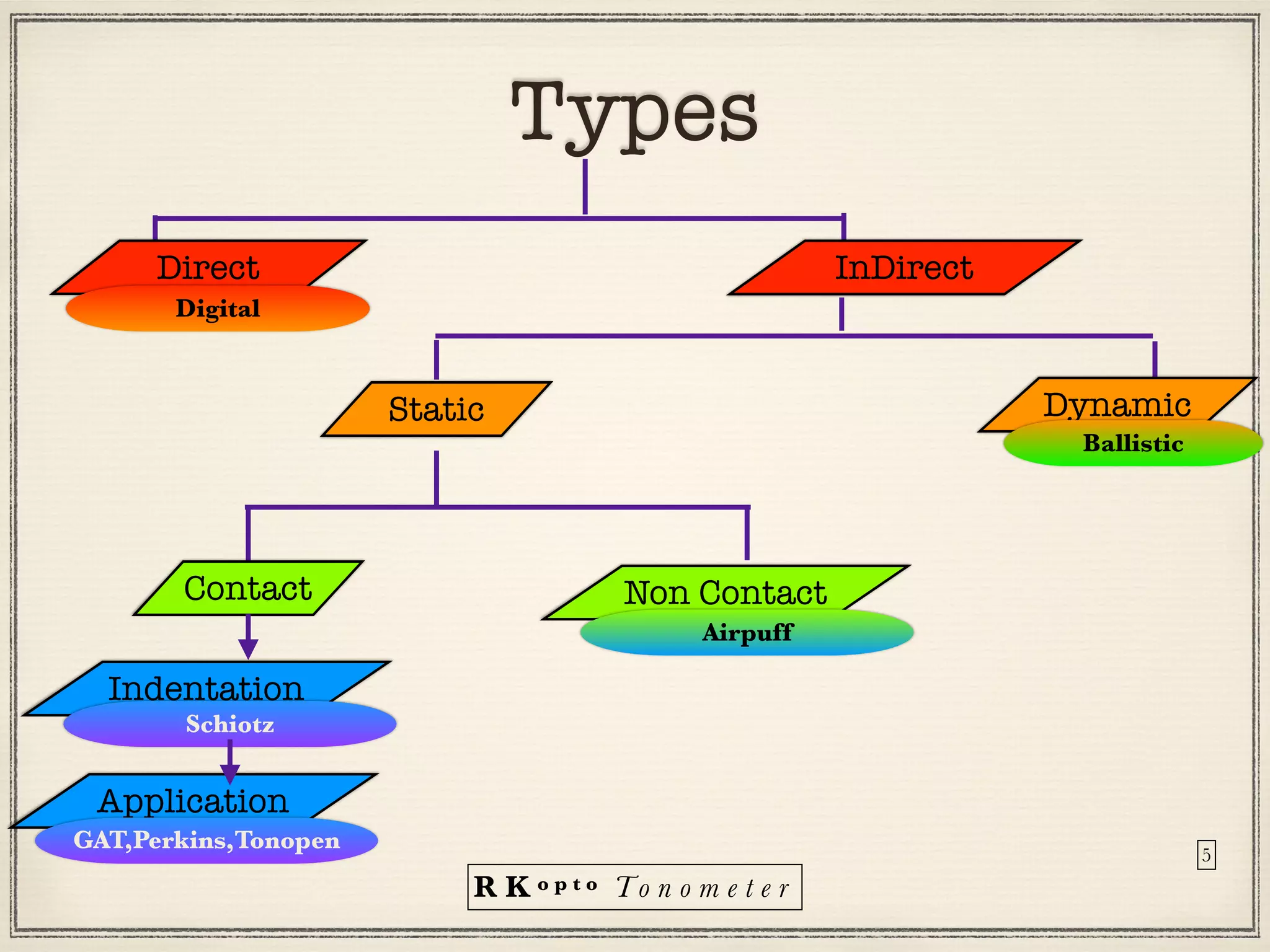
Types
5
Direct InDirect
Static Dynamic
Contact Non Contact
Indentation
Application
Schiotz


GAT,Perkins,Tonopen
Airpuff
Ballistic
Digital
R K o p t o To n o m e t e r
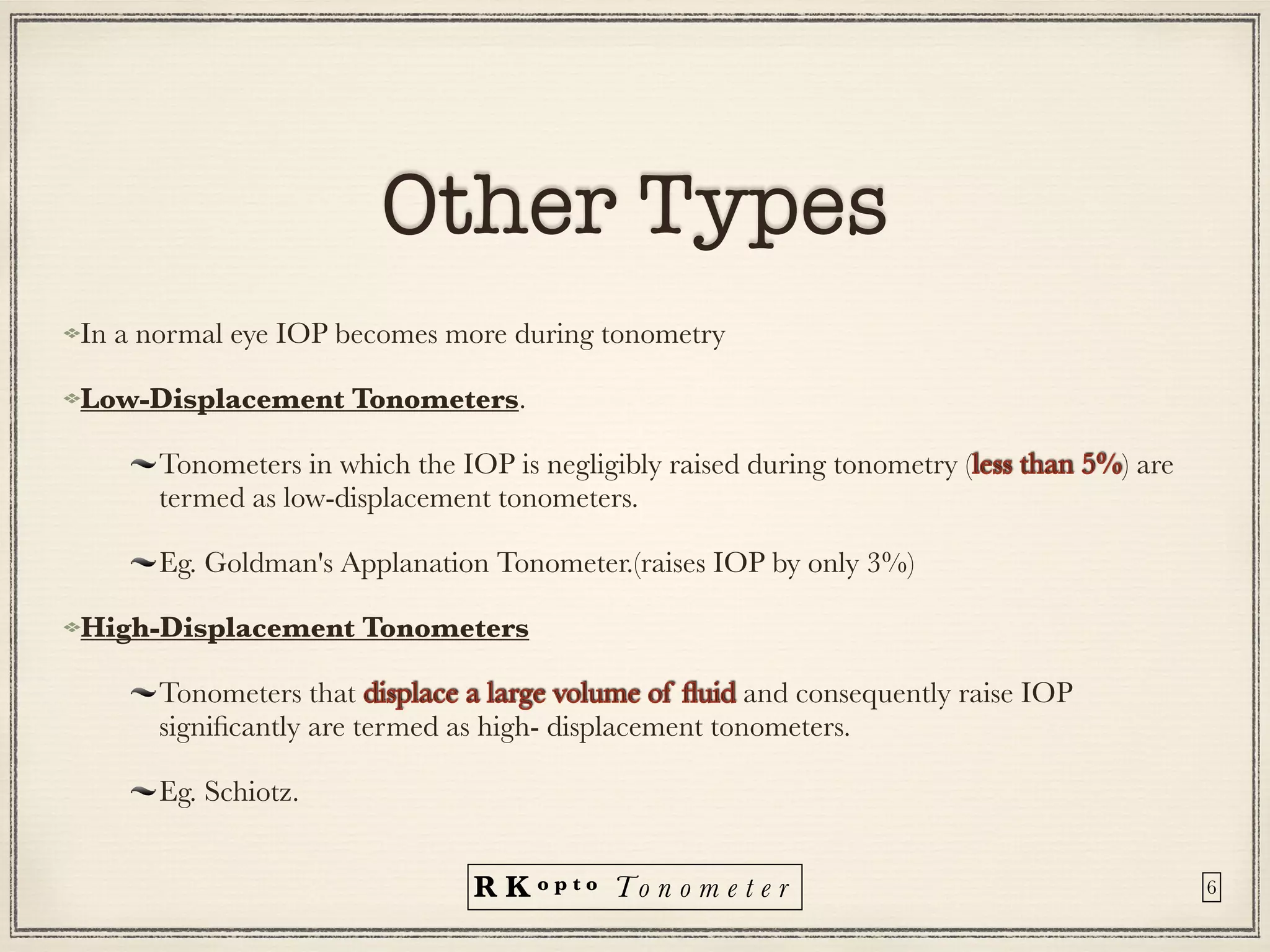
Other Types
In a normal eye IOP becomes more during tonometry


Low-Displacement Tonometers.


Tonometers in which the IOP is negligibly raised during tonometry (less than 5%) are
termed as low-displacement tonometers.


Eg. Goldman's Applanation Tonometer.(raises IOP by only 3%)


High-Displacement Tonometers


Tonometers that displace a large volume of
fl
uid and consequently raise IOP
signi
fi
cantly are termed as high- displacement tonometers.


Eg. Schiotz.
6
R K o p t o To n o m e t e r
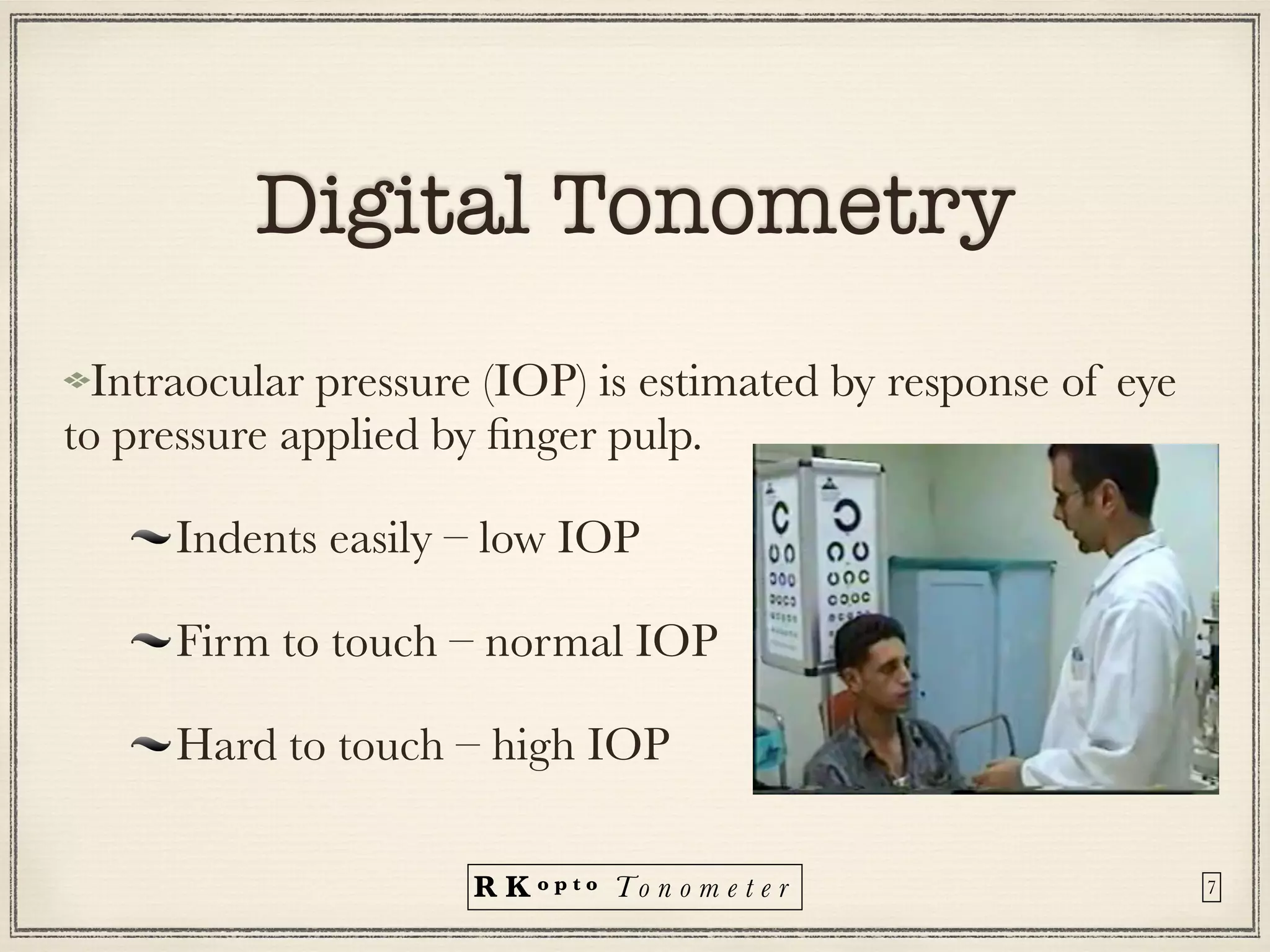
Digital Tonometry
Intraocular pressure (IOP) is estimated by response of eye
to pressure applied by
fi
nger pulp.


Indents easily – low IOP


Firm to touch – normal IOP


Hard to touch – high IOP
7
R K o p t o To n o m e t e r
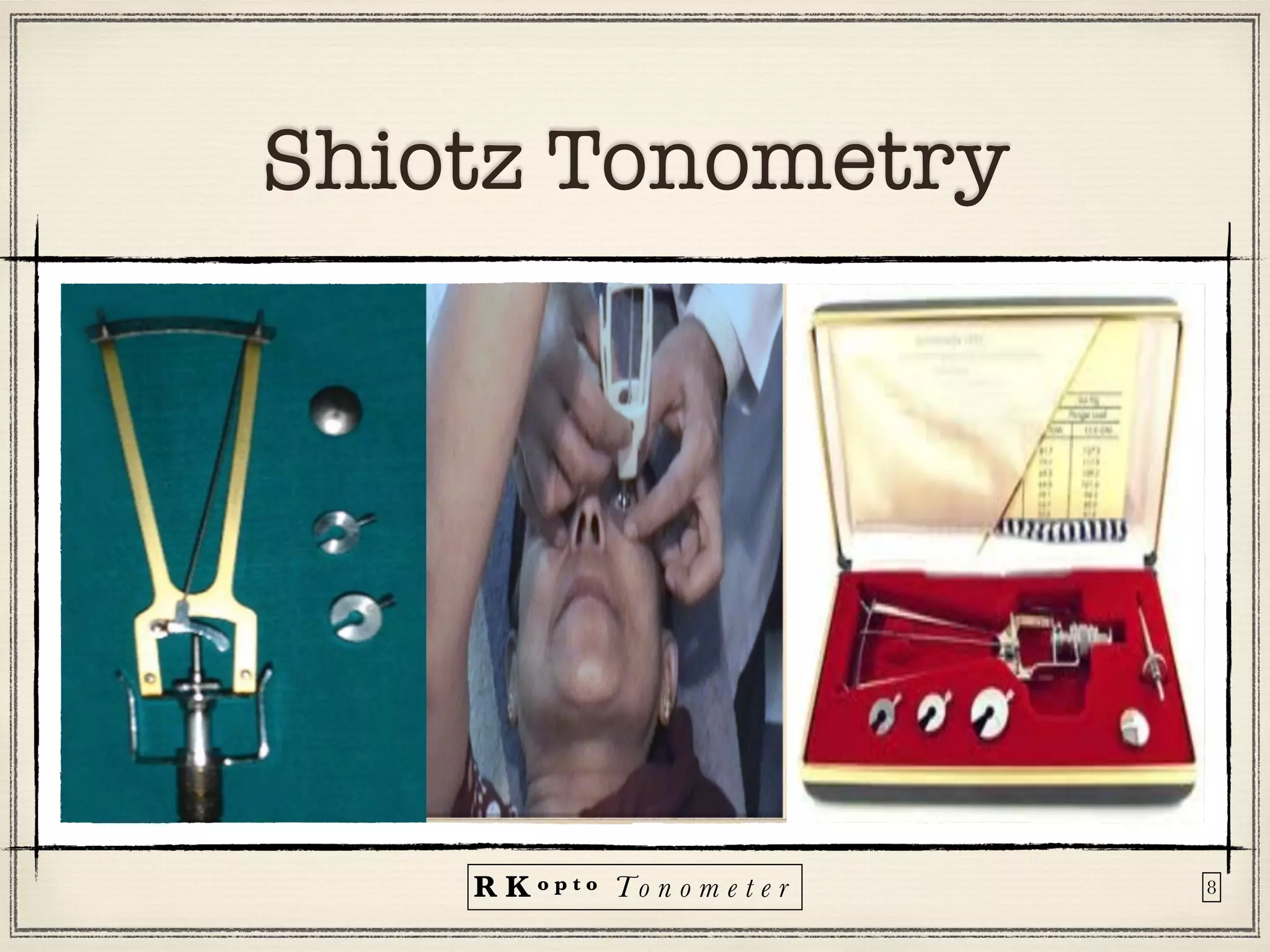
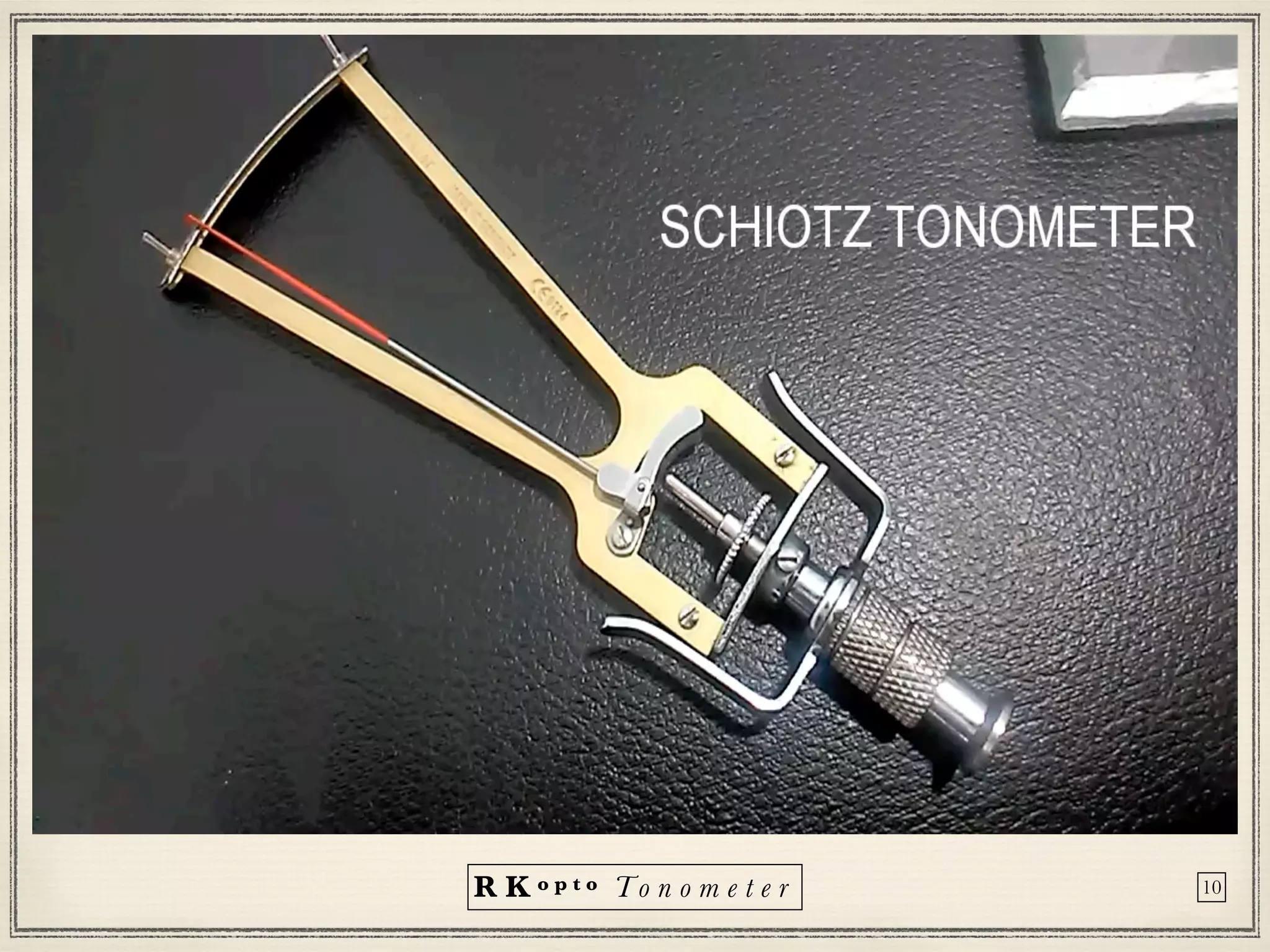
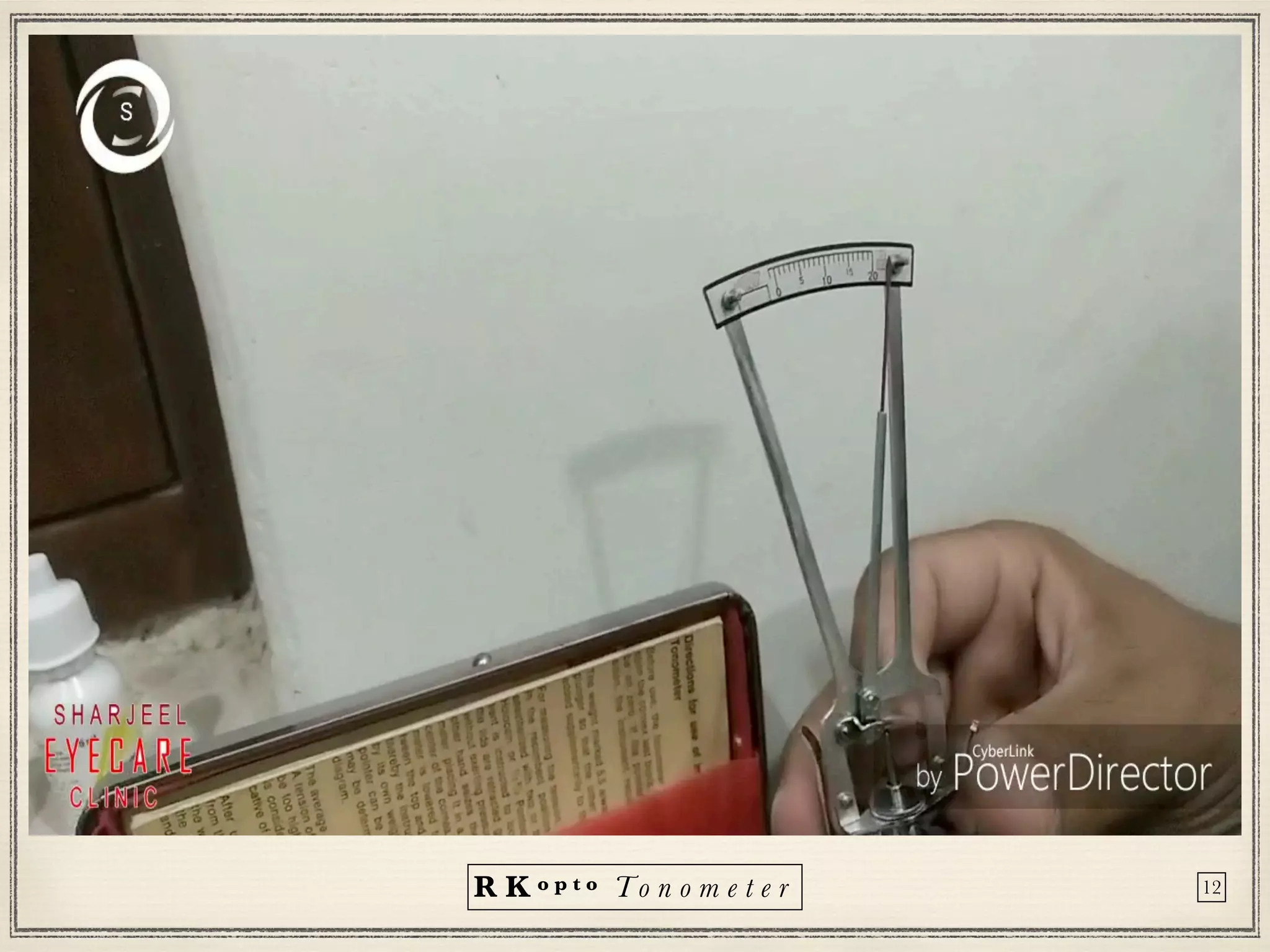
Shiotz Tonometry
8
R K o p t o To n o m e t e r
9
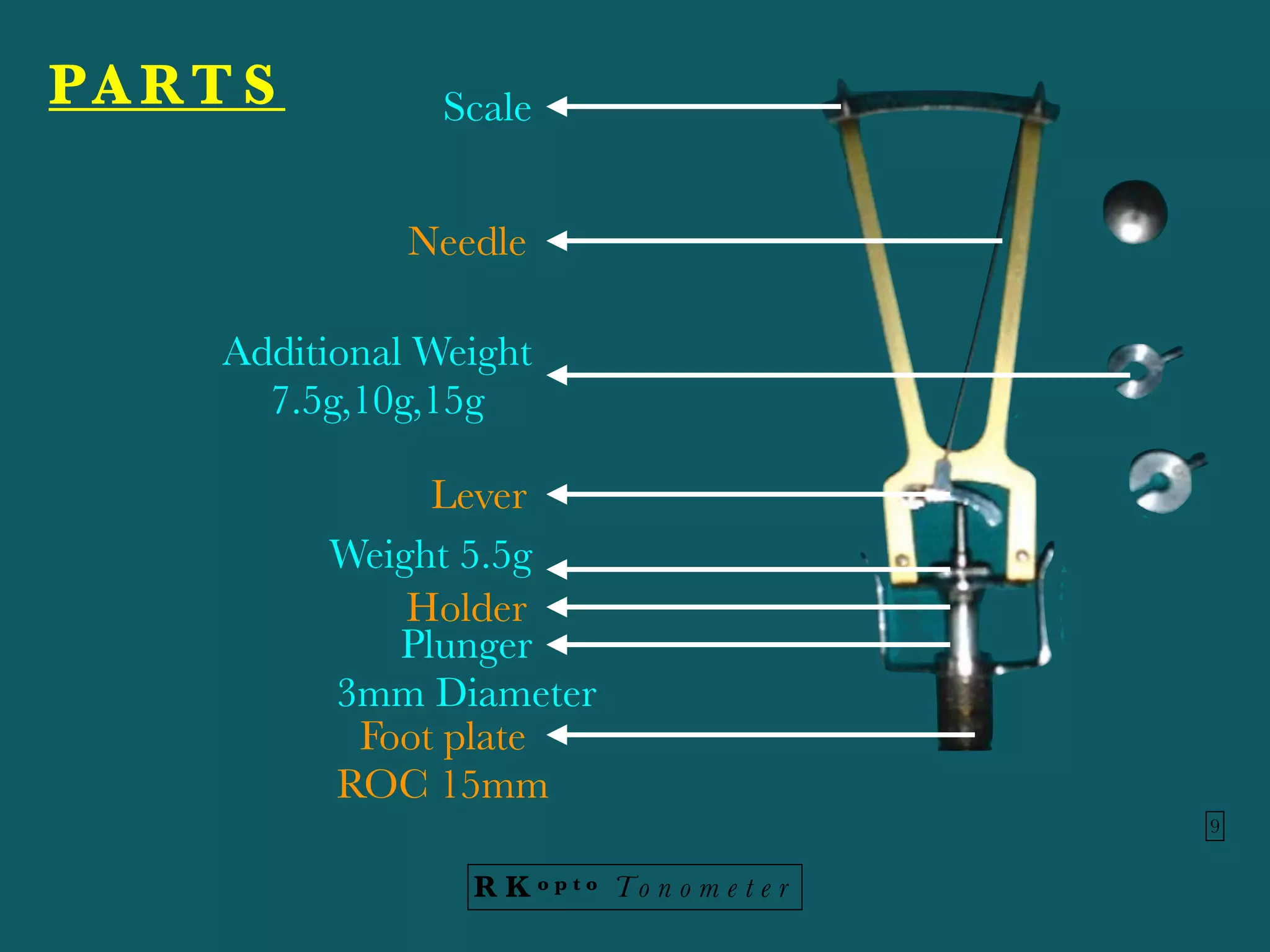
PA RT S Scale
Needle
Additional Weight


7.5g,10g,15g
Weight 5.5g
Foot plate


ROC 15mm
Plunger


3mm Diameter
Holder
Lever
R K o p t o To n o m e t e r 10
https://www.youtube.com/watch?v=8eSP-n2QEls
R K o p t o To n o m e t e r
Characteristics
The extent to which cornea is indented by plunger is measured as the
distance from the foot plate curve to the plunger base and a lever system
moves a needle on calibrated scale.
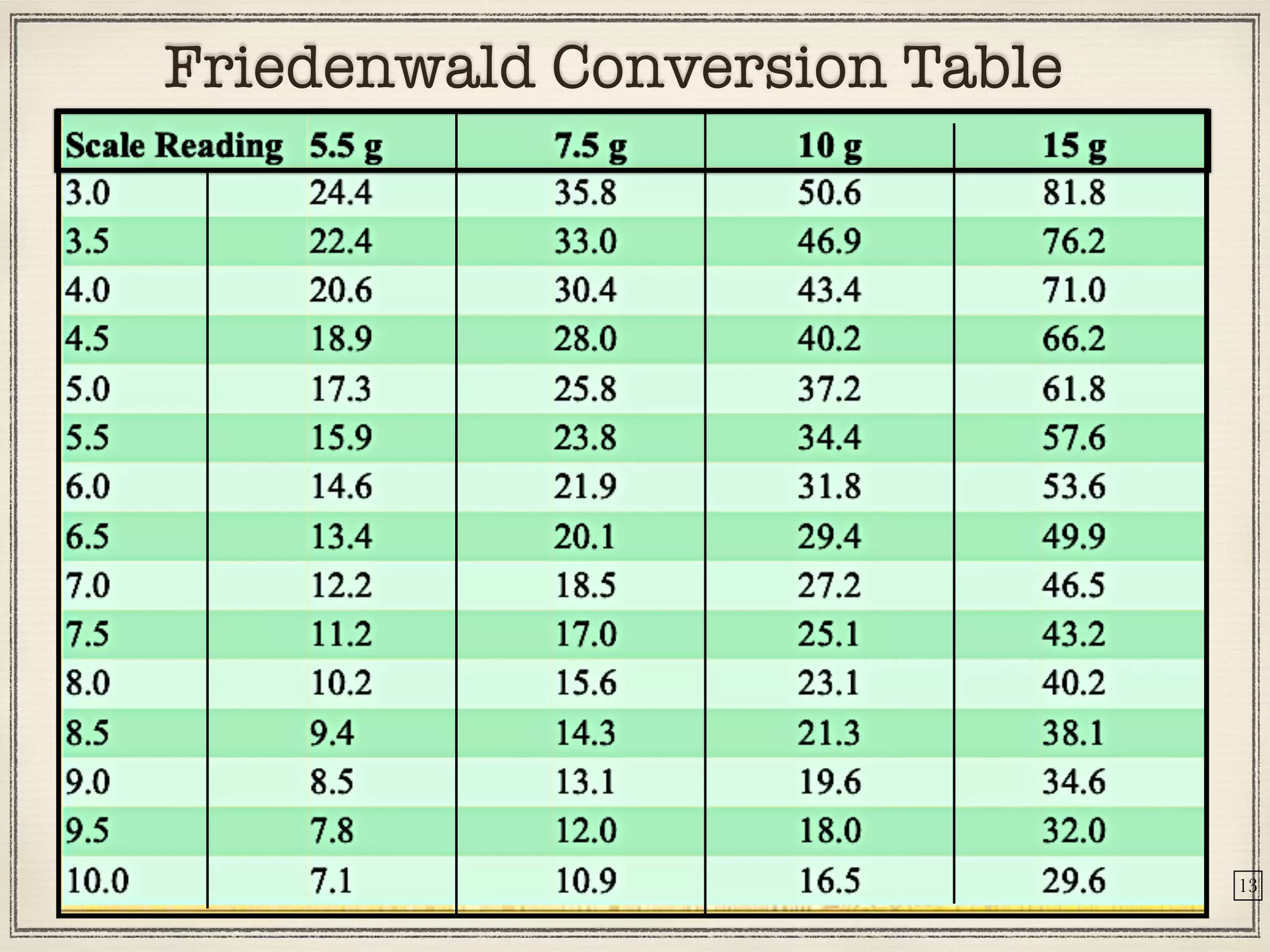
The indicated scale reading and the plunger weight are converted to an IOP
measurement.
More the plunger indents the cornea, higher the scale reading and lower the
IOP


Each scale unit represents 0.05 mm protrusion of the plunger.


11
R K o p t o To n o m e t e r 12
https://www.youtube.com/watch?v=uBzwd0w-Fbk
R K o p t o To n o m e t e r 13
Friedenwald Conversion Table
R K o p t o To n o m e t e r
Procedure
Patient should be anaesthetised with 0.5% proparacaine.


With the patient in supine position, looking up at a
fi
xation target while examiner separates
the lids and lowers the tonometer plate to rest on the anaesthetised cornea so that plunger is
free to move vertically.


Scale reading is measured.
The 5.5 gm weight is initially used.
If scale reading is 4 or less, additional weight is added to plunger.


Conversion table is used to derive IOP in mm Hg from scale reading and plunger weight.
14
R K o p t o To n o m e t e r
Source of Error
Accuracy is limited as ocular rigidity varies from eye to eye.
Repeated measurements lower IOP.
Steeper or a thicker cornea causes greater displacement of
Schiøtz reads lower than GAT
15
R K o p t o To n o m e t e r
Advantage
Simple technique


Elegant design


Portable


No need for SlitLamp or power supply Reasonably priced
Anodized scale mount which is highly resistant to sterilizing water.
Schiotz tonometer is still most widely tonometer
16
R K o p t o To n o m e t e r 17
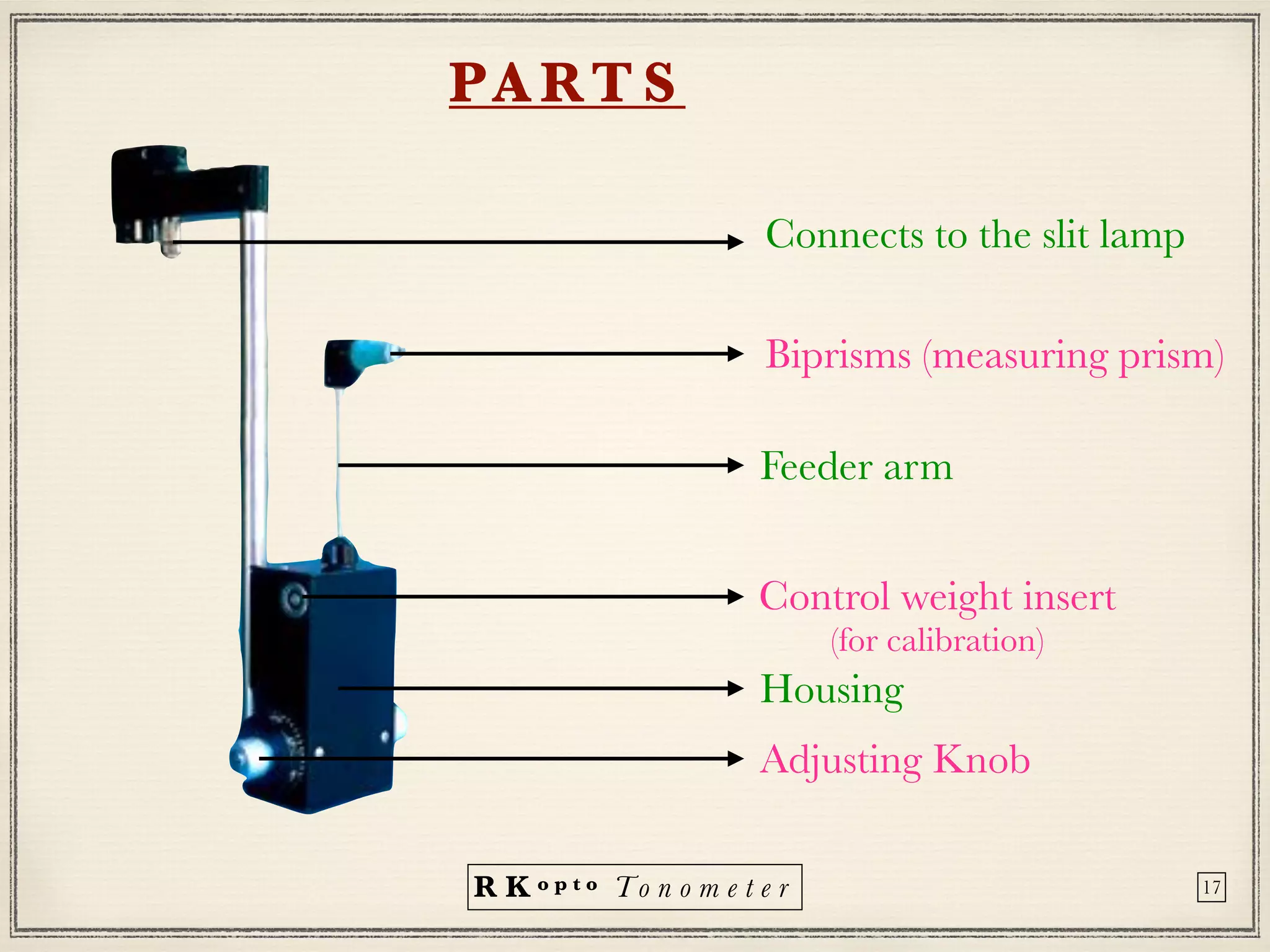
Connects to the slit lamp
Biprisms (measuring prism)
Adjusting Knob
Feeder arm
Control weight insert
(for calibration)
Housing
PA RT S
R K o p t o To n o m e t e r
Principle
Applanation tonometry is based on the Imbert-Fick Law.


It states that the pressure (p) inside an ideal dry, thin-
walled sphere equals the force (F) necessary to
fl
atten its
surface divided by the area of the
fl
attening (A).


F


P = —


A
18
R K o p t o To n o m e t e r
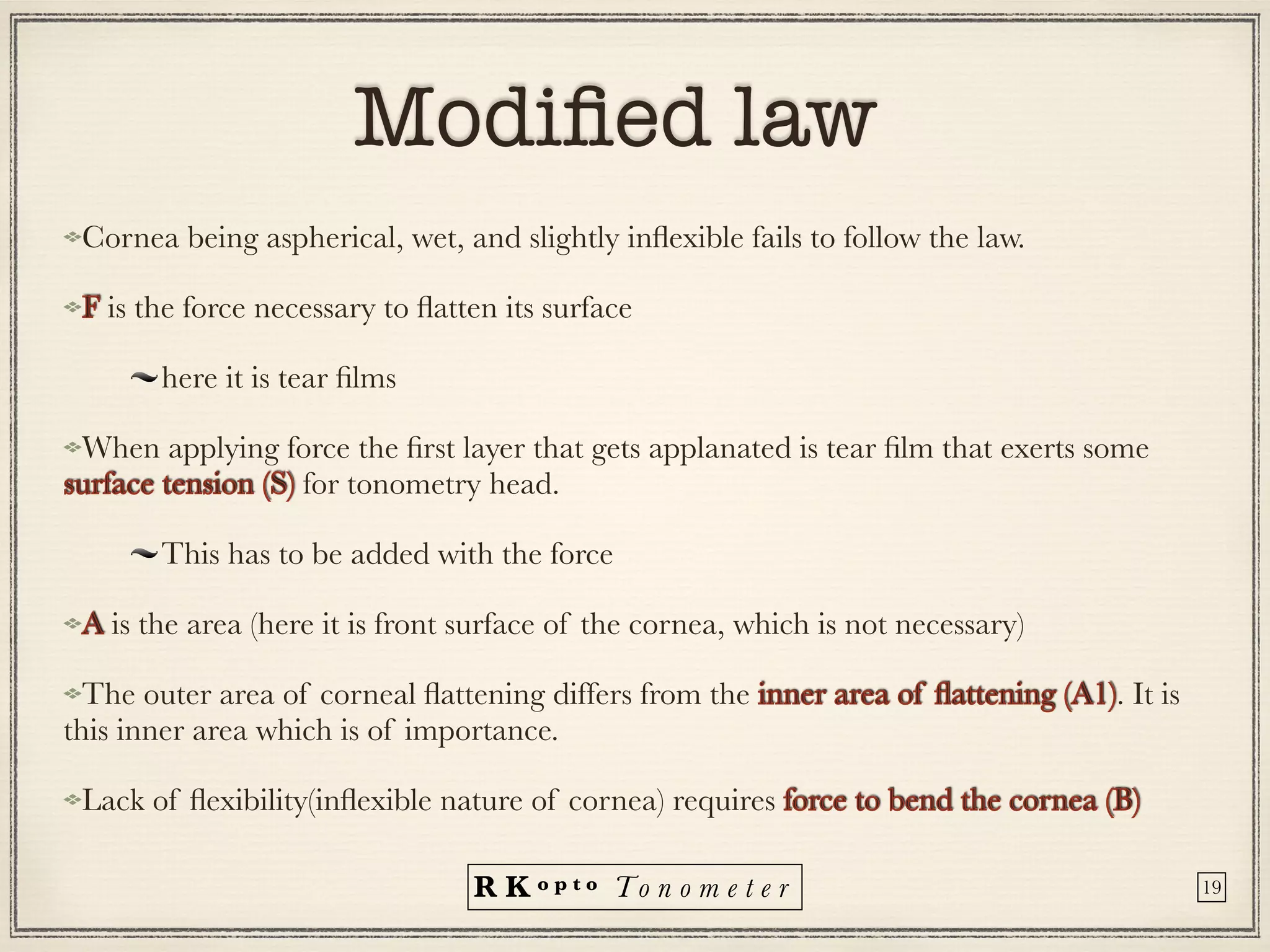
Modi
fi
ed law
Cornea being aspherical, wet, and slightly in
fl
exible fails to follow the law.


F is the force necessary to
fl
atten its surface


here it is tear
fi
lms


When applying force the
fi
rst layer that gets applanated is tear
fi
lm that exerts some
surface tension (S) for tonometry head.


This has to be added with the force


A is the area (here it is front surface of the cornea, which is not necessary)


The outer area of corneal
fl
attening differs from the inner area of
fl
attening (A1). It is
this inner area which is of importance.
Lack of
fl
exibility(in
fl
exible nature of cornea) requires force to bend the cornea (B)
19
R K o p t o To n o m e t e r


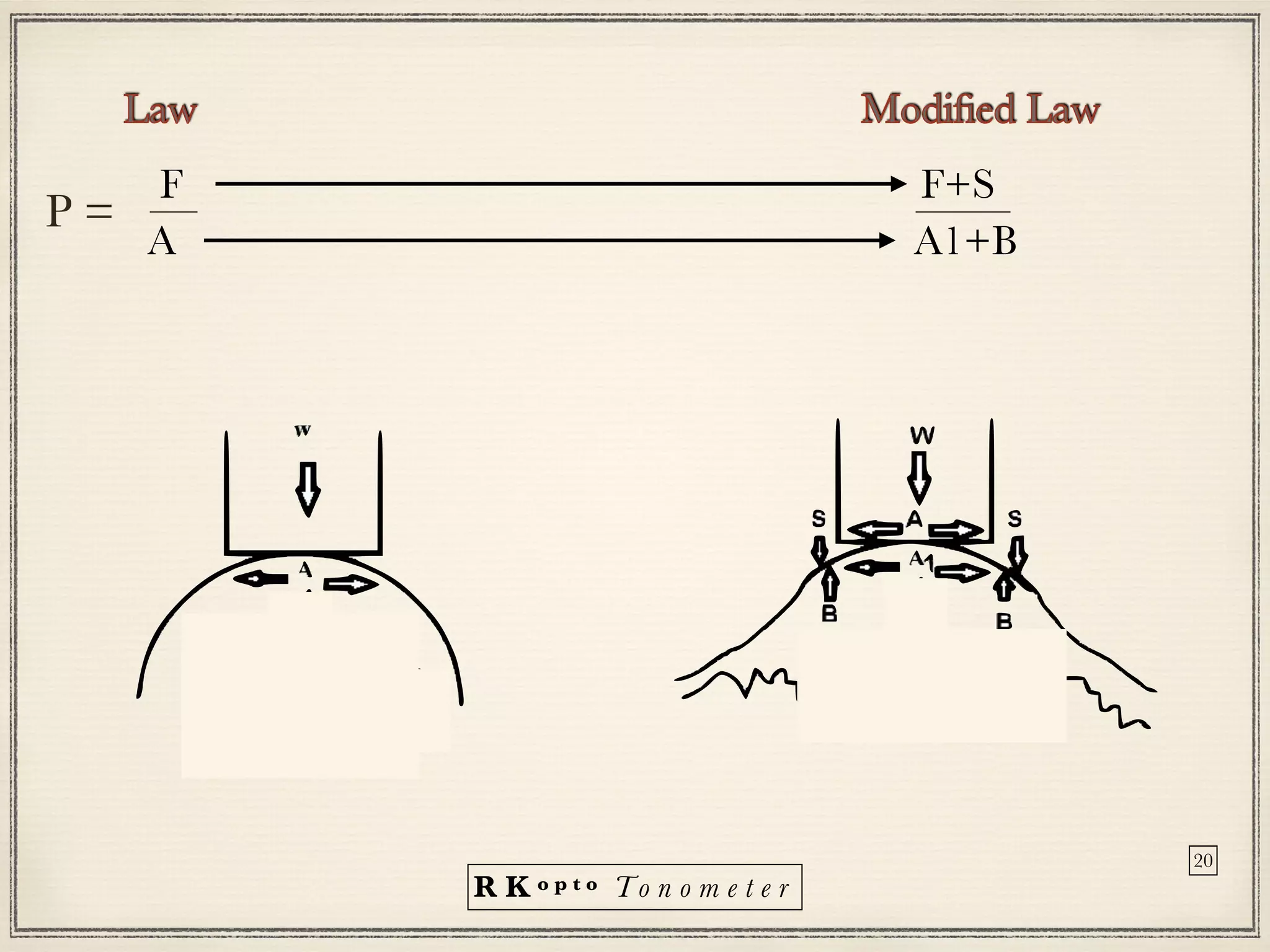
P = — ——
20
F F+S
A A1+B
Law Modi
fi
ed Law
R K o p t o To n o m e t e r
The instrument is mounted on a standard slit lamp in such a way that
the examiners view is directed through the centre of a plastic Biprism.


Biprism is attached by a rod to a housing which contains a coil spring
and series of levers that are used to adjust the force of the biprism
against the cornea.


Two beam splitting prisms within applanating unit optically convert
circular area of corneal contact in 2 semicircles.
21
R K o p t o To n o m e t e r
Procedure
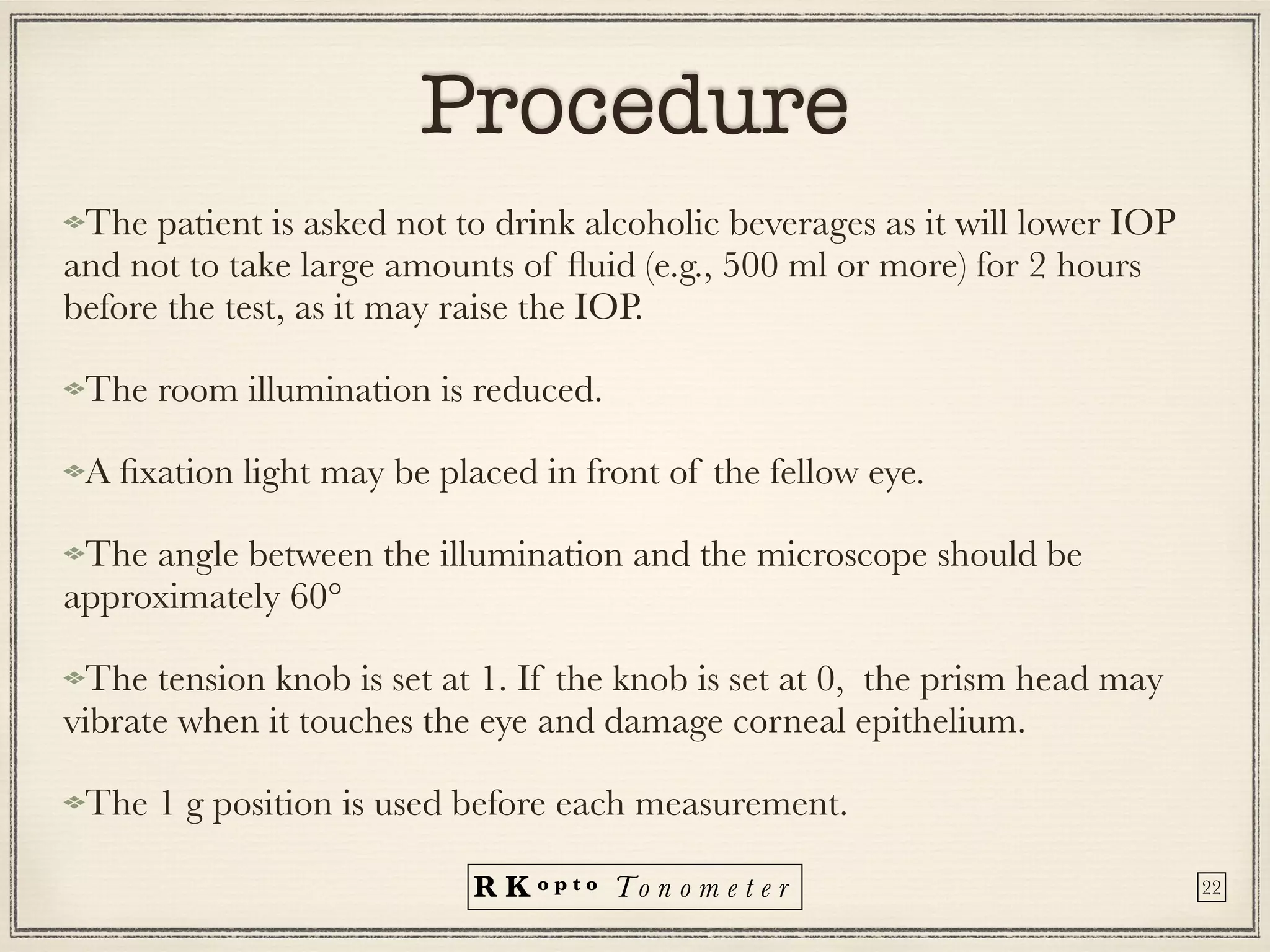
The patient is asked not to drink alcoholic beverages as it will lower IOP
and not to take large amounts of
fl
uid (e.g., 500 ml or more) for 2 hours
before the test, as it may raise the IOP.
The room illumination is reduced.


A
fi
xation light may be placed in front of the fellow eye.
The angle between the illumination and the microscope should be
approximately 60°
The tension knob is set at 1. If the knob is set at 0, the prism head may
vibrate when it touches the eye and damage corneal epithelium.


The 1 g position is used before each measurement.
22
R K o p t o To n o m e t e r
After instilling topical anaesthesia, cornea is made apparent by
instilling
fl
uorescein and viewed in cobalt blue light.
The biprism should not touch the lids or lashes because this
stimulates blinking and squeezing as a protective mechanism.
The patient should blink the eyes once or twice to spread the
fl
uorescein-stained tear
fi
lm over the cornea, and then should
keep the eyes open wide.
23
Procedure
R K o p t o To n o m e t e r 24
R K o p t o To n o m e t e r
Errors
25
R K o p t o To n o m e t e r
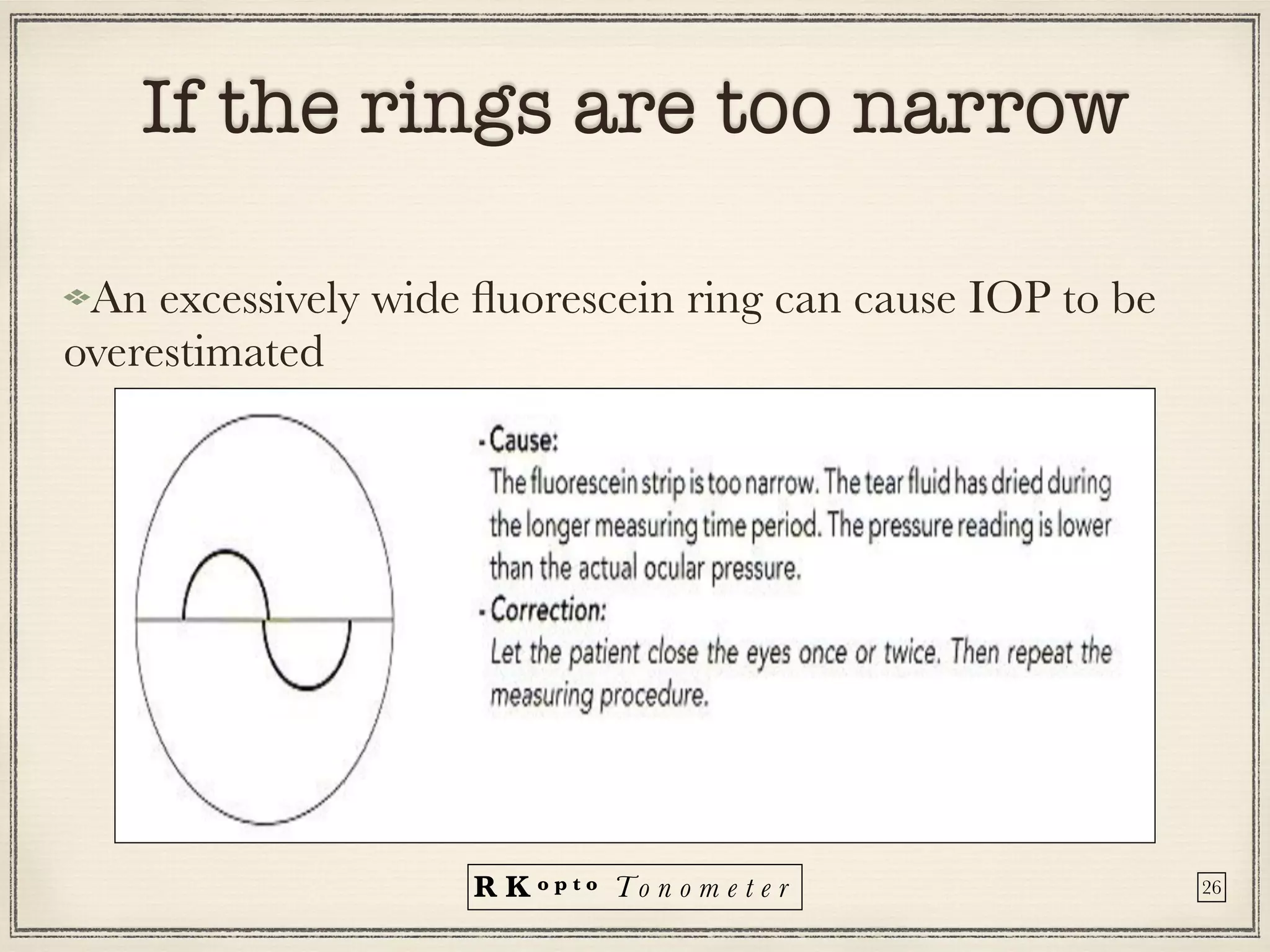
If the rings are too narrow


An excessively wide
fl
uorescein ring can cause IOP to be
overestimated
26
R K o p t o To n o m e t e r
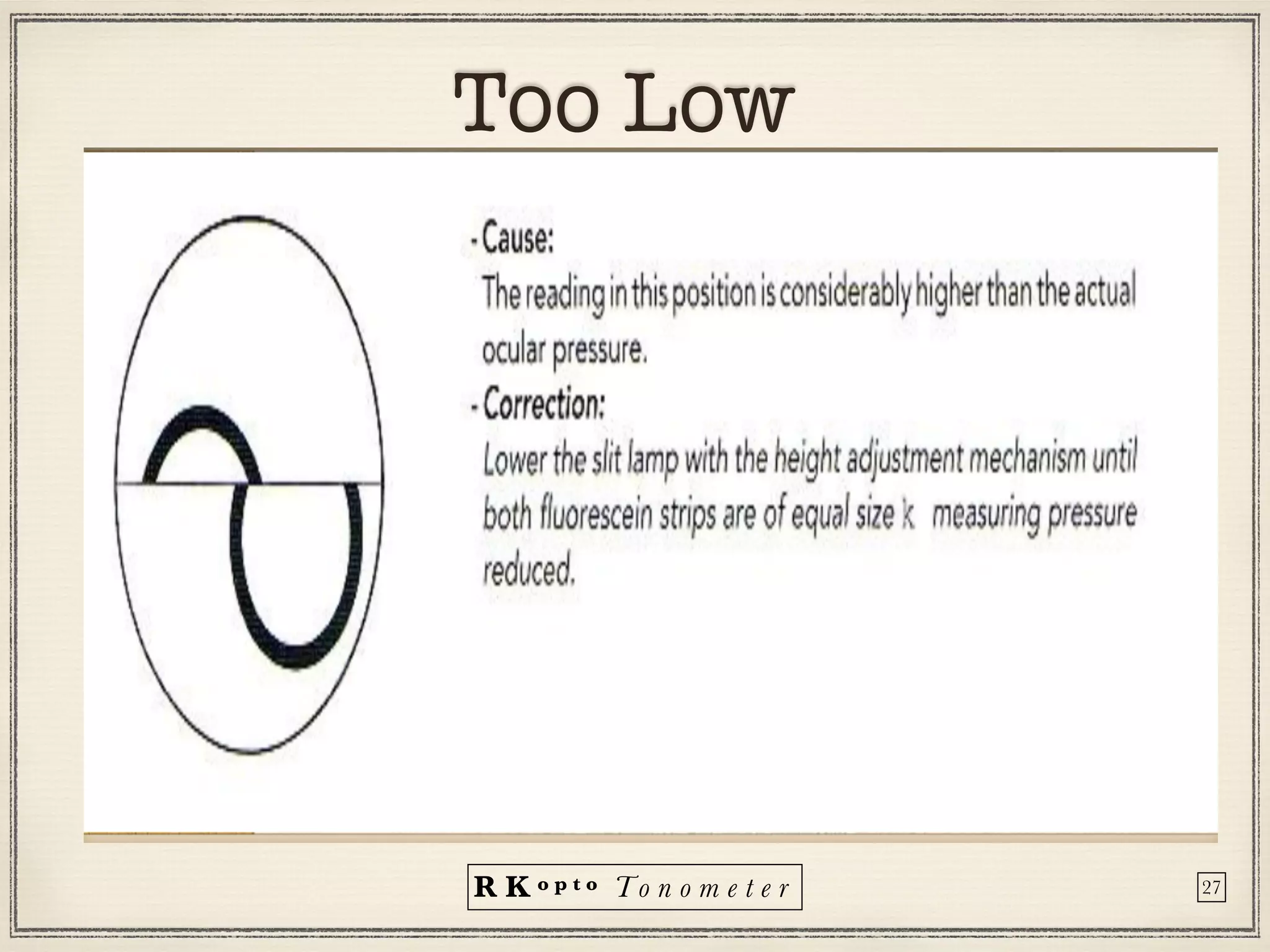
Too Low
27
R K o p t o To n o m e t e r
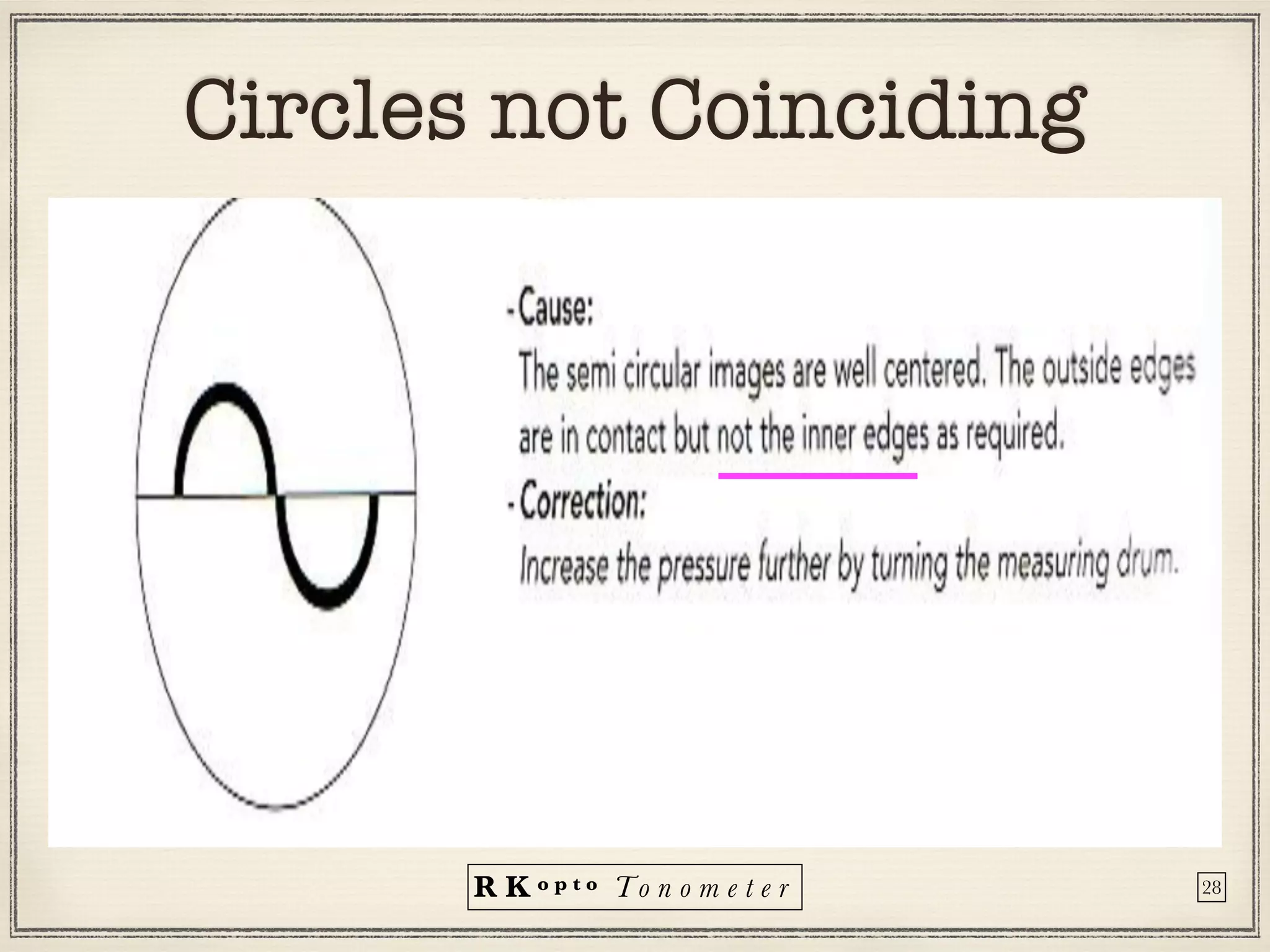
Circles not Coinciding
28
R K o p t o To n o m e t e r
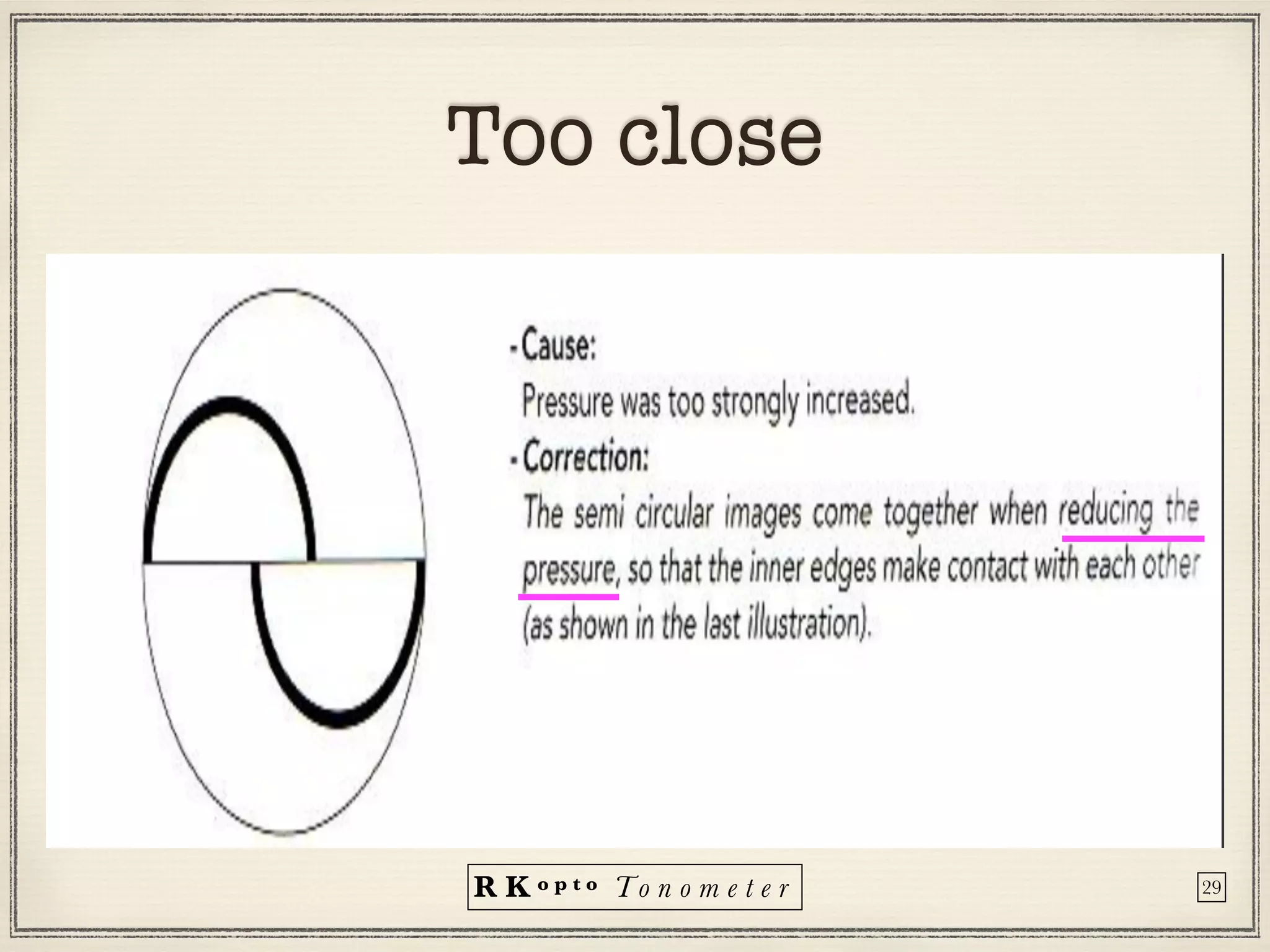
Too close
29
R K o p t o To n o m e t e r
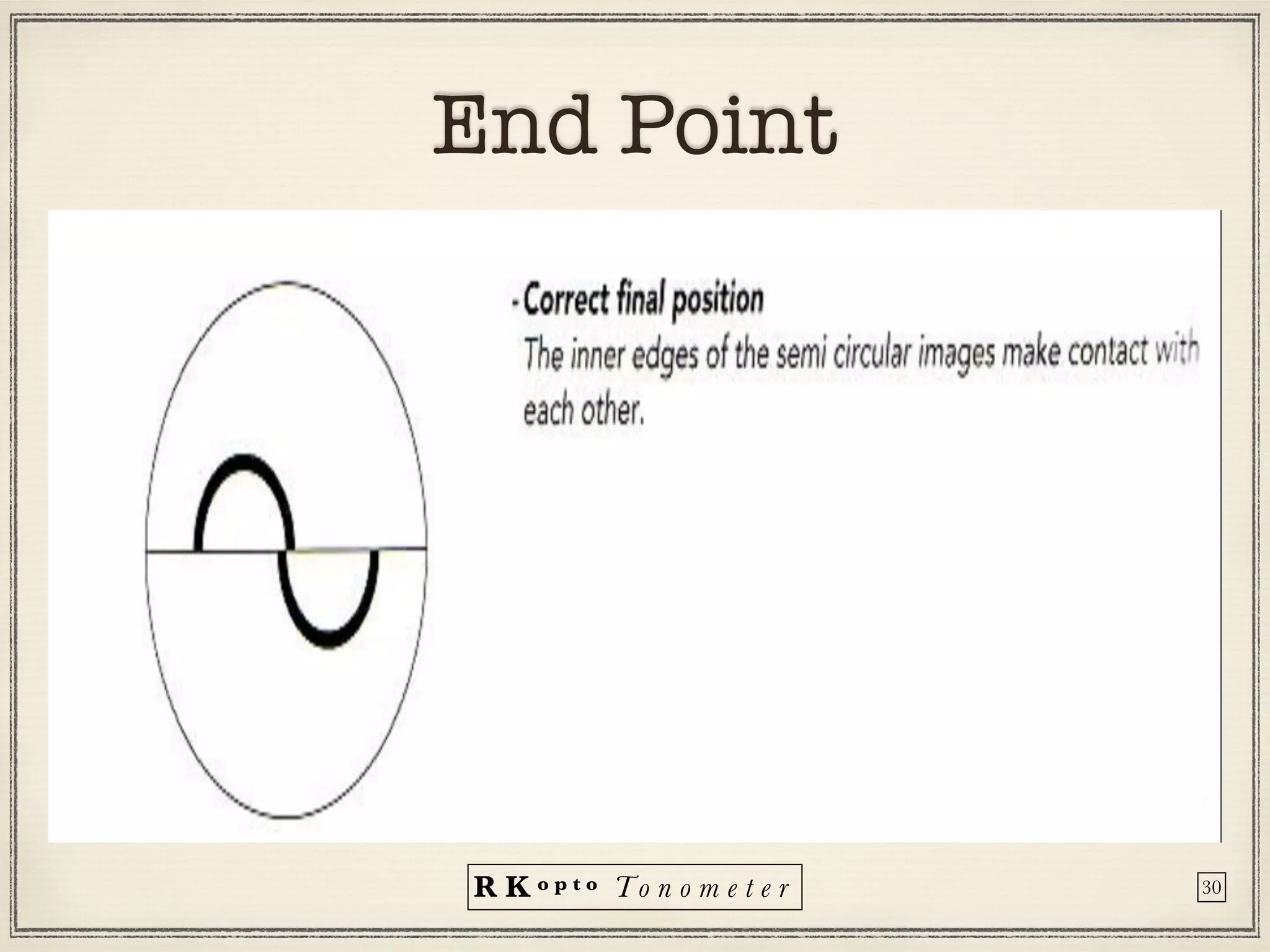
End Point
30
R K o p t o To n o m e t e r
Calibration
GAT should be calibrated periodically, at least twice in a
week.


If the GAT is not within 0.1 g (1 mmHg) of the correct
calibration, the instrument should be repaired.
31
R K o p t o To n o m e t e r
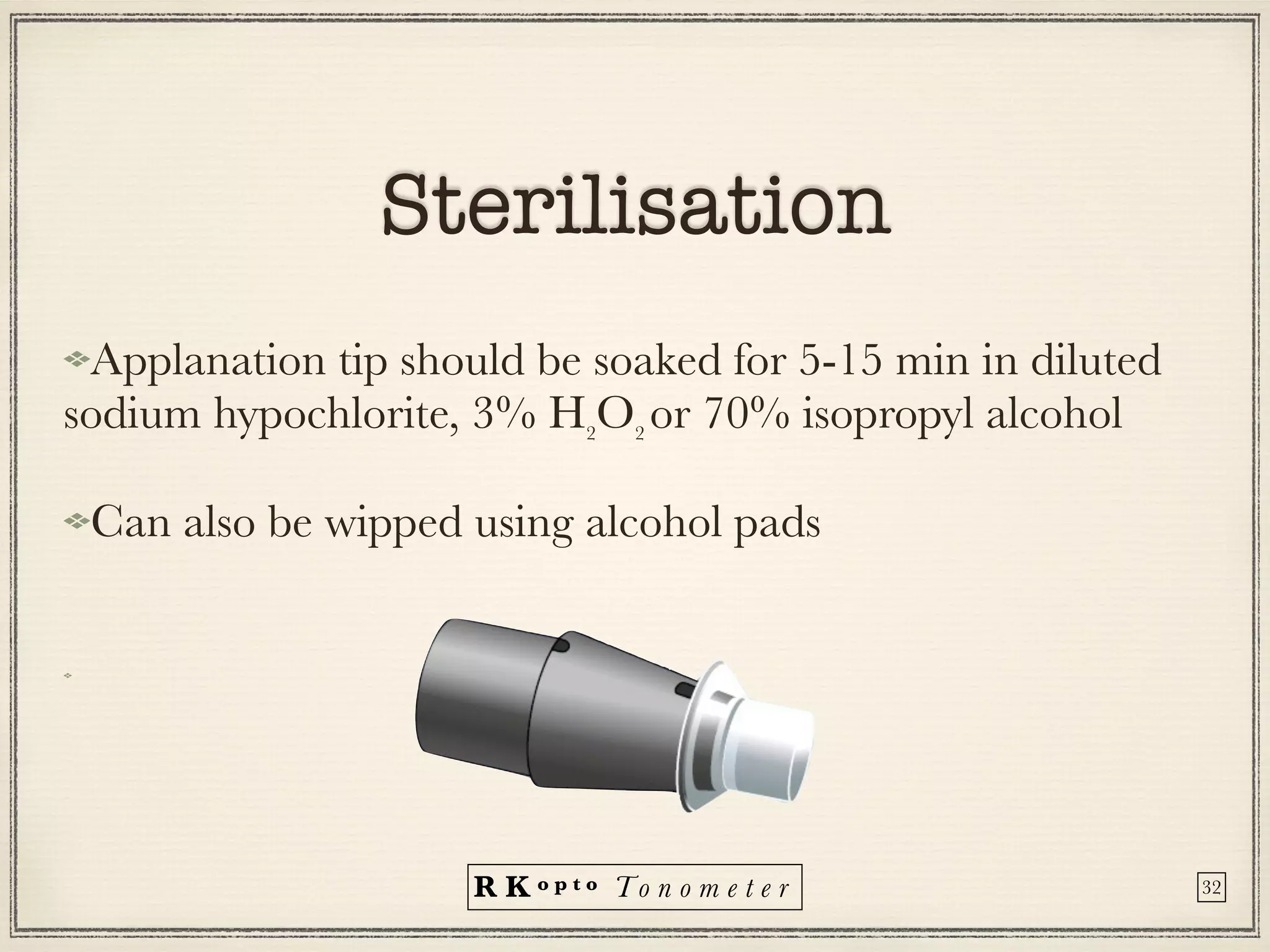
Sterilisation
Applanation tip should be soaked for 5-15 min in diluted
sodium hypochlorite, 3% H2
O2
or 70% isopropyl alcohol


Can also be wipped using alcohol pads


32
R K o p t o To n o m e t e r
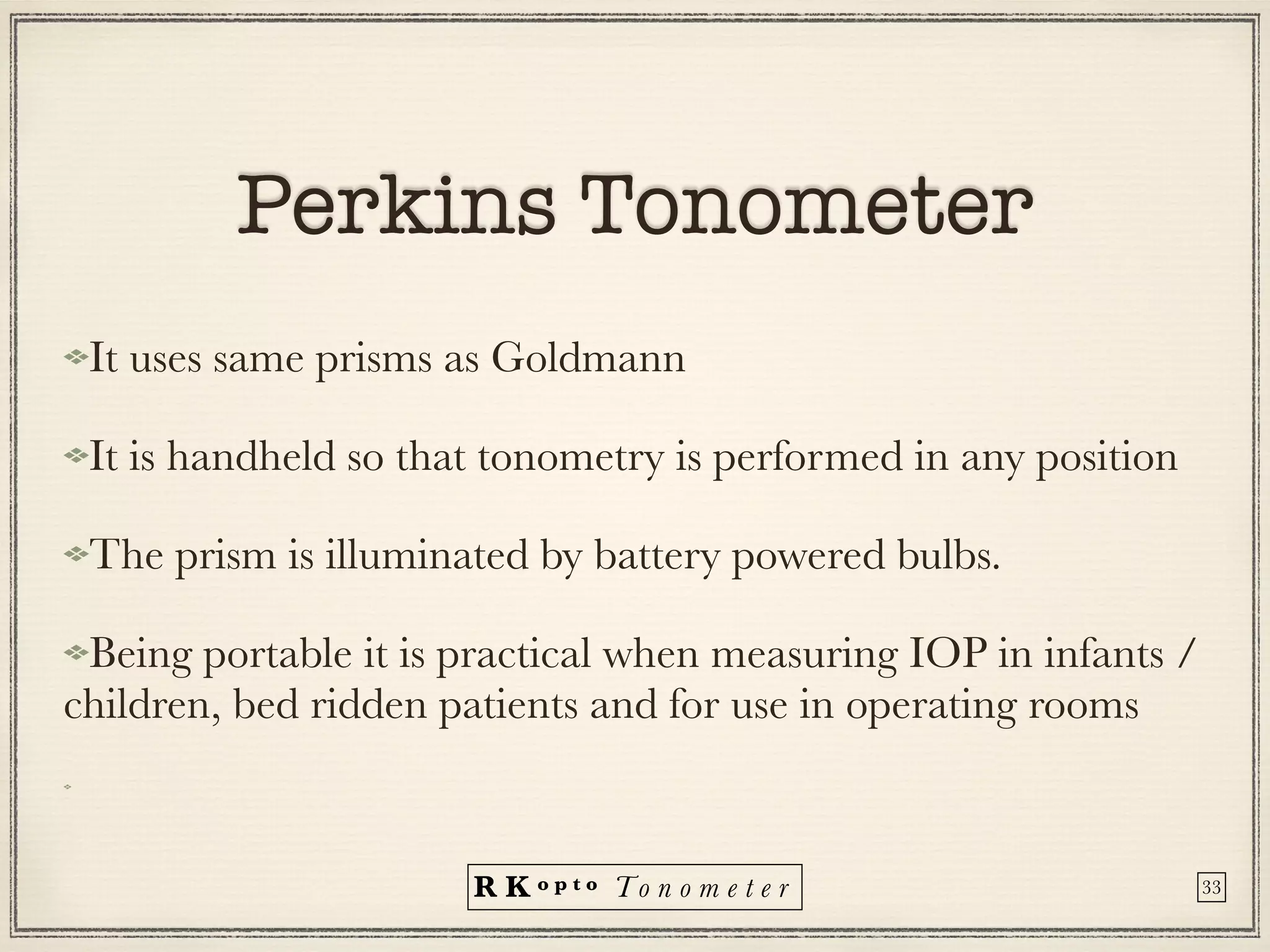
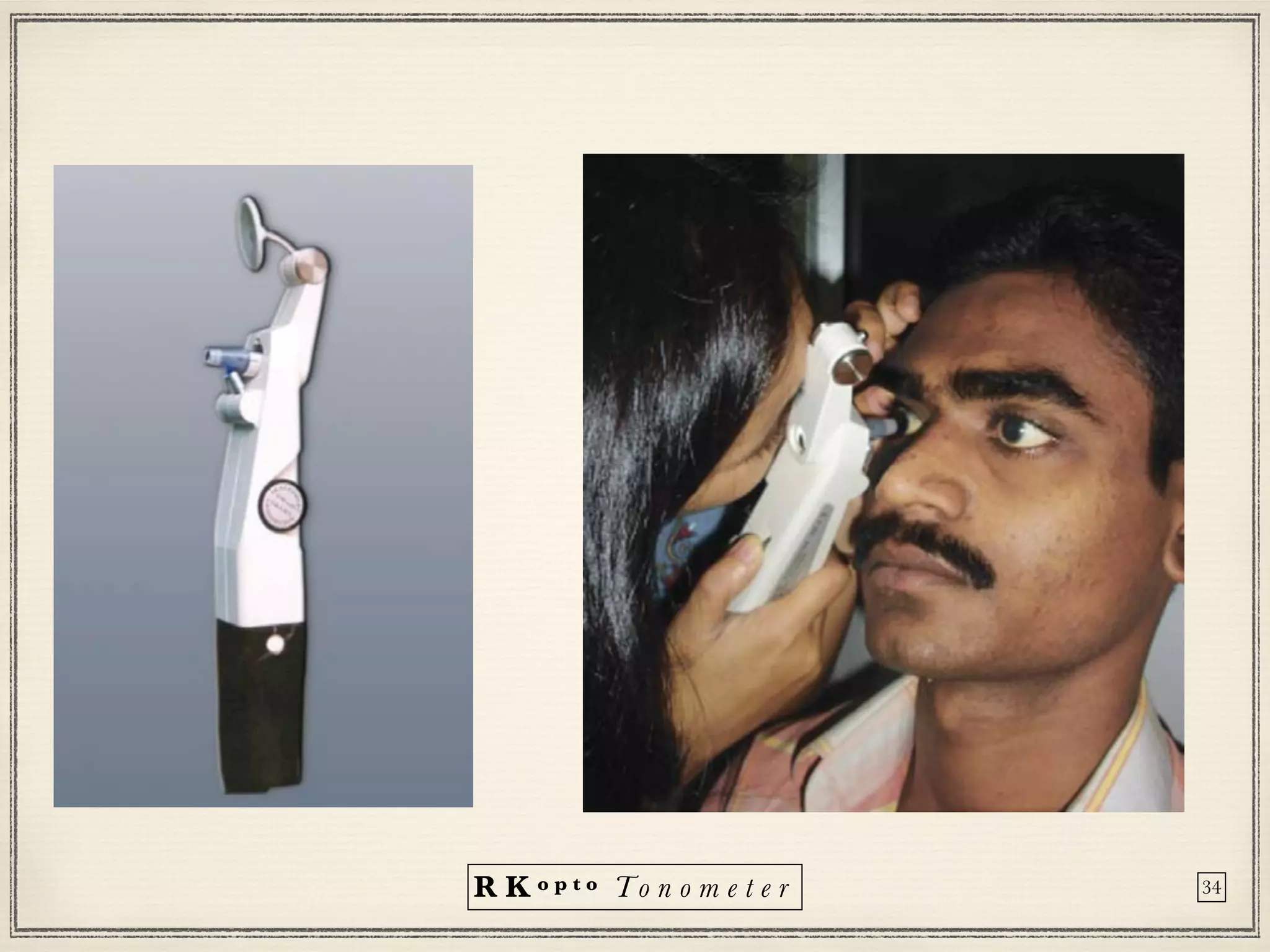
Perkins Tonometer
It uses same prisms as Goldmann
It is handheld so that tonometry is performed in any position
The prism is illuminated by battery powered bulbs.
Being portable it is practical when measuring IOP in infants /
children, bed ridden patients and for use in operating rooms
33
R K o p t o To n o m e t e r 34
R K o p t o To n o m e t e r
Tonopen
35
R K o p t o To n o m e t e r
Portable


It is particularly useful in community health fairs, on ward
rounds ,children, irregular surfaces,


Tono-Pen tends to overestimate the IOP in infants so its usefulness
in congenital glaucoma screening and monitoring is limited.
In band keratopathy where the surface of the pathology is harder
than normal cornea, the Tono-Pen tends to overestimate the IOP
36
R K o p t o To n o m e t e r
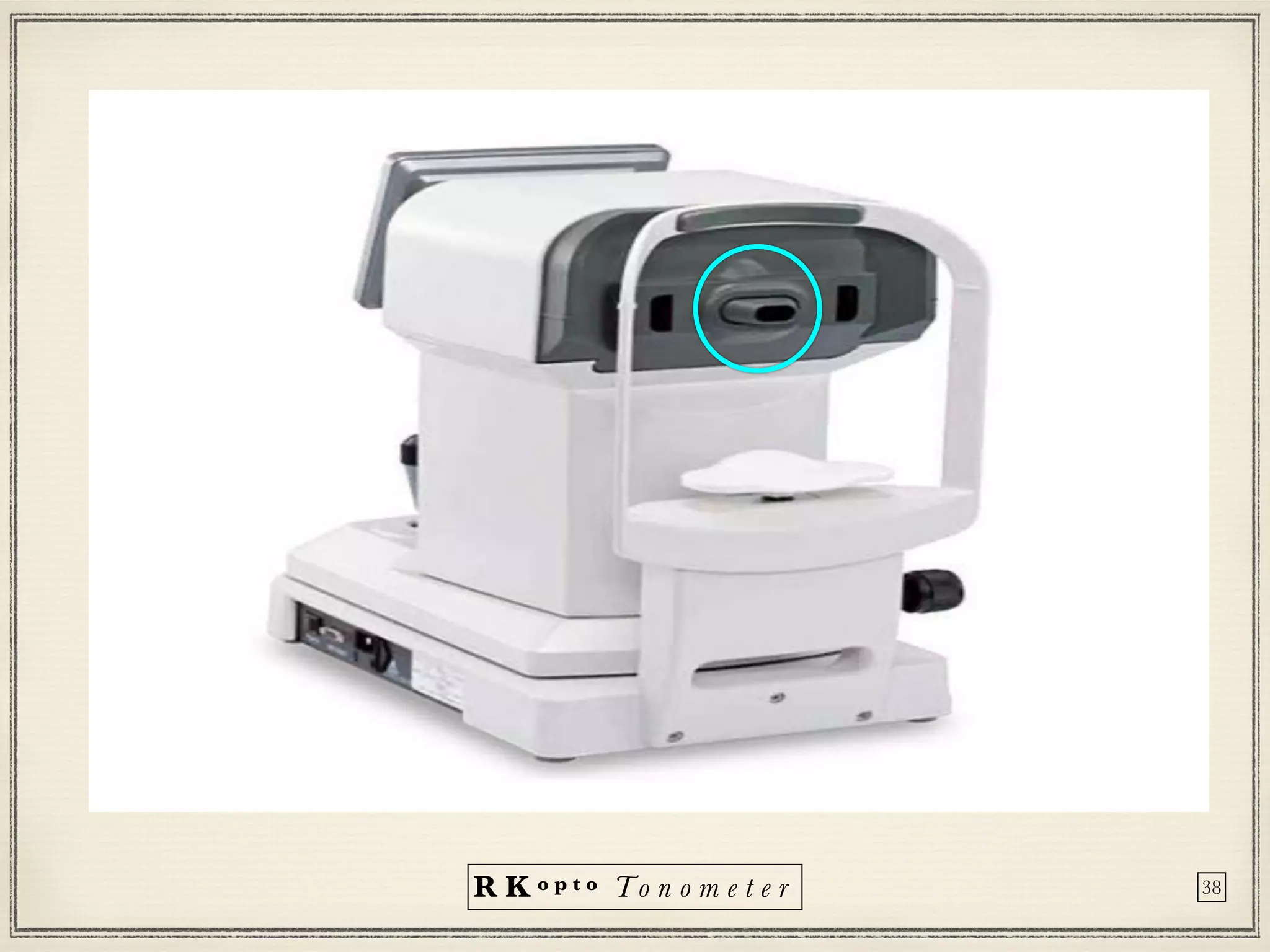
Non Contact Tonometer
Air puff tonometer


Commonly used and saves time.


A puff of air of known area is generated against cornea


When the sensor is activated by the re
fl
ected light, the air generator is
switched off.


The level of force at which the generator stops is recorded, and a
computer calculates and displays the intraocular pressure.
37
R K o p t o To n o m e t e r 38

Tonometer - Basics & Types

  • 1.
  • 2.
    R K op t o To n o m e t e r Tonometer Tonometry is the procedure performed to determine the intraocular pressure (IOP) 2
  • 3.
    R K op t o To n o m e t e r History 1826: William Bowman used digital tonometry as a routine examination test. 1885: Maklakov designed an applanation tonometer. This was used for a number of years till 1959. 1905: Hjalmar Schiotz produced his indentation tonometer. This made tonometry a simple and routine clinical test. 3
  • 4.
    R K op t o To n o m e t e r Ideal Tonometer Should give accurate and reasonable IOP measurement Convenient to use Simple to calibrate Stable from day to day Easier to standardise Free of maintenance problems 4
  • 5.
    R K op t o To n o m e t e r Types 5 Direct InDirect Static Dynamic Contact Non Contact Indentation Application Schiotz GAT,Perkins,Tonopen Airpuff Ballistic Digital
  • 6.
    R K op t o To n o m e t e r Other Types In a normal eye IOP becomes more during tonometry Low-Displacement Tonometers. Tonometers in which the IOP is negligibly raised during tonometry (less than 5%) are termed as low-displacement tonometers. Eg. Goldman's Applanation Tonometer.(raises IOP by only 3%) High-Displacement Tonometers Tonometers that displace a large volume of fl uid and consequently raise IOP signi fi cantly are termed as high- displacement tonometers. Eg. Schiotz. 6
  • 7.
    R K op t o To n o m e t e r Digital Tonometry Intraocular pressure (IOP) is estimated by response of eye to pressure applied by fi nger pulp. Indents easily – low IOP Firm to touch – normal IOP Hard to touch – high IOP 7
  • 8.
    R K op t o To n o m e t e r Shiotz Tonometry 8
  • 9.
    R K op t o To n o m e t e r 9 PA RT S Scale Needle Additional Weight 7.5g,10g,15g Weight 5.5g Foot plate ROC 15mm Plunger 3mm Diameter Holder Lever
  • 10.
    R K op t o To n o m e t e r 10 https://www.youtube.com/watch?v=8eSP-n2QEls
  • 11.
    R K op t o To n o m e t e r Characteristics The extent to which cornea is indented by plunger is measured as the distance from the foot plate curve to the plunger base and a lever system moves a needle on calibrated scale. The indicated scale reading and the plunger weight are converted to an IOP measurement. More the plunger indents the cornea, higher the scale reading and lower the IOP Each scale unit represents 0.05 mm protrusion of the plunger. 11
  • 12.
    R K op t o To n o m e t e r 12 https://www.youtube.com/watch?v=uBzwd0w-Fbk
  • 13.
    R K op t o To n o m e t e r 13 Friedenwald Conversion Table
  • 14.
    R K op t o To n o m e t e r Procedure Patient should be anaesthetised with 0.5% proparacaine. With the patient in supine position, looking up at a fi xation target while examiner separates the lids and lowers the tonometer plate to rest on the anaesthetised cornea so that plunger is free to move vertically. Scale reading is measured. The 5.5 gm weight is initially used. If scale reading is 4 or less, additional weight is added to plunger. Conversion table is used to derive IOP in mm Hg from scale reading and plunger weight. 14
  • 15.
    R K op t o To n o m e t e r Source of Error Accuracy is limited as ocular rigidity varies from eye to eye. Repeated measurements lower IOP. Steeper or a thicker cornea causes greater displacement of Schiøtz reads lower than GAT 15
  • 16.
    R K op t o To n o m e t e r Advantage Simple technique Elegant design Portable No need for SlitLamp or power supply Reasonably priced Anodized scale mount which is highly resistant to sterilizing water. Schiotz tonometer is still most widely tonometer 16
  • 17.
    R K op t o To n o m e t e r 17 Connects to the slit lamp Biprisms (measuring prism) Adjusting Knob Feeder arm Control weight insert (for calibration) Housing PA RT S
  • 18.
    R K op t o To n o m e t e r Principle Applanation tonometry is based on the Imbert-Fick Law. It states that the pressure (p) inside an ideal dry, thin- walled sphere equals the force (F) necessary to fl atten its surface divided by the area of the fl attening (A). F P = — A 18
  • 19.
    R K op t o To n o m e t e r Modi fi ed law Cornea being aspherical, wet, and slightly in fl exible fails to follow the law. F is the force necessary to fl atten its surface here it is tear fi lms When applying force the fi rst layer that gets applanated is tear fi lm that exerts some surface tension (S) for tonometry head. This has to be added with the force A is the area (here it is front surface of the cornea, which is not necessary) The outer area of corneal fl attening differs from the inner area of fl attening (A1). It is this inner area which is of importance. Lack of fl exibility(in fl exible nature of cornea) requires force to bend the cornea (B) 19
  • 20.
    R K op t o To n o m e t e r P = — —— 20 F F+S A A1+B Law Modi fi ed Law
  • 21.
    R K op t o To n o m e t e r The instrument is mounted on a standard slit lamp in such a way that the examiners view is directed through the centre of a plastic Biprism. Biprism is attached by a rod to a housing which contains a coil spring and series of levers that are used to adjust the force of the biprism against the cornea. Two beam splitting prisms within applanating unit optically convert circular area of corneal contact in 2 semicircles. 21
  • 22.
    R K op t o To n o m e t e r Procedure The patient is asked not to drink alcoholic beverages as it will lower IOP and not to take large amounts of fl uid (e.g., 500 ml or more) for 2 hours before the test, as it may raise the IOP. The room illumination is reduced. A fi xation light may be placed in front of the fellow eye. The angle between the illumination and the microscope should be approximately 60° The tension knob is set at 1. If the knob is set at 0, the prism head may vibrate when it touches the eye and damage corneal epithelium. The 1 g position is used before each measurement. 22
  • 23.
    R K op t o To n o m e t e r After instilling topical anaesthesia, cornea is made apparent by instilling fl uorescein and viewed in cobalt blue light. The biprism should not touch the lids or lashes because this stimulates blinking and squeezing as a protective mechanism. The patient should blink the eyes once or twice to spread the fl uorescein-stained tear fi lm over the cornea, and then should keep the eyes open wide. 23 Procedure
  • 24.
    R K op t o To n o m e t e r 24
  • 25.
    R K op t o To n o m e t e r Errors 25
  • 26.
    R K op t o To n o m e t e r If the rings are too narrow An excessively wide fl uorescein ring can cause IOP to be overestimated 26
  • 27.
    R K op t o To n o m e t e r Too Low 27
  • 28.
    R K op t o To n o m e t e r Circles not Coinciding 28
  • 29.
    R K op t o To n o m e t e r Too close 29
  • 30.
    R K op t o To n o m e t e r End Point 30
  • 31.
    R K op t o To n o m e t e r Calibration GAT should be calibrated periodically, at least twice in a week. If the GAT is not within 0.1 g (1 mmHg) of the correct calibration, the instrument should be repaired. 31
  • 32.
    R K op t o To n o m e t e r Sterilisation Applanation tip should be soaked for 5-15 min in diluted sodium hypochlorite, 3% H2 O2 or 70% isopropyl alcohol Can also be wipped using alcohol pads 32
  • 33.
    R K op t o To n o m e t e r Perkins Tonometer It uses same prisms as Goldmann It is handheld so that tonometry is performed in any position The prism is illuminated by battery powered bulbs. Being portable it is practical when measuring IOP in infants / children, bed ridden patients and for use in operating rooms 33
  • 34.
    R K op t o To n o m e t e r 34
  • 35.
    R K op t o To n o m e t e r Tonopen 35
  • 36.
    R K op t o To n o m e t e r Portable It is particularly useful in community health fairs, on ward rounds ,children, irregular surfaces, Tono-Pen tends to overestimate the IOP in infants so its usefulness in congenital glaucoma screening and monitoring is limited. In band keratopathy where the surface of the pathology is harder than normal cornea, the Tono-Pen tends to overestimate the IOP 36
  • 37.
    R K op t o To n o m e t e r Non Contact Tonometer Air puff tonometer Commonly used and saves time. A puff of air of known area is generated against cornea When the sensor is activated by the re fl ected light, the air generator is switched off. The level of force at which the generator stops is recorded, and a computer calculates and displays the intraocular pressure. 37
  • 38.
    R K op t o To n o m e t e r 38