Building a smarter application stack
Tomas	
  Doran	
  
@bobtfish	
  
2014-­‐06-­‐10
Docker is the future
• Preaching to the converted here ;)

• Game changing technology

• No silver bullets (ever)
• Introduces it’s own set of problems and issues
• Dependency discovery / wiring
• Scheduling
2
Smartstack
• One possible solution to discovery
problems

• This talk:
• Application architecture
• Problem(s) we’re solving
• Why this solution works well for us
• Alternate solutions
3
Microservices - also the future!
• The same as SOA
• But one API per service.
• Own data store!

• Lots of services (dozens, maybe 100s)

• All individually very simple
• Easy to reason about.
• Easy to replace
4
Don’t break the site - ever!!!
• Microservices are individually deployable!
• When we say “Don’t break the site”
• We mean
• Don’t break all of the site!
5
Don’t break the site - ever!!!
• If you have graceful degradation…
• You can ignore MTBF in the backend services!
• You only care about MTTR.
6
“I’ll just break this out into it’s own
application, as it’ll be easier to
maintain in 10 years time”
- Pre seed funding
nobody, ever!
7
Monolith - the reality
• Everyone has one of these :)
• If you’re far enough down the path, you call
this ‘The presentation layer’.

• Still poses a challenge
• need async requests
• need graceful degradation
8
Monolith - the reality
• Most popular service

• Most dependencies
• Call into 10s or 100s of other services in a
request!

• Needs circuit breakers + dynamic
configuration
9
No silver bullet = No one solution
• You should always have 2.
• Nagios / Sensu
• RRDs + Ganglia / Graphite + Diamond
• YAML files / Zookeeper
10
No silver bullet = No one solution
• ‘Top down’ architecture sucks.
• Instead, broad goals + ’Bottom up’ architecture
• Internal competition!
• Replacing the incumbent solution happens
organically
• If your thing works better, people will want to
move! 

• Not perfect! Better than top-down!
11
“Humans are bad at predicting the performance of
complex systems […]. Our ability to create large
and complex systems fools us into believing that
we’re also entitled to understand them”

- Carlos Bueno “Mature optimization handbook”

12
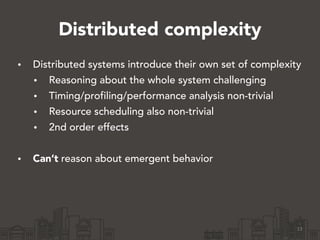
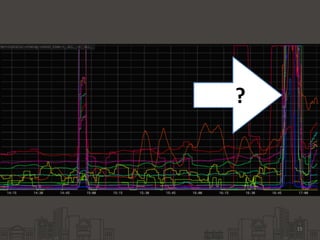
Distributed complexity
• Distributed systems introduce their own set of complexity
• Reasoning about the whole system challenging
• Timing/profiling/performance analysis non-trivial
• Resource scheduling also non-trivial
• 2nd order effects
!
• Can’t reason about emergent behavior
13
14
15
?
16
?
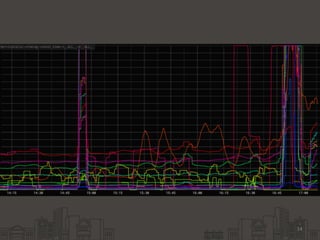
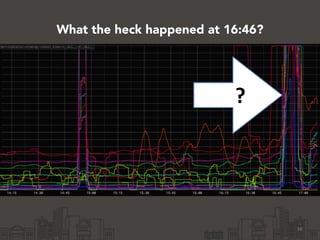
What the heck happened at 16:46?
17
?
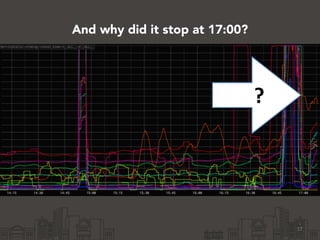
And why did it stop at 17:00?
Dynamic architecture
• Cattle not pets
• AWS and VMs in ‘the cloud’ started this
• Docker takes it a step further

• Explicitly manage persistent state
• Explicit regular recycling
• All updates are redeploys

18
Dependency nightmares
• Almost everything has some dependencies
• Simple example, web app with a mysql DB
• App config in a YAML file

• Mysql container address changes when you restart mysql!
• Oops, app can’t find mysql!

• Do I need to restart every application using mysql?
• Sucks!
• Do I need to rebuild application containers using mysql?
• To edit the config YAML file!
• Super super sucks! 19
Runtime wiring
• mysql failovers - the simple case!

• Presentation layer talking to service REST layers
• Different deployment schedules
• No downtime

• Only possible solution: wiring dependencies at runtime
• A challenge
• Also an opportunity

• DNS is workable in some cases
20
Dynamic discovery
• Discovery becomes a core problem

• DNS re-resolving not generally trustworthy
• You need to test everything for this

• DNS balancing (internally) is awful
• Failed node + multiple connections/requests
• DNS round robin
• Everything sees failure
• Slow to shift traffic
• Round robin is crappy for load balancing

21
Externalized wiring
• Remove a lot of complexity from the application domain

• Run a load balancer (haproxy) on each machine

• Applications always connect to load balancer on fixed
host/port
• localhost on traditional metal/VMs
• supplied by —link or environment variables in Docker

• Applications become wiring agnostic!
22
Externalized wiring
23
‘Client side load balancing’
• Lots of projects use this approach:
• Project Atomic
• Marathon + Mesos-Docker
• vulcand (https://github.com/mailgun/vulcand)
• Frontrunner (https://github.com/Wizcorp/
frontrunner)
• Consul
!
• Smartstack
24
Legacy infrastructure
• Physical machines
• Application images in AMIs
• kvm

• Can’t just use container links or a Docker only
solution

• Want to use the same (uniform) solution
everywhere.
25
Entropy reduction
• You can’t change everything at once!

• Everything will tend towards chaos
• ‘Old infrastructure’
• ‘New infrastructure’
• ‘New new infrastructure’
!
• Solution specifically chosen so it could be generic.
26
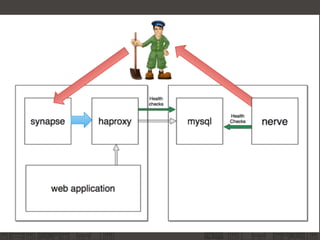
SmartStack
• 2 parts
• Synapse
• Nerve
!
• Conceptually simple
• Very flexible
• Easy to hack on
• Plays well on traditional machines
• Plays well in docker
27
Synapse
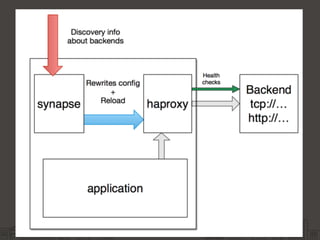
• Does discovery against a pluggable backend
• Writes out a haproxy configuration

• Assign a well known port to all services
• Application connects to that port
• haproxy forwards to an available backend

• Your application doesn’t need to know about discovery!

• Technology agnostic - works the same on metal/VMs/Docker
28
29
Why synapse?
• haproxy is a well known solution
• ruby - easy to modify
• simple (has one job)
• Pluggable - discovery with multiple methods:
• JSON config (static)
• zookeeper
• etcd
• docker API
• ec2 tags
• Flexible
• Deploy one per instance
• Or pairs as dedicated lbs 30
Nerve
• Health checks services
• Health checks are pluggable.
• HTTP (flexible) + mysql come out the box
• Registers service information to backend
• zookeeper
• etcd (beta)
31
32
Connector agnostic containers
• On ‘real servers’ or VMs, running a synapse
instance per box is fine.

• In docker, we want to abstract more than that
• Make containers connector agnostic!
• They don’t need to know or care
• Upgrade independently.
33
Synapse <3 ambassador
containers
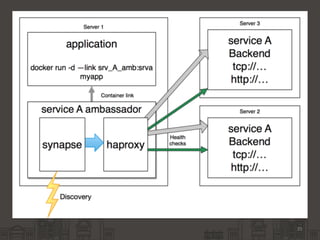
• ‘Ambassador pattern’
• Run a synapse ‘ambassador’ container on each host
for each service
• Link each application to the ambassador for each of
it’s dependencies
• Environment variables to each service’s haproxy
• Separates synapse management (i.e. changing the
wiring) from application management (i.e.
upgrading the app version).
34
35
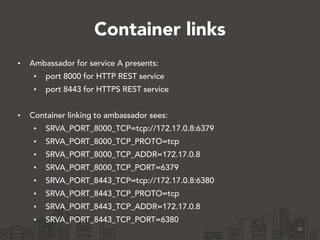
Container links
• Ambassador for service A presents:
• port 8000 for HTTP REST service
• port 8443 for HTTPS REST service
!
• Container linking to ambassador sees:
• SRVA_PORT_8000_TCP=tcp://172.17.0.8:6379
• SRVA_PORT_8000_TCP_PROTO=tcp
• SRVA_PORT_8000_TCP_ADDR=172.17.0.8
• SRVA_PORT_8000_TCP_PORT=6379
• SRVA_PORT_8443_TCP=tcp://172.17.0.8:6380
• SRVA_PORT_8443_TCP_PROTO=tcp
• SRVA_PORT_8443_TCP_ADDR=172.17.0.8
• SRVA_PORT_8443_TCP_PORT=6380
36
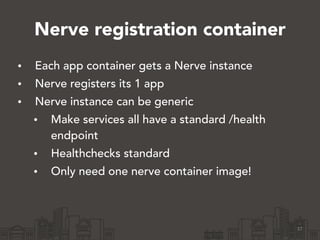
Nerve registration container
• Each app container gets a Nerve instance
• Nerve registers its 1 app
• Nerve instance can be generic
• Make services all have a standard /health
endpoint
• Healthchecks standard
• Only need one nerve container image!
37
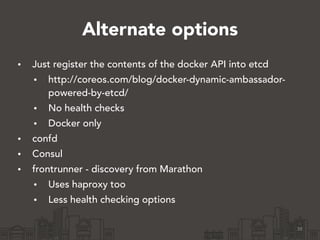
Alternate options
• Just register the contents of the docker API into etcd
• http://coreos.com/blog/docker-dynamic-ambassador-
powered-by-etcd/
• No health checks
• Docker only
• confd
• Consul
• frontrunner - discovery from Marathon
• Uses haproxy too
• Less health checking options
38
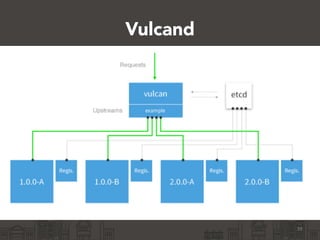
Vulcand
39
Issues
• If you have lots of machines + services, you have a lot
of Synapses
• haproxy health checks can become expensive on
end user apps
• Nerve helps with this

• Lots of small load balancers is harder to reason about
than a few big ones
40
Live demo?
41
Thanks
• Slides will be online

http://slideshare.net/bobtfish

• Official Smartstack site:

http://nerds.airbnb.com/smartstack-service-discovery-cloud/

• Pre-built containers to play with + blog post

http://engineeringblog.yelp.com/

https://index.docker.io/u/bobtfish/synapse-etcd-amb/

https://index.docker.io/u/bobtfish/nerve-etcd/

• Questions?
42

Building a Smarter Application Stack

  • 1.
    Building a smarterapplication stack Tomas  Doran   @bobtfish   2014-­‐06-­‐10
  • 2.
    Docker is thefuture • Preaching to the converted here ;)
 • Game changing technology
 • No silver bullets (ever) • Introduces it’s own set of problems and issues • Dependency discovery / wiring • Scheduling 2
  • 3.
    Smartstack • One possiblesolution to discovery problems
 • This talk: • Application architecture • Problem(s) we’re solving • Why this solution works well for us • Alternate solutions 3
  • 4.
    Microservices - alsothe future! • The same as SOA • But one API per service. • Own data store!
 • Lots of services (dozens, maybe 100s)
 • All individually very simple • Easy to reason about. • Easy to replace 4
  • 5.
    Don’t break thesite - ever!!! • Microservices are individually deployable! • When we say “Don’t break the site” • We mean • Don’t break all of the site! 5
  • 6.
    Don’t break thesite - ever!!! • If you have graceful degradation… • You can ignore MTBF in the backend services! • You only care about MTTR. 6
  • 7.
    “I’ll just breakthis out into it’s own application, as it’ll be easier to maintain in 10 years time” - Pre seed funding nobody, ever! 7
  • 8.
    Monolith - thereality • Everyone has one of these :) • If you’re far enough down the path, you call this ‘The presentation layer’.
 • Still poses a challenge • need async requests • need graceful degradation 8
  • 9.
    Monolith - thereality • Most popular service
 • Most dependencies • Call into 10s or 100s of other services in a request!
 • Needs circuit breakers + dynamic configuration 9
  • 10.
    No silver bullet= No one solution • You should always have 2. • Nagios / Sensu • RRDs + Ganglia / Graphite + Diamond • YAML files / Zookeeper 10
  • 11.
    No silver bullet= No one solution • ‘Top down’ architecture sucks. • Instead, broad goals + ’Bottom up’ architecture • Internal competition! • Replacing the incumbent solution happens organically • If your thing works better, people will want to move! 
 • Not perfect! Better than top-down! 11
  • 12.
    “Humans are badat predicting the performance of complex systems […]. Our ability to create large and complex systems fools us into believing that we’re also entitled to understand them”
 - Carlos Bueno “Mature optimization handbook”
 12
  • 13.
    Distributed complexity • Distributedsystems introduce their own set of complexity • Reasoning about the whole system challenging • Timing/profiling/performance analysis non-trivial • Resource scheduling also non-trivial • 2nd order effects ! • Can’t reason about emergent behavior 13
  • 14.
  • 15.
  • 16.
    16 ? What the heckhappened at 16:46?
  • 17.
    17 ? And why didit stop at 17:00?
  • 18.
    Dynamic architecture • Cattlenot pets • AWS and VMs in ‘the cloud’ started this • Docker takes it a step further
 • Explicitly manage persistent state • Explicit regular recycling • All updates are redeploys
 18
  • 19.
    Dependency nightmares • Almosteverything has some dependencies • Simple example, web app with a mysql DB • App config in a YAML file
 • Mysql container address changes when you restart mysql! • Oops, app can’t find mysql!
 • Do I need to restart every application using mysql? • Sucks! • Do I need to rebuild application containers using mysql? • To edit the config YAML file! • Super super sucks! 19
  • 20.
    Runtime wiring • mysqlfailovers - the simple case!
 • Presentation layer talking to service REST layers • Different deployment schedules • No downtime
 • Only possible solution: wiring dependencies at runtime • A challenge • Also an opportunity
 • DNS is workable in some cases 20
  • 21.
    Dynamic discovery • Discoverybecomes a core problem
 • DNS re-resolving not generally trustworthy • You need to test everything for this
 • DNS balancing (internally) is awful • Failed node + multiple connections/requests • DNS round robin • Everything sees failure • Slow to shift traffic • Round robin is crappy for load balancing
 21
  • 22.
    Externalized wiring • Removea lot of complexity from the application domain
 • Run a load balancer (haproxy) on each machine
 • Applications always connect to load balancer on fixed host/port • localhost on traditional metal/VMs • supplied by —link or environment variables in Docker
 • Applications become wiring agnostic! 22
  • 23.
  • 24.
    ‘Client side loadbalancing’ • Lots of projects use this approach: • Project Atomic • Marathon + Mesos-Docker • vulcand (https://github.com/mailgun/vulcand) • Frontrunner (https://github.com/Wizcorp/ frontrunner) • Consul ! • Smartstack 24
  • 25.
    Legacy infrastructure • Physicalmachines • Application images in AMIs • kvm
 • Can’t just use container links or a Docker only solution
 • Want to use the same (uniform) solution everywhere. 25
  • 26.
    Entropy reduction • Youcan’t change everything at once!
 • Everything will tend towards chaos • ‘Old infrastructure’ • ‘New infrastructure’ • ‘New new infrastructure’ ! • Solution specifically chosen so it could be generic. 26
  • 27.
    SmartStack • 2 parts •Synapse • Nerve ! • Conceptually simple • Very flexible • Easy to hack on • Plays well on traditional machines • Plays well in docker 27
  • 28.
    Synapse • Does discoveryagainst a pluggable backend • Writes out a haproxy configuration
 • Assign a well known port to all services • Application connects to that port • haproxy forwards to an available backend
 • Your application doesn’t need to know about discovery!
 • Technology agnostic - works the same on metal/VMs/Docker 28
  • 29.
  • 30.
    Why synapse? • haproxyis a well known solution • ruby - easy to modify • simple (has one job) • Pluggable - discovery with multiple methods: • JSON config (static) • zookeeper • etcd • docker API • ec2 tags • Flexible • Deploy one per instance • Or pairs as dedicated lbs 30
  • 31.
    Nerve • Health checksservices • Health checks are pluggable. • HTTP (flexible) + mysql come out the box • Registers service information to backend • zookeeper • etcd (beta) 31
  • 32.
  • 33.
    Connector agnostic containers •On ‘real servers’ or VMs, running a synapse instance per box is fine.
 • In docker, we want to abstract more than that • Make containers connector agnostic! • They don’t need to know or care • Upgrade independently. 33
  • 34.
    Synapse <3 ambassador containers •‘Ambassador pattern’ • Run a synapse ‘ambassador’ container on each host for each service • Link each application to the ambassador for each of it’s dependencies • Environment variables to each service’s haproxy • Separates synapse management (i.e. changing the wiring) from application management (i.e. upgrading the app version). 34
  • 35.
  • 36.
    Container links • Ambassadorfor service A presents: • port 8000 for HTTP REST service • port 8443 for HTTPS REST service ! • Container linking to ambassador sees: • SRVA_PORT_8000_TCP=tcp://172.17.0.8:6379 • SRVA_PORT_8000_TCP_PROTO=tcp • SRVA_PORT_8000_TCP_ADDR=172.17.0.8 • SRVA_PORT_8000_TCP_PORT=6379 • SRVA_PORT_8443_TCP=tcp://172.17.0.8:6380 • SRVA_PORT_8443_TCP_PROTO=tcp • SRVA_PORT_8443_TCP_ADDR=172.17.0.8 • SRVA_PORT_8443_TCP_PORT=6380 36
  • 37.
    Nerve registration container •Each app container gets a Nerve instance • Nerve registers its 1 app • Nerve instance can be generic • Make services all have a standard /health endpoint • Healthchecks standard • Only need one nerve container image! 37
  • 38.
    Alternate options • Justregister the contents of the docker API into etcd • http://coreos.com/blog/docker-dynamic-ambassador- powered-by-etcd/ • No health checks • Docker only • confd • Consul • frontrunner - discovery from Marathon • Uses haproxy too • Less health checking options 38
  • 39.
  • 40.
    Issues • If youhave lots of machines + services, you have a lot of Synapses • haproxy health checks can become expensive on end user apps • Nerve helps with this
 • Lots of small load balancers is harder to reason about than a few big ones 40
  • 41.
  • 42.
    Thanks • Slides willbe online
 http://slideshare.net/bobtfish
 • Official Smartstack site:
 http://nerds.airbnb.com/smartstack-service-discovery-cloud/
 • Pre-built containers to play with + blog post
 http://engineeringblog.yelp.com/
 https://index.docker.io/u/bobtfish/synapse-etcd-amb/
 https://index.docker.io/u/bobtfish/nerve-etcd/
 • Questions? 42