From Months to Minutes

How GE Appliances Brought Docker Into the Enterprise

Tom Barber – Cloud Computing Technologist

Brett Luckabaugh – Enterprise Software Architect
GE Appliances
GE Appliances is at the forefront of building
innovative, energy-efficient appliances that
improve people’s lives.
• Headquartered in Louisville, KY
• $5 Billion+ in revenue
• 12,000+ employees
geappliances.com
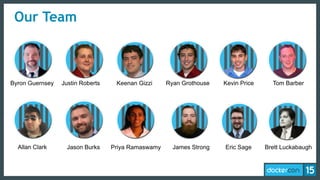
Our Team
Byron Guernsey Ryan GrothouseKeenan Gizzi
Allan Clark Priya Ramaswamy Eric SageJason Burks
Kevin PriceJustin Roberts
James Strong
Tom Barber
Brett Luckabaugh
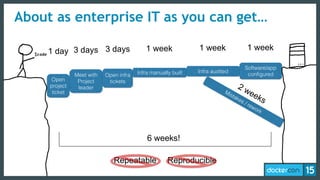
About as enterprise IT as you can get…
Open
project
ticket
1 day
Meet with
Project
leader
3 days
Open infra
tickets
3 days
Infra manually built
1 week
Infra audited
1 week
Mistakes / rework
2 weeks
6 weeks!
Software/app
configured
1 week
Repeatable Reproducible
I’ll have 1 cloud please…
• Mid 2012: Formation of a cloud focused team with an
agile culture
• Goals: Automate Infrastructure, Modernize Paradigm
• Leveraged Puppet
• 1 year to self-service IaaS solution
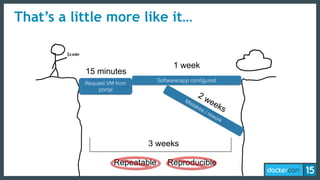
That’s a little more like it…
Request VM from
portal
15 minutes
Software/app configured
1 week
Mistakes / rework
2 weeks
3 weeks
Repeatable Reproducible
Good start... Now what?
• 2013: Improve IaaS
• Exploring self-service application platform
(PaaS) automation
• Leverage Puppet as our PaaS toolset
• App owners develop and contribute to puppet
modules
Eh…maybe not so much
• Terrible rate of adoption
- High barrier to entry for app owners
- Reluctant to learn or write Puppet despite industry training
- Highly heterogeneous environment with proprietary apps
• Our Team – The Bottleneck
• Generic Builds
- Avoiding automation
- Manually configured environments -> snowflakes
- Access and privilege restrictions
- Tickets and waiting
- No way to quickly replicate environments
It’s not you…it’s me
• Early 2014 - Our team was having success with
Puppet for IaaS and DBaaS
• However, our larger organization was not
having success using Puppet for self-service
PaaS
• But where do we go from here?
What about this Docker…
• Started at DockerCon 2014
• Docker + Mesosphere - August 2014
- Docker
• High portability
• Lower barrier to entry -> possibly drive greater adoption? – if
you can use a shell, you can grasp a Dockerfile
- Mesosphere
• Fast deployments, scheduling of tasks, scaling, management
of containers, self-healing/fault tolerant, simplification of
datacenter management
Our self-service gap
• Process gap between Docker and our Users
- No shell access to Docker
- Can’t deploy Docker from Marathon UI
- Users not going to build API calls
- Lets not just turn everyone loose on the full API
• How do we bridge that Gap?
- Looked for tools in August 2014, found none that
really met our needs
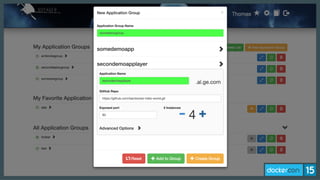
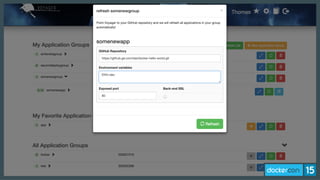
What’s Voyager?
• Web application to bridge the gap
• Three person team developed initial MVP version in
2 weeks
• MVP features:
- Automated Docker builds without shell access
- Images built from GitHub repositories
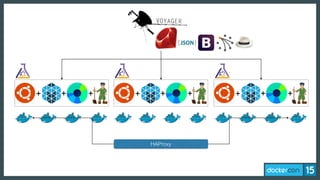
- Configurable RESTful service discovery/load balancing
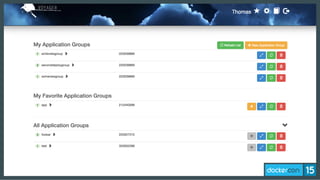
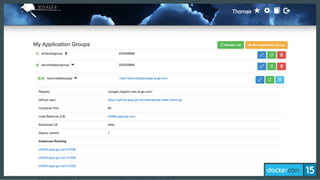
- UI and APIs to tie it all together
• UI – ease of use for all
• APIs – enable continuous integration
HAProxy
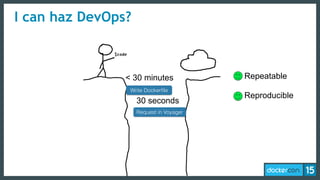
I can haz DevOps?
Write Dockerfile
< 30 minutes
Request in Voyager
30 seconds
Repeatable
Reproducible
I think our compliance lead just exploded…
• New concept of immutable infrastructure
- ITIL/Compliance
- How do I ssh? Which Server?
- What do I do if my app instances are having problems?
• Education gap on Docker principals
• Highly heterogeneous environment
- How do I support everything, but do it well?
• Security
- Freedom to put whatever in container?
It’s all about that app…
• A focus shift from infrastructure to app
- ITIL/Compliance
• Policies and processes historically geared towards infrastructure
• Must shift to the app in this model
• Provide Education
- Help users differentiate images/containers, encourage
environment variable configuration, best practices
• Adding features constantly, but carefully
- Highly heterogeneous environment
• Focus on being really good at running Docker containers
• Balance accommodating everything with keeping it simple
Dude…where's my server?
• How do I ssh? Which Server?
- No shell is an adjustment
- External log shipping provides insight
- Encourage new mindset with uneasy app owners
• What do I do if my app instances are having
problems?
- Break our old habits of server hugging
- Just throw bad ones away and replace
- Cheapening of app delivery enables this
Bro…it’s probably fine
• Security
- Double edged sword - freedom vs. control
• Encourage best practices
• Education
• Minimize container footprint/attack vectors
• Shift/decentralize security responsibility to app teams
• App teams take over patching
So does it work?
• Benefits
- Instant scalability
- 14x density
• User feedback on usability is positive
• Docker adoption rates are high
- Currently running 350+ apps = 800+ containers, and growing daily
- Our most critical applications are running in Docker
• Mesosphere + Docker = stable and outage resilient
• Flexibility
- Supports legacy applications well
- Enables modern practices - micro-services and continuous integration
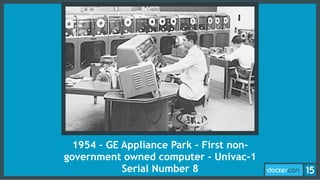
1954 – GE Appliance Park – First non-
government owned computer - Univac-1
Serial Number 8
Fast forward 61 years…
• Same data center, slightly different hardware
• Ongoing project to move apps to new private
and public clouds
• Planned exit strategy -> multiple years
• With Docker in the fold?
- Completed so far 45%+ in ~4 months
So where do we go next?
• Broad Open Issues
- Windows support?
- Persistent storage?
- Networking (SDN containers)?
• Organizational Goals
- Oracle ERP in Docker?
- Drive density - 1000’s of containers per blade
- Too many load balancers -> containerize -> improve service
discovery
- Honeybadger - Multi-cloud spanning/support
- Pushing Docker’s portability to its logical conclusion
Thank you
Tom Barber
thomas.barber@ge.com
Brett Luckabaugh
brett.luckabaugh@ge.com
@barberta2 @OverflownStack

DockerCon SF 2015: From Months to Minutes

  • 1.
    From Months toMinutes
 How GE Appliances Brought Docker Into the Enterprise
 Tom Barber – Cloud Computing Technologist
 Brett Luckabaugh – Enterprise Software Architect
  • 2.
    GE Appliances GE Appliancesis at the forefront of building innovative, energy-efficient appliances that improve people’s lives. • Headquartered in Louisville, KY • $5 Billion+ in revenue • 12,000+ employees geappliances.com
  • 3.
    Our Team Byron GuernseyRyan GrothouseKeenan Gizzi Allan Clark Priya Ramaswamy Eric SageJason Burks Kevin PriceJustin Roberts James Strong Tom Barber Brett Luckabaugh
  • 4.
    About as enterpriseIT as you can get… Open project ticket 1 day Meet with Project leader 3 days Open infra tickets 3 days Infra manually built 1 week Infra audited 1 week Mistakes / rework 2 weeks 6 weeks! Software/app configured 1 week Repeatable Reproducible
  • 5.
    I’ll have 1cloud please… • Mid 2012: Formation of a cloud focused team with an agile culture • Goals: Automate Infrastructure, Modernize Paradigm • Leveraged Puppet • 1 year to self-service IaaS solution
  • 6.
    That’s a littlemore like it… Request VM from portal 15 minutes Software/app configured 1 week Mistakes / rework 2 weeks 3 weeks Repeatable Reproducible
  • 7.
    Good start... Nowwhat? • 2013: Improve IaaS • Exploring self-service application platform (PaaS) automation • Leverage Puppet as our PaaS toolset • App owners develop and contribute to puppet modules
  • 8.
    Eh…maybe not somuch • Terrible rate of adoption - High barrier to entry for app owners - Reluctant to learn or write Puppet despite industry training - Highly heterogeneous environment with proprietary apps • Our Team – The Bottleneck • Generic Builds - Avoiding automation - Manually configured environments -> snowflakes - Access and privilege restrictions - Tickets and waiting - No way to quickly replicate environments
  • 9.
    It’s not you…it’sme • Early 2014 - Our team was having success with Puppet for IaaS and DBaaS • However, our larger organization was not having success using Puppet for self-service PaaS • But where do we go from here?
  • 10.
    What about thisDocker… • Started at DockerCon 2014 • Docker + Mesosphere - August 2014 - Docker • High portability • Lower barrier to entry -> possibly drive greater adoption? – if you can use a shell, you can grasp a Dockerfile - Mesosphere • Fast deployments, scheduling of tasks, scaling, management of containers, self-healing/fault tolerant, simplification of datacenter management
  • 11.
    Our self-service gap •Process gap between Docker and our Users - No shell access to Docker - Can’t deploy Docker from Marathon UI - Users not going to build API calls - Lets not just turn everyone loose on the full API • How do we bridge that Gap? - Looked for tools in August 2014, found none that really met our needs
  • 13.
    What’s Voyager? • Webapplication to bridge the gap • Three person team developed initial MVP version in 2 weeks • MVP features: - Automated Docker builds without shell access - Images built from GitHub repositories - Configurable RESTful service discovery/load balancing - UI and APIs to tie it all together • UI – ease of use for all • APIs – enable continuous integration
  • 14.
  • 19.
    I can hazDevOps? Write Dockerfile < 30 minutes Request in Voyager 30 seconds Repeatable Reproducible
  • 20.
    I think ourcompliance lead just exploded… • New concept of immutable infrastructure - ITIL/Compliance - How do I ssh? Which Server? - What do I do if my app instances are having problems? • Education gap on Docker principals • Highly heterogeneous environment - How do I support everything, but do it well? • Security - Freedom to put whatever in container?
  • 21.
    It’s all aboutthat app… • A focus shift from infrastructure to app - ITIL/Compliance • Policies and processes historically geared towards infrastructure • Must shift to the app in this model • Provide Education - Help users differentiate images/containers, encourage environment variable configuration, best practices • Adding features constantly, but carefully - Highly heterogeneous environment • Focus on being really good at running Docker containers • Balance accommodating everything with keeping it simple
  • 22.
    Dude…where's my server? •How do I ssh? Which Server? - No shell is an adjustment - External log shipping provides insight - Encourage new mindset with uneasy app owners • What do I do if my app instances are having problems? - Break our old habits of server hugging - Just throw bad ones away and replace - Cheapening of app delivery enables this
  • 23.
    Bro…it’s probably fine •Security - Double edged sword - freedom vs. control • Encourage best practices • Education • Minimize container footprint/attack vectors • Shift/decentralize security responsibility to app teams • App teams take over patching
  • 24.
    So does itwork? • Benefits - Instant scalability - 14x density • User feedback on usability is positive • Docker adoption rates are high - Currently running 350+ apps = 800+ containers, and growing daily - Our most critical applications are running in Docker • Mesosphere + Docker = stable and outage resilient • Flexibility - Supports legacy applications well - Enables modern practices - micro-services and continuous integration
  • 25.
    1954 – GEAppliance Park – First non- government owned computer - Univac-1 Serial Number 8
  • 26.
    Fast forward 61years… • Same data center, slightly different hardware • Ongoing project to move apps to new private and public clouds • Planned exit strategy -> multiple years • With Docker in the fold? - Completed so far 45%+ in ~4 months
  • 27.
    So where dowe go next? • Broad Open Issues - Windows support? - Persistent storage? - Networking (SDN containers)? • Organizational Goals - Oracle ERP in Docker? - Drive density - 1000’s of containers per blade - Too many load balancers -> containerize -> improve service discovery - Honeybadger - Multi-cloud spanning/support - Pushing Docker’s portability to its logical conclusion
  • 28.
    Thank you Tom Barber thomas.barber@ge.com BrettLuckabaugh brett.luckabaugh@ge.com @barberta2 @OverflownStack