Tokyo Stock
Exchange
(NIKKI)
Presented By-
KALEEM SARWAR BHATTI
(023) BBA-13
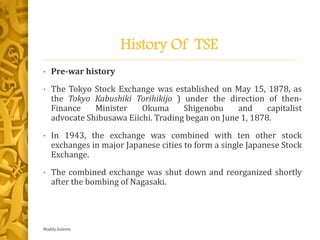
TOKYO STOCK EXCHANGE
Maddy.kaleem
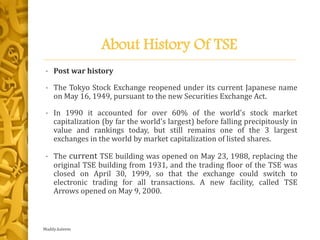
History Of TSE
• Pre-war history
• The Tokyo Stock Exchange was established on May 15, 1878, as
the Tokyo Kabushiki Torihikijo ) under the direction of then-
Finance Minister Okuma Shigenobu and capitalist
advocate Shibusawa Eiichi. Trading began on June 1, 1878.
• In 1943, the exchange was combined with ten other stock
exchanges in major Japanese cities to form a single Japanese Stock
Exchange.
• The combined exchange was shut down and reorganized shortly
after the bombing of Nagasaki.
Maddy.kaleem
About History Of TSE
• Post war history
• The Tokyo Stock Exchange reopened under its current Japanese name
on May 16, 1949, pursuant to the new Securities Exchange Act.
• In 1990 it accounted for over 60% of the world's stock market
capitalization (by far the world's largest) before falling precipitously in
value and rankings today, but still remains one of the 3 largest
exchanges in the world by market capitalization of listed shares.
• The current TSE building was opened on May 23, 1988, replacing the
original TSE building from 1931, and the trading floor of the TSE was
closed on April 30, 1999, so that the exchange could switch to
electronic trading for all transactions. A new facility, called TSE
Arrows opened on May 9, 2000.
Maddy.kaleem
About History Of TSE
• In 2001, the TSE restructured itself as a stock company: before
this time, it was structured as an incorporated association with
its members as shareholders.
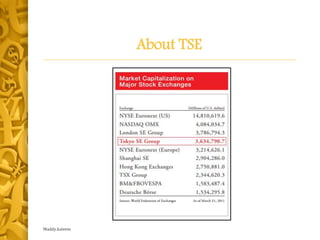
• It is the third largest stock exchange in the world by aggregate
market capitalization of its listed companies.
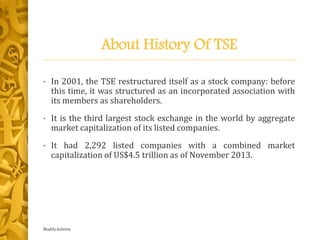
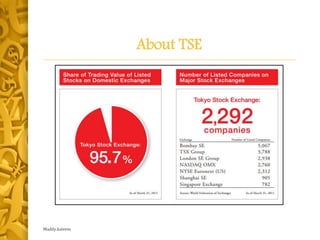
• It had 2,292 listed companies with a combined market
capitalization of US$4.5 trillion as of November 2013.
Maddy.kaleem
About TSE
Maddy.kaleem
About TSE
Maddy.kaleem
NIKKI 225
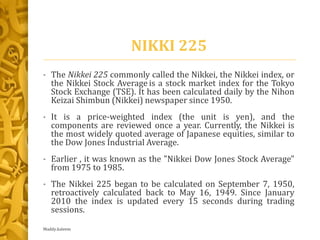
• The Nikkei 225 commonly called the Nikkei, the Nikkei index, or
the Nikkei Stock Average is a stock market index for the Tokyo
Stock Exchange (TSE). It has been calculated daily by the Nihon
Keizai Shimbun (Nikkei) newspaper since 1950.
• It is a price-weighted index (the unit is yen), and the
components are reviewed once a year. Currently, the Nikkei is
the most widely quoted average of Japanese equities, similar to
the Dow Jones Industrial Average.
• Earlier , it was known as the "Nikkei Dow Jones Stock Average"
from 1975 to 1985.
• The Nikkei 225 began to be calculated on September 7, 1950,
retroactively calculated back to May 16, 1949. Since January
2010 the index is updated every 15 seconds during trading
sessions.
Maddy.kaleem
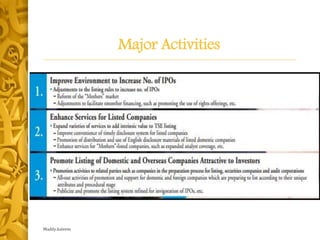
Major Activities
Maddy.kaleem
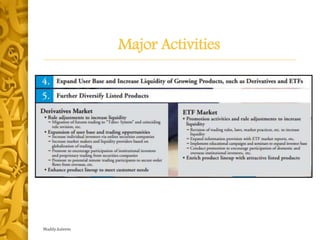
Major Activities
Maddy.kaleem
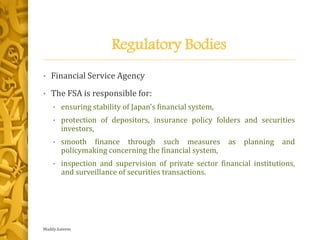
Regulatory Bodies
• Financial Service Agency
• The FSA is responsible for:
• ensuring stability of Japan's financial system,
• protection of depositors, insurance policy folders and securities
investors,
• smooth finance through such measures as planning and
policymaking concerning the financial system,
• inspection and supervision of private sector financial institutions,
and surveillance of securities transactions.
Maddy.kaleem
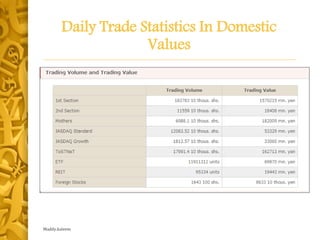
Daily Trade Statistics In Domestic
Values
Maddy.kaleem

Tokyo Stock Excnage presentation

  • 1.
  • 2.
  • 3.
    History Of TSE •Pre-war history • The Tokyo Stock Exchange was established on May 15, 1878, as the Tokyo Kabushiki Torihikijo ) under the direction of then- Finance Minister Okuma Shigenobu and capitalist advocate Shibusawa Eiichi. Trading began on June 1, 1878. • In 1943, the exchange was combined with ten other stock exchanges in major Japanese cities to form a single Japanese Stock Exchange. • The combined exchange was shut down and reorganized shortly after the bombing of Nagasaki. Maddy.kaleem
  • 4.
    About History OfTSE • Post war history • The Tokyo Stock Exchange reopened under its current Japanese name on May 16, 1949, pursuant to the new Securities Exchange Act. • In 1990 it accounted for over 60% of the world's stock market capitalization (by far the world's largest) before falling precipitously in value and rankings today, but still remains one of the 3 largest exchanges in the world by market capitalization of listed shares. • The current TSE building was opened on May 23, 1988, replacing the original TSE building from 1931, and the trading floor of the TSE was closed on April 30, 1999, so that the exchange could switch to electronic trading for all transactions. A new facility, called TSE Arrows opened on May 9, 2000. Maddy.kaleem
  • 5.
    About History OfTSE • In 2001, the TSE restructured itself as a stock company: before this time, it was structured as an incorporated association with its members as shareholders. • It is the third largest stock exchange in the world by aggregate market capitalization of its listed companies. • It had 2,292 listed companies with a combined market capitalization of US$4.5 trillion as of November 2013. Maddy.kaleem
  • 6.
  • 7.
  • 8.
    NIKKI 225 • TheNikkei 225 commonly called the Nikkei, the Nikkei index, or the Nikkei Stock Average is a stock market index for the Tokyo Stock Exchange (TSE). It has been calculated daily by the Nihon Keizai Shimbun (Nikkei) newspaper since 1950. • It is a price-weighted index (the unit is yen), and the components are reviewed once a year. Currently, the Nikkei is the most widely quoted average of Japanese equities, similar to the Dow Jones Industrial Average. • Earlier , it was known as the "Nikkei Dow Jones Stock Average" from 1975 to 1985. • The Nikkei 225 began to be calculated on September 7, 1950, retroactively calculated back to May 16, 1949. Since January 2010 the index is updated every 15 seconds during trading sessions. Maddy.kaleem
  • 9.
  • 10.
  • 11.
    Regulatory Bodies • FinancialService Agency • The FSA is responsible for: • ensuring stability of Japan's financial system, • protection of depositors, insurance policy folders and securities investors, • smooth finance through such measures as planning and policymaking concerning the financial system, • inspection and supervision of private sector financial institutions, and surveillance of securities transactions. Maddy.kaleem
  • 12.
    Daily Trade StatisticsIn Domestic Values Maddy.kaleem