 Present by – Pushpraj Singh Sisodiya.
 Class – MCA.
 Section – B.
 College – Lakshmi Narain College of
Technology.
Introduction of Tokens
Tokens is the most importantelementto be used in
creating a program in C. We can define the token
as the smallest individual element in C. For
`example,we cannotcreate a sentencewithout
using words; similarly, we cannot create a program
in C without using tokens in C.
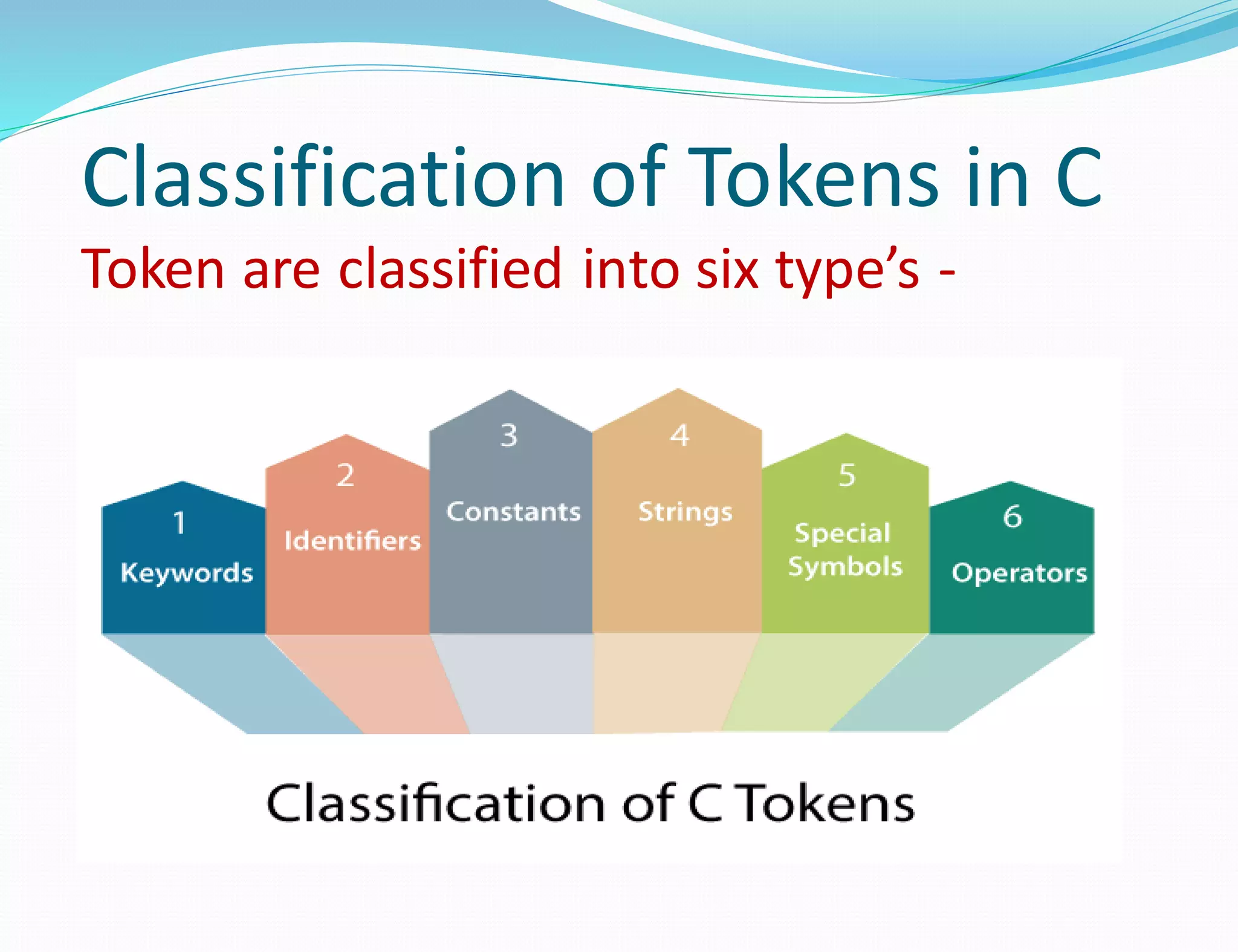
Classification of Tokens in C
Token are classified into six type’s -
Let's understand each token one by one.
Keywords –
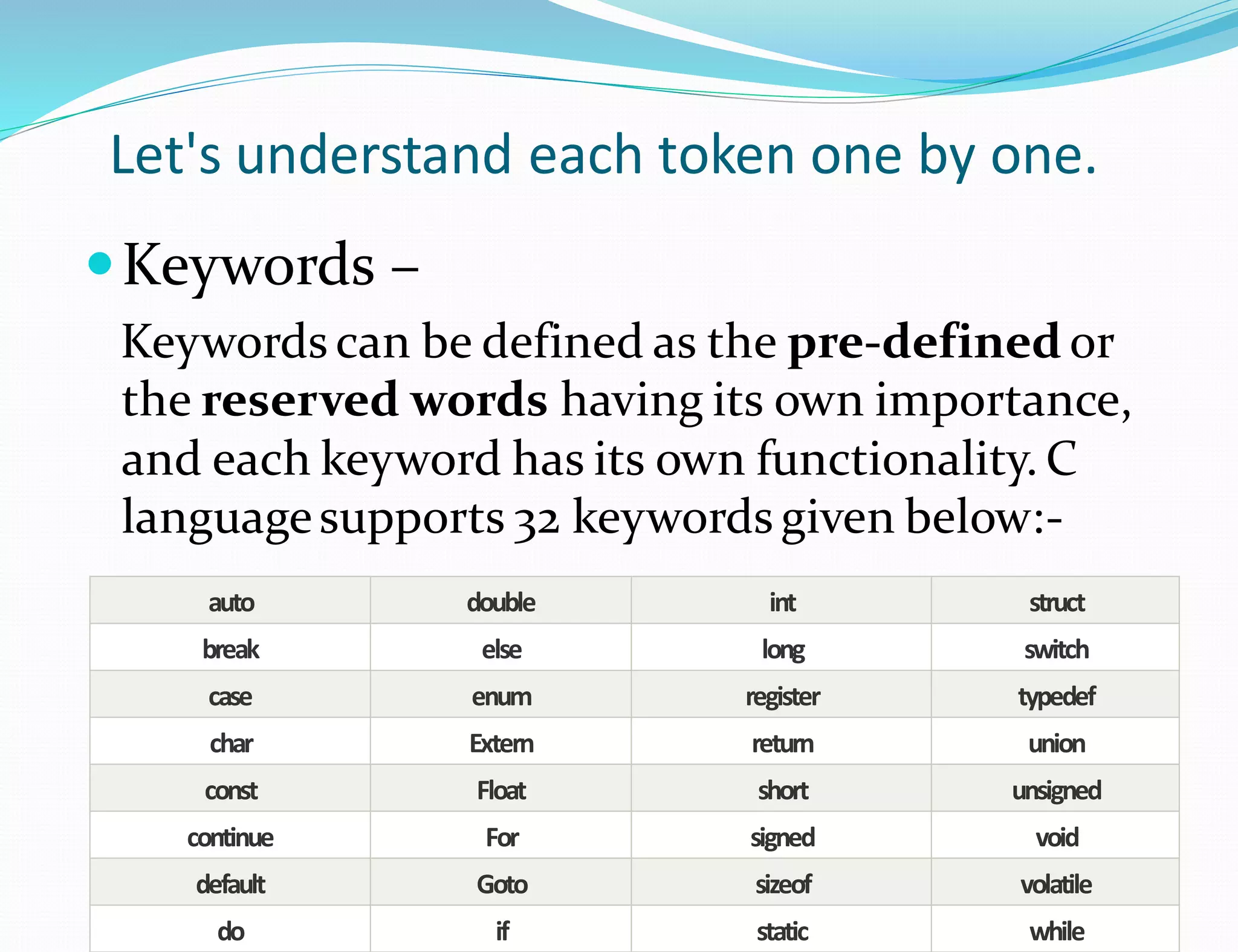
Keywords can be defined as the pre-defined or
the reserved words having its own importance,
and each keyword has its own functionality. C
languagesupports 32 keywords given below:-
auto double int struct
break else long switch
case enum register typedef
char Extern return union
const Float short unsigned
continue For signed void
default Goto sizeof volatile
do if static while
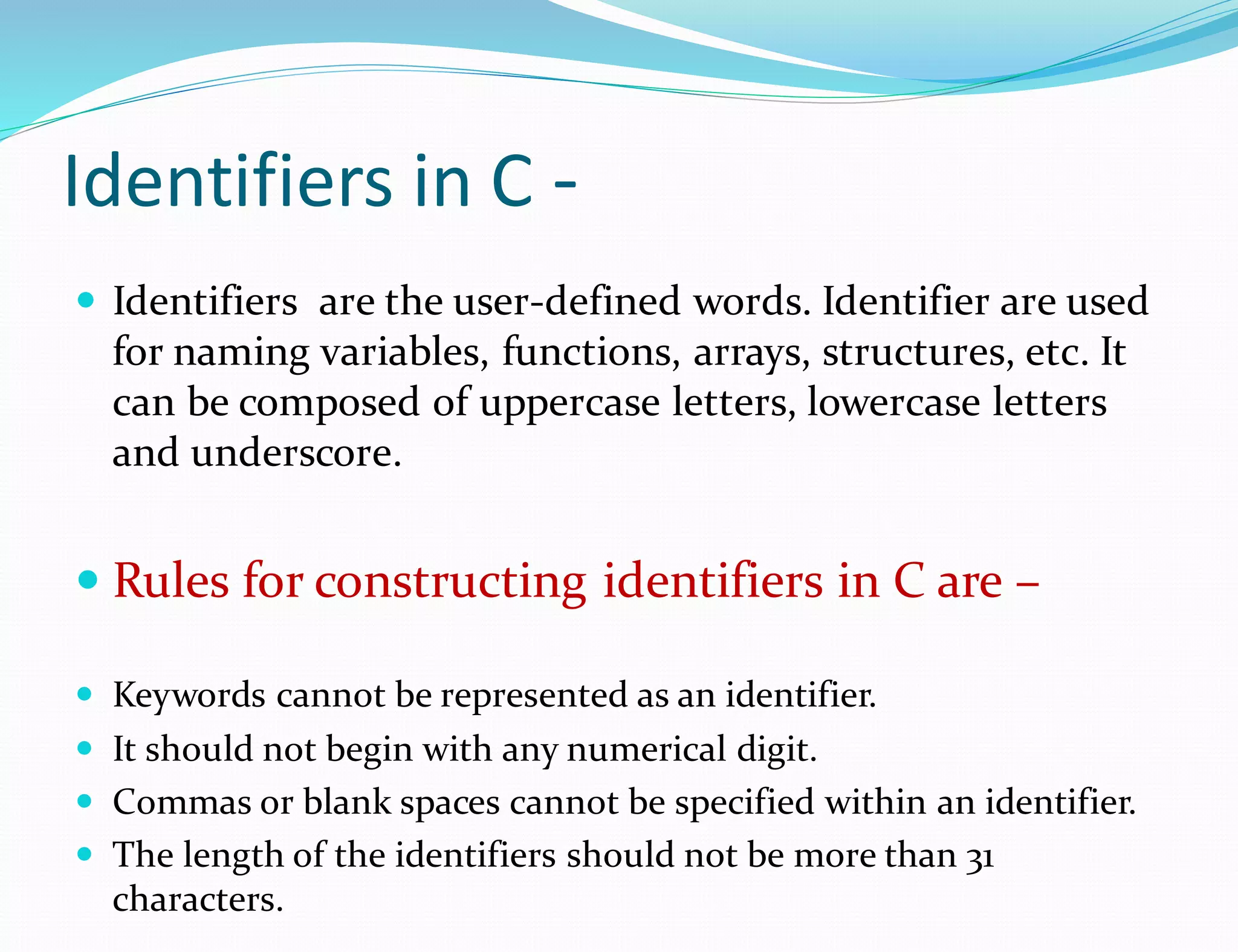
Identifiers in C -
 Identifiers are the user-defined words. Identifier are used
for naming variables, functions, arrays, structures, etc. It
can be composed of uppercase letters, lowercase letters
and underscore.
 Rules for constructing identifiers in C are –
 Keywords cannot be represented as an identifier.
 It should not begin with any numerical digit.
 Commas or blank spaces cannot be specified within an identifier.
 The length of the identifiers should not be more than 31
characters.
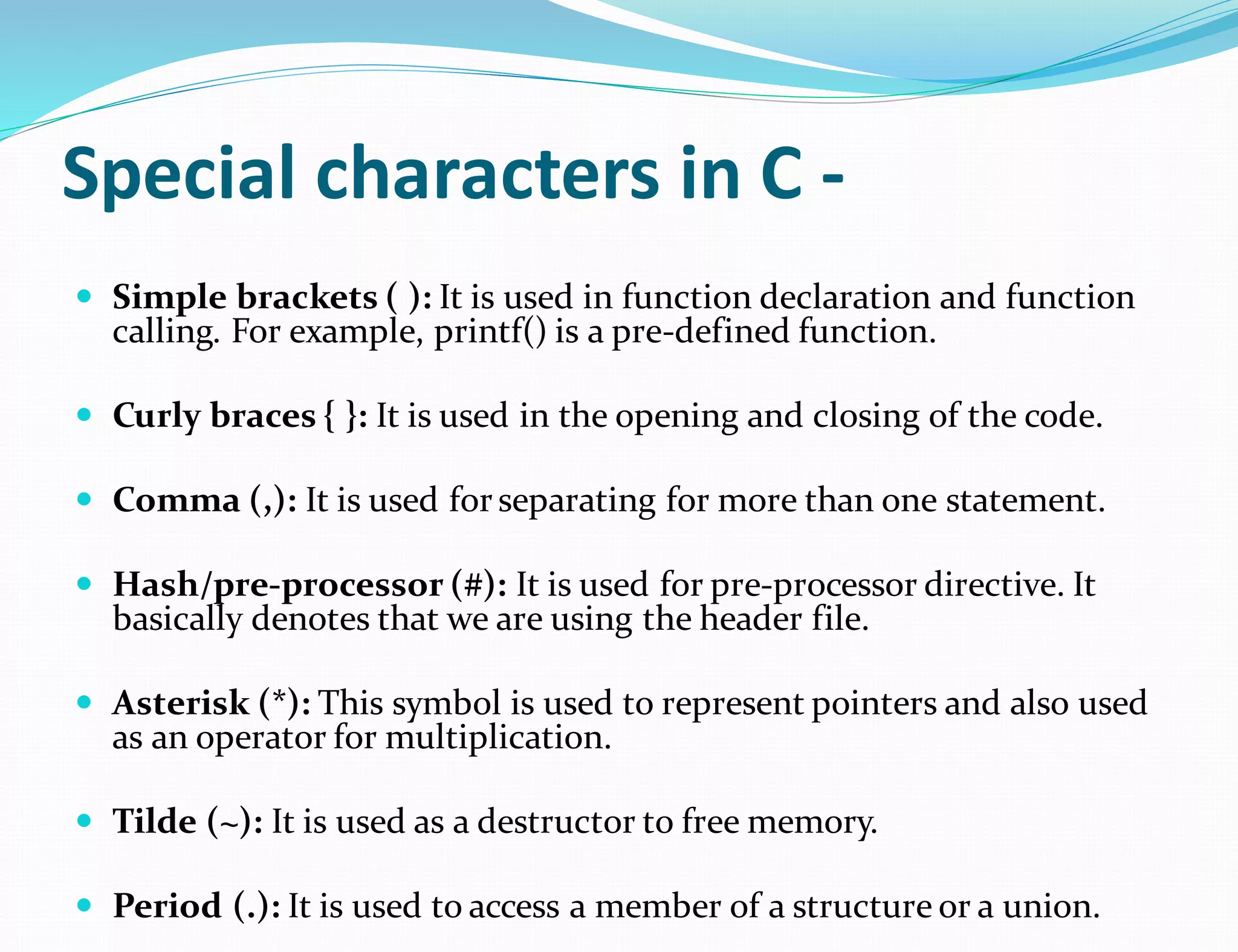
Special characters in C -
 Simple brackets ( ): It is used in function declaration and function
calling. For example, printf() is a pre-defined function.
 Curly braces { }: It is used in the opening and closing of the code.
 Comma (,): It is used for separating for more than one statement.
 Hash/pre-processor (#): It is used for pre-processor directive. It
basically denotes that we are using the header file.
 Asterisk (*): This symbol is used to represent pointers and also used
as an operator for multiplication.
 Tilde (~): It is used as a destructor to free memory.
 Period (.): It is used to access a member of a structure or a union.
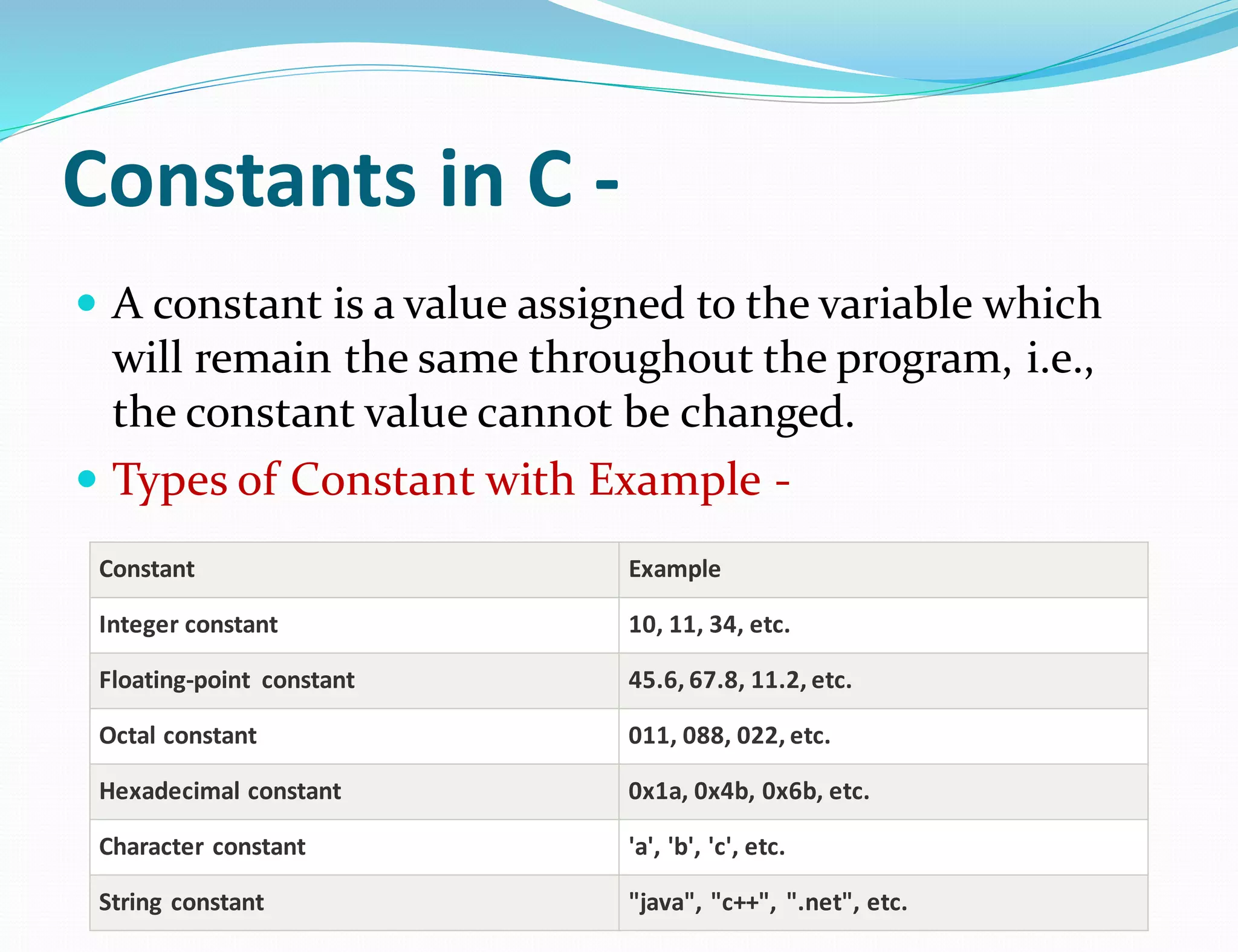
Constants in C -
 A constant is a value assigned to the variable which
will remain the same throughout the program, i.e.,
the constant value cannot be changed.
 Types of Constant with Example -
Constant Example
Integer constant 10, 11, 34, etc.
Floating-point constant 45.6, 67.8, 11.2, etc.
Octal constant 011, 088, 022, etc.
Hexadecimal constant 0x1a, 0x4b, 0x6b, etc.
Character constant 'a', 'b', 'c', etc.
String constant "java", "c++", ".net", etc.

Tokens In C.pdf

  • 1.
     Present by– Pushpraj Singh Sisodiya.  Class – MCA.  Section – B.  College – Lakshmi Narain College of Technology.
  • 2.
    Introduction of Tokens Tokensis the most importantelementto be used in creating a program in C. We can define the token as the smallest individual element in C. For `example,we cannotcreate a sentencewithout using words; similarly, we cannot create a program in C without using tokens in C.
  • 3.
    Classification of Tokensin C Token are classified into six type’s -
  • 4.
    Let's understand eachtoken one by one. Keywords – Keywords can be defined as the pre-defined or the reserved words having its own importance, and each keyword has its own functionality. C languagesupports 32 keywords given below:- auto double int struct break else long switch case enum register typedef char Extern return union const Float short unsigned continue For signed void default Goto sizeof volatile do if static while
  • 5.
    Identifiers in C-  Identifiers are the user-defined words. Identifier are used for naming variables, functions, arrays, structures, etc. It can be composed of uppercase letters, lowercase letters and underscore.  Rules for constructing identifiers in C are –  Keywords cannot be represented as an identifier.  It should not begin with any numerical digit.  Commas or blank spaces cannot be specified within an identifier.  The length of the identifiers should not be more than 31 characters.
  • 6.
    Special characters inC -  Simple brackets ( ): It is used in function declaration and function calling. For example, printf() is a pre-defined function.  Curly braces { }: It is used in the opening and closing of the code.  Comma (,): It is used for separating for more than one statement.  Hash/pre-processor (#): It is used for pre-processor directive. It basically denotes that we are using the header file.  Asterisk (*): This symbol is used to represent pointers and also used as an operator for multiplication.  Tilde (~): It is used as a destructor to free memory.  Period (.): It is used to access a member of a structure or a union.
  • 7.
    Constants in C-  A constant is a value assigned to the variable which will remain the same throughout the program, i.e., the constant value cannot be changed.  Types of Constant with Example - Constant Example Integer constant 10, 11, 34, etc. Floating-point constant 45.6, 67.8, 11.2, etc. Octal constant 011, 088, 022, etc. Hexadecimal constant 0x1a, 0x4b, 0x6b, etc. Character constant 'a', 'b', 'c', etc. String constant "java", "c++", ".net", etc.