Global AI Bootcamp
Bulgaria 2025
Our Proud Sponsors
2025- Bulgaria
Long Live Intelligent Agents
End of Traditional Software is Near
Agent Era is About Redefining Digital Work & Assistance
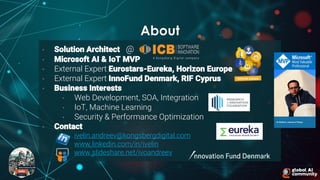
• Solution Architect @
• Microsoft AI & IoT MVP
• External Expert Eurostars-Eureka, Horizon Europe
• External Expert InnoFund Denmark, RIF Cyprus
• Business Interests
• Web Development, SOA, Integration
• IoT, Machine Learning
• Security & Performance Optimization
• Contact
• ivelin.andreev@kongsbergdigital.com
• www.linkedin.com/in/ivelin
• www.slideshare.net/ivoandreev
About
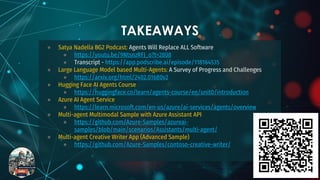
TAKEAWAYS
● Satya Nadella BG2 Podcast: Agents Will Replace ALL Software
● https://youtu.be/9NtsnzRFJ_o?t=2808
● Transcript - https://app.podscribe.ai/episode/118164535
● Large Language Model based Multi-Agents: A Survey of Progress and Challenges
● https://arxiv.org/html/2402.01680v2
● Hugging Face AI Agents Course
● https://huggingface.co/learn/agents-course/en/unit0/introduction
● Azure AI Agent Service
● https://learn.microsoft.com/en-us/azure/ai-services/agents/overview
● Multi-agent Multimodal Sample with Azure Assistant API
● https://github.com/Azure-Samples/azureai-
samples/blob/main/scenarios/Assistants/multi-agent/
● Multi-agent Creative Writer App (Advanced Sample)
● https://github.com/Azure-Samples/contoso-creative-writer/
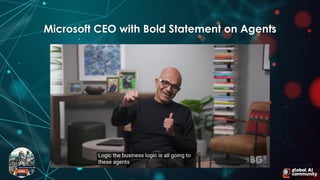
Microsoft CEO with Bold Statement on Agents
The AI tier will become the place where all the logic
is, people will start replacing backends. (Dec 2024)
Interview Highlights
IT Business Challenges…
● Traditional tools are uncapable of maintaining context and handling
complex, continuous interactions well.
● Manual repetitive tasks handling reduces productivity and efficiency.
● Inefficient fragmentation of data and functionality across systems
● Users require increasingly personalized experiences and better interaction
● Processing vast amounts of data manually is challenging
● Organizations need to quickly adopt innovative solutions
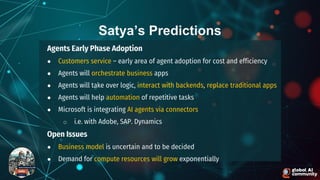
Agents Early Phase Adoption
● Customers service – early area of agent adoption for cost and efficiency
● Agents will orchestrate business apps
● Agents will take over logic, interact with backends, replace traditional apps
● Agents will help automation of repetitive tasks
● Microsoft is integrating AI agents via connectors
o i.e. with Adobe, SAP. Dynamics
Open Issues
● Business model is uncertain and to be decided
● Demand for compute resources will grow exponentially
Satya’s Predictions
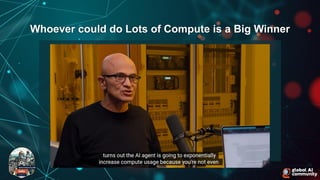
Whoever could do Lots of Compute is a Big Winner
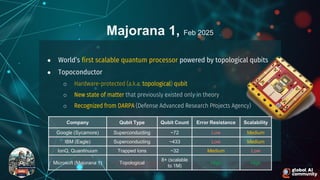
● World’s first scalable quantum processor powered by topological qubits
● Topoconductor
o Hardware-protected (a.k.a. topological) qubit
o New state of matter that previously existed only in theory
o Recognized from DARPA (Defense Advanced Research Projects Agency)
Majorana 1, Feb 2025
Company Qubit Type Qubit Count Error Resistance Scalability
Google (Sycamore) Superconducting ~72 Low Medium
IBM (Eagle) Superconducting ~433 Low Medium
IonQ, Quantinuum Trapped Ions ~32 Medium Low
Microsoft (Majorana 1) Topological
8+ (scalable
to 1M)
High High
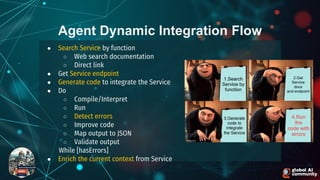
● Search Service by function
○ Web search documentation
○ Direct link
● Get Service endpoint
● Generate code to integrate the Service
● Do
○ Compile/Interpret
○ Run
○ Detect errors
○ Improve code
○ Map output to JSON
○ Validate output
While [hasErrors]
● Enrich the current context from Service
Agent Dynamic Integration Flow
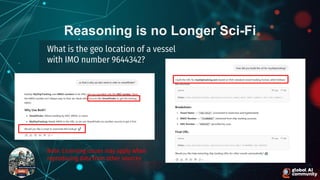
What is the geo location of a vessel
with IMO number 9644342?
Note: Licensing issues may apply when
reproducing data from other sources
Reasoning is no Longer Sci-Fi
AI Agents …
• Are Autonomous
• Have Objectives
• Interact with Environment & Act
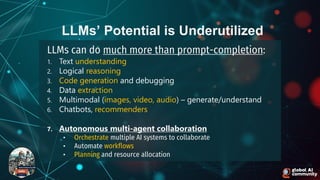
LLMs can do much more than prompt-completion:
1. Text understanding
2. Logical reasoning
3. Code generation and debugging
4. Data extraction
5. Multimodal (images, video, audio) – generate/understand
6. Chatbots, recommenders
7. Autonomous multi-agent collaboration
• Orchestrate multiple AI systems to collaborate
• Automate workflows
• Planning and resource allocation
LLMs’ Potential is Underutilized
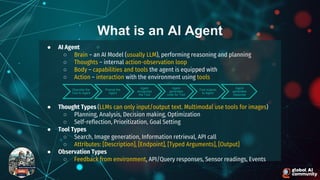
● AI Agent
○ Brain – an AI Model (usually LLM), performing reasoning and planning
○ Thoughts – internal action-observation loop
○ Body – capabilities and tools the agent is equipped with
○ Action – interaction with the environment using tools
● Thought Types (LLMs can only input/output text. Multimodal use tools for images)
○ Planning, Analysis, Decision making, Optimization
○ Self-reflection, Prioritization, Goal Setting
● Tool Types
○ Search, Image generation, Information retrieval, API call
○ Attributes: [Description], [Endpoint], [Typed Arguments], [Output]
● Observation Types
○ Feedback from environment, API/Query responses, Sensor readings, Events
What is an AI Agent
Describe the
Tool to Agent
Prompt the
Agent
Agent
recognizes
the Tool
Agent
generates
code for Tool
Tool outputs
to Agent
Agent
generates
response
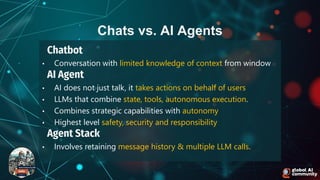
Chatbot
• Conversation with limited knowledge of context from window
AI Agent
• AI does not just talk, it takes actions on behalf of users
• LLMs that combine state, tools, autonomous execution.
• Combines strategic capabilities with autonomy
• Highest level safety, security and responsibility
Agent Stack
• Involves retaining message history & multiple LLM calls.
Chats vs. AI Agents
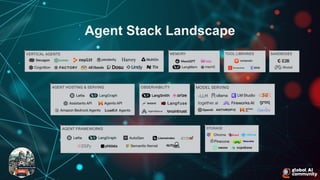
Agent Stack
• Model & Storage
• Tools
• Deployment & Serving
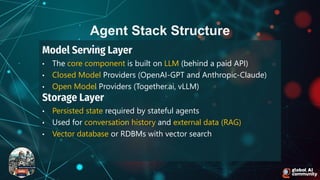
Model Serving Layer
• The core component is built on LLM (behind a paid API)
• Closed Model Providers (OpenAI-GPT and Anthropic-Claude)
• Open Model Providers (Together.ai, vLLM)
Storage Layer
• Persisted state required by stateful agents
• Used for conversation history and external data (RAG)
• Vector database or RDBMs with vector search
Agent Stack Structure
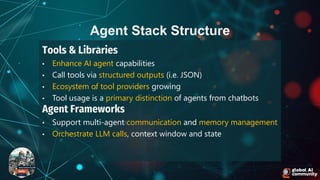
Tools & Libraries
• Enhance AI agent capabilities
• Call tools via structured outputs (i.e. JSON)
• Ecosystem of tool providers growing
• Tool usage is a primary distinction of agents from chatbots
Agent Frameworks
• Support multi-agent communication and memory management
• Orchestrate LLM calls, context window and state
Agent Stack Structure
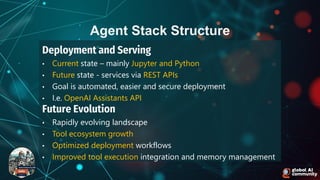
Deployment and Serving
• Current state – mainly Jupyter and Python
• Future state - services via REST APIs
• Goal is automated, easier and secure deployment
• I.e. OpenAI Assistants API
Future Evolution
• Rapidly evolving landscape
• Tool ecosystem growth
• Optimized deployment workflows
• Improved tool execution integration and memory management
Agent Stack Structure
Agent Stack Landscape
From Agents to Multi-Agents
• Collaboration
• Typical Challenges
● Involves multiple intelligent agents interacting and collaborating.
● Capable of decisions and action in typically human domains
● Benefits
• Complex problem-solving
• Coordination
• Scalability
● Azure Assistants API
○ Easy to use framework for creating multi-agent systems
○ Persistent muti-agent systems, virtually indefinite context
○ Access and process files, code and functions
Multi-Agent Systems
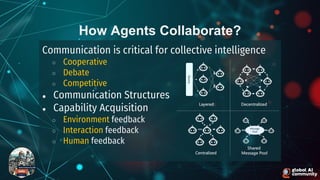
Communication is critical for collective intelligence
○ Cooperative
○ Debate
○ Competitive
● Communication Structures
● Capability Acquisition
○ Environment feedback
○ Interaction feedback
○ Human feedback
How Agents Collaborate?
Collective Intelligence
● Traditional MA Systems use reinforcement learning to learn from offline data
● LLM-MA learn from instant feedback
Scalability
● Each LLM-based agent is based on an LLM (i.e. GPT4) and requires huge resources
● Coordination complexity raises significantly with number of agents
Multi-Modal Environment
● LLM agents are focused on text-based environments
● Integration in multimodal environment (sensors, video, audio) is a huge challenge
Hallucinations Challenge
● Generating a factually incorrect output of an LLM is a huge problem
● The problem could be multiplied in MA scenario
LLM-MA are Different from Traditional
Azure AI Foundry – Agent Service
• Assistants vs. AI Agents
• Service Highlights
• Agentic Tools
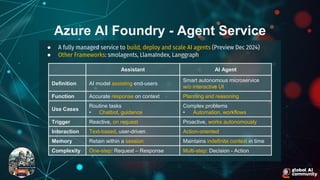
● A fully managed service to build, deploy and scale AI agents (Preview Dec 2024)
● Other Frameworks: smolagents, LlamaIndex, Langgraph
Azure AI Foundry - Agent Service
Assistant AI Agent
Definition AI model assisting end-users
Smart autonomous microservice
w/o interactive UI
Function Accurate response on context Planning and reasoning
Use Cases
Routine tasks
• Chatbot, guidance
Complex problems
• Automation, workflows
Trigger Reactive, on request Proactive, works autonomously
Interaction Text-based, user-driven Action-oriented
Memory Retain within a session Maintains indefinite context in time
Complexity One-step: Request – Response Multi-step: Decision - Action
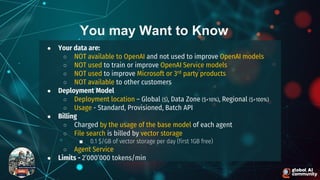
● Your data are:
○ NOT available to OpenAI and not used to improve OpenAI models
○ NOT used to train or improve OpenAI Service models
○ NOT used to improve Microsoft or 3rd party products
○ NOT available to other customers
● Deployment Model
○ Deployment location – Global ($), Data Zone ($+10%), Regional ($+100%)
○ Usage - Standard, Provisioned, Batch API
● Billing
○ Charged by the usage of the base model of each agent
○ File search is billed by vector storage
■ 0.1 $/GB of vector storage per day (first 1GB free)
○ Agent Service
● Limits - 2’000’000 tokens/min
You may Want to Know
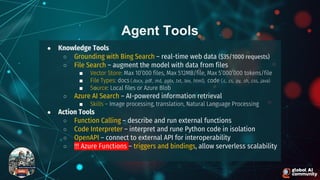
● Knowledge Tools
○ Grounding with Bing Search – real-time web data ($35/1000 requests)
○ File Search – augment the model with data from files
■ Vector Store: Max 10’000 files, Max 512MB/file, Max 5’000’000 tokens/file
■ File Types: docs (.docx, .pdf, .md, .pptx, .txt, .tex, .html), code (.c, .cs, .py, .sh, .css, .java)
■ Source: Local files or Azure Blob
○ Azure AI Search – AI-powered information retrieval
■ Skills – Image processing, translation, Natural Language Processing
● Action Tools
○ Function Calling – describe and run external functions
○ Code Interpreter – interpret and rune Python code in isolation
○ OpenAPI – connect to external API for interoperability
○ !!! Azure Functions – triggers and bindings, allow serverless scalability
Agent Tools
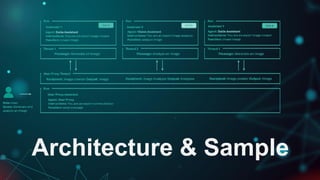
Architecture & Sample
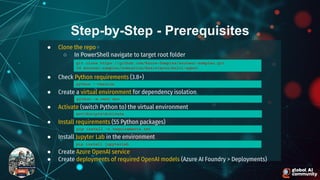
● Clone the repo
○ In PowerShell navigate to target root folder
● Check Python requirements (3.8+)
● Create a virtual environment for dependency isolation
● Activate (switch Python to) the virtual environment
● Install requirements (55 Python packages)
● Install Jupyter Lab in the environment
● Create Azure OpenAI service
● Create deployments of required OpenAI models (Azure AI Foundry > Deployments)
Step-by-Step - Prerequisites
git clone https://github.com/Azure-Samples/azureai-samples.git
cd azureai-samples/scenarios/Assistants/multi-agent
python --version
python -m venv env
envScriptsActivate
pip install -r requirements.txt
pip install jupyterlab
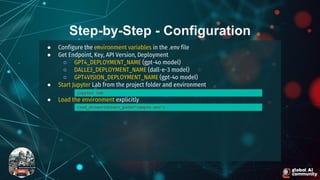
● Configure the environment variables in the .env file
● Get Endpoint, Key, API Version, Deployment
○ GPT4_DEPLOYMENT_NAME (gpt-4o model)
○ DALLE3_DEPLOYMENT_NAME (dall-e-3 model)
○ GPT4VISION_DEPLOYMENT_NAME (gpt-4o model)
● Start Jupyter Lab from the project folder and environment
● Load the environment explicitly
Step-by-Step - Configuration
jupyter lab
load_dotenv(dotenv_path="sample.env")
THANK YOU