Embedding EA in the organization

           Dr. Bas van Gils
Abstract


In this short presentation I will present a vision on
 embedding an enterprise architecture practice in
   the organization. I will start with a high-level
 overview of how I see the EA discipline. I will also
     present my ideas on how to link to other
       disciplines in the organization, such as
  strategy, risk management, security, etcetera.


                                                    2
Bas van Gils


               +31-(0)6-484 320 88
               b.vangils@bizzdesign.nl
               http://linkedin.com/in/basvg
               http://blog.bizzdesign.com
               http://www.twitter.com/basvg


                                         3
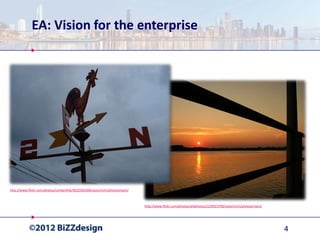
EA: Vision for the enterprise


http://www.flickr.com/photos/ramkarthik/4022566308/sizes/m/in/photostream/


                                                                             http://www.flickr.com/photos/wtlphotos/2139923706/sizes/m/in/photostream/


                                                                                                                                                         4
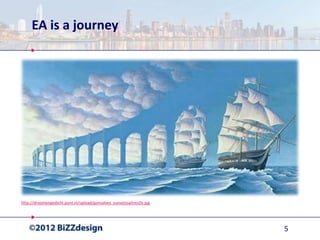
EA is a journey


http://droomengedicht.punt.nl/upload/gonsalves_sunsetssailresiZe.jpg


                                                                       5
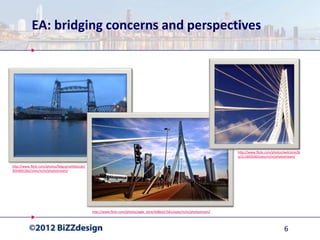
EA: bridging concerns and perspectives


                                                                                                                                 http://www.flickr.com/photos/welcome2b
                                                                                                                                 o/211605030/sizes/m/in/photostream/

http://www.flickr.com/photos/fatguyinalittlecoat/
3054691362/sizes/m/in/photostream/


                                                    http://www.flickr.com/photos/aigle_dore/5086327581/sizes/m/in/photostream/


                                                                                                                                                             6
Enterprise Architecture


  EA is a conceptual tool that helps organizations get
  a deeper understanding of their own structure and
  of the way they work. It provides a map of the
  enterprise and it is a “route planner” for business
  and technology change. Important uses of it are in
  systematic IT planning/ architecting and in
  enhanced analysis and support for decision-making.


                      handbook enterprise architecture, BiZZdesign, 2012


                                                                           7
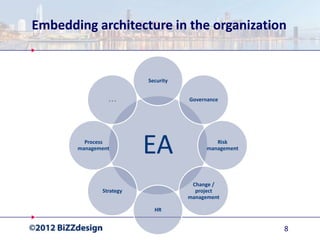
Embedding architecture in the organization


                         Security


                ...                 Governance


         Process
       management
                         EA                  Risk
                                          management


                                     Change /
              Strategy                project
                                    management

                           HR


                                                       8
Security


• Has its own frameworks and approaches
• Is considered to be a specialism, not something that
  “architects can also do on the side”
• In TOGAF:
   – Security is covered in the “guidelines and techniques” section
   – This is being reworked, TOGAF is integrating with SABSA
• Typical frameworks to consider:
   – SABSA
   – CISSP
   – CISM

                                                                      9
Governance


• There are many different types of governance in
  the organization. Architecture is but one aspect!
• Governance structures should be set-up integrally.
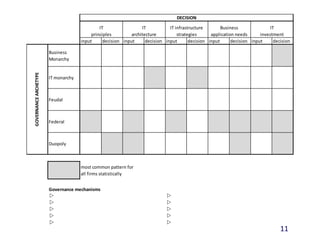
  Consider using a variant of the IT Governance
  assessment matrix:
   – 6 archetypes
   – 6 key players identified
• Link to governance frameworks such as COBIT, ASL/ ITIL
• Link to existing governance initiatives (data
  governance, security governance)

                                                       10
DECISION
                                              IT                  IT           IT infrastructure        Business               IT
                                          principles         architecture          strategies      application needs      investment
                                     input      decision input      decision input       decision input      decision input      decision

                       Business
                       Monarchy
GOVERNANCE ARCHETYPE


                       IT monarchy


                       Feudal


                       Federal


                       Duopoly


                                     most common pattern for
                                     all firms statistically


                       Governance mechanisms
                       w                                                      w
                       w                                                      w
                       w                                                      w
                       w                                                      w
                       w                                                      w
                                                                                                                                    11
Risk management


• Risk has many different definitions
• Risk management techniques can / should be used in
  each of the phases of TOGAF
   – Covers a broad spectrum of types of risk
   – Templates available for structured documentation / analysis
   – Aimed at mitigating risk
• Many project management approaches and security
  frameworks also have built-in
  methods, approaches, and standards for risk
  management
• Key to success is to establish roles and responsibilities
  and use an integrated approach to risk management
                                                                   12
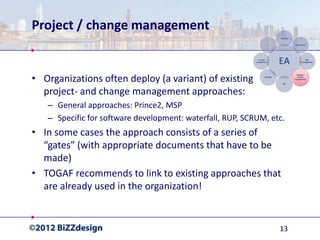
Project / change management


• Organizations often deploy (a variant) of existing
  project- and change management approaches:
   – General approaches: Prince2, MSP
   – Specific for software development: waterfall, RUP, SCRUM, etc.
• In some cases the approach consists of a series of
  “gates” (with appropriate documents that have to be
  made)
• TOGAF recommends to link to existing approaches that
  are already used in the organization!


                                                                 13
Human Resources


• Architects are “only humans”
• Building an EA-capability requires people to grow in
  their role
• Close co-operation with HR is required in terms of:
   –   Defining what it means to be an EA
   –   What KPI’s the performance of the EA-team is assessed against
   –   Which training is required, by who, and when
   –   How, and to what degree, non-architects should be trained in
       architecture approaches, methods etc. in order to ease
       integrating the EA-approach in the organization


                                                                  14
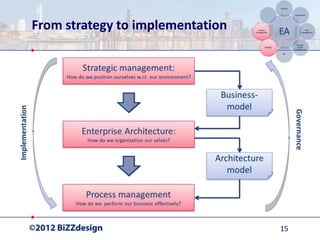
From strategy to implementation


                                  15
What do you think? Please let me
know your thoughts, suggestions,
best practices, and cases via E-mail

b.vangils@bizzdesig.nl
© 2012, BiZZdesign. All rights reserved.
BiZZdesign and BiZZdesign logos are registered trademarks of BiZZdesign Company.   17

Embedding ea

  • 1.
    Embedding EA inthe organization Dr. Bas van Gils
  • 2.
    Abstract In this shortpresentation I will present a vision on embedding an enterprise architecture practice in the organization. I will start with a high-level overview of how I see the EA discipline. I will also present my ideas on how to link to other disciplines in the organization, such as strategy, risk management, security, etcetera. 2
  • 3.
    Bas van Gils +31-(0)6-484 320 88 b.vangils@bizzdesign.nl http://linkedin.com/in/basvg http://blog.bizzdesign.com http://www.twitter.com/basvg 3
  • 4.
    EA: Vision forthe enterprise http://www.flickr.com/photos/ramkarthik/4022566308/sizes/m/in/photostream/ http://www.flickr.com/photos/wtlphotos/2139923706/sizes/m/in/photostream/ 4
  • 5.
    EA is ajourney http://droomengedicht.punt.nl/upload/gonsalves_sunsetssailresiZe.jpg 5
  • 6.
    EA: bridging concernsand perspectives http://www.flickr.com/photos/welcome2b o/211605030/sizes/m/in/photostream/ http://www.flickr.com/photos/fatguyinalittlecoat/ 3054691362/sizes/m/in/photostream/ http://www.flickr.com/photos/aigle_dore/5086327581/sizes/m/in/photostream/ 6
  • 7.
    Enterprise Architecture EA is a conceptual tool that helps organizations get a deeper understanding of their own structure and of the way they work. It provides a map of the enterprise and it is a “route planner” for business and technology change. Important uses of it are in systematic IT planning/ architecting and in enhanced analysis and support for decision-making. handbook enterprise architecture, BiZZdesign, 2012 7
  • 8.
    Embedding architecture inthe organization Security ... Governance Process management EA Risk management Change / Strategy project management HR 8
  • 9.
    Security • Has itsown frameworks and approaches • Is considered to be a specialism, not something that “architects can also do on the side” • In TOGAF: – Security is covered in the “guidelines and techniques” section – This is being reworked, TOGAF is integrating with SABSA • Typical frameworks to consider: – SABSA – CISSP – CISM 9
  • 10.
    Governance • There aremany different types of governance in the organization. Architecture is but one aspect! • Governance structures should be set-up integrally. Consider using a variant of the IT Governance assessment matrix: – 6 archetypes – 6 key players identified • Link to governance frameworks such as COBIT, ASL/ ITIL • Link to existing governance initiatives (data governance, security governance) 10
  • 11.
    DECISION IT IT IT infrastructure Business IT principles architecture strategies application needs investment input decision input decision input decision input decision input decision Business Monarchy GOVERNANCE ARCHETYPE IT monarchy Feudal Federal Duopoly most common pattern for all firms statistically Governance mechanisms w w w w w w w w w w 11
  • 12.
    Risk management • Riskhas many different definitions • Risk management techniques can / should be used in each of the phases of TOGAF – Covers a broad spectrum of types of risk – Templates available for structured documentation / analysis – Aimed at mitigating risk • Many project management approaches and security frameworks also have built-in methods, approaches, and standards for risk management • Key to success is to establish roles and responsibilities and use an integrated approach to risk management 12
  • 13.
    Project / changemanagement • Organizations often deploy (a variant) of existing project- and change management approaches: – General approaches: Prince2, MSP – Specific for software development: waterfall, RUP, SCRUM, etc. • In some cases the approach consists of a series of “gates” (with appropriate documents that have to be made) • TOGAF recommends to link to existing approaches that are already used in the organization! 13
  • 14.
    Human Resources • Architectsare “only humans” • Building an EA-capability requires people to grow in their role • Close co-operation with HR is required in terms of: – Defining what it means to be an EA – What KPI’s the performance of the EA-team is assessed against – Which training is required, by who, and when – How, and to what degree, non-architects should be trained in architecture approaches, methods etc. in order to ease integrating the EA-approach in the organization 14
  • 15.
    From strategy toimplementation 15
  • 16.
    What do youthink? Please let me know your thoughts, suggestions, best practices, and cases via E-mail b.vangils@bizzdesig.nl
  • 17.
    © 2012, BiZZdesign.All rights reserved. BiZZdesign and BiZZdesign logos are registered trademarks of BiZZdesign Company. 17

Editor's Notes

  • #5 This is the traditional view of EA: the “vision” for the enterprise, the “dot on the horizon” that we are navigating to.Stress that in this vision there is still a big debate: document the vision using principles, or using models? Our view: both!  refer to Architect where we have the motivation extension
  • #6 EA is more than pretty pictures. Real work has to be done if you want to get somewhere. EA as a journey positions EA as they way to get where you want. If you take this perspective, and see EA as a process  link to the ADM from TOGAF.
  • #7 EA is a discipline that builds bridges:Between business/ IT (or ‘BIAT’)Between strategy and execution (see “from strategy to execution” further down in this deck)Between “IST” and “SOLL”Between “vision” an “reality”In some groups it works to call attention to a random big city with a big river in the middle. Explain that one bank of the river is “now”, and the other is “the future” and work a good story around that
  • #8 This one comes from the handbook and has the advantage of combining “EA as product”, and “EA as something we do to get results”. Put this slide on, talk for a while and see how the audience reacts. It is less “technocratic” than the ANSI/ISO definition