10 May | Saturday | Sofia
Microsoft MVP (AI & IoT)
ivelin.andreev@kongsbergdigital.com
www.linkedin.com/in/ivelin
www.slideshare.net/ivoandreev
Horizon Europe
Eurostars -Eureka
RIF Cyprus
Innovation Fund Denmark
Solution Architect
External Expert • External Expert
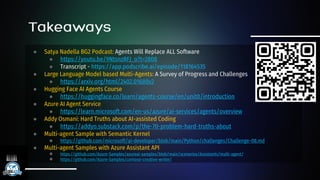
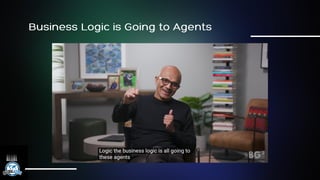
● Satya Nadella BG2 Podcast: Agents Will Replace ALL Software
● https://youtu.be/9NtsnzRFJ_o?t=2808
● Transcript - https://app.podscribe.ai/episode/118164535
● Large Language Model based Multi-Agents: A Survey of Progress and Challenges
● https://arxiv.org/html/2402.01680v2
● Hugging Face AI Agents Course
● https://huggingface.co/learn/agents-course/en/unit0/introduction
● Azure AI Agent Service
● https://learn.microsoft.com/en-us/azure/ai-services/agents/overview
● Addy Osmani: Hard Truths about AI-assisted Coding
● https://addyo.substack.com/p/the-70-problem-hard-truths-about
● Multi-agent Sample with Semantic Kernel
● https://github.com/microsoft/ai-developer/blob/main/Python/challenges/Challenge-08.md
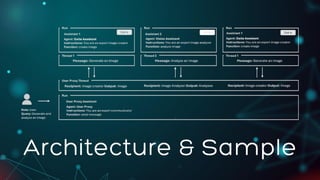
● Multi-agent Samples with Azure Assistant API
● https://github.com/Azure-Samples/azureai-samples/blob/main/scenarios/Assistants/multi-agent/
● https://github.com/Azure-Samples/contoso-creative-writer/
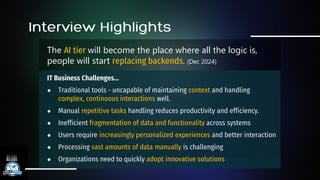
The AI tier will become the place where all the logic is,
people will start replacing backends. (Dec 2024)
IT Business Challenges…
● Traditional tools - uncapable of maintaining context and handling
complex, continuous interactions well.
● Manual repetitive tasks handling reduces productivity and efficiency.
● Inefficient fragmentation of data and functionality across systems
● Users require increasingly personalized experiences and better interaction
● Processing vast amounts of data manually is challenging
● Organizations need to quickly adopt innovative solutions
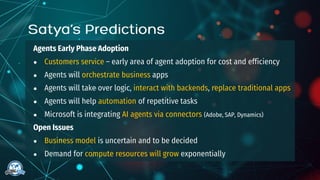
Agents Early Phase Adoption
● Customers service – early area of agent adoption for cost and efficiency
● Agents will orchestrate business apps
● Agents will take over logic, interact with backends, replace traditional apps
● Agents will help automation of repetitive tasks
● Microsoft is integrating AI agents via connectors (Adobe, SAP, Dynamics)
Open Issues
● Business model is uncertain and to be decided
● Demand for compute resources will grow exponentially
AI Agents …
• Are Autonomous
• Have Objectives
• Interact with Environment & Act
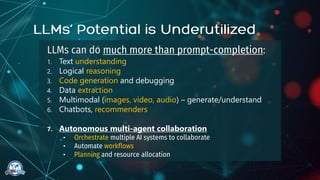
LLMs can do much more than prompt-completion:
1. Text understanding
2. Logical reasoning
3. Code generation and debugging
4. Data extraction
5. Multimodal (images, video, audio) – generate/understand
6. Chatbots, recommenders
7. Autonomous multi-agent collaboration
• Orchestrate multiple AI systems to collaborate
• Automate workflows
• Planning and resource allocation
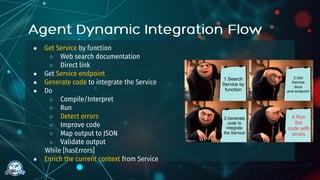
● Get Service by function
○ Web search documentation
○ Direct link
● Get Service endpoint
● Generate code to integrate the Service
● Do
○ Compile/Interpret
○ Run
○ Detect errors
○ Improve code
○ Map output to JSON
○ Validate output
While [hasErrors]
● Enrich the current context from Service
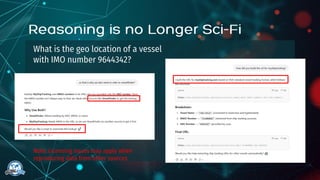
What is the geo location of a vessel
with IMO number 9644342?
Note: Licensing issues may apply when
reproducing data from other sources
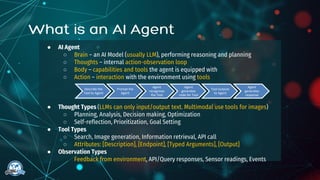
● AI Agent
○ Brain – an AI Model (usually LLM), performing reasoning and planning
○ Thoughts – internal action-observation loop
○ Body – capabilities and tools the agent is equipped with
○ Action – interaction with the environment using tools
● Thought Types (LLMs can only input/output text. Multimodal use tools for images)
○ Planning, Analysis, Decision making, Optimization
○ Self-reflection, Prioritization, Goal Setting
● Tool Types
○ Search, Image generation, Information retrieval, API call
○ Attributes: [Description], [Endpoint], [Typed Arguments], [Output]
● Observation Types
○ Feedback from environment, API/Query responses, Sensor readings, Events
Describe the
Tool to Agent
Prompt the
Agent
Agent
recognizes
the Tool
Agent
generates
code for Tool
Tool outputs
to Agent
Agent
generates
response
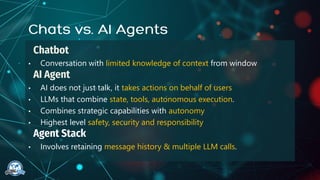
Chatbot
• Conversation with limited knowledge of context from window
AI Agent
• AI does not just talk, it takes actions on behalf of users
• LLMs that combine state, tools, autonomous execution.
• Combines strategic capabilities with autonomy
• Highest level safety, security and responsibility
Agent Stack
• Involves retaining message history & multiple LLM calls.
LLM Agents & Coding
• AI Agents for Coding
• First Impressions and Second Thoughts
• The Knowledge Paradox
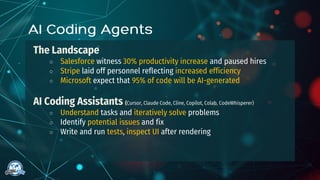
The Landscape
○ Salesforce witness 30% productivity increase and paused hires
○ Stripe laid off personnel reflecting increased efficiency
○ Microsoft expect that 95% of code will be AI-generated
AI Coding Assistants (Cursor, Claude Code, Cline, Copilot, Colab, CodeWhisperer)
○ Understand tasks and iteratively solve problems
○ Identify potential issues and fix
○ Write and run tests, inspect UI after rendering
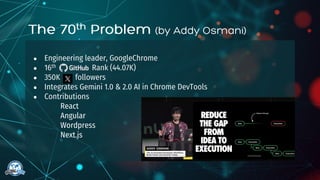
● Engineering leader, GoogleChrome
● 16th Rank (44.07K)
● 350K followers
● Integrates Gemini 1.0 & 2.0 AI in Chrome DevTools
● Contributions
○ React
○ Angular
○ Wordpress
○ Next.js
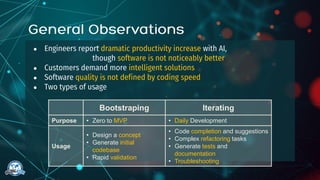
● Engineers report dramatic productivity increase with AI,
though software is not noticeably better
● Customers demand more intelligent solutions
● Software quality is not defined by coding speed
● Two types of usage
Bootstraping Iterating
Purpose • Zero to MVP • Daily Development
Usage
• Design a concept
• Generate initial
codebase
• Rapid validation
• Code completion and suggestions
• Complex refactoring tasks
• Generate tests and
documentation
• Troubleshooting
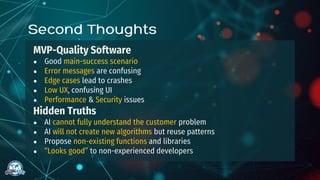
MVP-Quality Software
● Good main-success scenario
● Error messages are confusing
● Edge cases lead to crashes
● Low UX, confusing UI
● Performance & Security issues
Hidden Truths
● AI cannot fully understand the customer problem
● AI will not create new algorithms but reuse patterns
● Propose non-existing functions and libraries
● “Looks good” to non-experienced developers
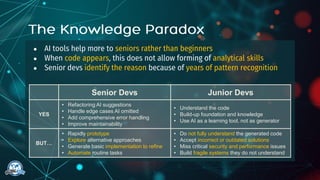
● AI tools help more to seniors rather than beginners
● When code appears, this does not allow forming of analytical skills
● Senior devs identify the reason because of years of pattern recognition
Senior Devs Junior Devs
YES
• Refactoring AI suggestions
• Handle edge cases AI omitted
• Add comprehensive error handling
• Improve maintainability
• Understand the code
• Build-up foundation and knowledge
• Use AI as a learning tool, not as generator
BUT…
• Rapidly prototype
• Explore alternative approaches
• Generate basic implementation to refine
• Automate routine tasks
• Do not fully understand the generated code
• Accept incorrect or outdated solutions
• Miss critical security and performance issues
• Build fragile systems they do not understand
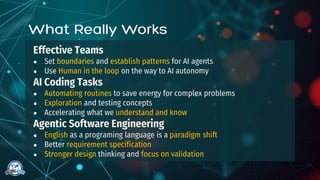
Effective Teams
● Set boundaries and establish patterns for AI agents
● Use Human in the loop on the way to AI autonomy
AI Coding Tasks
● Automating routines to save energy for complex problems
● Exploration and testing concepts
● Accelerating what we understand and know
Agentic Software Engineering
● English as a programing language is a paradigm shift
● Better requirement specification
● Stronger design thinking and focus on validation
Agent Global Ecosystem
• MCP Protocol
• Google Agent-2-Agent Protocol
• AI Foundry Semantic Kernel
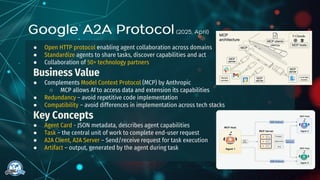
● Open HTTP protocol enabling agent collaboration across domains
● Standardize agents to share tasks, discover capabilities and act
● Collaboration of 50+ technology partners
Business Value
● Complements Model Context Protocol (MCP) by Anthropic
○ MCP allows AI to access data and extension its capabilities
● Redundancy – avoid repetitive code implementation
● Compatibility – avoid differences in implementation across tech stacks
Key Concepts
● Agent Card - JSON metadata, describes agent capabilities
● Task – the central unit of work to complete end-user request
● A2A Client, A2A Server – Send/receive request for task execution
● Artifact – output, generated by the agent during task
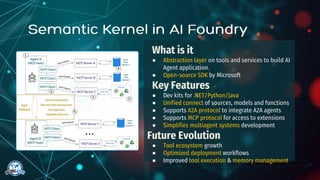
What is it
● Abstraction layer on tools and services to build AI
Agent application.
● Open-source SDK by Microsoft
Key Features
● Dev kits for .NET/Python/Java
● Unified connect of sources, models and functions
● Supports A2A protocol to integrate A2A agents
● Supports MCP protocol for access to extensions
● Simplifies multiagent systems development
Future Evolution
● Tool ecosystem growth
● Optimized deployment workflows
● Improved tool execution & memory management
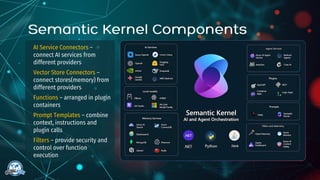
AI Service Connectors –
connect AI services from
different providers
Vector Store Connectors –
connect stores(memory) from
different providers
Functions – arranged in plugin
containers
Prompt Templates – combine
context, instructions and
plugin calls
Filters – provide security and
control over function
execution
From Agents to Multi-Agents
• When multi-agents are better
• Typical Challenges
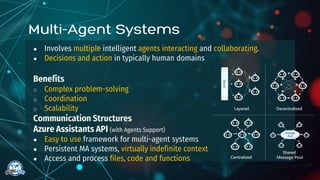
● Involves multiple intelligent agents interacting and collaborating.
● Decisions and action in typically human domains
Benefits
o Complex problem-solving
o Coordination
o Scalability
Communication Structures
Azure Assistants API (with Agents Support)
● Easy to use framework for multi-agent systems
● Persistent MA systems, virtually indefinite context
● Access and process files, code and functions
Collective Intelligence
● Traditional MA Systems use reinforcement learning to learn from offline data
● LLM-MA learn from instant feedback
Scalability
● Each LLM-based agent is based on an LLM (i.e. GPT4) and requires huge resources
● Coordination complexity raises significantly with number of agents
Multi-Modal Environment
● LLM agents are focused on text-based environments
● Integration in multimodal environment (sensors, video, audio) is a huge challenge
Hallucinations Challenge
● Generating a factually incorrect output of an LLM is a huge problem
● The problem could be multiplied in MA scenario
● Solved by Ground Truth (RAG) or Human in the Loop
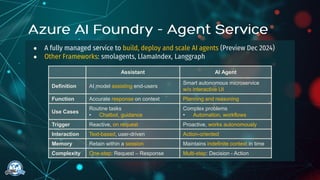
Azure AI Foundry – Agent Service
• Assistants vs. AI Agents
• Service Highlights
• Agentic Tools
● A fully managed service to build, deploy and scale AI agents (Preview Dec 2024)
● Other Frameworks: smolagents, LlamaIndex, Langgraph
Assistant AI Agent
Definition AI model assisting end-users
Smart autonomous microservice
w/o interactive UI
Function Accurate response on context Planning and reasoning
Use Cases
Routine tasks
• Chatbot, guidance
Complex problems
• Automation, workflows
Trigger Reactive, on request Proactive, works autonomously
Interaction Text-based, user-driven Action-oriented
Memory Retain within a session Maintains indefinite context in time
Complexity One-step: Request – Response Multi-step: Decision - Action
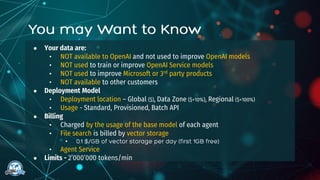
● Your data are:
• NOT available to OpenAI and not used to improve OpenAI models
• NOT used to train or improve OpenAI Service models
• NOT used to improve Microsoft or 3rd party products
• NOT available to other customers
● Deployment Model
• Deployment location – Global ($), Data Zone ($+10%), Regional ($+100%)
• Usage - Standard, Provisioned, Batch API
● Billing
• Charged by the usage of the base model of each agent
• File search is billed by vector storage
•
• Agent Service
● Limits - 2’000’000 tokens/min
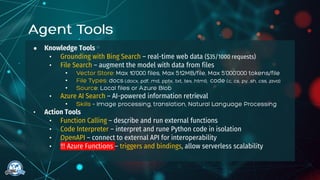
● Knowledge Tools
• Grounding with Bing Search – real-time web data ($35/1000 requests)
• File Search – augment the model with data from files
•
•
•
• Azure AI Search – AI-powered information retrieval
•
• Action Tools
• Function Calling – describe and run external functions
• Code Interpreter – interpret and rune Python code in isolation
• OpenAPI – connect to external API for interoperability
• !!! Azure Functions – triggers and bindings, allow serverless scalability
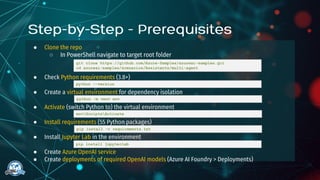
● Clone the repo
○ In PowerShell navigate to target root folder
● Check Python requirements (3.8+)
● Create a virtual environment for dependency isolation
● Activate (switch Python to) the virtual environment
● Install requirements (55 Python packages)
● Install Jupyter Lab in the environment
● Create Azure OpenAI service
● Create deployments of required OpenAI models (Azure AI Foundry > Deployments)
git clone https://github.com/Azure-Samples/azureai-samples.git
cd azureai-samples/scenarios/Assistants/multi-agent
python --version
python -m venv env
envScriptsActivate
pip install -r requirements.txt
pip install jupyterlab
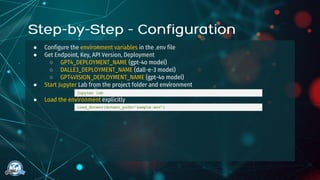
● Configure the environment variables in the .env file
● Get Endpoint, Key, API Version, Deployment
○ GPT4_DEPLOYMENT_NAME (gpt-4o model)
○ DALLE3_DEPLOYMENT_NAME (dall-e-3 model)
○ GPT4VISION_DEPLOYMENT_NAME (gpt-4o model)
● Start Jupyter Lab from the project folder and environment
● Load the environment explicitly
jupyter lab
load_dotenv(dotenv_path="sample.env")
Multi-Agent Era will Define the Future of Software