Dr. Inayat u Rahman Abbasi
Professor of Biochemistry
North West School of Medicine
Peshawar- Pakistan
Dr. Inayat u Rahman Abbasi 1
Learning Objectives
What is collagen & its importance in human.
Name some types of collagen found in human.
What is the amino acid sequence in collagen
 Why Glycine has importance in collagen.
 How collagen is synthesized &
What are post-translational modifications.
 What is coss-linkages & triple helix in collagen.
Name some abnormalities of collagen in human.
Dr. Inayat u Rahman Abbasi 2
Collagen Introduction:
 Major structural protein found in connective
tissue.
 Derived from a Greek word meaning the
substance to produce glue.
 Most abundant protein found in human
body.
 25-30% of the total weight of protein in body
is collagen.
Dr. Inayat u Rahman Abbasi 3
 Serves to hold together the cells in tissue.
 A major fibrous element of tissues like bone,
teeth, tendon, cartilage and blood vessels
 By classification it is an example of sclero-
proteins which is a simple protein (contain
only amino acids).
 Collagen and Elastin are the examples of
fibrous proteins.
Dr. Inayat u Rahman Abbasi 4
 They are found as components of skin,
connective tissue, blood vessels, sclera and
cornea of eye.
 It is long, rigid structure in which three
polypeptides are wound around one another in
a rope like fashion.
 These polypeptides are called α-helix.
 They are arranged in a triple helix.
 Polypeptide chains are held together by
hydrogen bonds.
Dr. Inayat u Rahman Abbasi 5
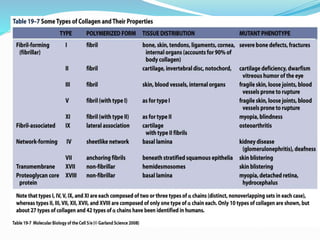
Types of Collagen
Collagen type I
Found in the supporting elements of high tensile
strength.
Found in bone, skin, tendon, muscles, cornea and
walls of blood vessels.
Collagen type II
Found in cartilaginous tissues.
Found in inter vertebral disk, vitreous body and
hyaline cartilage.
Dr. Inayat u Rahman Abbasi 6
Collagen type III
Found in distensible tissues.
Fetal skin, blood vessels.
Collagen type IV
 Found in the basement membranes and muscles.
Collagen type VII
 Beneath stratified squamous epithelia
Dr. Inayat u Rahman Abbasi 7
Collagen type IX
Found in cartilage
Collagen type XII
Tendon, ligaments
Dr. Inayat u Rahman Abbasi 8
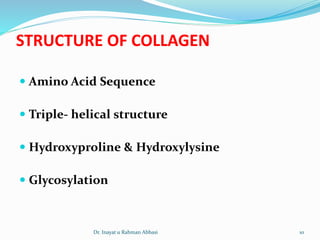
STRUCTURE OF COLLAGEN
 Amino Acid Sequence
 Triple- helical structure
 Hydroxyproline & Hydroxylysine
 Glycosylation
Dr. Inayat u Rahman Abbasi 10
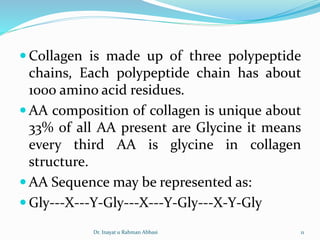
 Collagen is made up of three polypeptide
chains, Each polypeptide chain has about
1000 amino acid residues.
 AA composition of collagen is unique about
33% of all AA present are Glycine it means
every third AA is glycine in collagen
structure.
 AA Sequence may be represented as:
 Gly---X---Y-Gly---X---Y-Gly---X-Y-Gly
Dr. Inayat u Rahman Abbasi 11
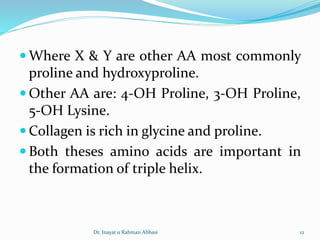
 Where X & Y are other AA most commonly
proline and hydroxyproline.
 Other AA are: 4-OH Proline, 3-OH Proline,
5-OH Lysine.
 Collagen is rich in glycine and proline.
 Both theses amino acids are important in
the formation of triple helix.
Dr. Inayat u Rahman Abbasi 12
Amino acid sequence in collagen
 Glycine smallest of all AA is found in every third
position of polypeptide chain of collagen
 Gly---X---Y-Gly---X---Y-
 Where X is frequently proline and Y is often
hydroxyproline (but can be hydroxylysine)
 Thus AA sequence is usually:
 (Gly--- proline --- hydroxyproline )333-Gly
Dr. Inayat u Rahman Abbasi 13
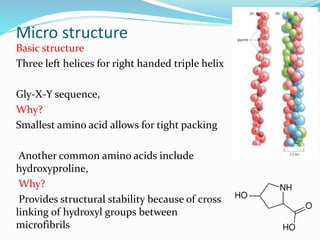
Micro structure
Basic structure
Three left helices for right handed triple helix
Gly-X-Y sequence,
Why?
Smallest amino acid allows for tight packing
Another common amino acids include
hydroxyproline,
Why?
Provides structural stability because of cross
linking of hydroxyl groups between
microfibrils
Synthesis of Collagen:
Synthesized by fibroblast intracellular
as a large precursor called precollegen
(MW 360 KDa).
Precollege then secreted and cleaved by
specific peptidases to from
Tropocollagen.
That is later converts into collagen
Dr. Inayat u Rahman Abbasi 15
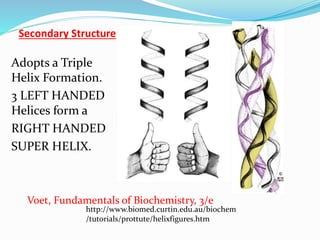
Secondary Structure
Adopts a Triple
Helix Formation.
3 LEFT HANDED
Helices form a
RIGHT HANDED
SUPER HELIX.
http://www.biomed.curtin.edu.au/biochem
/tutorials/prottute/helixfigures.htm
Voet, Fundamentals of Biochemistry, 3/e
Post-Translational Modification:
 Hydroxylation:
 Hydroxylation of protein and Lysine residue of
collagen is the important post translational
modification.
 Proloyl-hydroxylase and Lysyl-Hydroxylase are two
important oxygenase enzymes causing these
modifications.
Dr. Inayat u Rahman Abbasi 17
 These Enzymes contains ferrous Iron at its active site
and required reducing agent like ascorbic acid (vit C).
 So vitamin C deficiency (called Scurvey) leads to poor
hydroxylation causing spongy & bleeding gums.
 It is the main biochemical defect seen in survey.
Dr. Inayat u Rahman Abbasi 18
Glycosylation of Precollegen
 After Hydroxylation the next modification is
Glycosylation of Polypeptide chains of
Collagen
 The common carbohydrate residue added
are galactose and glucose by transferase
enzymes
 The Glycosylation occur only on the
hydroxyl lysine residues
Dr. Inayat u Rahman Abbasi 19
Extracellular Maturation of Collagen:
 Inside Fibroblast Polypeptides chains are
synthesized
 Proline and Lysine residues are
Hydroxylated
 Glycosylation of Lysine take Place
 Then precollege molecules are secreted
 Outside the cell precollegen is cleaved by
peptidase.
Dr. Inayat u Rahman Abbasi 20
About 150AA in N-terminal & 300 AA
in C-terminal area of Polypeptide are
cleaved.
Then precollegen molecules are
assembled into collagen.
Finally covalent cross-linkings are
formed and mature collagen is formed
Dr. Inayat u Rahman Abbasi 21
Triple Branded Helix of Collagen :
 The collagen is a rod like structure.
 Each of the 3-Polypeptide chain is held in a
helical conformation by winding around
each other.
 The three strands are hydrogen bounded to
each other.
 Glycine because of its smaller size, can fill
into crowded interior of collagen triple
helix.
Dr. Inayat u Rahman Abbasi 22
Cross-Link in Collagen Fibers:
 Polypeptide precursors of collagen molecule are
formed in fibroblast and are secreted into
extracellular matrix.
 After enzymatic modification the mature collagen
molecule aggregate and become cross-linked to
form collagen fibril.
 Cross- linking is essential for tensile strength of
collagen in connective tissues.
 Any change or mutation that interferes these
cross-linking affects the stability of collagen
molecule.
Dr. Inayat u Rahman Abbasi 23
Function of Collagen
 To give Support to organs
 To provide alignment of cells that helps in
proliferation and differentiation of cell
 In blood vessels, if collagen is exposed,
platelets adhere and thrombus formation is
initiated
Dr. Inayat u Rahman Abbasi 24
Degradation of Collagen:
 Occur by collageusases enzyme.
 Collagen is a protein resistant by ordinary enzyme
 Causes of Collagen resorption are:
 Bone/Cartilage resorption
 Osteoporosis, Tumor Metastasis
 During Postpartum involution of Uterus
 Rickets/Osteomalacia, Osteoarthritis
 Rheumatoid arthritis, Vitamin C deficiency
Dr. Inayat u Rahman Abbasi 25
Abnormalities in Collagen:
 Some disease are related to abnormalities of
collagen like:
 Osteogenesis Imperfecta
 Ehlers –Danlos Syndrome
 Marfan’s Syndrome
 Deficiency of Ascorbic acid
Dr. Inayat u Rahman Abbasi 26
Osteogenesis Imperfecta
 Also known as Britle Bone Syndrome.
 In this disorder bones are easily bend &
fractured.
 Other s/s are: retarded (delayed) wound
healing, rotated & twisted spine.
 Few sub-types, type I is called osteogenesis
Imperfecta Tarda.
Dr. Inayat u Rahman Abbasi 27
s/s fractures secondary to minor
trauma in infancy.
bowing or fractures of long bones.
cause is mostly the mutation causing
replacement of glycine residue by other
amino acid with bulky side chain.
this leads to abnormal polypeptide &
inability to form triple-helix
conformation of collagen.
Dr. Inayat u Rahman Abbasi 28
Ehlers –Danlos Syndrome (EDS):
 Herogenous group of generalized connective
tissue disorder
 Due to deficiency of collagen-processing
enzyme (lysyl hydroxylase or procollagen
peptidase)
 Or due to mutation in amino acid sequence
of collagen type I, III or V
 Most clinically important mutation found in
type II collagen
Dr. Inayat u Rahman Abbasi 29
 Because type III is an important component
of arteries, so mainly lethal vascular
problems occur in these patients
 EDS is a group of disorder in which cys or
ser is replaced the gly of collagen. It
produces weakness in connective tissues
leading to arterial rupture, rupture of uterus
during pregnancy or labor, intestinal
perforation & easy bruisability of skin.
Dr. Inayat u Rahman Abbasi 30
Marfan’s Syndrome:
 It is a defect in type I collagen & is
characterize by skin, eye and heart
manifestations.
 The aorta & pulmonary arteries are weak or
may ruptured.
 There is defect in the cross-linking of
collagen causing loss of strength &
abnormalities.
Dr. Inayat u Rahman Abbasi 31
Vitamin C Deficiency Scurvey
 Vitamin C is required for hydroxylation of
Pro to hydroxy-proline(Hpro)by prolyl-
hydroxylase.
So deficiency of vitamin C (Scurvey)causes
decreased Hpro synthesis.
Retarded growth process in childrens.
Poor wound healings.
Bleeding from gums.
High capillary fragility & hemorrhages in
skin. Dr. Inayat u Rahman Abbasi 32
THANK YOU
Dr. Inayat u Rahman Abbasi 33

Collagen ppt(1)

  • 1.
    Dr. Inayat uRahman Abbasi Professor of Biochemistry North West School of Medicine Peshawar- Pakistan Dr. Inayat u Rahman Abbasi 1
  • 2.
    Learning Objectives What iscollagen & its importance in human. Name some types of collagen found in human. What is the amino acid sequence in collagen  Why Glycine has importance in collagen.  How collagen is synthesized & What are post-translational modifications.  What is coss-linkages & triple helix in collagen. Name some abnormalities of collagen in human. Dr. Inayat u Rahman Abbasi 2
  • 3.
    Collagen Introduction:  Majorstructural protein found in connective tissue.  Derived from a Greek word meaning the substance to produce glue.  Most abundant protein found in human body.  25-30% of the total weight of protein in body is collagen. Dr. Inayat u Rahman Abbasi 3
  • 4.
     Serves tohold together the cells in tissue.  A major fibrous element of tissues like bone, teeth, tendon, cartilage and blood vessels  By classification it is an example of sclero- proteins which is a simple protein (contain only amino acids).  Collagen and Elastin are the examples of fibrous proteins. Dr. Inayat u Rahman Abbasi 4
  • 5.
     They arefound as components of skin, connective tissue, blood vessels, sclera and cornea of eye.  It is long, rigid structure in which three polypeptides are wound around one another in a rope like fashion.  These polypeptides are called α-helix.  They are arranged in a triple helix.  Polypeptide chains are held together by hydrogen bonds. Dr. Inayat u Rahman Abbasi 5
  • 6.
    Types of Collagen Collagentype I Found in the supporting elements of high tensile strength. Found in bone, skin, tendon, muscles, cornea and walls of blood vessels. Collagen type II Found in cartilaginous tissues. Found in inter vertebral disk, vitreous body and hyaline cartilage. Dr. Inayat u Rahman Abbasi 6
  • 7.
    Collagen type III Foundin distensible tissues. Fetal skin, blood vessels. Collagen type IV  Found in the basement membranes and muscles. Collagen type VII  Beneath stratified squamous epithelia Dr. Inayat u Rahman Abbasi 7
  • 8.
    Collagen type IX Foundin cartilage Collagen type XII Tendon, ligaments Dr. Inayat u Rahman Abbasi 8
  • 10.
    STRUCTURE OF COLLAGEN Amino Acid Sequence  Triple- helical structure  Hydroxyproline & Hydroxylysine  Glycosylation Dr. Inayat u Rahman Abbasi 10
  • 11.
     Collagen ismade up of three polypeptide chains, Each polypeptide chain has about 1000 amino acid residues.  AA composition of collagen is unique about 33% of all AA present are Glycine it means every third AA is glycine in collagen structure.  AA Sequence may be represented as:  Gly---X---Y-Gly---X---Y-Gly---X-Y-Gly Dr. Inayat u Rahman Abbasi 11
  • 12.
     Where X& Y are other AA most commonly proline and hydroxyproline.  Other AA are: 4-OH Proline, 3-OH Proline, 5-OH Lysine.  Collagen is rich in glycine and proline.  Both theses amino acids are important in the formation of triple helix. Dr. Inayat u Rahman Abbasi 12
  • 13.
    Amino acid sequencein collagen  Glycine smallest of all AA is found in every third position of polypeptide chain of collagen  Gly---X---Y-Gly---X---Y-  Where X is frequently proline and Y is often hydroxyproline (but can be hydroxylysine)  Thus AA sequence is usually:  (Gly--- proline --- hydroxyproline )333-Gly Dr. Inayat u Rahman Abbasi 13
  • 14.
    Micro structure Basic structure Threeleft helices for right handed triple helix Gly-X-Y sequence, Why? Smallest amino acid allows for tight packing Another common amino acids include hydroxyproline, Why? Provides structural stability because of cross linking of hydroxyl groups between microfibrils
  • 15.
    Synthesis of Collagen: Synthesizedby fibroblast intracellular as a large precursor called precollegen (MW 360 KDa). Precollege then secreted and cleaved by specific peptidases to from Tropocollagen. That is later converts into collagen Dr. Inayat u Rahman Abbasi 15
  • 16.
    Secondary Structure Adopts aTriple Helix Formation. 3 LEFT HANDED Helices form a RIGHT HANDED SUPER HELIX. http://www.biomed.curtin.edu.au/biochem /tutorials/prottute/helixfigures.htm Voet, Fundamentals of Biochemistry, 3/e
  • 17.
    Post-Translational Modification:  Hydroxylation: Hydroxylation of protein and Lysine residue of collagen is the important post translational modification.  Proloyl-hydroxylase and Lysyl-Hydroxylase are two important oxygenase enzymes causing these modifications. Dr. Inayat u Rahman Abbasi 17
  • 18.
     These Enzymescontains ferrous Iron at its active site and required reducing agent like ascorbic acid (vit C).  So vitamin C deficiency (called Scurvey) leads to poor hydroxylation causing spongy & bleeding gums.  It is the main biochemical defect seen in survey. Dr. Inayat u Rahman Abbasi 18
  • 19.
    Glycosylation of Precollegen After Hydroxylation the next modification is Glycosylation of Polypeptide chains of Collagen  The common carbohydrate residue added are galactose and glucose by transferase enzymes  The Glycosylation occur only on the hydroxyl lysine residues Dr. Inayat u Rahman Abbasi 19
  • 20.
    Extracellular Maturation ofCollagen:  Inside Fibroblast Polypeptides chains are synthesized  Proline and Lysine residues are Hydroxylated  Glycosylation of Lysine take Place  Then precollege molecules are secreted  Outside the cell precollegen is cleaved by peptidase. Dr. Inayat u Rahman Abbasi 20
  • 21.
    About 150AA inN-terminal & 300 AA in C-terminal area of Polypeptide are cleaved. Then precollegen molecules are assembled into collagen. Finally covalent cross-linkings are formed and mature collagen is formed Dr. Inayat u Rahman Abbasi 21
  • 22.
    Triple Branded Helixof Collagen :  The collagen is a rod like structure.  Each of the 3-Polypeptide chain is held in a helical conformation by winding around each other.  The three strands are hydrogen bounded to each other.  Glycine because of its smaller size, can fill into crowded interior of collagen triple helix. Dr. Inayat u Rahman Abbasi 22
  • 23.
    Cross-Link in CollagenFibers:  Polypeptide precursors of collagen molecule are formed in fibroblast and are secreted into extracellular matrix.  After enzymatic modification the mature collagen molecule aggregate and become cross-linked to form collagen fibril.  Cross- linking is essential for tensile strength of collagen in connective tissues.  Any change or mutation that interferes these cross-linking affects the stability of collagen molecule. Dr. Inayat u Rahman Abbasi 23
  • 24.
    Function of Collagen To give Support to organs  To provide alignment of cells that helps in proliferation and differentiation of cell  In blood vessels, if collagen is exposed, platelets adhere and thrombus formation is initiated Dr. Inayat u Rahman Abbasi 24
  • 25.
    Degradation of Collagen: Occur by collageusases enzyme.  Collagen is a protein resistant by ordinary enzyme  Causes of Collagen resorption are:  Bone/Cartilage resorption  Osteoporosis, Tumor Metastasis  During Postpartum involution of Uterus  Rickets/Osteomalacia, Osteoarthritis  Rheumatoid arthritis, Vitamin C deficiency Dr. Inayat u Rahman Abbasi 25
  • 26.
    Abnormalities in Collagen: Some disease are related to abnormalities of collagen like:  Osteogenesis Imperfecta  Ehlers –Danlos Syndrome  Marfan’s Syndrome  Deficiency of Ascorbic acid Dr. Inayat u Rahman Abbasi 26
  • 27.
    Osteogenesis Imperfecta  Alsoknown as Britle Bone Syndrome.  In this disorder bones are easily bend & fractured.  Other s/s are: retarded (delayed) wound healing, rotated & twisted spine.  Few sub-types, type I is called osteogenesis Imperfecta Tarda. Dr. Inayat u Rahman Abbasi 27
  • 28.
    s/s fractures secondaryto minor trauma in infancy. bowing or fractures of long bones. cause is mostly the mutation causing replacement of glycine residue by other amino acid with bulky side chain. this leads to abnormal polypeptide & inability to form triple-helix conformation of collagen. Dr. Inayat u Rahman Abbasi 28
  • 29.
    Ehlers –Danlos Syndrome(EDS):  Herogenous group of generalized connective tissue disorder  Due to deficiency of collagen-processing enzyme (lysyl hydroxylase or procollagen peptidase)  Or due to mutation in amino acid sequence of collagen type I, III or V  Most clinically important mutation found in type II collagen Dr. Inayat u Rahman Abbasi 29
  • 30.
     Because typeIII is an important component of arteries, so mainly lethal vascular problems occur in these patients  EDS is a group of disorder in which cys or ser is replaced the gly of collagen. It produces weakness in connective tissues leading to arterial rupture, rupture of uterus during pregnancy or labor, intestinal perforation & easy bruisability of skin. Dr. Inayat u Rahman Abbasi 30
  • 31.
    Marfan’s Syndrome:  Itis a defect in type I collagen & is characterize by skin, eye and heart manifestations.  The aorta & pulmonary arteries are weak or may ruptured.  There is defect in the cross-linking of collagen causing loss of strength & abnormalities. Dr. Inayat u Rahman Abbasi 31
  • 32.
    Vitamin C DeficiencyScurvey  Vitamin C is required for hydroxylation of Pro to hydroxy-proline(Hpro)by prolyl- hydroxylase. So deficiency of vitamin C (Scurvey)causes decreased Hpro synthesis. Retarded growth process in childrens. Poor wound healings. Bleeding from gums. High capillary fragility & hemorrhages in skin. Dr. Inayat u Rahman Abbasi 32
  • 33.
    THANK YOU Dr. Inayatu Rahman Abbasi 33