Denture Lining Materials
1
Dr. Sadaf Humayoun
Associate Professor & HOD Dental Materials
Rawal Institute of Health Sciences
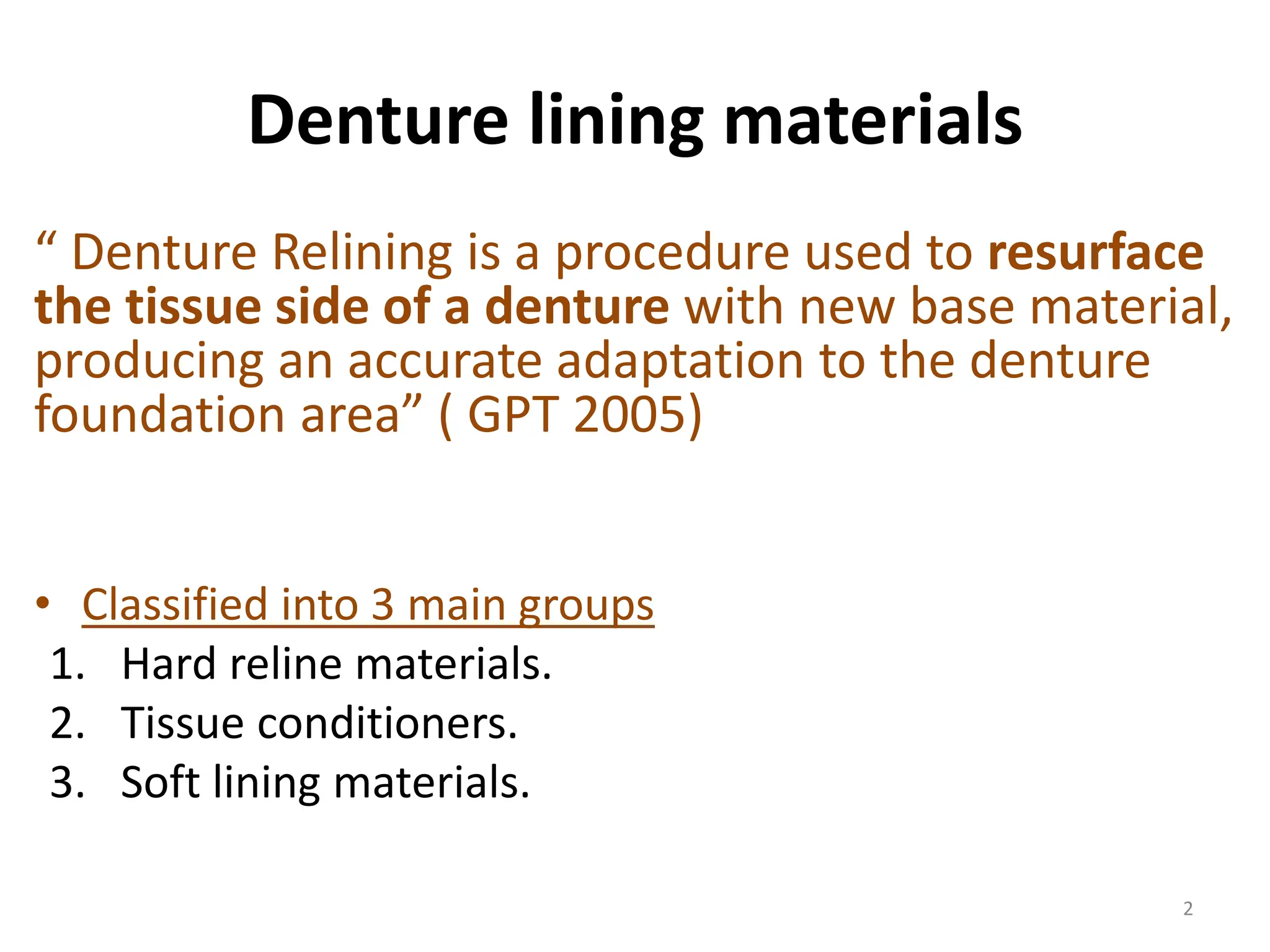
Denture lining materials
“ Denture Relining is a procedure used to resurface
the tissue side of a denture with new base material,
producing an accurate adaptation to the denture
foundation area” ( GPT 2005)
• Classified into 3 main groups
1. Hard reline materials.
2. Tissue conditioners.
3. Soft lining materials.
2
Denture lining materials
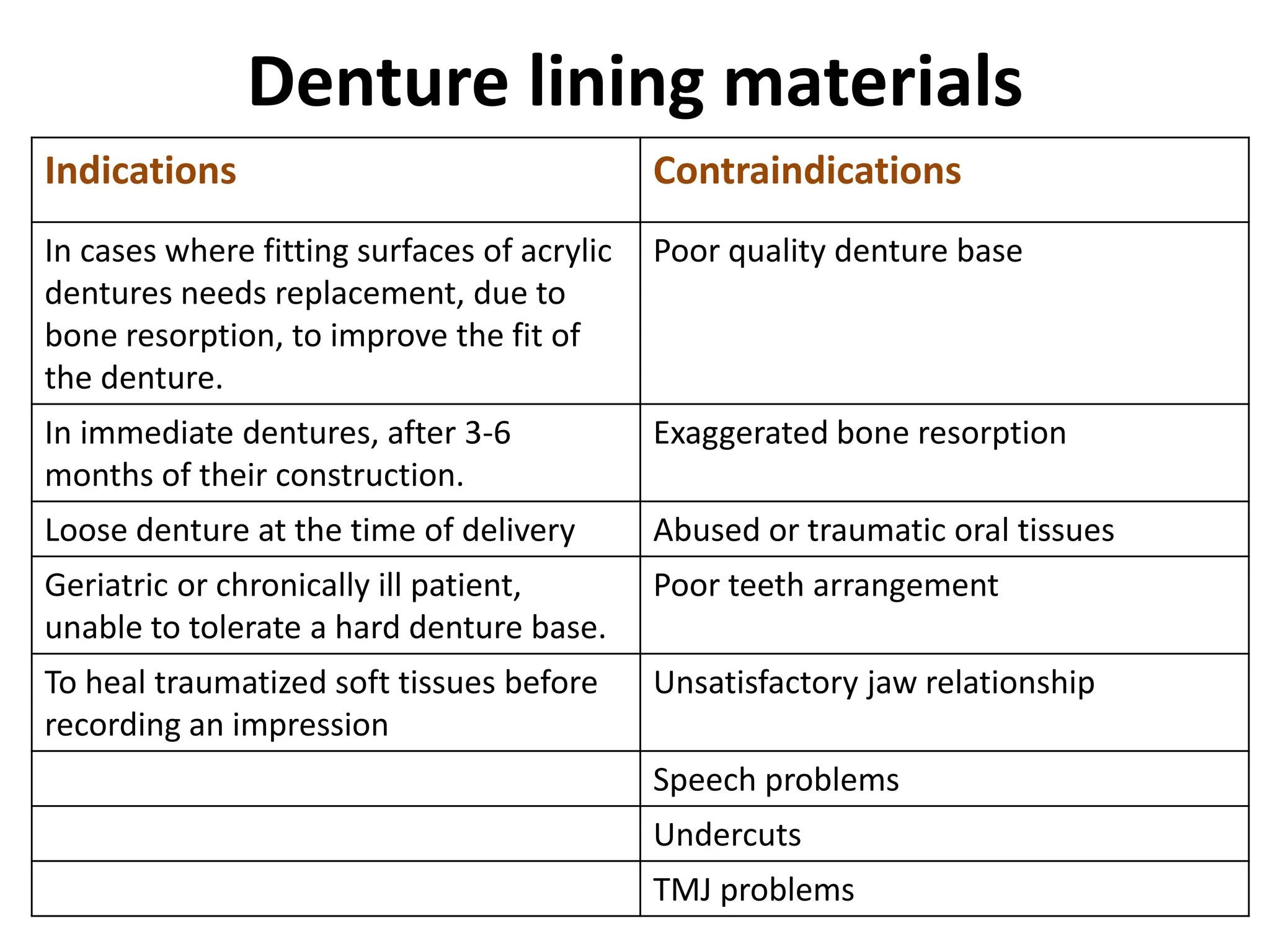
Indications Contraindications
In cases where fitting surfaces of acrylic
dentures needs replacement, due to
bone resorption, to improve the fit of
the denture.
Poor quality denture base
In immediate dentures, after 3-6
months of their construction.
Exaggerated bone resorption
Loose denture at the time of delivery Abused or traumatic oral tissues
Geriatric or chronically ill patient,
unable to tolerate a hard denture base.
Poor teeth arrangement
To heal traumatized soft tissues before
recording an impression
Unsatisfactory jaw relationship
Speech problems
Undercuts
TMJ problems
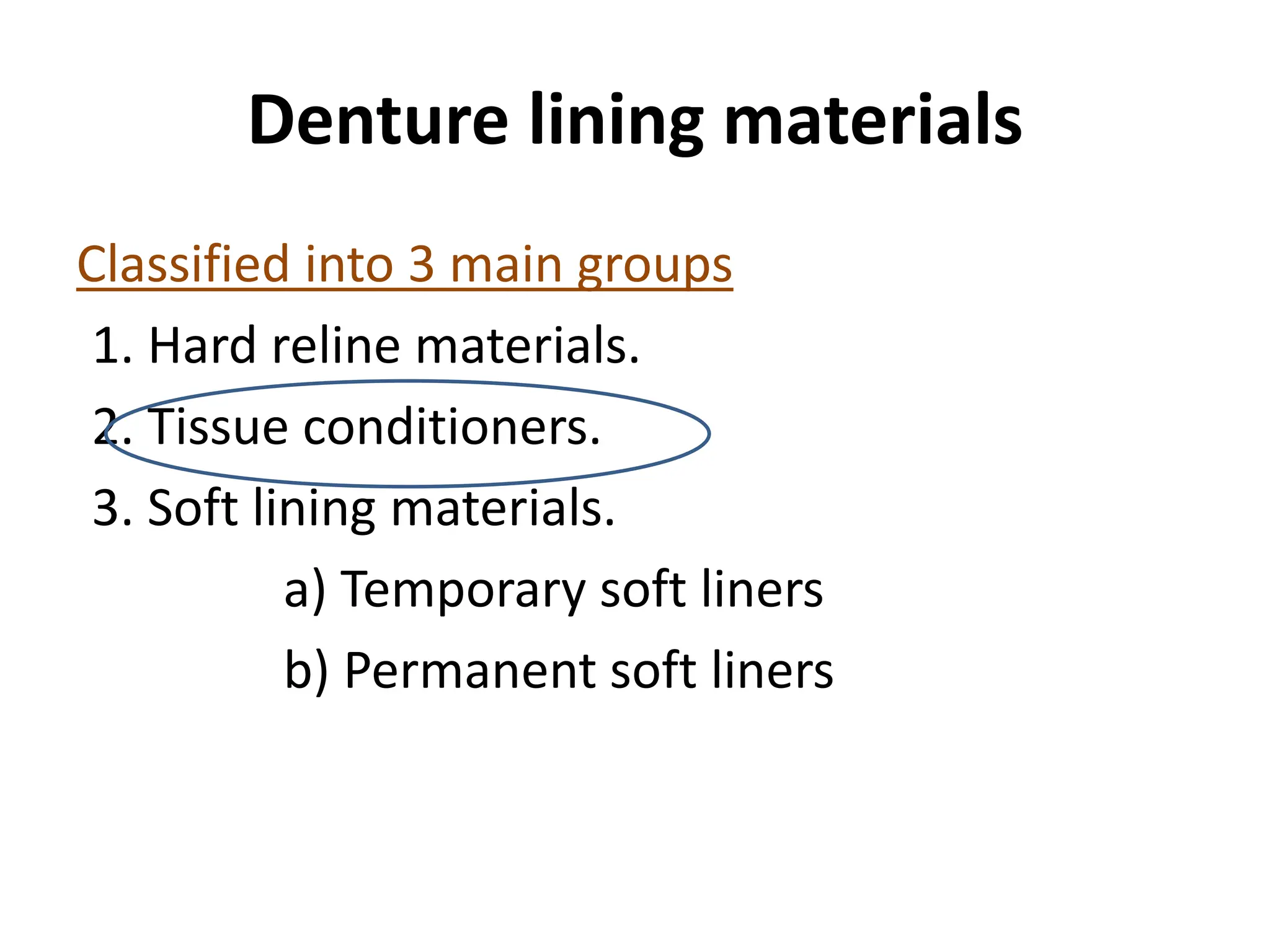
Denture lining materials
Classified into 3 main groups
1. Hard reline materials.
2. Tissue conditioners.
3. Soft lining materials.
a) Temporary soft liners
b) Permanent soft liners
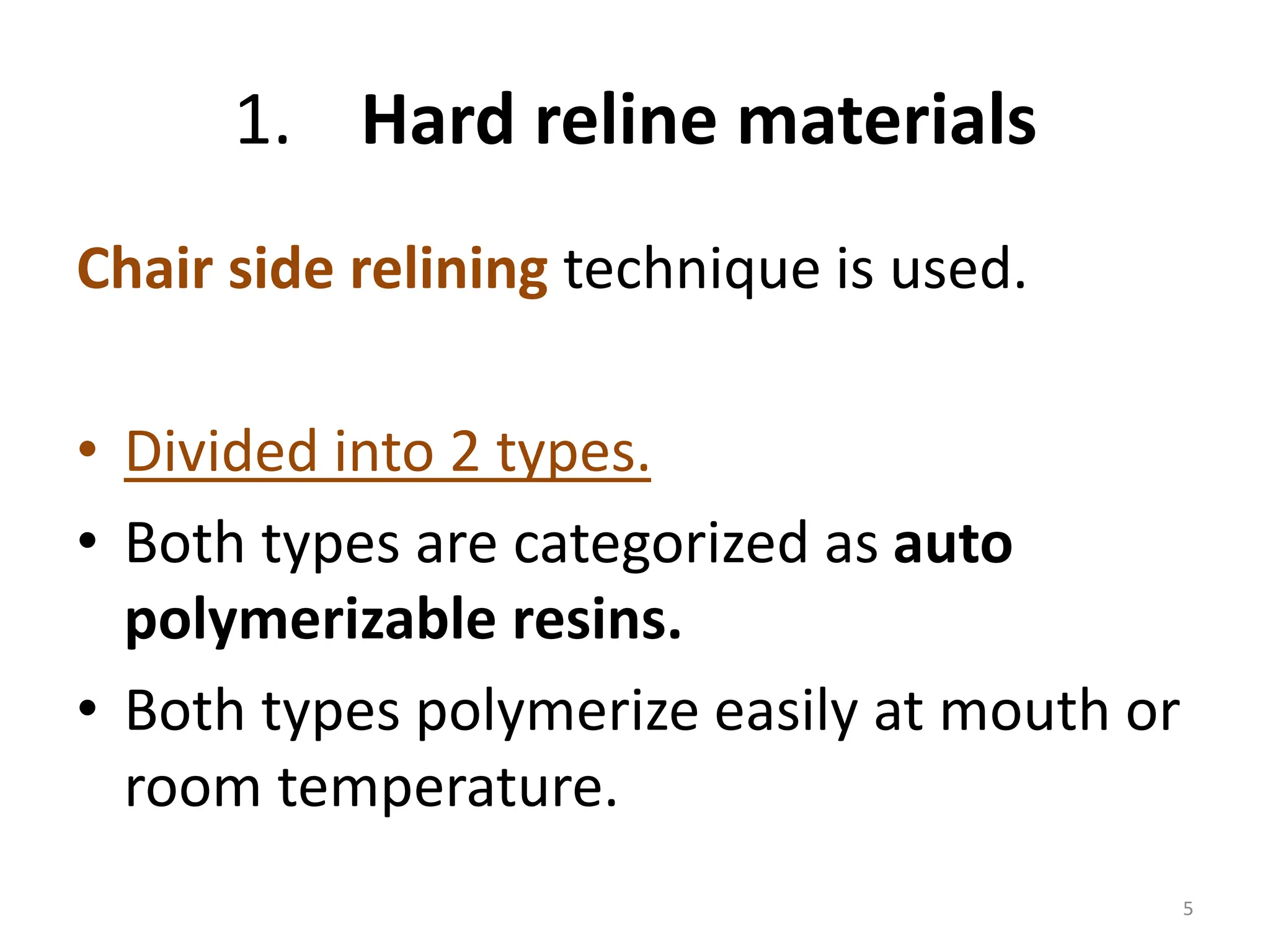
1. Hard reline materials
Chair side relining technique is used.
• Divided into 2 types.
• Both types are categorized as auto
polymerizable resins.
• Both types polymerize easily at mouth or
room temperature.
5
1. Hard Reline Materials
Type 1
Powder Polymer beads Polymethylmethacrylate
Initiator Benzoyl peroxide
Pigments Inorganic salts
Liquid Monomer Methylmethacrylate
Plasticizer Di-n-butylphthalate Tg
Chemical activator Tertiary amine
6
Composition: Autopolymerizing resins ( readily polymerize at room
temperature or mouth temperature).
Type 2
Powder Polymer beads Polyethylmethacrylate
Initiator Benzoyl peroxide
Liquid Monomer Butylmethacrylate Tg
Chemical activator Tertiaty amine
Pigments Inorganic salts
1. Hard Reline Materials
Manipulation:
• Relieve the fitting surface i.e. grinding away some of the hard
surface of acrylic base.
• Powder and liquid are mixed and applied over the fitting
surface of the acrylic base.
• Seated into the patient’s mouth whilst still fluid.
• Closed mouth technique (mouth closed into gentle contact) is
used.
• The reline soon becomes rubbery having the recorded patients
soft tissue impression.
• The denture is removed from the patients mouth and is
allowed to bench cure because of exothermic heat.
• The relined denture is normally ready for trimming n polishing
within 30 minutes. 7
1. Hard Reline Materials
8
Advantages Disadvantages
It provides a chairside reline to the denture. Direct contact with the oral tissues is a disadvantage.
In cases where fitting surfaces of acrylic dentures
needs replacement, due to bone resorption, to
improve the fit of the denture.
Methyl methacrylate in the monomer may cause allergic
reaction.
In immediate dentures, after 3-6 months of their
construction.
Low values of glass transition temperature (Tg) in both
type 1 and type 2 materials may lead to increased
dimensional instability.
Loose denture at the time of delivery May become porous due to air entrapment during
mixing which decreases patient acceptance and
increases debris contamination and colonization by
microorganisms.
Geriatric or chronically ill patient Operator has little control over the thickness of the
material which may modify the vertical relationship
and may cause anteroposterior positional error or lateral
cant.
Increase in thickness of the “palate” of an upper
denture, which patients often find unacceptable
Properties:
Denture lining materials
Classified into 3 main groups
1. Hard reline materials.
2. Tissue conditioners.
3. Soft lining materials.
a) Temporary soft liners
b) Permanent soft liners
2. Tissue Conditioners
• Soft denture liners.
• Applied to the fitting surface of the denture.
• Provides temporary cushion to the fitting
surface.
• Plastic flow continues for 24-36 hours after
mixing and therefore capture a functional
shape of supporting tissues.
• Several applications in denture works.
10
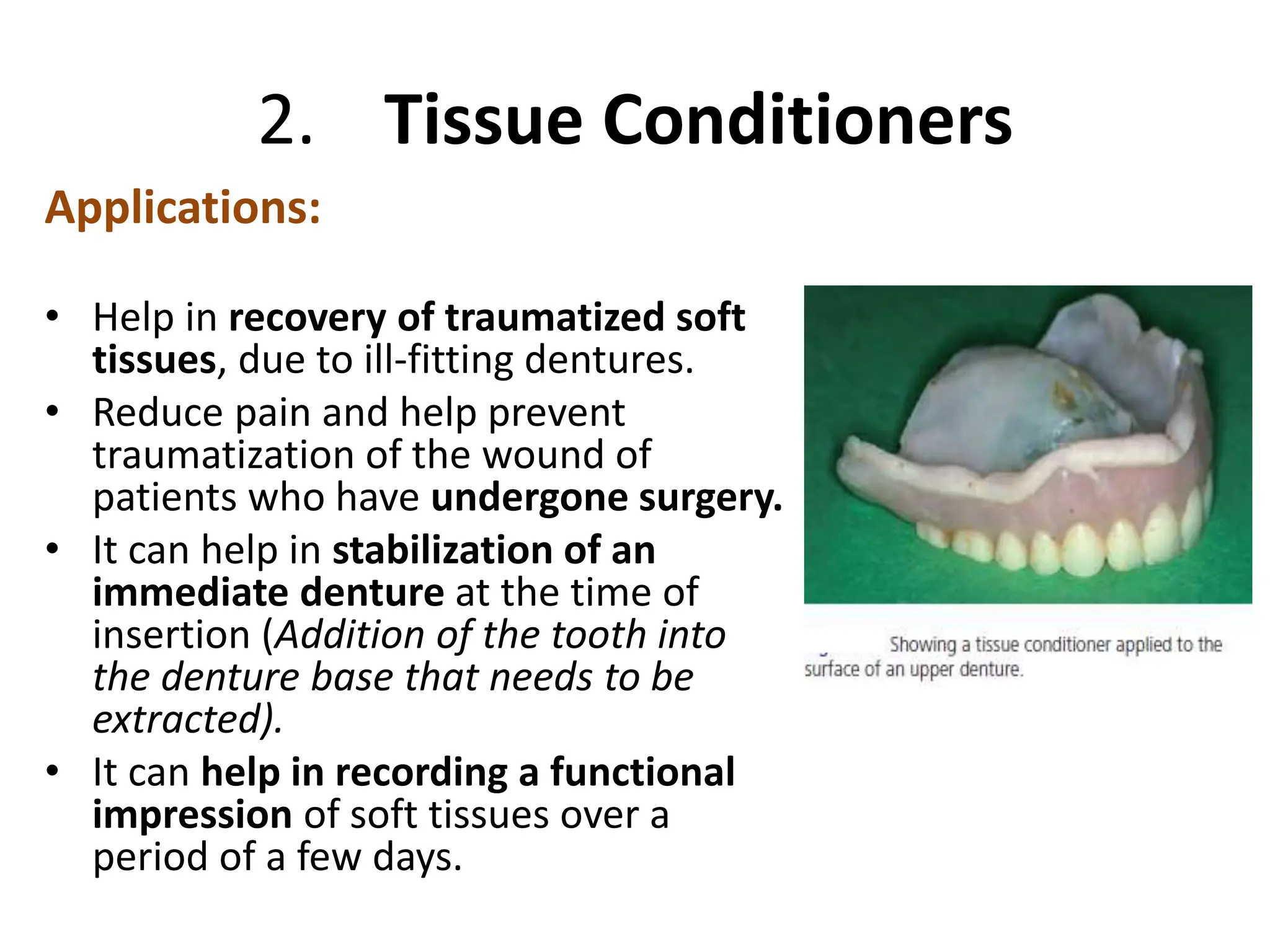
Applications:
• Help in recovery of traumatized soft
tissues, due to ill-fitting dentures.
• Reduce pain and help prevent
traumatization of the wound of
patients who have undergone surgery.
• It can help in stabilization of an
immediate denture at the time of
insertion (Addition of the tooth into
the denture base that needs to be
extracted).
• It can help in recording a functional
impression of soft tissues over a
period of a few days.
2. Tissue Conditioners
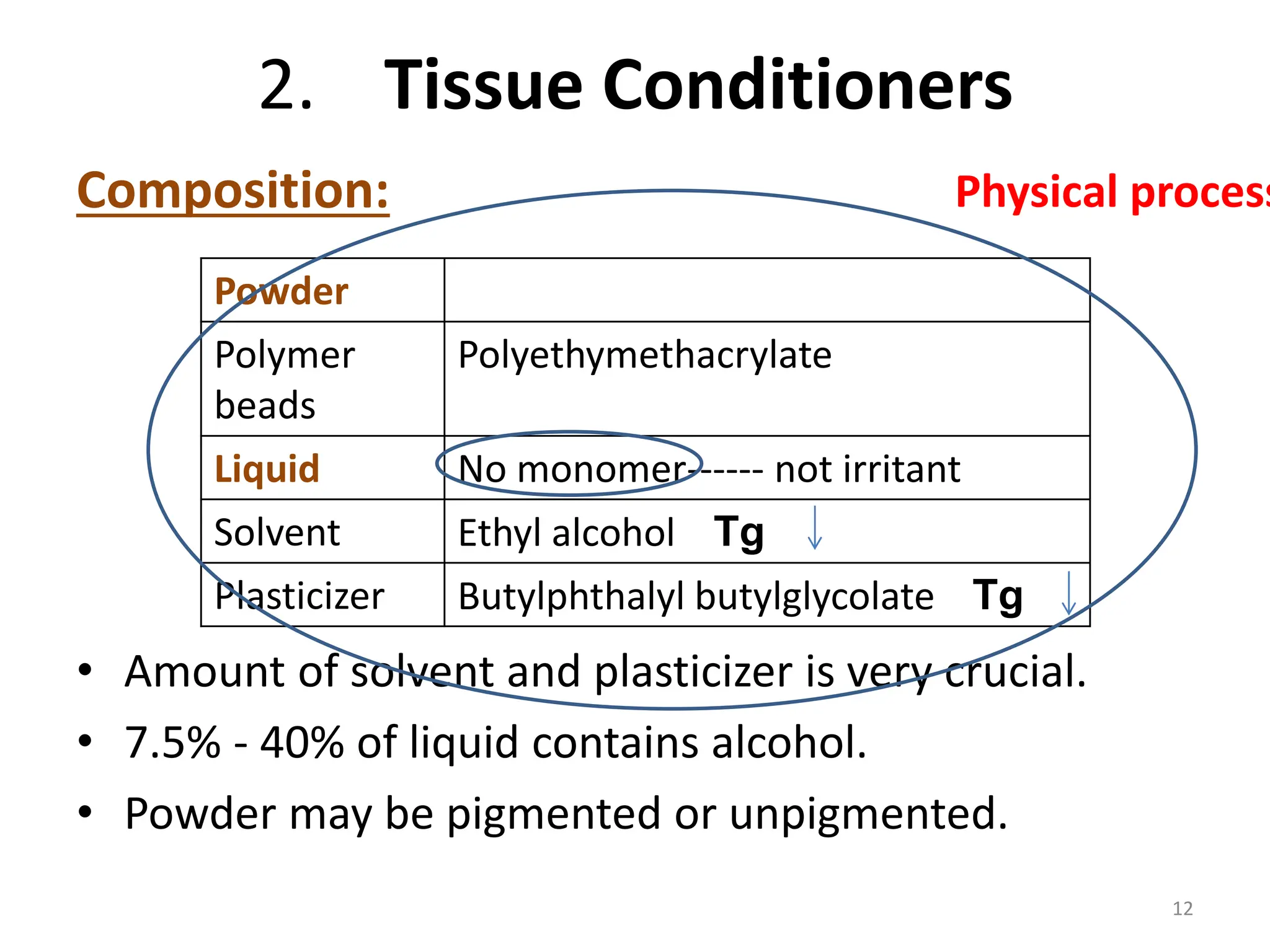
Composition:
• Amount of solvent and plasticizer is very crucial.
• 7.5% - 40% of liquid contains alcohol.
• Powder may be pigmented or unpigmented.
12
Powder
Polymer
beads
Polyethymethacrylate
Liquid No monomer------ not irritant
Solvent Ethyl alcohol Tg
Plasticizer Butylphthalyl butylglycolate Tg
Physical process
2. Tissue Conditioners
Manipulation: (chairside technique)
• On mixing powder and liquid, physical process occurs.
• Smaller polymeric beads get dissolved and larger beads swell up
on absorbing solvent.
• Freshly mixed material is applied to the fitting surface of the
denture and is seated in the patients mouth while still in fluid
state.
• Fluid state of the material ensures a cushion of reasonable
thickness without undue increase in height of the denture.
• Final set material is gel-like and ideally should form a regular
layer over the whole of the fitting surface of the denture.
• High methacrylate, ethyl methacrylate, plasticizer and solvent
gives softness.
• Normally denture and patient’s soft tissues are inspected after 2-
3 days.
13
2. Tissue Conditioners
Properties:
• Non-irritant due to the absence of acrylic monomers from
the liquid component.
• Initially very soft and Viscoelastic ( perform both as a
tissue conditioner and functional impression material).
• Undergo permanent deformation under even small load.
• Material do not remain permanently soft.
• Time taken for the material to become hard and loose the
cushioning effect varies from days to a couple of weeks.
• Conditioner should be replaced after 2- 3 days till the tissue
has healed properly.
14
Denture lining materials
Classified into 3 main groups
1. Hard reline materials.
2. Tissue conditioners.
3. Soft lining materials.
a) Temporary soft liners
b) Permanent soft liners
3. Soft Lining Materials
• Can be sub divided into
a) Temporary soft lining materials.
b) Permanent soft lining materials.
16
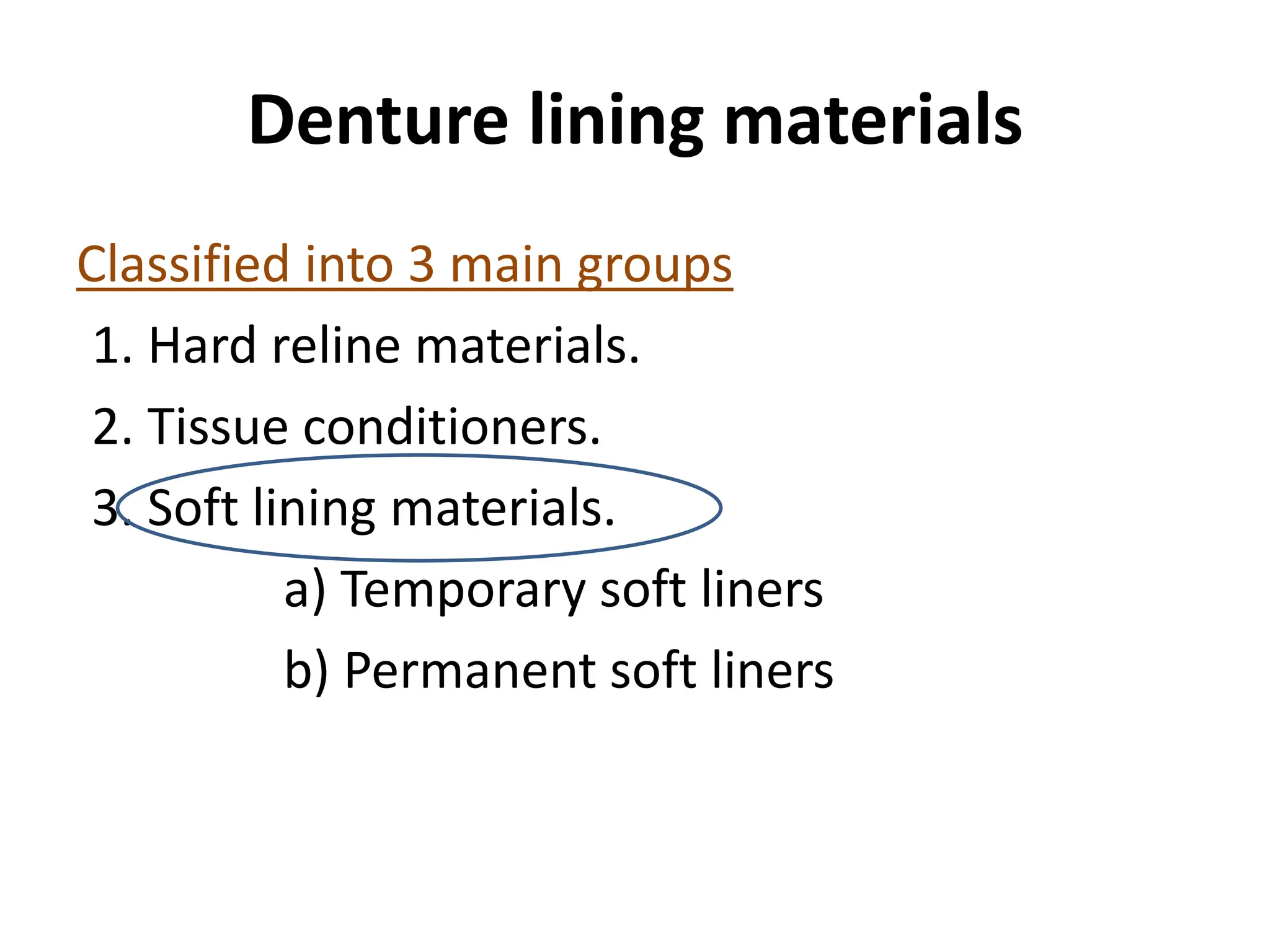
Denture lining materials
Classified into 3 main groups
1. Hard reline materials.
2. Tissue conditioners.
3. Soft lining materials.
a) Temporary soft liners
b) Permanent soft liners
3. Soft Lining Materials
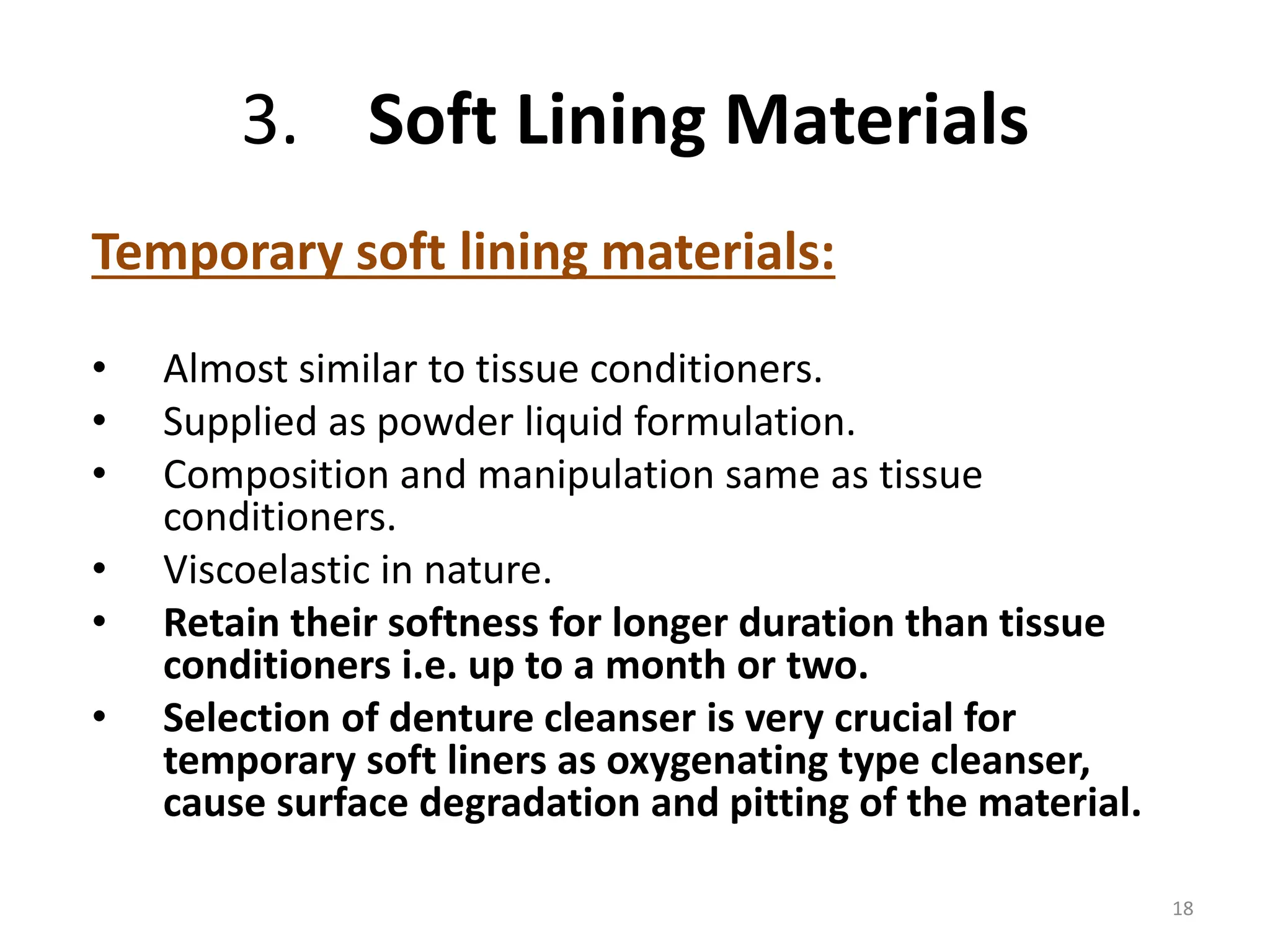
Temporary soft lining materials:
• Almost similar to tissue conditioners.
• Supplied as powder liquid formulation.
• Composition and manipulation same as tissue
conditioners.
• Viscoelastic in nature.
• Retain their softness for longer duration than tissue
conditioners i.e. up to a month or two.
• Selection of denture cleanser is very crucial for
temporary soft liners as oxygenating type cleanser,
cause surface degradation and pitting of the material.
18
3. Soft Lining Materials
Temporary soft lining materials ; Applications:
• In cases where it is not practicable to replace the conditioner every
2 – 3 days as they take longer to harden and do not require
frequent replacement.
• They may be used as a means of temporarily improving the fit of
an ill fitting denture until such a time as a new denture can be
constructed.
• As a diagnostic aid to ascertain whether the patient would benefit
from a permanent soft lining.
Both tissue conditioners and temporary soft liners will go hard
with surface becoming rough and irregular, increasing the risk
of trauma and colonization by Candida in this hardened state,
increasing the risk of a denture-induced stomatitis.
Denture lining materials
Classified into 3 main groups
1. Hard reline materials.
2. Tissue conditioners.
3. Soft lining materials.
a) Temporary soft liners
b) Permanent soft liners
3. Soft Lining Materials
Permanent soft lining materials:
• Commonly used in patients that cannot tolerate a hard base.
• In patients with thin mandibular mucosa.
• These materials should remain permanently soft for the life
time of the denture.
• Elasticity of these materials is very important.
Requirements of Permanent/ long term Soft Liners:
• Permanently soft, ideally for the life time of the denture.
• Should be elastic in order to give a cushioning effect and
prevent unacceptable distortions during service.
• The lining should adhere to the denture base.
• The material should be non-toxic, non-irritant and incapable of
sustaining the growth of harmful bacteria or fungi. 21
Available Permanent soft lining materials
22
Acrylic
Addition
Two paste
and similar
to addition
cured
silicone
elastomeric
impression
materials
Condensation
Paste: Hydroxyl
terminated
polydimethylsiloxan
e polymer with filler
& Liquid:
Crosslinking agent
(Tetraethylsilicate)
and a catalyst
(organo-tin
compound).
P:L—condensation
crosslinking reaction
with Alcohol
byproduct.
Cold cure
Chairside
technique. Can
be readily
applied to an
existing
denture.
Harden with in
a period of a
few weeks or
at best a few
months,
therefore
require regular
replacements.
Polyphosphazine
Sheet form
Silicone
Cold cure
Heat cure
Processed in the
lab at the same
time with the
acrylic base.
Powder: polyethyl
or butyl
methacrylate
beads with
initiator and
pigment.
Liquid:
butylmethacrylate
& Plasticizer
Heat cure
(Processed in lab)
Single paste of
vinyl terminated
polydimethylsilox
ane polymer with
filler and an
initiator.
Vinyl gp. undergo
chain extension,
increases viscosity
& Crosslinking,
develop elasticity.
Tendency to peel away
(Processed in lab)
3. Soft Lining Materials
Heat cure acrylic (Permanent soft liner):
• It is in powder liquid formulation.
• Powder consist of poly ethyl or poly butyl methacrylate
(rely for softness on higher methacrylate and a
plasticizer) along with some peroxide initiator and
pigment.
• Liquid consists of butyl methacrylate and plasticizer.
• Dough is formed which is then heat treated
simultaneously with the hard acrylic base in the
laboratory and are normally applied to a new denture.
23
3. Soft Lining Materials
Heat cure silicone (Permanent soft liner) :
• It is used in the same way as heat cure acrylic.
• Presented in a single paste formulation.
• Paste consist of polydimethylsiloxane polymer
with pendant or terminal vinyl groups (chain
linking and crosslinking).
• The paste also contains inert fillers and initiators
which breakdown on heating to initiate the
crosslinking reaction.
24
3. Soft Lining Materials
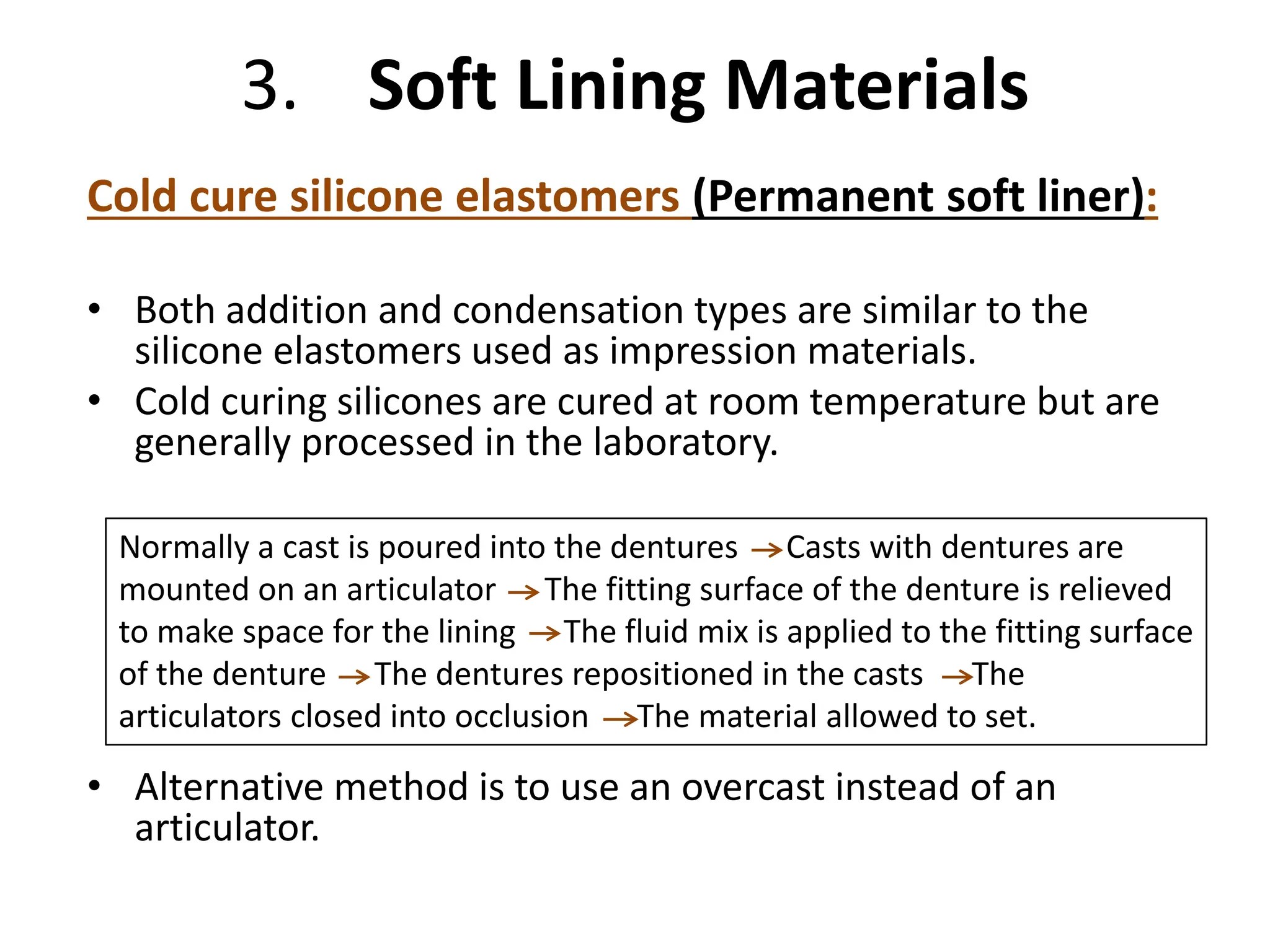
Cold cure silicone elastomers (Permanent soft liner):
• Both addition and condensation types are similar to the
silicone elastomers used as impression materials.
• Cold curing silicones are cured at room temperature but are
generally processed in the laboratory.
• Alternative method is to use an overcast instead of an
articulator.
Normally a cast is poured into the dentures Casts with dentures are
mounted on an articulator The fitting surface of the denture is relieved
to make space for the lining The fluid mix is applied to the fitting surface
of the denture The dentures repositioned in the casts The
articulators closed into occlusion The material allowed to set.
3. Soft Lining Materials
Polyphosphazine:
• Supplied in sheet form.
• Manipulated similar to the heat cure silicone
products.
• Polymerize by heat cure.
• Curing cycle can be,
– 74°C for 8 hours.
OR
– 74 °C for 2½ hours followed by 100 °C for 30 minutes.
26
3. Soft Lining Materials
Properties:
• All types are soft and give an adequate cushioning effect.
• Cushioning effect depends upon the thickness of material.
– 2-3 mm is sufficient for adequate cushioning effect.
• Harden through loss of alcohol and leaching of plasticizer.
• The silicones have good elastic properties and retain their shape
after setting despite being subjected to masticatory loading.
• Acrylic materials are viscoelastic and gradually become distorted.
• Adequate bond with the denture base for acrylic and heat cured
silicone products. Cold cure silicone has tendency to peel away.
• Some permanent soft liners are adversely affected by denture
cleansers. Oxygenating cleansers may cause surface pitting in
acrylic linings whilst brushing accelerates the rate of silicone soft
liners detachment.
27
Soft Lining Materials
Comparison of Acrylic & Silicone Soft Lining Materials
Acrylic Soft Liner Silicone Soft Liner
Less resilient High resilient
Hardens by time More water sorption
Good bonding with base material Poor bonding to acrylic denture base
material
Acceptable tear resistance Low tear resistance
Better abrasion resistance Low abrasion resistance
Resistant to damage by denture
cleansers
Lower resistance to damage by denture
cleansers
More susceptibility to microorganism
growth
3. Soft Lining Materials
None of the soft lining materials can be
considered truly permanent in nature since
none could be expected to last the full lifetime
of a denture, requiring regular review of
patients.
Self-administered Relining Materials
• Such products contain methacrylate or vinyl
polymers along with a plasticizer and a solvent.
• They enable patient to improve the fit of a denture
and provide a soft cushioning effect without having
to visit the dentist.
• They should be limited for short term emergency use
as long term use of such products can lead to
harmful effects on the hard and soft oral tissues such
as irritation, severe bone loss and tumors related to
their use.
Rebasing
“It is the laboratory procedure of replacing the
entire denture base material on an existing
prosthesis.”
Indications:
• Where the observed clinical changes are
moderate to severe.
• Some processing fault in the denture base for e.g.
porosity.
• Discoloration of base material.
• Where porcelain teeth have been used.

topic 4 Denture Lining Materiioals.pptx

  • 1.
    Denture Lining Materials 1 Dr.Sadaf Humayoun Associate Professor & HOD Dental Materials Rawal Institute of Health Sciences
  • 2.
    Denture lining materials “Denture Relining is a procedure used to resurface the tissue side of a denture with new base material, producing an accurate adaptation to the denture foundation area” ( GPT 2005) • Classified into 3 main groups 1. Hard reline materials. 2. Tissue conditioners. 3. Soft lining materials. 2
  • 3.
    Denture lining materials IndicationsContraindications In cases where fitting surfaces of acrylic dentures needs replacement, due to bone resorption, to improve the fit of the denture. Poor quality denture base In immediate dentures, after 3-6 months of their construction. Exaggerated bone resorption Loose denture at the time of delivery Abused or traumatic oral tissues Geriatric or chronically ill patient, unable to tolerate a hard denture base. Poor teeth arrangement To heal traumatized soft tissues before recording an impression Unsatisfactory jaw relationship Speech problems Undercuts TMJ problems
  • 4.
    Denture lining materials Classifiedinto 3 main groups 1. Hard reline materials. 2. Tissue conditioners. 3. Soft lining materials. a) Temporary soft liners b) Permanent soft liners
  • 5.
    1. Hard relinematerials Chair side relining technique is used. • Divided into 2 types. • Both types are categorized as auto polymerizable resins. • Both types polymerize easily at mouth or room temperature. 5
  • 6.
    1. Hard RelineMaterials Type 1 Powder Polymer beads Polymethylmethacrylate Initiator Benzoyl peroxide Pigments Inorganic salts Liquid Monomer Methylmethacrylate Plasticizer Di-n-butylphthalate Tg Chemical activator Tertiary amine 6 Composition: Autopolymerizing resins ( readily polymerize at room temperature or mouth temperature). Type 2 Powder Polymer beads Polyethylmethacrylate Initiator Benzoyl peroxide Liquid Monomer Butylmethacrylate Tg Chemical activator Tertiaty amine Pigments Inorganic salts
  • 7.
    1. Hard RelineMaterials Manipulation: • Relieve the fitting surface i.e. grinding away some of the hard surface of acrylic base. • Powder and liquid are mixed and applied over the fitting surface of the acrylic base. • Seated into the patient’s mouth whilst still fluid. • Closed mouth technique (mouth closed into gentle contact) is used. • The reline soon becomes rubbery having the recorded patients soft tissue impression. • The denture is removed from the patients mouth and is allowed to bench cure because of exothermic heat. • The relined denture is normally ready for trimming n polishing within 30 minutes. 7
  • 8.
    1. Hard RelineMaterials 8 Advantages Disadvantages It provides a chairside reline to the denture. Direct contact with the oral tissues is a disadvantage. In cases where fitting surfaces of acrylic dentures needs replacement, due to bone resorption, to improve the fit of the denture. Methyl methacrylate in the monomer may cause allergic reaction. In immediate dentures, after 3-6 months of their construction. Low values of glass transition temperature (Tg) in both type 1 and type 2 materials may lead to increased dimensional instability. Loose denture at the time of delivery May become porous due to air entrapment during mixing which decreases patient acceptance and increases debris contamination and colonization by microorganisms. Geriatric or chronically ill patient Operator has little control over the thickness of the material which may modify the vertical relationship and may cause anteroposterior positional error or lateral cant. Increase in thickness of the “palate” of an upper denture, which patients often find unacceptable Properties:
  • 9.
    Denture lining materials Classifiedinto 3 main groups 1. Hard reline materials. 2. Tissue conditioners. 3. Soft lining materials. a) Temporary soft liners b) Permanent soft liners
  • 10.
    2. Tissue Conditioners •Soft denture liners. • Applied to the fitting surface of the denture. • Provides temporary cushion to the fitting surface. • Plastic flow continues for 24-36 hours after mixing and therefore capture a functional shape of supporting tissues. • Several applications in denture works. 10
  • 11.
    Applications: • Help inrecovery of traumatized soft tissues, due to ill-fitting dentures. • Reduce pain and help prevent traumatization of the wound of patients who have undergone surgery. • It can help in stabilization of an immediate denture at the time of insertion (Addition of the tooth into the denture base that needs to be extracted). • It can help in recording a functional impression of soft tissues over a period of a few days. 2. Tissue Conditioners
  • 12.
    2. Tissue Conditioners Composition: •Amount of solvent and plasticizer is very crucial. • 7.5% - 40% of liquid contains alcohol. • Powder may be pigmented or unpigmented. 12 Powder Polymer beads Polyethymethacrylate Liquid No monomer------ not irritant Solvent Ethyl alcohol Tg Plasticizer Butylphthalyl butylglycolate Tg Physical process
  • 13.
    2. Tissue Conditioners Manipulation:(chairside technique) • On mixing powder and liquid, physical process occurs. • Smaller polymeric beads get dissolved and larger beads swell up on absorbing solvent. • Freshly mixed material is applied to the fitting surface of the denture and is seated in the patients mouth while still in fluid state. • Fluid state of the material ensures a cushion of reasonable thickness without undue increase in height of the denture. • Final set material is gel-like and ideally should form a regular layer over the whole of the fitting surface of the denture. • High methacrylate, ethyl methacrylate, plasticizer and solvent gives softness. • Normally denture and patient’s soft tissues are inspected after 2- 3 days. 13
  • 14.
    2. Tissue Conditioners Properties: •Non-irritant due to the absence of acrylic monomers from the liquid component. • Initially very soft and Viscoelastic ( perform both as a tissue conditioner and functional impression material). • Undergo permanent deformation under even small load. • Material do not remain permanently soft. • Time taken for the material to become hard and loose the cushioning effect varies from days to a couple of weeks. • Conditioner should be replaced after 2- 3 days till the tissue has healed properly. 14
  • 15.
    Denture lining materials Classifiedinto 3 main groups 1. Hard reline materials. 2. Tissue conditioners. 3. Soft lining materials. a) Temporary soft liners b) Permanent soft liners
  • 16.
    3. Soft LiningMaterials • Can be sub divided into a) Temporary soft lining materials. b) Permanent soft lining materials. 16
  • 17.
    Denture lining materials Classifiedinto 3 main groups 1. Hard reline materials. 2. Tissue conditioners. 3. Soft lining materials. a) Temporary soft liners b) Permanent soft liners
  • 18.
    3. Soft LiningMaterials Temporary soft lining materials: • Almost similar to tissue conditioners. • Supplied as powder liquid formulation. • Composition and manipulation same as tissue conditioners. • Viscoelastic in nature. • Retain their softness for longer duration than tissue conditioners i.e. up to a month or two. • Selection of denture cleanser is very crucial for temporary soft liners as oxygenating type cleanser, cause surface degradation and pitting of the material. 18
  • 19.
    3. Soft LiningMaterials Temporary soft lining materials ; Applications: • In cases where it is not practicable to replace the conditioner every 2 – 3 days as they take longer to harden and do not require frequent replacement. • They may be used as a means of temporarily improving the fit of an ill fitting denture until such a time as a new denture can be constructed. • As a diagnostic aid to ascertain whether the patient would benefit from a permanent soft lining. Both tissue conditioners and temporary soft liners will go hard with surface becoming rough and irregular, increasing the risk of trauma and colonization by Candida in this hardened state, increasing the risk of a denture-induced stomatitis.
  • 20.
    Denture lining materials Classifiedinto 3 main groups 1. Hard reline materials. 2. Tissue conditioners. 3. Soft lining materials. a) Temporary soft liners b) Permanent soft liners
  • 21.
    3. Soft LiningMaterials Permanent soft lining materials: • Commonly used in patients that cannot tolerate a hard base. • In patients with thin mandibular mucosa. • These materials should remain permanently soft for the life time of the denture. • Elasticity of these materials is very important. Requirements of Permanent/ long term Soft Liners: • Permanently soft, ideally for the life time of the denture. • Should be elastic in order to give a cushioning effect and prevent unacceptable distortions during service. • The lining should adhere to the denture base. • The material should be non-toxic, non-irritant and incapable of sustaining the growth of harmful bacteria or fungi. 21
  • 22.
    Available Permanent softlining materials 22 Acrylic Addition Two paste and similar to addition cured silicone elastomeric impression materials Condensation Paste: Hydroxyl terminated polydimethylsiloxan e polymer with filler & Liquid: Crosslinking agent (Tetraethylsilicate) and a catalyst (organo-tin compound). P:L—condensation crosslinking reaction with Alcohol byproduct. Cold cure Chairside technique. Can be readily applied to an existing denture. Harden with in a period of a few weeks or at best a few months, therefore require regular replacements. Polyphosphazine Sheet form Silicone Cold cure Heat cure Processed in the lab at the same time with the acrylic base. Powder: polyethyl or butyl methacrylate beads with initiator and pigment. Liquid: butylmethacrylate & Plasticizer Heat cure (Processed in lab) Single paste of vinyl terminated polydimethylsilox ane polymer with filler and an initiator. Vinyl gp. undergo chain extension, increases viscosity & Crosslinking, develop elasticity. Tendency to peel away (Processed in lab)
  • 23.
    3. Soft LiningMaterials Heat cure acrylic (Permanent soft liner): • It is in powder liquid formulation. • Powder consist of poly ethyl or poly butyl methacrylate (rely for softness on higher methacrylate and a plasticizer) along with some peroxide initiator and pigment. • Liquid consists of butyl methacrylate and plasticizer. • Dough is formed which is then heat treated simultaneously with the hard acrylic base in the laboratory and are normally applied to a new denture. 23
  • 24.
    3. Soft LiningMaterials Heat cure silicone (Permanent soft liner) : • It is used in the same way as heat cure acrylic. • Presented in a single paste formulation. • Paste consist of polydimethylsiloxane polymer with pendant or terminal vinyl groups (chain linking and crosslinking). • The paste also contains inert fillers and initiators which breakdown on heating to initiate the crosslinking reaction. 24
  • 25.
    3. Soft LiningMaterials Cold cure silicone elastomers (Permanent soft liner): • Both addition and condensation types are similar to the silicone elastomers used as impression materials. • Cold curing silicones are cured at room temperature but are generally processed in the laboratory. • Alternative method is to use an overcast instead of an articulator. Normally a cast is poured into the dentures Casts with dentures are mounted on an articulator The fitting surface of the denture is relieved to make space for the lining The fluid mix is applied to the fitting surface of the denture The dentures repositioned in the casts The articulators closed into occlusion The material allowed to set.
  • 26.
    3. Soft LiningMaterials Polyphosphazine: • Supplied in sheet form. • Manipulated similar to the heat cure silicone products. • Polymerize by heat cure. • Curing cycle can be, – 74°C for 8 hours. OR – 74 °C for 2½ hours followed by 100 °C for 30 minutes. 26
  • 27.
    3. Soft LiningMaterials Properties: • All types are soft and give an adequate cushioning effect. • Cushioning effect depends upon the thickness of material. – 2-3 mm is sufficient for adequate cushioning effect. • Harden through loss of alcohol and leaching of plasticizer. • The silicones have good elastic properties and retain their shape after setting despite being subjected to masticatory loading. • Acrylic materials are viscoelastic and gradually become distorted. • Adequate bond with the denture base for acrylic and heat cured silicone products. Cold cure silicone has tendency to peel away. • Some permanent soft liners are adversely affected by denture cleansers. Oxygenating cleansers may cause surface pitting in acrylic linings whilst brushing accelerates the rate of silicone soft liners detachment. 27
  • 28.
    Soft Lining Materials Comparisonof Acrylic & Silicone Soft Lining Materials Acrylic Soft Liner Silicone Soft Liner Less resilient High resilient Hardens by time More water sorption Good bonding with base material Poor bonding to acrylic denture base material Acceptable tear resistance Low tear resistance Better abrasion resistance Low abrasion resistance Resistant to damage by denture cleansers Lower resistance to damage by denture cleansers More susceptibility to microorganism growth
  • 29.
    3. Soft LiningMaterials None of the soft lining materials can be considered truly permanent in nature since none could be expected to last the full lifetime of a denture, requiring regular review of patients.
  • 30.
    Self-administered Relining Materials •Such products contain methacrylate or vinyl polymers along with a plasticizer and a solvent. • They enable patient to improve the fit of a denture and provide a soft cushioning effect without having to visit the dentist. • They should be limited for short term emergency use as long term use of such products can lead to harmful effects on the hard and soft oral tissues such as irritation, severe bone loss and tumors related to their use.
  • 31.
    Rebasing “It is thelaboratory procedure of replacing the entire denture base material on an existing prosthesis.” Indications: • Where the observed clinical changes are moderate to severe. • Some processing fault in the denture base for e.g. porosity. • Discoloration of base material. • Where porcelain teeth have been used.