ENGLISH GRAMMAR
ARTICLES
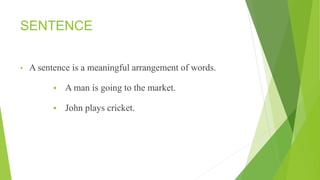
SENTENCE
• A sentence is a meaningful arrangement of words.
 A man is going to the market.
 John plays cricket.
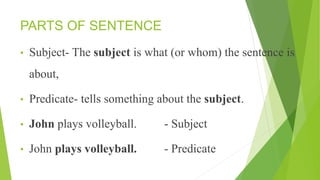
PARTS OF SENTENCE
• Subject- The subject is what (or whom) the sentence is
about,
• Predicate- tells something about the subject.
• John plays volleyball. - Subject
• John plays volleyball. - Predicate
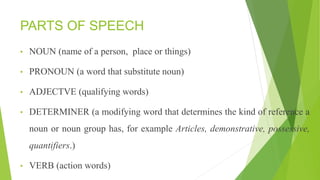
PARTS OF SPEECH
• NOUN (name of a person, place or things)
• PRONOUN (a word that substitute noun)
• ADJECTVE (qualifying words)
• DETERMINER (a modifying word that determines the kind of reference a
noun or noun group has, for example Articles, demonstrative, possessive,
quantifiers.)
• VERB (action words)
PARTS OF SPEECH
• ADVERB (a word or phrase that modifies the meaning of an
adjective, verb, or other adverb, expressing manner, place, time, or
degree)
• PREPOSITION (a word governing, and usually preceding, a noun or
pronoun and expressing a relation to another word or element in the
clause)
• CONJUNCTION (a word used to connect clauses or sentences or to
coordinate words in the same clause)
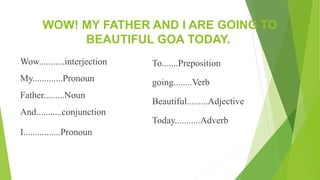
WOW! MY FATHER AND I ARE GOING TO
BEAUTIFUL GOA TODAY.
Wow...........interjection
My.............Pronoun
Father.........Noun
And...........conjunction
I................Pronoun
To.......Preposition
going........Verb
Beautiful.........Adjective
Today...........Adverb
ARTICLES
• An article is a word used to modify a noun.
• We use articles to point out or refer to nouns in conversation and
writing.
USES OF ARTICLES
• Are used with certain categories of proper nouns
• Are used with common nouns or noun phrases
• Consist of the indefinite article (a/an) and the definite article (the)
• Are absent in non-specific cases and are indicated by the Ø (zero article)
TYPES OF ARTICLES
• Indefinite article- speaks of any person thing or place, a and an
is determined by sound before a word -with a vowel sound an
is used : e.g., an egg, an honest man, an hour, and with
consonant sound a is used: e.g., a university, a unique.
• Definite article- tells us about a specific person, e.g. ‘the’
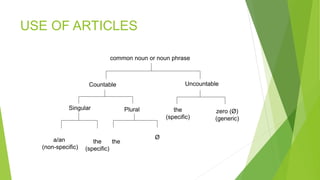
USE OF ARTICLES
common noun or noun phrase
Countable Uncountable
Singular Plural
a/an
(non-specific)
the
(specific)
the
Ø
the
(specific)
zero (Ø)
(generic)
USE OF INDEFINITE ARTICLE
• Before a singular countable noun: A doctor, A school, A man
• To represent a class: A doctor is a respectable member of
society.
• In the sense of any: A book, A girl
• In exclamations, even with uncountable sometimes: what an
idea!
• Some expressions of quantity and numbers: a dozen, a lot of.
• With few and little to convey a positive sense: a few, a little.
OMISSION OF INDEFINITE ARTICLE
• Before plural nouns: girls, houses, chair
• Before uncountables: kindness, water, honesty, fear
• Before words denoting meals: lunch, dinner
• Before a noun used in universally applicable generalisation: Man is
mortal.
DEFINITE ARTICLE
• points out some particular person or thing as : the doctor - where ‘the’
points out some particular doctor.
• is used before singular countable nouns, plural countable and
uncountable nouns, e.g. The book, the books, the milk
USE OF DEFINITE ARTICLES
• When a singular noun represent a whole class e.g. The cow is a useful
animal.
• Before some proper names e.g., oceans and seas: the Pacific, the black
sea; rivers : the Ganga, the Nile
• Before the names of certain books : e.g., The Vedas, the Puranas, the
Ramayana
• Before names of things unique of their kind; as e.g., The sun, the sky,
the earth
• Before a Proper noun when it is qualified by an adjective or a defining
adjectival clause e.g., The great Caesar, The immortal Shakespeare
USE OF DEFINITE ARTICLES
• With Superlatives, e.g., This is the best book of chemistry.
• With ordinals : e.g., He was the first man to arrive.
• As an Adverb with Comparatives : e.g., The more the merrier.
• Before the names of ships, some buildings, newspapers, directions etc.:
e.g., The Times of India, The Taj Mahal, the east.
• Before titles and surname: the king, the president, the Nigams
• Before some historical events: the French Revolution
OMISSION OF THE ARTICLE
• Before names of substances, proper and abstract nouns (uncountable
nouns): e.g., Sugar is bad for your teeth/ Delhi is the capital of India.
• Before plural countable nouns: e.g., Children, students.
• Before languages, names of games, meals e.g., English, badminton,
lunch.
• Before names of the articles of clothing and parts of body: shirt, finger,
hands, cap
EXERCISE
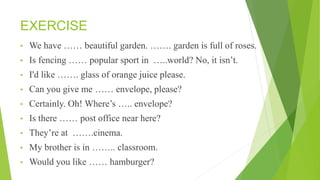
• We have …… beautiful garden. ……. garden is full of roses.
• Is fencing …… popular sport in …..world? No, it isn’t.
• I'd like ……. glass of orange juice please.
• Can you give me …… envelope, please?
• Certainly. Oh! Where’s ….. envelope?
• Is there …… post office near here?
• They’re at …….cinema.
• My brother is in …….. classroom.
• Would you like …… hamburger?
EXERCISE
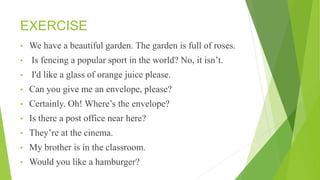
• We have a beautiful garden. The garden is full of roses.
• Is fencing a popular sport in the world? No, it isn’t.
• I'd like a glass of orange juice please.
• Can you give me an envelope, please?
• Certainly. Oh! Where’s the envelope?
• Is there a post office near here?
• They’re at the cinema.
• My brother is in the classroom.
• Would you like a hamburger?

Articles

  • 1.
  • 2.
    SENTENCE • A sentenceis a meaningful arrangement of words.  A man is going to the market.  John plays cricket.
  • 3.
    PARTS OF SENTENCE •Subject- The subject is what (or whom) the sentence is about, • Predicate- tells something about the subject. • John plays volleyball. - Subject • John plays volleyball. - Predicate
  • 4.
    PARTS OF SPEECH •NOUN (name of a person, place or things) • PRONOUN (a word that substitute noun) • ADJECTVE (qualifying words) • DETERMINER (a modifying word that determines the kind of reference a noun or noun group has, for example Articles, demonstrative, possessive, quantifiers.) • VERB (action words)
  • 5.
    PARTS OF SPEECH •ADVERB (a word or phrase that modifies the meaning of an adjective, verb, or other adverb, expressing manner, place, time, or degree) • PREPOSITION (a word governing, and usually preceding, a noun or pronoun and expressing a relation to another word or element in the clause) • CONJUNCTION (a word used to connect clauses or sentences or to coordinate words in the same clause)
  • 6.
    WOW! MY FATHERAND I ARE GOING TO BEAUTIFUL GOA TODAY. Wow...........interjection My.............Pronoun Father.........Noun And...........conjunction I................Pronoun To.......Preposition going........Verb Beautiful.........Adjective Today...........Adverb
  • 7.
    ARTICLES • An articleis a word used to modify a noun. • We use articles to point out or refer to nouns in conversation and writing.
  • 8.
    USES OF ARTICLES •Are used with certain categories of proper nouns • Are used with common nouns or noun phrases • Consist of the indefinite article (a/an) and the definite article (the) • Are absent in non-specific cases and are indicated by the Ø (zero article)
  • 9.
    TYPES OF ARTICLES •Indefinite article- speaks of any person thing or place, a and an is determined by sound before a word -with a vowel sound an is used : e.g., an egg, an honest man, an hour, and with consonant sound a is used: e.g., a university, a unique. • Definite article- tells us about a specific person, e.g. ‘the’
  • 10.
    USE OF ARTICLES commonnoun or noun phrase Countable Uncountable Singular Plural a/an (non-specific) the (specific) the Ø the (specific) zero (Ø) (generic)
  • 11.
    USE OF INDEFINITEARTICLE • Before a singular countable noun: A doctor, A school, A man • To represent a class: A doctor is a respectable member of society. • In the sense of any: A book, A girl • In exclamations, even with uncountable sometimes: what an idea! • Some expressions of quantity and numbers: a dozen, a lot of. • With few and little to convey a positive sense: a few, a little.
  • 12.
    OMISSION OF INDEFINITEARTICLE • Before plural nouns: girls, houses, chair • Before uncountables: kindness, water, honesty, fear • Before words denoting meals: lunch, dinner • Before a noun used in universally applicable generalisation: Man is mortal.
  • 13.
    DEFINITE ARTICLE • pointsout some particular person or thing as : the doctor - where ‘the’ points out some particular doctor. • is used before singular countable nouns, plural countable and uncountable nouns, e.g. The book, the books, the milk
  • 14.
    USE OF DEFINITEARTICLES • When a singular noun represent a whole class e.g. The cow is a useful animal. • Before some proper names e.g., oceans and seas: the Pacific, the black sea; rivers : the Ganga, the Nile • Before the names of certain books : e.g., The Vedas, the Puranas, the Ramayana • Before names of things unique of their kind; as e.g., The sun, the sky, the earth • Before a Proper noun when it is qualified by an adjective or a defining adjectival clause e.g., The great Caesar, The immortal Shakespeare
  • 15.
    USE OF DEFINITEARTICLES • With Superlatives, e.g., This is the best book of chemistry. • With ordinals : e.g., He was the first man to arrive. • As an Adverb with Comparatives : e.g., The more the merrier. • Before the names of ships, some buildings, newspapers, directions etc.: e.g., The Times of India, The Taj Mahal, the east. • Before titles and surname: the king, the president, the Nigams • Before some historical events: the French Revolution
  • 16.
    OMISSION OF THEARTICLE • Before names of substances, proper and abstract nouns (uncountable nouns): e.g., Sugar is bad for your teeth/ Delhi is the capital of India. • Before plural countable nouns: e.g., Children, students. • Before languages, names of games, meals e.g., English, badminton, lunch. • Before names of the articles of clothing and parts of body: shirt, finger, hands, cap
  • 17.
    EXERCISE • We have…… beautiful garden. ……. garden is full of roses. • Is fencing …… popular sport in …..world? No, it isn’t. • I'd like ……. glass of orange juice please. • Can you give me …… envelope, please? • Certainly. Oh! Where’s ….. envelope? • Is there …… post office near here? • They’re at …….cinema. • My brother is in …….. classroom. • Would you like …… hamburger?
  • 18.
    EXERCISE • We havea beautiful garden. The garden is full of roses. • Is fencing a popular sport in the world? No, it isn’t. • I'd like a glass of orange juice please. • Can you give me an envelope, please? • Certainly. Oh! Where’s the envelope? • Is there a post office near here? • They’re at the cinema. • My brother is in the classroom. • Would you like a hamburger?