DESCRIPTIVE
WRITING
Definition of Descriptive Writing
Descriptive writing is writing in which
the author's intent is to create a vivid
image of what he/she is describing in
the mind of the reader.
It relies on the author using detailed
descriptions that convey the sensory
details of what he/she is describing,
often with the use of specific
techniques.
STRONG DESCRIPTION
A DESCRIPTION may have just a few
details, or it may have dozens, but the
important thing is that they all work
together to create vivid image in the
reader’s mind.
FINDING DETAILS
You need to provide your readers with
details to help them imagine these
things.
A description without details is like a
frame without a picture:
you can’t expect your readers
to see anything if you don’t give them
something to look at.
METHODS YOU
USE IN
DESCRIBING
OBSERVATION
 Use it in something you
actually see.
 What is your overall
impression?
 What sounds do you hear?
 To what could you compare
it?
RESEARCH
 After observing it, a research
can help
 Visit the library in your
school or neighborhood.
 Encyclopedias and other
references contain detailed
information about almost
ever conceivable subject.
MEMORY
 If you want to describe
something that you observed
in the past, use your
memory.
 Create an image based on
everything that you
remember.
 Let your mind review it,
noting details.
IMAGINATION
 Use it if you want to describe
something that doesn’t exist.
 Because the details is
imaginary, you can make up
all the details you need.
 Create a details in your mind
examine it closely.
Descriptive writing directly contrasts
with concise writing.
Descriptive writing requires the author
to spend a great deal of time and words
painting a visual picture for the reader,
in concise writing, the author's intent is
to use as precise language and as few
words as possible to convey their
meaning.
Descriptive writing directly contrasts
with concise writing.
For example:
Concise: He saw she was wearing a red
dress.
Descriptive: The dress was the red of
every man's middle-aged crisis sports
car, and parts of it reflected the lights in
the room like the sun off of the hood. For
him, they were two lost dreams.
Descriptive writing directly contrasts
with concise writing.
For example:
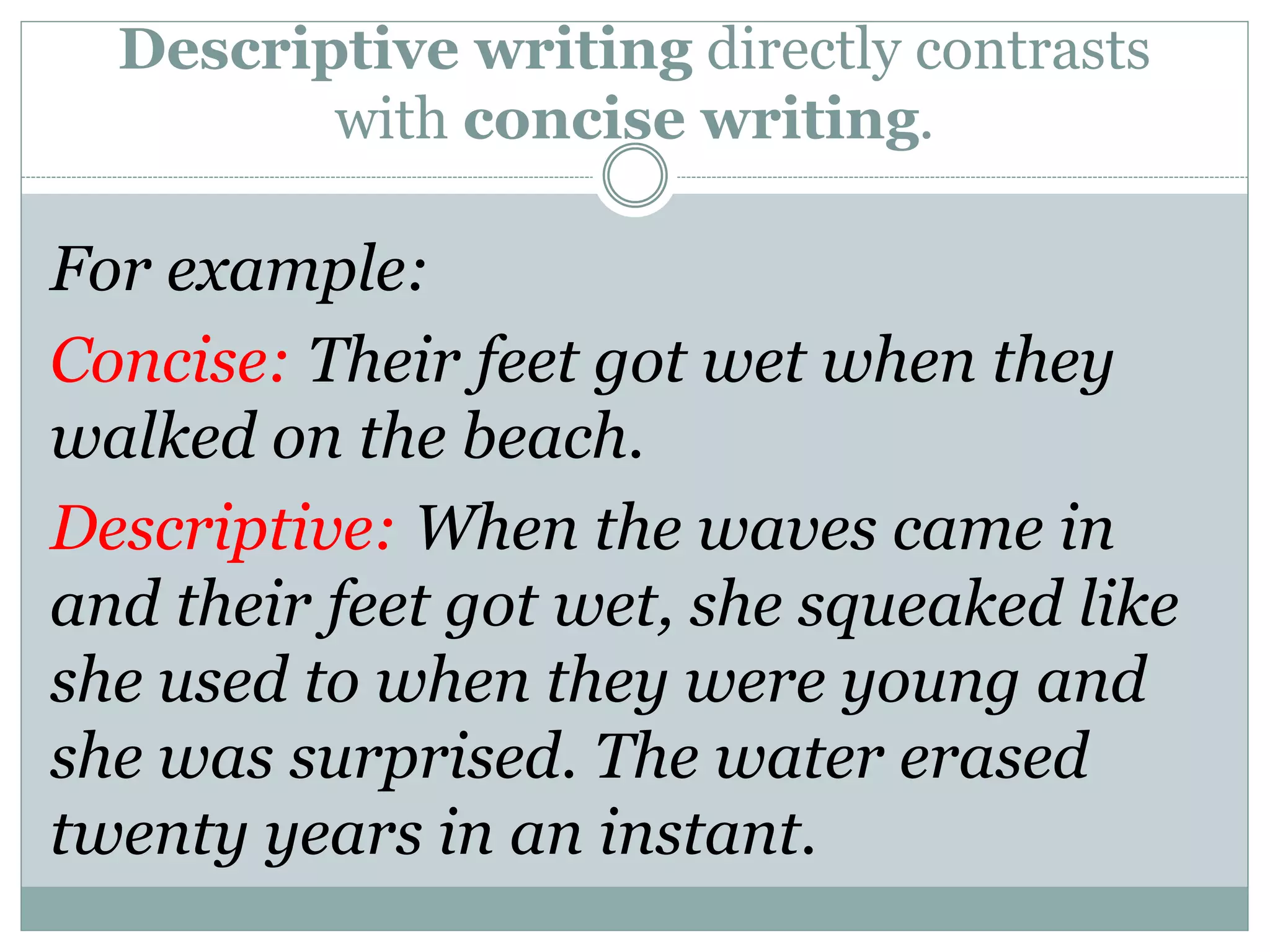
Concise: Their feet got wet when they
walked on the beach.
Descriptive: When the waves came in
and their feet got wet, she squeaked like
she used to when they were young and
she was surprised. The water erased
twenty years in an instant.
Descriptive writing directly contrasts
with concise writing.
The meaning of each pair is generally
the same, but the effect of the writing is
different. In concise writing, the reader
receives the essential information
quickly. In descriptive writing, the
reader is more able to picture the scene.
Five Main Techniques in Descriptive
Writing
1. Five Senses Rule
For any novice writer learning the ropes of
descriptive writing, the first rule is to appeal
to all the five senses of the reader.
Using detail that attracts the five senses, sight,
hearing, taste, touch, and smell will surely set
the tone right for a good piece of descriptive
writing.
This kind of detail will make the writing more
interesting and engaging.
Five Main Techniques in Descriptive
Writing
2. Removing Apparent Description
Description or detail that is very normal and
apparent should be left out of writing as it
takes up undue space.
Using that space to fill your work with fresh
new ideas or words will make your writing
more convincing.
It will also give you more time and room to
think of other ways of making your writing
interesting.
Five Main Techniques in Descriptive
Writing
3. Using Figurative/ Descriptive Literary
Techniques
Techniques such as Personification, Similies,
Hyperboles, Onomatopoeia, and Metaphors
are critical masterstrokes that writers use.
Not only do these enhance the language but
also provide richness to the writing.
When you attribute a human quality or
emotion to an inanimate object that is called
Personification.
Five Main Techniques in Descriptive
Writing
4. Using Fresh/New Descriptive Words
Sometimes, fresh and novel words or phrases stick
with readers.
That is why descriptive writing is a constantly
evolving process.
There is no one correct way of writing in this style.
If the readers connect with your words then you
know it’s right.
That is why finding fresh ways to connect with the
reader is important.
Five Main Techniques in Descriptive
Writing
5. Reading Good Samples of Descriptive Writing
Reading is a very easy yet sublime way to improve any
type of writing skill. It doesn’t matter whether the
material is descriptive or narrative in nature.
What matters is that reading is a very subconscious
way of learning how to write well and descriptive
writing is no different. If you wish to succeed as a fine
descriptive writer then, the most natural way to do so
is to read descriptive material yourself. Reading and
writing are a part and partial of our lives, we are
surrounded by language and words.
Five Main Techniques in Descriptive
Writing
The more we read, the more exposure we get
to different writing styles, new words, and
phrases, or even new trends of writing.
The mind absorbs several concepts, ideas,
signs, words, and detail subconsciously.
The trick is to make reading a constant habit
so that the information being synced in can
also translate through personal skill and help
you tell your story successfully.

Descriptive-Writing.ppt

  • 1.
  • 2.
    Definition of DescriptiveWriting Descriptive writing is writing in which the author's intent is to create a vivid image of what he/she is describing in the mind of the reader. It relies on the author using detailed descriptions that convey the sensory details of what he/she is describing, often with the use of specific techniques.
  • 3.
    STRONG DESCRIPTION A DESCRIPTIONmay have just a few details, or it may have dozens, but the important thing is that they all work together to create vivid image in the reader’s mind.
  • 4.
    FINDING DETAILS You needto provide your readers with details to help them imagine these things. A description without details is like a frame without a picture: you can’t expect your readers to see anything if you don’t give them something to look at.
  • 5.
  • 6.
    OBSERVATION  Use itin something you actually see.  What is your overall impression?  What sounds do you hear?  To what could you compare it?
  • 7.
    RESEARCH  After observingit, a research can help  Visit the library in your school or neighborhood.  Encyclopedias and other references contain detailed information about almost ever conceivable subject.
  • 8.
    MEMORY  If youwant to describe something that you observed in the past, use your memory.  Create an image based on everything that you remember.  Let your mind review it, noting details.
  • 9.
    IMAGINATION  Use itif you want to describe something that doesn’t exist.  Because the details is imaginary, you can make up all the details you need.  Create a details in your mind examine it closely.
  • 10.
    Descriptive writing directlycontrasts with concise writing. Descriptive writing requires the author to spend a great deal of time and words painting a visual picture for the reader, in concise writing, the author's intent is to use as precise language and as few words as possible to convey their meaning.
  • 11.
    Descriptive writing directlycontrasts with concise writing. For example: Concise: He saw she was wearing a red dress. Descriptive: The dress was the red of every man's middle-aged crisis sports car, and parts of it reflected the lights in the room like the sun off of the hood. For him, they were two lost dreams.
  • 12.
    Descriptive writing directlycontrasts with concise writing. For example: Concise: Their feet got wet when they walked on the beach. Descriptive: When the waves came in and their feet got wet, she squeaked like she used to when they were young and she was surprised. The water erased twenty years in an instant.
  • 13.
    Descriptive writing directlycontrasts with concise writing. The meaning of each pair is generally the same, but the effect of the writing is different. In concise writing, the reader receives the essential information quickly. In descriptive writing, the reader is more able to picture the scene.
  • 14.
    Five Main Techniquesin Descriptive Writing 1. Five Senses Rule For any novice writer learning the ropes of descriptive writing, the first rule is to appeal to all the five senses of the reader. Using detail that attracts the five senses, sight, hearing, taste, touch, and smell will surely set the tone right for a good piece of descriptive writing. This kind of detail will make the writing more interesting and engaging.
  • 15.
    Five Main Techniquesin Descriptive Writing 2. Removing Apparent Description Description or detail that is very normal and apparent should be left out of writing as it takes up undue space. Using that space to fill your work with fresh new ideas or words will make your writing more convincing. It will also give you more time and room to think of other ways of making your writing interesting.
  • 16.
    Five Main Techniquesin Descriptive Writing 3. Using Figurative/ Descriptive Literary Techniques Techniques such as Personification, Similies, Hyperboles, Onomatopoeia, and Metaphors are critical masterstrokes that writers use. Not only do these enhance the language but also provide richness to the writing. When you attribute a human quality or emotion to an inanimate object that is called Personification.
  • 17.
    Five Main Techniquesin Descriptive Writing 4. Using Fresh/New Descriptive Words Sometimes, fresh and novel words or phrases stick with readers. That is why descriptive writing is a constantly evolving process. There is no one correct way of writing in this style. If the readers connect with your words then you know it’s right. That is why finding fresh ways to connect with the reader is important.
  • 18.
    Five Main Techniquesin Descriptive Writing 5. Reading Good Samples of Descriptive Writing Reading is a very easy yet sublime way to improve any type of writing skill. It doesn’t matter whether the material is descriptive or narrative in nature. What matters is that reading is a very subconscious way of learning how to write well and descriptive writing is no different. If you wish to succeed as a fine descriptive writer then, the most natural way to do so is to read descriptive material yourself. Reading and writing are a part and partial of our lives, we are surrounded by language and words.
  • 19.
    Five Main Techniquesin Descriptive Writing The more we read, the more exposure we get to different writing styles, new words, and phrases, or even new trends of writing. The mind absorbs several concepts, ideas, signs, words, and detail subconsciously. The trick is to make reading a constant habit so that the information being synced in can also translate through personal skill and help you tell your story successfully.

Editor's Notes

  • #3 Vivid producing powerful feelings or strong
  • #4 Vivid producing powerful feelings or strong