BY
TIPS ANDTRICKSTO MAKING A GOOD
SCIENTIFIC SEMINAR PRESENTATION
Oluwatobi Adekunle, OSO
8-6-2016
TITLE PAGE
 TOPIC
◦ Capitalize
◦ Italicize botanical names
◦ Add authorities to the botanical names
 NAME
◦ First and second name first (in sentence case)
◦ Last name should be last (may be in CAPITAL LETTER)
◦ Matric No.
◦ Degree/School (e.g. B.Sc., Ibadan)
 NOTE
◦ Capitalize and embolden every slide headings
◦ Subheadings (if present) should be emboldened in sentence case
◦ Italicize, write in full and add authorities for every first time a
Botanical names would be used
◦ Abbreviation of Generic names is permitted, but not permitted for
specific names
◦ “Species” as a word can be shortened as sp. (for one species) or
spp. (for more than one) - but NEVER ITALICIZE
 FONT
◦ TNR/Arial/Calibri
◦ Headings – above 28
◦ Body – between 20 and 28
◦ Titles of tables and figures – between 10 and 16
BEFOREYOU CONTINUE
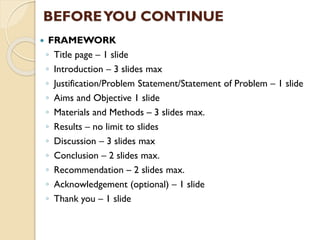
 FRAMEWORK
◦ Title page – 1 slide
◦ Introduction – 3 slides max
◦ Justification/Problem Statement/Statement of Problem – 1 slide
◦ Aims and Objective 1 slide
◦ Materials and Methods – 3 slides max.
◦ Results – no limit to slides
◦ Discussion – 3 slides max
◦ Conclusion – 2 slides max.
◦ Recommendation – 2 slides max.
◦ Acknowledgement (optional) – 1 slide
◦ Thank you – 1 slide
BEFOREYOU CONTINUE
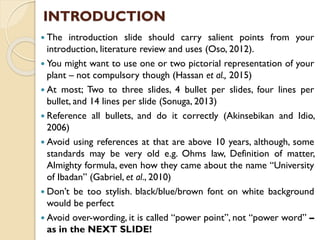
 The introduction slide should carry salient points from your
introduction, literature review and uses (Oso, 2012).
 You might want to use one or two pictorial representation of your
plant – not compulsory though (Hassan et al., 2015)
 At most; Two to three slides, 4 bullet per slides, four lines per
bullet, and 14 lines per slide (Sonuga, 2013)
 Reference all bullets, and do it correctly (Akinsebikan and Idio,
2006)
 Avoid using references at that are above 10 years, although, some
standards may be very old e.g. Ohms law, Definition of matter,
Almighty formula, even how they came about the name “University
of Ibadan” (Gabriel, et al., 2010)
 Don’t be too stylish. black/blue/brown font on white background
would be perfect
 Avoid over-wording, it is called “power point”, not “power word” –
as in the NEXT SLIDE!
INTRODUCTION
 The introduction slide should carry salient points from your introduction, literature review
and uses (Oso, 2012).
 You might want to use one or two pictorial representation of your plant – not compulsory
though (Hassan et al., 2015)
 At most; Two to three slides, 4 bullet per slides, four lines per bullet, and 14 lines per slide
(Sonuga, 2013)
 Reference all bullets, and do it correctly (Akinsebikan and Idio, 2006)
 Avoid using references at that are above 10 years, although, some standards may be very old
e.g. Ohms law, Definition of matter, Almighty formula, even how they came about the name
“University of Ibadan” (Gabriel, et al., 2010)
 Don’t be too stylish.White and black/blue would be perfect
 Avoid over-wording, it’s a power point, not a power word
 The introduction slide should carry salient points from your introduction, literature review
and uses (Oso, 2012).
 You might want to use one or two pictorial representation of your plant – not compulsory
though (Hassan et al., 2015)
 At most; Two to three slides, 4 bullet per slides, four lines per bullet, and 14 lines per slide
(Sonuga, 2013)
 Reference all bullets, and do it correctly (Akinsebikan and Idio, 2006)
 Avoid using references at that are above 10 years, although, some standards may be very old
e.g. Ohms law, Definition of matter, Almighty formula, even how they came about the name
“University of Ibadan” (Gabriel, et al., 2010)
 Don’t be too stylish.White and black/blue would be perfect
 Avoid over-wording, it’s a power point, not a power word
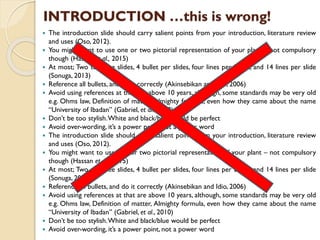
INTRODUCTION …this is wrong!
JUSTIFICATION
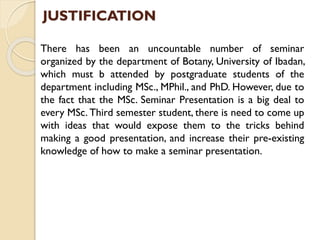
There has been an uncountable number of seminar
organized by the department of Botany, University of Ibadan,
which must b attended by postgraduate students of the
department including MSc., MPhil., and PhD. However, due to
the fact that the MSc. Seminar Presentation is a big deal to
every MSc. Third semester student, there is need to come up
with ideas that would expose them to the tricks behind
making a good presentation, and increase their pre-existing
knowledge of how to make a seminar presentation.
JUSTIFICATION
 Justify your work, tell us the rationale behind it, make a
statement the of problem you are trying to address
 Justification is Statement of problem …correct
 Justification is different from statement of problem
…wrong
 Do not reference except in cases of quotes or examples,
and this situation might not apply to botany
 Do not bullet except in rare cases
AIM AND OBJECTIVES
This research is aimed at revealing to the masters student, the
secret behind making a good seminar presentation
The objectives include;To
 get the masters students informed
 bring it to the notice of the department
 make a 20 minute PowerPoint presentation …without
making them sleep
 get feedback from the students
 Materials Used
 Sample Collection
 Method
 Experimental Design
 AnalyticalTools Used
MATERIALS AND METHODS
 There MAY be no need for you to list the materials as some of
them would be reflected when talking about the methodology.
 Some people separate materials from method - STILL OKAY!!!
 The number of slides varies by research, but it is advisable not to
go beyond three slides – MAY BE MORETHOUGH!
 Sample collection is largely dependent on type of research
 Names and number of species collected should be included, as
well as their locations.
 It is wise to italicize Botanical names and include the GPS locations
of the location the plants were collected, whether locally or
internationally named locations.
 Some people also add voucher number or authentication number
- ADVISABLE
MATERIALS AND METHODS
 Methods may not be explained if it has been used before, but please
state the method and reference the research paper in which it was
explicitly stated – PLEASE MAKE SURE the paper is easily
accessible, and that you know the method well you know the method
VERYVERYWELL
 Reference every method used if it has been used before, and in the
case of modification of a method, state the reference too, if not
modified by you.
 Experimental designs used should be stated especially for field
researchers. Laboratory based researchers may not have too serious
experimental designs enough to be stated – BUT all researches
must/usually have an experimental design
 Units of measurements must be stated
 Magnifications must be stated if used – x10 or Mag 10 or 10micron
MATERIALS AND METHODS
 Analysis may be quantitative or qualitative, either ways, analytical tools
should be explicitly stated
 IT SHOULD BE NOTED THAT THERE MUST BE A FORM
OF ANALYSIS, EITHER QUANTITATIVE OR QUALITATIVE
OR BOTH
 Quantitative tools include – DMRT, SAS, SPSS etc, usually very
peculiar to Ethnobotany, Mycology, Pathology, Ecology, Lower Green
Plants, Physiology
 Qualitative tools include – PAUP, Phylip, SeqMan, BioEdit,
Photomicrography etc, very peculiar to Anatomy, Taxonomy,
Phylogenetics, Palynology/Paleaobotany
 Both analytical tools are usually combined to give a robust result and
discussion. It is however not compulsory for both to be applied in
equal proportions …especially because
 There may be more of quantitative results in some research, while
others have more of qualitative results
 They are dependent on each other
MATERIALS AND METHODS
RESULTS
 Be direct and straight to the point
 Record important results
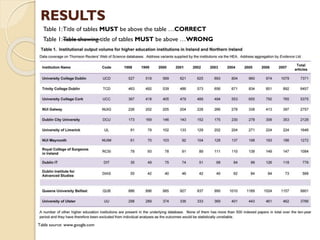
 Present table without lines except for borders above and below
 Figures or plates should be arranged neatly; maximum of 6 per page
only if you are working on comparative studies
 “Figure” is the modern word is the same as “Plates” which is an
archaic word. Any of the two is accepted as long as you stick to one
throughout the work.
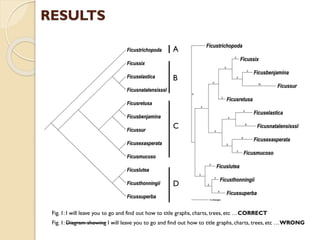
 Graphs, charts, trees should be under figures/plates, and it should be
one per page
 Titles of tables should be above, while title of figures should be below
 Follow the tables and figures numerically and continue from previous
numbering especially if you have some figures or plates in previous
slides
 Label figures neatly, with magnification (x10 or mag. 10).
 Use keys where necessary
 “title showing” or “table showing” are words that should be avoided
 DO NOT REFERENCE RESULTS
RESULTS
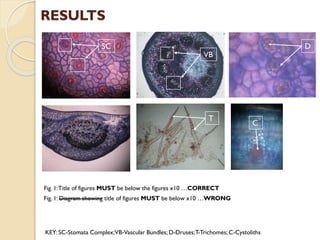
Fig. 1:Title of figures MUST be below the figures x10 …CORRECT
Fig. 1: Diagram showing title of figures MUST be below x10 …WRONG
T
DSC
VB
C
KEY: SC-Stomata Complex;VB-Vascular Bundles; D-Druses;T-Trichomes; C-Cystoliths
RESULTS
Fig. 1: I will leave you to go and find out how to title graphs, charts, trees, etc …CORRECT
Fig. 1: Diagram showing I will leave you to go and find out how to title graphs, charts, trees, etc …WRONG
A
B
C
D
RESULTS
Table 1:Title of tables MUST be above the table …CORRECT
Table 1:Table showing title of tables MUST be above …WRONG
Table source: www.google.com
DISCUSSION
 Should be concise and straight to the point
 Try limit it to at most; 3 slides, 4 bullets per slide, 4 lines
per bullet, and 14 lines per slide
 In each bullet, talk about at least one result against other
research works in that line
 Every bullet could either support, oppose, or corroborate
other research work, but PLEASE, every discussion
bullet must be referenced
CONCLUSION
• After been exposed to tricks on having a good
presentation, it should be NOTED that conclusion
should not be referenced especially because you are the
one making the conclusion.
• It may also be bulleted if you have more than one, but try
limit the bullets to 3 or 4 per slide
RECOMMENDATION
• If you have any recommendation, always separate it from
conclusion, as they are totally different words.
• It is not compulsory for every research work to have a
recommendation if you are still on the work, but it is
advisable to recommend because it is evidence that you want
your work to influence the world, or have a follow up
research that would influence the world.
• It is permitted to bullet recommendations as well if you have
more than one.
OPTIONAL SLIDES
• Acknowledgement may not be compulsory
• Reference page should be left out. You may choose to put
it, but PLEASE, don’t talk about it.
• ThankYou page
 Bring alongs: Book, Biro, System and Flash drive
 Dress well: be very comfortable
◦ Recommended: plain shirt, tie, suit, black/navy blue trouser and skirt,
neck scarf, broch, rose, flat shiny black shoes, well
brushed/combed/plaited/neatly packed hair
◦ Avoid: native, high heels, bow-tie, red shirt, white skirts/trouser
 Gesticulations should be slightly flairful (if there is a word like that)
 Smile once in a while
 Do not panic at any point in time
 Be relaxed, go easy and fast at the same time …lol
 Do not shout – you are talking into the mic
 Be passionate about the presentation
 Look into your friend’s eyes when you get stuck, the answers are
in his or her smile and gesticulations
OTHERS
OTHERS
 Skip unnecessary points
 When you are corrected, don’t try to argue, don’t just say noted.
PLEASE listen and take it down on your note - It shows
seriousness
 Make an attempt to logically answer every question thrown at
you
 If you do not have a response to a question, please confess by
saying “I don’t know, but I’ll check it up after now” – BUT don’t
always “not know”
 PLEASE Mind your language because what sounds
normal/ordinary to you may be really offensive to someone else
– Personal experience
 It is not your job to call anyone to order, it is the job of the
moderator – BUT there should be no need for that, as your
presentation should win everyone’s attention
 Don’t bite/chew your pen, or stare into space
Ssssshhhh …MY SECRET WEAPON
Look deeply into your lecturers and colleagues eyes at every
second of the presentation, even when they are asking their
questions
Why
 It naturally builds your confidence
 It may lower the stance or strong resolve of the people you are
presenting to
 They become too attentive
 They may even become too passionate to stop clapping for you
after your presentation
On a flip side
 If you try this as a girl when being asked out by a guy, he may
loose confidence/ego and begin to stammer
 If you try it as a guy asking a girl out, who knows, you might just
land your dream girl
 If you two try it out when he’s asking you out …I wouldn’t have
an answer to what - I’ve never experienced it
BEFOREYOU LEAVE
 All references in the ‘introduction” slide are names of graduate
students in the Department of Botany, University of Ibadan, and
are used for illustrations sake, as no paper was published relating
to this at this time slideshow was designed.
 All ideas are based on my personal experiences from
conferences and seminars attended, videos watched, books read.
 All the figures used are from my personal research work.
 I am currently a PhD student at the department of Botany,
University of Ibadan
 My academic interests include: systematics/taxonomy,
phylogenetics, plant anatomy, developmental plant
biology/ontogeny, digitization, dna barcoding
 My extracurricular interests include: going on field trips, writing,
reading, playing board games, playing the piano, exploring
computer limits, traveling, making friends, and cooking
 Contact me: osooluwatobia@gmail.com …twitter, facebook,
linkedin, Instagram, academia
tips and tricks to making a good research presentation

tips and tricks to making a good research presentation

  • 1.
    BY TIPS ANDTRICKSTO MAKINGA GOOD SCIENTIFIC SEMINAR PRESENTATION Oluwatobi Adekunle, OSO 8-6-2016
  • 2.
    TITLE PAGE  TOPIC ◦Capitalize ◦ Italicize botanical names ◦ Add authorities to the botanical names  NAME ◦ First and second name first (in sentence case) ◦ Last name should be last (may be in CAPITAL LETTER) ◦ Matric No. ◦ Degree/School (e.g. B.Sc., Ibadan)
  • 3.
     NOTE ◦ Capitalizeand embolden every slide headings ◦ Subheadings (if present) should be emboldened in sentence case ◦ Italicize, write in full and add authorities for every first time a Botanical names would be used ◦ Abbreviation of Generic names is permitted, but not permitted for specific names ◦ “Species” as a word can be shortened as sp. (for one species) or spp. (for more than one) - but NEVER ITALICIZE  FONT ◦ TNR/Arial/Calibri ◦ Headings – above 28 ◦ Body – between 20 and 28 ◦ Titles of tables and figures – between 10 and 16 BEFOREYOU CONTINUE
  • 4.
     FRAMEWORK ◦ Titlepage – 1 slide ◦ Introduction – 3 slides max ◦ Justification/Problem Statement/Statement of Problem – 1 slide ◦ Aims and Objective 1 slide ◦ Materials and Methods – 3 slides max. ◦ Results – no limit to slides ◦ Discussion – 3 slides max ◦ Conclusion – 2 slides max. ◦ Recommendation – 2 slides max. ◦ Acknowledgement (optional) – 1 slide ◦ Thank you – 1 slide BEFOREYOU CONTINUE
  • 5.
     The introductionslide should carry salient points from your introduction, literature review and uses (Oso, 2012).  You might want to use one or two pictorial representation of your plant – not compulsory though (Hassan et al., 2015)  At most; Two to three slides, 4 bullet per slides, four lines per bullet, and 14 lines per slide (Sonuga, 2013)  Reference all bullets, and do it correctly (Akinsebikan and Idio, 2006)  Avoid using references at that are above 10 years, although, some standards may be very old e.g. Ohms law, Definition of matter, Almighty formula, even how they came about the name “University of Ibadan” (Gabriel, et al., 2010)  Don’t be too stylish. black/blue/brown font on white background would be perfect  Avoid over-wording, it is called “power point”, not “power word” – as in the NEXT SLIDE! INTRODUCTION
  • 6.
     The introductionslide should carry salient points from your introduction, literature review and uses (Oso, 2012).  You might want to use one or two pictorial representation of your plant – not compulsory though (Hassan et al., 2015)  At most; Two to three slides, 4 bullet per slides, four lines per bullet, and 14 lines per slide (Sonuga, 2013)  Reference all bullets, and do it correctly (Akinsebikan and Idio, 2006)  Avoid using references at that are above 10 years, although, some standards may be very old e.g. Ohms law, Definition of matter, Almighty formula, even how they came about the name “University of Ibadan” (Gabriel, et al., 2010)  Don’t be too stylish.White and black/blue would be perfect  Avoid over-wording, it’s a power point, not a power word  The introduction slide should carry salient points from your introduction, literature review and uses (Oso, 2012).  You might want to use one or two pictorial representation of your plant – not compulsory though (Hassan et al., 2015)  At most; Two to three slides, 4 bullet per slides, four lines per bullet, and 14 lines per slide (Sonuga, 2013)  Reference all bullets, and do it correctly (Akinsebikan and Idio, 2006)  Avoid using references at that are above 10 years, although, some standards may be very old e.g. Ohms law, Definition of matter, Almighty formula, even how they came about the name “University of Ibadan” (Gabriel, et al., 2010)  Don’t be too stylish.White and black/blue would be perfect  Avoid over-wording, it’s a power point, not a power word INTRODUCTION …this is wrong!
  • 7.
    JUSTIFICATION There has beenan uncountable number of seminar organized by the department of Botany, University of Ibadan, which must b attended by postgraduate students of the department including MSc., MPhil., and PhD. However, due to the fact that the MSc. Seminar Presentation is a big deal to every MSc. Third semester student, there is need to come up with ideas that would expose them to the tricks behind making a good presentation, and increase their pre-existing knowledge of how to make a seminar presentation.

  • 8.
    JUSTIFICATION  Justify yourwork, tell us the rationale behind it, make a statement the of problem you are trying to address  Justification is Statement of problem …correct  Justification is different from statement of problem …wrong  Do not reference except in cases of quotes or examples, and this situation might not apply to botany  Do not bullet except in rare cases
  • 9.
    AIM AND OBJECTIVES Thisresearch is aimed at revealing to the masters student, the secret behind making a good seminar presentation The objectives include;To  get the masters students informed  bring it to the notice of the department  make a 20 minute PowerPoint presentation …without making them sleep  get feedback from the students
  • 10.
     Materials Used Sample Collection  Method  Experimental Design  AnalyticalTools Used MATERIALS AND METHODS
  • 11.
     There MAYbe no need for you to list the materials as some of them would be reflected when talking about the methodology.  Some people separate materials from method - STILL OKAY!!!  The number of slides varies by research, but it is advisable not to go beyond three slides – MAY BE MORETHOUGH!  Sample collection is largely dependent on type of research  Names and number of species collected should be included, as well as their locations.  It is wise to italicize Botanical names and include the GPS locations of the location the plants were collected, whether locally or internationally named locations.  Some people also add voucher number or authentication number - ADVISABLE MATERIALS AND METHODS
  • 12.
     Methods maynot be explained if it has been used before, but please state the method and reference the research paper in which it was explicitly stated – PLEASE MAKE SURE the paper is easily accessible, and that you know the method well you know the method VERYVERYWELL  Reference every method used if it has been used before, and in the case of modification of a method, state the reference too, if not modified by you.  Experimental designs used should be stated especially for field researchers. Laboratory based researchers may not have too serious experimental designs enough to be stated – BUT all researches must/usually have an experimental design  Units of measurements must be stated  Magnifications must be stated if used – x10 or Mag 10 or 10micron MATERIALS AND METHODS
  • 13.
     Analysis maybe quantitative or qualitative, either ways, analytical tools should be explicitly stated  IT SHOULD BE NOTED THAT THERE MUST BE A FORM OF ANALYSIS, EITHER QUANTITATIVE OR QUALITATIVE OR BOTH  Quantitative tools include – DMRT, SAS, SPSS etc, usually very peculiar to Ethnobotany, Mycology, Pathology, Ecology, Lower Green Plants, Physiology  Qualitative tools include – PAUP, Phylip, SeqMan, BioEdit, Photomicrography etc, very peculiar to Anatomy, Taxonomy, Phylogenetics, Palynology/Paleaobotany  Both analytical tools are usually combined to give a robust result and discussion. It is however not compulsory for both to be applied in equal proportions …especially because  There may be more of quantitative results in some research, while others have more of qualitative results  They are dependent on each other MATERIALS AND METHODS
  • 14.
    RESULTS  Be directand straight to the point  Record important results  Present table without lines except for borders above and below  Figures or plates should be arranged neatly; maximum of 6 per page only if you are working on comparative studies  “Figure” is the modern word is the same as “Plates” which is an archaic word. Any of the two is accepted as long as you stick to one throughout the work.  Graphs, charts, trees should be under figures/plates, and it should be one per page  Titles of tables should be above, while title of figures should be below  Follow the tables and figures numerically and continue from previous numbering especially if you have some figures or plates in previous slides  Label figures neatly, with magnification (x10 or mag. 10).  Use keys where necessary  “title showing” or “table showing” are words that should be avoided  DO NOT REFERENCE RESULTS
  • 15.
    RESULTS Fig. 1:Title offigures MUST be below the figures x10 …CORRECT Fig. 1: Diagram showing title of figures MUST be below x10 …WRONG T DSC VB C KEY: SC-Stomata Complex;VB-Vascular Bundles; D-Druses;T-Trichomes; C-Cystoliths
  • 16.
    RESULTS Fig. 1: Iwill leave you to go and find out how to title graphs, charts, trees, etc …CORRECT Fig. 1: Diagram showing I will leave you to go and find out how to title graphs, charts, trees, etc …WRONG A B C D
  • 17.
    RESULTS Table 1:Title oftables MUST be above the table …CORRECT Table 1:Table showing title of tables MUST be above …WRONG Table source: www.google.com
  • 18.
    DISCUSSION  Should beconcise and straight to the point  Try limit it to at most; 3 slides, 4 bullets per slide, 4 lines per bullet, and 14 lines per slide  In each bullet, talk about at least one result against other research works in that line  Every bullet could either support, oppose, or corroborate other research work, but PLEASE, every discussion bullet must be referenced
  • 19.
    CONCLUSION • After beenexposed to tricks on having a good presentation, it should be NOTED that conclusion should not be referenced especially because you are the one making the conclusion. • It may also be bulleted if you have more than one, but try limit the bullets to 3 or 4 per slide
  • 20.
    RECOMMENDATION • If youhave any recommendation, always separate it from conclusion, as they are totally different words. • It is not compulsory for every research work to have a recommendation if you are still on the work, but it is advisable to recommend because it is evidence that you want your work to influence the world, or have a follow up research that would influence the world. • It is permitted to bullet recommendations as well if you have more than one.
  • 21.
    OPTIONAL SLIDES • Acknowledgementmay not be compulsory • Reference page should be left out. You may choose to put it, but PLEASE, don’t talk about it. • ThankYou page
  • 22.
     Bring alongs:Book, Biro, System and Flash drive  Dress well: be very comfortable ◦ Recommended: plain shirt, tie, suit, black/navy blue trouser and skirt, neck scarf, broch, rose, flat shiny black shoes, well brushed/combed/plaited/neatly packed hair ◦ Avoid: native, high heels, bow-tie, red shirt, white skirts/trouser  Gesticulations should be slightly flairful (if there is a word like that)  Smile once in a while  Do not panic at any point in time  Be relaxed, go easy and fast at the same time …lol  Do not shout – you are talking into the mic  Be passionate about the presentation  Look into your friend’s eyes when you get stuck, the answers are in his or her smile and gesticulations OTHERS
  • 23.
    OTHERS  Skip unnecessarypoints  When you are corrected, don’t try to argue, don’t just say noted. PLEASE listen and take it down on your note - It shows seriousness  Make an attempt to logically answer every question thrown at you  If you do not have a response to a question, please confess by saying “I don’t know, but I’ll check it up after now” – BUT don’t always “not know”  PLEASE Mind your language because what sounds normal/ordinary to you may be really offensive to someone else – Personal experience  It is not your job to call anyone to order, it is the job of the moderator – BUT there should be no need for that, as your presentation should win everyone’s attention  Don’t bite/chew your pen, or stare into space
  • 24.
    Ssssshhhh …MY SECRETWEAPON Look deeply into your lecturers and colleagues eyes at every second of the presentation, even when they are asking their questions Why  It naturally builds your confidence  It may lower the stance or strong resolve of the people you are presenting to  They become too attentive  They may even become too passionate to stop clapping for you after your presentation On a flip side  If you try this as a girl when being asked out by a guy, he may loose confidence/ego and begin to stammer  If you try it as a guy asking a girl out, who knows, you might just land your dream girl  If you two try it out when he’s asking you out …I wouldn’t have an answer to what - I’ve never experienced it
  • 25.
    BEFOREYOU LEAVE  Allreferences in the ‘introduction” slide are names of graduate students in the Department of Botany, University of Ibadan, and are used for illustrations sake, as no paper was published relating to this at this time slideshow was designed.  All ideas are based on my personal experiences from conferences and seminars attended, videos watched, books read.  All the figures used are from my personal research work.  I am currently a PhD student at the department of Botany, University of Ibadan  My academic interests include: systematics/taxonomy, phylogenetics, plant anatomy, developmental plant biology/ontogeny, digitization, dna barcoding  My extracurricular interests include: going on field trips, writing, reading, playing board games, playing the piano, exploring computer limits, traveling, making friends, and cooking  Contact me: osooluwatobia@gmail.com …twitter, facebook, linkedin, Instagram, academia