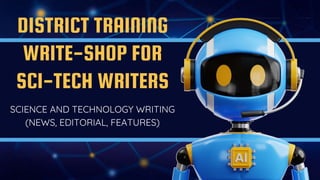
DISTRICT TRAINING
WRITE-SHOP FOR
SCI-TECH WRITERS
SCIENCE AND TECHNOLOGY WRITING
(NEWS, EDITORIAL, FEATURES)
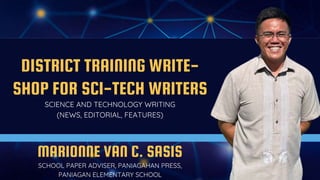
DISTRICT TRAINING WRITE-
SHOP FOR SCI-TECH WRITERS
SCIENCE AND TECHNOLOGY WRITING
(NEWS, EDITORIAL, FEATURES)
MARIONNE VAN C. SASIS
SCHOOL PAPER ADVISER, PANIAGAHAN PRESS,
PANIAGAN ELEMENTARY SCHOOL
LEARNING OBJECTIVES
appreciate the
value of
informing
readers of
science and
technology
advancements
understand
the techniques
in writing
Science/
Technology
apply the
techniques in
writing Sci/Tech
in an editorial,
features and
news article
WHAT IS SCIENCE AND
TECHNOLOGY WRITING?
SCIENCE WRITING
is the latest form of Philippine Journalism.
A science writer should be able to communicate
clearly and effectively so that he can popularize
and translate scientific reports into stories.
WHY IS SCIENCE AND
TECHNOLOGY IMPORTANT?
THERE IS ALWAYS
WONDER AND AMAZEMENT
TO BE HAD IN SCIENCE, IF
YOU KNOW WHERE AND
HOW TO LOOK!
IS SCIENCE BORING?
• SCIENCE NEWS REPORTING
• SCIENCE WRITING BY A SCIENTIST OR BY A NON-SCIENTIST FOR
MASS CONSUMPTION.
• HIS/HER REPORT IS WRITTEN FOR MASS UNDERSTANDING.
• HE/SHE WRITES HIS/HER STORY IN SUCH A WAY THAT THE
SCIENCE UN-ORIENTED READER MAY UNDERSTAND AND
APPRECIATE IT BECAUSE IT IS WRITTEN IN LAYMAN’S LANGUAGE.
• HE/SHE WRITES HIS/HER STORY IN SUCH A WAY THAT THE
SCIENCE UN-ORIENTED READER MAY UNDERSTAND AND
APPRECIATE IT BECAUSE IT IS WRITTEN IN LAYMAN’S LANGUAGE.
SCIENCE NEWS WRITING COVERS...
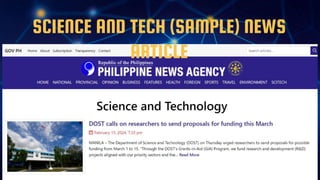
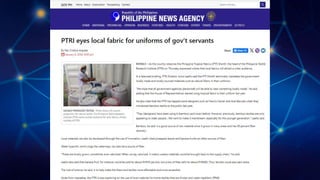
SCIENCE AND TECH (SAMPLE) NEWS
ARTICLE
TECHNICAL VS NON-TECHNICAL
• The objective of technical writing is to emphasize hand-in
information
• The main aim of journalistic writing is to inform, interpret,
entertain, and to educate.
• Purpose of Technical Writing - The main purpose of
technical writing is to inform and persuade by providing
facts and opinion based on facts that help readers
answer question, solve a problem, make a decision, or
perform a task.
CHARACTERISTICS TECHNICAL WRITING
• It contains only factual information
presented objectively.
• All data could be verified and would not
change unless new findings are made.
• The writing depends on the author’s
treatment of the subject and by the
reader’s need to useful information.
TECHNICAL WRITING
Technical subject is
specialized and usually
mechanical or scientific.
SPECIFIC USES OF TECHNICAL WRITING SKILLS
• Modern society is becoming highly technical
• Police and fire personnel write detailed incidents or
investigation report that must be clear enough to serve as
evidence in court.
• Nurses and medical technicians keep daily records that are
crucial to patients’ welfare particularly as bases for litigations
• Secretaries must write clear and precise memos, letters,
minutes, and reports.
• Managers write memos, personal evaluation, requisitions, and
instructions.
SCIENCE EDITORIALS
• Analysis of the issue must be
based on scientific facts and
following the scientific
method
• Assumptions raised must be
based on solid logic and
following the scientific
method
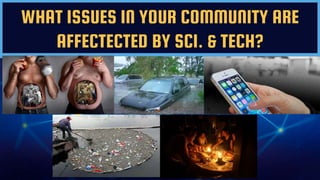
WHAT ISSUES IN YOUR COMMUNITY ARE
AFFECTECTED BY SCI. & TECH?
DO’S AND DON’TS
IN TECHNICAL
WRITING...
DO’S AND DON’TS IN TECHNICAL WRITING...
• Omit no key words
• Avoid ambiguous phrases – in technical writing, a sentence should
have one meaning only.
• Avoid over-stuffing – a sentence that crams so many ideas, forces
readers to struggle in order to get what is meant.
• Avoid un-stacked modifiers – too many nouns stacked up as
modifiers in front of another noun make for hard reading.
• Rearrange word order – just as any paragraph has a key sentence,
any sentence has a key word or phrase. For emphasis, place the key
word or phrase at the beginning or end of the sentence.
DO’S AND DON’TS IN TECHNICAL WRITING...
• Use the active voice
• Make sentences concise (brief) – a concise sentence is brief but
informative. It gets right to the point w/o clutter.
• Eliminate redundancy – avoid using phrase when a word will do.
• Avoid needless repetition
• Avoid “there” sentence openers – save words and improve your
emphasis by avoiding “there is” and “there are” at the beginning
of the sentences.
• Avoid certain “it” sentence openers – eliminate any ”It” that does
not refer to somerthing specific.
DO’S AND DON’TS IN TECHNICAL WRITING...
• Delete needless “to be” construction – forms of the verb “to be” (is,
was, are) often add clutter w/o adding meaning.
• Avoid excessive prepositions
• Use “that and “which” sparingly
• Fight noun addiction – excessive nouns make sentences awkward and
wordy
• Make negative positive – save words and get to the point by
eliminating negative construction.
• Clear out the clutter words
• Delete needless preface – get to the point. Deliver to the point w/o a
long wind-up.
DO’S AND DON’TS IN TECHNICAL WRITING...
• Avoid triteness
• Avoid over-statement
• Avoid sweeping generalization
• Use specific, concrete language.
HOW TO WRITE SCIENCE AND TECH ARTICLES...
(GUIDELINES)
• FORM AND STYLE- 40%
• -Manifests unity and coherence to the theme /topic given
• -Has catchy and appropriate headline that is also clear and free of bias
• -Observes the rules of grammar
• -Shows logical presentation of arguments
• -Contains leads that are clearly written and focused on the most
important detail
• -Follows appropriate form and style
• -Uses appropriate terms and lingo to report/discuss events
• -Observes gender-fair language.
HOW TO WRITE SCIENCE AND TECH ARTICLES...
(GUIDELINES)
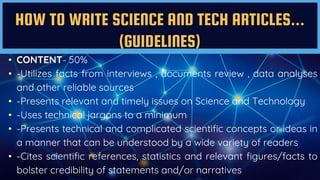
• CONTENT- 50%
• -Utilizes facts from interviews , documents review , data analyses
and other reliable sources
• -Presents relevant and timely issues on Science and Technology
• -Uses technical jargons to a minimum
• -Presents technical and complicated scientific concepts or ideas in
a manner that can be understood by a wide variety of readers
• -Cites scientific references, statistics and relevant figures/facts to
bolster credibility of statements and/or narratives
HOW TO WRITE SCIENCE AND TECH ARTICLES...
(GUIDELINES)
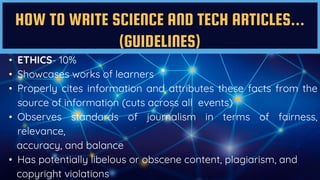
• ETHICS- 10%
• Showcases works of learners
• Properly cites information and attributes these facts from the
source of information (cuts across all events)
• Observes standards of journalism in terms of fairness,
relevance,
accuracy, and balance
• Has potentially libelous or obscene content, plagiarism, and
copyright violations
THANK YOU FOR
PARTICIPATING!
• http://www.wfsj.org/course/index-e.html http://boredomtherapy.com/nerd-science-jokes/
• http://xkcd.com/
• http://www.scidev.net/global/biotechnology/news/citizen-scientists-pitch-new-uses-for-
paper-microscope.html
• http://www.gmanetwork.com/news/story/401385/scitech/science/us-backed-uplb-
graduate-program-focused-on-marine-biodiversity
• http://www.gmanetwork.com/news/story/293017/scitech/science/food-for-thought-adobo-
and-the-filipino-genome
• http://mypocketshurt90.tumblr.com/post/27495622491/i-sent-this-paper-to-jk-rowling-
explaining-how-the
• http://www.theguardian.com/commentisfree/2014/oct/09/guardian-view-on-ebola-
fighting-fear-as-well-as-infection
• http://www.beatricebiologist.com/
• http://www.nextnature.net/wp-
LEARNING RESOURCES

Science and Technology Writing 2024.pptx

  • 1.
    DISTRICT TRAINING WRITE-SHOP FOR SCI-TECHWRITERS SCIENCE AND TECHNOLOGY WRITING (NEWS, EDITORIAL, FEATURES)
  • 2.
    DISTRICT TRAINING WRITE- SHOPFOR SCI-TECH WRITERS SCIENCE AND TECHNOLOGY WRITING (NEWS, EDITORIAL, FEATURES) MARIONNE VAN C. SASIS SCHOOL PAPER ADVISER, PANIAGAHAN PRESS, PANIAGAN ELEMENTARY SCHOOL
  • 3.
    LEARNING OBJECTIVES appreciate the valueof informing readers of science and technology advancements understand the techniques in writing Science/ Technology apply the techniques in writing Sci/Tech in an editorial, features and news article
  • 4.
    WHAT IS SCIENCEAND TECHNOLOGY WRITING? SCIENCE WRITING is the latest form of Philippine Journalism. A science writer should be able to communicate clearly and effectively so that he can popularize and translate scientific reports into stories.
  • 5.
    WHY IS SCIENCEAND TECHNOLOGY IMPORTANT? THERE IS ALWAYS WONDER AND AMAZEMENT TO BE HAD IN SCIENCE, IF YOU KNOW WHERE AND HOW TO LOOK!
  • 6.
  • 7.
    • SCIENCE NEWSREPORTING • SCIENCE WRITING BY A SCIENTIST OR BY A NON-SCIENTIST FOR MASS CONSUMPTION. • HIS/HER REPORT IS WRITTEN FOR MASS UNDERSTANDING. • HE/SHE WRITES HIS/HER STORY IN SUCH A WAY THAT THE SCIENCE UN-ORIENTED READER MAY UNDERSTAND AND APPRECIATE IT BECAUSE IT IS WRITTEN IN LAYMAN’S LANGUAGE. • HE/SHE WRITES HIS/HER STORY IN SUCH A WAY THAT THE SCIENCE UN-ORIENTED READER MAY UNDERSTAND AND APPRECIATE IT BECAUSE IT IS WRITTEN IN LAYMAN’S LANGUAGE. SCIENCE NEWS WRITING COVERS...
  • 9.
    SCIENCE AND TECH(SAMPLE) NEWS ARTICLE
  • 11.
    TECHNICAL VS NON-TECHNICAL •The objective of technical writing is to emphasize hand-in information • The main aim of journalistic writing is to inform, interpret, entertain, and to educate. • Purpose of Technical Writing - The main purpose of technical writing is to inform and persuade by providing facts and opinion based on facts that help readers answer question, solve a problem, make a decision, or perform a task.
  • 12.
    CHARACTERISTICS TECHNICAL WRITING •It contains only factual information presented objectively. • All data could be verified and would not change unless new findings are made. • The writing depends on the author’s treatment of the subject and by the reader’s need to useful information.
  • 13.
    TECHNICAL WRITING Technical subjectis specialized and usually mechanical or scientific.
  • 14.
    SPECIFIC USES OFTECHNICAL WRITING SKILLS • Modern society is becoming highly technical • Police and fire personnel write detailed incidents or investigation report that must be clear enough to serve as evidence in court. • Nurses and medical technicians keep daily records that are crucial to patients’ welfare particularly as bases for litigations • Secretaries must write clear and precise memos, letters, minutes, and reports. • Managers write memos, personal evaluation, requisitions, and instructions.
  • 15.
    SCIENCE EDITORIALS • Analysisof the issue must be based on scientific facts and following the scientific method • Assumptions raised must be based on solid logic and following the scientific method
  • 17.
    WHAT ISSUES INYOUR COMMUNITY ARE AFFECTECTED BY SCI. & TECH?
  • 18.
    DO’S AND DON’TS INTECHNICAL WRITING...
  • 19.
    DO’S AND DON’TSIN TECHNICAL WRITING... • Omit no key words • Avoid ambiguous phrases – in technical writing, a sentence should have one meaning only. • Avoid over-stuffing – a sentence that crams so many ideas, forces readers to struggle in order to get what is meant. • Avoid un-stacked modifiers – too many nouns stacked up as modifiers in front of another noun make for hard reading. • Rearrange word order – just as any paragraph has a key sentence, any sentence has a key word or phrase. For emphasis, place the key word or phrase at the beginning or end of the sentence.
  • 20.
    DO’S AND DON’TSIN TECHNICAL WRITING... • Use the active voice • Make sentences concise (brief) – a concise sentence is brief but informative. It gets right to the point w/o clutter. • Eliminate redundancy – avoid using phrase when a word will do. • Avoid needless repetition • Avoid “there” sentence openers – save words and improve your emphasis by avoiding “there is” and “there are” at the beginning of the sentences. • Avoid certain “it” sentence openers – eliminate any ”It” that does not refer to somerthing specific.
  • 21.
    DO’S AND DON’TSIN TECHNICAL WRITING... • Delete needless “to be” construction – forms of the verb “to be” (is, was, are) often add clutter w/o adding meaning. • Avoid excessive prepositions • Use “that and “which” sparingly • Fight noun addiction – excessive nouns make sentences awkward and wordy • Make negative positive – save words and get to the point by eliminating negative construction. • Clear out the clutter words • Delete needless preface – get to the point. Deliver to the point w/o a long wind-up.
  • 22.
    DO’S AND DON’TSIN TECHNICAL WRITING... • Avoid triteness • Avoid over-statement • Avoid sweeping generalization • Use specific, concrete language.
  • 23.
    HOW TO WRITESCIENCE AND TECH ARTICLES... (GUIDELINES) • FORM AND STYLE- 40% • -Manifests unity and coherence to the theme /topic given • -Has catchy and appropriate headline that is also clear and free of bias • -Observes the rules of grammar • -Shows logical presentation of arguments • -Contains leads that are clearly written and focused on the most important detail • -Follows appropriate form and style • -Uses appropriate terms and lingo to report/discuss events • -Observes gender-fair language.
  • 24.
    HOW TO WRITESCIENCE AND TECH ARTICLES... (GUIDELINES) • CONTENT- 50% • -Utilizes facts from interviews , documents review , data analyses and other reliable sources • -Presents relevant and timely issues on Science and Technology • -Uses technical jargons to a minimum • -Presents technical and complicated scientific concepts or ideas in a manner that can be understood by a wide variety of readers • -Cites scientific references, statistics and relevant figures/facts to bolster credibility of statements and/or narratives
  • 25.
    HOW TO WRITESCIENCE AND TECH ARTICLES... (GUIDELINES) • ETHICS- 10% • Showcases works of learners • Properly cites information and attributes these facts from the source of information (cuts across all events) • Observes standards of journalism in terms of fairness, relevance, accuracy, and balance • Has potentially libelous or obscene content, plagiarism, and copyright violations
  • 26.
  • 27.
    • http://www.wfsj.org/course/index-e.html http://boredomtherapy.com/nerd-science-jokes/ •http://xkcd.com/ • http://www.scidev.net/global/biotechnology/news/citizen-scientists-pitch-new-uses-for- paper-microscope.html • http://www.gmanetwork.com/news/story/401385/scitech/science/us-backed-uplb- graduate-program-focused-on-marine-biodiversity • http://www.gmanetwork.com/news/story/293017/scitech/science/food-for-thought-adobo- and-the-filipino-genome • http://mypocketshurt90.tumblr.com/post/27495622491/i-sent-this-paper-to-jk-rowling- explaining-how-the • http://www.theguardian.com/commentisfree/2014/oct/09/guardian-view-on-ebola- fighting-fear-as-well-as-infection • http://www.beatricebiologist.com/ • http://www.nextnature.net/wp- LEARNING RESOURCES