The Public School
Reinvention
Project
Stepping stones: Enhancing the quality of
primary education
TIME SPRINTERS:
Siddharth Naidu, Dhruv Kumar, Parth Joshi, Roop Narayan Singh, Vivek Kumar
Indian School of Mines, Dhanbad
What is wrong?
Only 43% of the enrolled
children complete
elementary education and
quality of education
remains retarded as
indicated by official DISE
data.
Issues at
hand Remedial
measures taken
by government
The effectiveness of government
policies has proved to be minimal
given the huge additional fiscal
burden that these have added.
The Indian Scenario
Education at every level-primary, secondary and tertiary, are
inextricably affected by each other. Most importantly, the education
received by an individual at primary level forms the foundation of
one’s life. It has a deep impact on the choices that will be effectively
available to him at secondary and tertiary levels and in the case of our
country, whether he will have any choice available at all.
73% of the India’s student population studies in
government schools.
• Minimal allocation and poor management of the available
resources are the primary reasons for backwardness of
government schools.
Based on the government’s own report 17 states in India
are in need of immediate attention.
• Education, being a state subject depends heavily on the
state administration which is not efficient enough to
centrally monitor such a large and diverse school network.
From giving away free midday meals to simplification of
course curriculum and toughening of the school norms,
the government has tried many measures but their
effectiveness is clearly questionable.
• The reason being that these measures followed a
centralized and uniform method of enforcement which
completely ignored the local needs and the resources
available (especially human resources) in different regions.
The Government School obstacle
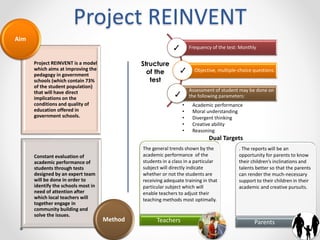
Project REINVENT
Project REINVENT is a model
which aims at improving the
pedagogy in government
schools (which contain 73%
of the student population)
that will have direct
implications on the
conditions and quality of
education offered in
government schools.
Aim
Constant evaluation of
academic performance of
students through tests
designed by an expert team
will be done in order to
identify the schools most in
need of attention after
which local teachers will
together engage in
community building and
solve the issues.
Method
Structure
of the
test
Frequency of the test: Monthly
Objective, multiple-choice questions.
Assessment of student may be done on
the following parameters:
• Academic performance
• Moral understanding
• Divergent thinking
• Creative ability
• Reasoning
Teachers Parents
Dual Targets
The general trends shown by the
academic performance of the
students in a class in a particular
subject will directly indicate
whether or not the students are
receiving adequate training in that
particular subject which will
enable teachers to adjust their
teaching methods most optimally.
. The reports will be an
opportunity for parents to know
their children’s inclinations and
talents better so that the parents
can render the much-necessary
support to their children in their
academic and creative pursuits.
The Process
Expert Team
• Members of the team will be
from different academic
backgrounds who will make
the test.
• The team would be
constituted at state level.
• The reports of consistently
extraordinary performers may
also be sent to experts for
better analysis.
School
• The tests are sent out to
the government schools
each month where the
students take the test.
• Every student will take
the test without any
external assistance
under the invigilation of
the school teachers and
local volunteers.
Evaluation
Centre
• The tests are then sent
to evaluation centres
where the tests are
analyzed and evaluated
using a software
program
• The reports of the
students will be
generated based on the
guidelines given by the
expert team.
Two copies of
the final
reports are
sent back to
school, one
each for the
parents and
teachers
All schools will be divided into
cohorts on the bais of their
proximity with each other.These
cohorts will convene regular
meetings in which solutions will be
devised for issues that will come to
light through the general trends
observed in the reports of different
classes in different schools.
• Evaluation centres will make the reports on basis of the analysis
done through a software built exclusively for this purpose.
• In this software, the answers to all questions will be inputted
and based on the information provided by the expert team, a
marking scheme would be followed.
• Finally, output would be generated along with pre-stored
comments by the expert team corresponding to the score
acquired.
Post-test Action
If the issues faced are indeed due to quality of teaching
and the situation remains so even after 3 months without
any tangible improvement, then they could undergo
short-term professional training which would be
organized at state-level.
If the issues being faced are primarily due to
infrastructural handicaps or social conditions in the
region, then the grievances will be advocated at the
state-level
Cohort-level meetings to devise solutions based
on the trends observed in the reports and
organizing teaching workshops sensitive to local
challenges by pooling in human resources
The test reports will help teachers to know their
students better and provide them with individual
attention and support in accordance with every
child’s behavior and inclination.
Cohort: Cohorts will be
constituted consisting of four
or five schools in close
proximity with each other.
Grievance redressal: A network of
NGOs operating within the state will
be responsible along with the school
authorities to put pressure on the
state government to allocate
adequate resources in places where
required.
State-level programmes: Short-
term training, interactive
sessions and other constructive
programmes by professionals
will be organized every month
in which any government school
teacher from anywhere in the
state will be free to participate..
• The Evaluation Team in a
region would be responsible
for evaluating the tests
electronically i.e. scanning the
OMR sheets obtained from all
the government schools in the
region and make reports
through the special software
that would be made available
to them.
• Skilled, with basic computer
knowledge but work can be
done on weekends and hence,
volunteers like college students
and working individuals and
existing NGOs may come
forward to take this task
• The Logistics Team in every
cohort would be responsible
for getting the test papers
printed and delivered on the
day of the test, ensuring the
safe delivery of all the test
papers to the nearest
evaluation centre and delivery
of the reports back to the
corresponding schools.
• Semi-skilled who would have
to work on weekdays and
hence, would have to be given
a fixed wage. Logistics Evaluation
Training
Government
Intervention
• For advocacy of
improvements in social and
infrastructural conditions in
a region through
government intervention as
discussed in the previous
slide, a network of NGOs
operating in a state would
have to be brought together
which would then act as a
massive pressure group
advocating for necessary
action on part of the
government.
• The Training Team would be
responsible for organizing the
state-level programmes every
month calling upon
professionals to have
sessions with the
government school teachers
and address the challenges
that they face
• Skilled team responsible for
organizing the workshop or
any other state-level
programme as felt needed
whenever possible..
Human
Resource
required
• Setting up of evaluation centres with at
least one computer and an OMR reader.
• At full potential when every government
school in India would be covered under
the model and where an evaluation
centre will be set up for every 1500
students or approximately every 10
schools, there would be close to 85,000
evaluation centres all over India.
• In that case scenario, a one-time capital
investment of Rs 170 crore will go down
in setting up these 85, 000 centes.
• But this can be significantly reduced if
used computers are bought instead of
new ones and can be further reduced if
computers are not bought and only
rented wherever possible.
• Since computers are only required for
evaluation purposes which could be done
on weekends, if organizations are willing
to let out their computers for one
weekend every month for our purpose,
then also costs will reduce significantly.
• Implementing such cutbacks could reduce
the cost to upto 1/3rd of the estimated
value.
• Most importantly, the model will spread
only gradually and therefore, the entire
cost would not have to be bore at once.
• At full potential, around 13 crore test
papers would have to be printed every
month.
• If each test paper consists of an
average of 10 pages and one OMR
sheet, then printing cost cannot exceed
Rs, 6 or 7 per test paper.
Transportation cost would be minimal
since test papers would not be centrally
printed and would be printed in every
region separately and transported to the
evaluation centre within the region by the
Logistics Team.
• State-level programmes that would be
carried out every month in every state
for all government school teachers of
the state have to include academicians
and dignitaries from all over India and
have to be organized in a way that
teachers actually feel that they belong
to a respected and intellectual class of
the society and their actions are
determinant in moulding India’s future.
• An allocation of Rs. 2 lakh per month
for every state would be the maximum
limit.
• Wages would have to be given to
people whenever volunteers are not
available.
• The Logistics Team and the Evaluation
Team will consist mostly of on-wage
skilled and semi-skilled workers.
• But since work is minimal i.e. only 2 or
3 days a month, wage expenditures will
not be too large.
IT Infrastructure costs Printing costs
Transportation osts
State-level programmes
Human Resource Costs
Rs. 150-
170 crore
Rs. 60-80
crore per
month
Rs. 1-2
lakhs per
month
Rs. 25-30
lakhs per
month
Rs. 7-8
lakhs per
month
Full potential
maximum
expenditure
Large expenditure is involved at full potential.
The biggest question is whether there is any use in conducting a
test to assess academic performance of students when this
already being done through school examinations
Since the State-level programmes would be held at a specific
location every month, only the teachers living in proximity may
attend the proramme, therefore limiting it’s reach and
effectiveness.
This project depends heavily on volunteering and without active
volunteering at each level, it’s effectiveness will be reduced
especially when it comes to pursuading government school
teachers to take this extra burden.
• The quickest way of fully implementing this project at a pan-India
level is through government support, both financial and legal.
• But even without any considerable government support, this model
could still be implemented by establishing a very wide-network of
NGOs which would pool in financial resources from local sources and
start at a small-scale and gradually scale up as awareness about the
project and it’s impact grows and more sources of funds arise.
Departure from existing system
• Firstly, it takes into account a broader view of learning and
intelligence as it accommodates parameters like creative ability,
moral understanding, etc. as well.
• The thrust of this model lies in the chain reaction that is set off once
the results of the tests are distributed. It allows teachers and parents
from different schools to come together to interact and work as a
community to devise solutions to their problems.
• The excessive centralization of norms and policies ignores the social
and infrastructural condition in any region. This makes teachers
merely instruction takers from State administration and essentially
excludes them and even retards them from effectively being a part of
the education system which is the biggest reason for a general dearth
seen among government school teachers. Our model strikes at the
heart of this problem.
State-level programmes
• The State-level programmes should not be held only at a specific
location and should be shifted every month and in states with high
population, should be held more than once a month at different
locations.
Government support
Challenges & Solutions
CHALLENGES
SOLUTIONS
Impact
Measurement of impact
• Through the tests taken under this project, we could easily see whether or not conditions in any
government school are improving.
Sustainability of the model
• As pointed out earlier, the biggest concern of this project is the financial burden.
• If the project succeeds on a small-scale, then the government could lend financial support which would
make the project a reality at a pan-India level.
• The government intervention would not cause any operational constraint as the model is a
decentralized one based upon the principle of community building.
• Any leakages in the proceedings can be easily detected. For example, inefficient logistics will be
detected by the Evaluation team. Delays in evaluation of tests can be detected by the school. The failure
of schools to act upon the problems will be reflected by the general trends observed in future test
results.
Scalability of the model
• The model being a decentralized one, can be easily scaled to the highest level given the finances are in
place.
• If awareness about the project is spread, then volunteers will come ahead and the project could be
implemented all over India.
Monitoring mechanism
• As pointed out in the previous slide, this project depends heavily on active volunteering which makes
proper monitoring absolutely necessary.
• As mentioned above, leakages at one level of the process will be detected the next level. But still, this
would not suffice and hence, a special team has to be constituted in every state which would constantly
monitor if the low-performing schools in the states show any signs of improvement or not.
• If not, then the teachers in those schools would be persuaded to attend the State-level programmes
and if the reasons for low performance is due to lack of resources, then NGOs in and around the region
will be activated to put pressure on the government to intervene (Slide 6).
• In order to ensure complete transparency and increase efficiency, general trends of each school will also
be put up online on the website so that anybody can view the general performance of the students in
any government school in any state within our network. This will put more pressure on the low-
performing government schools to improve.
• Possibly, this could even make active citizens and NGOs to get involved in putting pressure on these
schools and the government to improve the conditions in these schools.
References
• Children in India 2012 – A Statistical Appraisal, Ministry of
statistics and Programme Implementation, Government of
India
• Elementary Education in India: Progress towards UEE, Flash
Statistics DISE 2011-12, {published by – National University of
Education Planning and Administration

timmesprinters92

  • 1.
    The Public School Reinvention Project Steppingstones: Enhancing the quality of primary education TIME SPRINTERS: Siddharth Naidu, Dhruv Kumar, Parth Joshi, Roop Narayan Singh, Vivek Kumar Indian School of Mines, Dhanbad
  • 2.
    What is wrong? Only43% of the enrolled children complete elementary education and quality of education remains retarded as indicated by official DISE data. Issues at hand Remedial measures taken by government The effectiveness of government policies has proved to be minimal given the huge additional fiscal burden that these have added. The Indian Scenario Education at every level-primary, secondary and tertiary, are inextricably affected by each other. Most importantly, the education received by an individual at primary level forms the foundation of one’s life. It has a deep impact on the choices that will be effectively available to him at secondary and tertiary levels and in the case of our country, whether he will have any choice available at all. 73% of the India’s student population studies in government schools. • Minimal allocation and poor management of the available resources are the primary reasons for backwardness of government schools. Based on the government’s own report 17 states in India are in need of immediate attention. • Education, being a state subject depends heavily on the state administration which is not efficient enough to centrally monitor such a large and diverse school network. From giving away free midday meals to simplification of course curriculum and toughening of the school norms, the government has tried many measures but their effectiveness is clearly questionable. • The reason being that these measures followed a centralized and uniform method of enforcement which completely ignored the local needs and the resources available (especially human resources) in different regions. The Government School obstacle
  • 3.
    Project REINVENT Project REINVENTis a model which aims at improving the pedagogy in government schools (which contain 73% of the student population) that will have direct implications on the conditions and quality of education offered in government schools. Aim Constant evaluation of academic performance of students through tests designed by an expert team will be done in order to identify the schools most in need of attention after which local teachers will together engage in community building and solve the issues. Method Structure of the test Frequency of the test: Monthly Objective, multiple-choice questions. Assessment of student may be done on the following parameters: • Academic performance • Moral understanding • Divergent thinking • Creative ability • Reasoning Teachers Parents Dual Targets The general trends shown by the academic performance of the students in a class in a particular subject will directly indicate whether or not the students are receiving adequate training in that particular subject which will enable teachers to adjust their teaching methods most optimally. . The reports will be an opportunity for parents to know their children’s inclinations and talents better so that the parents can render the much-necessary support to their children in their academic and creative pursuits.
  • 4.
    The Process Expert Team •Members of the team will be from different academic backgrounds who will make the test. • The team would be constituted at state level. • The reports of consistently extraordinary performers may also be sent to experts for better analysis. School • The tests are sent out to the government schools each month where the students take the test. • Every student will take the test without any external assistance under the invigilation of the school teachers and local volunteers. Evaluation Centre • The tests are then sent to evaluation centres where the tests are analyzed and evaluated using a software program • The reports of the students will be generated based on the guidelines given by the expert team. Two copies of the final reports are sent back to school, one each for the parents and teachers All schools will be divided into cohorts on the bais of their proximity with each other.These cohorts will convene regular meetings in which solutions will be devised for issues that will come to light through the general trends observed in the reports of different classes in different schools. • Evaluation centres will make the reports on basis of the analysis done through a software built exclusively for this purpose. • In this software, the answers to all questions will be inputted and based on the information provided by the expert team, a marking scheme would be followed. • Finally, output would be generated along with pre-stored comments by the expert team corresponding to the score acquired.
  • 5.
    Post-test Action If theissues faced are indeed due to quality of teaching and the situation remains so even after 3 months without any tangible improvement, then they could undergo short-term professional training which would be organized at state-level. If the issues being faced are primarily due to infrastructural handicaps or social conditions in the region, then the grievances will be advocated at the state-level Cohort-level meetings to devise solutions based on the trends observed in the reports and organizing teaching workshops sensitive to local challenges by pooling in human resources The test reports will help teachers to know their students better and provide them with individual attention and support in accordance with every child’s behavior and inclination. Cohort: Cohorts will be constituted consisting of four or five schools in close proximity with each other. Grievance redressal: A network of NGOs operating within the state will be responsible along with the school authorities to put pressure on the state government to allocate adequate resources in places where required. State-level programmes: Short- term training, interactive sessions and other constructive programmes by professionals will be organized every month in which any government school teacher from anywhere in the state will be free to participate..
  • 6.
    • The EvaluationTeam in a region would be responsible for evaluating the tests electronically i.e. scanning the OMR sheets obtained from all the government schools in the region and make reports through the special software that would be made available to them. • Skilled, with basic computer knowledge but work can be done on weekends and hence, volunteers like college students and working individuals and existing NGOs may come forward to take this task • The Logistics Team in every cohort would be responsible for getting the test papers printed and delivered on the day of the test, ensuring the safe delivery of all the test papers to the nearest evaluation centre and delivery of the reports back to the corresponding schools. • Semi-skilled who would have to work on weekdays and hence, would have to be given a fixed wage. Logistics Evaluation Training Government Intervention • For advocacy of improvements in social and infrastructural conditions in a region through government intervention as discussed in the previous slide, a network of NGOs operating in a state would have to be brought together which would then act as a massive pressure group advocating for necessary action on part of the government. • The Training Team would be responsible for organizing the state-level programmes every month calling upon professionals to have sessions with the government school teachers and address the challenges that they face • Skilled team responsible for organizing the workshop or any other state-level programme as felt needed whenever possible.. Human Resource required
  • 7.
    • Setting upof evaluation centres with at least one computer and an OMR reader. • At full potential when every government school in India would be covered under the model and where an evaluation centre will be set up for every 1500 students or approximately every 10 schools, there would be close to 85,000 evaluation centres all over India. • In that case scenario, a one-time capital investment of Rs 170 crore will go down in setting up these 85, 000 centes. • But this can be significantly reduced if used computers are bought instead of new ones and can be further reduced if computers are not bought and only rented wherever possible. • Since computers are only required for evaluation purposes which could be done on weekends, if organizations are willing to let out their computers for one weekend every month for our purpose, then also costs will reduce significantly. • Implementing such cutbacks could reduce the cost to upto 1/3rd of the estimated value. • Most importantly, the model will spread only gradually and therefore, the entire cost would not have to be bore at once. • At full potential, around 13 crore test papers would have to be printed every month. • If each test paper consists of an average of 10 pages and one OMR sheet, then printing cost cannot exceed Rs, 6 or 7 per test paper. Transportation cost would be minimal since test papers would not be centrally printed and would be printed in every region separately and transported to the evaluation centre within the region by the Logistics Team. • State-level programmes that would be carried out every month in every state for all government school teachers of the state have to include academicians and dignitaries from all over India and have to be organized in a way that teachers actually feel that they belong to a respected and intellectual class of the society and their actions are determinant in moulding India’s future. • An allocation of Rs. 2 lakh per month for every state would be the maximum limit. • Wages would have to be given to people whenever volunteers are not available. • The Logistics Team and the Evaluation Team will consist mostly of on-wage skilled and semi-skilled workers. • But since work is minimal i.e. only 2 or 3 days a month, wage expenditures will not be too large. IT Infrastructure costs Printing costs Transportation osts State-level programmes Human Resource Costs Rs. 150- 170 crore Rs. 60-80 crore per month Rs. 1-2 lakhs per month Rs. 25-30 lakhs per month Rs. 7-8 lakhs per month Full potential maximum expenditure
  • 8.
    Large expenditure isinvolved at full potential. The biggest question is whether there is any use in conducting a test to assess academic performance of students when this already being done through school examinations Since the State-level programmes would be held at a specific location every month, only the teachers living in proximity may attend the proramme, therefore limiting it’s reach and effectiveness. This project depends heavily on volunteering and without active volunteering at each level, it’s effectiveness will be reduced especially when it comes to pursuading government school teachers to take this extra burden. • The quickest way of fully implementing this project at a pan-India level is through government support, both financial and legal. • But even without any considerable government support, this model could still be implemented by establishing a very wide-network of NGOs which would pool in financial resources from local sources and start at a small-scale and gradually scale up as awareness about the project and it’s impact grows and more sources of funds arise. Departure from existing system • Firstly, it takes into account a broader view of learning and intelligence as it accommodates parameters like creative ability, moral understanding, etc. as well. • The thrust of this model lies in the chain reaction that is set off once the results of the tests are distributed. It allows teachers and parents from different schools to come together to interact and work as a community to devise solutions to their problems. • The excessive centralization of norms and policies ignores the social and infrastructural condition in any region. This makes teachers merely instruction takers from State administration and essentially excludes them and even retards them from effectively being a part of the education system which is the biggest reason for a general dearth seen among government school teachers. Our model strikes at the heart of this problem. State-level programmes • The State-level programmes should not be held only at a specific location and should be shifted every month and in states with high population, should be held more than once a month at different locations. Government support Challenges & Solutions CHALLENGES SOLUTIONS
  • 9.
    Impact Measurement of impact •Through the tests taken under this project, we could easily see whether or not conditions in any government school are improving. Sustainability of the model • As pointed out earlier, the biggest concern of this project is the financial burden. • If the project succeeds on a small-scale, then the government could lend financial support which would make the project a reality at a pan-India level. • The government intervention would not cause any operational constraint as the model is a decentralized one based upon the principle of community building. • Any leakages in the proceedings can be easily detected. For example, inefficient logistics will be detected by the Evaluation team. Delays in evaluation of tests can be detected by the school. The failure of schools to act upon the problems will be reflected by the general trends observed in future test results. Scalability of the model • The model being a decentralized one, can be easily scaled to the highest level given the finances are in place. • If awareness about the project is spread, then volunteers will come ahead and the project could be implemented all over India. Monitoring mechanism • As pointed out in the previous slide, this project depends heavily on active volunteering which makes proper monitoring absolutely necessary. • As mentioned above, leakages at one level of the process will be detected the next level. But still, this would not suffice and hence, a special team has to be constituted in every state which would constantly monitor if the low-performing schools in the states show any signs of improvement or not. • If not, then the teachers in those schools would be persuaded to attend the State-level programmes and if the reasons for low performance is due to lack of resources, then NGOs in and around the region will be activated to put pressure on the government to intervene (Slide 6). • In order to ensure complete transparency and increase efficiency, general trends of each school will also be put up online on the website so that anybody can view the general performance of the students in any government school in any state within our network. This will put more pressure on the low- performing government schools to improve. • Possibly, this could even make active citizens and NGOs to get involved in putting pressure on these schools and the government to improve the conditions in these schools.
  • 10.
    References • Children inIndia 2012 – A Statistical Appraisal, Ministry of statistics and Programme Implementation, Government of India • Elementary Education in India: Progress towards UEE, Flash Statistics DISE 2011-12, {published by – National University of Education Planning and Administration