ENHANCING THE QUALITY OF PRIMARY
EDUCATION IN INDIA
INCLUSIVE, GOOD-QUALITY EDUCATION IS A FOUNDATION FOR
DYNAMIC AND EQUITABLE SOCIETIES.
-DESMOND TUTU
NEED FOR EDUCATION
REFORM
 To eradicate quota system,
 To ensure equality in its true sense,
 For betterment of the country,
 Educated youth will result in development of the country
in every field,
 To ensure world class quality education, and
 To ensure the citizen/children of this country are no less
than anyone studying abroad.
CAUSES OF THE
PROBLEM
Over Population
Lack of Funds therefore lack of infrastructural set up
Uneducated Parents
Lack of Awareness
Discouraging atmosphere at schools
Lack of honest attempts
REASONING
Every child should have the opportunity to receive a quality
education.
One of the most powerful tools for empowering individuals
and communities is making certain that any individual who
wants to receive a quality education can do so.
PROSPOSED SOLUTIONS
Implementation of SARVA SIKSHA ABHIYAN (2000) at grass
root level.
A Common Cluster of School Model ( 7-8 Primary branch
schools connected to Central Primary School in a village to
aim exchange of resources between schools, meeting of
teacher and training and compensating the absence of
teachers).
Transportation for Students and Teachers. (This is to
establish smooth functioning of schooling in far areas
benefiting students from other villages if schooling facilities
are not there).
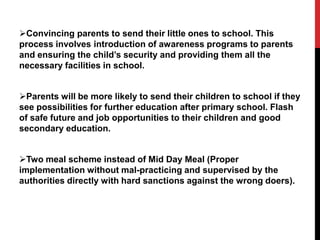
Convincing parents to send their little ones to school. This
process involves introduction of awareness programs to parents
and ensuring the child’s security and providing them all the
necessary facilities in school.
Parents will be more likely to send their children to school if they
see possibilities for further education after primary school. Flash
of safe future and job opportunities to their children and good
secondary education.
Two meal scheme instead of Mid Day Meal (Proper
implementation without mal-practicing and supervised by the
authorities directly with hard sanctions against the wrong doers).
Teacher’s Willingness to perform their task.
Proper Finance by the Government to ensure the students must
get all facilities in the school.
Sports facilities to make students Fit and act as a “talent hunt”
with coaching facilities.
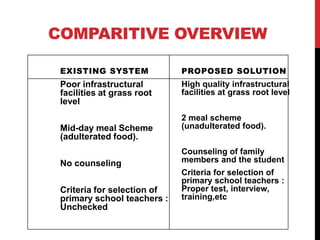
COMPARITIVE OVERVIEW
EXISTING SYSTEM
Poor infrastructural
facilities at grass root
level
Mid-day meal Scheme
(adulterated food).
No counseling
Criteria for selection of
primary school teachers :
Unchecked
PROPOSED SOLUTION
High quality infrastructural
facilities at grass root level
2 meal scheme
(unadulterated food).
Counseling of family
members and the student
Criteria for selection of
primary school teachers :
Proper test, interview,
training,etc
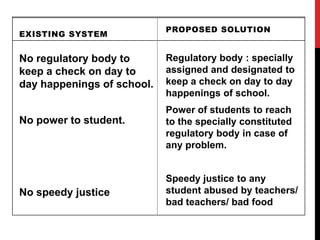
EXISTING SYSTEM
No regulatory body to
keep a check on day to
day happenings of school.
No power to student.
No speedy justice
PROPOSED SOLUTION
Regulatory body : specially
assigned and designated to
keep a check on day to day
happenings of school.
Power of students to reach
to the specially constituted
regulatory body in case of
any problem.
Speedy justice to any
student abused by teachers/
bad teachers/ bad food
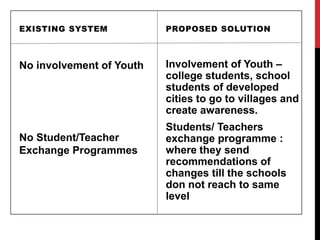
EXISTING SYSTEM
No involvement of Youth
No Student/Teacher
Exchange Programmes
PROPOSED SOLUTION
Involvement of Youth –
college students, school
students of developed
cities to go to villages and
create awareness.
Students/ Teachers
exchange programme :
where they send
recommendations of
changes till the schools
don not reach to same
level
PROPOSED SOLUTIONS
Teacher’s training should be must.
NGO’s shall be given a task to supervise and ensure quality
education.
Opportunity for paid work for students to enhance their
skills and provide them with some financial aid.
Promoting student’s performances by rewarding them and
their teachers.
Companies have started with the concept of corporate
social responsibilities, big companies shall adopt the school
and provide them with necessary things and material.
IMPLEMENTATION
It is not difficult to implement small -small steps in order to
create and strengthen the education system at the grass root
level.
School students, college students as a part of their
institution’s compulsory activities can take up the task of
helping NGO’s working in this field.
Students can do internships with such NGO’s and help in
bringing a change in the society.
Its like adopting a village, adopt a school concept !!
Government at their level must allocate funds for the lower
level education sector by ensuring how mush they require on
the basis of a committee after their surveying is done.
The teachers at the primary level must be evaluated and
checked. They should have a minimum attendance criteria, they
must show what she is teaching and must give a detailed report
of each student and his need and interests.
The collector must designate people and form special
committees to take up this task.
The District Magistrate must be the reporting authority for all
the schools in his/her jurisdiction.
IMPACT
The change will be evident from the list of number of
students who would have enrolled themselves in 10th and
12th standards.
Where quota system will not be a need because the
education at this level will bring everyone at the same level.
CHALLENGES
Convincing for allocation of appropriate funds
Absence of dedicated youth
Lack of government support in establishing a committee to
review the functioning of all the schools.
CONCLUDING REMARKS BY:
MOZAH BINT NASSER AL
MISSNED
The right to a quality education is, I believe, the perfect path
to bridge the gap between different cultures and to reconcile
various civilizations. Without such a right, the values of
liberty, justice and equality will have no meaning. Ignorance
is by far the biggest danger and threat to humankind.
A collective affair by:
Anisha Mathur
Gajanand Kirodiwal
Abhishek Kumar
Purvasha Mansharamani
Suyash Pratap Singh
Symbiosis Law School, Noida

Sym5

  • 1.
    ENHANCING THE QUALITYOF PRIMARY EDUCATION IN INDIA INCLUSIVE, GOOD-QUALITY EDUCATION IS A FOUNDATION FOR DYNAMIC AND EQUITABLE SOCIETIES. -DESMOND TUTU
  • 2.
    NEED FOR EDUCATION REFORM To eradicate quota system,  To ensure equality in its true sense,  For betterment of the country,  Educated youth will result in development of the country in every field,  To ensure world class quality education, and  To ensure the citizen/children of this country are no less than anyone studying abroad.
  • 3.
    CAUSES OF THE PROBLEM OverPopulation Lack of Funds therefore lack of infrastructural set up Uneducated Parents Lack of Awareness Discouraging atmosphere at schools Lack of honest attempts
  • 4.
    REASONING Every child shouldhave the opportunity to receive a quality education. One of the most powerful tools for empowering individuals and communities is making certain that any individual who wants to receive a quality education can do so.
  • 5.
    PROSPOSED SOLUTIONS Implementation ofSARVA SIKSHA ABHIYAN (2000) at grass root level. A Common Cluster of School Model ( 7-8 Primary branch schools connected to Central Primary School in a village to aim exchange of resources between schools, meeting of teacher and training and compensating the absence of teachers). Transportation for Students and Teachers. (This is to establish smooth functioning of schooling in far areas benefiting students from other villages if schooling facilities are not there).
  • 6.
    Convincing parents tosend their little ones to school. This process involves introduction of awareness programs to parents and ensuring the child’s security and providing them all the necessary facilities in school. Parents will be more likely to send their children to school if they see possibilities for further education after primary school. Flash of safe future and job opportunities to their children and good secondary education. Two meal scheme instead of Mid Day Meal (Proper implementation without mal-practicing and supervised by the authorities directly with hard sanctions against the wrong doers).
  • 7.
    Teacher’s Willingness toperform their task. Proper Finance by the Government to ensure the students must get all facilities in the school. Sports facilities to make students Fit and act as a “talent hunt” with coaching facilities.
  • 8.
    COMPARITIVE OVERVIEW EXISTING SYSTEM Poorinfrastructural facilities at grass root level Mid-day meal Scheme (adulterated food). No counseling Criteria for selection of primary school teachers : Unchecked PROPOSED SOLUTION High quality infrastructural facilities at grass root level 2 meal scheme (unadulterated food). Counseling of family members and the student Criteria for selection of primary school teachers : Proper test, interview, training,etc
  • 9.
    EXISTING SYSTEM No regulatorybody to keep a check on day to day happenings of school. No power to student. No speedy justice PROPOSED SOLUTION Regulatory body : specially assigned and designated to keep a check on day to day happenings of school. Power of students to reach to the specially constituted regulatory body in case of any problem. Speedy justice to any student abused by teachers/ bad teachers/ bad food
  • 10.
    EXISTING SYSTEM No involvementof Youth No Student/Teacher Exchange Programmes PROPOSED SOLUTION Involvement of Youth – college students, school students of developed cities to go to villages and create awareness. Students/ Teachers exchange programme : where they send recommendations of changes till the schools don not reach to same level
  • 11.
    PROPOSED SOLUTIONS Teacher’s trainingshould be must. NGO’s shall be given a task to supervise and ensure quality education. Opportunity for paid work for students to enhance their skills and provide them with some financial aid. Promoting student’s performances by rewarding them and their teachers. Companies have started with the concept of corporate social responsibilities, big companies shall adopt the school and provide them with necessary things and material.
  • 12.
    IMPLEMENTATION It is notdifficult to implement small -small steps in order to create and strengthen the education system at the grass root level. School students, college students as a part of their institution’s compulsory activities can take up the task of helping NGO’s working in this field. Students can do internships with such NGO’s and help in bringing a change in the society. Its like adopting a village, adopt a school concept !!
  • 13.
    Government at theirlevel must allocate funds for the lower level education sector by ensuring how mush they require on the basis of a committee after their surveying is done. The teachers at the primary level must be evaluated and checked. They should have a minimum attendance criteria, they must show what she is teaching and must give a detailed report of each student and his need and interests. The collector must designate people and form special committees to take up this task. The District Magistrate must be the reporting authority for all the schools in his/her jurisdiction.
  • 14.
    IMPACT The change willbe evident from the list of number of students who would have enrolled themselves in 10th and 12th standards. Where quota system will not be a need because the education at this level will bring everyone at the same level.
  • 15.
    CHALLENGES Convincing for allocationof appropriate funds Absence of dedicated youth Lack of government support in establishing a committee to review the functioning of all the schools.
  • 16.
    CONCLUDING REMARKS BY: MOZAHBINT NASSER AL MISSNED The right to a quality education is, I believe, the perfect path to bridge the gap between different cultures and to reconcile various civilizations. Without such a right, the values of liberty, justice and equality will have no meaning. Ignorance is by far the biggest danger and threat to humankind.
  • 17.
    A collective affairby: Anisha Mathur Gajanand Kirodiwal Abhishek Kumar Purvasha Mansharamani Suyash Pratap Singh Symbiosis Law School, Noida