MANTHAN TOPIC: STEPPING STONES
FINISHING SCHOOL
TO PRODUCE MORE COMPETENT TEACHERS
KEERTIVARDHAN M .JOSHI, HARSHAVARDHAN M. JOSHI, KIRAN K.N.
GARGI P.E., RAJATHA N. RAO
SAPTHAGIRI COLLEGE OF ENGINEERING, BANGALORE.
A comparison of the literacy rates of the countries
which have gained independence in the 20th
century .
 58% of the children in India do
not complete their primary
education.
 50% of the students are under-
qualified for their existing grade.
Scope:
Causes:
 70% of Indians live in villages and most of
them inherit their traditional occupation.
Assertion: They opt not to get educated
since their daily bread is assured.
 Poverty is one of the major hindrances to
education.
Assertion: The very reason for poverty is
lack of education.
 The lack of motivation to get educated.
Assertion: This curbs the desire to grow.
To sum it up, the potential of education is
undermined.
Why this topic?
On a broader scale, each of the given
fourteen themes is in some or the other
way related to the fact that there is a lack
of education.
 India is a young nation. There are
about 540 million youth and this
number is bound to increase. To make
tomorrow’s youth powerful and
competent, it is imperative to ensure
that today’s children are trained well.
 The onus of this, obviously lies
predominantly on the teachers.
India CzechIsrael Bosnia
96%
99%
74%
89%
[1]
[2]
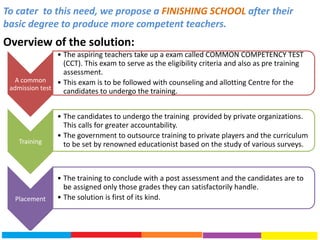
To cater to this need, we propose a FINISHING SCHOOL after their
basic degree to produce more competent teachers.
Overview of the solution:
A common
admission test
• The aspiring teachers take up a exam called COMMON COMPETENCY TEST
(CCT). This exam to serve as the eligibility criteria and also as pre training
assessment.
• This exam is to be followed with counseling and allotting Centre for the
candidates to undergo the training.
Training
• The candidates to undergo the training provided by private organizations.
This calls for greater accountability.
• The government to outsource training to private players and the curriculum
to be set by renowned educationist based on the study of various surveys.
Placement
• The training to conclude with a post assessment and the candidates are to
be assigned only those grades they can satisfactorily handle.
• The solution is first of its kind.
Establishment of the Finishing Schools
Building:
 Government to allot a special section of the
financial budget to build and maintain such
schools , one at each district.
 Commissioning a Secretariat at the CM level
to look after the interim processes.
 The Secretariat to work in close association
with PWD office during this process.
 Depending on the staffing statistics and the
population of each district, a building of
required capacity is to be built. The building
must consist of all the required amenities
and also the classrooms are to be digitized.
The District Commissioner to aid in
allocating the land.
Funding:
 As stated earlier, some portion of the
financial budget to be kept aside to build
and maintain such schools.
 Apart from this, the COMMON
COMPETENCY TEST can only be taken up at
some entrance fee and also the nominal
fees collected from candidates for the
training.
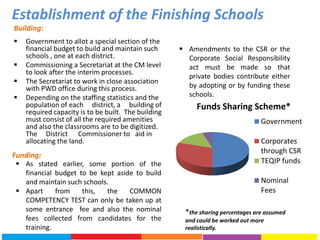
 Amendments to the CSR or the
Corporate Social Responsibility
act must be made so that
private bodies contribute either
by adopting or by funding these
schools.
Funds Sharing Scheme*
Government
Corporates
through CSR
TEQIP funds
Nominal
Fees
*the sharing percentages are assumed
and could be worked out more
realistically.
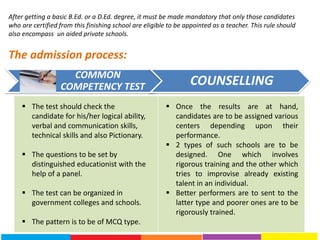
COMMON
COMPETENCY TEST COUNSELLING
After getting a basic B.Ed. or a D.Ed. degree, it must be made mandatory that only those candidates
who are certified from this finishing school are eligible to be appointed as a teacher. This rule should
also encompass un aided private schools.
The admission process:
 The test should check the
candidate for his/her logical ability,
verbal and communication skills,
technical skills and also Pictionary.
 The questions to be set by
distinguished educationist with the
help of a panel.
 The test can be organized in
government colleges and schools.
 The pattern is to be of MCQ type.
 Once the results are at hand,
candidates are to be assigned various
centers depending upon their
performance.
 2 types of such schools are to be
designed. One which involves
rigorous training and the other which
tries to improvise already existing
talent in an individual.
 Better performers are to sent to the
latter type and poorer ones are to be
rigorously trained.
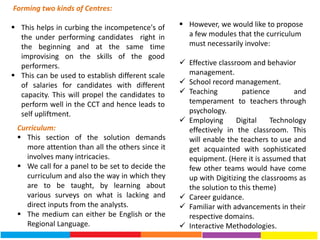
Forming two kinds of Centres:
 This helps in curbing the incompetence's of
the under performing candidates right in
the beginning and at the same time
improvising on the skills of the good
performers.
 This can be used to establish different scale
of salaries for candidates with different
capacity. This will propel the candidates to
perform well in the CCT and hence leads to
self upliftment.
Curriculum:
 This section of the solution demands
more attention than all the others since it
involves many intricacies.
 We call for a panel to be set to decide the
curriculum and also the way in which they
are to be taught, by learning about
various surveys on what is lacking and
direct inputs from the analysts.
 The medium can either be English or the
Regional Language.
 However, we would like to propose
a few modules that the curriculum
must necessarily involve:
 Effective classroom and behavior
management.
 School record management.
 Teaching patience and
temperament to teachers through
psychology.
 Employing Digital Technology
effectively in the classroom. This
will enable the teachers to use and
get acquainted with sophisticated
equipment. (Here it is assumed that
few other teams would have come
up with Digitizing the classrooms as
the solution to this theme)
 Career guidance.
 Familiar with advancements in their
respective domains.
 Interactive Methodologies.
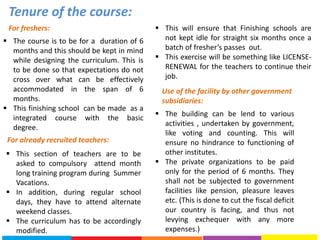
Tenure of the course:
For freshers:
 The course is to be for a duration of 6
months and this should be kept in mind
while designing the curriculum. This is
to be done so that expectations do not
cross over what can be effectively
accommodated in the span of 6
months.
 This finishing school can be made as a
integrated course with the basic
degree.
For already recruited teachers:
 This section of teachers are to be
asked to compulsory attend month
long training program during Summer
Vacations.
 In addition, during regular school
days, they have to attend alternate
weekend classes.
 The curriculum has to be accordingly
modified.
 This will ensure that Finishing schools are
not kept idle for straight six months once a
batch of fresher’s passes out.
 This exercise will be something like LICENSE-
RENEWAL for the teachers to continue their
job.
Use of the facility by other government
subsidiaries:
 The building can be lend to various
activities , undertaken by government,
like voting and counting. This will
ensure no hindrance to functioning of
other institutes.
 The private organizations to be paid
only for the period of 6 months. They
shall not be subjected to government
facilities like pension, pleasure leaves
etc. (This is done to cut the fiscal deficit
our country is facing, and thus not
levying exchequer with any more
expenses.)
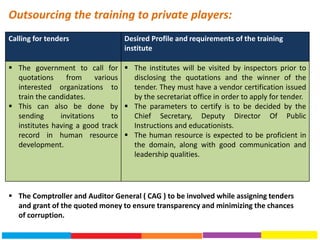
Calling for tenders Desired Profile and requirements of the training
institute
 The government to call for
quotations from various
interested organizations to
train the candidates.
 This can also be done by
sending invitations to
institutes having a good track
record in human resource
development.
 The institutes will be visited by inspectors prior to
disclosing the quotations and the winner of the
tender. They must have a vendor certification issued
by the secretariat office in order to apply for tender.
 The parameters to certify is to be decided by the
Chief Secretary, Deputy Director Of Public
Instructions and educationists.
 The human resource is expected to be proficient in
the domain, along with good communication and
leadership qualities.
Outsourcing the training to private players:
 The Comptroller and Auditor General ( CAG ) to be involved while assigning tenders
and grant of the quoted money to ensure transparency and minimizing the chances
of corruption.
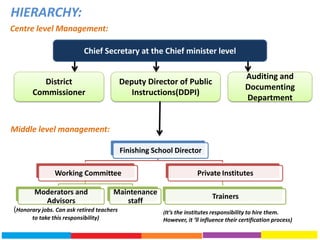
HIERARCHY:
Centre level Management:
Chief Secretary at the Chief minister level
Auditing and
Documenting
Department
District
Commissioner
Deputy Director of Public
Instructions(DDPI)
Middle level management:
Finishing School Director
Working Committee
Moderators and
Advisors
Maintenance
staff
Private Institutes
Trainers
(Honorary jobs. Can ask retired teachers
to take this responsibility)
(It’s the institutes responsibility to hire them.
However, it ‘ll influence their certification process)
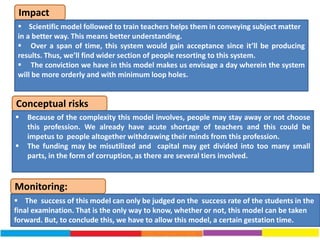
Impact
Conceptual risks
 Scientific model followed to train teachers helps them in conveying subject matter
in a better way. This means better understanding.
 Over a span of time, this system would gain acceptance since it’ll be producing
results. Thus, we’ll find wider section of people resorting to this system.
 The conviction we have in this model makes us envisage a day wherein the system
will be more orderly and with minimum loop holes.
 Because of the complexity this model involves, people may stay away or not choose
this profession. We already have acute shortage of teachers and this could be
impetus to people altogether withdrawing their minds from this profession.
 The funding may be misutilized and capital may get divided into too many small
parts, in the form of corruption, as there are several tiers involved.
Monitoring:
 The success of this model can only be judged on the success rate of the students in the
final examination. That is the only way to know, whether or not, this model can be taken
forward. But, to conclude this, we have to allow this model, a certain gestation time.
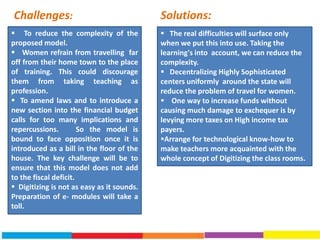
 To reduce the complexity of the
proposed model.
 Women refrain from travelling far
off from their home town to the place
of training. This could discourage
them from taking teaching as
profession.
 To amend laws and to introduce a
new section into the financial budget
calls for too many implications and
repercussions. So the model is
bound to face opposition once it is
introduced as a bill in the floor of the
house. The key challenge will be to
ensure that this model does not add
to the fiscal deficit.
 Digitizing is not as easy as it sounds.
Preparation of e- modules will take a
toll.
 The real difficulties will surface only
when we put this into use. Taking the
learning's into account, we can reduce the
complexity.
 Decentralizing Highly Sophisticated
centers uniformly around the state will
reduce the problem of travel for women.
 One way to increase funds without
causing much damage to exchequer is by
levying more taxes on High income tax
payers.
Arrange for technological know-how to
make teachers more acquainted with the
whole concept of Digitizing the class rooms.
Solutions:Challenges:
References:
1) Internet : Wikipedia
2) Manthan Resource files.
All the ideas presented are a product of deep thought and
deliberation. It was our will and to some extent, strategy to make
minimal use of internet as we wanted our work to be authentic
and 100% original. No hard facts or Numbers are used and hence
not many citations.

Manthan1

  • 1.
    MANTHAN TOPIC: STEPPINGSTONES FINISHING SCHOOL TO PRODUCE MORE COMPETENT TEACHERS KEERTIVARDHAN M .JOSHI, HARSHAVARDHAN M. JOSHI, KIRAN K.N. GARGI P.E., RAJATHA N. RAO SAPTHAGIRI COLLEGE OF ENGINEERING, BANGALORE.
  • 2.
    A comparison ofthe literacy rates of the countries which have gained independence in the 20th century .  58% of the children in India do not complete their primary education.  50% of the students are under- qualified for their existing grade. Scope: Causes:  70% of Indians live in villages and most of them inherit their traditional occupation. Assertion: They opt not to get educated since their daily bread is assured.  Poverty is one of the major hindrances to education. Assertion: The very reason for poverty is lack of education.  The lack of motivation to get educated. Assertion: This curbs the desire to grow. To sum it up, the potential of education is undermined. Why this topic? On a broader scale, each of the given fourteen themes is in some or the other way related to the fact that there is a lack of education.  India is a young nation. There are about 540 million youth and this number is bound to increase. To make tomorrow’s youth powerful and competent, it is imperative to ensure that today’s children are trained well.  The onus of this, obviously lies predominantly on the teachers. India CzechIsrael Bosnia 96% 99% 74% 89% [1] [2]
  • 3.
    To cater tothis need, we propose a FINISHING SCHOOL after their basic degree to produce more competent teachers. Overview of the solution: A common admission test • The aspiring teachers take up a exam called COMMON COMPETENCY TEST (CCT). This exam to serve as the eligibility criteria and also as pre training assessment. • This exam is to be followed with counseling and allotting Centre for the candidates to undergo the training. Training • The candidates to undergo the training provided by private organizations. This calls for greater accountability. • The government to outsource training to private players and the curriculum to be set by renowned educationist based on the study of various surveys. Placement • The training to conclude with a post assessment and the candidates are to be assigned only those grades they can satisfactorily handle. • The solution is first of its kind.
  • 4.
    Establishment of theFinishing Schools Building:  Government to allot a special section of the financial budget to build and maintain such schools , one at each district.  Commissioning a Secretariat at the CM level to look after the interim processes.  The Secretariat to work in close association with PWD office during this process.  Depending on the staffing statistics and the population of each district, a building of required capacity is to be built. The building must consist of all the required amenities and also the classrooms are to be digitized. The District Commissioner to aid in allocating the land. Funding:  As stated earlier, some portion of the financial budget to be kept aside to build and maintain such schools.  Apart from this, the COMMON COMPETENCY TEST can only be taken up at some entrance fee and also the nominal fees collected from candidates for the training.  Amendments to the CSR or the Corporate Social Responsibility act must be made so that private bodies contribute either by adopting or by funding these schools. Funds Sharing Scheme* Government Corporates through CSR TEQIP funds Nominal Fees *the sharing percentages are assumed and could be worked out more realistically.
  • 5.
    COMMON COMPETENCY TEST COUNSELLING Aftergetting a basic B.Ed. or a D.Ed. degree, it must be made mandatory that only those candidates who are certified from this finishing school are eligible to be appointed as a teacher. This rule should also encompass un aided private schools. The admission process:  The test should check the candidate for his/her logical ability, verbal and communication skills, technical skills and also Pictionary.  The questions to be set by distinguished educationist with the help of a panel.  The test can be organized in government colleges and schools.  The pattern is to be of MCQ type.  Once the results are at hand, candidates are to be assigned various centers depending upon their performance.  2 types of such schools are to be designed. One which involves rigorous training and the other which tries to improvise already existing talent in an individual.  Better performers are to sent to the latter type and poorer ones are to be rigorously trained.
  • 6.
    Forming two kindsof Centres:  This helps in curbing the incompetence's of the under performing candidates right in the beginning and at the same time improvising on the skills of the good performers.  This can be used to establish different scale of salaries for candidates with different capacity. This will propel the candidates to perform well in the CCT and hence leads to self upliftment. Curriculum:  This section of the solution demands more attention than all the others since it involves many intricacies.  We call for a panel to be set to decide the curriculum and also the way in which they are to be taught, by learning about various surveys on what is lacking and direct inputs from the analysts.  The medium can either be English or the Regional Language.  However, we would like to propose a few modules that the curriculum must necessarily involve:  Effective classroom and behavior management.  School record management.  Teaching patience and temperament to teachers through psychology.  Employing Digital Technology effectively in the classroom. This will enable the teachers to use and get acquainted with sophisticated equipment. (Here it is assumed that few other teams would have come up with Digitizing the classrooms as the solution to this theme)  Career guidance.  Familiar with advancements in their respective domains.  Interactive Methodologies.
  • 7.
    Tenure of thecourse: For freshers:  The course is to be for a duration of 6 months and this should be kept in mind while designing the curriculum. This is to be done so that expectations do not cross over what can be effectively accommodated in the span of 6 months.  This finishing school can be made as a integrated course with the basic degree. For already recruited teachers:  This section of teachers are to be asked to compulsory attend month long training program during Summer Vacations.  In addition, during regular school days, they have to attend alternate weekend classes.  The curriculum has to be accordingly modified.  This will ensure that Finishing schools are not kept idle for straight six months once a batch of fresher’s passes out.  This exercise will be something like LICENSE- RENEWAL for the teachers to continue their job. Use of the facility by other government subsidiaries:  The building can be lend to various activities , undertaken by government, like voting and counting. This will ensure no hindrance to functioning of other institutes.  The private organizations to be paid only for the period of 6 months. They shall not be subjected to government facilities like pension, pleasure leaves etc. (This is done to cut the fiscal deficit our country is facing, and thus not levying exchequer with any more expenses.)
  • 8.
    Calling for tendersDesired Profile and requirements of the training institute  The government to call for quotations from various interested organizations to train the candidates.  This can also be done by sending invitations to institutes having a good track record in human resource development.  The institutes will be visited by inspectors prior to disclosing the quotations and the winner of the tender. They must have a vendor certification issued by the secretariat office in order to apply for tender.  The parameters to certify is to be decided by the Chief Secretary, Deputy Director Of Public Instructions and educationists.  The human resource is expected to be proficient in the domain, along with good communication and leadership qualities. Outsourcing the training to private players:  The Comptroller and Auditor General ( CAG ) to be involved while assigning tenders and grant of the quoted money to ensure transparency and minimizing the chances of corruption.
  • 9.
    HIERARCHY: Centre level Management: ChiefSecretary at the Chief minister level Auditing and Documenting Department District Commissioner Deputy Director of Public Instructions(DDPI) Middle level management: Finishing School Director Working Committee Moderators and Advisors Maintenance staff Private Institutes Trainers (Honorary jobs. Can ask retired teachers to take this responsibility) (It’s the institutes responsibility to hire them. However, it ‘ll influence their certification process)
  • 10.
    Impact Conceptual risks  Scientificmodel followed to train teachers helps them in conveying subject matter in a better way. This means better understanding.  Over a span of time, this system would gain acceptance since it’ll be producing results. Thus, we’ll find wider section of people resorting to this system.  The conviction we have in this model makes us envisage a day wherein the system will be more orderly and with minimum loop holes.  Because of the complexity this model involves, people may stay away or not choose this profession. We already have acute shortage of teachers and this could be impetus to people altogether withdrawing their minds from this profession.  The funding may be misutilized and capital may get divided into too many small parts, in the form of corruption, as there are several tiers involved. Monitoring:  The success of this model can only be judged on the success rate of the students in the final examination. That is the only way to know, whether or not, this model can be taken forward. But, to conclude this, we have to allow this model, a certain gestation time.
  • 11.
     To reducethe complexity of the proposed model.  Women refrain from travelling far off from their home town to the place of training. This could discourage them from taking teaching as profession.  To amend laws and to introduce a new section into the financial budget calls for too many implications and repercussions. So the model is bound to face opposition once it is introduced as a bill in the floor of the house. The key challenge will be to ensure that this model does not add to the fiscal deficit.  Digitizing is not as easy as it sounds. Preparation of e- modules will take a toll.  The real difficulties will surface only when we put this into use. Taking the learning's into account, we can reduce the complexity.  Decentralizing Highly Sophisticated centers uniformly around the state will reduce the problem of travel for women.  One way to increase funds without causing much damage to exchequer is by levying more taxes on High income tax payers. Arrange for technological know-how to make teachers more acquainted with the whole concept of Digitizing the class rooms. Solutions:Challenges:
  • 12.
    References: 1) Internet :Wikipedia 2) Manthan Resource files. All the ideas presented are a product of deep thought and deliberation. It was our will and to some extent, strategy to make minimal use of internet as we wanted our work to be authentic and 100% original. No hard facts or Numbers are used and hence not many citations.