






National Education Policy 2020; Higher Education
:Teacher Education
Dr.Omprakash H.M, Professor
Head, S M R S M.Ed P.G. College
Reshmi Vidyabhavan, Sarswatipur
Behind G U K, Kusunoor Road
Gulbarga-585 106, Karnataka
Mobile No: +91 9901982999
E-mail: dr.omprakash322017@gmail.com
Visit my website: www.nanoteaching.com
Ll
L
L
l
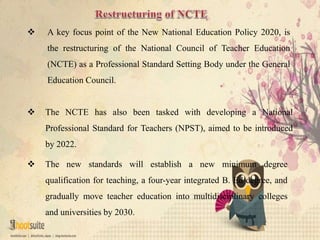
 A key focus point of the New National Education Policy 2020, is
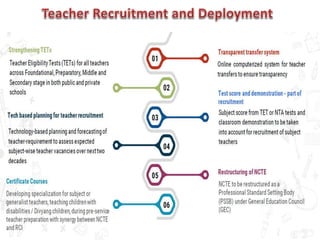
the restructuring of the National Council of Teacher Education
(NCTE) as a Professional Standard Setting Body under the General
Education Council.
 The NCTE has also been tasked with developing a National
Professional Standard for Teachers (NPST), aimed to be introduced
by 2022.
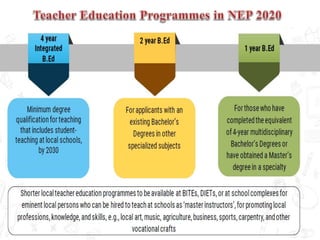
 The new standards will establish a new minimum degree
qualification for teaching, a four-year integrated B. Ed degree, and
gradually move teacher education into multidisciplinary colleges
and universities by 2030.
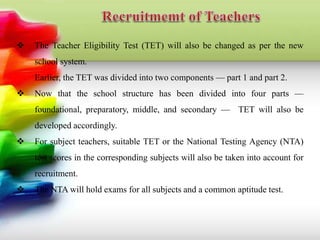
 The Teacher Eligibility Test (TET) will also be changed as per the new
school system.
Earlier, the TET was divided into two components — part 1 and part 2.
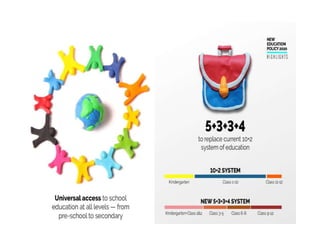
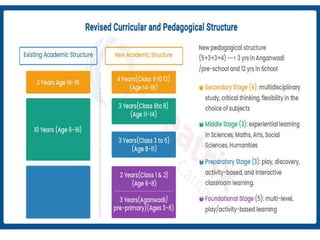
 Now that the school structure has been divided into four parts —
foundational, preparatory, middle, and secondary — TET will also be
developed accordingly.
 For subject teachers, suitable TET or the National Testing Agency (NTA)
test scores in the corresponding subjects will also be taken into account for
recruitment.
 The NTA will hold exams for all subjects and a common aptitude test.
 Those who qualify TET will have to give a demonstration or appear in an
interview, and show their knowledge of the local language, as per the new
policy.
 As per the NEP, “Interview will become an integral part of teacher hiring”.
These interviews would also assess comfort and proficiency in teaching in
the local language. It would be a must for teachers in private schools as well
to qualify TET.
 The hiring and vacancies in schools will be managed digitally. A technology-
based comprehensive teacher-requirement planning forecasting exercise will
be conducted by each state to assess expected subject-wise teacher vacancies
over the next two decades.
 To ensure that outstanding meritorious students enter the teaching profession
– especially from rural areas – a large number of merit-based scholarships
shall be instituted across the country for studying quality 4-year integrated
B. Ed programs.
 In rural areas, special merit-based scholarships will be established that also
include preferential employment in their local areas upon successful
completion of their B. Ed programmes.
 Such scholarships will provide local job opportunities to local students,
especially female students so that these students serve as local-area role
models and as highly qualified teachers who speak the local language.
 Teachers who have already been hired will be expected to participate in at
least 50 hours of continuous professional development (CPD) every year.
 CPD opportunities will cover latest pedagogies regarding foundational
literacy and numeracy. Formative & adaptive assessment of learning
outcomes, competency-based learning and related pedagogies.
 Platforms will be developed for teachers to share ideas/best practices.
 The merit-based structure of tenure, promotion, and salary structure will
be developed. Under this model, teachers will be incentivized. The
system of assessment will consist of multiple parameters. These
parameters will be developed by each state and will include peer reviews,
attendance, commitment, hours of CPD, and other forms of service to the
school and the community.
 Incentives will be provided for teachers to take up teaching jobs in rural
areas.
 Outstanding school teachers with demonstrated leadership and
management skills would be trained over time to take on academic
leadership positions
 A common guiding set of National Professional Standards for Teachers
(NPST) will be developed by 2022, by the National Council for Teacher
Education. The professional standards will be reviewed every 10 years.
 Teacher transfers will be halted, as per NEP 2020. Transfers will be allowed
in “very special circumstances”. Furthermore, transfers will be conducted
through an online computerized system that ensures transparency.
 “In order to fully restore the integrity of the teacher education system,
stringent action will be taken against substandard stand-alone Teacher
Education Institutions (TEIs) running in the country, including shutting them
down, if required,” as per NEP.
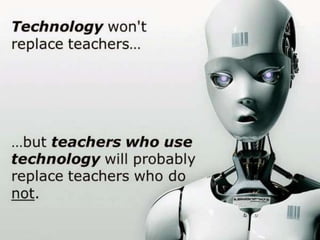
 Use of technology in teaching
In order to improve classroom process,
enable disadvantaged groups to have easy
access to classroom education and to
enable professional development of
teachers, the use of technology will be
encouraged to impart education to
students.
 For this purpose, New Educational
Technology Forum (NETF) will be set up.
With this, teachers will have to acquire the
skills to be technologically advanced.
 The policy calls for reduction in school curriculum to promote high
quality content, critical thinking and analysis-based learning. The
curriculum will be reduced to its core and there will be more of
interactive teaching instead of textbook learning.
 This would require CTET or TET qualified teachers to adapt ways to
make students understand the core essentials of the subjects and
develop critical thinking instead of rote learning.
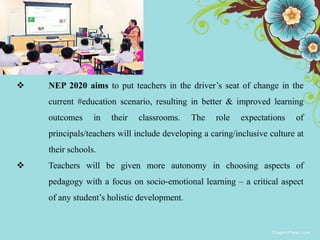
 NEP 2020 aims to put teachers in the driver’s seat of change in the
current #education scenario, resulting in better & improved learning
outcomes in their classrooms. The role expectations of
principals/teachers will include developing a caring/inclusive culture at
their schools.
 Teachers will be given more autonomy in choosing aspects of
pedagogy with a focus on socio-emotional learning – a critical aspect
of any student’s holistic development.
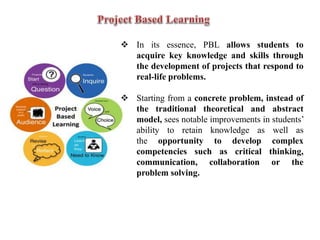
 In its essence, PBL allows students to
acquire key knowledge and skills through
the development of projects that respond to
real-life problems.
 Starting from a concrete problem, instead of
the traditional theoretical and abstract
model, sees notable improvements in students’
ability to retain knowledge as well as
the opportunity to develop complex
competencies such as critical thinking,
communication, collaboration or the
problem solving.
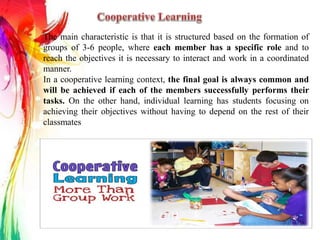
The main characteristic is that it is structured based on the formation of
groups of 3-6 people, where each member has a specific role and to
reach the objectives it is necessary to interact and work in a coordinated
manner.
In a cooperative learning context, the final goal is always common and
will be achieved if each of the members successfully performs their
tasks. On the other hand, individual learning has students focusing on
achieving their objectives without having to depend on the rest of their
classmates
The integration of game mechanics and
dynamics in non-ludic environments, or
gamification, has been practiced for a long
time. Over the past few years, however, and
particularly due to the evolution of
videogames, the phenomenon has gathered
unprecedented dimension, and is one of the
most talked about as a current and future
trend of the EdTech industry.
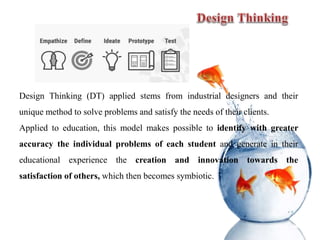
Design Thinking (DT) applied stems from industrial designers and their
unique method to solve problems and satisfy the needs of their clients.
Applied to education, this model makes possible to identify with greater
accuracy the individual problems of each student and generate in their
educational experience the creation and innovation towards the
satisfaction of others, which then becomes symbiotic.
The goal of Thinking-Based Learning
(TBL), developing thinking skills beyond memorization and, in
doing so, developing effective thinking on part of the students.
Teach them to contextualize, analyze, relate, argue… In short,
convert information into knowledge.
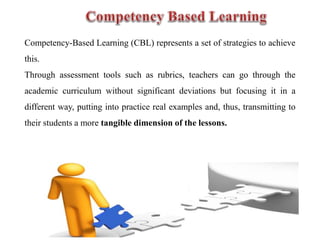
Competency-Based Learning (CBL) represents a set of strategies to achieve
this.
Through assessment tools such as rubrics, teachers can go through the
academic curriculum without significant deviations but focusing it in a
different way, putting into practice real examples and, thus, transmitting to
their students a more tangible dimension of the lessons.
439/5/2020

Dr.Omprakash H M-National Education Policy 2020;Higher Education: Teacher Education

  • 1.
    National Education Policy2020; Higher Education :Teacher Education Dr.Omprakash H.M, Professor Head, S M R S M.Ed P.G. College Reshmi Vidyabhavan, Sarswatipur Behind G U K, Kusunoor Road Gulbarga-585 106, Karnataka Mobile No: +91 9901982999 E-mail: dr.omprakash322017@gmail.com Visit my website: www.nanoteaching.com
  • 5.
  • 12.
     A keyfocus point of the New National Education Policy 2020, is the restructuring of the National Council of Teacher Education (NCTE) as a Professional Standard Setting Body under the General Education Council.  The NCTE has also been tasked with developing a National Professional Standard for Teachers (NPST), aimed to be introduced by 2022.  The new standards will establish a new minimum degree qualification for teaching, a four-year integrated B. Ed degree, and gradually move teacher education into multidisciplinary colleges and universities by 2030.
  • 15.
     The TeacherEligibility Test (TET) will also be changed as per the new school system. Earlier, the TET was divided into two components — part 1 and part 2.  Now that the school structure has been divided into four parts — foundational, preparatory, middle, and secondary — TET will also be developed accordingly.  For subject teachers, suitable TET or the National Testing Agency (NTA) test scores in the corresponding subjects will also be taken into account for recruitment.  The NTA will hold exams for all subjects and a common aptitude test.
  • 16.
     Those whoqualify TET will have to give a demonstration or appear in an interview, and show their knowledge of the local language, as per the new policy.  As per the NEP, “Interview will become an integral part of teacher hiring”. These interviews would also assess comfort and proficiency in teaching in the local language. It would be a must for teachers in private schools as well to qualify TET.  The hiring and vacancies in schools will be managed digitally. A technology- based comprehensive teacher-requirement planning forecasting exercise will be conducted by each state to assess expected subject-wise teacher vacancies over the next two decades.
  • 17.
     To ensurethat outstanding meritorious students enter the teaching profession – especially from rural areas – a large number of merit-based scholarships shall be instituted across the country for studying quality 4-year integrated B. Ed programs.  In rural areas, special merit-based scholarships will be established that also include preferential employment in their local areas upon successful completion of their B. Ed programmes.  Such scholarships will provide local job opportunities to local students, especially female students so that these students serve as local-area role models and as highly qualified teachers who speak the local language.
  • 18.
     Teachers whohave already been hired will be expected to participate in at least 50 hours of continuous professional development (CPD) every year.  CPD opportunities will cover latest pedagogies regarding foundational literacy and numeracy. Formative & adaptive assessment of learning outcomes, competency-based learning and related pedagogies.  Platforms will be developed for teachers to share ideas/best practices.
  • 19.
     The merit-basedstructure of tenure, promotion, and salary structure will be developed. Under this model, teachers will be incentivized. The system of assessment will consist of multiple parameters. These parameters will be developed by each state and will include peer reviews, attendance, commitment, hours of CPD, and other forms of service to the school and the community.  Incentives will be provided for teachers to take up teaching jobs in rural areas.  Outstanding school teachers with demonstrated leadership and management skills would be trained over time to take on academic leadership positions
  • 20.
     A commonguiding set of National Professional Standards for Teachers (NPST) will be developed by 2022, by the National Council for Teacher Education. The professional standards will be reviewed every 10 years.  Teacher transfers will be halted, as per NEP 2020. Transfers will be allowed in “very special circumstances”. Furthermore, transfers will be conducted through an online computerized system that ensures transparency.  “In order to fully restore the integrity of the teacher education system, stringent action will be taken against substandard stand-alone Teacher Education Institutions (TEIs) running in the country, including shutting them down, if required,” as per NEP.
  • 21.
     Use oftechnology in teaching In order to improve classroom process, enable disadvantaged groups to have easy access to classroom education and to enable professional development of teachers, the use of technology will be encouraged to impart education to students.  For this purpose, New Educational Technology Forum (NETF) will be set up. With this, teachers will have to acquire the skills to be technologically advanced.
  • 22.
     The policycalls for reduction in school curriculum to promote high quality content, critical thinking and analysis-based learning. The curriculum will be reduced to its core and there will be more of interactive teaching instead of textbook learning.  This would require CTET or TET qualified teachers to adapt ways to make students understand the core essentials of the subjects and develop critical thinking instead of rote learning.
  • 26.
     NEP 2020aims to put teachers in the driver’s seat of change in the current #education scenario, resulting in better & improved learning outcomes in their classrooms. The role expectations of principals/teachers will include developing a caring/inclusive culture at their schools.  Teachers will be given more autonomy in choosing aspects of pedagogy with a focus on socio-emotional learning – a critical aspect of any student’s holistic development.
  • 28.
     In itsessence, PBL allows students to acquire key knowledge and skills through the development of projects that respond to real-life problems.  Starting from a concrete problem, instead of the traditional theoretical and abstract model, sees notable improvements in students’ ability to retain knowledge as well as the opportunity to develop complex competencies such as critical thinking, communication, collaboration or the problem solving.
  • 29.
    The main characteristicis that it is structured based on the formation of groups of 3-6 people, where each member has a specific role and to reach the objectives it is necessary to interact and work in a coordinated manner. In a cooperative learning context, the final goal is always common and will be achieved if each of the members successfully performs their tasks. On the other hand, individual learning has students focusing on achieving their objectives without having to depend on the rest of their classmates
  • 30.
    The integration ofgame mechanics and dynamics in non-ludic environments, or gamification, has been practiced for a long time. Over the past few years, however, and particularly due to the evolution of videogames, the phenomenon has gathered unprecedented dimension, and is one of the most talked about as a current and future trend of the EdTech industry.
  • 31.
    Design Thinking (DT)applied stems from industrial designers and their unique method to solve problems and satisfy the needs of their clients. Applied to education, this model makes possible to identify with greater accuracy the individual problems of each student and generate in their educational experience the creation and innovation towards the satisfaction of others, which then becomes symbiotic.
  • 32.
    The goal ofThinking-Based Learning (TBL), developing thinking skills beyond memorization and, in doing so, developing effective thinking on part of the students. Teach them to contextualize, analyze, relate, argue… In short, convert information into knowledge.
  • 33.
    Competency-Based Learning (CBL)represents a set of strategies to achieve this. Through assessment tools such as rubrics, teachers can go through the academic curriculum without significant deviations but focusing it in a different way, putting into practice real examples and, thus, transmitting to their students a more tangible dimension of the lessons.
  • 43.