Revitalizing undergraduate
education
G E E T H A V E N KATA RA M A N
IS undergraduate education important? Before seeking answers to the question, we
should take note of the fact that most articles that are written concerning the state of
education in India are either on various aspects of school education or on higher
education, but in a macro sort of way. They seldom focus on undergraduate education. I
would like to argue that undergraduate education cannot be ignored; if anything it
requires focused attention. One simple reason is that undergraduate education is the most
important link that binds school education and the university system. School teachers as
well as faculty involved in teaching and research in any discipline have passed through
the portals of an undergraduate institution. Most jobs in the organized sector too currently
require the mandatory stamp of being a graduate. In this sense undergraduate education is
the central pivot that connects all the spokes in the wheel constituting the educated
populace of our country.
It seems a crime, therefore, that in discussions on higher education, there is at best only
lip service paid to the state of undergraduate education. Indeed, even when people do
recognize that the situation vis-à-vis undergraduate education is dire, the assessment is
that since the task of reforming undergraduate education is Herculean it seems best to
concentrate on more doable tasks which may bear fruit in the short run.
In Delhi University alone there are 79 undergraduate colleges affiliated to the university
with more than a lakh students and almost 7000 college teachers. In comparison, the
number of students in the 86 or so postgraduate departments of the university do not
exceed 10,000 and the number of faculty members in these departments is less than 3000.
This disparity in numbers is but natural since the ‘number pyramid’ narrows rapidly as
we ascend higher in the educational scale. Nevertheless the step-motherly treatment
shown in addressing issues that are vital and peculiar to undergraduate education is
downright unfair.
There is a somewhat different but equally important issue concerning the percentage of
graduates in our population. It has been argued that a growing economy like India’s
requires a much larger trained work-force than is currently available. While there can be
debate as to whether this training should be ‘vocational’, ‘professional’ or ‘academic’, or
even as to what percentage of our GDP ought to be invested in each of these, there can be
no doubt on the need for expansion of each of these sectors.
So we face the dual challenge of bringing in a much larger percentage of our population
into the higher education system and at the same time delivering a certain ‘quality of
product’ through our higher education system. The now famous statement of the
corporate sector that no more than 25 out of a hundred graduates are employable is a sad
reflection of the apathetic response of both our government and the participants in the
process of undergraduate education.
To expand higher education substantially without taking a closer look at the current
ailments that afflict the system as a whole, and undergraduate education in particular, is
akin to moving from the frying pan into the fire. While the discussion here focuses on the
ills that plague undergraduate education, a similar situation, if not worse, would be
prevalent as far as postgraduate education is concerned.
Before we concentrate on the current problems of the undergraduate system we need to
keep in mind that for school-leaving students, the state funded undergraduate college is a
place of reasonable academic quality where there is a blending and mixing of students of
varied backgrounds, both academic and otherwise. For a school-leaving student who has
not had access to good school education, especially those who complete school education
through the publicly funded school system, access to a state funded undergraduate college
is a matter of supreme importance. Thus the university system in India has to cope with
both increasing this level of access as also maintaining a reasonable quality of academic
education.
Let us consider a student who has spent the requisite three years studying for a Bachelor’s
degree. Ideally, irrespective of the type of employment or higher studies that the student
pursues, there are certain minimum qualifications which we hope the student would have
gained during this period – a certain amount of knowledge in his or her discipline of

study, good communication skills both verbal and written, some familiarity with using
computers and, most important, the capacity to formulate ideas, analyse them and to think
creatively. We would also like the student to have read books both in his or her discipline
and outside of it and equally, be aware of the world outside of academia.
The capacity to develop and hone the skills mentioned above depends primarily on the
ability of the student to think, notwithstanding the help that a well-designed syllabus and
examination system can render. The biggest damage done by our school system and
perpetuated by our system of higher education is the impairing of thinking faculties.
While curiosity is encouraged and even celebrated in young children, it is often ruthlessly
scotched later, the process intensifying as soon as they reach middle school.
Thinking skills are ironically sacrificed at the altar of completing a prescribed syllabus.
So when a student enters an undergraduate college, she has already been through several
years of education where the entire emphasis has been on learning to score well in
examinations. Unfortunately, with the kind of examinations that we excel in setting, both
in schools and in most universities, doing well in an examination indicates that we have
learnt to regurgitate memorized material well. This is also the main reason why tuition
and coaching centres flourish for school students and, worse still, for undergraduates and
even postgraduates in certain disciplines.
Perhaps there ought to be a reconsideration of what type of a school leaving examination
there should be. If we continue with an examination which measures a minimum standard
like the current senior secondary examinations, we must rethink whether the scores in
that should be the main criteria for admitting a student to study a discipline of her choice
at the undergraduate level.
The choice of course of study at the undergraduate level is usually influenced by many
factors. It is eminently possible that a student ends up studying a subject that she is not
really interested in or even has an aptitude for. Given these circumstances, what can be
done to help the undergraduate student achieve her potential and to equip her with a set of
skills for the future?
There are many improvements that one can envisage even in the current system. Some
of these can be easily implemented at the college level. The first of these would be to
disseminate the kind of courses of study that are part of undergraduate education to
school students. Often, the student who likes mathematics at school or has scored enough
to gain admission into a mathematics programme at the college level, realizes to her
dismay that college level mathematics does not bear any similarity to what she did at
school.
While at school the student mainly learnt methods and formulae to solve numerical
questions, at the undergraduate level mathematics is all about why these methods and
formulae work. The subject is abstract, theoretical and delves deep into structures.
Counselling by faculty at colleges, open days for school students, well-produced
literature emphasizing such facts and informative departmental websites, can prevent
students from making wrong choices. These days there are so many options available to a
student completing an undergraduate degree in terms of future study and employment
that there is no compulsion for a student to choose one course over the other, purely in
terms of the ‘employability factor’.
Once a student is admitted to an undergraduate programme, the teacher can and should
lay emphasis on teaching styles and practices that will help the student to think rather
than reproduce material. One can start by encouraging the student to read widely and to
ask questions. Once the class is interactive it automatically cuts out passive reception.
Class assignments and tests should have a major component of ‘unseen’ questions that
require thinking. Assigning group projects that require students to work together, making
students present short lectures or seminars and write essays and book or chapter reviews,
are all means that will take us closer to our goals. All this of course requires enthusiasm,
commitment and zeal from the teachers. But should this not be considered the absolute
minimum that a teacher can contribute from within?
This brings us to another crucial issue. Obviously the average teacher at the
undergraduate level is not doing these things, otherwise we would not be in the morass
we are in. The working conditions of an undergraduate teacher are not designed to attract
and retain the best of our academically inclined students. Should a teacher of such calibre
stray into the system, she soon realizes that the current system neither rewards a good
teacher nor, at the same time, punish a bad one. It simply treats everyone in the same
way. There are few incentives for a teacher to improve academically and there are no
disincentives to prevent teachers from becoming ‘non-academic teachers’. It is only a
teacher’s self motivation and conscience that stands in the way of a fall in standards,
assuming of course that these were high to start with.
The minimum qualification required for a lecturer at an undergraduate college is just a
master’s degree and the clearing of a national eligibility examination. Once one gains
‘permanent’ employment as a lecturer it is next to impossible to be removed, even if one
has not been doing the basic task of ‘attending classes’ as a ‘teacher’. One is almost
certainly ensured the two promotions possible in ones career in a time-bound way,
euphemistically called ‘merit promotions’. The minimum requirement for these
promotions is to have audited a certain number of three week long ‘orientation’ and
‘refresher courses’.
If we have impaired our students’ thinking abilities by wrong emphasis on rote learning
and marks, then we have certainly killed any chance of attracting and retaining our
academic talent in academia with the current set-up. Add to this the fact that pay scales
and the perquisites in academia are in no competition whatsoever with other sectors of
employment.
Many teachers do not have a wider interest in the discipline that they teach. One is not
talking of research interests but rather a basic curiosity that any individual participating in
the discipline is expected to have. Most teachers would answer in the negative to the
following questions, even in the best of the colleges that we have today:
1. What new books or material have you consulted for delivering your lectures?
2. Have you during the academic year learnt something new from classroom discussions
in the paper you are teaching?
3. Have you read any articles in academic journals during the year?
4. Have you been able to think of any new questions (at various levels) to discuss/ set in
assignments or tests for your students?
5. Have you made sure that at least a certain percentage of questions asked in your test
are those not seen by your student but are of the sort that a bright student can think and
solve to a large extent?
Again, one can perhaps think of some small measures that might help. Make it
mandatory for the students to give their feedback through a well-designed response form:
starting with the percentage of classes that the teacher has taken to the actual quality of
teaching, reference materials provided, types of assignments, projects and tests given, etc.
These should be made public. The teachers should also be required to publicly post a self-
assessment of what they have achieved academically, say in the past two years. This will
certainly prevent them from resting on laurels like a gold-medal gathering dust for 25
years! Overall there should be strong academic accountability measures in place for
teachers with promotions tied to real academic output rather than (in-) convenient audits.
Alongside, we must address the needs of an undergraduate who is perhaps ill-prepared
for the course that she has taken. There is a requirement for bridge courses that can help
the student. This need could be addressed via e-learning platforms and by involving
research scholars and graduate students in teaching these courses. We should design, as
part of the syllabi, short mandatory courses in writing as also modules that build up basic
computer skills for students who need them. Most crucially, the examination system
needs to stop awarding students high marks for reproducing rote answers to known
questions. All this would certainly ameliorate the situation in undergraduate education
and possibly act a s an incentive for the teacher to ransack the library!
Maybe much of what we have discussed is not new or unknown to people who are part
of academia. So why have these measures not been put in place? Actually a better
question to ask would be, ‘who will bell the cat’? Any mandatory measure which requires
a teacher to put in more effort is likely to be strenuously opposed by the teaching
community. Leaving such measures to the personal choice of the teacher too will not be
able to overcome the inertia that the ‘teacher at rest’ possesses in the current system. It
requires strong political and administrative will to carry out such reform. Add to this
bubbling cauldron the fact that even if rules and regulations are in place, in practice, our
administrators at the university and college level are masters at sweeping disliked rules
under the carpet and at throwing the university (rule) red book out of the window.
Yet, one can only hope that some day we will be able to build academic institutions that
celebrate academia, that we will have institutional frameworks that last beyond the
individual, and that professionalism will dominate personal animosities. This is because
the times that we live in will force us to evolve, for to continue on our current path can
only lead to the extinction of academic institutions.
The problem
‘Is there a World Cup for embroidery?’ cries Shanta, a 25 year old Lambani tribal
exuberantly. ‘If so, I am going to win it!’ Shanta is one of 300 Lambani women
embroiderers Dastkar works with in Karnataka. She has just heard that she is the
youngest ever recipient of the National Master Craftsperson Award.
What actually prevents women like Shanta – talented, feisty, incredibly bright, a bit of a
rebel (at 18 she left a marriage that went wrong, had a child out of wedlock, and now
lives on what she earns by her embroidery) – becoming an international designer-
entrepreneur like Ritu Kumar, or a cultural celebrity like Anjoli Ela Menon? Why don’t
they feature on Page 3 or the Economic Times? The answer is a combination of education,
opportunity and social conditioning. Crafts and craftspeople are simply not part of the
mental makeup and mainstream structure of contemporary India. As another Dastkar
craftsperson, Shiva Kashyap, a Madhubani painter from North Bihar, said sadly, ‘We may
be wage earners but we are still walking on someone else’s feet. Because we lack the
tools of education and language, we are still dependent.’
Two years back, I was asked to be part of the National Curriculum Review – presaging a
major overhaul of the Indian educational system. My specific task was to head and
coordinate a subcommittee to integrate ‘Heritage Crafts’ into the school curriculum. The
NCERT committee, consisted of academics, artists, craft authorities, teachers, NGOs,
proponents of alternative education, representatives from KVIC (Khadi and Village
Industries Commission), NID (National Institute of Design), CCRT (Centre for Cultural
Resources and Training), Bal Bhavan, and Shanti Niketan. Others joined us at the
meetings to present views and suggestions.
Our overall vision was a rounded and holistic education that equipped the Indian youth of
today for the challenges of a global and rapidly developing society while preserving their
own cultural assets, traditions and values. We wanted to incorporate the cultural, social
and creative attributes of craft into the educational system through both theory and
practice, and to ensure that craft was viewed as a professional skill, leading to
employment opportunities.
As someone said, ‘Tell me and I’ll forget, show me and I may not remember, involve me
and I’ll understand.’
Knowledge is an experience not a formula.
There are some sobering facts that set the scene and focused our minds:
* India is home to 16% of the world’s population.
* India spends 3.8% of its GDP on education and 46% of its population of 15 plus is
illiterate.
* Since most of the population growth in India is taking place amongst those who will
have the least skills/education when entering the job market, India is likely to be
inundated with either completely illiterate or poorly schooled youth and children.
* With 388 million children under 15 years of age, India is facing a major challenge on
the educational front.
* 54% of adults in India cannot read or write.
* Craftspeople form the second largest employment sector in India, second only to
agriculture. One in every 200 Indians is an artisan.
We had other concerns: Did the term ‘heritage’ send out wrong, revivalist, ‘dead history’
messages to the young? Should the study of heritage crafts be confined to traditional
Indian crafts, or extend to contemporary and non-indigenous techniques? How does one
make the study of craft relevant and exciting to the urban young? How could the practical
experience of working with crafts be translated to textbooks and manuals given the
already overcrowded curriculum, and a lack of trained and sensitized teachers. Or ensure
that craft should not become a second-class option for non-achievers and (very
importantly) that the study of heritage craft should not be highjacked or manipulated for
politico-cultural reasons.
A common accusation against Indians is that we have a greater ability to visualise dreams
than realise them. So we felt it important to develop a range of recommendations that
were practical, specific and accessible, backed by personal experience, data and
guidelines – building on the strengths rather than weaknesses of the system.
We were conscious of being the voice of a sector of over ten million practitioners with a
geographic spread across the entire country, and which covers a huge gamut of widely
differing work structures and cultures, employing widely differing techniques and
technologies, using materials that range from clay to precious metal. It is the largest
sector of employment after agriculture, and one of the largest contributors to the
economy, in export revenues as well as domestic sales.
In addition, craft can be used as a means of interpreting many social issues and ways of
life. Craft in India is so universally prevalent that it has over the centuries been used as a
metaphor for numerous philosophic, metaphysical and social concepts. Many words,
forms of measurement, colours and materials have a craft origin. The taana and baana of
life is something all of us are familiar with, yet take for granted. Caste, gender, religion,
and social practice all play significant, varying roles. All these differing criteria need to
be kept in consideration when we strategize. There is no generic answer – all we could
attempt to do is create an understanding of the diversity and complexity of the sector, as
we posed the question: Can exclusion be transformed into awareness? The contention of
our group was that it can, and craft, both practice and theory, can become a powerful tool
of emotional, economic and intellectual empowerment for children at all levels, locations
and sectors of school and society.
Phrases like craft and heritage carry a lot of baggage with them. In the Indian context,
they are especially emotive. To metro trendy young yuppies, they carry connotations that
are boring, passé and irrelevant; to others they carry all the echoes of a 5,000 year old
civilization with rich multiple cultures and traditions that each of us claims ownership to
and wants never to change. Some want the heritage clock to stop short at pre-Mughal
India; few recognise that craft never was and never should be static.
Contemporary Indians get terribly excited when an Indian enters space, wins a beauty
contest, or gets a silver medal at the Olympics. Sania Mirza entering the tennis top 100
has us agog. But few appreciate our unique distinction of having literally millions of
existing master craftspeople, practising skills that are no longer extant in the rest of the
world.
Paradoxically, while craft traditions are a unique mechanism for rural artisans entering
the economic mainstream for the first time, they also carry the stigma of inferiority and
backwardness as India enters a period of hi-tech industrialization and globalization. Craft
and the ancillary aspects of design and tradition are considered by activists and
economists, bureaucrats and business strategists, as peripheral and elitist. Craftspeople
are always seen as picturesque exhibits of our past, rather than dynamic entrepreneurs of
our present and future. We forget that one out of every 200 Indians is an artisan.
Hand craft is a production process and a wonderful indigenous technology, not an
outmoded tradition. The raw materials (cane, cotton, clay, wood, wool, silk, minerals) are
not only indigenously available but environmentally friendly. The existence of unique
living craft skills, techniques, designs and products is India’s great strength, not
weakness. This point needs to be emphasized in the school curriculum, and craft taught as
a professional expertise rather than a ‘hobby’.
One of the areas we focused on was a specialized stream of education for crafts pockets
where the bulk of the community are craftspeople. In India, the decision is often between
a craftsman’s child learning ancestral skills (while on the job, and contributing to the
family income in the process) while remaining academically illiterate or getting a
conventional education. Given the poor levels of rural and state-provided education,
formal schooling might not actually equip him for any job in the future.
Archana Kumari comes from a small village in one of the poorest and most deprived
areas of India – Muzaffarpur district in North Bihar. At age 14, she left school, earning a
pittance doing the traditional sujni embroidery of the area. At age 17 her creative skills
came to the notice of a local non-government organization, ADITHI and a Canadian
textile expert, Skye Morisson who together sent her to NIFT, the National Institute of
Fashion Technology on a scholarship. Despite being handicapped by her lack of English
and other academic skills, Archana regularly topped her class in NIFT, won a prize for the
Best Design Collection of the year, and has been accepted at NIFT for further studies on
her own merit. She says her hand skills and experience of working hands-on in craft have
given her an edge over the other students. Her regret is that the local school did not give
her and other children the early grounding that would have empowered them to be both
craftswomen and entrepreneurs.
As Cyrus Vakil, who headed one of the other NCERT subcommittees, rightly said:
‘Education is the primary means of economic mobility today.’
Craft skills should be on par with other vocational training, especially in traditional crafts
pockets, part of a properly structured curriculum, with trainers or parents paid to impart
the skill, rather than use children as unpaid labour. Equally important is the issue of
providing facilities for conventional education alongside those teaching traditional skills;
scheduling semesters and hours according to the work structures and seasonality of craft
production. Most young craftspeople do not attend school because school hours and
location make it impossible to avail of both disciplines. Much of craft production is
usually a seasonal affair, with peaks and lows according to market demands. School
terms and curricula could be organized accordingly.
In areas where craft is the primary activity, children should be able to opt for craft as a
course option, offered as a specialized stream in itself, learning ancillary skills like
product design, book keeping, display, merchandising and entrepreneurial skills. For
example, in a handloom weaving area, the course skills that should be taught include
entrepreneurship, money management, communication, textile design, draughtsmanship,
scale drawing, history of the craft, and technical skills. The young craftspeople should
also have exposure to other weaving styles, and the different yarns, counts, looms, as well
as interaction with other designers, artists and craftspeople.
To those of us now looking at the new millennium and seeking new directions for India,
the potential of crafts and craftspeople is something younger generations should be
sensitized to. Let us not lose sight of the fact that every ten years we lose ten per cent of
our craftspeople.
The steps needed to prepare and include crafts-people and take them forward as skilled
entrepreneurs and economic partners are something we must all introspect on and
develop – creating awareness of and building on the strengths rather than weaknesses of
each craft and craft community, and being sensitive to their different nuances and cultural
consciousness. Economics may be the driving need, but social, cultural and familial
concerns must also shape the direction and decision-making process. We need to take the
craftspeople with us. Learning to listen as well as speak is something we all need to learn.
There must be a shift from patronage to partnership.
‘I should be paid more, because I was thinking and doing,’ one Kalaraksha craftswoman
from Kutch succinctly said!
There has, rightly, been an outcry and proposed legislation against the exploitative
practice of child labour. However, in the craft sector with family trades, the age old
system of apprenticeship, properly regulated, could be developed as an alternative
education rather than exploitation. A blanket ban on children learning craft would lose out
on a unique opportunity to create a skilled workforce of potential high earners and self-
employment, in a country with rising unemployment and few employment avenues for
rural youth, especially home-based women. But let me also stress that in my view any
child under fifteen who is not at school is child labour.
Sadly, in the craft sector in India, the choice is often between a craftsman’s child learning
ancestral skills (while on the job, and contributing to the family income in the process)
while remaining academically illiterate or at best getting a conventional education. Given
the very poor levels of rural and state-provided education, such schooling might not
actually equip him for any job in the future. In Ranthambhore, the village school teacher
would report on duty to sign his daily attendance, and then go off to the forest as a tourist
guide!
For me, this is the crucial issue. Not poverty, which is often cited as a justification for
child labour, but whether there are alternative educational opportunities for a child which
would give him/her the same employment avenues? Can child labour be transformed –
through legislation and through innovative new planning and educational mechanisms –
into a vibrant new form of training and empowerment? In particular home-based
traditional industries, and those relating to women.
Training in craft skills, whether at home, or through the traditional guru-shishya
parampara, should be recognized as industrial training, and given the same support as
other technical and vocational education. The family, master craftsperson, cooperative
society, institution or NGO imparting the training should receive some stipend so that the
child rather than the employer receives any money (s)he may earn in the process.
Otherwise, there is the temptation, often succumbed to, of making the children bonded
labour under the guise of imparting a skill – as has happened in the brass industry in UP
and Andhra Pradesh, where craft has moved from a family occupation to an assembly-
line mass manufacture. The carpet industry is another notorious example, though
international pressure and legislation have forced some changes. The Rugmark Smiling
Carpet example, though not perfect in either concept or application, could be a module
for developing further strategies.
In a country as diverse and multidimensional as India, there is no one single solution, or
methodology. Working as part of the NCERT Focus Group we all agreed that:
* The inclusion of Heritage Crafts as a focus area in the National Curriculum Review for
the first time was a significant though belated recognition of the importance of the sector.
* This presented an unique opportunity to review and impact on the education system in
India today.
* The challenge is not only to develop an innovative, meaningful programme, but ensure
its implementation.
* Therefore the recommendations need to be accessible and adaptable to the situation and
resources (human and fiscal) of the government schools.
* Recommendations need to address the concerns of both parents and children, if they are
to be accepted.
* In a market-driven society, unless parents are convinced that the curriculum enhances
the professional development of the child, they will not extend support.
* The universal disillusionment and discontent, at every level, with the current
educational system presents both a challenge and an opportunity for change.
Specifically as regards craft:
* That Indian craft and its millions of practising craftspeople are a huge and important
resource of traditional knowledge and indigenous technologies.
* That this resource could be used to value-add to the educational system in a number of
ways.
* That craft should be taught both as a vocational, creative activity and as a theoretical
social science.
* That craft should not only be taught as a separate subject in its own right, but integrated
into the study of history, social and environmental studies, geography, arts and
economics, since it is an integral part of Indian culture, aesthetics and the economy.
* That craft is particularly suited to value-add to projects of all kinds – as an illustrative
teaching aid, and as a learning device.
* That experiencing and working hands-on with a craft medium can lead to learning that
is useful and enriching, whatever the discipline or profession a child may eventually
choose. Working with ones hands, materials and techniques helps in both understanding
processes and in problem solving.
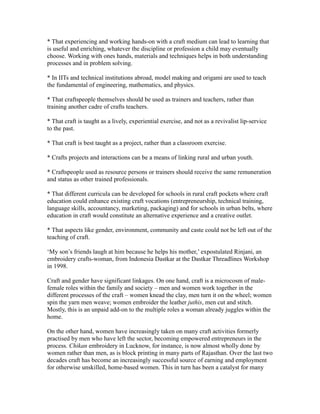
* In IITs and technical institutions abroad, model making and origami are used to teach
the fundamental of engineering, mathematics, and physics.
* That craftspeople themselves should be used as trainers and teachers, rather than
training another cadre of crafts teachers.
* That craft is taught as a lively, experiential exercise, and not as a revivalist lip-service
to the past.
* That craft is best taught as a project, rather than a classroom exercise.
* Crafts projects and interactions can be a means of linking rural and urban youth.
* Craftspeople used as resource persons or trainers should receive the same remuneration
and status as other trained professionals.
* That different curricula can be developed for schools in rural craft pockets where craft
education could enhance existing craft vocations (entrepreneurship, technical training,
language skills, accountancy, marketing, packaging) and for schools in urban belts, where
education in craft would constitute an alternative experience and a creative outlet.
* That aspects like gender, environment, community and caste could not be left out of the
teaching of craft.
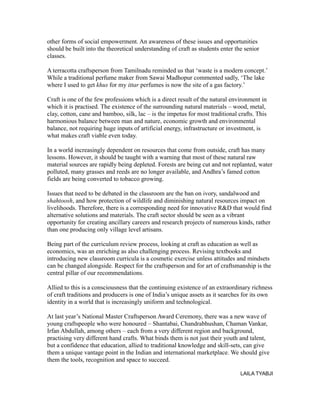
‘My son’s friends laugh at him because he helps his mother,’ expostulated Rinjani, an
embroidery crafts-woman, from Indonesia Dastkar at the Dastkar Threadlines Workshop
in 1998.
Craft and gender have significant linkages. On one hand, craft is a microcosm of male-
female roles within the family and society – men and women work together in the
different processes of the craft – women knead the clay, men turn it on the wheel; women
spin the yarn men weave; women embroider the leather juthis, men cut and stitch.
Mostly, this is an unpaid add-on to the multiple roles a woman already juggles within the
home.
On the other hand, women have increasingly taken on many craft activities formerly
practised by men who have left the sector, becoming empowered entrepreneurs in the
process. Chikan embroidery in Lucknow, for instance, is now almost wholly done by
women rather than men, as is block printing in many parts of Rajasthan. Over the last two
decades craft has become an increasingly successful source of earning and employment
for otherwise unskilled, home-based women. This in turn has been a catalyst for many
other forms of social empowerment. An awareness of these issues and opportunities
should be built into the theoretical understanding of craft as students enter the senior
classes.
A terracotta craftsperson from Tamilnadu reminded us that ‘waste is a modern concept.’
While a traditional perfume maker from Sawai Madhopur commented sadly, ‘The lake
where I used to get khus for my ittar perfumes is now the site of a gas factory.’
Craft is one of the few professions which is a direct result of the natural environment in
which it is practised. The existence of the surrounding natural materials – wood, metal,
clay, cotton, cane and bamboo, silk, lac – is the impetus for most traditional crafts. This
harmonious balance between man and nature, economic growth and environmental
balance, not requiring huge inputs of artificial energy, infrastructure or investment, is
what makes craft viable even today.
In a world increasingly dependent on resources that come from outside, craft has many
lessons. However, it should be taught with a warning that most of these natural raw
material sources are rapidly being depleted. Forests are being cut and not replanted, water
polluted, many grasses and reeds are no longer available, and Andhra’s famed cotton
fields are being converted to tobacco growing.
Issues that need to be debated in the classroom are the ban on ivory, sandalwood and
shahtoosh, and how protection of wildlife and diminishing natural resources impact on
livelihoods. Therefore, there is a corresponding need for innovative R&D that would find
alternative solutions and materials. The craft sector should be seen as a vibrant
opportunity for creating ancillary careers and research projects of numerous kinds, rather
than one producing only village level artisans.
Being part of the curriculum review process, looking at craft as education as well as
economics, was an enriching as also challenging process. Revising textbooks and
introducing new classroom curricula is a cosmetic exercise unless attitudes and mindsets
can be changed alongside. Respect for the craftsperson and for art of craftsmanship is the
central pillar of our recommendations.
Allied to this is a consciousness that the continuing existence of an extraordinary richness
of craft traditions and producers is one of India’s unique assets as it searches for its own
identity in a world that is increasingly uniform and technological.
At last year’s National Master Craftsperson Award Ceremony, there was a new wave of
young craftspeople who were honoured – Shantabai, Chandrabhushan, Chaman Vankar,
Irfan Abdullah, among others – each from a very different region and background,
practising very different hand crafts. What binds them is not just their youth and talent,
but a confidence that education, allied to traditional knowledge and skill-sets, can give
them a unique vantage point in the Indian and international marketplace. We should give
them the tools, recognition and space to succeed.
LAILA TYABJI
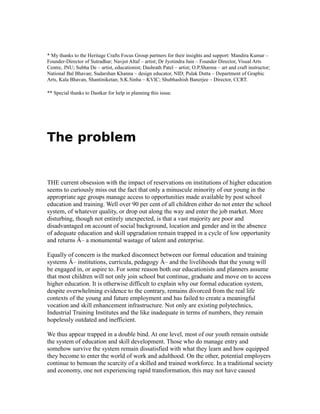
* My thanks to the Heritage Crafts Focus Group partners for their insights and support: Mandira Kumar –
Founder-Director of Sutradhar; Navjot Altaf – artist; Dr Jyotindra Jain – Founder Director, Visual Arts
Centre, JNU; Subha De – artist, educationist; Dashrath Patel – artist; O.P.Sharma – art and craft instructor;
National Bal Bhavan; Sudarshan Khanna – design educator, NID; Pulak Dutta – Department of Graphic
Arts, Kala Bhavan, Shantiniketan; S.K.Sinha – KVIC; Shubhashish Banerjee – Director, CCRT.
** Special thanks to Dastkar for help in planning this issue.
The problem
THE current obsession with the impact of reservations on institutions of higher education
seems to curiously miss out the fact that only a minuscule minority of our young in the
appropriate age groups manage access to opportunities made available by post school
education and training. Well over 90 per cent of all children either do not enter the school
system, of whatever quality, or drop out along the way and enter the job market. More
disturbing, though not entirely unexpected, is that a vast majority are poor and
disadvantaged on account of social background, location and gender and in the absence
of adequate education and skill upgradation remain trapped in a cycle of low opportunity
and returns – a monumental wastage of talent and enterprise.
Equally of concern is the marked disconnect between our formal education and training
systems – institutions, curricula, pedagogy – and the livelihoods that the young will
be engaged in, or aspire to. For some reason both our educationists and planners assume
that most children will not only join school but continue, graduate and move on to access
higher education. It is otherwise difficult to explain why our formal education system,
despite overwhelming evidence to the contrary, remains divorced from the real life
contexts of the young and future employment and has failed to create a meaningful
vocation and skill enhancement infrastructure. Not only are existing polytechnics,
Industrial Training Institutes and the like inadequate in terms of numbers, they remain
hopelessly outdated and inefficient.
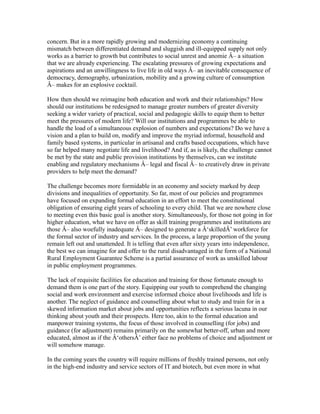
We thus appear trapped in a double bind. At one level, most of our youth remain outside
the system of education and skill development. Those who do manage entry and
somehow survive the system remain dissatisfied with what they learn and how equipped
they become to enter the world of work and adulthood. On the other, potential employers
continue to bemoan the scarcity of a skilled and trained workforce. In a traditional society
and economy, one not experiencing rapid transformation, this may not have caused
concern. But in a more rapidly growing and modernizing economy a continuing
mismatch between differentiated demand and sluggish and ill-equipped supply not only
works as a barrier to growth but contributes to social unrest and anomie – a situation
that we are already experiencing. The escalating pressures of growing expectations and
aspirations and an unwillingness to live life in old ways – an inevitable consequence of
democracy, demography, urbanization, mobility and a growing culture of consumption
– makes for an explosive cocktail.
How then should we reimagine both education and work and their relationships? How
should our institutions be redesigned to manage greater numbers of greater diversity
seeking a wider variety of practical, social and pedagogic skills to equip them to better
meet the pressures of modern life? Will our institutions and programmes be able to
handle the load of a simultaneous explosion of numbers and expectations? Do we have a
vision and a plan to build on, modify and improve the myriad informal, household and
family based systems, in particular in artisanal and crafts based occupations, which have
so far helped many negotiate life and livelihood? And if, as is likely, the challenge cannot
be met by the state and public provision institutions by themselves, can we institute
enabling and regulatory mechanisms – legal and fiscal – to creatively draw in private
providers to help meet the demand?
The challenge becomes more formidable in an economy and society marked by deep
divisions and inequalities of opportunity. So far, most of our policies and programmes
have focused on expanding formal education in an effort to meet the constitutional
obligation of ensuring eight years of schooling to every child. That we are nowhere close
to meeting even this basic goal is another story. Simultaneously, for those not going in for
higher education, what we have on offer as skill training programmes and institutions are
those – also woefully inadequate – designed to generate a ‘skilled’ workforce for
the formal sector of industry and services. In the process, a large proportion of the young
remain left out and unattended. It is telling that even after sixty years into independence,
the best we can imagine for and offer to the rural disadvantaged in the form of a National
Rural Employment Guarantee Scheme is a partial assurance of work as unskilled labour
in public employment programmes.
The lack of requisite facilities for education and training for those fortunate enough to
demand them is one part of the story. Equipping our youth to comprehend the changing
social and work environment and exercise informed choice about livelihoods and life is
another. The neglect of guidance and counselling about what to study and train for in a
skewed information market about jobs and opportunities reflects a serious lacuna in our
thinking about youth and their prospects. Here too, akin to the formal education and
manpower training systems, the focus of those involved in counselling (for jobs) and
guidance (for adjustment) remains primarily on the somewhat better-off, urban and more
educated, almost as if the ‘others’ either face no problems of choice and adjustment or
will somehow manage.
In the coming years the country will require millions of freshly trained persons, not only
in the high-end industry and service sectors of IT and biotech, but even more in what
today are economically and socially ‘undervalued’ sectors and skills. As much as
doctors and engineers we need nurses and lab assistants, technicians, electricians and
masons – and this list can be expanded ad nauseam. A skilled workforce is needed not
just for the formal sector but in agriculture, forestry, dairying, the growing sector of retail
and so on. Equally, as much as for the job market, we need to create support mechanisms
for the self-employed – craftspersons and artisans – for skill upgradation, learning to
deal with changed market conditions and so on. Finally, the challenge is to engage with
not only the potential entrants to the workforce but also those currently employed and
either facing prospects of retrenchment and closure or seeking an improvement in their
prospects.
Education and training cannot and should not be reduced to merely meeting manpower
requirements for the production process. Of equal concern is the need to create an active
and socially concerned citizenry – one willing and able to engage in the adventure of
forging an inclusive, caring and optimistic nation. This issue of Seminar explores some
facets of the complex relationships between learning, livelihoods and growing up in the
hope that our young are better equipped to respond to the challenges of a rapidly
transforming environment.
Where do children go after
class VIII?
V I N O D RA I N A
WHERE do children go after class eight was the question that haunted us while running
the Hoshangabad Science Teaching Programme (HSTP) over thirty years (1972-2002) in
rural government middle schools of Madhya Pradesh. Since the programme ran in a
substantial number of schools – about 2000 – at the time (it was inexplicably
withdrawn in 2002 by the Madhya Pradesh government) and the class eight test was a
board examination, the issue was anything but minor.
Our concern was more pedagogical than developmental, though the two are inextricably
interwoven. Specifically, the predicament was whether to assume that the class eight
children would enter class nine in a secondary school, or was it more sensible to assume
that she would not be pursuing education anymore and class eight ought to be assumed as
the terminal stage of her education? The answer was critical in deciding the content and
process of the middle-board stage – whether it should have substantial linkages with the
secondary stage, or alternatively, stress a pedagogy more supportive to a child seeking
some form of livelihood, assuming that she would effectively drop-off from the formal
education system at this stage.
The prevailing situation was of course contradictory. The official syllabus, content and
process was based on the assumption that each child would not only enter the secondary
stage, but continue into higher education. But in actual fact, the drop-off rate by class
eight in Madhya Pradesh at that time was above 70% (it is not much lower now). Of a
hundred children admitted to class one, one could safely assume that seventy would not
pursue secondary education. The question was – where do these seventy children go,
and what and how should they learn?
What was true of HSTP in Madhya Pradesh then is obviously true for the entire country,
then and now, though with degrees of variation between states. Nationally, only around
5% of our children in the 6-14 age-group, numbering around 200 million, enter the higher
education stage, and presumably find vocations and livelihoods commensurate with their
educational attainments. What then is the relationship between education and livelihoods
for the staggering 95% children who do not participate in higher education?
The restricted nature of such a query that seeks to explore links between education and
livelihoods, could justifiably provoke a counter question – isn’t the purpose of
education larger than merely preparing children for the job market? If so, how does it
matter at which stage they terminate their education, so long as at each stage they receive
a liberal education of adequate quality that moulds their creative potential and shapes
qualities of good citizenship, a viewpoint closely resembling that held by Tagore.
Admittedly, this larger purpose of education should never escape our vision, but it is
equally important to keep in mind that the aspiration of every child in school, and of their
parents, is that not only will education make a child ‘siyana’(worldly-wise) but also
help them find a decent livelihood. Whereas it would be improper to reduce the purpose
of education to mere livelihoods, it would be equally wrong to assert that education has
nothing to do with acquiring knowledge and skills suitable for a vocation and livelihood.
Since GandhiÂ’s vision of education for a new India, in particular the nai talim
formulations, stressed on linking education with work as a means for social
transformation, the inherent difference between his and TagoreÂ’s approaches,
exemplified by nai talim schools and Shantiniketan, led to a vigorous debate between
these giants which ought to be cherished as a great intellectual heritage of our country.
Unfortunately, intellectual heritage rarely shapes our bureaucratic processes. Many years
ago, it appeared that the powers that be chose to jettison Tagore and opt for Gandhi by
dumping the term education from the concerned ministry and replacing it with ‘Human
Resource DevelopmentÂ’. In bureaucratic terms it only meant an inconvenience, like
having to reprint different letterheads, but in educational and intellectual terms this was a
significant departure, implying that henceforth, education would have the reduced
purpose of linking it to the production of human resources for the labour market. Even
though the move remains intriguing and questionable, unfortunately the opportunity it
provided to experiment with Gandhian ideas linking work and livelihoods to education
never materialized, rendering the entire exercise as merely cosmetic. Nor, as will be
subsequently argued, did it result in ensuring that a majority of children become
‘educated’ human resources for development.
In order to uncover the massive exclusion in the education ladder, and hence to decent
vocations, let us examine the relevant data from the primary to the higher levels. The 86th
amendment of the Constitution makes education a fundamental right for children between
the age groups 6 to 14. In other words, it is now mandatory for the state to provide eight
years of education, free of charge, to all children of the country. Under the directive
principle contained in the original Article 45 of the Constitution, this should have been
achieved by 1960, since the Constitution directed that this objective be achieved within
ten years from the date it became operative, which was 1950. (One cannot omit to
mention, with a sense of anguish and anger, that the 86th amendment through the new
Article 21A denies the child population of 0-6 years the fundamental right to Early Child
Care and Education, ECCE).
So what is the situation 46 years after this deadline expired? The population of 6 to 14
year olds in the country, as mentioned earlier, is around 20 crore. Of these: the number of
children in primary schools is around 12.2 crore; in middle schools it is around 4.7 crore.
That makes a total of around 17 crore children in the 6-14 age group who interact with
the school. One says interact because the drop-off rate from class 1-5 at the primary, and
class 1-8 at middle levels is 35.9 and 52% respectively, implying that of the 17 crore
children enrolled in classes 1-8, over 8.5 crore drop-off. The conclusion is obvious; of the
20 crore children in the 6-14 age group, around three crore remain unenrolled and about
8.5 crore drop-off. Taken together, we have the staggering fact that more than half the
children, around 11.5 crore, in the age group covered by the fundamental right to eight
years of free education as enjoined by the Constitution, do not enjoy that right. That the
excluded mainly belong to the socially marginalized communities like dalits, adivasis,
OBCs and girls, as also the poor ought to be self-evident.
Such a major exclusion at the very base of the education ladder is the chief malady
affecting the entire education system, tainting its higher forms. We are aware that
millions of children in India are either not allowed to be born through foeticide,
particularly the girl child, or die at an early age. Of those who are allowed to live,
numbering 20 crore in the 6-14 age group, one can say that around three crore suffer
educational foeticide (as never enrolled) and nearly 8.5 crore are victims of educational
infanticide (as drop-outs). This constitutes a demographic and educational catastrophe
whose magnitude exceeds that of sub-Saharan Africa.
The situation obviously replicates itself as we go up the educational ladder:
* The number of students at the class 9 and 10 level in schools numbers 2.2 crore.
* At class 11 and 12, this number reduces by half to 1.1 crore.
* At graduate and post graduate level, the enrolment is around 76 lakh.
* Engineering/Technology/Architecture account for around seven lakh.
* Medicine has an enrolment of a mere three lakh students.
* Agriculture and Forestry together have about 55,000 students.
The filters on the way up on the education ladder therefore exclude the following
numbers at each stage:
* From primary to middle level, of the 12.2 crore enrolled, about 7.5 crore are eliminated.
* From middle (class 8) to class 10, of 4.7 crore around 2.5 crore children are eliminated.
* Most astonishingly, of the 2.2 crore children in class 10, half of them, 1.1 crore children
are filtered out by class 12! This should give us some idea about the degree of failure at
the class 10 board examination, and the accompanying trauma for the sixteen year
adolescents.
* It would appear that of the slightly over one crore students at class 12 level, a majority
migrate to some kind of higher education, the general three year degree being the most
dominant (nearly half). Taking all forms of post-class 12 courses, the total number,
however, constitutes only about 7% of children that enroll at the primary level, and only
around 5% of the total population of 6-14 year olds.
The conclusion is inescapable – of 100 children in the 6-14 age group, three never
enroll, about 24 reach the middle school level, around 11 the class 10 level, around six
the class 12 level, around four the graduate and post graduate level, and one-half enter
technical areas like engineering, technology, architecture and medicine.
That means around 90 children out of 100, or around 18 crore children out of the total 6-
14 population of 20 crore, are out of the education scene by class eight. Which brings us
back to our original question – where do they go? What kind of livelihoods do they
engage in? And what are the pedagogical implications of such a massive exclusion? If
only around five children out of 100 move into a graduate degree and above, what kind of
knowledge and pedagogical links should each stage of education have with each other?
Does it make sense to first determine the content of knowledge at the post-graduate level
and then work backwards to what a child should learn at each stage? If 95 out of 100
children do not go beyond class 12, how should the content and pedagogy be determined
up to class eight and class 12 levels? And what are the implications of this massive
exclusion on manpower planning?
Before we examine the above questions, let us assume that in order to fulfil some basic
norms of social justice, as also to ensure the availability of adequate, educated and
competent workforce at each level, at least 25% of children in primary schools should
move into higher education. What are the conditions required for that to happen? Given
that the 6-14 population is around 20 crore, the movement of 25% amongst them would
mean that instead of about one crore currently able to make their way into higher
education around five crore should be able to do so.
Many factors would determine the movement of around 25% children to higher
education, but here we shall limit ourselves to the question of finances. Though
institutional capacity, governance systems, socio-cultural factors and academic
considerations are significant in determining the progress in the educational ladder,
public spending on education is obviously a key determining factor in deciding what kind
of opportunities the marginalized sections would have in pursuing education at higher
levels.
Beginning with the specific recommendation of the Kothari Commission in 1966, that the
responsibility of the state should be to invest at least 6% of GDP in education, this figure
has since guided discussion on the quantum of public funding in education. It is worth
recollecting that the figure emerged from evidence the world over, that educationally
sound countries have invested a minimum of 6% of GDP or more of public funds in
education, irrespective of the kind of political system they operated under, capitalist or
socialist.
To fast track this well-known debate about the public under-funding of Indian
education, let us focus on the commitment in the National Common Minimum
Programme of the present UPA government; that public funding on education will be
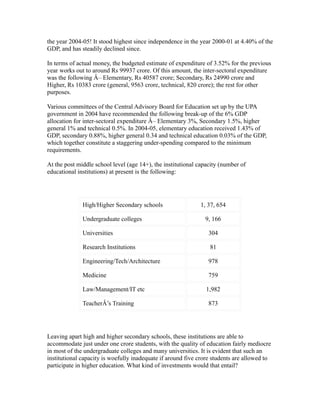
raised to 6% of the GDP in a ‘phased manner’. The curious fact is that state funding
on education has in fact reduced from 3.81% in the year 2003-04 to 3.52% of the GDP in
the year 2004-05! It stood highest since independence in the year 2000-01 at 4.40% of the
GDP, and has steadily declined since.
In terms of actual money, the budgeted estimate of expenditure of 3.52% for the previous
year works out to around Rs 99937 crore. Of this amount, the inter-sectoral expenditure
was the following – Elementary, Rs 40587 crore; Secondary, Rs 24990 crore and
Higher, Rs 10383 crore (general, 9563 crore, technical, 820 crore); the rest for other
purposes.
Various committees of the Central Advisory Board for Education set up by the UPA
government in 2004 have recommended the following break-up of the 6% GDP
allocation for inter-sectoral expenditure – Elementary 3%, Secondary 1.5%, higher
general 1% and technical 0.5%. In 2004-05, elementary education received 1.43% of
GDP, secondary 0.88%, higher general 0.34 and technical education 0.03% of the GDP,
which together constitute a staggering under-spending compared to the minimum
requirements.
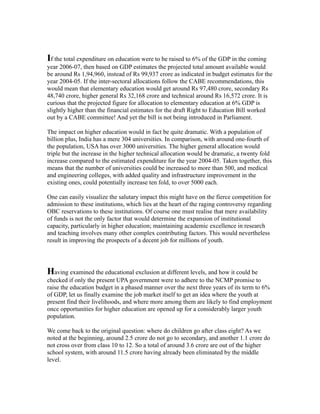
At the post middle school level (age 14+), the institutional capacity (number of
educational institutions) at present is the following:
High/Higher Secondary schools 1, 37, 654
Undergraduate colleges 9, 166
Universities 304
Research Institutions 81
Engineering/Tech/Architecture 978
Medicine 759
Law/Management/IT etc 1,982
TeacherÂ’s Training 873
Leaving apart high and higher secondary schools, these institutions are able to
accommodate just under one crore students, with the quality of education fairly mediocre
in most of the undergraduate colleges and many universities. It is evident that such an
institutional capacity is woefully inadequate if around five crore students are allowed to
participate in higher education. What kind of investments would that entail?
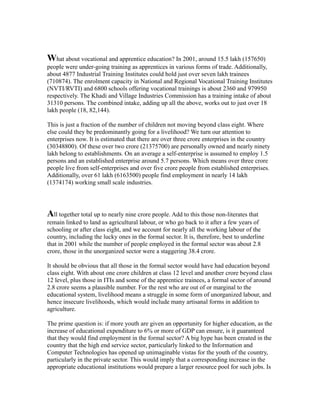
If the total expenditure on education were to be raised to 6% of the GDP in the coming
year 2006-07, then based on GDP estimates the projected total amount available would
be around Rs 1,94,960, instead of Rs 99,937 crore as indicated in budget estimates for the
year 2004-05. If the inter-sectoral allocations follow the CABE recommendations, this
would mean that elementary education would get around Rs 97,480 crore, secondary Rs
48,740 crore, higher general Rs 32,168 crore and technical around Rs 16,572 crore. It is
curious that the projected figure for allocation to elementary education at 6% GDP is
slightly higher than the financial estimates for the draft Right to Education Bill worked
out by a CABE committee! And yet the bill is not being introduced in Parliament.
The impact on higher education would in fact be quite dramatic. With a population of
billion plus, India has a mere 304 universities. In comparison, with around one-fourth of
the population, USA has over 3000 universities. The higher general allocation would
triple but the increase in the higher technical allocation would be dramatic, a twenty fold
increase compared to the estimated expenditure for the year 2004-05. Taken together, this
means that the number of universities could be increased to more than 500, and medical
and engineering colleges, with added quality and infrastructure improvement in the
existing ones, could potentially increase ten fold, to over 5000 each.
One can easily visualize the salutary impact this might have on the fierce competition for
admission to these institutions, which lies at the heart of the raging controversy regarding
OBC reservations to these institutions. Of course one must realise that mere availability
of funds is not the only factor that would determine the expansion of institutional
capacity, particularly in higher education; maintaining academic excellence in research
and teaching involves many other complex contributing factors. This would nevertheless
result in improving the prospects of a decent job for millions of youth.
Having examined the educational exclusion at different levels, and how it could be
checked if only the present UPA government were to adhere to the NCMP promise to
raise the education budget in a phased manner over the next three years of its term to 6%
of GDP, let us finally examine the job market itself to get an idea where the youth at
present find their livelihoods, and where more among them are likely to find employment
once opportunities for higher education are opened up for a considerably larger youth
population.
We come back to the original question: where do children go after class eight? As we
noted at the beginning, around 2.5 crore do not go to secondary, and another 1.1 crore do
not cross over from class 10 to 12. So a total of around 3.6 crore are out of the higher
school system, with around 11.5 crore having already been eliminated by the middle
level.
What about vocational and apprentice education? In 2001, around 15.5 lakh (157650)
people were under-going training as apprentices in various forms of trade. Additionally,
about 4877 Industrial Training Institutes could hold just over seven lakh trainees
(710874). The enrolment capacity in National and Regional Vocational Training Institutes
(NVTI/RVTI) and 6800 schools offering vocational trainings is about 2360 and 979950
respectively. The Khadi and Village Industries Commission has a training intake of about
31310 persons. The combined intake, adding up all the above, works out to just over 18
lakh people (18, 82,144).
This is just a fraction of the number of children not moving beyond class eight. Where
else could they be predominantly going for a livelihood? We turn our attention to
enterprises now. It is estimated that there are over three crore enterprises in the country
(30348800). Of these over two crore (21375700) are personally owned and nearly ninety
lakh belong to establishments. On an average a self-enterprise is assumed to employ 1.5
persons and an established enterprise around 5.7 persons. Which means over three crore
people live from self-enterprises and over five crore people from established enterprises.
Additionally, over 61 lakh (6163500) people find employment in nearly 14 lakh
(1374174) working small scale industries.
All together total up to nearly nine crore people. Add to this those non-literates that
remain linked to land as agricultural labour, or who go back to it after a few years of
schooling or after class eight, and we account for nearly all the working labour of the
country, including the lucky ones in the formal sector. It is, therefore, best to underline
that in 2001 while the number of people employed in the formal sector was about 2.8
crore, those in the unorganized sector were a staggering 38.4 crore.
It should be obvious that all those in the formal sector would have had education beyond
class eight. With about one crore children at class 12 level and another crore beyond class
12 level, plus those in ITIs and some of the apprentice trainees, a formal sector of around
2.8 crore seems a plausible number. For the rest who are out of or marginal to the
educational system, livelihood means a struggle in some form of unorganized labour, and
hence insecure livelihoods, which would include many artisanal forms in addition to
agriculture.
The prime question is: if more youth are given an opportunity for higher education, as the
increase of educational expenditure to 6% or more of GDP can ensure, is it guaranteed
that they would find employment in the formal sector? A big hype has been created in the
country that the high end service sector, particularly linked to the Information and
Computer Technologies has opened up unimaginable vistas for the youth of the country,
particularly in the private sector. This would imply that a corresponding increase in the
appropriate educational institutions would prepare a larger resource pool for such jobs. Is
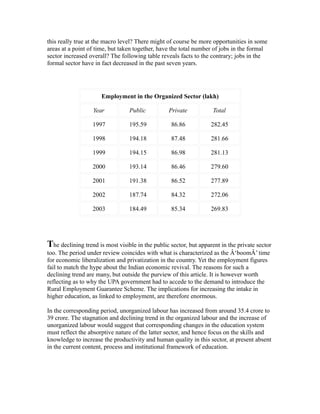
this really true at the macro level? There might of course be more opportunities in some
areas at a point of time, but taken together, have the total number of jobs in the formal
sector increased overall? The following table reveals facts to the contrary; jobs in the
formal sector have in fact decreased in the past seven years.
Employment in the Organized Sector (lakh)
Year Public Private Total
1997 195.59 86.86 282.45
1998 194.18 87.48 281.66
1999 194.15 86.98 281.13
2000 193.14 86.46 279.60
2001 191.38 86.52 277.89
2002 187.74 84.32 272.06
2003 184.49 85.34 269.83
The declining trend is most visible in the public sector, but apparent in the private sector
too. The period under review coincides with what is characterized as the ‘boom’ time
for economic liberalization and privatization in the country. Yet the employment figures
fail to match the hype about the Indian economic revival. The reasons for such a
declining trend are many, but outside the purview of this article. It is however worth
reflecting as to why the UPA government had to accede to the demand to introduce the
Rural Employment Guarantee Scheme. The implications for increasing the intake in
higher education, as linked to employment, are therefore enormous.
In the corresponding period, unorganized labour has increased from around 35.4 crore to
39 crore. The stagnation and declining trend in the organized labour and the increase of
unorganized labour would suggest that corresponding changes in the education system
must reflect the absorptive nature of the latter sector, and hence focus on the skills and
knowledge to increase the productivity and human quality in this sector, at present absent
in the current content, process and institutional framework of education.
So, while there may be need for a larger number of IITs IIMs, medical colleges and
universities to meet the aspirations of the increasingly richer middle class population
(with many of them aspiring to enter the labour market of countries other than India),
there is greater need to increase the capacity of appropriate agricultural institutions, small
scale industry training centres, ITIs for appropriate technologies and other low end
service sector areas, which are providing some form of employment, even though
insecure, to a much larger populace.
Likewise, the existing higher education institutions would require to get linked with those
areas of employment that are available to most, and that seems to be the unorganized
sector at present, unless massive economic changes are initiated to increase the formal
sector, particularly its public component. Appropriate changes in the school curriculum
might go a long way in arresting the non-participation, through the phenomenon of
dropping-off of a majority of children at the middle and secondary levels, which is a grim
reminder that the majority of children do not find the usual kind of education relevant to
their lives and livelihoods.
As to changes in the curriculum, it is strange that the ‘discarded’ notions of Gandhi,
which formed the basis of the nai talim formulations, should now seem so meaningful
that the NCERT in formulating the National Curriculum Framework 2005 thought of
revisiting them. Like the following:
‘…whatever may be true of other countries, in India at any rate where 80% of the
population is agricultural and another 10% industrial, it is a crime to make education
merely literary, and to make unfit boys and girls for manual work in after-life. Indeed I
hold that as the larger part of our time is devoted to labour for earning our bread, our
children must from their infancy be taught the dignity of such labour. Our children should
not be so taught as to despise labourÂ… It is a sad thing that our school boys look upon
manual labour with disfavour, if not contemptÂ’ (Collected Works 21:38-9).
One cannot end without pointing out that despite (or because of) such an exclusionary
education system, the country was recently seized by the problem of a few thousand
medical students opposing reservations, without sparing any thought for the millions
from marginalized communities that are eliminated at the basic education stage itself, and
hence can have no claims to seats at the higher level. Just as an aborted female foetus has
no claim to the mid-day meal scheme, a non-enrolled or drop-out child has no claim to
the IIT-JEE exam or a post-graduate medical seat. The aborted foetus is dead and gone; it
cannot feel or express anger. But the excluded child is alive, becomes an adult and
requires a livelihood. The country better beware of the anger of such deprived youth. In
sheer numbers the media supported medical studentsÂ’ anti-reservation stir would appear
inconsequential.
* The data used in this article comes from a variety of sources, like Selected Education Statistics, MHRD,
2003, Census 2001, UGC, Ministry of Labour etc, which have been compiled in the Manpower Profile –
India Yearbook 2004, published for the Institute of Applied Manpower Research by Concept Publication,
2005.
Data related to expenditure on education, has been taken from the ‘Report of the Committee on CMP
ProgramÂ’s Commitment of 6% of GDP to EducationÂ’, NIEPA, November 2005.
Training for the new economy
G L E N N G . C H R I S T O
PEOPLEÂ’S knowledge and skills play a role in the development of society. The
importance of human capital as a source of economic growth is gaining in emphasis,
especially with the shift from an agricultural-industrial economy to a knowledge based
one. India though rich in human capital is poor in human development. The challenge is
to reduce this gap and the responsibility lies with the three major stakeholders:
government, the education system and the labour market.
The responsibility of government is to develop the country, that of education to develop
human capacity and of the labour market to develop productivity. These three circles are
interlocked and overlapping, with shared responsibility and benefits. But so far, the
various stakeholders have demonstrated little intention to synergise their efforts.
The Report of the Working Group on Adolescents of the Planning Commission makes a
poignant commentary on school education: ‘Despite some attempts to make the school
curriculum joyful and child-centred, what is taught in school is still far from being
relevant for the majority of our students. As a result of an irrelevant and poorly designed
curriculum, a large proportion of children drop out before they complete elementary
school. Most children who drop out are from disadvantaged families and failure in school
draws them deeper into the "nexus of disadvantage". The last few decades have seen a
rising tide of educational aspirations, especially from the poor and disadvantaged.
However, their hopes of quality education are massively frustrated.Â’
This summing up of school education is telling and the situation in higher education is as
dismal. The governance and administration of higher education in India is synonymous
with state policy and diktats. The Ministry of Human Resource Development, the
University Grants Commission and the statutory bodies for professional disciplines work
as the collective control mechanism for higher education in our country. These
organizations are the think-tanks, policy formulating bodies and the regulatory authorities
all rolled into one. It is from this apparatus and through the government universities that
higher education is delivered.
There is of course the private sector, consisting mostly of non-profit colleges, but they
are affiliated to government universities and are thereby kept in rein. Many of these
private colleges fall in the missionary category, such as Loyola and St. XavierÂ’s in
various cities. They have been around from before independence, are of high quality and
are trusted. In another category are the entrepreneurial institutions, sometimes referred to
as capitation colleges. They have grown in number, especially in the realm of
professional education, are often embroiled in controversy and are considered suspect.
They resist state control and are often at loggerheads with government and have an
uneasy relationship with the statutory councils. Overall, the private sector has little say in
matters of higher education in the country.
The university system is antiquated, the curricula are behind-the-times and research
inadequate and of poor quality. Small wonder then that only one Indian university figures
in the top 500 in the world. Of course there are high quality state run institutions that
cannot escape mention, such as the IITs (Indian Institute of Technology), IIMs (Indian
Institute of Management) and AIIMS (All India Institute of Medical Sciences). The most
noteworthy aspect of this group of institutions is that they are free from the statutory
control of bodies like the AICTE (All India Council of Technical Education) and MCI
(Medical Council of India). Hence there is a strong argument for loosening the
stranglehold of these bodies on professional education. In a recent survey of higher
education, the Economist observed that worldwide statutory controls were being relaxed
in favour of institutional autonomy. The lone exception was India, where in fact,
government control is tightening.
A major attempt by the government to increase employability and address the needs of
the labour market is vocational education, emphasized in the National Policy on
Education, adopted in 1986. By 1994, almost 0.91 million were enrolled in 16,450
vocational sections in 5,701 schools. However, the quality of the vocational courses is a
cause for concern. According to a Planning Commission report, the progress was
considered sluggish and the links with industry weak.
The experiment of setting up a ‘land army’ in Karnataka in the 1970s to raise the
level of skills among the youth, has been inadequately studied and seems to merit careful
re-examination. The Karnataka Land Army Corporation was originally established to
provide employment to the rural unemployed by taking up labour oriented works in
drought prone areas such as construction of minor irrigation tanks, percolation tanks,
rural roads, low cost houses, school buildings, rural hospitals and hostels for the rural
students. KLAC, however, has become increasingly controversial because of allegations
of corruption and poor quality of work.
University education, except for a handful of noteworthy exceptions, has failed our
students. The suitability of university graduates in low-wage countries was the subject of
a McKinsey Global Institute study in 2004. Only 25% of Indian engineering, IT and
management graduates were found suitable for employment. Among arts, science and
commerce graduates the figure was a dismal 10%. The study described the reasons for the
low quality of Indian graduates (see Table I).
TABLE I
Factors Contributing to Poor Quality of Graduates
* Low quality of most institutions of higher education
* Lack of necessary language skills
* Lack of proper work culture such as
– Interpersonal skills
– Attitude to work
– Team spirit
The reform of higher education is one of the three ‘high priority areas’ listed by the
All India Management Association in order for India to become an economic
powerhouse. The report bemoans the fact that despite numerous committees and
commissions, little has been done to align university education with national economic
development.
Given this patchwork scenario in higher education, it is hardly surprising that there is a
disconnect with the world of work, especially the labour markets. There is no focused
effort to create courses that are consonant with IndiaÂ’s development needs, match
course content with industry needs, or provide life or career skills to students. The higher
education establishment has failed to reach out to industry, and is therefore pathetically
out of touch with market realities. No one is steering the ship.
The labour force participation rate (LPFR) is a measure of the proportion of an
economyÂ’s working-age population that is economically active; it provides an
indication of the relative size of the supply of labour available for the production of
goods and services.
The labour force participation rate in India has remained between 42-43% for the last 30
years. The figure for rural India is around 45% and for urban India around 36%. For
males it has remained around 55% and for females about 29%. However, with age-
standardisation, a clear decline can be observed in the young population aged 10-24
years. The main contributory factor is increased enrolment in school and college. Another
recent observation is the increase in LFPR for urban females, perhaps because of the rise
in proportion of high school and college graduates in the subset. The current low figure
for women may actually be higher, given the discrepancy between the census and the
National Sample Survey figures, possibly due to response errors. Many women who
perform multiple roles may consider household work more important than their paid job
and respond accordingly.
The 1993-94 data shows a small decline of in the level of unemployment. According to
an appraisal of the Planning Commission, unemployment rates for male and female in
both rural and urban areas have declined from 1987-88 to 1993-94. However, thin sample
surveys showed an increase in unemployment rates in 1994-95 and 1995-96, which
declined in 1997.
The unorganised sector of employment is expanding because compared to a labour force
growth at 1.5%, the organised sector employment is increasing at less than 1%, primarily
due to a sharp reduction in the rate of growth of employment in the public sector. In the
organised sector, growth of private sector jobs, however, has accelerated after 1994, and
has been much higher than in the public sector in recent years.
Informal sector workers dominate the Indian labour market and represent some 90% of
the total Indian workforce. IndiaÂ’s unorganized sector is one of the largest, if not the
largest, in the postindustrial world. The organized sector in India, according to the
National Accounts Statistics of India, is defined as employment in the public sector and
recognized educational institutions, and employment in enterprises registered under the
Indian Factories, Bidi and Cigar Workers, Co-operative Societies and Provident Fund
Acts. For statistical purposes, the remainder of the workforce is classified as being in the
unorganized sector (see Table II). In more generic terms, informal employment comprises
both self-employment in informal enterprises (small or unregistered) – including
employers, employees, own account operators, and unpaid family workers – and wage-
based employment undertaken without a transparent employment contract in both
informal and formal sector enterprises.
Table II
Profile of IndiaÂ’s Unorganized Sector, 2000
Total Employment
(million)
274, 123, 398
Total Informal
Employment (million)
252, 118, 370
Item Men Women Total
Employed in Agriculture 58 78 64%
Employed in Non-
agriculture
42 22 36%
100 100 100
Non-agricultural Workers In Rural
Areas
45%
In Urban
Areas
55%
The root of the problem is ‘jobless growth’ in the Indian economy, that is, despite an
acceleration in the growth rate in India, the pace of creation of work opportunities has not
kept pace with the growing requirements. In the post-liberalisation period, unemployment
rose from 6.0% in 1993-94 to 7.3% in 1999-2000 resulting in an additional 27 million job
seekers. The most disturbing fact is that of these 74% are in the rural areas and 60%
among them are educated. The estimated number of unemployed today is between 50 and
100 million.
Education by itself does not generate economic growth, but contributes to economic
growth. Education is not the only factor contributing to the problems of the labour market
but direct or indirect relationships need to be examined.
The lack of training for work poses less of a problem in rural than in urban areas, in part
because new entrants do not encounter difficulties in beginning work on the family farm
or in the family enterprise. The continuing dominance of the agriculture sector and of
self-employment in the rural employment structure still permits many new entrants in the
countryside to take up the family vocation without any formal training. However, the
Indian rural situation is no longer static and educated rural youth have also begun to look
for urban-type work opportunities, particularly those with a reasonable performance in
the public examinations.
The nature of work opportunities sought by the youth has also been changing because of
the considerable growth in the number of high school and college graduates. According to
the census data relating to the educational qualifications of the youth during 1981-91, the
number of high school graduates or matriculates (including those obtaining a technical or
non-technical diploma not equal to a degree) increased by 75% from 17.76 to 31 million,
and that of college graduates rose by 96% from 2.43 to 4.77 million. The underlying
average annual rates of growth of 5.8 and 7% are much higher than the rate of growth of
employment in the organised sector, in which the matriculates and college graduates seek
to be absorbed.
The ‘educated’ or the high school and college graduates seek non-manual work
opportunities, particularly in the non-agriculture sector. In recent years there have been
reports from some parts of India, such as the Saurashtra region as well as the fertile and
prosperous Kheda district in Gujarat state, about the scarcity of agricultural labour
because of the preference of the young new entrants into the workforce for non-
agricultural work, which does not involve soiling the hands. Also, the preference for
organised sector employment seems a rational response to the differentials between
regular employment on the one hand and the casual work and self-employment on the
other with respect to the security of work and other benefits such as the indexing of
salaries and various kinds of paid leave enjoyed by the privileged workers of the formal
sector.
Nevertheless the vast majority of the labour force is in the unorganized sector. What are
the educational needs for this segment of the labour force to increase their productivity?
Literacy is basic, but more important than a formal education would be technical training
in improved agricultural practices, small-scale industries and entrepreneurship.
The New Economy is defined by Wikipedia Encyclopedia as ‘The evolution from an
industrial-manufacturing economy into a high technology-based economy, arising from
new developments in the Internet, telecommunications and computer sectors.Â’
Though the New Economy addresses only a small segment of the labour market, it has
grabbed much of the present-day media attention. Measures of human capital are now
focused on scientific and technical manpower which form hardly one per cent of IndiaÂ’s
total human capital. Even official government reports demonstrate this skewed approach.
Certain occupations are considered as characteristic of the New Economy. These sectors
have grown substantially in India and projections for new jobs in 2005 are listed in Table
III.
TABLE III
New Economy Job Projections 2005
Sector Ma Foi
Consultants
India Today
IT/ITES* 1,00,000 2,75,000
Telecom 25,000 90,000
Financial 30,000 75,000
Biotech 50,000
Textiles/garments 2,00,000
Retail 35,000 50,000
Auto/ancillary 70,000
*1.6 million by 2010 (Nasscom)
Little thought is given to careers or personal development. What passes off as career
guidance is slanted towards commercial interests such as admission to private high-fee
institutes and is provided by the institutes themselves or by self-styled counselling
organizations which are often recruiting agencies for private colleges or industry. There
are finishing schools which claim to enhance communication and presentation skills and
groom students to perform well in job interviews.
Industry is not waiting for higher education to get its act together. Industry-oriented non-
degree education is flourishing. There are innumerable computer institutes, some
operating on a large and profitable scale like Aptech and NIIT, which also have centres in
other countries. Many universities, public and private, offer distance education in New
Economy disciplines through commercial franchises. Several MNCs like Microsoft, Intel
and Cisco offer certification that enhances the resumes of job-seekers. Industry itself
offers in-house training for new entrants. Some of these courses are six months long and
offer cutting-edge hands-on skills. These courses are geared to industry needs and little
thought is given to the all-round or long-term development of the individual.
To screen the huge numbers of applicants for new economy jobs, companies and
recruitment agencies have resorted to personality, psychological and intelligence tests.
These tests tend to be modelled on instruments used in the West. Even in those countries,
the tests are often criticized for their lack of reliability and applicability across different
cultures. Unfortunately, the tests have not been validated for Indian subjects. One ‘skills
assessment companyÂ’ claims to have evaluated more than nine lakh candidates,
including applicants for government jobs.
The government should focus strongly on literacy, primary and secondary education. In
higher education, government institutions should support generic disciplines that are not
market-oriented, extend support to institutions that offer access to disadvantaged students
and provide guarantees for student loans. Private institutions should offer courses that
cater to the market. The government should loosen the regulation of education, and
permit institutions to innovate.
Industry and educationists should cooperate in developing curricula, in offering practical
training and in conducting research in applied aspects, including testing for
employability. The interface between education and the labour market (the school to work
transition) could be smoothened by innovative programmes conducted by academia and
industry. Career guidance, career management and lifelong learning should be another
area of shared responsibility.
All stakeholders need to find ways to include the youth who are outside the school
system.
References:
National Council of Applied Economic Research, New Delhi, 2005.
Work Orientation and Responses to Career Choices – Indian Regional Survey. The Promise Foundation,
Bangalore, India, 2006.
Tan J.P. and A. Mingat, Education in Asia: A Comparative Study of Cost and Financing. The World Bank,
1992.
E. Balaji, ‘Mega Offering’, The Week, 3 April 2005, pp. 16-33.
M. Goyal, ‘Hot Jobs’, India Today, March 2005, pp. 32-44.
McKinsey Global Institute: McKinsey.com.
IndiaÂ’s New Opportunity 2020. All India Management Association, Confederation of Indian Industry and
the Boston Consulting Group, 2003.
Quenching the Thirst: Meeting the Demand for Tertiary Education in Asia. Kai-ming Cheng. US/OECD
Conference on Trade in Educational Services, 2002.
Newsweek, special edition, ‘The Knowledge Revolution’, December 2005, Education Section, pp. 86-
95.
The Report of the Working Group on Adolescents for the Tenth Five Year Plan. Government of India,
Planning Commission, 2001.
Prime MinisterÂ’s Council on Trade and Industry. A Policy Framework for Reforms in Education. Ambani-
Birla Report, 2000.
International Labour Organization. Employment and Training Papers 36. Unemployment Among Youth in
India: Level, Nature and Policy Implications. Action Programme on Youth Unemployment. Pravin Visaria,
1998.
International Labour Organization, Global Employment Trends 2005.
Asian Development Bank Report, November 2003.
Planning Commission Report, 1996.
Special Report: Higher Education. The Economist, 25 February 2005, pp. 63-65.
‘Test of Your Skills’, Outlook, 28 February 2006.
Privilege and disadvantage
G I D E O N A R U L M A N I
A young personÂ’s transition into the world of work marks one of the most important
milestones in her life. Reaching and crossing this milestone is influenced by numerous
socio-economic, cultural and psychological forces. In some families it is the culmination
of a process of being prepared and educated, empowering the young person to make this
transition from a position of strength. In other families, socio-economic forces forestall
such preparatory efforts and the young person enters the world of work from a position of
disadvantage.
The tremendous changes in the world of work place immense pressure on a young person
to make effective choices pertaining to her entry into the world of work. Yet, theoretically
sound, culturally and psychologically validated career counselling services to support
career development are not generally available for wider use in the Indian situation.
Most often the term ‘career’ is associated with what the ‘rich’ can afford and is
sometimes dismissed as being irrelevant to the needs of the disadvantaged and those
living in poverty. It is essential that career development is defined within the multiple
realities and paradoxes that comprise the Indian situation. When understood to mean
livelihood or occupation or vocation or in its most simple sense, a suitable job, the
crosscutting relevance of career development to all sections of the population becomes
immediately evident. Within this broader perspective, career counselling could serve as a
tool to support young people to choose and plan effectively for a successful career.
In an attempt to document the factors that influence the Indian adolescentÂ’s orientation
to work, livelihood and career, The Promise Foundation recently conducted a survey in
15 Indian regions, covering a sample of about 7000 adolescents and young adults
(WORCC-IRS, 2006). The findings of this survey were subsequently debated at a
National Consultation on Career Psychology (NCCP) by scholars, government officials,
NGOs, international agencies, school boards, principals, counsellors and others who work
with adolescents and the youth. This paper draws on the WORCC-IRS findings and the
outcomes of the NCCP.
TABLE 1
Excerpts from narratives of WORCC-IRS participants on the theme:
‘Which career path are you going to take? What are its benefits?’
I will start working after 10th. I have to become financially independent.
Boy, Class 10, 14 years, low SES, Shimoga.
Find part time job after class 10th and also study. Learning while earning is
what I like most. It is what I have to do to help my family.
Boy, Class 10, 14 years, low SES, Dehradun.
I would prefer a professional course because it has high salary and good status
in society. Diploma courses do not give a good standing.
Girl, Class 10, 14 years, middle SES, Vasco, Goa.
I would like to take up commerce after 10th. I would like to take up MBA. I
will be able to make lots of money and have a successful career.
Girl, Class 10, 15 years, upper middle SES, Bangalore.
I want to become an engineer, as it will give happiness and money. I will get a
beautiful wife which will make my parents proud.
Boy, Class 12, 18 years, middle SES, Dhule.
Only poor people go for vocational training. My father is a manager. I cannot
think of a polytechnic course.
Boy, Class 12, 18 years, upper middle SES, Srinagar.
Source: WORCC-IRS 2006.
One of our most robust findings is that the young personÂ’s socio-economic status (SES)
has a significant influence on orientations to work, livelihood and career. This may
appear obvious and there is indeed an intuitive awareness among academics and
practitioners that disadvantaged groups are likely to be more vulnerable to discontinuities
in their career development than their more privileged counterparts. A closer look,
however, reveals important psychological strands that are associated with these
vulnerabilities. This paper examines the impact of three variables on SES, namely, career
path orientations, perceptions of career barriers and social cognitions in the form of
career beliefs. The interactions of these variables with SES throw light on how privilege
and disadvantage impact career development trajectories.
Orientations to career paths: Three career paths commonly present themselves to our
young at the point of transition from school, namely: (i) start working immediately if a
job is available, without further qualifications; (ii) find a part-time job and study side by
side; and (iii) take up full-time further studies.
WORCC-IRS reveals that young people from disadvantaged backgrounds seem to be
more strongly oriented toward finding work as soon as possible. Those from more
privileged homes on the other hand definitely prefer to go in for full-time further
education in order to prepare for entry into the world of work.
It is the participant perception of parental approval for the three career paths that gives us
deeper insights into the dynamics of career path orientations. At the lower SES level,
while approval is the highest for full-time study, the difference in parental approval for
the other two paths is not markedly different. On the other hand, as SES increases,
parental approval for full-time study increases, pushing approval for the other two
options to lower levels. The spread in parental approval becomes most stark amongst the
higher SES groups where parental approval for full-time study is strikingly higher than
working full-time or finding a part-time job. In fact this difference is so marked that it is
likely that the other two career paths would be looked down upon at this SES level.
It appears therefore that young people from more privileged backgrounds grow up in an
environment where continuing with full-time study is expected, approved and supported.
On the other hand, disadvantaged young people receive family support which is more
generalised. While full-time study is not discredited (perhaps even sought after),
economic necessities push the young person more strongly toward working full-time or at
least taking a part-time job.
An important corollary to this finding is linked to occupational prestige. The impact of
SES is most marked when questions of dignity and social status are raised. Higher SES
groups almost unanimously express the belief that occupations such as farmer and
carpenter are of low status and require ‘no formal training’ or ‘qualifications’.
They perceive a lack of respect if they opt for ‘such careers’. Similar sentiments are
not as frequent and all pervasive among the lower SES group. The higher SES groups
firmly believe that they must aspire for college education and obtain a university degree.
The possibility of seeking further education through the polytechnic based vocational
stream is rejected by those from more privileged backgrounds. Other investigations have
also found that social class and not personal ability seems to be the driving force behind
the orientation to career paths (Desai and Whiteside, 2000).
TABLE 2
Excerpts from narratives of WORCC-IRS participants on the theme:
‘What do people in your area commonly believe about career
planning?Â’
* Only rich people get jobs and succeed.
Boy, Class 10, 15 years, low SES, Vasco, Goa.
* I believe that the path to success is through science and engineering.
Vocational courses are low in value. They are meant for those from poor
families who cannot afford high education.
Boy, Class 10, 16 years, upper middle SES, Bangalore.
* The main target for work is to become a wealthy person. I will achieve this
by becoming a computer engineer because I am interested in computers.
Boy, Class 12, 18 years, upper middle SES, Margao, Goa.
* In my native village people are less educated, very few people are educated.
Most of the low earners earn about Rs 1000 per month. So there is a belief
that there is no need for better job. In their minds their job is very good.
Girl, 2nd year diploma, 19 years, middle SES, Guwahati.
* People go for higher studies thinking that they will get a good job, but fate
plays a bigger role than education. General knowledge is enough to get a job.
Boy, 2nd year diploma, 17 years, low SES, Bhadravati.
* Brahmins’ occupation – priest. Low caste people – gutter cleaning or to
work in municipality. Rich people – doing big business.
Boy, 2nd year diploma, 17 years, upper middle SES, Bhadravati.
Excerpts from the narratives of young people in the survey presented in Table 1 provide
an eloquent illustration of the differences in orientation to career paths across SES
groups.
Perception of barriers: Barriers are internal or external blocks that interfere with or
disrupt career preparation. Internal barriers may be related to self-conception, motivation
to achieve and negative beliefs. External barriers may be related to external frustrations
arising from lack of resources, discrimination, lack of information and so on. The manner
in which an individual perceives a barrier determines to a large extent how the person
will approach the barrier (Swanson, Daniels and Tokar, 1996; McWhirter, 1997).
The lower SES group in the WORCC-IRS reported a higher level of barriers to their
career development. As expected, financial difficulty is expressed as the most significant
barrier. What is important, however, is the finding that young people from lower SES
homes are expected to bear a significantly higher level of family responsibility, while
young people from higher SES groups seem to be shielded from these responsibilities.
Further, almost one fourth of the lower SES young people surveyed report that their
personal capacities are such that they would find it difficult to make a success of their
careers.
Given below is a revealing analysis of the WORCC-IRS participantsÂ’ responses to
three specific statements related to career barriers:
Statement 1: My family expects me to start contributing to the family income as soon as
possible. As a result I cannot continue with further education.
While 20.3% of the lower SES group rated this item as a ‘significant barrier’ (the
highest rating the scale used), only 6.3% of the higher SES group gave a similar rating.
Statement 2: I have to do many things to help my family and so I may not be able to
devote time or effort for career preparation.
20.3% of participants from lower SES homes rated this item as a ‘significant barrier’,
while just 8.5% of the higher SES groups give a similar rating.
Statement 3: My poor performance in studies will make it difficult for me to study
further.
22.4% of the low SES group rated this item as a ‘significant barrier’. In contrast,
12.9% of the higher SES groups rated this statement at the same level.
Career beliefs are a conglomerate of attitudes, opinions, convictions and notions that
seem to cohere together to create mindsets that underlie peopleÂ’s orientation to the idea
of a career (Krumboltz, 1979; Arulmani and Nag-Arulmani, 2004). These patterns of
thinking may or may not be grounded in reality. Yet, whether rational or not, these
assumptions predispose the individual to making career decisions in a certain manner.
The higher SES groups recorded the most positive beliefs about planning for the future
through career development. In contrast, a higher level of negativity in beliefs about
career preparation is recorded in the lower SES group. Their life situation and
experiences appear to push the disadvantaged young person towards a more pessimistic
view of the future and of career development. Fatalistic beliefs seem to diminish as SES
increases and disadvantages reduce, and are replaced by more positive and hopeful
orientations. SES variations are also seen regarding beliefs pertaining to control and self-
direction. The lower SES groups seem to experience difficulties in believing that they can
take control and direct their lives towards future goals. On the other hand, this feeling of
helplessness and lack of control seems to decrease at higher SES levels and young people
belonging to the more privileged classes are willing to take control of their lives and
make the best of what is available.
Excerpts from narratives presented in Table 2 provide examples of these differences in
career beliefs.
Career development discontinuities – an accumulation of disadvantage: Young people
from poor homes are required to consider their transition into the world of work while
simultaneously grappling with poverty, unstable family structures and financial
constraints. At a practical level, families that are poverty-stricken may have realistic
concerns about their ability to pay for their childrenÂ’s further education. The task of
meeting physical needs may be of greater urgency to socio-economically disadvantaged
individuals than seeking out information and making career plans. Survival needs in the
present may be so pressing that planning for what could come to fruition only sometime
in the future may not be consistent with the reality perceptions of the young person from
a poor home.
The strong predisposition of the disadvantaged to search for work before acquiring work
skills implies that they will only occupy an unskilled status in the world of work. This has
far reaching ramifications on the continuity of their career development. Research into
the effects of premature entry into the world of work on later employment indicates that
the poorly educated are at highest risk of unemployment in their later lives (e.g. Ekstrom,
Freeberg and Rock, 1987). Others have found that those who left school at the minimum
age to get work were likely to spend most of their lives in part-time, unskilled jobs or on
social welfare (Banks, 1992). In the absence of social welfare in India, unemployment is
an ever-present reality.
Career development discontinuities – when privilege turns to disadvantage: This paper
has consistently highlighted the psychological factors that underlie the career
development difficulties of the disadvantaged. This does not mean that those from more
privileged backgrounds do not face the risk of career development discontinuities. The
higher SES groups in this study present a picture that is typical across cultures. This SES
level offers a comfortable lifestyle, with enough left over to give the children in the
family a start in their lives. Middle class families have usually been able to accumulate
sufficient resources to offer their children a foundation upon which they could build their
lives. However, these resources are not sufficient to preclude the necessity of children
from these families having to become independent earners. In the absence of surpluses,
therefore, the middle class familyÂ’s primary concern is the utilisation of existing
resources in a manner that would yield the highest benefit.
Making effective career choices and developing a career plan that would optimally use
family savings is thus an important concern for families at this SES level. Furthermore,
the middle classes have tasted the fruits of prosperity and have also equipped themselves
with the wherewithal to rise to higher levels of prosperity. The middle classes in almost
all cultures are simultaneously confronted by the threat of slipping back to lower levels of
social standing and the real possibility of rising up to higher levels along the status
continuum. Indeed, it is this group that has everything to lose and everything to gain.
Career success is one of the most important mechanisms available to these families to
ensure that they keep moving higher up along the SES continuum.
Driven as they are by high aspirations and the desire to reach higher pinnacles of success,
the middle classes are at high risk in choosing careers based on what the career offers
rather than grounding career choice on the personhood of the career chooser. At one level,
the findings on parental approval discussed above, indicate the quality of support that
young people receive from their parents and families. At another level this could also be
indicative of the kind of pressure young people experience to ‘get into the right
college’, and choose ‘good’ careers. Privilege could bring with it the burden of
making career choices that are socially acceptable – pushing the personhood of the
individual to the background. In such situations people from privileged backgrounds
could be entering the world of work from positions of disadvantage.
Ours is a country where services that support the career development of the youth are
bereft of the consideration of policy-makers, researchers or practitioners. It is imperative
that greater attention be directed toward this aspect of education in order to bring to full
flower our youthful human resource. Having said this, the point we make is that career
counselling needs are present, albeit in different forms, irrespective of whether the
individual is from a background of disadvantage or privilege. In reality the importance of
career planning is independent of socio-economic status. Career counselling is relevant
and necessary for all social classes.
The crucial point to be noted is that counselling needs significantly vary across social
groups. A single, standardised intervention cannot adequately address career development
needs over a wide range of groups. While the themes and targets of counselling are
perhaps similar, the methods of implementation need to be finely tuned to the special
requirements that emerge within different socio-economic status groups. For example,
career counselling that attempts to facilitate livelihood planning for the socio-
economically disadvantaged would need to take serious note of the fatalistic overtones
and the negative career beliefs that seem to characterise the young personÂ’s view of the
future. Of course this is not always the case. Yet, interventions for livelihood
empowerment often do not account for the career beliefs of the disadvantaged young. In
similar manner, career counselling would need to address the single minded search of
middle and upper middle groups to find success through ‘good’ careers.
A relevant career counselling programme would address the question of transition from
school in a person-centred manner. Irrespective of social class, for some this may mean
college education, for others it could be vocational education. Effective counselling
would take privilege and disadvantage into account and empower the individual to enter
the world of work from a position of strength rather than disadvantage.
* This paper is based on the WORCC-IRS (2006), for which partial support was received from the Sir
Ratan Tata Trust.
References:
Arulmani, G. and Nag-Arulmani, S. (2004). Career Counselling: A Handbook. Tata McGraw Hill, New
Delhi, pp. 107-109.
Banks, M. (1992). Careers and Identities. Open University Press, Milton Keynes.
Ekstrom, B.R., E.N. Freeberg and A.D. Rock (1987). ‘The Effects of a Youth Employment Program on
Participation in Later EmploymentÂ’, Evaluation Review 11(1), 84-101.
Krumboltz, J.D. (1979). A Social Learning Theory of Career Decision Making, in A.M. Mitchell and G.B.
Jones (eds.), Social Learning and Career Decision Making (pp. 19-49). Carroll Press, USA.
McWhirter, E.H. (1997). ‘Perceived Barriers to Education and Career: Ethnic and Gender Differences’,
Journal of Vocational Behaviour 50(1), 124-140.
Swanson, J.L., K.K. Daniels and D.M. Tokar (1996). ‘Assessing Perceptions of Career-Related Barriers:
The Career Barrier InventoryÂ’, Journal of Career Assessment 4(2), 219-244.
Work Orientations and Responses to Career Choices: Indian Regional Survey (WORCC-IRS) (2006), The
Promise Foundation, Bangalore, India.
Youth and livelihoods
S . Y. Q U RA I S H I
INDIA has experienced dramatic social, economic, demographic and cultural
transformations in the last couple of decades. These transformations have impinged
forcefully on the countryÂ’s youth population who, in many respects, have been a bridge
generation between the old and the new. They differ greatly from earlier generations in
many ways – they are the first generation to have grown up in independent India, have
been exposed to mass media and, importantly, been the first to grow up in an era of
globalization.
The youth comprise nearly 47% of IndiaÂ’s population. The number of young in the age
group of 13-35 years, according to the 2001 Census, was estimated at about 47 crore,
which is anticipated to increase to about 57 crore by the year 2016. The availability of a
human resource of such magnitude for achieving socio-economic change and
technological excellence needs commensurate infrastructure and suitable priorities to
maximize its contribution to national development. It is, therefore, necessary that this
vibrant and strong resource of the country be focused on not only as a beneficiary but
also as a valuable partner in the process of national planning and development. The youth
of the country need to be empowered to participate effectively in the process of decision-
making at all levels.
There exists a general consensus that the search for appropriate developmental policies
failed to deliver the desired results over the past decades, in part as a consequence of
underestimating the value of youth power. Appropriate economic policies cannot be
conceived independently of their social and political context; these in turn have a direct
correlation to the role of civil society, youth empowerment, good governance and the rule
of law.
Livelihoods security has become a key social development issue in world affairs. Despite
decades of ‘development’, poverty has continued to increase. Existing development
approaches may lend themselves to elegant models, but they have not worked. We need
to find alternative paths.
The concept of livelihoods encompasses varied ways of living that meet individual,
household and community needs. Needs understood holistically include the social,
economic, cultural and spiritual. Livelihoods incorporate the goals and processes to
empower individuals to meet their basic needs with dignity. Currently there is little
coherence about the concept, its definition, threats to its realisation, and policy
responsibilities. Few countries or international development partners have adopted
livelihoods as central to their national policies or poverty reduction strategies. Even fewer
national development plans have programmes and schemes that unify thought and action
on livelihoods.
There are more than a billion young people in the world of which 850 million live in
poor countries. The largest proportion of the worldÂ’s poor youth in the age group of 15-
24 years live in Asia. Five of the ten countries with the largest concentrations of young
people living on less than US $1 a day are found in Asia: India (67.7 million), the
PeopleÂ’s Republic of China (33.3 million), Bangladesh (9.9 million), Indonesia (3.1
million) and Vietnam (2.9 million). At the same time, in the last decennium, various
Asian countries have made major developmental achievements.
One of the more dramatic changes in IndiaÂ’s youth population in recent decades has
been an exponential increase in personal mobility, with liberalization as a major driver. In
assessing their life chances, most young people are no longer confined to the
opportunities in their local area, as was the case with many earlier. Perhaps the most
universal feature of population mobility is that it is selective of young adults.
The world community is aware of the special needs of the youth. The first recognition of
this came when the United Nations declared 1985 as the International Year of Youth
(IYY) with the banner theme ‘participation, development and peace’. Since then the
world has experienced fundamental political, social, economic and cultural changes. The
Youth Development Summit in Cairo (2002), drew utmost attention of the member
countries about the need for ensuring livelihood opportunities for the young people in
their national policies, plans and programmes.
As a follow up to the IYY, the UN General Assembly in its 50th session, Agenda item
105, adopted the world programme of action for youth which went beyond stating that
the youth are a major human resource for development and key agents for social change,
economic progress and technological innovations. The assembly identified ten priority
areas for interventions: education, employment, hunger and poverty, health, environment,
drug abuse, juvenile delinquency, leisure time activities, development of girls and young
women and the full and effective participation of youth in the life of society and in the
decision-making. It invited governments, NGOs, public and private sectors and youth
organizations to implement the Programme of Action (POA) by undertaking relevant
activities outlined in the POA.
IndiaÂ’s National Youth Policy, 2003 affirms the national commitment for composite
and all-round development of youth and seeks to establish an all India perspective to
fulfil their legitimate aspirations and empower them to successfully accomplishing the
challenging task of national reconstruction and social change that lie ahead. In this
regard, the policy recognizes four thrust areas, i.e. youth empowerment, gender justice,
inter-sectoral approach, and information and research network. It also highlights eight
key sectors of youth development. They are education, training and empowerment,
health, environment, sports and recreation, art and culture, science and technology, and
civics and citizenship.
The National Youth Policy has specifically acknowledged the need for education and
training of young people to make them socially useful and economically productive. The
policy directs the government to ensure gainful employment and adequate opportunities
for the personal development and advancement of those who are not currently employed.
It mandates the government to provide social safety nets and protection to the young
people from all manner of exploitation. Of the key sectors of youth concern identified by
the national policy, training and employment is a priority leading to real youth
empowerment.
Youth empowerment is central to any youth development effort. In essence, it means
helping young people with optimum opportunities to contribute to the economic, social
and cultural advancement of their families, community and the country enabling them to
reach their full potential. Further, the National Commission for Youth has identified three
dimensions of youth empowerment: (i) Young people are empowered when they are free
to make informed decisions, to take actions based on their decision and simultaneously
accept responsibility for the consequences of that decision and action; (ii) Generating
enabling conditions and climate in which young people can act on their own behalf and
on their own terms without external interventions; and (iii) Creating a stable environment
for them to grow up and facilitate their eventual access to an economic and social base
supported by appropriate legal and administrative framework and a positive value system.
As the ideal understanding of sustainable livelihoods is a process of mediation between
economic, social and environment objectives, and between the objectives of government,
business and civil society, it is essential to ensure an equality of bargaining power and to
institutionalize the roles of the three sectors for environment management.
For a livelihood to be sustainable it must be adaptive and able to withstand stress. It
should also safeguard rather than damage the natural environment. Sustainable
livelihoods put people first and are based on the belief that local struggles against poverty
will lead us to development strategies that work. They can be understood as both a goal
and an approach.
The concept of livelihoods security complements that of human development by
ensuring that the benefits of development reach the most vulnerable groups and that the
downside risks of development and impacts of conflict are addressed to ensure security to
the lives and livelihoods of individuals and communities.
Development planners are working to integrate the livelihood security concept into local,
regional and national development process through practical applications. Defining
livelihood security as the removal or reduction of vulnerability to economic,
environmental, social and cultural threats that undermine progressive development of
communities, the approach is to increase human security for the sustainable livelihoods
of vulnerable communities by: (i) mainstreaming livelihood security concerns into
development policy and local/regional development planning; (ii) building capacity to
incorporate human security into local development planning; and (iii) increasing
opportunities for the inclusion of the most vulnerable communities into mainstream
economic and social development process.
Communities with sustainable livelihoods are able to emerge from poverty and maintain
an informal safety-net mechanism when subject to shocks triggered by a financial crisis,
environmental destruction, or conflict as well as chronic problems such as illness, death
of the breadwinner, indebtedness, social oppression, and seasonal variations in
vulnerability. Sustainable livelihoods are a valuable means to ensure human security with
the potential to address several dimensions of vulnerability. Emphasis is laid on
mobilization of the community, in particular women, and expanding womenÂ’s
livelihoods.
Asset base protection and improvement with a focus on natural resources, social assets
and access to finance are the key to a social safety net. The lives and livelihoods of the
poorest and most vulnerable groups in rural and remote areas are directly dependent on
the natural resource base. Destruction of the natural resource base, including land, water
and forest is seriously threatening human security. The move towards decentralized,
participatory, local management of natural resources in the past couple of decades has
highlighted the important role of the community as a unit for natural resource
management.
Employment generation for the youth, who are the most productive section of society, has
to be the highest priority of the government. Past experience has shown that economic
growth does not always generate the needed employment. Employment growth in rural
India has already slowed down to 1.3% per annum (IDR, 2004-05). Aware of this, the
Planning Commission and the government have already reviewed the employment
strategy and started segmenting the youth into various categories and targeting them with
new employment generation and guarantee schemes.
The strategy for employment generation as recommended by the Task Force in the
Planning Commission is based on intervention in five major areas:
1. Accelerating the rate of growth of GDP, with a particular emphasis on sectors likely to
ensure the spread of income to the low-income segments of the labour force.
2. Pursuing appropriate sectoral policies in individual sectors, which are particularly
important for employment generation. These sector level policies must be broadly
consistent with the overall objective of accelerating GDP growth.
3. Implementing focused special programmes for creating additional employment of
enhancing income generation from existing activities aimed at helping vulnerable groups
that may not be sufficiently benefited by the more general growth promoting policies.
4. Pursuing suitable policies for education and skill development which would upgrade
the quality of the labour force and make it capable of supporting a growth process that
generates high quality jobs.
5. Ensuring that the policy and legal environment governing the labour market
encourages labour absorption, especially in the organized sector.
The continuation of economic growth at an average of about 6.5% will not yield a
significant improvement in the employment situation, especially the extent of open
unemployment. The expected annual addition to the labour force is about 8.7 million per
year over the next ten years. We need to accelerate GDP growth to a range between 8%
and 9% to achieve our objective of generating enough additional employment to provide
productive employment opportunities and ensure a sufficient regulation of labour markets
in general to improve the quality of existing employment.
There is an urgent need to increase public investment in agriculture, especially in
irrigation and water management. The ability to do so is severely constrained by resource
availability at the state level. Part of the solution lies in bringing about a general
improvement in the resources position of the states. However, this can be supplemented
by restructuring the existing allocation of resources to agriculture by reducing subsidies
and increasing user charges (e.g. in power, irrigation and fertiliser) and devoting the
resources thus mobilised to increasing public investment in this sector.
Agricultural exports are typically labour intensive, and their potential has not been
adequately exploited in the past. Steps are needed to increase agricultural exports to
support the diversification of agriculture, which is an important element in achieving
faster agricultural growth in the future. Export controls on agricultural products should be
abolished and other instruments used to achieve domestic price objectives which are
sought to be achieved through export controls.
Almost 70% of the total employment opportunities generated over the next ten years are
likely to be in the services sector. Some of the sector policy issues constraining growth of
services in critical sectors where growth could lead to faster growth in employment and
improvement in the quality of employment are mentioned below.
IndiaÂ’s potential for both domestic and international tourism is greatly underutilised.
Expansion in international tourism could contribute a substantial expansion in high
quality employment opportunities in the years ahead. Hotel room capacity in major
Indian tourist centres (especially of the mid-price variety) is not adequate to support an
expanded flow of tourists. Local authorities must take steps to earmark available land for
hotel construction and expedite grant of necessary permissions for setting up of good
quality hotels at reasonable prices. Existing policy on bilateral air agreements needs to be
urgently reviewed to ensure sufficient expansion in airline seat capacity to India. Visa
regime needs to be liberalised to allow tourists to obtain a tourist visa on arrival at the
airport, as is the practice in many important tourist destinations.
Information Technology holds out promising prospects for creation of high quality
employment for skilled workers in software development and in a wide range of IT
enabled services. The current boom in the IT sector is an indicator of the opportunities.
Government policy must give high priority to ensuring that the environment remains
conducive to growth. High quality telecommunications and domestic and international
connectivity with adequate band width is critical.
The government should continuously monitor developments in this sector and especially
our performance against those of our emerging competitors internationally, to identify
constraints in competitiveness and the need for policy modifications, if any.
Real estate development, because of the construction activity it involves, is one of the
most labour intensive sectors and can generate a large number of work opportunities.
However, laws governing land development and rent control have pushed the market
underground and restricted the growth of this sector.
Emergence of modern and large transport companies will not only improve the
efficiency of the sector but also provide better working conditions to the workers in this
sector and in associated roadside activities like repair services etc. Development of high
quality roads and establishment of mechanised truck terminals are necessary to make this
possible.
The retail trade in India is characterised by small establishments and modernising it by
involving large department stores is often considered detrimental to the employment
objective. This may not be necessarily true. The switch to modern retailing will certainly
improve the quality of employment in the sector. It will also help to develop effective
supply chains linking producers with potential consumers and provide quick feedback to
producers on consumer tastes. This can bring many potential producers into the market
without having to worry about marketing their output.
There is considerable scope for expansion of employment in provision of education and
health services. Though much of the expansion is expected to come from the public
sector, there is also room to consider a combination of public and private sectors. The
role of private sector in improving the reach of educational facilities is already felt in
cities and towns. State governments should encourage the role of the private sector by
replacing controls with a modern regulatory system that provides right atmosphere for
private participation.
In addition to service sector activities discussed above, a host of new activities are likely
to gain significance in the future that will provide new opportunities for employment.
As youth unemployment constitutes a major part of the overall national problem, any
strategies formulated to combat it cannot be totally divorced from the overall
employment strategy. However, the fact that the majority of youth would be first-time
entrants to the labour force calls for certain special measures, short and long-term, to
tackle the problem. Important among these are measures aimed at (a) promoting
employability of youth by investing in education and vocational training and improving
the impact of such investments, (b) giving the same opportunity for young women as to
young men, (c) developing entrepreneurship, making it easier to start and run enterprises
to provide more and better jobs for the youth, (d) placing employment creation at the
centre of macro-economic policy and (e) installing efficient labour market institutions to
guide and support youth in their transition from vocational preparation to the pursuit of
chosen vocations.
Some of the programmes/schemes of Government of India focusing on livelihoods issue
are discussed below.
Swarnjayanti Gram Swarozgar Yojana: Launched in April 1999, the objective of the
Swarnjayanti Gram Swarozgar Yojana (SGSY) is to bring the assisted poor families
(swarozgaries) above the poverty line by ensuring appreciable sustained level of income
over a period of time. This objective is to be achieved by inter alia organising the rural
poor into self help groups (SHGs) through the process of social mobilization, their
training and capacity building and provision of income generating assets. The SHG
approach helps the poor to build their self-confidence through community action.
Interactions in group meetings and collective decision-making enables them in
identification and prioritization of their needs and resources. It is expected that this
process would ultimately lead to the strengthening and socio-economic empowerment of
the rural poor as well as improve their collective bargaining power.
Sampoorna Grameen Rozgar Yojana: The primary objective Sampoorna Grameen
Rozgar Yojana (SGRY) is to provide additional and supplementary wage employment
and thereby provide food security and improve nutritional levels in all rural areas. The
secondary objective is the creation of durable community, social and economic assets and
infrastructural development in rural areas. The programme is being implemented as a
centrally sponsored scheme on cost sharing basis between the Centre and the states in the
ratio of 75:25 of the cash component of the programme.
The SGRY is open to all rural poor who are in need of wage employment and desire to do
manual and unskilled work in and around their village/habitat. The programme is self-
targeting in nature. While providing wage employment, preference shall be given to
agricultural wage earners, non-agricultural unskilled wage earners, marginal farmers, the
persons affected due to calamities, women, members of Scheduled Castes/Scheduled
Tribes and parents of child labour withdrawn from hazardous occupations, parents of
handicapped children or adult children of handicapped parents who are desirous of
working for wage employment.
National Rural Employment Guarantee Act, 2005: The National Rural Employment
Guarantee Act, 2005 (NREGA) guarantees 100 days of employment in a financial year to
any rural household whose adult members are willing to do unskilled manual work. The
act is in force initially in 200 districts, and will be extended gradually to other areas
notified by the central government. It will cover the whole country within five years.
This act is an important step towards the realization of the right to work. It is also
expected to enhance peopleÂ’s livelihoods on a sustained basis, by developing the
economic and social infrastructure in rural areas. The choice of works seeks to address
the causes of chronic poverty such as drought, deforestation and soil erosion. Effectively
implemented, the employment generated under the act has the potential of transforming
the geography of poverty.
NREGA calls for the formulation of a Rural Employment Guarantee Scheme (REGS) by
each state government within six months of the date of commencement of the act. The
purpose of the scheme is to give effect to the legal guarantee of work by providing at
least 100 days of guaranteed employment to every rural household whose adult members
volunteer to do unskilled manual work subject to the conditions of this act. Each Rural
Employment Guarantee Scheme is required to have the minimum features specified in
Schedule I and Schedule II of the Act.
There are two dimensions to livelihoods security – one related to reducing insecurities
caused by chronic poverty and the other to using economic development and security as a
means to bring peace to a region. The lack of education increases vulnerability as it limits
the opportunities for earning a livelihood, receiving entitlements and protection. While
increasing access to basic education is being stressed on one hand, increased access to the
new Information and Communication Technologies is being stressed on the other to
increase peopleÂ’s opportunities to emerge from poverty. Vocational skills and
knowledge sharing are also important to further economic development.
Health is another component of livelihoods security. Health for livelihoods security can
be achieved through reduced vulnerability to disease and increased access to health
services. To reduce vulnerability to disease, the spread of infectious diseases needs to be
controlled while improving access to basic services such as water and sanitation needs.
Access to health services is essential to cure disease as well as to reduce infant and
maternal mortality which are high in many parts of the country, particularly in the remote
areas. Health services include both curative and preventive strategies.
It is difficult to exaggerate the importance of the present youth generation in shaping the
future prosperity, sustainability and stability of the country. They are the first generation
to feel the full impact of globalization and partly, as a result, are strongly differentiated
from earlier cohorts passing through this lifecycle stage. This presents both challenges
and opportunities. The key point is that while globalization promotes opportunities for
some, by no means does it do so for all. Moreover its negative fallout is
disproportionately experienced by other groups lower down in the socio-economic ladder.
Handling this contradiction remains our greatest policy challenge.
References:
Aguirre, A.D., 2004. Government Response to Youth, Poverty and Conflict: Voices of Young Filipinos in
Child-Friendly Cities, in L.M. Hanley, B.A. Ruble and J.S. Tulchin (eds.) Youth, Poverty, and Conflict in
Southeast Asian Cities, Woodrow Wilson International Center for Scholars, Washington, D.C., pp. 85-107.
Anonymous (1998). Environmental Security Study – Emerging International Definitions, Perceptions,
and Policy Considerations. Internet documents: http://www.acunu.org/millennium/es-exsum.html
Anonymous (2004). Pathways to Environmental Security – Chairman’s Summary of the Proceedings of
The Hague Conference on Environment, Security and Sustainable Development, Netherlands.
Anonymous (2005). Environment and Security, International Institute for Sustainable Development.
Internet document: http://www.iisd.org/natres/security/
Asian Development Bank, 2004. Developing the Diaspora. Paper presented at Third Coordination Meeting
on International Migration, Population Division, Department of Economic and Social Affairs, United
Nations Secretariat, New York, 27-28 October. http://econ.worldbank.org/view.php?type=5&id-29100
Government of India (2000). Vision 2020, Planning Commission, Government of India, New Delhi.
Hugo, G.J., 2004. Labour Mobility and Urbanisation in Asia: Lessons Learned and Good Practices. Paper
presented at the China Employment Forum organised by the Ministry of Labour and Social Security of
China and the International Labour Office, Beijing, 28-30 April.
Organization for Economic Cooperation and Development (OECD), 1995. Trends in International
Migration: Continuous Reporting System on Migration: Annual Report 1994, OECD, Paris.
UNFPA Expert Group Meeting, United Nations Population Fund, New York.
United Nations, 2003. World Population Prospects: The 2002 Revision Volume II : Sex and Age, United
Nations, New York.
Context specific career
counselling
M AL AV I KA KA P U R
IN the Indian context career psychology may be viewed from two distinct vantage points
– the first with a focus on issues of ‘practice’, the second on ‘research’.
In understanding the practice of career counselling we need to move from a narrow and
specific to a broader perspective. In the last three decades the author herself moved away
from a narrow focus on clinical practice with disturbed children in the child guidance
clinic of the National Institute of Mental Health and Neuro-sciences, Bangalore, first to
urban schools in 1976 and subsequently in the past few years to rural schools. In the
process she discovered, not surprisingly, that the teachers were far more interested in the
scholastic performance of the children than their mental health problems.
Though the author was initially drawn to work on the ‘scholastic problem’ as an entry
point, the lack of concern in the school setting about the normal developmental needs of
children and their mental health was shocking. Clearly, there was need to sensitize the
teachers to child mental health and disabilities. The need to incorporate mental health,
academic achievement and promoting normal development in the physical, intellectual
language, emotional, social, moral and sexual domains and in the area of disabilities
propelled the author into an activist mode. She decided to work as a consultant, training
the teachers in identification, management and referral of children with problems to the
appropriate agencies. The above narrative reflects the transition from a specific to a
broader activist mode of practice.
Second, let us look at the movement of career counselling from a segmental and western
perspective to a holistic (ancient Indian) approach. During the course of the above work,
especially in the rural areas, the value of a holistic approach became obvious if one had to
accommodate the differences among children across age, gender, caste, religion, socio
economic and educational backgrounds and rural and urban residence. Interventions,
career counselling or otherwise, need to be calibrated to accommodate the above
differences.
Third, a look at socioeconomic and urban rural divides makes clear that the contexts and
circumstances surrounding the caste system are important. This is highlighted by the
WORCC-IRS report by Arulmani and Arulmani (2006), revealing observed differences
among adolescents belonging to the general category and scheduled castes and backward
classes in the social cognitive realm, showing higher attitude of cynicism and negative
career beliefs in SC and BC groups. Significantly, a large number from these groups have
fatalistic thoughts and believe that they are unable to exercise control over the trajectory
of their lives. They lack motivation to fight against the odds. However, the general castes
are insulated by their caste status and show a stronger orientation for creating
opportunities.
The study also highlights the negative repercussion of affirmative action on the general
category group, sowing the seeds of resentment and hostility. Career counselling requires
a fine sense of balance to help the client navigate between the positive and negative
aspects of affirmative action. The WORCC-IRS report also highlights the role of parents
or significant others in the career decisions of their children. No career decisions are
made without the cooperation of the significant others. Perhaps parental career
counselling for their children seems to be a desirable option to support the adolescents.
An attempt was made to study the nature of career choice in the rural setting. The author
and her colleague Ranga Naik carried out a study in two villages in HD Kote taluk in
Mysore district. Five focus group interviews were conducted in the villages of Sargur and
Kothegal. Each group consisted of 14-16 adolescent boys and girls and their parents.
Unlike urban SC/BC parents, rural parents want their children to study further to the
extent possible. They also believe that their children should not toil hard physically as
they did on the farm or as coolies, but instead lead a somewhat comfortable life in
government jobs or as teachers. Surprisingly, the parents leave the entire choice of career
options to their children, as they are better educated. They did not object if their children
went off to work in the city as long as it was not too far. But despite the faith reposed in
them by their parents, the children themselves were rather muddled and hardly thought
much about the possible career options. They were happy to study up to PUC, TCH or
BA and considered science subjects as being difficult. Becoming a teacher, conductor or
joining the police force were the preferred job options. Their role models were drawn
from those individuals with whom they were familiar. Many also opted for ITI diplomas
as they offered the possibility of factory jobs in the city. Generally, children do not appear
to plan for their future in a serious manner.
Neither the parents nor children seem concerned about prestigious occupations such as
being a doctor, engineer or lawyer and earning a lot of money. They only want enough
money to live comfortably.
For rural children, career counselling requires groundwork to establish market demand in
and around their districts. These options may be gathered in the schools in the form of
projects, life skills training, role-play and discussion. It is worth noting that both very
high aspirations and cynicism were not present among the rural youth.
In order to reach out to such a heterogeneous and large population there is need to create
multiple cadres of workers such as teachers/helpers in the schools and even interested
adults in the community, in addition to the cadre of trained counsellors. At the top of the
pyramid are the trained career counsellors especially with a background of psychology.
Their functions are: (a) direct consultancy as career counselling on payment to the
youngsters, applicable mostly to adolescents in urban schools and colleges; (b) training of
other cadres of workers; (c) developing appropriate tools of assessment both for baseline
assessment and for evaluation of the efficiency of the strategies used; and (d) evolving
strategies of counselling which are appropriate in the Indian context to suit the needs of
different groups.
Here I would like to highlight two points. The super specialists in any field, including
career psychology, often feel compelled to share everything they know the way they have
learnt it. A parallel can be drawn to the mythology of Ramayana when Hanuman carried
an entire mountain as he could not identify the ‘sanjeevani’ plant to revive
Lakshmana.
We as professionals need to decide the essence of the content that has to be
communicated. The model should be that of a refrigerator; assembling a refrigerator is a
highly complex task but using one is not. In the authorÂ’s experience it is possible to
communicate complex issues in a simple manner. Career counselling should follow a
simple and compact format in terms of the core concepts and not go into unnecessary
details as it is normally communicated.
It is undeniable that in most schools at the grassroots level the teachers are overburdened
by both multiple roles and large numbers of children. It is often unrealistic to even expect
them to manage the regular classroom teaching. We tend to overlook the enormous
resource we have in our country, our children. The authorÂ’s own work (Kapur 1995,
1997, 2003 and 2005) provides evidence that children can act as their own resource with
adults serving as catalysts in the initial stage till the child gets started. The counselling
can be done through life skills training, role-play and focus group interviews and
discussions that form the rubric of relevant and realistic career aspirations.
Apart from career information, aptitude and interest, the cognitive and emotional
characteristics of the individual also play a significant role. Psychological assessment lies
at the core of exploring the cognitive and emotional domains. While there are several
well-known tests of cognitive functions, it is essential to note that the rural and
disadvantaged groups perform poorly in these tests. This does not imply that the children
lack potential. In the authorÂ’s experience, there is invariably a significant improvement
in their performance after intervention. IQ and similar quotients too need to be considered
as ‘fluid states’ and not as rigid standards.
In the realm of personality, it appears that the temperamental traits are better indicators of
emotional predisposition in children rather than traits derived from personality tests
standardized on adults. It is worth noting that the ancient Indian concept of temperament,
i.e., triguna referring to the satvic (well-being), rajasik (easily aroused) and tamasik
(torpid/dull) is easier for parents to relate to. The triguna construct goes beyond the
limitations of specific trait theories.
The psychologists and career counsellors are guilty of complacency when it comes to
evaluating the impact of their counselling. If a farmer casts some seeds on the ground and
assumes that there will be a good crop, he will invariably be labelled the village idiot!
But the so-called professionals do not worry about such mundane things as the evaluation
of actual outcome! The quality of services would improve enormously if only the
importance of evaluation is taken into consideration at the stage of planning services.
Quality control of what is hoisted on the children under the guise of career counselling is
absolutely essential. Ethical practice should be of utmost concern to any practitioner and
the consumer. There should be a monitoring body to protect the interests of the counsellor
and client alike. To sum up, career counselling is an ever-expanding field that needs to be
holistic, with inbuilt evaluation to ensure sound practice.
Theory and empirical research are essential for the advancement of any scientific
endeavour. Unfortunately, much of the research in India is anchored to western theories
of career counselling, and often to a single theoretical framework. These theories are
based on empirical research on a different population, more homogenous in its
psychosocial and cultural contexts. The models drawn on such theories are often
untenable in our ground realities because of an extremely heterogeneous population
marked by class, caste and socio-economic divides. In addition, while a single theory
usually fails to explain such a diverse population, several theories together may
contribute to a better understanding.
i) It is essential for a researcher to examine the ground realities using ethnographic
methods and testing them against the available theories. It may also be necessary to
derive culturally relevant theories instead of recycling western ones.
ii) Empirical studies should, whenever possible, be longitudinal as choosing a career has
life long implications. When this is not possible, crossover designs using cross-sectional
and longitudinal methods can be used.
iii) There is a need to shift from fact-finding research to applied research as career
counselling is essentially embedded in practice.
iv) Evaluative research should become the bedrock of career counselling. Process
evaluation using qualitative methods and outcome evaluation using quantitative
assessment would help the empirical research to become more scientific and useful. A
country like India cannot afford to fritter away time, manpower and financial resources
on research that has no application in the field. Evaluative research is not a luxury; it is a
necessity.
v) Ethics in research practice is essential. Currently most Indian researchers are
insufficiently aware of the ethical aspects of research. Larger grant giving agencies
rightly insist on ethical guidelines.
To conclude, career psychology is an important area that holds the key to the future of
most adolescents in the country. In India, career counselling needs to be anchored to
ground realities of the job market, career choice and skills equipment and the match
between them. Instead of relying on western theories and technologies, we need to evolve
and evaluate context specific strategies of reaching out to a large population of
adolescents in an effective manner.
References:
Hendren, R. Birrel Weisen and J. Orley, Mental Health Programmes in Schools. Division of Mental Health,
Geneva. WHO/MNH, 93.3 First revision – 1994.
Arulmani, G. and Sonali Nag Arulmani, Work Orientation and Responses to Career Choices: Indian
Regional Survey, WORCC-IRS draft report, 2006.
Kapur, M., Mental Health of Indian Children, Sage, Delhi, 1995.
Kapur, M., Mental Health in Indian Children, Sage, Delhi, 1997.
Kapur, M. and H. Uma, Promotion of Psychosocial Development of Rural School Children. A project
report submitted to the National Council for Rural Institutes (NCRI), MHRD. New Delhi, 2003.
Kapur, M., Innovative Approaches for Promotion: Psychosocial Development of Scheduled Caste and
Tribal Children in Ashram Schools. Project report submitted to the WHO India Office, New Delhi, 2005.
Kapur, M. and Ranga Naik, A Study of Career Choices Among Rural Adolescents (unpublished report),
2006.
Life Skills Education in School, Division of Mental Health and Prevention of Substance Abuse,
WHO/MNH/PSF 93.7A. Rev. 2.
Learning and livelihood
V I M A L A RA M AC H A N D RA N
THE decade of the 1990s showered both unprecedented national and international
attention and funding on universal elementary education (education for all). This period
also witnessed a growing disillusionment about adult literacy programmes with policy-
makers and administrators arguing that it was important to shut the tap before mopping
the floor. Though some constituencies continued to emphasise the relevance of adult
learning, the focus by and large shifted to elementary education. Equally, the forward
linkages that make education meaningful for the poor – skill-based education,
continuing education, training and so on – took a back seat.
This was also a period when development practitioners, decision-makers (national
governments) and donors argued for greater efficiency in delivering aid. Credit and
micro-finance were seen not only as promoting entrepreneurship and self-reliance, but as
being the most efficient means of reaching resources to the poor, especially poor women.
Let us not forget that the creditworthiness of poor women (as compared to poor men) was
the focus of international attention in the decade of the 1980s – development
professionals across the world argued that increasing the income of women directly
benefited the family, especially children. Livelihood became synonymous with micro-
finance and self-help.
It is worth asking whether these new trends/priorities represent competing frameworks or
if there is scope for greater synergy and learning.
Does one necessarily have to choose between elementary education and post-elementary
livelihood oriented education, delivering credit and enhancing womenÂ’s access to
education, training and information to make informed choices, and group formation for
credit or for empowerment?
Does education play any role in enabling people, especially poor women, to acquire the
necessary skills and confidence? Can education be an empowering experience for the
poor – in particular the young – men and women?
I will draw upon the experience in India to argue that illiteracy or low educational levels
and lack of access to continuing education opportunities inhibit the ability of women to
go beyond basic/subsistence level activities. Equally, in the absence of meaningful
education, one that enables the poor to negotiate the world they live in from a position of
strength, young people find little relevance of education beyond acquiring basic literacy
and numeracy skills. I would like to start with an example where young school dropouts
(boys and girls) were instrumental in designing a programme that tried to address their
strategic as well as immediate and practical needs.
Namma Bhoomi is a residential school for young people managed by The Concerned for
Working Children, mainly erstwhile child workers and school dropouts. This is an
educational programme that stems from youth groups called the Bhima Sangha in the
villages and urban slums, focusing on quality improvement in elementary schools to
ensure more children do not drop out and a vocational/technical programme which
develops skills that they can use in their lives, skills that are linked to a specific vocation
– construction industry, horticulture, agriculture, food processing, carpentry, plumbing,
and so on.
The educational and training programme has four components:
1. A curriculum that enables young people to acquire grade 10 level competency in
language, mathematics, science etc.
2. General educational and awareness programmes that address their developmental
needs – focusing on development of the individual. The programmes include promotion
of gender sensitivity, sex education, information on reproduction, health and nutrition,
environment education, yoga, physical education, oral history of the area, creative and
life skills (cooking, sewing, minor electrical repairs and first aid). Much of this is done as
a part of structured activities in school.
3. A third dimension responds to their empowerment needs. These are addressed through
a range of activities and discussions on the rights of children, analysis of social and
political structures, organisation building (Bhima Sangha/Makkala Panchayat), resource
management, crisis and conflict management, planning and strategising and talking about
the future.
4. The fourth component focuses on professional and vocational training through a range
of skill training courses. The students learn the entire process of a trade from raw material
procurement/processing, design, marketing and accessing credit to managing finance and
production. They are placed as apprentices in their chosen trade for a year as part of the
programme.
When children complete the 18 months to 24 month programme, they are encouraged to
form a group, linked to credit institutions and supported for a short while before they are
on their own. Most of the young people in this group are above the age of 16.
This unique experiment has attracted a great deal of attention. However, policy-makers,
administrators or donors feel that it cuts across sectors – elementary education, post
elementary education and training, adult education, livelihood creation, micro-finance
and social mobilisation – thereby making it difficult to support.
It is often claimed that (unlike Bangladesh) the thrift and credit movement in India is not
a national phenomenon and that it may be too early to make any conclusive statement
about its effectiveness in reducing poverty or empowering women to eke out a life with
dignity. Yet, the previous decade did witness an unprecedented growth of micro-finance
institutions. Andhra Pradesh emerged as the forerunner with the government putting its
weight behind womenÂ’s groups. It is claimed that over 600,000 such registered groups
exist.
Nevertheless, the levels of poverty have not fallen, farmer suicides continue, and children
continue to drop out (or even pulled out) of schools. The situation of girls is particularly
worrisome. Even as the cities boom, the rural poor are being pushed into more
unsustainable livelihoods like rolling tobacco and working on hybrid cotton seed farms.
Andhra Pradesh is also home to another interesting programme – Mahila Samakhya
(Education for WomenÂ’s Equality), which gives precedence to social mobilisation,
education (know/understand/analyse the structures of oppression), group formation,
information and self-development (enhancing self-esteem and confidence,
bargaining/negotiating).
Professor Lakshmi Lingam from the Tata Institute of Social Sciences, has been studying
the impact of these two very different kinds of programmes on womenÂ’s lives. A rural
woman leader associated with both programmes said to her: ‘Ikkada (here) anta
demagu, paisa ledo; Akkada (there) anta paisa, demagu ledu.Â’
Here – there is a lot of awareness and ideas but there is no money. There – there is a
lot of money but no awareness and ideas.
It is of course not as simple as it sounds. Livelihood programmes (in most areas) have
essentially been reduced to providing credit through womenÂ’s groups. There is little
investment, however, in understanding the economic, social as well as the natural
resource base that forms the backbone of livelihood. Pumping money without ideas or a
strategy to create livelihood options may provide some short term benefits, but is unlikely
to be sustainable in the long run.
Exploring options of sustainable livelihood requires analysis of the local
economy/market, the natural resource base, the geographic/physical location,
infrastructure, linkages available for marketing/credit and the like. Prevailing social and
gender relations also influence the choices women make. All this demands – of women
– the ability to critically analyse the situation on the ground, weigh the pros and cons,
strategise and, most importantly, acquire the necessary skills.
Empowerment is an exercise of ‘informed choice’ within an expanding framework of
information, knowledge, analysis and processing, one which enables poor women to
discover new possibilities and new options. Raising critical consciousness through
dialogue within organised womenÂ’s groups is like preparing the ground before you sow
paddy. Encouraging women to come together in groups and handing them some funds to
rotate is just one step. The larger question remains, whether women who have been
brought together make informed choices, are able to access skills and other intellectual
resources, negotiate some space for work within the family and in the community and are
able to forge linkages outside their immediate environment.
This is where education comes in. Let us take a typical self-help group (SHG) in Andhra
Pradesh. It could consist of 10 to 15 women, most from the same village, often from the
same community and economic status. They pool in their monthly savings and rotate it as
a personal consumption loan for six months to a year till they become eligible for a
grant/loan from a local NGO or a government programme or even a non-banking finance
company. Most reports on micro-finance programmes reveal that women members of
SHGs are not the poorest of the poor, usually a step above the lowest quartile of the
population. They may undertake some farm based activity by taking a loan and ploughing
it into the family land, invest it in their family occupation, or start some small trading
activity.
Women, in effect, become the conduit through which the family is able to access some
credit, though reports on recent suicides of farmers indicate that men still take the major
loans which involve mortgaging the land or the house or other family assets. In reality,
womenÂ’s SHGs are engaged in some kind of economic activity. This continues to be
perceived as ‘small’, an add on.
We do not know how much of this ‘loan’ is being used for livelihood creation and
how much is being rotated – taking one loan to pay off another. Nor what proportion of
the funds are going into meeting emergency consumption needs. Nevertheless, it is
worrisome that nearly all strategies linked to sustainable livelihood seem to lead to
micro-finance, almost as if there are no other viable options.
What is happening on the education and training front? There seems to be a fatigue
associated with adult education; the same with training for adult women. A recent review
of education and training programmes for adult women (DFID, literacy and livelihood
website) highlights the dominant perception that such interventions have little impact.
One reason could be the poor design of the education/training programmes, mostly a
mechanical/didactic exercise. More significant, however, is the prevailing disconnect
between the real needs of young people and womenÂ’s groups and the education/training
that is on offer. People are also sceptical about ‘literacy’ – learning to sign one’s
name or read a few signboards may help a woman out of the stigma of illiteracy, but does
not (in any substantial way) change anything else.
Education has become increasingly alienated from the livelihood and survival needs of
people. While elementary education is a universal good and few will disagree that basic
reading, writing and cognitive development are absolutely necessary, we have failed
when it comes to post elementary or post middle-school education. There is a woeful
absence of continuing education opportunities which link literacy and education to self-
development and skill training, leading to greater bargaining power and self-esteem.
Such programmes could act as a bridge between the children and adults, creating a
positive environment for education as an instrument for social change. Equally, rooted
and grounded education programmes that take the prevailing social, economic and market
situation as a point of departure could emerge as powerful suction pump, pull children
through elementary education and attract young adults, especially young women.
It is the content of our education and training programmes that has rendered them
irrelevant. Therefore, throwing education and training out of the window is indeed
unfortunate. ItÂ’s time we acknowledged the criticality of education in poor womenÂ’s
struggle for sustainable livelihood. WomenÂ’s access to/utilisation of funds for income
generating activities or to credit is constrained when they are not well-informed, educated
and lack self-confidence. Credit, productive assets and skill cannot be used to benefit the
poor unless they are aware, confident and powerful as a collective to resist the landlords,
money lenders, unscrupulous middlemen, functionaries of programmes and so on.
Awareness, education and a strong sense of self-worth enable the poor, especially women,
to articulate their needs and demand what is within their reach.
Equally, education alone is not enough; it cannot enhance peopleÂ’s access to livelihood
opportunities without access to credit and productive assets. Contextualising literacy to
the specific livelihood opportunity and to the needs of group management adds that extra
zing to literacy. Critical consciousness, skills, confidence, self-esteem, collective strength
when matched with productive assets and credit make a big difference. Learning and
livelihood are inextricably inter-linked. The question is not whether the two go together,
but how they can be woven together.
What we need is to promote a comprehensive empowerment plus or a credit plus
approach – loans combined with social mobilisation, participation, training and
education. This is a slow process – one where women are able to deal with structures of
oppression and bring about a qualitative difference in their ability to negotiate the world.
It would be useful to conclude with an example from Andhra Pradesh – a modest effort
to bring about synergy between education and livelihood. The Mahila Samakhya
Programme (known as Mahila Samatha in Andhra) works with socially deprived groups
– most members of women’s groups are agricultural labourers or marginal farmers.
80% of all agricultural activity in the district is rain-fed. Migration is thus a way of life.
Cumulative indebtedness is a major concern, with families taking loans from big
farmers/money lenders and mortgaging their only resource – labour.
MSP decided to work with women in addressing issues of sustainable livelihood. As the
programme had already helped create mahila sangams (womenÂ’s groups), it decided to
focus on groups that were strong. So what did they do? Women got together and made an
assessment of the situation and what economic activity might yield considerable income
to the collective. They knew agriculture – this was their strength. So they decided to
lease land and cultivate local crops. But the quantum of resources they needed was much
more than what conventional SHGs offered.
The first year was not encouraging. As they had not built up reserves, they were forced to
sell the crop immediately after harvest rather than when the prices were high. The next
year, they refused to sell to middle-men but took the produce to the wholesale market.
They also tried to time the sale. Simultaneously, they opened up an outlet for sale of
fertilizers in the village. This both brought down their own cost and gave them an
additional source of income. Some groups diversified into transportation of goods.
It was soon noticed that the workload of their daughters had increased as women
transferred part of their daily work to the young girls at home. The result – girls
dropped out after primary school.
Women started discussing such issues within their group and in the family. If women are
instrumental in pulling their families out of the debt trap, how would it affect their
relationship with their husbands and sons? Do men become less responsive and
responsible for family survival? How can they be involved in the process?
At each point women were supported with information and training. They were able to
articulate their problems and seek out the required information.
Yes, a lot of this had been tried in many parts of the world. But keeping the education and
training link alive – as a continuous process – was critical in strengthening women’s
ability to move out of bare subsistence and add value to their work and lives.
The problem today is that we seek simple solutions to very complex problems. The
choice is not between elementary education and post elementary education and training.
Nor is it between education and training and micro finance. Finally, the choice is not
between group formation for credit and social mobilisation to develop the collective
bargaining and negotiating power of poor women and men. These are not competing
frameworks and when combined can work wonders if only we eschew the turf wars
plaguing both the education (adult and elementary) and the livelihood communities.
What hope do we have to combat poverty if the credit/livelihood constituency ignores
basic, life-skill and livelihood education, and the formal education community pays little
attention to skills for survival or skills for living a life of dignity?
* Based on a presentation to the 8th UKFIET International Conference on Education and Development,
Oxford, September 2005.
Adolescent India
K R I S H N A KU M A R
WHEN I first saw the word ‘Kishore’ written on a signboard in the campus of that
unique institution, Kishore Bharati, my heart filled up with a vague apprehension. Can
the turbulent romanticism and attraction for abstractions associated with being a kishore
or adolescent be institutionalised? Later on, when Kishore BharatiÂ’s amazing world
suddenly vanished, it felt as if a dream had ended. Fortunately, Kishore Bharati left
behind its more stable progeny, Eklavya, aptly named after the tribal boy who refused to
be deterred by the difficulty of finding an accepting teacher and carrying on with archery
without a thumb. The challenges before todayÂ’s tribal adolescents are no less daunting,
and the larger context is far more volatile and complex than it was in the times of the
Mahabharata.
Why just tribal adolescents, childhood in rural India as a whole is in a state we would
rather not appreciate. In the case of infants and children attending the primary classes at
school, we know the extent of the neglect they suffer, and therefore can hope for
improvement. In the states of the South, the system is in better shape, and might develop
new characteristics like imagination and flexible responsiveness. In the rest of India,
improvement in the rural childÂ’s lot is going to take much more effort than the system
in place is ready to put in. But when it comes to the rural adolescent, no one has taken
stock of the scale of issues.
Let me first share what little I know about the psychological dimensions of the problem
we face. The previous sentence conceals no personal apology. Drawing upon psychology
is a genuine problem. Developmental psychologists are a shrinking tribe in India, their
language an endangered discourse. I do not meet people who have read the works of the
late Durganand Sinha. Sudhir Kakar is now better known as a novelist than for his path-
breaking study of male infancy, The Inner World. This classic can still frighten and
inspire even if you take its message half as seriously as it is conveyed in the book. The
mother-son continuum Kakar draws in the context of infancy, is grounded in a world in
which the young mother depends on her son for emotional security. The book explains
how this romantic bond sets in a cycle of dependency and fear when infancy terminates,
rather dramatically, and a long, confused male latency and adolescence starts, the latter
characterized by the foreknowledge that independence is a futile dream.
I have already gone a little beyond KakarÂ’s balanced description into my own summary
of the limited literature we possess on adolescence in modernizing India. One of the key
points of this summary is that adolescence in India is marked by confusion over personal
and collective identity in addition to the sadness that the sudden end to a prolonged
infancy imprints on the growing male. Comparable analysis of the socialization of girls is
hard to come by. How girls become women is something we know rather little about,
though literary and biographical knowledge is now becoming available.
The family holds the key to containing the fire that muzzled dreaming ignites. The
success of development planning in certain parts of India has a great deal to do with the
secret, unsolicited cooperation that the state has received from the family. Trouble has
begun to brew because the family appears to be losing grip. The millions of infants who
grow up with an absentee father or who have no memories of a stable dwelling have an
orientation to life no one can offhand delineate. There are many parts of metropolitan
India where the alienation of adolescents and youth matches descriptions generated in the
metropolitan slums of Latin America and Africa. Unemployment has been steadily rising
in the countryside; the institution which has permitted the state the luxury of neglecting
the rise is the family. How far can the family serve this role?
In the absence of decent sociological studies from different parts of the country, one leans
on literature, personal knowledge of those who know better, and logical deduction. These
are not reliable indicators of anything, but they do have suggestive value. It seems the
family, particularly the authority of the father in enforcing decisions, is still strong, but
the more generalized hold of the family in shaping urges and conduct is waning. Neither
the immediate nor the distant context is conducive to the familyÂ’s capacity to socialize
the young for a life of uncertainty and the force of unknown factors.
The spread of small arms across the northern countryside has cast an everyday shadow of
violence. The spread of television has routinized a culture of sensations which are not
capable of being translated from the virtual to the physical world. As an experience,
education has failed to gain respect in the village though it has acquired status. It is not
associated in the popular mind with ideas or lasting inner resources, but only with
opportunities to earn money, and these opportunities are scarce even in the urban world,
what to speak of the village. The implication is an unpurposive, rather depressive youth
culture.
How pervasive it is may be hard to assess, but there is continuity between stampede
deaths in a UP town when an army recruitment drive attracts a few lakhs, and deaths in
IndiaÂ’s software capital following the passing away of a matinee hero.
One of the many roles education performs as a matter of routine is to declare several
million youngsters ‘fail’. Both in scale and in its dramatic character, this annual
labelling exercise can only be compared to the inoculation programme, the only difficulty
in this comparison being that the award of ‘fail’ status enhances the receiver’s
vulnerability whereas inoculation imparts protection. What happens to the stigmatised?
Those who get categorized as failures within a school stage mostly drag on, hoping to
‘pass’ next summer. The official expression ‘retention’ is a matter of policy –
although state practices vary – in the primary classes, hence those who fail cannot
easily disenrol. However, those who fail in the final year of a stage, e.g. in Class V, VIII,
or X have a strong chance of not coming back.
I have often wondered why failing is treated as an active verb in the English grammar. In
Hindi it is not possible to attribute failure directly to the one who has failed – woh fail
ho gaya, the ‘ho’ suggesting external forces. In public lore, however, the word
conveys hubris. The one who fails at school carries not just a stigma but a sense of fate.
For a long time, failure at college carried a form of residual prestige, derived from having
gone to college and having appeared at a university exam. In her study of autobiographies
written by Indians during the 19th and early 20th centuries, Judith Walsh records the
popularity of the letterhead entry ‘BA Fail’. Universities like Calcutta flaunted their
high failure rate as a means of conveying rigour. Calcutta still takes pride in being stingy
about awarding first class which stands at 60%. School boards have now increasingly
made this a redundant watershed; in Delhi, for instance, a 60% scorer has no hope of
admission to a course of college of choice.
Despite the inflation in high school scores, the idea that a high rate of failure means a
better exam continues to sit peacefully in the public mind, muddy and bewildered though
it is on account of familiar stories of exam culture, such as mass copying, contracted
centres, proxy candidates, and so on. Generally, it seems the newspaper reading public
feels reassured when the pass percentage is low. Such sordid stuff is for villagers to cope
with. The fact that CBSE results – announced in the Delhi media as if they are national
results – show a high pass percentage in ‘public’ schools merely confirms the
popular perception of these schools as being decent institutions. Provincial boards do not
have the aura of CBSE; their pass percentages are not widely known. Class X results are
typically far lower than Class XII, which is in all likelihood a structural feature of the
system. It permits the system to siphon off a few million children after Class X. What
happens to them?
When people like ‘us’, i.e. readers of Seminar, think of career options for our
children, we have in mind certain kinds of trajectories all of which end up in living a
copy of what is regarded as a decent life. We have been vaguely aware since our
childhoods that this kind of lifestyle is not available to all, that it cannot become available
to all. Some of us recognize, if the earth is to be saved, that the lifestyle of the effectively
educated need not be available to all. When we were young, it was accessible to just a
few families in the district. Thousands of others who lived in the town headquarters and
the vast countryside surrounding it lived a different life cycle, with no bank accounts, no
admission forms, no VPP deliveries from shops located in distant cities.
The great development game aimed at stretching the orbit of this lifestyle, with saving
accounts in post offices, fertilizers and functional literacy. Now, some forty years after
bank nationalization and the arrival of foreign banks, and hybrid seeds which brought the
Green Revolution giving way to genetically modified seeds, ‘we’ feel the country has
bypassed the worst fallouts of what was described in books that our fathers read as
explosion of the population bomb. Little do we realise, and our morning papers shield us
from any thought that might invade and offer the insight, that the countryside is
exploding with rampant unemployment, displacement, violence and a sense of
hopelessness among adolescents.
Adolescents are supposed to be especially prone to the depression of the idealistic, not
the depression of the bewildered and the frustrated. To offer hope to our rural adolescents
of both sexes, we must try to understand what happens to the dreams they are supposed to
entertain in the course of their natural development as young adults. These dreams are
often vague, at least partly because the kind of education rural schools provide fails to
nurture self-worth and the capacity to reflect on oneself. Language teaching is dominated
by the anxiety to mainstream, denying dignity to rural tongues, ignoring the role that
language plays in building memory and imagination.
Any positive planning for the rural adolescent must take into account what is happening
in the context of agriculture and in the heritage craft sectors. These two are our
civilizational resources, and it is wrong to see them in purely material terms.
Biotechnology is undoubtedly an exciting field to those of us who regard the pursuit of it
as something good for its own sake, but its meaning for the peasant who will negotiate
his own and his familyÂ’s existence in the shadow of a world he will decipher even less
than he deciphered the inscription on pesticide bottles are quite different.
If I go on in this vein, I will lose quite a few of my readers, especially those who work as
civil servants and are excited by the tiny fruits and seeds of post-industrial development
that have been showered on India of late. They do not want to engage with issues that
complicate development plans already in place. I wonder if they have accepted the
prospect of a vast death for IndiaÂ’s rural masses, in the battle for sustainable modernity
for the India that has begun to look like a pale copy of the smaller countries of Europe.
If I am wrong, I would like to make a plea in defence of some conventional ideas and
institutions. Decent schooling and health at public expense of the state are primarily
qualifiers for the title of a welfare state. Let us not outsource these; let us not destroy the
institutional apparatus that was devised in the Nehru era to strive for these basic services.
The apparatus, even the Directorate of Education, deserves to be reformed, not destroyed,
in the name of privatisation or panchayati raj. Good governance must be inclusive, giving
a place to all players, but someone has to take responsibility.
It is nobodyÂ’s design that our state Secretariats and Directorates of Education are
preoccupied with transfers and court cases. These offices of VictoriaÂ’s Raj need
curriculum experts, professional managers of mass recruitment and publication,
psychologists, sociologists and artists to guide policy. Each school needs counsellors and
curriculum consultants, telephones and internet, library and workshop. Enrichment of the
rural school will create, apart from lakhs of jobs and business opportunities, an ethos
capable of inspiring the young to succeed in a million different ways rather than fail in
just one.
All this and more can be planned and done if we stop dreaming like adolescents and sit
up like adults to take a realistic look at our stunted, bruised system. If the village school
is to be upgraded and improved, the headmaster and teachers would need better salary
and status, not worse than what it is. It is simply amazing how rigid and cold our
provincial directorates and district-level authorities are towards teachers. Casualisation of
the teaching workforce in the name of accountability will decimate a role that has given
inspiration and reason to hope to millions of youth. On areas linked to education and
livelihoods, craft cooperatives will need to be nourished as economic and pedagogic
bodies. DIETs will require an apparatus capable of serving the curricular needs of
schools, and for this industrialists will need to help.
An Institute of Education in every district was not a bad starting point, but we have made
little progress in giving imaginative functions to this institute. In general, the bureaucracy
has managed to keep new institutions like the DIET under tight control of the kind that
schools have been used to. Imparting of authority and a professional leadership role to
school heads can help us move on. This calls for a policy to treat the school as a unit,
open them up to civic intervention, and to recognize teaching as an inviolable
professional activity (as suggested by the Chattopadhyay Commission). I suppose the
satisfaction of running one Navodaya in every district is so great that we do not want to
even imagine what it might mean to run every school like a Navodaya, or at least like a
Kendriya Vidyalaya. Children born in families of central government servants have
enjoyed the KVÂ’s modest, decent national norms. When will it be time to say that India
is capable of extending these norms to schools whose children did not organize their birth
so it would occur in a central government servantÂ’s home?

Undergraduate education

  • 1.
    Revitalizing undergraduate education G EE T H A V E N KATA RA M A N IS undergraduate education important? Before seeking answers to the question, we should take note of the fact that most articles that are written concerning the state of education in India are either on various aspects of school education or on higher education, but in a macro sort of way. They seldom focus on undergraduate education. I would like to argue that undergraduate education cannot be ignored; if anything it requires focused attention. One simple reason is that undergraduate education is the most important link that binds school education and the university system. School teachers as well as faculty involved in teaching and research in any discipline have passed through the portals of an undergraduate institution. Most jobs in the organized sector too currently require the mandatory stamp of being a graduate. In this sense undergraduate education is the central pivot that connects all the spokes in the wheel constituting the educated populace of our country. It seems a crime, therefore, that in discussions on higher education, there is at best only lip service paid to the state of undergraduate education. Indeed, even when people do recognize that the situation vis-à-vis undergraduate education is dire, the assessment is that since the task of reforming undergraduate education is Herculean it seems best to concentrate on more doable tasks which may bear fruit in the short run. In Delhi University alone there are 79 undergraduate colleges affiliated to the university with more than a lakh students and almost 7000 college teachers. In comparison, the number of students in the 86 or so postgraduate departments of the university do not exceed 10,000 and the number of faculty members in these departments is less than 3000. This disparity in numbers is but natural since the ‘number pyramid’ narrows rapidly as we ascend higher in the educational scale. Nevertheless the step-motherly treatment shown in addressing issues that are vital and peculiar to undergraduate education is downright unfair. There is a somewhat different but equally important issue concerning the percentage of graduates in our population. It has been argued that a growing economy like India’s requires a much larger trained work-force than is currently available. While there can be debate as to whether this training should be ‘vocational’, ‘professional’ or ‘academic’, or
  • 2.
    even as towhat percentage of our GDP ought to be invested in each of these, there can be no doubt on the need for expansion of each of these sectors. So we face the dual challenge of bringing in a much larger percentage of our population into the higher education system and at the same time delivering a certain ‘quality of product’ through our higher education system. The now famous statement of the corporate sector that no more than 25 out of a hundred graduates are employable is a sad reflection of the apathetic response of both our government and the participants in the process of undergraduate education. To expand higher education substantially without taking a closer look at the current ailments that afflict the system as a whole, and undergraduate education in particular, is akin to moving from the frying pan into the fire. While the discussion here focuses on the ills that plague undergraduate education, a similar situation, if not worse, would be prevalent as far as postgraduate education is concerned. Before we concentrate on the current problems of the undergraduate system we need to keep in mind that for school-leaving students, the state funded undergraduate college is a place of reasonable academic quality where there is a blending and mixing of students of varied backgrounds, both academic and otherwise. For a school-leaving student who has not had access to good school education, especially those who complete school education through the publicly funded school system, access to a state funded undergraduate college is a matter of supreme importance. Thus the university system in India has to cope with both increasing this level of access as also maintaining a reasonable quality of academic education. Let us consider a student who has spent the requisite three years studying for a Bachelor’s degree. Ideally, irrespective of the type of employment or higher studies that the student pursues, there are certain minimum qualifications which we hope the student would have gained during this period – a certain amount of knowledge in his or her discipline of study, good communication skills both verbal and written, some familiarity with using computers and, most important, the capacity to formulate ideas, analyse them and to think creatively. We would also like the student to have read books both in his or her discipline and outside of it and equally, be aware of the world outside of academia. The capacity to develop and hone the skills mentioned above depends primarily on the ability of the student to think, notwithstanding the help that a well-designed syllabus and examination system can render. The biggest damage done by our school system and perpetuated by our system of higher education is the impairing of thinking faculties. While curiosity is encouraged and even celebrated in young children, it is often ruthlessly scotched later, the process intensifying as soon as they reach middle school.
  • 3.
    Thinking skills areironically sacrificed at the altar of completing a prescribed syllabus. So when a student enters an undergraduate college, she has already been through several years of education where the entire emphasis has been on learning to score well in examinations. Unfortunately, with the kind of examinations that we excel in setting, both in schools and in most universities, doing well in an examination indicates that we have learnt to regurgitate memorized material well. This is also the main reason why tuition and coaching centres flourish for school students and, worse still, for undergraduates and even postgraduates in certain disciplines. Perhaps there ought to be a reconsideration of what type of a school leaving examination there should be. If we continue with an examination which measures a minimum standard like the current senior secondary examinations, we must rethink whether the scores in that should be the main criteria for admitting a student to study a discipline of her choice at the undergraduate level. The choice of course of study at the undergraduate level is usually influenced by many factors. It is eminently possible that a student ends up studying a subject that she is not really interested in or even has an aptitude for. Given these circumstances, what can be done to help the undergraduate student achieve her potential and to equip her with a set of skills for the future? There are many improvements that one can envisage even in the current system. Some of these can be easily implemented at the college level. The first of these would be to disseminate the kind of courses of study that are part of undergraduate education to school students. Often, the student who likes mathematics at school or has scored enough to gain admission into a mathematics programme at the college level, realizes to her dismay that college level mathematics does not bear any similarity to what she did at school. While at school the student mainly learnt methods and formulae to solve numerical questions, at the undergraduate level mathematics is all about why these methods and formulae work. The subject is abstract, theoretical and delves deep into structures. Counselling by faculty at colleges, open days for school students, well-produced literature emphasizing such facts and informative departmental websites, can prevent students from making wrong choices. These days there are so many options available to a student completing an undergraduate degree in terms of future study and employment that there is no compulsion for a student to choose one course over the other, purely in terms of the ‘employability factor’. Once a student is admitted to an undergraduate programme, the teacher can and should lay emphasis on teaching styles and practices that will help the student to think rather
  • 4.
    than reproduce material.One can start by encouraging the student to read widely and to ask questions. Once the class is interactive it automatically cuts out passive reception. Class assignments and tests should have a major component of ‘unseen’ questions that require thinking. Assigning group projects that require students to work together, making students present short lectures or seminars and write essays and book or chapter reviews, are all means that will take us closer to our goals. All this of course requires enthusiasm, commitment and zeal from the teachers. But should this not be considered the absolute minimum that a teacher can contribute from within? This brings us to another crucial issue. Obviously the average teacher at the undergraduate level is not doing these things, otherwise we would not be in the morass we are in. The working conditions of an undergraduate teacher are not designed to attract and retain the best of our academically inclined students. Should a teacher of such calibre stray into the system, she soon realizes that the current system neither rewards a good teacher nor, at the same time, punish a bad one. It simply treats everyone in the same way. There are few incentives for a teacher to improve academically and there are no disincentives to prevent teachers from becoming ‘non-academic teachers’. It is only a teacher’s self motivation and conscience that stands in the way of a fall in standards, assuming of course that these were high to start with. The minimum qualification required for a lecturer at an undergraduate college is just a master’s degree and the clearing of a national eligibility examination. Once one gains ‘permanent’ employment as a lecturer it is next to impossible to be removed, even if one has not been doing the basic task of ‘attending classes’ as a ‘teacher’. One is almost certainly ensured the two promotions possible in ones career in a time-bound way, euphemistically called ‘merit promotions’. The minimum requirement for these promotions is to have audited a certain number of three week long ‘orientation’ and ‘refresher courses’. If we have impaired our students’ thinking abilities by wrong emphasis on rote learning and marks, then we have certainly killed any chance of attracting and retaining our academic talent in academia with the current set-up. Add to this the fact that pay scales and the perquisites in academia are in no competition whatsoever with other sectors of employment. Many teachers do not have a wider interest in the discipline that they teach. One is not talking of research interests but rather a basic curiosity that any individual participating in the discipline is expected to have. Most teachers would answer in the negative to the following questions, even in the best of the colleges that we have today: 1. What new books or material have you consulted for delivering your lectures? 2. Have you during the academic year learnt something new from classroom discussions in the paper you are teaching?
  • 5.
    3. Have youread any articles in academic journals during the year? 4. Have you been able to think of any new questions (at various levels) to discuss/ set in assignments or tests for your students? 5. Have you made sure that at least a certain percentage of questions asked in your test are those not seen by your student but are of the sort that a bright student can think and solve to a large extent? Again, one can perhaps think of some small measures that might help. Make it mandatory for the students to give their feedback through a well-designed response form: starting with the percentage of classes that the teacher has taken to the actual quality of teaching, reference materials provided, types of assignments, projects and tests given, etc. These should be made public. The teachers should also be required to publicly post a self- assessment of what they have achieved academically, say in the past two years. This will certainly prevent them from resting on laurels like a gold-medal gathering dust for 25 years! Overall there should be strong academic accountability measures in place for teachers with promotions tied to real academic output rather than (in-) convenient audits. Alongside, we must address the needs of an undergraduate who is perhaps ill-prepared for the course that she has taken. There is a requirement for bridge courses that can help the student. This need could be addressed via e-learning platforms and by involving research scholars and graduate students in teaching these courses. We should design, as part of the syllabi, short mandatory courses in writing as also modules that build up basic computer skills for students who need them. Most crucially, the examination system needs to stop awarding students high marks for reproducing rote answers to known questions. All this would certainly ameliorate the situation in undergraduate education and possibly act a s an incentive for the teacher to ransack the library! Maybe much of what we have discussed is not new or unknown to people who are part of academia. So why have these measures not been put in place? Actually a better question to ask would be, ‘who will bell the cat’? Any mandatory measure which requires a teacher to put in more effort is likely to be strenuously opposed by the teaching community. Leaving such measures to the personal choice of the teacher too will not be able to overcome the inertia that the ‘teacher at rest’ possesses in the current system. It requires strong political and administrative will to carry out such reform. Add to this bubbling cauldron the fact that even if rules and regulations are in place, in practice, our administrators at the university and college level are masters at sweeping disliked rules under the carpet and at throwing the university (rule) red book out of the window.
  • 6.
    Yet, one canonly hope that some day we will be able to build academic institutions that celebrate academia, that we will have institutional frameworks that last beyond the individual, and that professionalism will dominate personal animosities. This is because the times that we live in will force us to evolve, for to continue on our current path can only lead to the extinction of academic institutions. The problem ‘Is there a World Cup for embroidery?’ cries Shanta, a 25 year old Lambani tribal exuberantly. ‘If so, I am going to win it!’ Shanta is one of 300 Lambani women embroiderers Dastkar works with in Karnataka. She has just heard that she is the youngest ever recipient of the National Master Craftsperson Award. What actually prevents women like Shanta – talented, feisty, incredibly bright, a bit of a rebel (at 18 she left a marriage that went wrong, had a child out of wedlock, and now lives on what she earns by her embroidery) – becoming an international designer- entrepreneur like Ritu Kumar, or a cultural celebrity like Anjoli Ela Menon? Why don’t they feature on Page 3 or the Economic Times? The answer is a combination of education, opportunity and social conditioning. Crafts and craftspeople are simply not part of the mental makeup and mainstream structure of contemporary India. As another Dastkar craftsperson, Shiva Kashyap, a Madhubani painter from North Bihar, said sadly, ‘We may be wage earners but we are still walking on someone else’s feet. Because we lack the tools of education and language, we are still dependent.’ Two years back, I was asked to be part of the National Curriculum Review – presaging a major overhaul of the Indian educational system. My specific task was to head and coordinate a subcommittee to integrate ‘Heritage Crafts’ into the school curriculum. The NCERT committee, consisted of academics, artists, craft authorities, teachers, NGOs, proponents of alternative education, representatives from KVIC (Khadi and Village Industries Commission), NID (National Institute of Design), CCRT (Centre for Cultural Resources and Training), Bal Bhavan, and Shanti Niketan. Others joined us at the meetings to present views and suggestions. Our overall vision was a rounded and holistic education that equipped the Indian youth of today for the challenges of a global and rapidly developing society while preserving their own cultural assets, traditions and values. We wanted to incorporate the cultural, social and creative attributes of craft into the educational system through both theory and
  • 7.
    practice, and toensure that craft was viewed as a professional skill, leading to employment opportunities. As someone said, ‘Tell me and I’ll forget, show me and I may not remember, involve me and I’ll understand.’ Knowledge is an experience not a formula. There are some sobering facts that set the scene and focused our minds: * India is home to 16% of the world’s population. * India spends 3.8% of its GDP on education and 46% of its population of 15 plus is illiterate. * Since most of the population growth in India is taking place amongst those who will have the least skills/education when entering the job market, India is likely to be inundated with either completely illiterate or poorly schooled youth and children. * With 388 million children under 15 years of age, India is facing a major challenge on the educational front. * 54% of adults in India cannot read or write. * Craftspeople form the second largest employment sector in India, second only to agriculture. One in every 200 Indians is an artisan. We had other concerns: Did the term ‘heritage’ send out wrong, revivalist, ‘dead history’ messages to the young? Should the study of heritage crafts be confined to traditional Indian crafts, or extend to contemporary and non-indigenous techniques? How does one make the study of craft relevant and exciting to the urban young? How could the practical experience of working with crafts be translated to textbooks and manuals given the already overcrowded curriculum, and a lack of trained and sensitized teachers. Or ensure that craft should not become a second-class option for non-achievers and (very importantly) that the study of heritage craft should not be highjacked or manipulated for politico-cultural reasons. A common accusation against Indians is that we have a greater ability to visualise dreams than realise them. So we felt it important to develop a range of recommendations that were practical, specific and accessible, backed by personal experience, data and guidelines – building on the strengths rather than weaknesses of the system. We were conscious of being the voice of a sector of over ten million practitioners with a geographic spread across the entire country, and which covers a huge gamut of widely differing work structures and cultures, employing widely differing techniques and technologies, using materials that range from clay to precious metal. It is the largest
  • 8.
    sector of employmentafter agriculture, and one of the largest contributors to the economy, in export revenues as well as domestic sales. In addition, craft can be used as a means of interpreting many social issues and ways of life. Craft in India is so universally prevalent that it has over the centuries been used as a metaphor for numerous philosophic, metaphysical and social concepts. Many words, forms of measurement, colours and materials have a craft origin. The taana and baana of life is something all of us are familiar with, yet take for granted. Caste, gender, religion, and social practice all play significant, varying roles. All these differing criteria need to be kept in consideration when we strategize. There is no generic answer – all we could attempt to do is create an understanding of the diversity and complexity of the sector, as we posed the question: Can exclusion be transformed into awareness? The contention of our group was that it can, and craft, both practice and theory, can become a powerful tool of emotional, economic and intellectual empowerment for children at all levels, locations and sectors of school and society. Phrases like craft and heritage carry a lot of baggage with them. In the Indian context, they are especially emotive. To metro trendy young yuppies, they carry connotations that are boring, passé and irrelevant; to others they carry all the echoes of a 5,000 year old civilization with rich multiple cultures and traditions that each of us claims ownership to and wants never to change. Some want the heritage clock to stop short at pre-Mughal India; few recognise that craft never was and never should be static. Contemporary Indians get terribly excited when an Indian enters space, wins a beauty contest, or gets a silver medal at the Olympics. Sania Mirza entering the tennis top 100 has us agog. But few appreciate our unique distinction of having literally millions of existing master craftspeople, practising skills that are no longer extant in the rest of the world. Paradoxically, while craft traditions are a unique mechanism for rural artisans entering the economic mainstream for the first time, they also carry the stigma of inferiority and backwardness as India enters a period of hi-tech industrialization and globalization. Craft and the ancillary aspects of design and tradition are considered by activists and economists, bureaucrats and business strategists, as peripheral and elitist. Craftspeople are always seen as picturesque exhibits of our past, rather than dynamic entrepreneurs of our present and future. We forget that one out of every 200 Indians is an artisan. Hand craft is a production process and a wonderful indigenous technology, not an outmoded tradition. The raw materials (cane, cotton, clay, wood, wool, silk, minerals) are not only indigenously available but environmentally friendly. The existence of unique living craft skills, techniques, designs and products is India’s great strength, not weakness. This point needs to be emphasized in the school curriculum, and craft taught as a professional expertise rather than a ‘hobby’. One of the areas we focused on was a specialized stream of education for crafts pockets where the bulk of the community are craftspeople. In India, the decision is often between
  • 9.
    a craftsman’s childlearning ancestral skills (while on the job, and contributing to the family income in the process) while remaining academically illiterate or getting a conventional education. Given the poor levels of rural and state-provided education, formal schooling might not actually equip him for any job in the future. Archana Kumari comes from a small village in one of the poorest and most deprived areas of India – Muzaffarpur district in North Bihar. At age 14, she left school, earning a pittance doing the traditional sujni embroidery of the area. At age 17 her creative skills came to the notice of a local non-government organization, ADITHI and a Canadian textile expert, Skye Morisson who together sent her to NIFT, the National Institute of Fashion Technology on a scholarship. Despite being handicapped by her lack of English and other academic skills, Archana regularly topped her class in NIFT, won a prize for the Best Design Collection of the year, and has been accepted at NIFT for further studies on her own merit. She says her hand skills and experience of working hands-on in craft have given her an edge over the other students. Her regret is that the local school did not give her and other children the early grounding that would have empowered them to be both craftswomen and entrepreneurs. As Cyrus Vakil, who headed one of the other NCERT subcommittees, rightly said: ‘Education is the primary means of economic mobility today.’ Craft skills should be on par with other vocational training, especially in traditional crafts pockets, part of a properly structured curriculum, with trainers or parents paid to impart the skill, rather than use children as unpaid labour. Equally important is the issue of providing facilities for conventional education alongside those teaching traditional skills; scheduling semesters and hours according to the work structures and seasonality of craft production. Most young craftspeople do not attend school because school hours and location make it impossible to avail of both disciplines. Much of craft production is usually a seasonal affair, with peaks and lows according to market demands. School terms and curricula could be organized accordingly. In areas where craft is the primary activity, children should be able to opt for craft as a course option, offered as a specialized stream in itself, learning ancillary skills like product design, book keeping, display, merchandising and entrepreneurial skills. For example, in a handloom weaving area, the course skills that should be taught include entrepreneurship, money management, communication, textile design, draughtsmanship, scale drawing, history of the craft, and technical skills. The young craftspeople should also have exposure to other weaving styles, and the different yarns, counts, looms, as well as interaction with other designers, artists and craftspeople. To those of us now looking at the new millennium and seeking new directions for India, the potential of crafts and craftspeople is something younger generations should be sensitized to. Let us not lose sight of the fact that every ten years we lose ten per cent of our craftspeople.
  • 10.
    The steps neededto prepare and include crafts-people and take them forward as skilled entrepreneurs and economic partners are something we must all introspect on and develop – creating awareness of and building on the strengths rather than weaknesses of each craft and craft community, and being sensitive to their different nuances and cultural consciousness. Economics may be the driving need, but social, cultural and familial concerns must also shape the direction and decision-making process. We need to take the craftspeople with us. Learning to listen as well as speak is something we all need to learn. There must be a shift from patronage to partnership. ‘I should be paid more, because I was thinking and doing,’ one Kalaraksha craftswoman from Kutch succinctly said! There has, rightly, been an outcry and proposed legislation against the exploitative practice of child labour. However, in the craft sector with family trades, the age old system of apprenticeship, properly regulated, could be developed as an alternative education rather than exploitation. A blanket ban on children learning craft would lose out on a unique opportunity to create a skilled workforce of potential high earners and self- employment, in a country with rising unemployment and few employment avenues for rural youth, especially home-based women. But let me also stress that in my view any child under fifteen who is not at school is child labour. Sadly, in the craft sector in India, the choice is often between a craftsman’s child learning ancestral skills (while on the job, and contributing to the family income in the process) while remaining academically illiterate or at best getting a conventional education. Given the very poor levels of rural and state-provided education, such schooling might not actually equip him for any job in the future. In Ranthambhore, the village school teacher would report on duty to sign his daily attendance, and then go off to the forest as a tourist guide! For me, this is the crucial issue. Not poverty, which is often cited as a justification for child labour, but whether there are alternative educational opportunities for a child which would give him/her the same employment avenues? Can child labour be transformed – through legislation and through innovative new planning and educational mechanisms – into a vibrant new form of training and empowerment? In particular home-based traditional industries, and those relating to women. Training in craft skills, whether at home, or through the traditional guru-shishya parampara, should be recognized as industrial training, and given the same support as other technical and vocational education. The family, master craftsperson, cooperative society, institution or NGO imparting the training should receive some stipend so that the child rather than the employer receives any money (s)he may earn in the process. Otherwise, there is the temptation, often succumbed to, of making the children bonded labour under the guise of imparting a skill – as has happened in the brass industry in UP and Andhra Pradesh, where craft has moved from a family occupation to an assembly- line mass manufacture. The carpet industry is another notorious example, though international pressure and legislation have forced some changes. The Rugmark Smiling
  • 11.
    Carpet example, thoughnot perfect in either concept or application, could be a module for developing further strategies. In a country as diverse and multidimensional as India, there is no one single solution, or methodology. Working as part of the NCERT Focus Group we all agreed that: * The inclusion of Heritage Crafts as a focus area in the National Curriculum Review for the first time was a significant though belated recognition of the importance of the sector. * This presented an unique opportunity to review and impact on the education system in India today. * The challenge is not only to develop an innovative, meaningful programme, but ensure its implementation. * Therefore the recommendations need to be accessible and adaptable to the situation and resources (human and fiscal) of the government schools. * Recommendations need to address the concerns of both parents and children, if they are to be accepted. * In a market-driven society, unless parents are convinced that the curriculum enhances the professional development of the child, they will not extend support. * The universal disillusionment and discontent, at every level, with the current educational system presents both a challenge and an opportunity for change. Specifically as regards craft: * That Indian craft and its millions of practising craftspeople are a huge and important resource of traditional knowledge and indigenous technologies. * That this resource could be used to value-add to the educational system in a number of ways. * That craft should be taught both as a vocational, creative activity and as a theoretical social science. * That craft should not only be taught as a separate subject in its own right, but integrated into the study of history, social and environmental studies, geography, arts and economics, since it is an integral part of Indian culture, aesthetics and the economy. * That craft is particularly suited to value-add to projects of all kinds – as an illustrative teaching aid, and as a learning device.
  • 12.
    * That experiencingand working hands-on with a craft medium can lead to learning that is useful and enriching, whatever the discipline or profession a child may eventually choose. Working with ones hands, materials and techniques helps in both understanding processes and in problem solving. * In IITs and technical institutions abroad, model making and origami are used to teach the fundamental of engineering, mathematics, and physics. * That craftspeople themselves should be used as trainers and teachers, rather than training another cadre of crafts teachers. * That craft is taught as a lively, experiential exercise, and not as a revivalist lip-service to the past. * That craft is best taught as a project, rather than a classroom exercise. * Crafts projects and interactions can be a means of linking rural and urban youth. * Craftspeople used as resource persons or trainers should receive the same remuneration and status as other trained professionals. * That different curricula can be developed for schools in rural craft pockets where craft education could enhance existing craft vocations (entrepreneurship, technical training, language skills, accountancy, marketing, packaging) and for schools in urban belts, where education in craft would constitute an alternative experience and a creative outlet. * That aspects like gender, environment, community and caste could not be left out of the teaching of craft. ‘My son’s friends laugh at him because he helps his mother,’ expostulated Rinjani, an embroidery crafts-woman, from Indonesia Dastkar at the Dastkar Threadlines Workshop in 1998. Craft and gender have significant linkages. On one hand, craft is a microcosm of male- female roles within the family and society – men and women work together in the different processes of the craft – women knead the clay, men turn it on the wheel; women spin the yarn men weave; women embroider the leather juthis, men cut and stitch. Mostly, this is an unpaid add-on to the multiple roles a woman already juggles within the home. On the other hand, women have increasingly taken on many craft activities formerly practised by men who have left the sector, becoming empowered entrepreneurs in the process. Chikan embroidery in Lucknow, for instance, is now almost wholly done by women rather than men, as is block printing in many parts of Rajasthan. Over the last two decades craft has become an increasingly successful source of earning and employment for otherwise unskilled, home-based women. This in turn has been a catalyst for many
  • 13.
    other forms ofsocial empowerment. An awareness of these issues and opportunities should be built into the theoretical understanding of craft as students enter the senior classes. A terracotta craftsperson from Tamilnadu reminded us that ‘waste is a modern concept.’ While a traditional perfume maker from Sawai Madhopur commented sadly, ‘The lake where I used to get khus for my ittar perfumes is now the site of a gas factory.’ Craft is one of the few professions which is a direct result of the natural environment in which it is practised. The existence of the surrounding natural materials – wood, metal, clay, cotton, cane and bamboo, silk, lac – is the impetus for most traditional crafts. This harmonious balance between man and nature, economic growth and environmental balance, not requiring huge inputs of artificial energy, infrastructure or investment, is what makes craft viable even today. In a world increasingly dependent on resources that come from outside, craft has many lessons. However, it should be taught with a warning that most of these natural raw material sources are rapidly being depleted. Forests are being cut and not replanted, water polluted, many grasses and reeds are no longer available, and Andhra’s famed cotton fields are being converted to tobacco growing. Issues that need to be debated in the classroom are the ban on ivory, sandalwood and shahtoosh, and how protection of wildlife and diminishing natural resources impact on livelihoods. Therefore, there is a corresponding need for innovative R&D that would find alternative solutions and materials. The craft sector should be seen as a vibrant opportunity for creating ancillary careers and research projects of numerous kinds, rather than one producing only village level artisans. Being part of the curriculum review process, looking at craft as education as well as economics, was an enriching as also challenging process. Revising textbooks and introducing new classroom curricula is a cosmetic exercise unless attitudes and mindsets can be changed alongside. Respect for the craftsperson and for art of craftsmanship is the central pillar of our recommendations. Allied to this is a consciousness that the continuing existence of an extraordinary richness of craft traditions and producers is one of India’s unique assets as it searches for its own identity in a world that is increasingly uniform and technological. At last year’s National Master Craftsperson Award Ceremony, there was a new wave of young craftspeople who were honoured – Shantabai, Chandrabhushan, Chaman Vankar, Irfan Abdullah, among others – each from a very different region and background, practising very different hand crafts. What binds them is not just their youth and talent, but a confidence that education, allied to traditional knowledge and skill-sets, can give them a unique vantage point in the Indian and international marketplace. We should give them the tools, recognition and space to succeed. LAILA TYABJI
  • 14.
    * My thanksto the Heritage Crafts Focus Group partners for their insights and support: Mandira Kumar – Founder-Director of Sutradhar; Navjot Altaf – artist; Dr Jyotindra Jain – Founder Director, Visual Arts Centre, JNU; Subha De – artist, educationist; Dashrath Patel – artist; O.P.Sharma – art and craft instructor; National Bal Bhavan; Sudarshan Khanna – design educator, NID; Pulak Dutta – Department of Graphic Arts, Kala Bhavan, Shantiniketan; S.K.Sinha – KVIC; Shubhashish Banerjee – Director, CCRT. ** Special thanks to Dastkar for help in planning this issue. The problem THE current obsession with the impact of reservations on institutions of higher education seems to curiously miss out the fact that only a minuscule minority of our young in the appropriate age groups manage access to opportunities made available by post school education and training. Well over 90 per cent of all children either do not enter the school system, of whatever quality, or drop out along the way and enter the job market. More disturbing, though not entirely unexpected, is that a vast majority are poor and disadvantaged on account of social background, location and gender and in the absence of adequate education and skill upgradation remain trapped in a cycle of low opportunity and returns – a monumental wastage of talent and enterprise. Equally of concern is the marked disconnect between our formal education and training systems – institutions, curricula, pedagogy – and the livelihoods that the young will be engaged in, or aspire to. For some reason both our educationists and planners assume that most children will not only join school but continue, graduate and move on to access higher education. It is otherwise difficult to explain why our formal education system, despite overwhelming evidence to the contrary, remains divorced from the real life contexts of the young and future employment and has failed to create a meaningful vocation and skill enhancement infrastructure. Not only are existing polytechnics, Industrial Training Institutes and the like inadequate in terms of numbers, they remain hopelessly outdated and inefficient. We thus appear trapped in a double bind. At one level, most of our youth remain outside the system of education and skill development. Those who do manage entry and somehow survive the system remain dissatisfied with what they learn and how equipped they become to enter the world of work and adulthood. On the other, potential employers continue to bemoan the scarcity of a skilled and trained workforce. In a traditional society and economy, one not experiencing rapid transformation, this may not have caused
  • 15.
    concern. But ina more rapidly growing and modernizing economy a continuing mismatch between differentiated demand and sluggish and ill-equipped supply not only works as a barrier to growth but contributes to social unrest and anomie – a situation that we are already experiencing. The escalating pressures of growing expectations and aspirations and an unwillingness to live life in old ways – an inevitable consequence of democracy, demography, urbanization, mobility and a growing culture of consumption – makes for an explosive cocktail. How then should we reimagine both education and work and their relationships? How should our institutions be redesigned to manage greater numbers of greater diversity seeking a wider variety of practical, social and pedagogic skills to equip them to better meet the pressures of modern life? Will our institutions and programmes be able to handle the load of a simultaneous explosion of numbers and expectations? Do we have a vision and a plan to build on, modify and improve the myriad informal, household and family based systems, in particular in artisanal and crafts based occupations, which have so far helped many negotiate life and livelihood? And if, as is likely, the challenge cannot be met by the state and public provision institutions by themselves, can we institute enabling and regulatory mechanisms – legal and fiscal – to creatively draw in private providers to help meet the demand? The challenge becomes more formidable in an economy and society marked by deep divisions and inequalities of opportunity. So far, most of our policies and programmes have focused on expanding formal education in an effort to meet the constitutional obligation of ensuring eight years of schooling to every child. That we are nowhere close to meeting even this basic goal is another story. Simultaneously, for those not going in for higher education, what we have on offer as skill training programmes and institutions are those – also woefully inadequate – designed to generate a ‘skilled’ workforce for the formal sector of industry and services. In the process, a large proportion of the young remain left out and unattended. It is telling that even after sixty years into independence, the best we can imagine for and offer to the rural disadvantaged in the form of a National Rural Employment Guarantee Scheme is a partial assurance of work as unskilled labour in public employment programmes. The lack of requisite facilities for education and training for those fortunate enough to demand them is one part of the story. Equipping our youth to comprehend the changing social and work environment and exercise informed choice about livelihoods and life is another. The neglect of guidance and counselling about what to study and train for in a skewed information market about jobs and opportunities reflects a serious lacuna in our thinking about youth and their prospects. Here too, akin to the formal education and manpower training systems, the focus of those involved in counselling (for jobs) and guidance (for adjustment) remains primarily on the somewhat better-off, urban and more educated, almost as if the ‘others’ either face no problems of choice and adjustment or will somehow manage. In the coming years the country will require millions of freshly trained persons, not only in the high-end industry and service sectors of IT and biotech, but even more in what
  • 16.
    today are economicallyand socially ‘undervalued’ sectors and skills. As much as doctors and engineers we need nurses and lab assistants, technicians, electricians and masons – and this list can be expanded ad nauseam. A skilled workforce is needed not just for the formal sector but in agriculture, forestry, dairying, the growing sector of retail and so on. Equally, as much as for the job market, we need to create support mechanisms for the self-employed – craftspersons and artisans – for skill upgradation, learning to deal with changed market conditions and so on. Finally, the challenge is to engage with not only the potential entrants to the workforce but also those currently employed and either facing prospects of retrenchment and closure or seeking an improvement in their prospects. Education and training cannot and should not be reduced to merely meeting manpower requirements for the production process. Of equal concern is the need to create an active and socially concerned citizenry – one willing and able to engage in the adventure of forging an inclusive, caring and optimistic nation. This issue of Seminar explores some facets of the complex relationships between learning, livelihoods and growing up in the hope that our young are better equipped to respond to the challenges of a rapidly transforming environment. Where do children go after class VIII? V I N O D RA I N A WHERE do children go after class eight was the question that haunted us while running the Hoshangabad Science Teaching Programme (HSTP) over thirty years (1972-2002) in rural government middle schools of Madhya Pradesh. Since the programme ran in a substantial number of schools – about 2000 – at the time (it was inexplicably withdrawn in 2002 by the Madhya Pradesh government) and the class eight test was a board examination, the issue was anything but minor. Our concern was more pedagogical than developmental, though the two are inextricably interwoven. Specifically, the predicament was whether to assume that the class eight children would enter class nine in a secondary school, or was it more sensible to assume that she would not be pursuing education anymore and class eight ought to be assumed as the terminal stage of her education? The answer was critical in deciding the content and process of the middle-board stage – whether it should have substantial linkages with the
  • 17.
    secondary stage, oralternatively, stress a pedagogy more supportive to a child seeking some form of livelihood, assuming that she would effectively drop-off from the formal education system at this stage. The prevailing situation was of course contradictory. The official syllabus, content and process was based on the assumption that each child would not only enter the secondary stage, but continue into higher education. But in actual fact, the drop-off rate by class eight in Madhya Pradesh at that time was above 70% (it is not much lower now). Of a hundred children admitted to class one, one could safely assume that seventy would not pursue secondary education. The question was – where do these seventy children go, and what and how should they learn? What was true of HSTP in Madhya Pradesh then is obviously true for the entire country, then and now, though with degrees of variation between states. Nationally, only around 5% of our children in the 6-14 age-group, numbering around 200 million, enter the higher education stage, and presumably find vocations and livelihoods commensurate with their educational attainments. What then is the relationship between education and livelihoods for the staggering 95% children who do not participate in higher education? The restricted nature of such a query that seeks to explore links between education and livelihoods, could justifiably provoke a counter question – isn’t the purpose of education larger than merely preparing children for the job market? If so, how does it matter at which stage they terminate their education, so long as at each stage they receive a liberal education of adequate quality that moulds their creative potential and shapes qualities of good citizenship, a viewpoint closely resembling that held by Tagore. Admittedly, this larger purpose of education should never escape our vision, but it is equally important to keep in mind that the aspiration of every child in school, and of their parents, is that not only will education make a child ‘siyana’(worldly-wise) but also help them find a decent livelihood. Whereas it would be improper to reduce the purpose of education to mere livelihoods, it would be equally wrong to assert that education has nothing to do with acquiring knowledge and skills suitable for a vocation and livelihood. Since Gandhi’s vision of education for a new India, in particular the nai talim formulations, stressed on linking education with work as a means for social transformation, the inherent difference between his and Tagore’s approaches, exemplified by nai talim schools and Shantiniketan, led to a vigorous debate between these giants which ought to be cherished as a great intellectual heritage of our country. Unfortunately, intellectual heritage rarely shapes our bureaucratic processes. Many years ago, it appeared that the powers that be chose to jettison Tagore and opt for Gandhi by dumping the term education from the concerned ministry and replacing it with ‘Human
  • 18.
    Resource Development’. Inbureaucratic terms it only meant an inconvenience, like having to reprint different letterheads, but in educational and intellectual terms this was a significant departure, implying that henceforth, education would have the reduced purpose of linking it to the production of human resources for the labour market. Even though the move remains intriguing and questionable, unfortunately the opportunity it provided to experiment with Gandhian ideas linking work and livelihoods to education never materialized, rendering the entire exercise as merely cosmetic. Nor, as will be subsequently argued, did it result in ensuring that a majority of children become ‘educated’ human resources for development. In order to uncover the massive exclusion in the education ladder, and hence to decent vocations, let us examine the relevant data from the primary to the higher levels. The 86th amendment of the Constitution makes education a fundamental right for children between the age groups 6 to 14. In other words, it is now mandatory for the state to provide eight years of education, free of charge, to all children of the country. Under the directive principle contained in the original Article 45 of the Constitution, this should have been achieved by 1960, since the Constitution directed that this objective be achieved within ten years from the date it became operative, which was 1950. (One cannot omit to mention, with a sense of anguish and anger, that the 86th amendment through the new Article 21A denies the child population of 0-6 years the fundamental right to Early Child Care and Education, ECCE). So what is the situation 46 years after this deadline expired? The population of 6 to 14 year olds in the country, as mentioned earlier, is around 20 crore. Of these: the number of children in primary schools is around 12.2 crore; in middle schools it is around 4.7 crore. That makes a total of around 17 crore children in the 6-14 age group who interact with the school. One says interact because the drop-off rate from class 1-5 at the primary, and class 1-8 at middle levels is 35.9 and 52% respectively, implying that of the 17 crore children enrolled in classes 1-8, over 8.5 crore drop-off. The conclusion is obvious; of the 20 crore children in the 6-14 age group, around three crore remain unenrolled and about 8.5 crore drop-off. Taken together, we have the staggering fact that more than half the children, around 11.5 crore, in the age group covered by the fundamental right to eight years of free education as enjoined by the Constitution, do not enjoy that right. That the excluded mainly belong to the socially marginalized communities like dalits, adivasis, OBCs and girls, as also the poor ought to be self-evident. Such a major exclusion at the very base of the education ladder is the chief malady affecting the entire education system, tainting its higher forms. We are aware that millions of children in India are either not allowed to be born through foeticide, particularly the girl child, or die at an early age. Of those who are allowed to live,
  • 19.
    numbering 20 crorein the 6-14 age group, one can say that around three crore suffer educational foeticide (as never enrolled) and nearly 8.5 crore are victims of educational infanticide (as drop-outs). This constitutes a demographic and educational catastrophe whose magnitude exceeds that of sub-Saharan Africa. The situation obviously replicates itself as we go up the educational ladder: * The number of students at the class 9 and 10 level in schools numbers 2.2 crore. * At class 11 and 12, this number reduces by half to 1.1 crore. * At graduate and post graduate level, the enrolment is around 76 lakh. * Engineering/Technology/Architecture account for around seven lakh. * Medicine has an enrolment of a mere three lakh students. * Agriculture and Forestry together have about 55,000 students. The filters on the way up on the education ladder therefore exclude the following numbers at each stage: * From primary to middle level, of the 12.2 crore enrolled, about 7.5 crore are eliminated. * From middle (class 8) to class 10, of 4.7 crore around 2.5 crore children are eliminated. * Most astonishingly, of the 2.2 crore children in class 10, half of them, 1.1 crore children are filtered out by class 12! This should give us some idea about the degree of failure at the class 10 board examination, and the accompanying trauma for the sixteen year adolescents. * It would appear that of the slightly over one crore students at class 12 level, a majority migrate to some kind of higher education, the general three year degree being the most dominant (nearly half). Taking all forms of post-class 12 courses, the total number, however, constitutes only about 7% of children that enroll at the primary level, and only around 5% of the total population of 6-14 year olds. The conclusion is inescapable – of 100 children in the 6-14 age group, three never enroll, about 24 reach the middle school level, around 11 the class 10 level, around six the class 12 level, around four the graduate and post graduate level, and one-half enter technical areas like engineering, technology, architecture and medicine. That means around 90 children out of 100, or around 18 crore children out of the total 6- 14 population of 20 crore, are out of the education scene by class eight. Which brings us
  • 20.
    back to ouroriginal question – where do they go? What kind of livelihoods do they engage in? And what are the pedagogical implications of such a massive exclusion? If only around five children out of 100 move into a graduate degree and above, what kind of knowledge and pedagogical links should each stage of education have with each other? Does it make sense to first determine the content of knowledge at the post-graduate level and then work backwards to what a child should learn at each stage? If 95 out of 100 children do not go beyond class 12, how should the content and pedagogy be determined up to class eight and class 12 levels? And what are the implications of this massive exclusion on manpower planning? Before we examine the above questions, let us assume that in order to fulfil some basic norms of social justice, as also to ensure the availability of adequate, educated and competent workforce at each level, at least 25% of children in primary schools should move into higher education. What are the conditions required for that to happen? Given that the 6-14 population is around 20 crore, the movement of 25% amongst them would mean that instead of about one crore currently able to make their way into higher education around five crore should be able to do so. Many factors would determine the movement of around 25% children to higher education, but here we shall limit ourselves to the question of finances. Though institutional capacity, governance systems, socio-cultural factors and academic considerations are significant in determining the progress in the educational ladder, public spending on education is obviously a key determining factor in deciding what kind of opportunities the marginalized sections would have in pursuing education at higher levels. Beginning with the specific recommendation of the Kothari Commission in 1966, that the responsibility of the state should be to invest at least 6% of GDP in education, this figure has since guided discussion on the quantum of public funding in education. It is worth recollecting that the figure emerged from evidence the world over, that educationally sound countries have invested a minimum of 6% of GDP or more of public funds in education, irrespective of the kind of political system they operated under, capitalist or socialist. To fast track this well-known debate about the public under-funding of Indian education, let us focus on the commitment in the National Common Minimum Programme of the present UPA government; that public funding on education will be raised to 6% of the GDP in a ‘phased manner’. The curious fact is that state funding on education has in fact reduced from 3.81% in the year 2003-04 to 3.52% of the GDP in
  • 21.
    the year 2004-05!It stood highest since independence in the year 2000-01 at 4.40% of the GDP, and has steadily declined since. In terms of actual money, the budgeted estimate of expenditure of 3.52% for the previous year works out to around Rs 99937 crore. Of this amount, the inter-sectoral expenditure was the following – Elementary, Rs 40587 crore; Secondary, Rs 24990 crore and Higher, Rs 10383 crore (general, 9563 crore, technical, 820 crore); the rest for other purposes. Various committees of the Central Advisory Board for Education set up by the UPA government in 2004 have recommended the following break-up of the 6% GDP allocation for inter-sectoral expenditure – Elementary 3%, Secondary 1.5%, higher general 1% and technical 0.5%. In 2004-05, elementary education received 1.43% of GDP, secondary 0.88%, higher general 0.34 and technical education 0.03% of the GDP, which together constitute a staggering under-spending compared to the minimum requirements. At the post middle school level (age 14+), the institutional capacity (number of educational institutions) at present is the following: High/Higher Secondary schools 1, 37, 654 Undergraduate colleges 9, 166 Universities 304 Research Institutions 81 Engineering/Tech/Architecture 978 Medicine 759 Law/Management/IT etc 1,982 Teacher’s Training 873 Leaving apart high and higher secondary schools, these institutions are able to accommodate just under one crore students, with the quality of education fairly mediocre in most of the undergraduate colleges and many universities. It is evident that such an institutional capacity is woefully inadequate if around five crore students are allowed to participate in higher education. What kind of investments would that entail?
  • 22.
    If the totalexpenditure on education were to be raised to 6% of the GDP in the coming year 2006-07, then based on GDP estimates the projected total amount available would be around Rs 1,94,960, instead of Rs 99,937 crore as indicated in budget estimates for the year 2004-05. If the inter-sectoral allocations follow the CABE recommendations, this would mean that elementary education would get around Rs 97,480 crore, secondary Rs 48,740 crore, higher general Rs 32,168 crore and technical around Rs 16,572 crore. It is curious that the projected figure for allocation to elementary education at 6% GDP is slightly higher than the financial estimates for the draft Right to Education Bill worked out by a CABE committee! And yet the bill is not being introduced in Parliament. The impact on higher education would in fact be quite dramatic. With a population of billion plus, India has a mere 304 universities. In comparison, with around one-fourth of the population, USA has over 3000 universities. The higher general allocation would triple but the increase in the higher technical allocation would be dramatic, a twenty fold increase compared to the estimated expenditure for the year 2004-05. Taken together, this means that the number of universities could be increased to more than 500, and medical and engineering colleges, with added quality and infrastructure improvement in the existing ones, could potentially increase ten fold, to over 5000 each. One can easily visualize the salutary impact this might have on the fierce competition for admission to these institutions, which lies at the heart of the raging controversy regarding OBC reservations to these institutions. Of course one must realise that mere availability of funds is not the only factor that would determine the expansion of institutional capacity, particularly in higher education; maintaining academic excellence in research and teaching involves many other complex contributing factors. This would nevertheless result in improving the prospects of a decent job for millions of youth. Having examined the educational exclusion at different levels, and how it could be checked if only the present UPA government were to adhere to the NCMP promise to raise the education budget in a phased manner over the next three years of its term to 6% of GDP, let us finally examine the job market itself to get an idea where the youth at present find their livelihoods, and where more among them are likely to find employment once opportunities for higher education are opened up for a considerably larger youth population. We come back to the original question: where do children go after class eight? As we noted at the beginning, around 2.5 crore do not go to secondary, and another 1.1 crore do not cross over from class 10 to 12. So a total of around 3.6 crore are out of the higher school system, with around 11.5 crore having already been eliminated by the middle level.
  • 23.
    What about vocationaland apprentice education? In 2001, around 15.5 lakh (157650) people were under-going training as apprentices in various forms of trade. Additionally, about 4877 Industrial Training Institutes could hold just over seven lakh trainees (710874). The enrolment capacity in National and Regional Vocational Training Institutes (NVTI/RVTI) and 6800 schools offering vocational trainings is about 2360 and 979950 respectively. The Khadi and Village Industries Commission has a training intake of about 31310 persons. The combined intake, adding up all the above, works out to just over 18 lakh people (18, 82,144). This is just a fraction of the number of children not moving beyond class eight. Where else could they be predominantly going for a livelihood? We turn our attention to enterprises now. It is estimated that there are over three crore enterprises in the country (30348800). Of these over two crore (21375700) are personally owned and nearly ninety lakh belong to establishments. On an average a self-enterprise is assumed to employ 1.5 persons and an established enterprise around 5.7 persons. Which means over three crore people live from self-enterprises and over five crore people from established enterprises. Additionally, over 61 lakh (6163500) people find employment in nearly 14 lakh (1374174) working small scale industries. All together total up to nearly nine crore people. Add to this those non-literates that remain linked to land as agricultural labour, or who go back to it after a few years of schooling or after class eight, and we account for nearly all the working labour of the country, including the lucky ones in the formal sector. It is, therefore, best to underline that in 2001 while the number of people employed in the formal sector was about 2.8 crore, those in the unorganized sector were a staggering 38.4 crore. It should be obvious that all those in the formal sector would have had education beyond class eight. With about one crore children at class 12 level and another crore beyond class 12 level, plus those in ITIs and some of the apprentice trainees, a formal sector of around 2.8 crore seems a plausible number. For the rest who are out of or marginal to the educational system, livelihood means a struggle in some form of unorganized labour, and hence insecure livelihoods, which would include many artisanal forms in addition to agriculture. The prime question is: if more youth are given an opportunity for higher education, as the increase of educational expenditure to 6% or more of GDP can ensure, is it guaranteed that they would find employment in the formal sector? A big hype has been created in the country that the high end service sector, particularly linked to the Information and Computer Technologies has opened up unimaginable vistas for the youth of the country, particularly in the private sector. This would imply that a corresponding increase in the appropriate educational institutions would prepare a larger resource pool for such jobs. Is
  • 24.
    this really trueat the macro level? There might of course be more opportunities in some areas at a point of time, but taken together, have the total number of jobs in the formal sector increased overall? The following table reveals facts to the contrary; jobs in the formal sector have in fact decreased in the past seven years. Employment in the Organized Sector (lakh) Year Public Private Total 1997 195.59 86.86 282.45 1998 194.18 87.48 281.66 1999 194.15 86.98 281.13 2000 193.14 86.46 279.60 2001 191.38 86.52 277.89 2002 187.74 84.32 272.06 2003 184.49 85.34 269.83 The declining trend is most visible in the public sector, but apparent in the private sector too. The period under review coincides with what is characterized as the ‘boom’ time for economic liberalization and privatization in the country. Yet the employment figures fail to match the hype about the Indian economic revival. The reasons for such a declining trend are many, but outside the purview of this article. It is however worth reflecting as to why the UPA government had to accede to the demand to introduce the Rural Employment Guarantee Scheme. The implications for increasing the intake in higher education, as linked to employment, are therefore enormous. In the corresponding period, unorganized labour has increased from around 35.4 crore to 39 crore. The stagnation and declining trend in the organized labour and the increase of unorganized labour would suggest that corresponding changes in the education system must reflect the absorptive nature of the latter sector, and hence focus on the skills and knowledge to increase the productivity and human quality in this sector, at present absent in the current content, process and institutional framework of education.
  • 25.
    So, while theremay be need for a larger number of IITs IIMs, medical colleges and universities to meet the aspirations of the increasingly richer middle class population (with many of them aspiring to enter the labour market of countries other than India), there is greater need to increase the capacity of appropriate agricultural institutions, small scale industry training centres, ITIs for appropriate technologies and other low end service sector areas, which are providing some form of employment, even though insecure, to a much larger populace. Likewise, the existing higher education institutions would require to get linked with those areas of employment that are available to most, and that seems to be the unorganized sector at present, unless massive economic changes are initiated to increase the formal sector, particularly its public component. Appropriate changes in the school curriculum might go a long way in arresting the non-participation, through the phenomenon of dropping-off of a majority of children at the middle and secondary levels, which is a grim reminder that the majority of children do not find the usual kind of education relevant to their lives and livelihoods. As to changes in the curriculum, it is strange that the ‘discarded’ notions of Gandhi, which formed the basis of the nai talim formulations, should now seem so meaningful that the NCERT in formulating the National Curriculum Framework 2005 thought of revisiting them. Like the following: ‘…whatever may be true of other countries, in India at any rate where 80% of the population is agricultural and another 10% industrial, it is a crime to make education merely literary, and to make unfit boys and girls for manual work in after-life. Indeed I hold that as the larger part of our time is devoted to labour for earning our bread, our children must from their infancy be taught the dignity of such labour. Our children should not be so taught as to despise labour… It is a sad thing that our school boys look upon manual labour with disfavour, if not contempt’ (Collected Works 21:38-9). One cannot end without pointing out that despite (or because of) such an exclusionary education system, the country was recently seized by the problem of a few thousand medical students opposing reservations, without sparing any thought for the millions from marginalized communities that are eliminated at the basic education stage itself, and hence can have no claims to seats at the higher level. Just as an aborted female foetus has no claim to the mid-day meal scheme, a non-enrolled or drop-out child has no claim to the IIT-JEE exam or a post-graduate medical seat. The aborted foetus is dead and gone; it cannot feel or express anger. But the excluded child is alive, becomes an adult and requires a livelihood. The country better beware of the anger of such deprived youth. In sheer numbers the media supported medical students’ anti-reservation stir would appear inconsequential.
  • 26.
    * The dataused in this article comes from a variety of sources, like Selected Education Statistics, MHRD, 2003, Census 2001, UGC, Ministry of Labour etc, which have been compiled in the Manpower Profile – India Yearbook 2004, published for the Institute of Applied Manpower Research by Concept Publication, 2005. Data related to expenditure on education, has been taken from the ‘Report of the Committee on CMP Program’s Commitment of 6% of GDP to Education’, NIEPA, November 2005. Training for the new economy G L E N N G . C H R I S T O PEOPLE’S knowledge and skills play a role in the development of society. The importance of human capital as a source of economic growth is gaining in emphasis, especially with the shift from an agricultural-industrial economy to a knowledge based one. India though rich in human capital is poor in human development. The challenge is to reduce this gap and the responsibility lies with the three major stakeholders: government, the education system and the labour market. The responsibility of government is to develop the country, that of education to develop human capacity and of the labour market to develop productivity. These three circles are interlocked and overlapping, with shared responsibility and benefits. But so far, the various stakeholders have demonstrated little intention to synergise their efforts. The Report of the Working Group on Adolescents of the Planning Commission makes a poignant commentary on school education: ‘Despite some attempts to make the school curriculum joyful and child-centred, what is taught in school is still far from being relevant for the majority of our students. As a result of an irrelevant and poorly designed curriculum, a large proportion of children drop out before they complete elementary school. Most children who drop out are from disadvantaged families and failure in school draws them deeper into the "nexus of disadvantage". The last few decades have seen a rising tide of educational aspirations, especially from the poor and disadvantaged. However, their hopes of quality education are massively frustrated.’ This summing up of school education is telling and the situation in higher education is as dismal. The governance and administration of higher education in India is synonymous with state policy and diktats. The Ministry of Human Resource Development, the University Grants Commission and the statutory bodies for professional disciplines work as the collective control mechanism for higher education in our country. These
  • 27.
    organizations are thethink-tanks, policy formulating bodies and the regulatory authorities all rolled into one. It is from this apparatus and through the government universities that higher education is delivered. There is of course the private sector, consisting mostly of non-profit colleges, but they are affiliated to government universities and are thereby kept in rein. Many of these private colleges fall in the missionary category, such as Loyola and St. Xavier’s in various cities. They have been around from before independence, are of high quality and are trusted. In another category are the entrepreneurial institutions, sometimes referred to as capitation colleges. They have grown in number, especially in the realm of professional education, are often embroiled in controversy and are considered suspect. They resist state control and are often at loggerheads with government and have an uneasy relationship with the statutory councils. Overall, the private sector has little say in matters of higher education in the country. The university system is antiquated, the curricula are behind-the-times and research inadequate and of poor quality. Small wonder then that only one Indian university figures in the top 500 in the world. Of course there are high quality state run institutions that cannot escape mention, such as the IITs (Indian Institute of Technology), IIMs (Indian Institute of Management) and AIIMS (All India Institute of Medical Sciences). The most noteworthy aspect of this group of institutions is that they are free from the statutory control of bodies like the AICTE (All India Council of Technical Education) and MCI (Medical Council of India). Hence there is a strong argument for loosening the stranglehold of these bodies on professional education. In a recent survey of higher education, the Economist observed that worldwide statutory controls were being relaxed in favour of institutional autonomy. The lone exception was India, where in fact, government control is tightening. A major attempt by the government to increase employability and address the needs of the labour market is vocational education, emphasized in the National Policy on Education, adopted in 1986. By 1994, almost 0.91 million were enrolled in 16,450 vocational sections in 5,701 schools. However, the quality of the vocational courses is a cause for concern. According to a Planning Commission report, the progress was considered sluggish and the links with industry weak. The experiment of setting up a ‘land army’ in Karnataka in the 1970s to raise the level of skills among the youth, has been inadequately studied and seems to merit careful re-examination. The Karnataka Land Army Corporation was originally established to provide employment to the rural unemployed by taking up labour oriented works in drought prone areas such as construction of minor irrigation tanks, percolation tanks, rural roads, low cost houses, school buildings, rural hospitals and hostels for the rural
  • 28.
    students. KLAC, however,has become increasingly controversial because of allegations of corruption and poor quality of work. University education, except for a handful of noteworthy exceptions, has failed our students. The suitability of university graduates in low-wage countries was the subject of a McKinsey Global Institute study in 2004. Only 25% of Indian engineering, IT and management graduates were found suitable for employment. Among arts, science and commerce graduates the figure was a dismal 10%. The study described the reasons for the low quality of Indian graduates (see Table I). TABLE I Factors Contributing to Poor Quality of Graduates * Low quality of most institutions of higher education * Lack of necessary language skills * Lack of proper work culture such as – Interpersonal skills – Attitude to work – Team spirit The reform of higher education is one of the three ‘high priority areas’ listed by the All India Management Association in order for India to become an economic powerhouse. The report bemoans the fact that despite numerous committees and commissions, little has been done to align university education with national economic development. Given this patchwork scenario in higher education, it is hardly surprising that there is a disconnect with the world of work, especially the labour markets. There is no focused effort to create courses that are consonant with India’s development needs, match course content with industry needs, or provide life or career skills to students. The higher education establishment has failed to reach out to industry, and is therefore pathetically out of touch with market realities. No one is steering the ship.
  • 29.
    The labour forceparticipation rate (LPFR) is a measure of the proportion of an economy’s working-age population that is economically active; it provides an indication of the relative size of the supply of labour available for the production of goods and services. The labour force participation rate in India has remained between 42-43% for the last 30 years. The figure for rural India is around 45% and for urban India around 36%. For males it has remained around 55% and for females about 29%. However, with age- standardisation, a clear decline can be observed in the young population aged 10-24 years. The main contributory factor is increased enrolment in school and college. Another recent observation is the increase in LFPR for urban females, perhaps because of the rise in proportion of high school and college graduates in the subset. The current low figure for women may actually be higher, given the discrepancy between the census and the National Sample Survey figures, possibly due to response errors. Many women who perform multiple roles may consider household work more important than their paid job and respond accordingly. The 1993-94 data shows a small decline of in the level of unemployment. According to an appraisal of the Planning Commission, unemployment rates for male and female in both rural and urban areas have declined from 1987-88 to 1993-94. However, thin sample surveys showed an increase in unemployment rates in 1994-95 and 1995-96, which declined in 1997. The unorganised sector of employment is expanding because compared to a labour force growth at 1.5%, the organised sector employment is increasing at less than 1%, primarily due to a sharp reduction in the rate of growth of employment in the public sector. In the organised sector, growth of private sector jobs, however, has accelerated after 1994, and has been much higher than in the public sector in recent years. Informal sector workers dominate the Indian labour market and represent some 90% of the total Indian workforce. India’s unorganized sector is one of the largest, if not the largest, in the postindustrial world. The organized sector in India, according to the National Accounts Statistics of India, is defined as employment in the public sector and recognized educational institutions, and employment in enterprises registered under the Indian Factories, Bidi and Cigar Workers, Co-operative Societies and Provident Fund Acts. For statistical purposes, the remainder of the workforce is classified as being in the unorganized sector (see Table II). In more generic terms, informal employment comprises both self-employment in informal enterprises (small or unregistered) – including employers, employees, own account operators, and unpaid family workers – and wage- based employment undertaken without a transparent employment contract in both informal and formal sector enterprises.
  • 30.
    Table II Profile ofIndia’s Unorganized Sector, 2000 Total Employment (million) 274, 123, 398 Total Informal Employment (million) 252, 118, 370 Item Men Women Total Employed in Agriculture 58 78 64% Employed in Non- agriculture 42 22 36% 100 100 100 Non-agricultural Workers In Rural Areas 45% In Urban Areas 55% The root of the problem is ‘jobless growth’ in the Indian economy, that is, despite an acceleration in the growth rate in India, the pace of creation of work opportunities has not kept pace with the growing requirements. In the post-liberalisation period, unemployment rose from 6.0% in 1993-94 to 7.3% in 1999-2000 resulting in an additional 27 million job seekers. The most disturbing fact is that of these 74% are in the rural areas and 60% among them are educated. The estimated number of unemployed today is between 50 and 100 million. Education by itself does not generate economic growth, but contributes to economic growth. Education is not the only factor contributing to the problems of the labour market but direct or indirect relationships need to be examined. The lack of training for work poses less of a problem in rural than in urban areas, in part because new entrants do not encounter difficulties in beginning work on the family farm or in the family enterprise. The continuing dominance of the agriculture sector and of self-employment in the rural employment structure still permits many new entrants in the
  • 31.
    countryside to takeup the family vocation without any formal training. However, the Indian rural situation is no longer static and educated rural youth have also begun to look for urban-type work opportunities, particularly those with a reasonable performance in the public examinations. The nature of work opportunities sought by the youth has also been changing because of the considerable growth in the number of high school and college graduates. According to the census data relating to the educational qualifications of the youth during 1981-91, the number of high school graduates or matriculates (including those obtaining a technical or non-technical diploma not equal to a degree) increased by 75% from 17.76 to 31 million, and that of college graduates rose by 96% from 2.43 to 4.77 million. The underlying average annual rates of growth of 5.8 and 7% are much higher than the rate of growth of employment in the organised sector, in which the matriculates and college graduates seek to be absorbed. The ‘educated’ or the high school and college graduates seek non-manual work opportunities, particularly in the non-agriculture sector. In recent years there have been reports from some parts of India, such as the Saurashtra region as well as the fertile and prosperous Kheda district in Gujarat state, about the scarcity of agricultural labour because of the preference of the young new entrants into the workforce for non- agricultural work, which does not involve soiling the hands. Also, the preference for organised sector employment seems a rational response to the differentials between regular employment on the one hand and the casual work and self-employment on the other with respect to the security of work and other benefits such as the indexing of salaries and various kinds of paid leave enjoyed by the privileged workers of the formal sector. Nevertheless the vast majority of the labour force is in the unorganized sector. What are the educational needs for this segment of the labour force to increase their productivity? Literacy is basic, but more important than a formal education would be technical training in improved agricultural practices, small-scale industries and entrepreneurship. The New Economy is defined by Wikipedia Encyclopedia as ‘The evolution from an industrial-manufacturing economy into a high technology-based economy, arising from new developments in the Internet, telecommunications and computer sectors.’ Though the New Economy addresses only a small segment of the labour market, it has grabbed much of the present-day media attention. Measures of human capital are now focused on scientific and technical manpower which form hardly one per cent of India’s total human capital. Even official government reports demonstrate this skewed approach. Certain occupations are considered as characteristic of the New Economy. These sectors have grown substantially in India and projections for new jobs in 2005 are listed in Table III.
  • 32.
    TABLE III New EconomyJob Projections 2005 Sector Ma Foi Consultants India Today IT/ITES* 1,00,000 2,75,000 Telecom 25,000 90,000 Financial 30,000 75,000 Biotech 50,000 Textiles/garments 2,00,000 Retail 35,000 50,000 Auto/ancillary 70,000 *1.6 million by 2010 (Nasscom) Little thought is given to careers or personal development. What passes off as career guidance is slanted towards commercial interests such as admission to private high-fee institutes and is provided by the institutes themselves or by self-styled counselling organizations which are often recruiting agencies for private colleges or industry. There are finishing schools which claim to enhance communication and presentation skills and groom students to perform well in job interviews. Industry is not waiting for higher education to get its act together. Industry-oriented non- degree education is flourishing. There are innumerable computer institutes, some operating on a large and profitable scale like Aptech and NIIT, which also have centres in other countries. Many universities, public and private, offer distance education in New Economy disciplines through commercial franchises. Several MNCs like Microsoft, Intel and Cisco offer certification that enhances the resumes of job-seekers. Industry itself offers in-house training for new entrants. Some of these courses are six months long and offer cutting-edge hands-on skills. These courses are geared to industry needs and little thought is given to the all-round or long-term development of the individual.
  • 33.
    To screen thehuge numbers of applicants for new economy jobs, companies and recruitment agencies have resorted to personality, psychological and intelligence tests. These tests tend to be modelled on instruments used in the West. Even in those countries, the tests are often criticized for their lack of reliability and applicability across different cultures. Unfortunately, the tests have not been validated for Indian subjects. One ‘skills assessment company’ claims to have evaluated more than nine lakh candidates, including applicants for government jobs. The government should focus strongly on literacy, primary and secondary education. In higher education, government institutions should support generic disciplines that are not market-oriented, extend support to institutions that offer access to disadvantaged students and provide guarantees for student loans. Private institutions should offer courses that cater to the market. The government should loosen the regulation of education, and permit institutions to innovate. Industry and educationists should cooperate in developing curricula, in offering practical training and in conducting research in applied aspects, including testing for employability. The interface between education and the labour market (the school to work transition) could be smoothened by innovative programmes conducted by academia and industry. Career guidance, career management and lifelong learning should be another area of shared responsibility. All stakeholders need to find ways to include the youth who are outside the school system. References: National Council of Applied Economic Research, New Delhi, 2005. Work Orientation and Responses to Career Choices – Indian Regional Survey. The Promise Foundation, Bangalore, India, 2006. Tan J.P. and A. Mingat, Education in Asia: A Comparative Study of Cost and Financing. The World Bank, 1992. E. Balaji, ‘Mega Offering’, The Week, 3 April 2005, pp. 16-33. M. Goyal, ‘Hot Jobs’, India Today, March 2005, pp. 32-44. McKinsey Global Institute: McKinsey.com. India’s New Opportunity 2020. All India Management Association, Confederation of Indian Industry and the Boston Consulting Group, 2003.
  • 34.
    Quenching the Thirst:Meeting the Demand for Tertiary Education in Asia. Kai-ming Cheng. US/OECD Conference on Trade in Educational Services, 2002. Newsweek, special edition, ‘The Knowledge Revolution’, December 2005, Education Section, pp. 86- 95. The Report of the Working Group on Adolescents for the Tenth Five Year Plan. Government of India, Planning Commission, 2001. Prime Minister’s Council on Trade and Industry. A Policy Framework for Reforms in Education. Ambani- Birla Report, 2000. International Labour Organization. Employment and Training Papers 36. Unemployment Among Youth in India: Level, Nature and Policy Implications. Action Programme on Youth Unemployment. Pravin Visaria, 1998. International Labour Organization, Global Employment Trends 2005. Asian Development Bank Report, November 2003. Planning Commission Report, 1996. Special Report: Higher Education. The Economist, 25 February 2005, pp. 63-65. ‘Test of Your Skills’, Outlook, 28 February 2006. Privilege and disadvantage G I D E O N A R U L M A N I A young person’s transition into the world of work marks one of the most important milestones in her life. Reaching and crossing this milestone is influenced by numerous socio-economic, cultural and psychological forces. In some families it is the culmination of a process of being prepared and educated, empowering the young person to make this transition from a position of strength. In other families, socio-economic forces forestall such preparatory efforts and the young person enters the world of work from a position of disadvantage. The tremendous changes in the world of work place immense pressure on a young person to make effective choices pertaining to her entry into the world of work. Yet, theoretically
  • 35.
    sound, culturally andpsychologically validated career counselling services to support career development are not generally available for wider use in the Indian situation. Most often the term ‘career’ is associated with what the ‘rich’ can afford and is sometimes dismissed as being irrelevant to the needs of the disadvantaged and those living in poverty. It is essential that career development is defined within the multiple realities and paradoxes that comprise the Indian situation. When understood to mean livelihood or occupation or vocation or in its most simple sense, a suitable job, the crosscutting relevance of career development to all sections of the population becomes immediately evident. Within this broader perspective, career counselling could serve as a tool to support young people to choose and plan effectively for a successful career. In an attempt to document the factors that influence the Indian adolescent’s orientation to work, livelihood and career, The Promise Foundation recently conducted a survey in 15 Indian regions, covering a sample of about 7000 adolescents and young adults (WORCC-IRS, 2006). The findings of this survey were subsequently debated at a National Consultation on Career Psychology (NCCP) by scholars, government officials, NGOs, international agencies, school boards, principals, counsellors and others who work with adolescents and the youth. This paper draws on the WORCC-IRS findings and the outcomes of the NCCP. TABLE 1 Excerpts from narratives of WORCC-IRS participants on the theme: ‘Which career path are you going to take? What are its benefits?’ I will start working after 10th. I have to become financially independent. Boy, Class 10, 14 years, low SES, Shimoga. Find part time job after class 10th and also study. Learning while earning is what I like most. It is what I have to do to help my family. Boy, Class 10, 14 years, low SES, Dehradun. I would prefer a professional course because it has high salary and good status in society. Diploma courses do not give a good standing. Girl, Class 10, 14 years, middle SES, Vasco, Goa.
  • 36.
    I would liketo take up commerce after 10th. I would like to take up MBA. I will be able to make lots of money and have a successful career. Girl, Class 10, 15 years, upper middle SES, Bangalore. I want to become an engineer, as it will give happiness and money. I will get a beautiful wife which will make my parents proud. Boy, Class 12, 18 years, middle SES, Dhule. Only poor people go for vocational training. My father is a manager. I cannot think of a polytechnic course. Boy, Class 12, 18 years, upper middle SES, Srinagar. Source: WORCC-IRS 2006. One of our most robust findings is that the young personÂ’s socio-economic status (SES) has a significant influence on orientations to work, livelihood and career. This may appear obvious and there is indeed an intuitive awareness among academics and practitioners that disadvantaged groups are likely to be more vulnerable to discontinuities in their career development than their more privileged counterparts. A closer look, however, reveals important psychological strands that are associated with these vulnerabilities. This paper examines the impact of three variables on SES, namely, career path orientations, perceptions of career barriers and social cognitions in the form of career beliefs. The interactions of these variables with SES throw light on how privilege and disadvantage impact career development trajectories. Orientations to career paths: Three career paths commonly present themselves to our young at the point of transition from school, namely: (i) start working immediately if a job is available, without further qualifications; (ii) find a part-time job and study side by side; and (iii) take up full-time further studies. WORCC-IRS reveals that young people from disadvantaged backgrounds seem to be more strongly oriented toward finding work as soon as possible. Those from more privileged homes on the other hand definitely prefer to go in for full-time further education in order to prepare for entry into the world of work.
  • 37.
    It is theparticipant perception of parental approval for the three career paths that gives us deeper insights into the dynamics of career path orientations. At the lower SES level, while approval is the highest for full-time study, the difference in parental approval for the other two paths is not markedly different. On the other hand, as SES increases, parental approval for full-time study increases, pushing approval for the other two options to lower levels. The spread in parental approval becomes most stark amongst the higher SES groups where parental approval for full-time study is strikingly higher than working full-time or finding a part-time job. In fact this difference is so marked that it is likely that the other two career paths would be looked down upon at this SES level. It appears therefore that young people from more privileged backgrounds grow up in an environment where continuing with full-time study is expected, approved and supported. On the other hand, disadvantaged young people receive family support which is more generalised. While full-time study is not discredited (perhaps even sought after), economic necessities push the young person more strongly toward working full-time or at least taking a part-time job. An important corollary to this finding is linked to occupational prestige. The impact of SES is most marked when questions of dignity and social status are raised. Higher SES groups almost unanimously express the belief that occupations such as farmer and carpenter are of low status and require ‘no formal training’ or ‘qualifications’. They perceive a lack of respect if they opt for ‘such careers’. Similar sentiments are not as frequent and all pervasive among the lower SES group. The higher SES groups firmly believe that they must aspire for college education and obtain a university degree. The possibility of seeking further education through the polytechnic based vocational stream is rejected by those from more privileged backgrounds. Other investigations have also found that social class and not personal ability seems to be the driving force behind the orientation to career paths (Desai and Whiteside, 2000). TABLE 2 Excerpts from narratives of WORCC-IRS participants on the theme: ‘What do people in your area commonly believe about career planning?’ * Only rich people get jobs and succeed. Boy, Class 10, 15 years, low SES, Vasco, Goa.
  • 38.
    * I believethat the path to success is through science and engineering. Vocational courses are low in value. They are meant for those from poor families who cannot afford high education. Boy, Class 10, 16 years, upper middle SES, Bangalore. * The main target for work is to become a wealthy person. I will achieve this by becoming a computer engineer because I am interested in computers. Boy, Class 12, 18 years, upper middle SES, Margao, Goa. * In my native village people are less educated, very few people are educated. Most of the low earners earn about Rs 1000 per month. So there is a belief that there is no need for better job. In their minds their job is very good. Girl, 2nd year diploma, 19 years, middle SES, Guwahati. * People go for higher studies thinking that they will get a good job, but fate plays a bigger role than education. General knowledge is enough to get a job. Boy, 2nd year diploma, 17 years, low SES, Bhadravati. * Brahmins’ occupation – priest. Low caste people – gutter cleaning or to work in municipality. Rich people – doing big business. Boy, 2nd year diploma, 17 years, upper middle SES, Bhadravati. Excerpts from the narratives of young people in the survey presented in Table 1 provide an eloquent illustration of the differences in orientation to career paths across SES groups. Perception of barriers: Barriers are internal or external blocks that interfere with or disrupt career preparation. Internal barriers may be related to self-conception, motivation to achieve and negative beliefs. External barriers may be related to external frustrations arising from lack of resources, discrimination, lack of information and so on. The manner in which an individual perceives a barrier determines to a large extent how the person will approach the barrier (Swanson, Daniels and Tokar, 1996; McWhirter, 1997). The lower SES group in the WORCC-IRS reported a higher level of barriers to their career development. As expected, financial difficulty is expressed as the most significant barrier. What is important, however, is the finding that young people from lower SES
  • 39.
    homes are expectedto bear a significantly higher level of family responsibility, while young people from higher SES groups seem to be shielded from these responsibilities. Further, almost one fourth of the lower SES young people surveyed report that their personal capacities are such that they would find it difficult to make a success of their careers. Given below is a revealing analysis of the WORCC-IRS participants’ responses to three specific statements related to career barriers: Statement 1: My family expects me to start contributing to the family income as soon as possible. As a result I cannot continue with further education. While 20.3% of the lower SES group rated this item as a ‘significant barrier’ (the highest rating the scale used), only 6.3% of the higher SES group gave a similar rating. Statement 2: I have to do many things to help my family and so I may not be able to devote time or effort for career preparation. 20.3% of participants from lower SES homes rated this item as a ‘significant barrier’, while just 8.5% of the higher SES groups give a similar rating. Statement 3: My poor performance in studies will make it difficult for me to study further. 22.4% of the low SES group rated this item as a ‘significant barrier’. In contrast, 12.9% of the higher SES groups rated this statement at the same level. Career beliefs are a conglomerate of attitudes, opinions, convictions and notions that seem to cohere together to create mindsets that underlie people’s orientation to the idea of a career (Krumboltz, 1979; Arulmani and Nag-Arulmani, 2004). These patterns of thinking may or may not be grounded in reality. Yet, whether rational or not, these assumptions predispose the individual to making career decisions in a certain manner. The higher SES groups recorded the most positive beliefs about planning for the future through career development. In contrast, a higher level of negativity in beliefs about career preparation is recorded in the lower SES group. Their life situation and experiences appear to push the disadvantaged young person towards a more pessimistic view of the future and of career development. Fatalistic beliefs seem to diminish as SES increases and disadvantages reduce, and are replaced by more positive and hopeful orientations. SES variations are also seen regarding beliefs pertaining to control and self- direction. The lower SES groups seem to experience difficulties in believing that they can
  • 40.
    take control anddirect their lives towards future goals. On the other hand, this feeling of helplessness and lack of control seems to decrease at higher SES levels and young people belonging to the more privileged classes are willing to take control of their lives and make the best of what is available. Excerpts from narratives presented in Table 2 provide examples of these differences in career beliefs. Career development discontinuities – an accumulation of disadvantage: Young people from poor homes are required to consider their transition into the world of work while simultaneously grappling with poverty, unstable family structures and financial constraints. At a practical level, families that are poverty-stricken may have realistic concerns about their ability to pay for their children’s further education. The task of meeting physical needs may be of greater urgency to socio-economically disadvantaged individuals than seeking out information and making career plans. Survival needs in the present may be so pressing that planning for what could come to fruition only sometime in the future may not be consistent with the reality perceptions of the young person from a poor home. The strong predisposition of the disadvantaged to search for work before acquiring work skills implies that they will only occupy an unskilled status in the world of work. This has far reaching ramifications on the continuity of their career development. Research into the effects of premature entry into the world of work on later employment indicates that the poorly educated are at highest risk of unemployment in their later lives (e.g. Ekstrom, Freeberg and Rock, 1987). Others have found that those who left school at the minimum age to get work were likely to spend most of their lives in part-time, unskilled jobs or on social welfare (Banks, 1992). In the absence of social welfare in India, unemployment is an ever-present reality. Career development discontinuities – when privilege turns to disadvantage: This paper has consistently highlighted the psychological factors that underlie the career development difficulties of the disadvantaged. This does not mean that those from more privileged backgrounds do not face the risk of career development discontinuities. The higher SES groups in this study present a picture that is typical across cultures. This SES level offers a comfortable lifestyle, with enough left over to give the children in the family a start in their lives. Middle class families have usually been able to accumulate sufficient resources to offer their children a foundation upon which they could build their lives. However, these resources are not sufficient to preclude the necessity of children from these families having to become independent earners. In the absence of surpluses, therefore, the middle class family’s primary concern is the utilisation of existing resources in a manner that would yield the highest benefit.
  • 41.
    Making effective careerchoices and developing a career plan that would optimally use family savings is thus an important concern for families at this SES level. Furthermore, the middle classes have tasted the fruits of prosperity and have also equipped themselves with the wherewithal to rise to higher levels of prosperity. The middle classes in almost all cultures are simultaneously confronted by the threat of slipping back to lower levels of social standing and the real possibility of rising up to higher levels along the status continuum. Indeed, it is this group that has everything to lose and everything to gain. Career success is one of the most important mechanisms available to these families to ensure that they keep moving higher up along the SES continuum. Driven as they are by high aspirations and the desire to reach higher pinnacles of success, the middle classes are at high risk in choosing careers based on what the career offers rather than grounding career choice on the personhood of the career chooser. At one level, the findings on parental approval discussed above, indicate the quality of support that young people receive from their parents and families. At another level this could also be indicative of the kind of pressure young people experience to ‘get into the right college’, and choose ‘good’ careers. Privilege could bring with it the burden of making career choices that are socially acceptable – pushing the personhood of the individual to the background. In such situations people from privileged backgrounds could be entering the world of work from positions of disadvantage. Ours is a country where services that support the career development of the youth are bereft of the consideration of policy-makers, researchers or practitioners. It is imperative that greater attention be directed toward this aspect of education in order to bring to full flower our youthful human resource. Having said this, the point we make is that career counselling needs are present, albeit in different forms, irrespective of whether the individual is from a background of disadvantage or privilege. In reality the importance of career planning is independent of socio-economic status. Career counselling is relevant and necessary for all social classes. The crucial point to be noted is that counselling needs significantly vary across social groups. A single, standardised intervention cannot adequately address career development needs over a wide range of groups. While the themes and targets of counselling are perhaps similar, the methods of implementation need to be finely tuned to the special requirements that emerge within different socio-economic status groups. For example, career counselling that attempts to facilitate livelihood planning for the socio- economically disadvantaged would need to take serious note of the fatalistic overtones and the negative career beliefs that seem to characterise the young person’s view of the future. Of course this is not always the case. Yet, interventions for livelihood empowerment often do not account for the career beliefs of the disadvantaged young. In similar manner, career counselling would need to address the single minded search of middle and upper middle groups to find success through ‘good’ careers.
  • 42.
    A relevant careercounselling programme would address the question of transition from school in a person-centred manner. Irrespective of social class, for some this may mean college education, for others it could be vocational education. Effective counselling would take privilege and disadvantage into account and empower the individual to enter the world of work from a position of strength rather than disadvantage. * This paper is based on the WORCC-IRS (2006), for which partial support was received from the Sir Ratan Tata Trust. References: Arulmani, G. and Nag-Arulmani, S. (2004). Career Counselling: A Handbook. Tata McGraw Hill, New Delhi, pp. 107-109. Banks, M. (1992). Careers and Identities. Open University Press, Milton Keynes. Ekstrom, B.R., E.N. Freeberg and A.D. Rock (1987). ‘The Effects of a Youth Employment Program on Participation in Later Employment’, Evaluation Review 11(1), 84-101. Krumboltz, J.D. (1979). A Social Learning Theory of Career Decision Making, in A.M. Mitchell and G.B. Jones (eds.), Social Learning and Career Decision Making (pp. 19-49). Carroll Press, USA. McWhirter, E.H. (1997). ‘Perceived Barriers to Education and Career: Ethnic and Gender Differences’, Journal of Vocational Behaviour 50(1), 124-140. Swanson, J.L., K.K. Daniels and D.M. Tokar (1996). ‘Assessing Perceptions of Career-Related Barriers: The Career Barrier Inventory’, Journal of Career Assessment 4(2), 219-244. Work Orientations and Responses to Career Choices: Indian Regional Survey (WORCC-IRS) (2006), The Promise Foundation, Bangalore, India. Youth and livelihoods S . Y. Q U RA I S H I
  • 43.
    INDIA has experienceddramatic social, economic, demographic and cultural transformations in the last couple of decades. These transformations have impinged forcefully on the country’s youth population who, in many respects, have been a bridge generation between the old and the new. They differ greatly from earlier generations in many ways – they are the first generation to have grown up in independent India, have been exposed to mass media and, importantly, been the first to grow up in an era of globalization. The youth comprise nearly 47% of India’s population. The number of young in the age group of 13-35 years, according to the 2001 Census, was estimated at about 47 crore, which is anticipated to increase to about 57 crore by the year 2016. The availability of a human resource of such magnitude for achieving socio-economic change and technological excellence needs commensurate infrastructure and suitable priorities to maximize its contribution to national development. It is, therefore, necessary that this vibrant and strong resource of the country be focused on not only as a beneficiary but also as a valuable partner in the process of national planning and development. The youth of the country need to be empowered to participate effectively in the process of decision- making at all levels. There exists a general consensus that the search for appropriate developmental policies failed to deliver the desired results over the past decades, in part as a consequence of underestimating the value of youth power. Appropriate economic policies cannot be conceived independently of their social and political context; these in turn have a direct correlation to the role of civil society, youth empowerment, good governance and the rule of law. Livelihoods security has become a key social development issue in world affairs. Despite decades of ‘development’, poverty has continued to increase. Existing development approaches may lend themselves to elegant models, but they have not worked. We need to find alternative paths. The concept of livelihoods encompasses varied ways of living that meet individual, household and community needs. Needs understood holistically include the social, economic, cultural and spiritual. Livelihoods incorporate the goals and processes to empower individuals to meet their basic needs with dignity. Currently there is little coherence about the concept, its definition, threats to its realisation, and policy responsibilities. Few countries or international development partners have adopted livelihoods as central to their national policies or poverty reduction strategies. Even fewer national development plans have programmes and schemes that unify thought and action on livelihoods. There are more than a billion young people in the world of which 850 million live in poor countries. The largest proportion of the world’s poor youth in the age group of 15- 24 years live in Asia. Five of the ten countries with the largest concentrations of young
  • 44.
    people living onless than US $1 a day are found in Asia: India (67.7 million), the People’s Republic of China (33.3 million), Bangladesh (9.9 million), Indonesia (3.1 million) and Vietnam (2.9 million). At the same time, in the last decennium, various Asian countries have made major developmental achievements. One of the more dramatic changes in India’s youth population in recent decades has been an exponential increase in personal mobility, with liberalization as a major driver. In assessing their life chances, most young people are no longer confined to the opportunities in their local area, as was the case with many earlier. Perhaps the most universal feature of population mobility is that it is selective of young adults. The world community is aware of the special needs of the youth. The first recognition of this came when the United Nations declared 1985 as the International Year of Youth (IYY) with the banner theme ‘participation, development and peace’. Since then the world has experienced fundamental political, social, economic and cultural changes. The Youth Development Summit in Cairo (2002), drew utmost attention of the member countries about the need for ensuring livelihood opportunities for the young people in their national policies, plans and programmes. As a follow up to the IYY, the UN General Assembly in its 50th session, Agenda item 105, adopted the world programme of action for youth which went beyond stating that the youth are a major human resource for development and key agents for social change, economic progress and technological innovations. The assembly identified ten priority areas for interventions: education, employment, hunger and poverty, health, environment, drug abuse, juvenile delinquency, leisure time activities, development of girls and young women and the full and effective participation of youth in the life of society and in the decision-making. It invited governments, NGOs, public and private sectors and youth organizations to implement the Programme of Action (POA) by undertaking relevant activities outlined in the POA. India’s National Youth Policy, 2003 affirms the national commitment for composite and all-round development of youth and seeks to establish an all India perspective to fulfil their legitimate aspirations and empower them to successfully accomplishing the challenging task of national reconstruction and social change that lie ahead. In this regard, the policy recognizes four thrust areas, i.e. youth empowerment, gender justice, inter-sectoral approach, and information and research network. It also highlights eight key sectors of youth development. They are education, training and empowerment, health, environment, sports and recreation, art and culture, science and technology, and civics and citizenship. The National Youth Policy has specifically acknowledged the need for education and training of young people to make them socially useful and economically productive. The policy directs the government to ensure gainful employment and adequate opportunities for the personal development and advancement of those who are not currently employed.
  • 45.
    It mandates thegovernment to provide social safety nets and protection to the young people from all manner of exploitation. Of the key sectors of youth concern identified by the national policy, training and employment is a priority leading to real youth empowerment. Youth empowerment is central to any youth development effort. In essence, it means helping young people with optimum opportunities to contribute to the economic, social and cultural advancement of their families, community and the country enabling them to reach their full potential. Further, the National Commission for Youth has identified three dimensions of youth empowerment: (i) Young people are empowered when they are free to make informed decisions, to take actions based on their decision and simultaneously accept responsibility for the consequences of that decision and action; (ii) Generating enabling conditions and climate in which young people can act on their own behalf and on their own terms without external interventions; and (iii) Creating a stable environment for them to grow up and facilitate their eventual access to an economic and social base supported by appropriate legal and administrative framework and a positive value system. As the ideal understanding of sustainable livelihoods is a process of mediation between economic, social and environment objectives, and between the objectives of government, business and civil society, it is essential to ensure an equality of bargaining power and to institutionalize the roles of the three sectors for environment management. For a livelihood to be sustainable it must be adaptive and able to withstand stress. It should also safeguard rather than damage the natural environment. Sustainable livelihoods put people first and are based on the belief that local struggles against poverty will lead us to development strategies that work. They can be understood as both a goal and an approach. The concept of livelihoods security complements that of human development by ensuring that the benefits of development reach the most vulnerable groups and that the downside risks of development and impacts of conflict are addressed to ensure security to the lives and livelihoods of individuals and communities. Development planners are working to integrate the livelihood security concept into local, regional and national development process through practical applications. Defining livelihood security as the removal or reduction of vulnerability to economic, environmental, social and cultural threats that undermine progressive development of communities, the approach is to increase human security for the sustainable livelihoods of vulnerable communities by: (i) mainstreaming livelihood security concerns into development policy and local/regional development planning; (ii) building capacity to incorporate human security into local development planning; and (iii) increasing
  • 46.
    opportunities for theinclusion of the most vulnerable communities into mainstream economic and social development process. Communities with sustainable livelihoods are able to emerge from poverty and maintain an informal safety-net mechanism when subject to shocks triggered by a financial crisis, environmental destruction, or conflict as well as chronic problems such as illness, death of the breadwinner, indebtedness, social oppression, and seasonal variations in vulnerability. Sustainable livelihoods are a valuable means to ensure human security with the potential to address several dimensions of vulnerability. Emphasis is laid on mobilization of the community, in particular women, and expanding womenÂ’s livelihoods. Asset base protection and improvement with a focus on natural resources, social assets and access to finance are the key to a social safety net. The lives and livelihoods of the poorest and most vulnerable groups in rural and remote areas are directly dependent on the natural resource base. Destruction of the natural resource base, including land, water and forest is seriously threatening human security. The move towards decentralized, participatory, local management of natural resources in the past couple of decades has highlighted the important role of the community as a unit for natural resource management. Employment generation for the youth, who are the most productive section of society, has to be the highest priority of the government. Past experience has shown that economic growth does not always generate the needed employment. Employment growth in rural India has already slowed down to 1.3% per annum (IDR, 2004-05). Aware of this, the Planning Commission and the government have already reviewed the employment strategy and started segmenting the youth into various categories and targeting them with new employment generation and guarantee schemes. The strategy for employment generation as recommended by the Task Force in the Planning Commission is based on intervention in five major areas: 1. Accelerating the rate of growth of GDP, with a particular emphasis on sectors likely to ensure the spread of income to the low-income segments of the labour force. 2. Pursuing appropriate sectoral policies in individual sectors, which are particularly important for employment generation. These sector level policies must be broadly consistent with the overall objective of accelerating GDP growth.
  • 47.
    3. Implementing focusedspecial programmes for creating additional employment of enhancing income generation from existing activities aimed at helping vulnerable groups that may not be sufficiently benefited by the more general growth promoting policies. 4. Pursuing suitable policies for education and skill development which would upgrade the quality of the labour force and make it capable of supporting a growth process that generates high quality jobs. 5. Ensuring that the policy and legal environment governing the labour market encourages labour absorption, especially in the organized sector. The continuation of economic growth at an average of about 6.5% will not yield a significant improvement in the employment situation, especially the extent of open unemployment. The expected annual addition to the labour force is about 8.7 million per year over the next ten years. We need to accelerate GDP growth to a range between 8% and 9% to achieve our objective of generating enough additional employment to provide productive employment opportunities and ensure a sufficient regulation of labour markets in general to improve the quality of existing employment. There is an urgent need to increase public investment in agriculture, especially in irrigation and water management. The ability to do so is severely constrained by resource availability at the state level. Part of the solution lies in bringing about a general improvement in the resources position of the states. However, this can be supplemented by restructuring the existing allocation of resources to agriculture by reducing subsidies and increasing user charges (e.g. in power, irrigation and fertiliser) and devoting the resources thus mobilised to increasing public investment in this sector. Agricultural exports are typically labour intensive, and their potential has not been adequately exploited in the past. Steps are needed to increase agricultural exports to support the diversification of agriculture, which is an important element in achieving faster agricultural growth in the future. Export controls on agricultural products should be abolished and other instruments used to achieve domestic price objectives which are sought to be achieved through export controls. Almost 70% of the total employment opportunities generated over the next ten years are likely to be in the services sector. Some of the sector policy issues constraining growth of services in critical sectors where growth could lead to faster growth in employment and improvement in the quality of employment are mentioned below. IndiaÂ’s potential for both domestic and international tourism is greatly underutilised. Expansion in international tourism could contribute a substantial expansion in high quality employment opportunities in the years ahead. Hotel room capacity in major Indian tourist centres (especially of the mid-price variety) is not adequate to support an expanded flow of tourists. Local authorities must take steps to earmark available land for
  • 48.
    hotel construction andexpedite grant of necessary permissions for setting up of good quality hotels at reasonable prices. Existing policy on bilateral air agreements needs to be urgently reviewed to ensure sufficient expansion in airline seat capacity to India. Visa regime needs to be liberalised to allow tourists to obtain a tourist visa on arrival at the airport, as is the practice in many important tourist destinations. Information Technology holds out promising prospects for creation of high quality employment for skilled workers in software development and in a wide range of IT enabled services. The current boom in the IT sector is an indicator of the opportunities. Government policy must give high priority to ensuring that the environment remains conducive to growth. High quality telecommunications and domestic and international connectivity with adequate band width is critical. The government should continuously monitor developments in this sector and especially our performance against those of our emerging competitors internationally, to identify constraints in competitiveness and the need for policy modifications, if any. Real estate development, because of the construction activity it involves, is one of the most labour intensive sectors and can generate a large number of work opportunities. However, laws governing land development and rent control have pushed the market underground and restricted the growth of this sector. Emergence of modern and large transport companies will not only improve the efficiency of the sector but also provide better working conditions to the workers in this sector and in associated roadside activities like repair services etc. Development of high quality roads and establishment of mechanised truck terminals are necessary to make this possible. The retail trade in India is characterised by small establishments and modernising it by involving large department stores is often considered detrimental to the employment objective. This may not be necessarily true. The switch to modern retailing will certainly improve the quality of employment in the sector. It will also help to develop effective supply chains linking producers with potential consumers and provide quick feedback to producers on consumer tastes. This can bring many potential producers into the market without having to worry about marketing their output. There is considerable scope for expansion of employment in provision of education and health services. Though much of the expansion is expected to come from the public sector, there is also room to consider a combination of public and private sectors. The role of private sector in improving the reach of educational facilities is already felt in cities and towns. State governments should encourage the role of the private sector by
  • 49.
    replacing controls witha modern regulatory system that provides right atmosphere for private participation. In addition to service sector activities discussed above, a host of new activities are likely to gain significance in the future that will provide new opportunities for employment. As youth unemployment constitutes a major part of the overall national problem, any strategies formulated to combat it cannot be totally divorced from the overall employment strategy. However, the fact that the majority of youth would be first-time entrants to the labour force calls for certain special measures, short and long-term, to tackle the problem. Important among these are measures aimed at (a) promoting employability of youth by investing in education and vocational training and improving the impact of such investments, (b) giving the same opportunity for young women as to young men, (c) developing entrepreneurship, making it easier to start and run enterprises to provide more and better jobs for the youth, (d) placing employment creation at the centre of macro-economic policy and (e) installing efficient labour market institutions to guide and support youth in their transition from vocational preparation to the pursuit of chosen vocations. Some of the programmes/schemes of Government of India focusing on livelihoods issue are discussed below. Swarnjayanti Gram Swarozgar Yojana: Launched in April 1999, the objective of the Swarnjayanti Gram Swarozgar Yojana (SGSY) is to bring the assisted poor families (swarozgaries) above the poverty line by ensuring appreciable sustained level of income over a period of time. This objective is to be achieved by inter alia organising the rural poor into self help groups (SHGs) through the process of social mobilization, their training and capacity building and provision of income generating assets. The SHG approach helps the poor to build their self-confidence through community action. Interactions in group meetings and collective decision-making enables them in identification and prioritization of their needs and resources. It is expected that this process would ultimately lead to the strengthening and socio-economic empowerment of the rural poor as well as improve their collective bargaining power. Sampoorna Grameen Rozgar Yojana: The primary objective Sampoorna Grameen Rozgar Yojana (SGRY) is to provide additional and supplementary wage employment and thereby provide food security and improve nutritional levels in all rural areas. The secondary objective is the creation of durable community, social and economic assets and infrastructural development in rural areas. The programme is being implemented as a centrally sponsored scheme on cost sharing basis between the Centre and the states in the ratio of 75:25 of the cash component of the programme.
  • 50.
    The SGRY isopen to all rural poor who are in need of wage employment and desire to do manual and unskilled work in and around their village/habitat. The programme is self- targeting in nature. While providing wage employment, preference shall be given to agricultural wage earners, non-agricultural unskilled wage earners, marginal farmers, the persons affected due to calamities, women, members of Scheduled Castes/Scheduled Tribes and parents of child labour withdrawn from hazardous occupations, parents of handicapped children or adult children of handicapped parents who are desirous of working for wage employment. National Rural Employment Guarantee Act, 2005: The National Rural Employment Guarantee Act, 2005 (NREGA) guarantees 100 days of employment in a financial year to any rural household whose adult members are willing to do unskilled manual work. The act is in force initially in 200 districts, and will be extended gradually to other areas notified by the central government. It will cover the whole country within five years. This act is an important step towards the realization of the right to work. It is also expected to enhance people’s livelihoods on a sustained basis, by developing the economic and social infrastructure in rural areas. The choice of works seeks to address the causes of chronic poverty such as drought, deforestation and soil erosion. Effectively implemented, the employment generated under the act has the potential of transforming the geography of poverty. NREGA calls for the formulation of a Rural Employment Guarantee Scheme (REGS) by each state government within six months of the date of commencement of the act. The purpose of the scheme is to give effect to the legal guarantee of work by providing at least 100 days of guaranteed employment to every rural household whose adult members volunteer to do unskilled manual work subject to the conditions of this act. Each Rural Employment Guarantee Scheme is required to have the minimum features specified in Schedule I and Schedule II of the Act. There are two dimensions to livelihoods security – one related to reducing insecurities caused by chronic poverty and the other to using economic development and security as a means to bring peace to a region. The lack of education increases vulnerability as it limits the opportunities for earning a livelihood, receiving entitlements and protection. While increasing access to basic education is being stressed on one hand, increased access to the new Information and Communication Technologies is being stressed on the other to increase people’s opportunities to emerge from poverty. Vocational skills and knowledge sharing are also important to further economic development. Health is another component of livelihoods security. Health for livelihoods security can be achieved through reduced vulnerability to disease and increased access to health services. To reduce vulnerability to disease, the spread of infectious diseases needs to be controlled while improving access to basic services such as water and sanitation needs. Access to health services is essential to cure disease as well as to reduce infant and
  • 51.
    maternal mortality whichare high in many parts of the country, particularly in the remote areas. Health services include both curative and preventive strategies. It is difficult to exaggerate the importance of the present youth generation in shaping the future prosperity, sustainability and stability of the country. They are the first generation to feel the full impact of globalization and partly, as a result, are strongly differentiated from earlier cohorts passing through this lifecycle stage. This presents both challenges and opportunities. The key point is that while globalization promotes opportunities for some, by no means does it do so for all. Moreover its negative fallout is disproportionately experienced by other groups lower down in the socio-economic ladder. Handling this contradiction remains our greatest policy challenge. References: Aguirre, A.D., 2004. Government Response to Youth, Poverty and Conflict: Voices of Young Filipinos in Child-Friendly Cities, in L.M. Hanley, B.A. Ruble and J.S. Tulchin (eds.) Youth, Poverty, and Conflict in Southeast Asian Cities, Woodrow Wilson International Center for Scholars, Washington, D.C., pp. 85-107. Anonymous (1998). Environmental Security Study – Emerging International Definitions, Perceptions, and Policy Considerations. Internet documents: http://www.acunu.org/millennium/es-exsum.html Anonymous (2004). Pathways to Environmental Security – Chairman’s Summary of the Proceedings of The Hague Conference on Environment, Security and Sustainable Development, Netherlands. Anonymous (2005). Environment and Security, International Institute for Sustainable Development. Internet document: http://www.iisd.org/natres/security/ Asian Development Bank, 2004. Developing the Diaspora. Paper presented at Third Coordination Meeting on International Migration, Population Division, Department of Economic and Social Affairs, United Nations Secretariat, New York, 27-28 October. http://econ.worldbank.org/view.php?type=5&id-29100 Government of India (2000). Vision 2020, Planning Commission, Government of India, New Delhi. Hugo, G.J., 2004. Labour Mobility and Urbanisation in Asia: Lessons Learned and Good Practices. Paper presented at the China Employment Forum organised by the Ministry of Labour and Social Security of China and the International Labour Office, Beijing, 28-30 April. Organization for Economic Cooperation and Development (OECD), 1995. Trends in International Migration: Continuous Reporting System on Migration: Annual Report 1994, OECD, Paris. UNFPA Expert Group Meeting, United Nations Population Fund, New York. United Nations, 2003. World Population Prospects: The 2002 Revision Volume II : Sex and Age, United Nations, New York.
  • 52.
    Context specific career counselling MAL AV I KA KA P U R IN the Indian context career psychology may be viewed from two distinct vantage points – the first with a focus on issues of ‘practice’, the second on ‘research’. In understanding the practice of career counselling we need to move from a narrow and specific to a broader perspective. In the last three decades the author herself moved away from a narrow focus on clinical practice with disturbed children in the child guidance clinic of the National Institute of Mental Health and Neuro-sciences, Bangalore, first to urban schools in 1976 and subsequently in the past few years to rural schools. In the process she discovered, not surprisingly, that the teachers were far more interested in the scholastic performance of the children than their mental health problems. Though the author was initially drawn to work on the ‘scholastic problem’ as an entry point, the lack of concern in the school setting about the normal developmental needs of children and their mental health was shocking. Clearly, there was need to sensitize the teachers to child mental health and disabilities. The need to incorporate mental health, academic achievement and promoting normal development in the physical, intellectual language, emotional, social, moral and sexual domains and in the area of disabilities propelled the author into an activist mode. She decided to work as a consultant, training the teachers in identification, management and referral of children with problems to the appropriate agencies. The above narrative reflects the transition from a specific to a broader activist mode of practice. Second, let us look at the movement of career counselling from a segmental and western perspective to a holistic (ancient Indian) approach. During the course of the above work, especially in the rural areas, the value of a holistic approach became obvious if one had to accommodate the differences among children across age, gender, caste, religion, socio economic and educational backgrounds and rural and urban residence. Interventions, career counselling or otherwise, need to be calibrated to accommodate the above differences. Third, a look at socioeconomic and urban rural divides makes clear that the contexts and circumstances surrounding the caste system are important. This is highlighted by the
  • 53.
    WORCC-IRS report byArulmani and Arulmani (2006), revealing observed differences among adolescents belonging to the general category and scheduled castes and backward classes in the social cognitive realm, showing higher attitude of cynicism and negative career beliefs in SC and BC groups. Significantly, a large number from these groups have fatalistic thoughts and believe that they are unable to exercise control over the trajectory of their lives. They lack motivation to fight against the odds. However, the general castes are insulated by their caste status and show a stronger orientation for creating opportunities. The study also highlights the negative repercussion of affirmative action on the general category group, sowing the seeds of resentment and hostility. Career counselling requires a fine sense of balance to help the client navigate between the positive and negative aspects of affirmative action. The WORCC-IRS report also highlights the role of parents or significant others in the career decisions of their children. No career decisions are made without the cooperation of the significant others. Perhaps parental career counselling for their children seems to be a desirable option to support the adolescents. An attempt was made to study the nature of career choice in the rural setting. The author and her colleague Ranga Naik carried out a study in two villages in HD Kote taluk in Mysore district. Five focus group interviews were conducted in the villages of Sargur and Kothegal. Each group consisted of 14-16 adolescent boys and girls and their parents. Unlike urban SC/BC parents, rural parents want their children to study further to the extent possible. They also believe that their children should not toil hard physically as they did on the farm or as coolies, but instead lead a somewhat comfortable life in government jobs or as teachers. Surprisingly, the parents leave the entire choice of career options to their children, as they are better educated. They did not object if their children went off to work in the city as long as it was not too far. But despite the faith reposed in them by their parents, the children themselves were rather muddled and hardly thought much about the possible career options. They were happy to study up to PUC, TCH or BA and considered science subjects as being difficult. Becoming a teacher, conductor or joining the police force were the preferred job options. Their role models were drawn from those individuals with whom they were familiar. Many also opted for ITI diplomas as they offered the possibility of factory jobs in the city. Generally, children do not appear to plan for their future in a serious manner. Neither the parents nor children seem concerned about prestigious occupations such as being a doctor, engineer or lawyer and earning a lot of money. They only want enough money to live comfortably. For rural children, career counselling requires groundwork to establish market demand in and around their districts. These options may be gathered in the schools in the form of projects, life skills training, role-play and discussion. It is worth noting that both very high aspirations and cynicism were not present among the rural youth.
  • 54.
    In order toreach out to such a heterogeneous and large population there is need to create multiple cadres of workers such as teachers/helpers in the schools and even interested adults in the community, in addition to the cadre of trained counsellors. At the top of the pyramid are the trained career counsellors especially with a background of psychology. Their functions are: (a) direct consultancy as career counselling on payment to the youngsters, applicable mostly to adolescents in urban schools and colleges; (b) training of other cadres of workers; (c) developing appropriate tools of assessment both for baseline assessment and for evaluation of the efficiency of the strategies used; and (d) evolving strategies of counselling which are appropriate in the Indian context to suit the needs of different groups. Here I would like to highlight two points. The super specialists in any field, including career psychology, often feel compelled to share everything they know the way they have learnt it. A parallel can be drawn to the mythology of Ramayana when Hanuman carried an entire mountain as he could not identify the ‘sanjeevani’ plant to revive Lakshmana. We as professionals need to decide the essence of the content that has to be communicated. The model should be that of a refrigerator; assembling a refrigerator is a highly complex task but using one is not. In the author’s experience it is possible to communicate complex issues in a simple manner. Career counselling should follow a simple and compact format in terms of the core concepts and not go into unnecessary details as it is normally communicated. It is undeniable that in most schools at the grassroots level the teachers are overburdened by both multiple roles and large numbers of children. It is often unrealistic to even expect them to manage the regular classroom teaching. We tend to overlook the enormous resource we have in our country, our children. The author’s own work (Kapur 1995, 1997, 2003 and 2005) provides evidence that children can act as their own resource with adults serving as catalysts in the initial stage till the child gets started. The counselling can be done through life skills training, role-play and focus group interviews and discussions that form the rubric of relevant and realistic career aspirations. Apart from career information, aptitude and interest, the cognitive and emotional characteristics of the individual also play a significant role. Psychological assessment lies at the core of exploring the cognitive and emotional domains. While there are several well-known tests of cognitive functions, it is essential to note that the rural and disadvantaged groups perform poorly in these tests. This does not imply that the children lack potential. In the author’s experience, there is invariably a significant improvement in their performance after intervention. IQ and similar quotients too need to be considered as ‘fluid states’ and not as rigid standards.
  • 55.
    In the realmof personality, it appears that the temperamental traits are better indicators of emotional predisposition in children rather than traits derived from personality tests standardized on adults. It is worth noting that the ancient Indian concept of temperament, i.e., triguna referring to the satvic (well-being), rajasik (easily aroused) and tamasik (torpid/dull) is easier for parents to relate to. The triguna construct goes beyond the limitations of specific trait theories. The psychologists and career counsellors are guilty of complacency when it comes to evaluating the impact of their counselling. If a farmer casts some seeds on the ground and assumes that there will be a good crop, he will invariably be labelled the village idiot! But the so-called professionals do not worry about such mundane things as the evaluation of actual outcome! The quality of services would improve enormously if only the importance of evaluation is taken into consideration at the stage of planning services. Quality control of what is hoisted on the children under the guise of career counselling is absolutely essential. Ethical practice should be of utmost concern to any practitioner and the consumer. There should be a monitoring body to protect the interests of the counsellor and client alike. To sum up, career counselling is an ever-expanding field that needs to be holistic, with inbuilt evaluation to ensure sound practice. Theory and empirical research are essential for the advancement of any scientific endeavour. Unfortunately, much of the research in India is anchored to western theories of career counselling, and often to a single theoretical framework. These theories are based on empirical research on a different population, more homogenous in its psychosocial and cultural contexts. The models drawn on such theories are often untenable in our ground realities because of an extremely heterogeneous population marked by class, caste and socio-economic divides. In addition, while a single theory usually fails to explain such a diverse population, several theories together may contribute to a better understanding. i) It is essential for a researcher to examine the ground realities using ethnographic methods and testing them against the available theories. It may also be necessary to derive culturally relevant theories instead of recycling western ones. ii) Empirical studies should, whenever possible, be longitudinal as choosing a career has life long implications. When this is not possible, crossover designs using cross-sectional and longitudinal methods can be used. iii) There is a need to shift from fact-finding research to applied research as career counselling is essentially embedded in practice.
  • 56.
    iv) Evaluative researchshould become the bedrock of career counselling. Process evaluation using qualitative methods and outcome evaluation using quantitative assessment would help the empirical research to become more scientific and useful. A country like India cannot afford to fritter away time, manpower and financial resources on research that has no application in the field. Evaluative research is not a luxury; it is a necessity. v) Ethics in research practice is essential. Currently most Indian researchers are insufficiently aware of the ethical aspects of research. Larger grant giving agencies rightly insist on ethical guidelines. To conclude, career psychology is an important area that holds the key to the future of most adolescents in the country. In India, career counselling needs to be anchored to ground realities of the job market, career choice and skills equipment and the match between them. Instead of relying on western theories and technologies, we need to evolve and evaluate context specific strategies of reaching out to a large population of adolescents in an effective manner. References: Hendren, R. Birrel Weisen and J. Orley, Mental Health Programmes in Schools. Division of Mental Health, Geneva. WHO/MNH, 93.3 First revision – 1994. Arulmani, G. and Sonali Nag Arulmani, Work Orientation and Responses to Career Choices: Indian Regional Survey, WORCC-IRS draft report, 2006. Kapur, M., Mental Health of Indian Children, Sage, Delhi, 1995. Kapur, M., Mental Health in Indian Children, Sage, Delhi, 1997. Kapur, M. and H. Uma, Promotion of Psychosocial Development of Rural School Children. A project report submitted to the National Council for Rural Institutes (NCRI), MHRD. New Delhi, 2003. Kapur, M., Innovative Approaches for Promotion: Psychosocial Development of Scheduled Caste and Tribal Children in Ashram Schools. Project report submitted to the WHO India Office, New Delhi, 2005. Kapur, M. and Ranga Naik, A Study of Career Choices Among Rural Adolescents (unpublished report), 2006. Life Skills Education in School, Division of Mental Health and Prevention of Substance Abuse, WHO/MNH/PSF 93.7A. Rev. 2.
  • 57.
    Learning and livelihood VI M A L A RA M AC H A N D RA N THE decade of the 1990s showered both unprecedented national and international attention and funding on universal elementary education (education for all). This period also witnessed a growing disillusionment about adult literacy programmes with policy- makers and administrators arguing that it was important to shut the tap before mopping the floor. Though some constituencies continued to emphasise the relevance of adult learning, the focus by and large shifted to elementary education. Equally, the forward linkages that make education meaningful for the poor – skill-based education, continuing education, training and so on – took a back seat. This was also a period when development practitioners, decision-makers (national governments) and donors argued for greater efficiency in delivering aid. Credit and micro-finance were seen not only as promoting entrepreneurship and self-reliance, but as being the most efficient means of reaching resources to the poor, especially poor women. Let us not forget that the creditworthiness of poor women (as compared to poor men) was the focus of international attention in the decade of the 1980s – development professionals across the world argued that increasing the income of women directly benefited the family, especially children. Livelihood became synonymous with micro- finance and self-help. It is worth asking whether these new trends/priorities represent competing frameworks or if there is scope for greater synergy and learning. Does one necessarily have to choose between elementary education and post-elementary livelihood oriented education, delivering credit and enhancing women’s access to education, training and information to make informed choices, and group formation for credit or for empowerment? Does education play any role in enabling people, especially poor women, to acquire the necessary skills and confidence? Can education be an empowering experience for the poor – in particular the young – men and women? I will draw upon the experience in India to argue that illiteracy or low educational levels and lack of access to continuing education opportunities inhibit the ability of women to go beyond basic/subsistence level activities. Equally, in the absence of meaningful education, one that enables the poor to negotiate the world they live in from a position of
  • 58.
    strength, young peoplefind little relevance of education beyond acquiring basic literacy and numeracy skills. I would like to start with an example where young school dropouts (boys and girls) were instrumental in designing a programme that tried to address their strategic as well as immediate and practical needs. Namma Bhoomi is a residential school for young people managed by The Concerned for Working Children, mainly erstwhile child workers and school dropouts. This is an educational programme that stems from youth groups called the Bhima Sangha in the villages and urban slums, focusing on quality improvement in elementary schools to ensure more children do not drop out and a vocational/technical programme which develops skills that they can use in their lives, skills that are linked to a specific vocation – construction industry, horticulture, agriculture, food processing, carpentry, plumbing, and so on. The educational and training programme has four components: 1. A curriculum that enables young people to acquire grade 10 level competency in language, mathematics, science etc. 2. General educational and awareness programmes that address their developmental needs – focusing on development of the individual. The programmes include promotion of gender sensitivity, sex education, information on reproduction, health and nutrition, environment education, yoga, physical education, oral history of the area, creative and life skills (cooking, sewing, minor electrical repairs and first aid). Much of this is done as a part of structured activities in school. 3. A third dimension responds to their empowerment needs. These are addressed through a range of activities and discussions on the rights of children, analysis of social and political structures, organisation building (Bhima Sangha/Makkala Panchayat), resource management, crisis and conflict management, planning and strategising and talking about the future. 4. The fourth component focuses on professional and vocational training through a range of skill training courses. The students learn the entire process of a trade from raw material procurement/processing, design, marketing and accessing credit to managing finance and production. They are placed as apprentices in their chosen trade for a year as part of the programme. When children complete the 18 months to 24 month programme, they are encouraged to form a group, linked to credit institutions and supported for a short while before they are on their own. Most of the young people in this group are above the age of 16. This unique experiment has attracted a great deal of attention. However, policy-makers, administrators or donors feel that it cuts across sectors – elementary education, post
  • 59.
    elementary education andtraining, adult education, livelihood creation, micro-finance and social mobilisation – thereby making it difficult to support. It is often claimed that (unlike Bangladesh) the thrift and credit movement in India is not a national phenomenon and that it may be too early to make any conclusive statement about its effectiveness in reducing poverty or empowering women to eke out a life with dignity. Yet, the previous decade did witness an unprecedented growth of micro-finance institutions. Andhra Pradesh emerged as the forerunner with the government putting its weight behind women’s groups. It is claimed that over 600,000 such registered groups exist. Nevertheless, the levels of poverty have not fallen, farmer suicides continue, and children continue to drop out (or even pulled out) of schools. The situation of girls is particularly worrisome. Even as the cities boom, the rural poor are being pushed into more unsustainable livelihoods like rolling tobacco and working on hybrid cotton seed farms. Andhra Pradesh is also home to another interesting programme – Mahila Samakhya (Education for Women’s Equality), which gives precedence to social mobilisation, education (know/understand/analyse the structures of oppression), group formation, information and self-development (enhancing self-esteem and confidence, bargaining/negotiating). Professor Lakshmi Lingam from the Tata Institute of Social Sciences, has been studying the impact of these two very different kinds of programmes on women’s lives. A rural woman leader associated with both programmes said to her: ‘Ikkada (here) anta demagu, paisa ledo; Akkada (there) anta paisa, demagu ledu.’ Here – there is a lot of awareness and ideas but there is no money. There – there is a lot of money but no awareness and ideas. It is of course not as simple as it sounds. Livelihood programmes (in most areas) have essentially been reduced to providing credit through women’s groups. There is little investment, however, in understanding the economic, social as well as the natural resource base that forms the backbone of livelihood. Pumping money without ideas or a strategy to create livelihood options may provide some short term benefits, but is unlikely to be sustainable in the long run. Exploring options of sustainable livelihood requires analysis of the local economy/market, the natural resource base, the geographic/physical location, infrastructure, linkages available for marketing/credit and the like. Prevailing social and gender relations also influence the choices women make. All this demands – of women
  • 60.
    – the abilityto critically analyse the situation on the ground, weigh the pros and cons, strategise and, most importantly, acquire the necessary skills. Empowerment is an exercise of ‘informed choice’ within an expanding framework of information, knowledge, analysis and processing, one which enables poor women to discover new possibilities and new options. Raising critical consciousness through dialogue within organised women’s groups is like preparing the ground before you sow paddy. Encouraging women to come together in groups and handing them some funds to rotate is just one step. The larger question remains, whether women who have been brought together make informed choices, are able to access skills and other intellectual resources, negotiate some space for work within the family and in the community and are able to forge linkages outside their immediate environment. This is where education comes in. Let us take a typical self-help group (SHG) in Andhra Pradesh. It could consist of 10 to 15 women, most from the same village, often from the same community and economic status. They pool in their monthly savings and rotate it as a personal consumption loan for six months to a year till they become eligible for a grant/loan from a local NGO or a government programme or even a non-banking finance company. Most reports on micro-finance programmes reveal that women members of SHGs are not the poorest of the poor, usually a step above the lowest quartile of the population. They may undertake some farm based activity by taking a loan and ploughing it into the family land, invest it in their family occupation, or start some small trading activity. Women, in effect, become the conduit through which the family is able to access some credit, though reports on recent suicides of farmers indicate that men still take the major loans which involve mortgaging the land or the house or other family assets. In reality, women’s SHGs are engaged in some kind of economic activity. This continues to be perceived as ‘small’, an add on. We do not know how much of this ‘loan’ is being used for livelihood creation and how much is being rotated – taking one loan to pay off another. Nor what proportion of the funds are going into meeting emergency consumption needs. Nevertheless, it is worrisome that nearly all strategies linked to sustainable livelihood seem to lead to micro-finance, almost as if there are no other viable options. What is happening on the education and training front? There seems to be a fatigue associated with adult education; the same with training for adult women. A recent review of education and training programmes for adult women (DFID, literacy and livelihood website) highlights the dominant perception that such interventions have little impact. One reason could be the poor design of the education/training programmes, mostly a
  • 61.
    mechanical/didactic exercise. Moresignificant, however, is the prevailing disconnect between the real needs of young people and women’s groups and the education/training that is on offer. People are also sceptical about ‘literacy’ – learning to sign one’s name or read a few signboards may help a woman out of the stigma of illiteracy, but does not (in any substantial way) change anything else. Education has become increasingly alienated from the livelihood and survival needs of people. While elementary education is a universal good and few will disagree that basic reading, writing and cognitive development are absolutely necessary, we have failed when it comes to post elementary or post middle-school education. There is a woeful absence of continuing education opportunities which link literacy and education to self- development and skill training, leading to greater bargaining power and self-esteem. Such programmes could act as a bridge between the children and adults, creating a positive environment for education as an instrument for social change. Equally, rooted and grounded education programmes that take the prevailing social, economic and market situation as a point of departure could emerge as powerful suction pump, pull children through elementary education and attract young adults, especially young women. It is the content of our education and training programmes that has rendered them irrelevant. Therefore, throwing education and training out of the window is indeed unfortunate. It’s time we acknowledged the criticality of education in poor women’s struggle for sustainable livelihood. Women’s access to/utilisation of funds for income generating activities or to credit is constrained when they are not well-informed, educated and lack self-confidence. Credit, productive assets and skill cannot be used to benefit the poor unless they are aware, confident and powerful as a collective to resist the landlords, money lenders, unscrupulous middlemen, functionaries of programmes and so on. Awareness, education and a strong sense of self-worth enable the poor, especially women, to articulate their needs and demand what is within their reach. Equally, education alone is not enough; it cannot enhance people’s access to livelihood opportunities without access to credit and productive assets. Contextualising literacy to the specific livelihood opportunity and to the needs of group management adds that extra zing to literacy. Critical consciousness, skills, confidence, self-esteem, collective strength when matched with productive assets and credit make a big difference. Learning and livelihood are inextricably inter-linked. The question is not whether the two go together, but how they can be woven together. What we need is to promote a comprehensive empowerment plus or a credit plus approach – loans combined with social mobilisation, participation, training and education. This is a slow process – one where women are able to deal with structures of oppression and bring about a qualitative difference in their ability to negotiate the world.
  • 62.
    It would beuseful to conclude with an example from Andhra Pradesh – a modest effort to bring about synergy between education and livelihood. The Mahila Samakhya Programme (known as Mahila Samatha in Andhra) works with socially deprived groups – most members of women’s groups are agricultural labourers or marginal farmers. 80% of all agricultural activity in the district is rain-fed. Migration is thus a way of life. Cumulative indebtedness is a major concern, with families taking loans from big farmers/money lenders and mortgaging their only resource – labour. MSP decided to work with women in addressing issues of sustainable livelihood. As the programme had already helped create mahila sangams (women’s groups), it decided to focus on groups that were strong. So what did they do? Women got together and made an assessment of the situation and what economic activity might yield considerable income to the collective. They knew agriculture – this was their strength. So they decided to lease land and cultivate local crops. But the quantum of resources they needed was much more than what conventional SHGs offered. The first year was not encouraging. As they had not built up reserves, they were forced to sell the crop immediately after harvest rather than when the prices were high. The next year, they refused to sell to middle-men but took the produce to the wholesale market. They also tried to time the sale. Simultaneously, they opened up an outlet for sale of fertilizers in the village. This both brought down their own cost and gave them an additional source of income. Some groups diversified into transportation of goods. It was soon noticed that the workload of their daughters had increased as women transferred part of their daily work to the young girls at home. The result – girls dropped out after primary school. Women started discussing such issues within their group and in the family. If women are instrumental in pulling their families out of the debt trap, how would it affect their relationship with their husbands and sons? Do men become less responsive and responsible for family survival? How can they be involved in the process? At each point women were supported with information and training. They were able to articulate their problems and seek out the required information. Yes, a lot of this had been tried in many parts of the world. But keeping the education and training link alive – as a continuous process – was critical in strengthening women’s ability to move out of bare subsistence and add value to their work and lives. The problem today is that we seek simple solutions to very complex problems. The choice is not between elementary education and post elementary education and training. Nor is it between education and training and micro finance. Finally, the choice is not between group formation for credit and social mobilisation to develop the collective
  • 63.
    bargaining and negotiatingpower of poor women and men. These are not competing frameworks and when combined can work wonders if only we eschew the turf wars plaguing both the education (adult and elementary) and the livelihood communities. What hope do we have to combat poverty if the credit/livelihood constituency ignores basic, life-skill and livelihood education, and the formal education community pays little attention to skills for survival or skills for living a life of dignity? * Based on a presentation to the 8th UKFIET International Conference on Education and Development, Oxford, September 2005. Adolescent India K R I S H N A KU M A R WHEN I first saw the word ‘Kishore’ written on a signboard in the campus of that unique institution, Kishore Bharati, my heart filled up with a vague apprehension. Can the turbulent romanticism and attraction for abstractions associated with being a kishore or adolescent be institutionalised? Later on, when Kishore Bharati’s amazing world suddenly vanished, it felt as if a dream had ended. Fortunately, Kishore Bharati left behind its more stable progeny, Eklavya, aptly named after the tribal boy who refused to be deterred by the difficulty of finding an accepting teacher and carrying on with archery without a thumb. The challenges before today’s tribal adolescents are no less daunting, and the larger context is far more volatile and complex than it was in the times of the Mahabharata. Why just tribal adolescents, childhood in rural India as a whole is in a state we would rather not appreciate. In the case of infants and children attending the primary classes at school, we know the extent of the neglect they suffer, and therefore can hope for improvement. In the states of the South, the system is in better shape, and might develop new characteristics like imagination and flexible responsiveness. In the rest of India, improvement in the rural child’s lot is going to take much more effort than the system in place is ready to put in. But when it comes to the rural adolescent, no one has taken stock of the scale of issues.
  • 64.
    Let me firstshare what little I know about the psychological dimensions of the problem we face. The previous sentence conceals no personal apology. Drawing upon psychology is a genuine problem. Developmental psychologists are a shrinking tribe in India, their language an endangered discourse. I do not meet people who have read the works of the late Durganand Sinha. Sudhir Kakar is now better known as a novelist than for his path- breaking study of male infancy, The Inner World. This classic can still frighten and inspire even if you take its message half as seriously as it is conveyed in the book. The mother-son continuum Kakar draws in the context of infancy, is grounded in a world in which the young mother depends on her son for emotional security. The book explains how this romantic bond sets in a cycle of dependency and fear when infancy terminates, rather dramatically, and a long, confused male latency and adolescence starts, the latter characterized by the foreknowledge that independence is a futile dream. I have already gone a little beyond KakarÂ’s balanced description into my own summary of the limited literature we possess on adolescence in modernizing India. One of the key points of this summary is that adolescence in India is marked by confusion over personal and collective identity in addition to the sadness that the sudden end to a prolonged infancy imprints on the growing male. Comparable analysis of the socialization of girls is hard to come by. How girls become women is something we know rather little about, though literary and biographical knowledge is now becoming available. The family holds the key to containing the fire that muzzled dreaming ignites. The success of development planning in certain parts of India has a great deal to do with the secret, unsolicited cooperation that the state has received from the family. Trouble has begun to brew because the family appears to be losing grip. The millions of infants who grow up with an absentee father or who have no memories of a stable dwelling have an orientation to life no one can offhand delineate. There are many parts of metropolitan India where the alienation of adolescents and youth matches descriptions generated in the metropolitan slums of Latin America and Africa. Unemployment has been steadily rising in the countryside; the institution which has permitted the state the luxury of neglecting the rise is the family. How far can the family serve this role? In the absence of decent sociological studies from different parts of the country, one leans on literature, personal knowledge of those who know better, and logical deduction. These are not reliable indicators of anything, but they do have suggestive value. It seems the family, particularly the authority of the father in enforcing decisions, is still strong, but the more generalized hold of the family in shaping urges and conduct is waning. Neither the immediate nor the distant context is conducive to the familyÂ’s capacity to socialize the young for a life of uncertainty and the force of unknown factors. The spread of small arms across the northern countryside has cast an everyday shadow of violence. The spread of television has routinized a culture of sensations which are not capable of being translated from the virtual to the physical world. As an experience, education has failed to gain respect in the village though it has acquired status. It is not
  • 65.
    associated in thepopular mind with ideas or lasting inner resources, but only with opportunities to earn money, and these opportunities are scarce even in the urban world, what to speak of the village. The implication is an unpurposive, rather depressive youth culture. How pervasive it is may be hard to assess, but there is continuity between stampede deaths in a UP town when an army recruitment drive attracts a few lakhs, and deaths in India’s software capital following the passing away of a matinee hero. One of the many roles education performs as a matter of routine is to declare several million youngsters ‘fail’. Both in scale and in its dramatic character, this annual labelling exercise can only be compared to the inoculation programme, the only difficulty in this comparison being that the award of ‘fail’ status enhances the receiver’s vulnerability whereas inoculation imparts protection. What happens to the stigmatised? Those who get categorized as failures within a school stage mostly drag on, hoping to ‘pass’ next summer. The official expression ‘retention’ is a matter of policy – although state practices vary – in the primary classes, hence those who fail cannot easily disenrol. However, those who fail in the final year of a stage, e.g. in Class V, VIII, or X have a strong chance of not coming back. I have often wondered why failing is treated as an active verb in the English grammar. In Hindi it is not possible to attribute failure directly to the one who has failed – woh fail ho gaya, the ‘ho’ suggesting external forces. In public lore, however, the word conveys hubris. The one who fails at school carries not just a stigma but a sense of fate. For a long time, failure at college carried a form of residual prestige, derived from having gone to college and having appeared at a university exam. In her study of autobiographies written by Indians during the 19th and early 20th centuries, Judith Walsh records the popularity of the letterhead entry ‘BA Fail’. Universities like Calcutta flaunted their high failure rate as a means of conveying rigour. Calcutta still takes pride in being stingy about awarding first class which stands at 60%. School boards have now increasingly made this a redundant watershed; in Delhi, for instance, a 60% scorer has no hope of admission to a course of college of choice. Despite the inflation in high school scores, the idea that a high rate of failure means a better exam continues to sit peacefully in the public mind, muddy and bewildered though it is on account of familiar stories of exam culture, such as mass copying, contracted centres, proxy candidates, and so on. Generally, it seems the newspaper reading public feels reassured when the pass percentage is low. Such sordid stuff is for villagers to cope with. The fact that CBSE results – announced in the Delhi media as if they are national results – show a high pass percentage in ‘public’ schools merely confirms the
  • 66.
    popular perception ofthese schools as being decent institutions. Provincial boards do not have the aura of CBSE; their pass percentages are not widely known. Class X results are typically far lower than Class XII, which is in all likelihood a structural feature of the system. It permits the system to siphon off a few million children after Class X. What happens to them? When people like ‘us’, i.e. readers of Seminar, think of career options for our children, we have in mind certain kinds of trajectories all of which end up in living a copy of what is regarded as a decent life. We have been vaguely aware since our childhoods that this kind of lifestyle is not available to all, that it cannot become available to all. Some of us recognize, if the earth is to be saved, that the lifestyle of the effectively educated need not be available to all. When we were young, it was accessible to just a few families in the district. Thousands of others who lived in the town headquarters and the vast countryside surrounding it lived a different life cycle, with no bank accounts, no admission forms, no VPP deliveries from shops located in distant cities. The great development game aimed at stretching the orbit of this lifestyle, with saving accounts in post offices, fertilizers and functional literacy. Now, some forty years after bank nationalization and the arrival of foreign banks, and hybrid seeds which brought the Green Revolution giving way to genetically modified seeds, ‘we’ feel the country has bypassed the worst fallouts of what was described in books that our fathers read as explosion of the population bomb. Little do we realise, and our morning papers shield us from any thought that might invade and offer the insight, that the countryside is exploding with rampant unemployment, displacement, violence and a sense of hopelessness among adolescents. Adolescents are supposed to be especially prone to the depression of the idealistic, not the depression of the bewildered and the frustrated. To offer hope to our rural adolescents of both sexes, we must try to understand what happens to the dreams they are supposed to entertain in the course of their natural development as young adults. These dreams are often vague, at least partly because the kind of education rural schools provide fails to nurture self-worth and the capacity to reflect on oneself. Language teaching is dominated by the anxiety to mainstream, denying dignity to rural tongues, ignoring the role that language plays in building memory and imagination. Any positive planning for the rural adolescent must take into account what is happening in the context of agriculture and in the heritage craft sectors. These two are our civilizational resources, and it is wrong to see them in purely material terms. Biotechnology is undoubtedly an exciting field to those of us who regard the pursuit of it as something good for its own sake, but its meaning for the peasant who will negotiate
  • 67.
    his own andhis familyÂ’s existence in the shadow of a world he will decipher even less than he deciphered the inscription on pesticide bottles are quite different. If I go on in this vein, I will lose quite a few of my readers, especially those who work as civil servants and are excited by the tiny fruits and seeds of post-industrial development that have been showered on India of late. They do not want to engage with issues that complicate development plans already in place. I wonder if they have accepted the prospect of a vast death for IndiaÂ’s rural masses, in the battle for sustainable modernity for the India that has begun to look like a pale copy of the smaller countries of Europe. If I am wrong, I would like to make a plea in defence of some conventional ideas and institutions. Decent schooling and health at public expense of the state are primarily qualifiers for the title of a welfare state. Let us not outsource these; let us not destroy the institutional apparatus that was devised in the Nehru era to strive for these basic services. The apparatus, even the Directorate of Education, deserves to be reformed, not destroyed, in the name of privatisation or panchayati raj. Good governance must be inclusive, giving a place to all players, but someone has to take responsibility. It is nobodyÂ’s design that our state Secretariats and Directorates of Education are preoccupied with transfers and court cases. These offices of VictoriaÂ’s Raj need curriculum experts, professional managers of mass recruitment and publication, psychologists, sociologists and artists to guide policy. Each school needs counsellors and curriculum consultants, telephones and internet, library and workshop. Enrichment of the rural school will create, apart from lakhs of jobs and business opportunities, an ethos capable of inspiring the young to succeed in a million different ways rather than fail in just one. All this and more can be planned and done if we stop dreaming like adolescents and sit up like adults to take a realistic look at our stunted, bruised system. If the village school is to be upgraded and improved, the headmaster and teachers would need better salary and status, not worse than what it is. It is simply amazing how rigid and cold our provincial directorates and district-level authorities are towards teachers. Casualisation of the teaching workforce in the name of accountability will decimate a role that has given inspiration and reason to hope to millions of youth. On areas linked to education and livelihoods, craft cooperatives will need to be nourished as economic and pedagogic bodies. DIETs will require an apparatus capable of serving the curricular needs of schools, and for this industrialists will need to help. An Institute of Education in every district was not a bad starting point, but we have made little progress in giving imaginative functions to this institute. In general, the bureaucracy has managed to keep new institutions like the DIET under tight control of the kind that schools have been used to. Imparting of authority and a professional leadership role to school heads can help us move on. This calls for a policy to treat the school as a unit, open them up to civic intervention, and to recognize teaching as an inviolable
  • 68.
    professional activity (assuggested by the Chattopadhyay Commission). I suppose the satisfaction of running one Navodaya in every district is so great that we do not want to even imagine what it might mean to run every school like a Navodaya, or at least like a Kendriya Vidyalaya. Children born in families of central government servants have enjoyed the KVÂ’s modest, decent national norms. When will it be time to say that India is capable of extending these norms to schools whose children did not organize their birth so it would occur in a central government servantÂ’s home?