Time-Triggered Architectures
The Time-Triggered Architecture:
           What Is It?
-The Time-Triggered Architecture (TTA) is a
  platform for safety-critical embedded systems
  E.g., aircraft and engine flight control
-Functionally, it is a TDMA (time-triggered) serial
  bus
-“Bus" understates its criticality and sophistication
  *It is the safety-critical core of the systems built
  above it
• The components of a TTA will
  communicate using a time-triggered
  protocol.
  – Hardware support needed for running the
   protocol.
TTA: Where Did It Come From?
-Developed by the group of Hermann
  Kopetz, TU Vienna
-Commercialized by TTTech
-TTA is unique in being developed for mass-
  market for automobile applications (Audi,
  PSA etc.) but also used for aircraft
  applications (Honeywell)
• Application domains:
  – Automotive electronics
  – Fly-by-wire cockpits
  – Railway signaling systems
• Reason: time-deterministic executions.
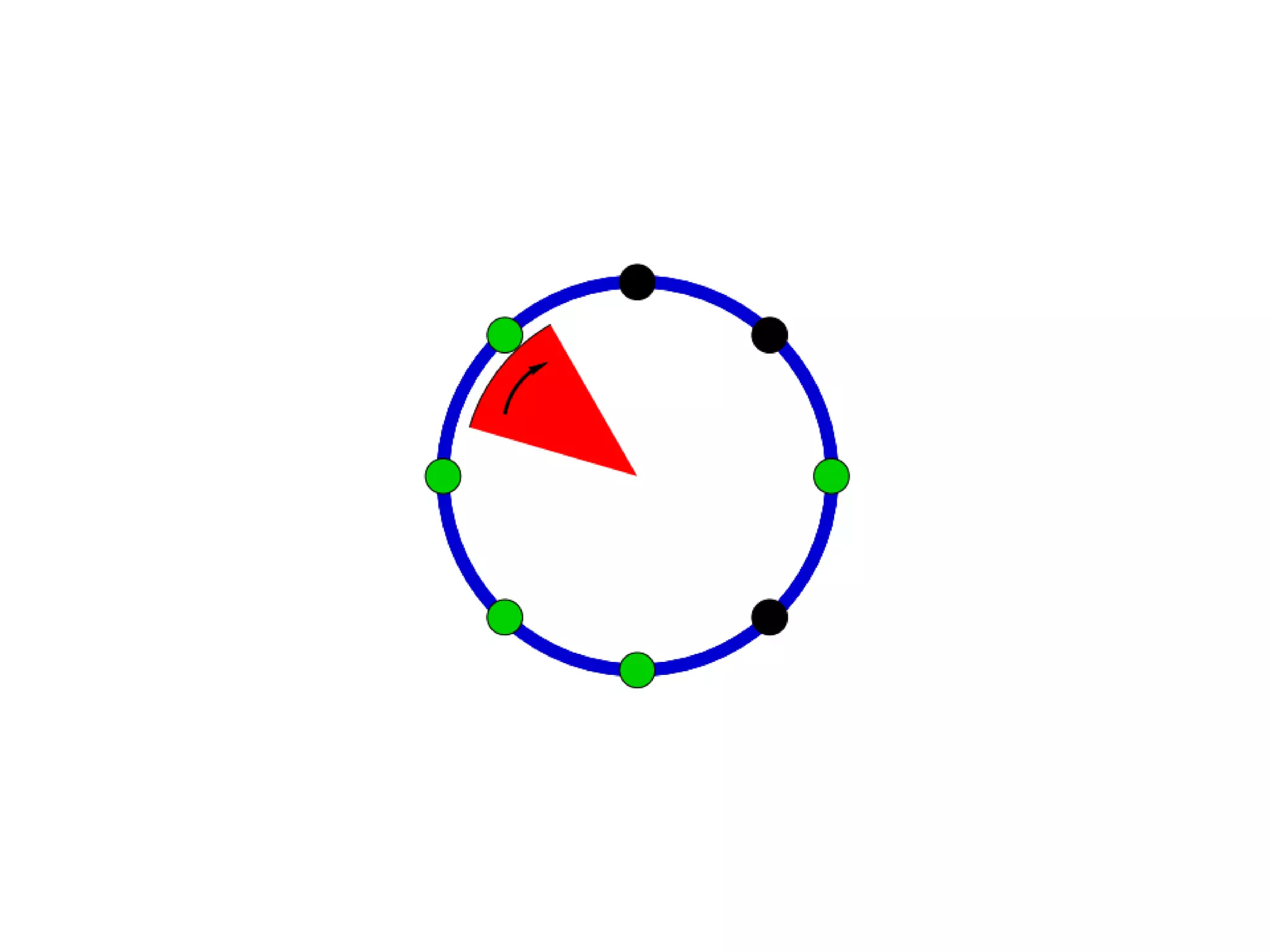
The Main Idea
• Time-triggered
  – Every speaker is assigned a predetermined time slot.
  – After one round, the speaker gets a slot again.
  – Also, a topic-schedule has been worked out in
    advance.
     • Top1, Top2, Top4 in the first round.
     • Top1, Top3 and Top5 in the second round
     • Top2, Top4 and Top5 in the third round.
  – Ensure no one breaks the rules!
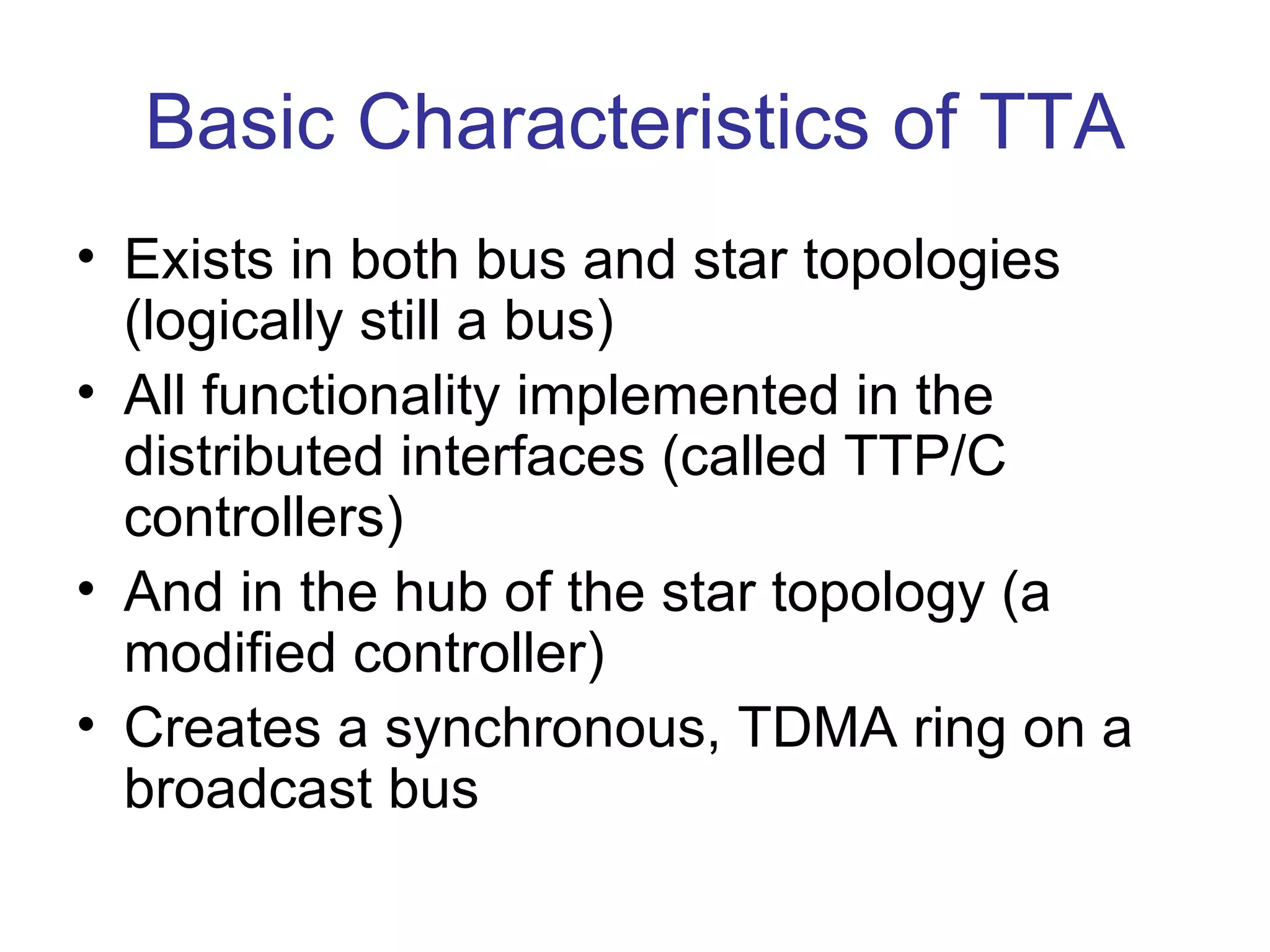
Basic Characteristics of TTA
• Exists in both bus and star topologies
  (logically still a bus)
• All functionality implemented in the
  distributed interfaces (called TTP/C
  controllers)
• And in the hub of the star topology (a
  modified controller)
• Creates a synchronous, TDMA ring on a
  broadcast bus
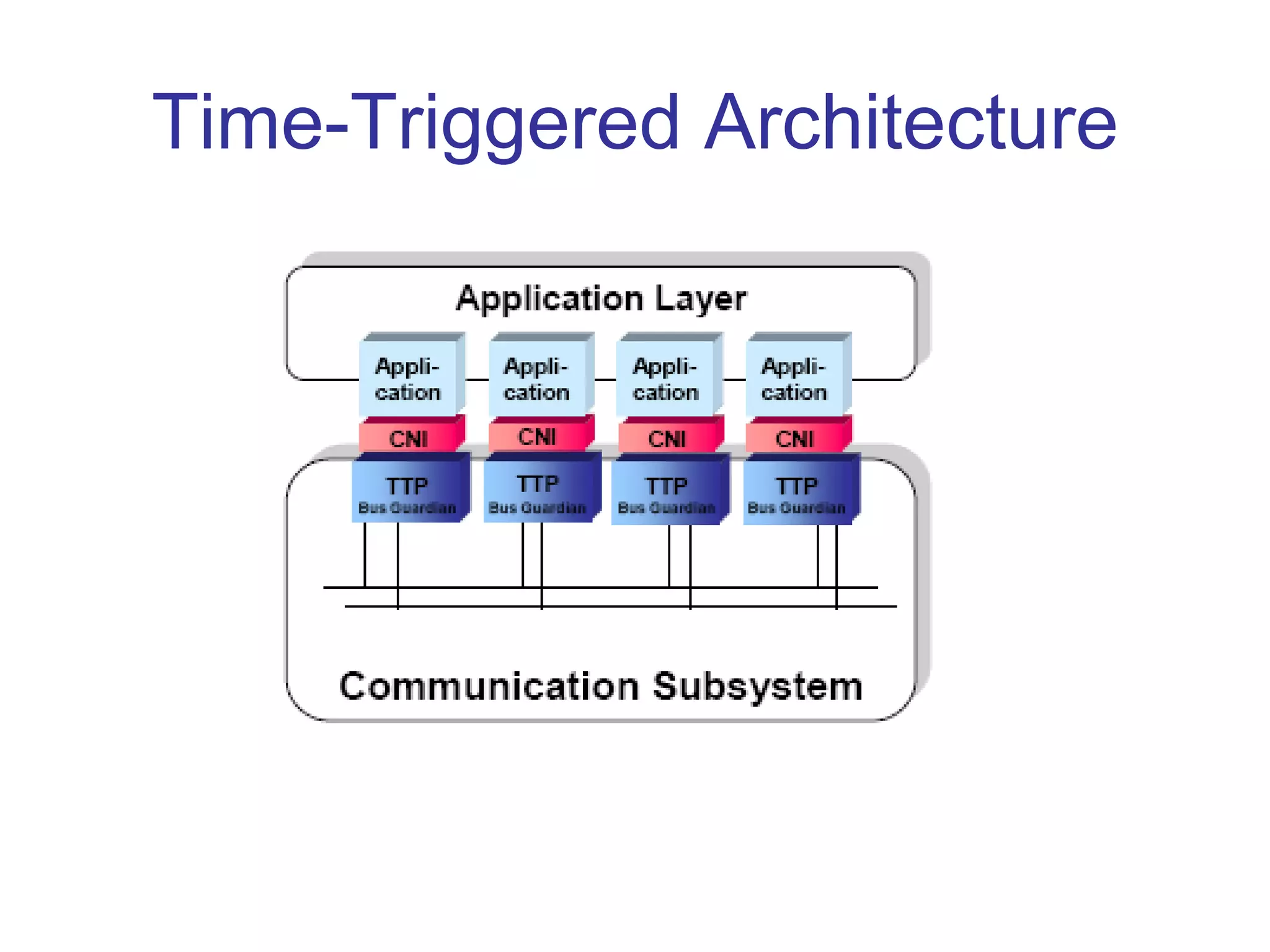
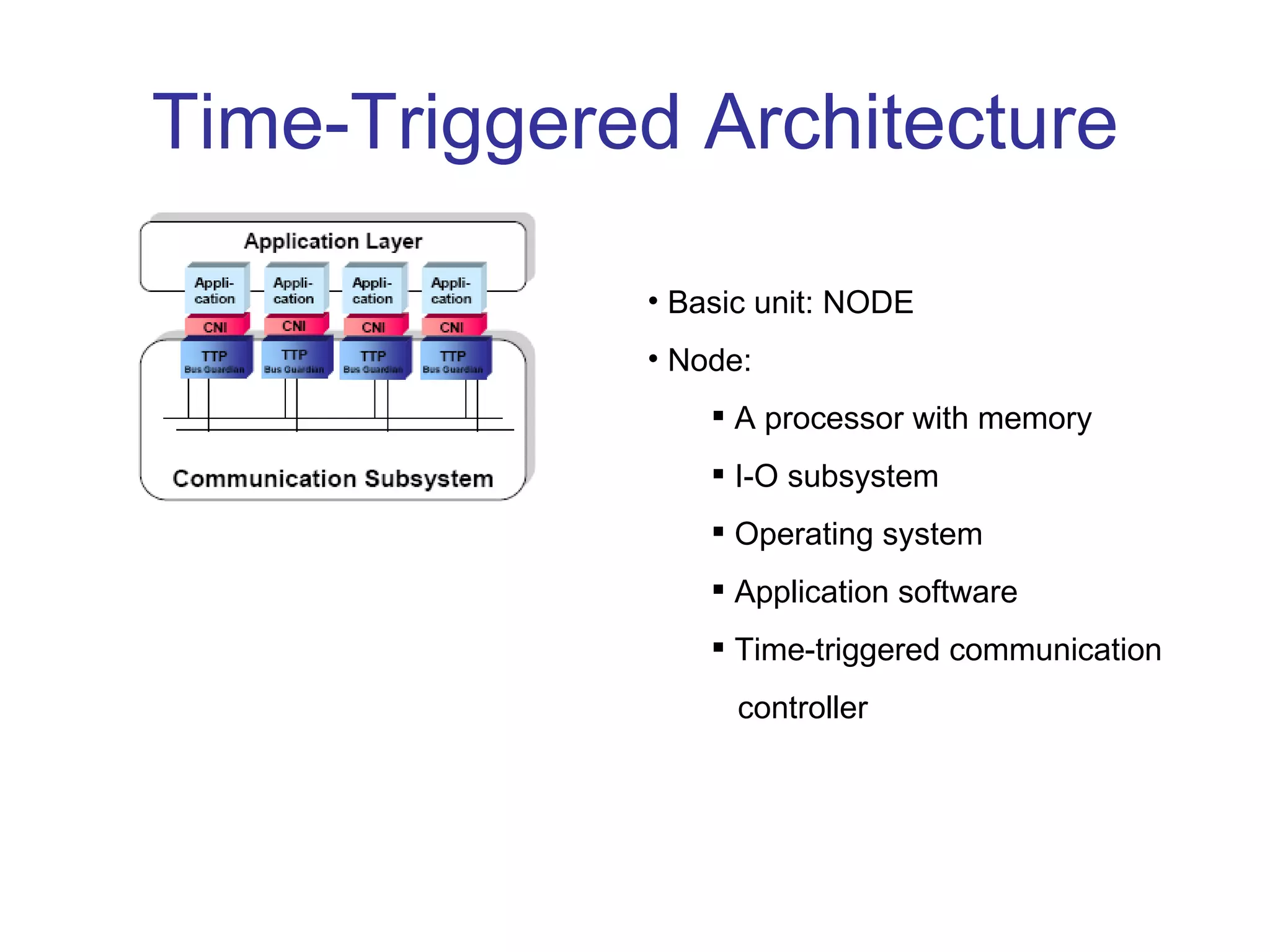
Time-Triggered Architecture

             • Basic unit: NODE
             • Node:
                  A processor with memory
                  I-O subsystem
                  Operating system
                  Application software
                  Time-triggered communication
                   controller
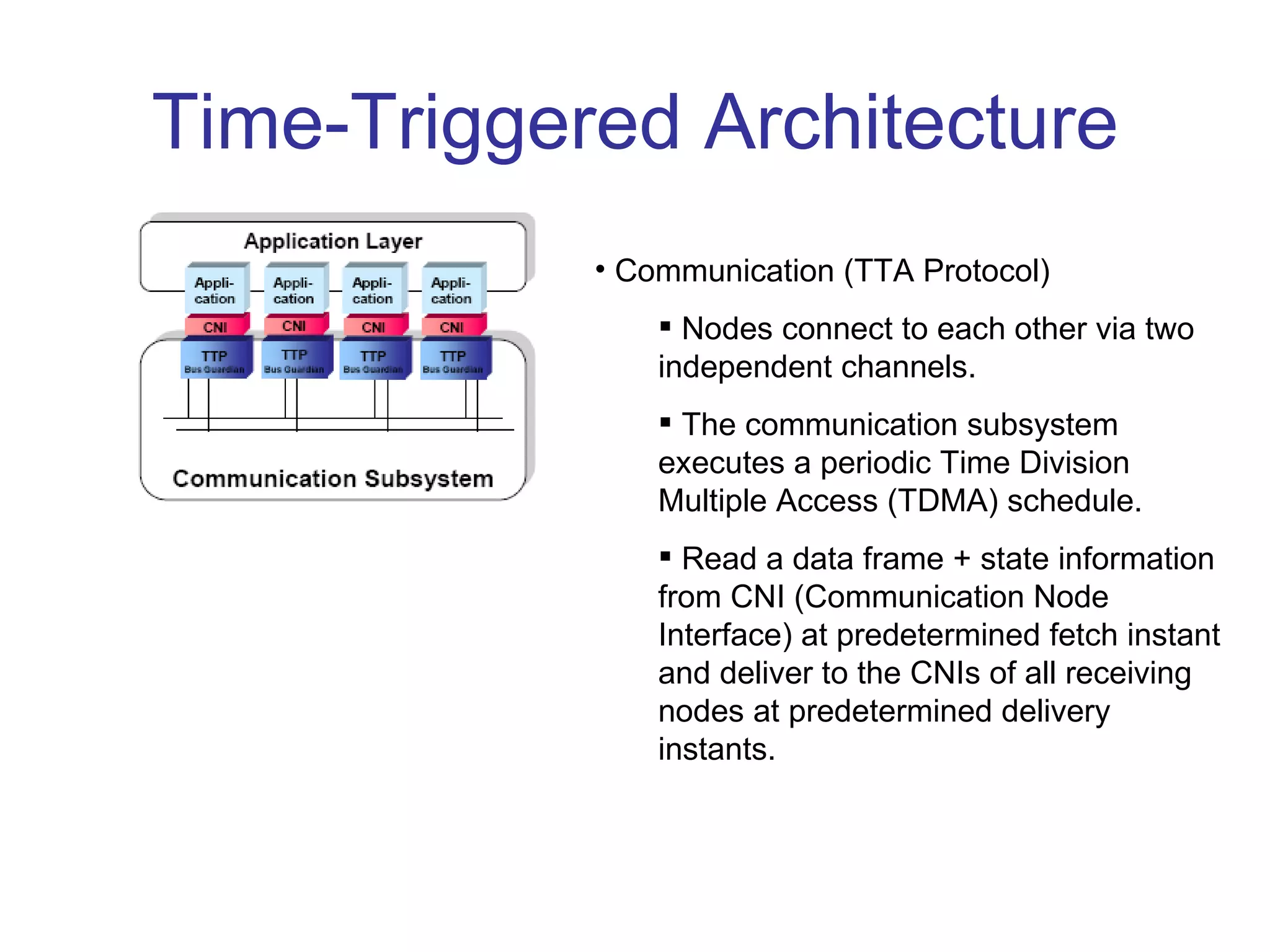
Time-Triggered Architecture
            • Communication (TTA Protocol)
                 Nodes connect to each other via two
                independent channels.
                 The communication subsystem
                executes a periodic Time Division
                Multiple Access (TDMA) schedule.
                 Read a data frame + state information
                from CNI (Communication Node
                Interface) at predetermined fetch instant
                and deliver to the CNIs of all receiving
                nodes at predetermined delivery
                instants.
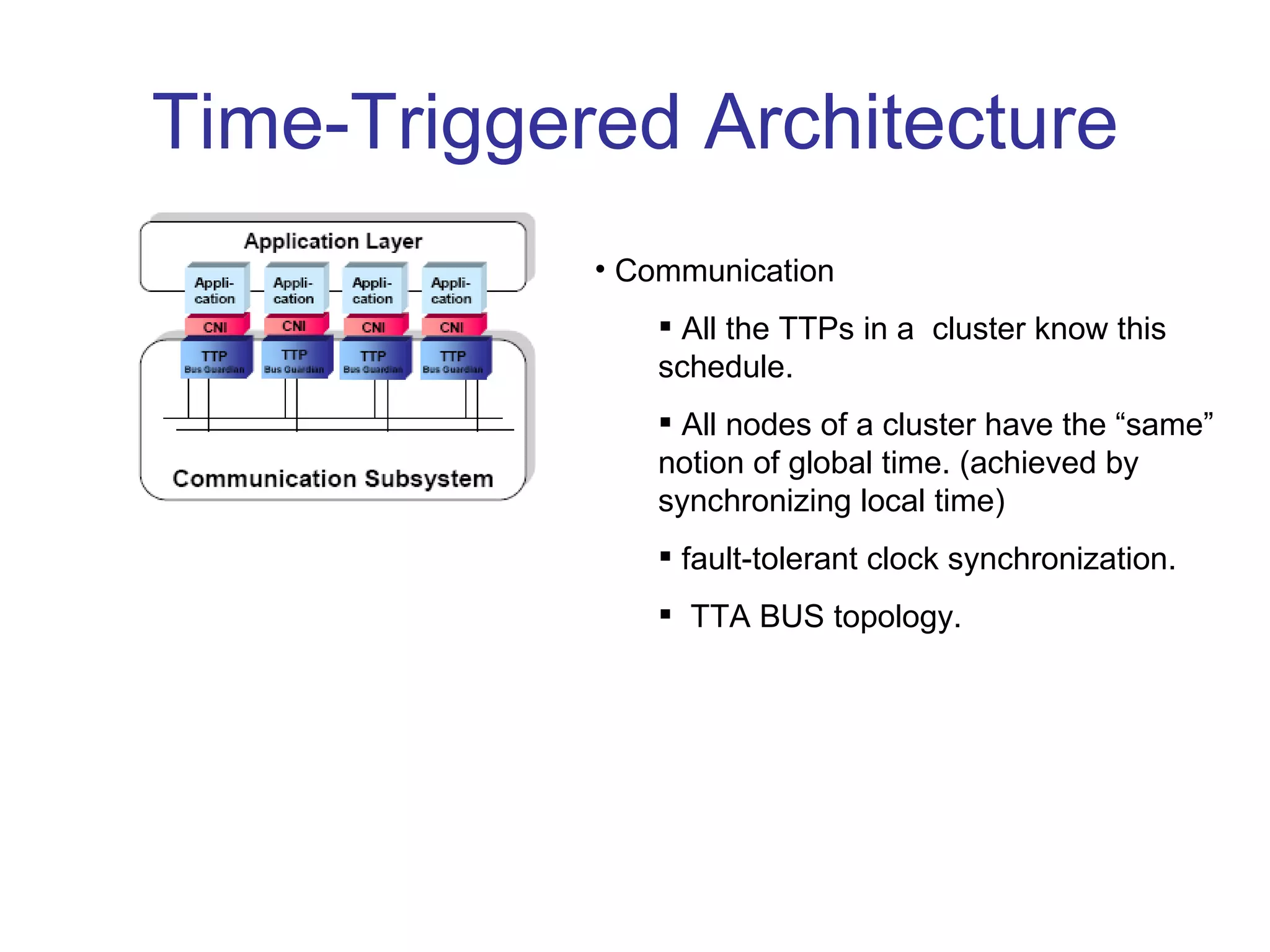
Time-Triggered Architecture
            • Communication
                All the TTPs in a cluster know this
               schedule.
                All nodes of a cluster have the “same”
               notion of global time. (achieved by
               synchronizing local time)
                fault-tolerant clock synchronization.
                TTA BUS topology.
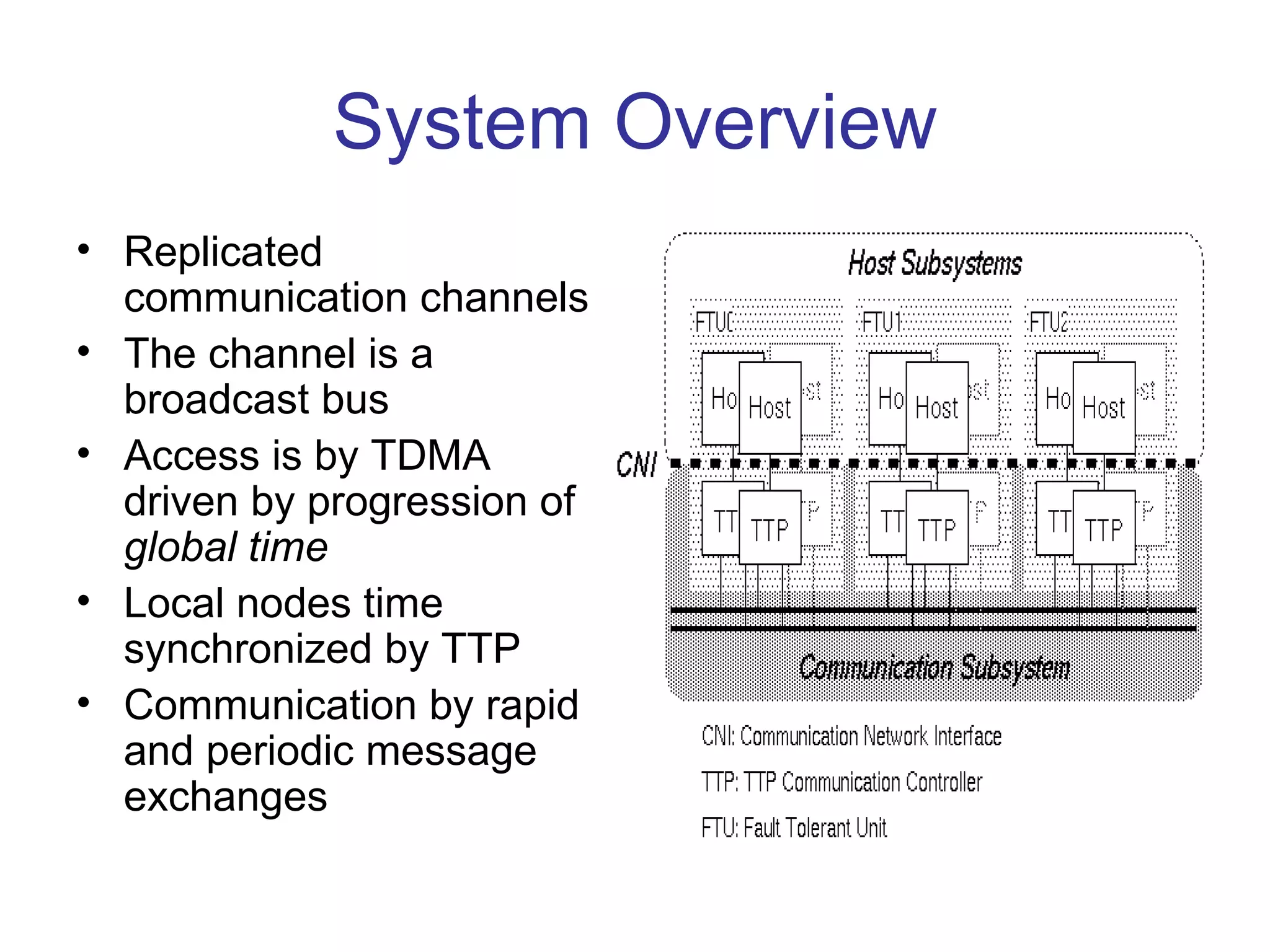
System Overview
• Replicated
  communication channels
• The channel is a
  broadcast bus
• Access is by TDMA
  driven by progression of
  global time
• Local nodes time
  synchronized by TTP
• Communication by rapid
  and periodic message
  exchanges
Features of the TTP
• Fault-tolerance
• Only data signals (and no control signals)
  cross interfaces.
• Integrates numerous services
  –   Predictable message transmission
  –   Message acknowledgement in group communication
  –   Clock synchronization
  –   Membership
TTP Design Rationale
• Sparse time base
   – Messages are sent only at statically designated intervals
   – Inflexible compared to Event-triggered (ET) model, but easier to
     test
• Use of a priori knowledge
   – All nodes are aware of when each node is scheduled to transmit
• Broadcast
   – Correctness of transmitted message can be concluded as soon
     as one receiver acknowledges message delivery (broadcast
     medium)
Protocol Highlights

• Bus access
  – A FTU will have one or two time slots depending on class of
    fault-tolerance
  – Number of slots in a TDMA round given to an FTU may also be
    different
• Membership Service
  – If a message from a sending node does not occur in designated
    interval, its membership is set to 0 in other nodes
  – Membership checked before transmission. A node is alive if
     • Its internal error detection mechanism has not indicated error
     • At least one of its transmitted frames has been correctly
       acknowledged.
Protocol Highlights
• Temporary blackout handling
  – Correlated failure of a number of nodes
  – Identified by sudden drop in membership
  – Nodes send I-messages and perform local
    emergency control
  – After membership has stabilized, mode
    changed to global emergency service
Protocol Highlights
Temporal encapsulation of nodes
   – Communication bandwidth assigned statically
   – Time base is sparse- every input can be observed
     and reproduced exactly
• Testability
   – Easy to test the implementation in comparison to ET
   – Easy to simulate –finite number of execution
     scenarios
      • Uncontrolled interactions between nodes are prevented
      • Determinism: can replicate states of nodes
Strengths
• Can provide fault-tolerant real-time performance
• Practical (MARS platform), efficient, and
  scalable
   – Can be implemented using available hardware,
     signalling mechanisms
   – Low overhead
   – High data rates, used in both twisted fiber and optical
     channels
• Reusability, composability, and testability
Weaknesses
• The schedule is fixed so there is no bandwidth
  allocated for alarms and other spontaneous
  messages
• All fault-tolerance mechanism is implemented
  at system level, this means that very little
  “freedom” is left for application specific
  implementations
• Addition of nodes affects the existing system
  (although not the application)
• Time-Triggered architectures and
  protocols will become important.
• Seemingly simple
  – But quite sophisticated
• for time-deterministic, robust distributed
  systems.

Time triggered arch.

  • 1.
  • 2.
    The Time-Triggered Architecture: What Is It? -The Time-Triggered Architecture (TTA) is a platform for safety-critical embedded systems E.g., aircraft and engine flight control -Functionally, it is a TDMA (time-triggered) serial bus -“Bus" understates its criticality and sophistication *It is the safety-critical core of the systems built above it
  • 3.
    • The componentsof a TTA will communicate using a time-triggered protocol. – Hardware support needed for running the protocol.
  • 4.
    TTA: Where DidIt Come From? -Developed by the group of Hermann Kopetz, TU Vienna -Commercialized by TTTech -TTA is unique in being developed for mass- market for automobile applications (Audi, PSA etc.) but also used for aircraft applications (Honeywell)
  • 5.
    • Application domains: – Automotive electronics – Fly-by-wire cockpits – Railway signaling systems • Reason: time-deterministic executions.
  • 6.
    The Main Idea •Time-triggered – Every speaker is assigned a predetermined time slot. – After one round, the speaker gets a slot again. – Also, a topic-schedule has been worked out in advance. • Top1, Top2, Top4 in the first round. • Top1, Top3 and Top5 in the second round • Top2, Top4 and Top5 in the third round. – Ensure no one breaks the rules!
  • 7.
    Basic Characteristics ofTTA • Exists in both bus and star topologies (logically still a bus) • All functionality implemented in the distributed interfaces (called TTP/C controllers) • And in the hub of the star topology (a modified controller) • Creates a synchronous, TDMA ring on a broadcast bus
  • 9.
  • 10.
    Time-Triggered Architecture • Basic unit: NODE • Node:  A processor with memory  I-O subsystem  Operating system  Application software  Time-triggered communication controller
  • 11.
    Time-Triggered Architecture • Communication (TTA Protocol)  Nodes connect to each other via two independent channels.  The communication subsystem executes a periodic Time Division Multiple Access (TDMA) schedule.  Read a data frame + state information from CNI (Communication Node Interface) at predetermined fetch instant and deliver to the CNIs of all receiving nodes at predetermined delivery instants.
  • 12.
    Time-Triggered Architecture • Communication  All the TTPs in a cluster know this schedule.  All nodes of a cluster have the “same” notion of global time. (achieved by synchronizing local time)  fault-tolerant clock synchronization.  TTA BUS topology.
  • 13.
    System Overview • Replicated communication channels • The channel is a broadcast bus • Access is by TDMA driven by progression of global time • Local nodes time synchronized by TTP • Communication by rapid and periodic message exchanges
  • 14.
    Features of theTTP • Fault-tolerance • Only data signals (and no control signals) cross interfaces. • Integrates numerous services – Predictable message transmission – Message acknowledgement in group communication – Clock synchronization – Membership
  • 15.
    TTP Design Rationale •Sparse time base – Messages are sent only at statically designated intervals – Inflexible compared to Event-triggered (ET) model, but easier to test • Use of a priori knowledge – All nodes are aware of when each node is scheduled to transmit • Broadcast – Correctness of transmitted message can be concluded as soon as one receiver acknowledges message delivery (broadcast medium)
  • 16.
    Protocol Highlights • Busaccess – A FTU will have one or two time slots depending on class of fault-tolerance – Number of slots in a TDMA round given to an FTU may also be different • Membership Service – If a message from a sending node does not occur in designated interval, its membership is set to 0 in other nodes – Membership checked before transmission. A node is alive if • Its internal error detection mechanism has not indicated error • At least one of its transmitted frames has been correctly acknowledged.
  • 17.
    Protocol Highlights • Temporaryblackout handling – Correlated failure of a number of nodes – Identified by sudden drop in membership – Nodes send I-messages and perform local emergency control – After membership has stabilized, mode changed to global emergency service
  • 18.
    Protocol Highlights Temporal encapsulationof nodes – Communication bandwidth assigned statically – Time base is sparse- every input can be observed and reproduced exactly • Testability – Easy to test the implementation in comparison to ET – Easy to simulate –finite number of execution scenarios • Uncontrolled interactions between nodes are prevented • Determinism: can replicate states of nodes
  • 19.
    Strengths • Can providefault-tolerant real-time performance • Practical (MARS platform), efficient, and scalable – Can be implemented using available hardware, signalling mechanisms – Low overhead – High data rates, used in both twisted fiber and optical channels • Reusability, composability, and testability
  • 20.
    Weaknesses • The scheduleis fixed so there is no bandwidth allocated for alarms and other spontaneous messages • All fault-tolerance mechanism is implemented at system level, this means that very little “freedom” is left for application specific implementations • Addition of nodes affects the existing system (although not the application)
  • 21.
    • Time-Triggered architecturesand protocols will become important. • Seemingly simple – But quite sophisticated • for time-deterministic, robust distributed systems.