Time  and Stress  Management CS7001 Workshop Idris Hsi November 15, 1999
Time Management Step 1 - List Your Tasks. Step 2 - Fill In Schedule Step 3 - Stop When Day/Week Is Full Step 4 - If Tasks Remain, Remove Time From Nonessential Tasks (i.e., Sleeping, Eating), Go To Step 2.
Stress Management Happy Hour - Friday at 6!
In Conclusion You All Know How To Manage Your Time and Stress. But wait…… Are there less masochistic ways to use time? And what is this stress thing anyhow?
Goals of this Workshop Examine Different Ways of Viewing Time Review Some Heuristics For Using Time Dealing with Stress (And Dangers of Long Term Stress) Grad School Survival Guidelines
Task not Time Management Time - Constant or Variable? Managing Time a Problem of Estimation Difficult to Estimate Variable Tasks Difficult to Account For Sources of Noise Better to Manage Around Tasks
Covey’s Time (Task) Management Matrix ©
Heuristics for Organizing Tasks Priority Order Task Duration Category Order Traveling Salesman
Using Small Bits Optimize for Large Chunks Small Bits are Unavoidable (5, 10, 15 min) Making Them Useful Planning (At least 10 minutes a day) Cleaning / Organization Chores Communication - Email, Phone Call Creativity / Brainstorming Small Tasks
The Art of Procrastination Art of Delaying the Inevitable Where can you lose time? Worrying about finishing on time. Worrying about the final outcome. Distractions. Doing “unimportant” things first.
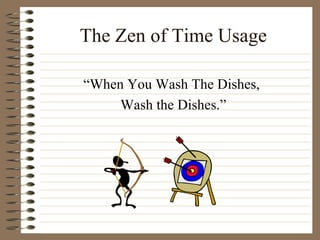
The Zen of Time Usage “When You Wash The Dishes,  Wash the Dishes.”
The Principle Of Immersion “ All Tasks Require A Period of Immersion in Direct Proportion to Their Difficulty.” DeMarco and Lister  Peopleware , (1987) Context Shifts in Work Interruptions require 15 minutes of reorientation. Important to Consolidate by Context
Some Days Are Impossible In spite of best efforts - It’s still impossible to get everything done. Partly the Environment or too many commitments. This can lead to stress.
What is Stress? In the Good Old Days on the Serengeti…. Flight or Fight Mechanisms (Adrenaline) Problems with Modern Life Survival Still Threatened
Manifestations of Stress Sources Personal Pressure to Succeed Financial Problems Relationship Problems Holidays Manifestations Increased Heart Rate, Sleeplessness, Anxiety, Variable Appetite
Long Term Stress Being in Panic Mode all the time Learned Helplessness Can lead to numerous health problems Can lead to Burnout
Managing Stress Redirect it into your work. Exercise. Keep a Regular Schedule (Eating, Sleeping, etc.) Eliminate or Reduce the Sources of Stress Most things aren’t THAT important. Seek help / advice from others.
Active Inactivity “Music is the Space Between Notes” - Claude Debussy Creating Empty Spaces in Life is Essential.
Artifacts for Staying on Track 10 Minutes a day for planning. Flexible Scheduling Automated Schedulers - Netscape Calendar, Microsoft Schedule, Outlook, Palm Pilot Pad of Paper - Running to-do list, place for unloading. A Watch
Developing The Habit Takes Discipline and Practice to Have Good Time Management Skills Develop Skills Incrementally Start by developing a realistic schedule Build in reward system for finishing things Over time, it’ll become second nature.
The Big Picture Important to know when you’ve done all that you can. Don’t schedule more than is humanly possible. Don’t stress about things that you can’t control. Keep the long term goals in mind. (The PhD)

Time Stress

  • 1.
    Time andStress Management CS7001 Workshop Idris Hsi November 15, 1999
  • 2.
    Time Management Step1 - List Your Tasks. Step 2 - Fill In Schedule Step 3 - Stop When Day/Week Is Full Step 4 - If Tasks Remain, Remove Time From Nonessential Tasks (i.e., Sleeping, Eating), Go To Step 2.
  • 3.
    Stress Management HappyHour - Friday at 6!
  • 4.
    In Conclusion YouAll Know How To Manage Your Time and Stress. But wait…… Are there less masochistic ways to use time? And what is this stress thing anyhow?
  • 5.
    Goals of thisWorkshop Examine Different Ways of Viewing Time Review Some Heuristics For Using Time Dealing with Stress (And Dangers of Long Term Stress) Grad School Survival Guidelines
  • 6.
    Task not TimeManagement Time - Constant or Variable? Managing Time a Problem of Estimation Difficult to Estimate Variable Tasks Difficult to Account For Sources of Noise Better to Manage Around Tasks
  • 7.
    Covey’s Time (Task)Management Matrix ©
  • 8.
    Heuristics for OrganizingTasks Priority Order Task Duration Category Order Traveling Salesman
  • 9.
    Using Small BitsOptimize for Large Chunks Small Bits are Unavoidable (5, 10, 15 min) Making Them Useful Planning (At least 10 minutes a day) Cleaning / Organization Chores Communication - Email, Phone Call Creativity / Brainstorming Small Tasks
  • 10.
    The Art ofProcrastination Art of Delaying the Inevitable Where can you lose time? Worrying about finishing on time. Worrying about the final outcome. Distractions. Doing “unimportant” things first.
  • 11.
    The Zen ofTime Usage “When You Wash The Dishes, Wash the Dishes.”
  • 12.
    The Principle OfImmersion “ All Tasks Require A Period of Immersion in Direct Proportion to Their Difficulty.” DeMarco and Lister Peopleware , (1987) Context Shifts in Work Interruptions require 15 minutes of reorientation. Important to Consolidate by Context
  • 13.
    Some Days AreImpossible In spite of best efforts - It’s still impossible to get everything done. Partly the Environment or too many commitments. This can lead to stress.
  • 14.
    What is Stress?In the Good Old Days on the Serengeti…. Flight or Fight Mechanisms (Adrenaline) Problems with Modern Life Survival Still Threatened
  • 15.
    Manifestations of StressSources Personal Pressure to Succeed Financial Problems Relationship Problems Holidays Manifestations Increased Heart Rate, Sleeplessness, Anxiety, Variable Appetite
  • 16.
    Long Term StressBeing in Panic Mode all the time Learned Helplessness Can lead to numerous health problems Can lead to Burnout
  • 17.
    Managing Stress Redirectit into your work. Exercise. Keep a Regular Schedule (Eating, Sleeping, etc.) Eliminate or Reduce the Sources of Stress Most things aren’t THAT important. Seek help / advice from others.
  • 18.
    Active Inactivity “Musicis the Space Between Notes” - Claude Debussy Creating Empty Spaces in Life is Essential.
  • 19.
    Artifacts for Stayingon Track 10 Minutes a day for planning. Flexible Scheduling Automated Schedulers - Netscape Calendar, Microsoft Schedule, Outlook, Palm Pilot Pad of Paper - Running to-do list, place for unloading. A Watch
  • 20.
    Developing The HabitTakes Discipline and Practice to Have Good Time Management Skills Develop Skills Incrementally Start by developing a realistic schedule Build in reward system for finishing things Over time, it’ll become second nature.
  • 21.
    The Big PictureImportant to know when you’ve done all that you can. Don’t schedule more than is humanly possible. Don’t stress about things that you can’t control. Keep the long term goals in mind. (The PhD)

Editor's Notes

  • #3 Begin With - You all know how to manage time. If you didn’t, you probably wouldn’t be in Graduate School. Your heuristics probably look like this.
  • #4 So now you’re stressed. The solution?
  • #5 So obviously, you all know how to manage your time and stress but clearly there must be some better ways to live. Plus, you’re all in it for the long haul. Over time, this heuristic will get you burned out.
  • #7 Time is, for all intents and purposes, constant, irreversible, and uncontrollable. Human perception of time is variable. Depends on amount of attention, energy, level of enjoyment, and time of day. Circadian Rhythms - levels of sunlight, amount of sleep required, problems with industrial living. Managing Time is a problem of estimation. How good are you at guessing how long it will take you to do something? Big issue in programming and manufacturing Most daily tasks are variable and have variable parameters (size of assignment, number of function points, thinking time). Many sources of noise exist - traffic,unexpected interruptions, errors, weather, etc. It’s better to manage your tasks and goals for the week then to manage time. This is a mental shift. You still need to schedule your tasks against a time framework but what you are able to accomplish and how you feel about your time usage will be different.
  • #8 Good Way of Viewing To-Do lists and daily activities. All activities have importance. Quadrant II activities are the most important because they prepare good foundations for later work and for life.
  • #9 Priority Order - In general, how we tend to view the world. In terms of must-do’s and should-do’s. It’s still a fairly good heuristics - getting the crucial tasks out of the way is important but shouldn’t be the only heuristic. Task Duration - How much time do you have? What can you do between that meeting at 3 and the meeting at 4:30? Breaking up tasks into large tasks and small tasks is fairly important. Traveling Salesman - Physical location - optimize around travel time and physical location. How can you minimize transit times? Even little times like going from your desk to another room can add up. How can you make your work areas more efficient? Category Order - Research, Personal, Social, Financial, etc. Think of your tasks in context of a goal or in terms of a part of your life that has some importance.
  • #11 Wastes more time worrying about the outcome or avoiding what seems to be unpleasant.
  • #12 Brief discussion of Zen and Samurai. Olympic Archer Story - Essentially means that when you undertake a task, you should focus on the task at hand without mental distraction.
  • #13 Difficult to juggle everything that you need to get done in a day or a week. One problem is that of Context Shifts Scenario of Getting up, meeting with advisor, then a committee meeting on recruiting, checking email about student problems, then research, then database class, then programming.
  • #16 Many others in both categories.
  • #17 What happens if you stay stressed for too long of a period of time? Rather unnatural. Experiments with Rats - negative reinforcement - just sits there and twitches. Life ceases to become fun.
  • #19 Quiet Fridays - no meetings. Creating Quiet Time - turn off phone, don’t check email, tell students and so on to respect this hour or so. My Saturdays - dedicated time for doing my things. Very important to break up your life with quiet periods for reflection, planning, and refocusing.
  • #20 Build in flexible schedules. Don’t optimize to the minute. Allow for error. Running to-do lists are useful for getting distracting thoughts out of your head.