Time Management
Define time management
• It is accomplishment of specified activities
during the time available or It is the process
of managing the things an individual does
with his or her available time.
• In reality time management is self
management (Ferner,1995).Explain?
What are the steps of analyzing and
managing time?
1. Analysis of current time use with time logs
(records)
2. Analysis time logs (records) to identify time
problems, causes and solutions
3. Self assessment setting goals and establishing
priorities
5.Implementing action plans that define tasks,
resources needs and time frames. s
6. Developing action plans that define tasks,
resource needs, and time frame
7. Developing technique and solution to
improve time management
8. Follow up and reanalysis
Prioritization
• After analyzing of personal characteristics ,
attitudes and behaviors that may block time
management effectiveness come setting goals
and establishing priorities. It is to know what
is to be done immediately and what is to be
made next.
Four categories of prioritization
• Important activities have an outcome that leads
to us achieving our goals, whether these are
professional or personal.
• Urgent activities demand immediate attention,
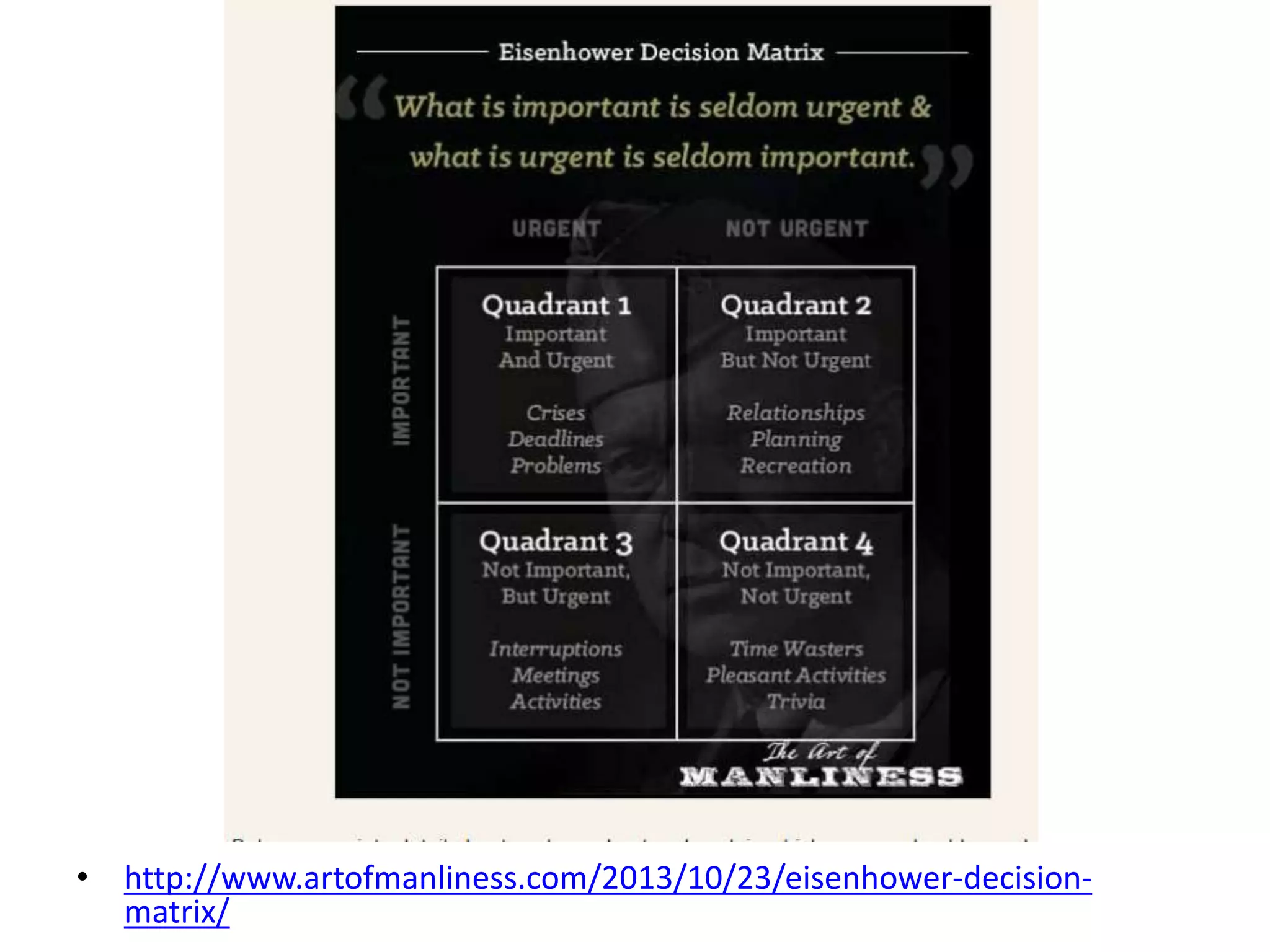
1. Important and urgent
2. Important but not urgent
3. Not important but urgent
4. Not important and not urgent
• They are called “The Eisenhower Method” or
“The Priority Matrix”)
Important and urgent
• Final paper submission
• Father is called by his kid’s principal saying you
need to come in for a meeting about his
behavior
• Car engine goes out and you want to go to the
hospital
Not important but urgent
• You are asked to replay a phone call
• Your young sister ask you take her to the tailor
now (important for her)
Important but not urgent
• Taking your vaccine which the due date for it
is after 2 months
• Its Sunday but you are called for family
meeting on Friday
4.Not important and not urgent
• Watching cartoons on TV
• Searching the net without any purpose
• http://www.artofmanliness.com/2013/10/23/eisenhower-decision-
matrix/
Pagana (1994) created a list of time
management techniques which are:
• Omission by decision ( deciding what is to be
done)
• Learn to say no
• Block interruptions e.g: phone calls
• Guarding an individual’s best or prime time
(what is your best time to work morning or
night)
• Programming blocks of time for large projects
• Organizing work place ( organize your desk or
room to avoid wasting time for searching)
• Managing committee meeting (prepare
agenda of meeting, be on time and finish on
time)
• Delegating (as group you want to start the
report but you needs guidance you can ask
one to go and ask the teacher about it)
• Planning the use of time (stick to your table) .
Other strategies are in your book page
130
• Analyze how time is spend
• Keep time log
• Develop specific statement of goal (short
term, and long term goal
• Focus yourself to get started
• Keep day to day list
• Anticipate unexpected result,,,,,,,,,,,,,,,
Stress Management
• Stress is: physical, mental , psychological or
spiritual response to stressor (Narasi 1994)
• Stressor is and experience in a person-
environment relationship that is evaluated by
a person as taxing or exceeding resources and
threating the sense of well being.
• Job stress: tension arising in aperson that is
related to the demands of the person’s role or
job.
• Burnout: response to chronic emotional stress
with three components a) Emotional or
physical exhaustion, B) Lowered job
productivity and c) Over de-penersonalization
(change in personality) .
Sources of stress in nursing
1. Individual source of stress
2. Organizational source of stress
1. Individual source of stress
• Source of stress in the nurse is from internal
or external
• Example of internal: a conflict inside a
working mother is worry how to balance the
requirement of her family as a mother and the
requirement of her as a teacher or manager.
•
• Example of external: work pressure makes the
changes in the personality of the employee.
E.g: the nurse will have hardiness (being brave
or have Courage to work)
2.Organizational source of stress
• It is from working environment or nature of
work.
e.g: nature of work : beside care, night shift, call
days,,,,,,,,,,,
e.g: working environment: unhealthy
relationship among staff, manger is not concern
with staff needs, no group work, turnover or
shortage,,,,, leading to role overload, role
ambiguity,,,,,,,,,,,,
Coping and Adaptation in nursing
• Development of internal waning
system to alert the individual to
stress
• Nurse needs to look at their best
interests
Stress management technique
• Ranges from individual to organizations
1. For the nurse include:
• Spend time on non related work activities
• Personal support network
• Identifying resource for problem solving
• Or considering resiging
2. At the organizational level include:
• Interaction of department and availability of
support system.
• Education about coping mechanism
• Assessment of nurse perception of work
status to make necessarily changes.
Other method for coping with stress
Physical activity
Nutritional control
Improving attitudes
Meditation
Relaxation,,,,,,,,,,,,,,,,,,,,,,,,,,,,,,,,,,,,,,,,,,,,,,,,,,,,,,,,,,
,,,,,,,,,,,,,,,,,,,,,,,,,,,,,,,,,,,,,,,,,,,,,,,,,,,,,,,,,,,,,,,,,,,,,,,,,,,
,,,,,,,,,,,,,,,,,,,,,,,,,,,,,,,,,,,,,,,,,,,,,,,,,,,,,,,,,,,,,,,,,,,,,,,,,,,
see more on page p 139
Thank You

Time managment

  • 1.
  • 2.
    Define time management •It is accomplishment of specified activities during the time available or It is the process of managing the things an individual does with his or her available time. • In reality time management is self management (Ferner,1995).Explain?
  • 3.
    What are thesteps of analyzing and managing time? 1. Analysis of current time use with time logs (records) 2. Analysis time logs (records) to identify time problems, causes and solutions 3. Self assessment setting goals and establishing priorities
  • 4.
    5.Implementing action plansthat define tasks, resources needs and time frames. s 6. Developing action plans that define tasks, resource needs, and time frame 7. Developing technique and solution to improve time management 8. Follow up and reanalysis
  • 5.
    Prioritization • After analyzingof personal characteristics , attitudes and behaviors that may block time management effectiveness come setting goals and establishing priorities. It is to know what is to be done immediately and what is to be made next.
  • 6.
    Four categories ofprioritization • Important activities have an outcome that leads to us achieving our goals, whether these are professional or personal. • Urgent activities demand immediate attention, 1. Important and urgent 2. Important but not urgent 3. Not important but urgent 4. Not important and not urgent • They are called “The Eisenhower Method” or “The Priority Matrix”)
  • 7.
    Important and urgent •Final paper submission • Father is called by his kid’s principal saying you need to come in for a meeting about his behavior • Car engine goes out and you want to go to the hospital
  • 8.
    Not important buturgent • You are asked to replay a phone call • Your young sister ask you take her to the tailor now (important for her)
  • 9.
    Important but noturgent • Taking your vaccine which the due date for it is after 2 months • Its Sunday but you are called for family meeting on Friday
  • 10.
    4.Not important andnot urgent • Watching cartoons on TV • Searching the net without any purpose
  • 11.
  • 12.
    Pagana (1994) createda list of time management techniques which are: • Omission by decision ( deciding what is to be done) • Learn to say no • Block interruptions e.g: phone calls • Guarding an individual’s best or prime time (what is your best time to work morning or night) • Programming blocks of time for large projects
  • 13.
    • Organizing workplace ( organize your desk or room to avoid wasting time for searching) • Managing committee meeting (prepare agenda of meeting, be on time and finish on time) • Delegating (as group you want to start the report but you needs guidance you can ask one to go and ask the teacher about it) • Planning the use of time (stick to your table) .
  • 14.
    Other strategies arein your book page 130 • Analyze how time is spend • Keep time log • Develop specific statement of goal (short term, and long term goal • Focus yourself to get started • Keep day to day list • Anticipate unexpected result,,,,,,,,,,,,,,,
  • 15.
  • 16.
    • Stress is:physical, mental , psychological or spiritual response to stressor (Narasi 1994) • Stressor is and experience in a person- environment relationship that is evaluated by a person as taxing or exceeding resources and threating the sense of well being.
  • 17.
    • Job stress:tension arising in aperson that is related to the demands of the person’s role or job. • Burnout: response to chronic emotional stress with three components a) Emotional or physical exhaustion, B) Lowered job productivity and c) Over de-penersonalization (change in personality) .
  • 18.
    Sources of stressin nursing 1. Individual source of stress 2. Organizational source of stress
  • 19.
    1. Individual sourceof stress • Source of stress in the nurse is from internal or external • Example of internal: a conflict inside a working mother is worry how to balance the requirement of her family as a mother and the requirement of her as a teacher or manager. •
  • 20.
    • Example ofexternal: work pressure makes the changes in the personality of the employee. E.g: the nurse will have hardiness (being brave or have Courage to work)
  • 21.
    2.Organizational source ofstress • It is from working environment or nature of work. e.g: nature of work : beside care, night shift, call days,,,,,,,,,,, e.g: working environment: unhealthy relationship among staff, manger is not concern with staff needs, no group work, turnover or shortage,,,,, leading to role overload, role ambiguity,,,,,,,,,,,,
  • 22.
    Coping and Adaptationin nursing • Development of internal waning system to alert the individual to stress • Nurse needs to look at their best interests
  • 23.
    Stress management technique •Ranges from individual to organizations 1. For the nurse include: • Spend time on non related work activities • Personal support network • Identifying resource for problem solving • Or considering resiging
  • 24.
    2. At theorganizational level include: • Interaction of department and availability of support system. • Education about coping mechanism • Assessment of nurse perception of work status to make necessarily changes.
  • 25.
    Other method forcoping with stress Physical activity Nutritional control Improving attitudes Meditation Relaxation,,,,,,,,,,,,,,,,,,,,,,,,,,,,,,,,,,,,,,,,,,,,,,,,,,,,,,,,,, ,,,,,,,,,,,,,,,,,,,,,,,,,,,,,,,,,,,,,,,,,,,,,,,,,,,,,,,,,,,,,,,,,,,,,,,,,,, ,,,,,,,,,,,,,,,,,,,,,,,,,,,,,,,,,,,,,,,,,,,,,,,,,,,,,,,,,,,,,,,,,,,,,,,,,,, see more on page p 139
  • 26.