DR. NAZATUL SHIMA
MS. CECILIA ANTHONY DAS
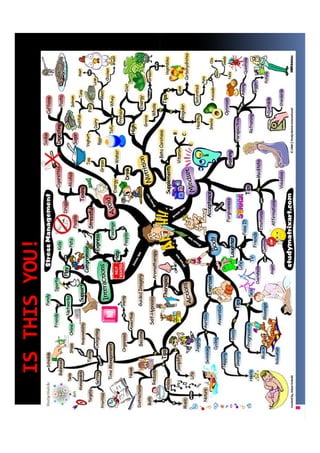
IS THIS YOU!
STRESS DEFINED
WHAT IS STRESS?
"The adverse reaction
people have to excessive
pressures or other types of
demand placed on them."
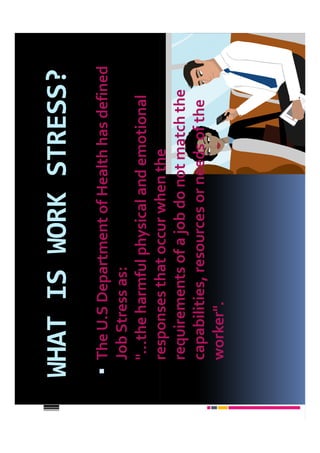
WHAT IS WORK STRESS?
 The U.S Department of Health has defined
 Job Stress as:
 "...the harmful physical and emotional
 responses that occur when the
 requirements of a job do not match the
 capabilities, resources or needs of the
 worker".
WHAT CAUSES STRESS AT WORK?
Causes of Stress At Work

 bullying or harassment, by anyone, not
 necessarily a person's manager
 feeling powerless and uninvolved in
 determining one's own responsibilities
 continuous unreasonable performance
 demands
 lack of effective communication and conflict
 resolution
 lack of job security
 long working hours
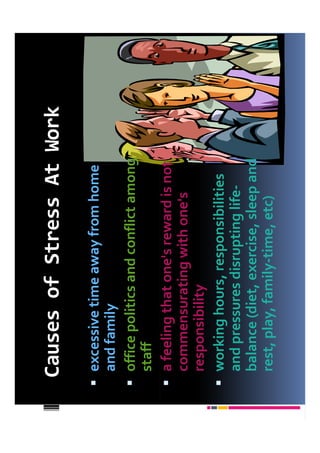
Causes of Stress At Work
excessive time away from home
and family
office politics and conflict among
staff
a feeling that one's reward is not
commensurating with one's
responsibility
working hours, responsibilities
and pressures disrupting life-
balance (diet, exercise, sleep and
rest, play, family-time, etc)
WHAT JOB CONDITIONS THAT
MAY LEAD TO STRESS?
Job Conditions That May Lead
to Stress
 The Design of Tasks.
 Heavy workload, infrequent rest breaks, long
 work hours and shift work; hectic and routine
 tasks that have little inherent meaning, do not
 utilize workers’ skills, and provide little sense of
 control.
 Example: David works to the point of exhaustion.
 Theresa is tied to the computer, allowing little
 room for flexibility, self-initiative, or rest.
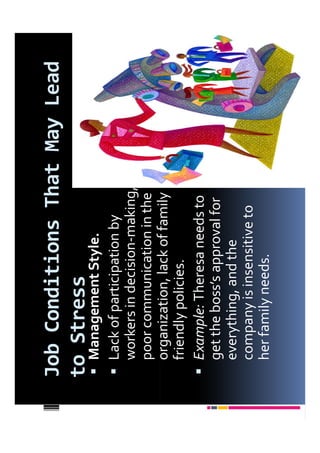
Job Conditions That May Lead
to Stress
 Management Style.
 Lack of participation by
 workers in decision-making,
 poor communication in the
 organization, lack of family
 friendly policies.
 Example: Theresa needs to
 get the boss’s approval for
 everything, and the
 company is insensitive to
 her family needs.
Job Conditions That May Lead
to Stress
 Interpersonal Relationships. Poor social
 environment and lack of support or help from
 co-workers and supervisors.
 Example: Theresa’s physical isolation reduces
 her opportunities to interact with other
 workers or receive help from them.
Job Conditions That May Lead
to Stress
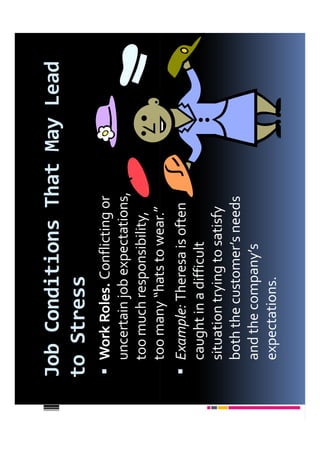
 Work Roles. Conflicting or
 uncertain job expectations,
 too much responsibility,
 too many “hats to wear.”
 Example: Theresa is often
 caught in a difficult
 situation trying to satisfy
 both the customer’s needs
 and the company’s
 expectations.
Job Conditions That May Lead
to Stress
 Career Concerns. Job insecurity
 and lack of opportunity for
 growth, advancement, or
 promotion; rapid changes for
 which workers are unprepared.
 Example: Since the reorganization
 at David’s plant, everyone is
 worried about their future with
 the company and what will
 happen next.
Job Conditions That May Lead
to Stress
 Environmental Conditions. Unpleasant or
 dangerous physical conditions such as
 crowding, noise, air pollution, or ergonomic
 problems.
 Example: David is exposed to constant noise
 at work.
WORK PERFORMANCE DUE TO
STRESS
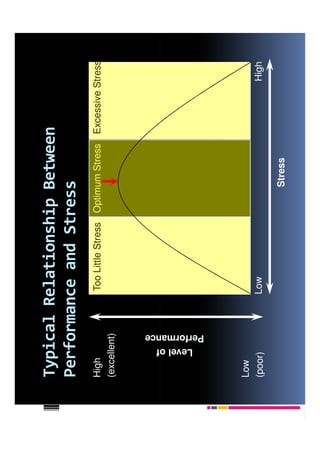
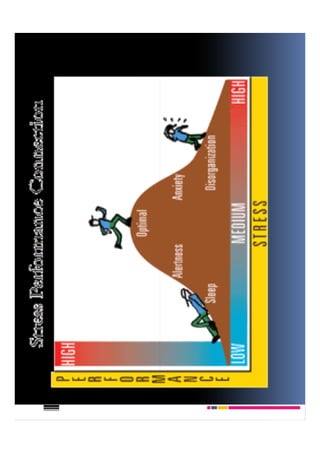
Typical Relationship Between
Performance and Stress
High               Too Little Stress Optimum Stress Excessive Stress
(excellent)


       Level of
       Level of
     Performance
     Performance
Low
(poor)             Low                                         High

                                         Stress
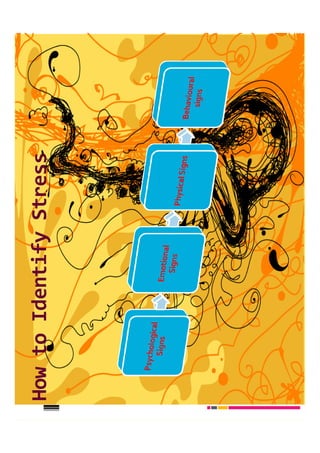
How to Identify Stress
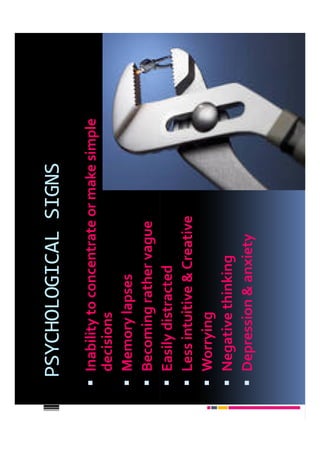
PSYCHOLOGICAL SIGNS
Inability to concentrate or make simple
decisions
Memory lapses
Becoming rather vague
Easily distracted
Less intuitive & Creative
Worrying
Negative thinking
Depression & anxiety
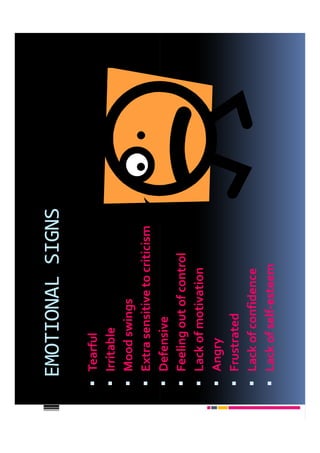
EMOTIONAL SIGNS
Tearful
Irritable
Mood swings
Extra sensitive to criticism
Defensive
Feeling out of control
Lack of motivation
Angry
Frustrated
Lack of confidence
Lack of self-esteem
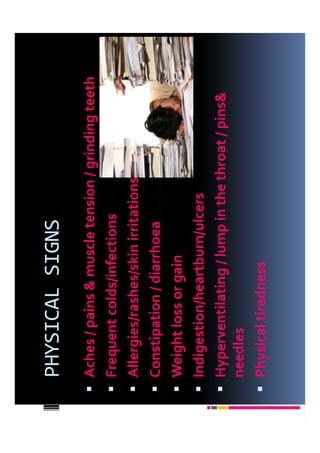
PHYSICAL SIGNS
Aches / pains & muscle tension / grinding teeth
Frequent colds/infections
Allergies/rashes/skin irritations
Constipation / diarrhoea
Weight loss or gain
Indigestion/heartburn/ulcers
Hyperventilating / lump in the throat / pins&
needles
Physical tiredness
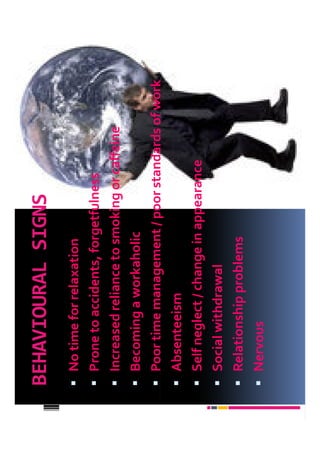
BEHAVIOURAL SIGNS
 No time for relaxation
 Prone to accidents, forgetfulness
 Increased reliance to smoking or caffeine
 Becoming a workaholic
 Poor time management / poor standards of work
 Absenteeism
 Self neglect / change in appearance
 Social withdrawal
 Relationship problems
 Nervous
HOW TO OVERCOME STRESS?
Top Ten Stress Busting Tips
      1. Learn to manage your time more
      effectively
        a lot of time IS WASTED doing unimportant tasks, especially
        when stressed, so prioritise your day and do the important
        jobs first. The unimportant ones can wait. don’t put off the
        unpleasant tasks – avoidance causes a great deal of stress.
        Give unpleasant tasks a high priority and do them first.

      2. Adopt a healthy lifestyle
        eat a healthy diet, exercise regularly and ensure YOU get
        adequate sleep & rest TO ENABLE the body to cope with
        stress should it occur. sign, don’t ignore it, ask for some help.
Top Ten Stress Busting Tips


3. Know your limitations and do not take on too much
  We cause ourselves a great deal of stress because we like people to like us and don’t want to let
  people down. We then end up doing more than we should. Learn to delegate effectively & be
  assertive so that you can say no without upsetting or offending.

4. Find out what causes you stress
  Take time to discover what is worrying you and try to change your thoughts & behaviour to reduce
  it.

5. Avoid unnecessary conflict
  Do not be too argumentative. Is it really worth the stress? Look for win - win situations. Look for a
  resolution to a dispute where both parties can achieve a positive outcome. Find out what the real
  cause of the problem is & deal with it.
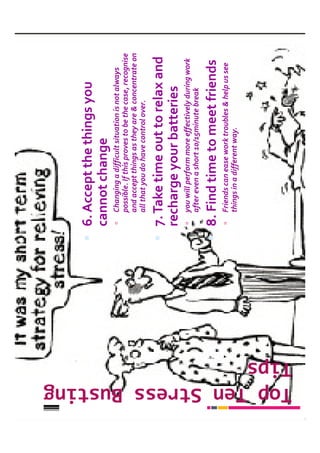
6. Accept the things you
                         cannot change
                           Changing a difficult situation is not always
                           possible. If this proves to be the case, recognise
                           and accept things as they are & concentrate on
                           all that you do have control over.

                         7. Take time out to relax and
                         recharge your batteries
                           you will perform more effectively during work
                           after even a short 10/15minute break

                         8. Find time to meet friends
                           Friends can ease work troubles & help us see
                           things in a different way.


Top Ten Stress Busting
Tips
Top Ten Stress Busting Tips
             9. Try to see things
             differently, develop a
             positive thinking style
               If something is concerning you, try to see
               it differently. Talk over your problem with
               somebody before it gets out of
               proportion. Often, talking to a
               friend/colleague/family member will help
               you see things from a different and less
               stressful perspective.

             10. Avoid alcohol, nicotine
             and caffeine as coping
             mechanisms
               Long term, these faulty coping
               mechanisms will just add to the problem.
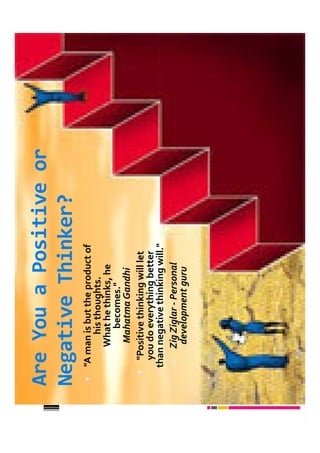
Are You a Positive or
Negative Thinker?
 "A man is but the product of
         his thoughts.
      What he thinks, he
           becomes."
      Mahatma Gandhi
   "Positive thinking will let
   you do everything better
 than negative thinking will."
     Zig Ziglar - Personal
      development guru
Take this short quiz to
determine what kind
of thinker you are!
WHAT NEXT?
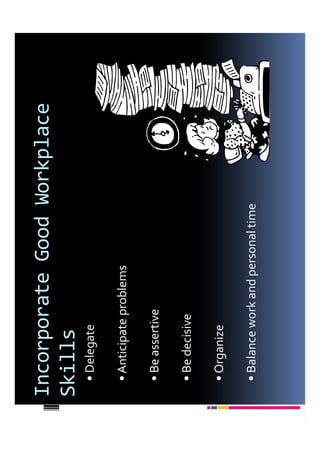
Incorporate Good Workplace
Skills
 • Delegate

 • Anticipate problems

 • Be assertive

 • Be decisive

 • Organize

 • Balance work and personal time
THANK
 YOU

Microsoft Power Point Stress Management

  • 1.
    DR. NAZATUL SHIMA MS.CECILIA ANTHONY DAS
  • 2.
  • 3.
  • 4.
    WHAT IS STRESS? "Theadverse reaction people have to excessive pressures or other types of demand placed on them."
  • 5.
    WHAT IS WORKSTRESS? The U.S Department of Health has defined Job Stress as: "...the harmful physical and emotional responses that occur when the requirements of a job do not match the capabilities, resources or needs of the worker".
  • 6.
  • 7.
    Causes of StressAt Work bullying or harassment, by anyone, not necessarily a person's manager feeling powerless and uninvolved in determining one's own responsibilities continuous unreasonable performance demands lack of effective communication and conflict resolution lack of job security long working hours
  • 8.
    Causes of StressAt Work excessive time away from home and family office politics and conflict among staff a feeling that one's reward is not commensurating with one's responsibility working hours, responsibilities and pressures disrupting life- balance (diet, exercise, sleep and rest, play, family-time, etc)
  • 9.
    WHAT JOB CONDITIONSTHAT MAY LEAD TO STRESS?
  • 10.
    Job Conditions ThatMay Lead to Stress The Design of Tasks. Heavy workload, infrequent rest breaks, long work hours and shift work; hectic and routine tasks that have little inherent meaning, do not utilize workers’ skills, and provide little sense of control. Example: David works to the point of exhaustion. Theresa is tied to the computer, allowing little room for flexibility, self-initiative, or rest.
  • 11.
    Job Conditions ThatMay Lead to Stress Management Style. Lack of participation by workers in decision-making, poor communication in the organization, lack of family friendly policies. Example: Theresa needs to get the boss’s approval for everything, and the company is insensitive to her family needs.
  • 12.
    Job Conditions ThatMay Lead to Stress Interpersonal Relationships. Poor social environment and lack of support or help from co-workers and supervisors. Example: Theresa’s physical isolation reduces her opportunities to interact with other workers or receive help from them.
  • 13.
    Job Conditions ThatMay Lead to Stress Work Roles. Conflicting or uncertain job expectations, too much responsibility, too many “hats to wear.” Example: Theresa is often caught in a difficult situation trying to satisfy both the customer’s needs and the company’s expectations.
  • 14.
    Job Conditions ThatMay Lead to Stress Career Concerns. Job insecurity and lack of opportunity for growth, advancement, or promotion; rapid changes for which workers are unprepared. Example: Since the reorganization at David’s plant, everyone is worried about their future with the company and what will happen next.
  • 15.
    Job Conditions ThatMay Lead to Stress Environmental Conditions. Unpleasant or dangerous physical conditions such as crowding, noise, air pollution, or ergonomic problems. Example: David is exposed to constant noise at work.
  • 16.
  • 17.
    Typical Relationship Between Performanceand Stress High Too Little Stress Optimum Stress Excessive Stress (excellent) Level of Level of Performance Performance Low (poor) Low High Stress
  • 19.
  • 20.
    PSYCHOLOGICAL SIGNS Inability toconcentrate or make simple decisions Memory lapses Becoming rather vague Easily distracted Less intuitive & Creative Worrying Negative thinking Depression & anxiety
  • 21.
    EMOTIONAL SIGNS Tearful Irritable Mood swings Extrasensitive to criticism Defensive Feeling out of control Lack of motivation Angry Frustrated Lack of confidence Lack of self-esteem
  • 22.
    PHYSICAL SIGNS Aches /pains & muscle tension / grinding teeth Frequent colds/infections Allergies/rashes/skin irritations Constipation / diarrhoea Weight loss or gain Indigestion/heartburn/ulcers Hyperventilating / lump in the throat / pins& needles Physical tiredness
  • 23.
    BEHAVIOURAL SIGNS Notime for relaxation Prone to accidents, forgetfulness Increased reliance to smoking or caffeine Becoming a workaholic Poor time management / poor standards of work Absenteeism Self neglect / change in appearance Social withdrawal Relationship problems Nervous
  • 24.
  • 25.
    Top Ten StressBusting Tips 1. Learn to manage your time more effectively a lot of time IS WASTED doing unimportant tasks, especially when stressed, so prioritise your day and do the important jobs first. The unimportant ones can wait. don’t put off the unpleasant tasks – avoidance causes a great deal of stress. Give unpleasant tasks a high priority and do them first. 2. Adopt a healthy lifestyle eat a healthy diet, exercise regularly and ensure YOU get adequate sleep & rest TO ENABLE the body to cope with stress should it occur. sign, don’t ignore it, ask for some help.
  • 26.
    Top Ten StressBusting Tips 3. Know your limitations and do not take on too much We cause ourselves a great deal of stress because we like people to like us and don’t want to let people down. We then end up doing more than we should. Learn to delegate effectively & be assertive so that you can say no without upsetting or offending. 4. Find out what causes you stress Take time to discover what is worrying you and try to change your thoughts & behaviour to reduce it. 5. Avoid unnecessary conflict Do not be too argumentative. Is it really worth the stress? Look for win - win situations. Look for a resolution to a dispute where both parties can achieve a positive outcome. Find out what the real cause of the problem is & deal with it.
  • 27.
    6. Accept thethings you cannot change Changing a difficult situation is not always possible. If this proves to be the case, recognise and accept things as they are & concentrate on all that you do have control over. 7. Take time out to relax and recharge your batteries you will perform more effectively during work after even a short 10/15minute break 8. Find time to meet friends Friends can ease work troubles & help us see things in a different way. Top Ten Stress Busting Top Ten Stress Busting Tips
  • 28.
    Top Ten StressBusting Tips 9. Try to see things differently, develop a positive thinking style If something is concerning you, try to see it differently. Talk over your problem with somebody before it gets out of proportion. Often, talking to a friend/colleague/family member will help you see things from a different and less stressful perspective. 10. Avoid alcohol, nicotine and caffeine as coping mechanisms Long term, these faulty coping mechanisms will just add to the problem.
  • 29.
    Are You aPositive or Negative Thinker? "A man is but the product of his thoughts. What he thinks, he becomes." Mahatma Gandhi "Positive thinking will let you do everything better than negative thinking will." Zig Ziglar - Personal development guru
  • 30.
    Take this shortquiz to determine what kind of thinker you are!
  • 31.
  • 32.
    Incorporate Good Workplace Skills • Delegate • Anticipate problems • Be assertive • Be decisive • Organize • Balance work and personal time
  • 33.