Time Management :
Quick Overview
Speaker : Navendu Bhatt
Disclaimer on content
“All the material is collected from internet such a Images, text, YouTube, Slide share
and other links.
This presentation is strictly prepared for educational purpose without any
commercial use. The intention of presenter is just collate various available
resources found on internet in one slide which can be freely used by other person
for enhancing the knowledge on this topic.
“Rivers maintain its purity for the virtue of its continuous flow , if it stops ,converts
into a muddy pond , Similarly Knowledge shall continuously flow”
“Keep Sharing and keep Growing”
Thanks Everyone , Navendu Bhatt
Introduction
https://www.youtube.com/watch?v=xsHew3pmYYw
Introduction video
Index
• Time Management pitfalls
• Definition and benefits
• Time Management Quadrant
• Tips for Successful Time Management
• Summary
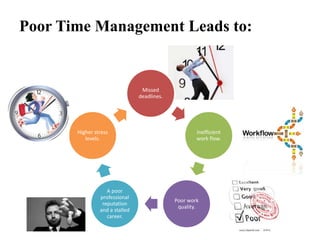
Poor Time Management Leads to:
Missed
deadlines.
Inefficient
work flow.
Poor work
quality.
A poor
professional
reputation
and a stalled
career.
Higher stress
levels.
Ten Time Management Mistakes
• Failing to Keep a To-Do List
• Not Setting Personal Goals
• Not Prioritizing
• Failing to Manage Distractions
• Procrastination
• Taking on too Much
• Thriving on "Busy"
• Multitasking
• Not Taking Breaks
• Ineffectively Scheduling Tasks
Definition:
Greater
productivity
and efficiency.
A better
professional
reputation.
Less stress.
Increased
opportunities
for
advancement.
Greater
opportunities
to achieve
important life
and career
goals.
“Time management” refers to the way that you organize
and plan how long you spend on specific activities.
Benefits of Time Management
Time Management Quadrants
Examples
Quadrant 1
Putting out a fire in your living room, meet the deadline
to pay taxes, fix a broken pipe in your kitchen, house chores,
attending to your crying infant, etc.
Quadrant 2
Save money, continue studying for another degree,
starting a family, exercising, home maintenance plan,
read, write, meditate, make time to spend with friends, etc.
Quadrant 3
A friend who asks for your help to fix their computer
(important to them, less so to you), answering a phone call,
someone that shows up (unplanned) and requests you assist them with something, booking a flight,
etc.
Quadrant 4
Watching TV, go on a shopping spree (ha! online shopping counts, too!), facebook's infinite scroll
(or twitter's, or tumblr's, or just the webz in general),etc.
“Being in Quadrant 2 brings Success”
Playing in 4 Quadrants
Manage your workplace
• De-clutter your desk by clearing it at the end of each working day
• File documents once they have been used
• Purge files regularly
• Organize a work flow system in your space
• Create Structured Folder & Clean up desktop on regular intervals
Managing Interruptions
•Come up with a game plan
Share your calendar with others
Use friendly, but direct reminders.
•When possible, go to another location (Meeting Rooms)
•When interrupted, state right away you only have x-minutes.
•Turn off all notification sounds for e-mail and social media.
•If you use MS Outlook, program it to open to your Calendar/Task view vs. your E-mail Inbox.
•During meetings, Follow an agenda with a timer & use MoM to summarize and delegate
•Signal to others when you don’t want to be interrupted & let others know that you prefer not to
be interrupted during specific times.
•Keep your cell phone off Internet off during working hours.
Meetings
 Only attend the meeting which is mandatory
 Always start the meeting on time, regardless of people who are late;
 Do not review the contents of the meeting with the people who are late for the part
they missed;
 Reduce the length of meetings to one hour maximum, and preferably less—try 30
minutes, even try 15 or 10 minutes;
 End the meeting on the agreed-upon time, even if the agenda is not finished;
 Invite fewer people to the meeting—productivity goes down with increasing
numbers of participants;
 Allow the right for employees to decline their attendance, without having to justify
themselves and without penalties;
 Reward those people who show up on time and even early with some kind of small
gift or reward;
 Don’t allow individuals to hijack or dominate meetings by frequent and endless
conversation. It’s the responsibility of the meeting leader to control this;
 End meetings early. People will be more positive about participating as a result;
Keeping the time logs
• A time-log is an effective way to see where your time actually
goes to during the working day Record the information for
about 2 weeks to get a representative picture of time spent
• Accuracy of estimating time for tasks
• Time stealing activities
• Level of interruption
• Loading during the day
• Crises points / tasks
Successful Delegation
- Using the Power of Other People's Help
Why People Don't Delegate
• The belief that, ‘I can do it better myself’
• Attachment with previous responsibility
• Lack of confidence and trust in subordinates
• Low self-confidence and insecurity
• Unwillingness to accept risk
• Time involved in explaining the task
• Fear of loss of power
• Lack of availability of competent subordinate
• Subordinates’ resistance to delegation
Successful Delegation
• Saves your time
• Develops your people
• Grooms a successor
• Motivates employees
• Improves productivity
• Improves communication
• Improves trust
• Improves outcomes
Work Life Balance
Summary
• Have a schedule List based on Priorities
• Take on realistic goals an schedule accurately
• Do not over-commit
• Set and agree priorities to distinguish between urgent and
important tasks
• Build in some flexibility to cope with anything
unexpected
• Control your documents, workspace and phone
• Don’t procrastinate – Manage Your Time Today
• Define and use periods of quality time in your schedule
• Learn to say No in a professional manner
• Stay away from perfectionism and aim for excellence
• Build in time for personal development
Time management v1.2

Time management v1.2

  • 1.
    Time Management : QuickOverview Speaker : Navendu Bhatt
  • 2.
    Disclaimer on content “Allthe material is collected from internet such a Images, text, YouTube, Slide share and other links. This presentation is strictly prepared for educational purpose without any commercial use. The intention of presenter is just collate various available resources found on internet in one slide which can be freely used by other person for enhancing the knowledge on this topic. “Rivers maintain its purity for the virtue of its continuous flow , if it stops ,converts into a muddy pond , Similarly Knowledge shall continuously flow” “Keep Sharing and keep Growing” Thanks Everyone , Navendu Bhatt
  • 3.
  • 4.
    Index • Time Managementpitfalls • Definition and benefits • Time Management Quadrant • Tips for Successful Time Management • Summary
  • 5.
    Poor Time ManagementLeads to: Missed deadlines. Inefficient work flow. Poor work quality. A poor professional reputation and a stalled career. Higher stress levels.
  • 6.
    Ten Time ManagementMistakes • Failing to Keep a To-Do List • Not Setting Personal Goals • Not Prioritizing • Failing to Manage Distractions • Procrastination • Taking on too Much • Thriving on "Busy" • Multitasking • Not Taking Breaks • Ineffectively Scheduling Tasks
  • 8.
    Definition: Greater productivity and efficiency. A better professional reputation. Lessstress. Increased opportunities for advancement. Greater opportunities to achieve important life and career goals. “Time management” refers to the way that you organize and plan how long you spend on specific activities. Benefits of Time Management
  • 9.
  • 10.
    Examples Quadrant 1 Putting outa fire in your living room, meet the deadline to pay taxes, fix a broken pipe in your kitchen, house chores, attending to your crying infant, etc. Quadrant 2 Save money, continue studying for another degree, starting a family, exercising, home maintenance plan, read, write, meditate, make time to spend with friends, etc. Quadrant 3 A friend who asks for your help to fix their computer (important to them, less so to you), answering a phone call, someone that shows up (unplanned) and requests you assist them with something, booking a flight, etc. Quadrant 4 Watching TV, go on a shopping spree (ha! online shopping counts, too!), facebook's infinite scroll (or twitter's, or tumblr's, or just the webz in general),etc. “Being in Quadrant 2 brings Success”
  • 11.
    Playing in 4Quadrants
  • 12.
    Manage your workplace •De-clutter your desk by clearing it at the end of each working day • File documents once they have been used • Purge files regularly • Organize a work flow system in your space • Create Structured Folder & Clean up desktop on regular intervals
  • 13.
    Managing Interruptions •Come upwith a game plan Share your calendar with others Use friendly, but direct reminders. •When possible, go to another location (Meeting Rooms) •When interrupted, state right away you only have x-minutes. •Turn off all notification sounds for e-mail and social media. •If you use MS Outlook, program it to open to your Calendar/Task view vs. your E-mail Inbox. •During meetings, Follow an agenda with a timer & use MoM to summarize and delegate •Signal to others when you don’t want to be interrupted & let others know that you prefer not to be interrupted during specific times. •Keep your cell phone off Internet off during working hours.
  • 14.
    Meetings  Only attendthe meeting which is mandatory  Always start the meeting on time, regardless of people who are late;  Do not review the contents of the meeting with the people who are late for the part they missed;  Reduce the length of meetings to one hour maximum, and preferably less—try 30 minutes, even try 15 or 10 minutes;  End the meeting on the agreed-upon time, even if the agenda is not finished;  Invite fewer people to the meeting—productivity goes down with increasing numbers of participants;  Allow the right for employees to decline their attendance, without having to justify themselves and without penalties;  Reward those people who show up on time and even early with some kind of small gift or reward;  Don’t allow individuals to hijack or dominate meetings by frequent and endless conversation. It’s the responsibility of the meeting leader to control this;  End meetings early. People will be more positive about participating as a result;
  • 15.
    Keeping the timelogs • A time-log is an effective way to see where your time actually goes to during the working day Record the information for about 2 weeks to get a representative picture of time spent • Accuracy of estimating time for tasks • Time stealing activities • Level of interruption • Loading during the day • Crises points / tasks
  • 16.
    Successful Delegation - Usingthe Power of Other People's Help Why People Don't Delegate • The belief that, ‘I can do it better myself’ • Attachment with previous responsibility • Lack of confidence and trust in subordinates • Low self-confidence and insecurity • Unwillingness to accept risk • Time involved in explaining the task • Fear of loss of power • Lack of availability of competent subordinate • Subordinates’ resistance to delegation Successful Delegation • Saves your time • Develops your people • Grooms a successor • Motivates employees • Improves productivity • Improves communication • Improves trust • Improves outcomes
  • 17.
  • 19.
    Summary • Have aschedule List based on Priorities • Take on realistic goals an schedule accurately • Do not over-commit • Set and agree priorities to distinguish between urgent and important tasks • Build in some flexibility to cope with anything unexpected • Control your documents, workspace and phone • Don’t procrastinate – Manage Your Time Today • Define and use periods of quality time in your schedule • Learn to say No in a professional manner • Stay away from perfectionism and aim for excellence • Build in time for personal development