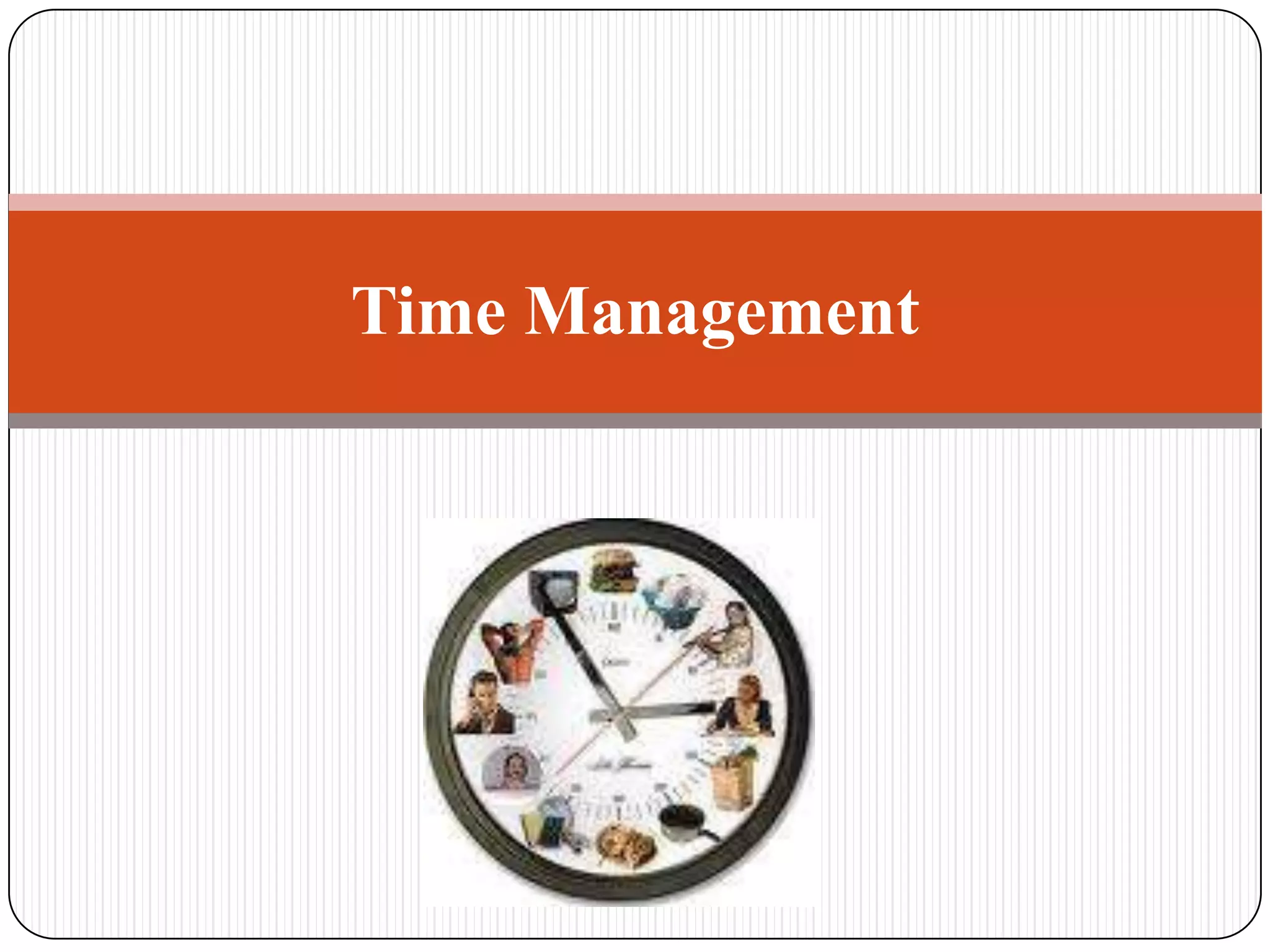


Time Management
Ice Breaker
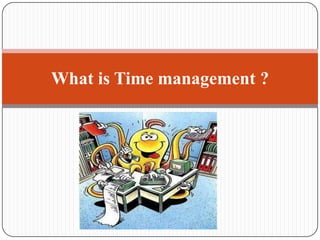
What is Time management ?
Time is what we want most, but...
      what we use worst. -

                        -William
             Penn
Story
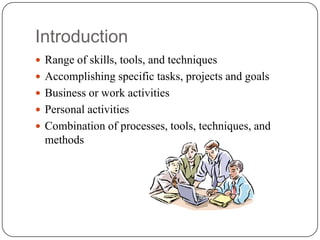
Introduction
 Range of skills, tools, and techniques
 Accomplishing specific tasks, projects and goals
 Business or work activities
 Personal activities
 Combination of processes, tools, techniques, and
  methods
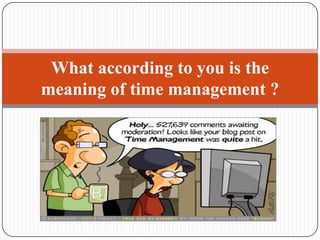
What according to you is the
meaning of time management ?
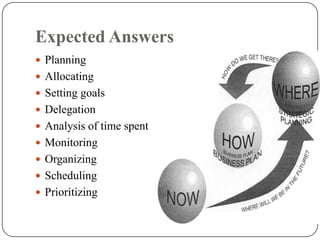
Expected Answers
 Planning
 Allocating
 Setting goals
 Delegation
 Analysis of time spent
 Monitoring
 Organizing
 Scheduling
 Prioritizing
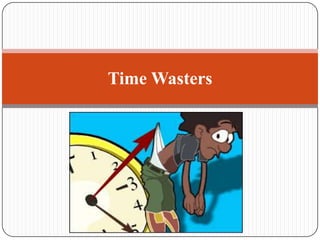
Time Wasters
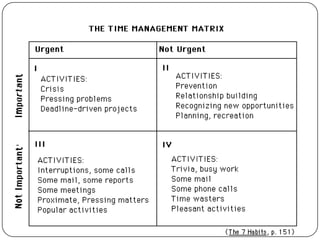
Activity
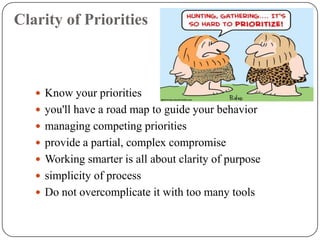
Clarity of Priorities


    Know your priorities
    you'll have a road map to guide your behavior
    managing competing priorities
    provide a partial, complex compromise
    Working smarter is all about clarity of purpose
    simplicity of process
    Do not overcomplicate it with too many tools
Investment of Time
 It's been said that 80% of our results come from 20%
  of our efforts.
 Maximize your efforts by investing 80% of your time
 Discover the things that produce the greatest results
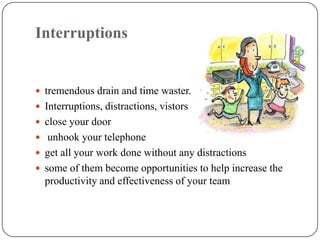
Interruptions


 tremendous drain and time waster.
 Interruptions, distractions, vistors
 close your door
 unhook your telephone
 get all your work done without any distractions
 some of them become opportunities to help increase the
  productivity and effectiveness of your team
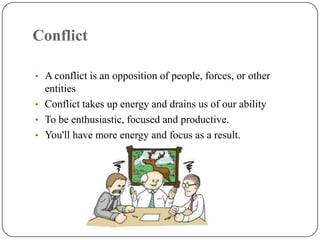
Conflict

• A conflict is an opposition of people, forces, or other
  entities
• Conflict takes up energy and drains us of our ability
• To be enthusiastic, focused and productive.
• You'll have more energy and focus as a result.
Personal Concerns During Business
Hours
 Personal issues including family problems, life changing
    situations, emotional difficulties, illness
   can impact your job and ultimately your ability to advance
    your career
   Try as you might to keep your private life separate from
    your work life
   Learn how to keep personal issues from negatively
    affecting your job
   Respect the boundaries between personal concerns and
    business
   Stay focused on the present task at hand while also
    minimizing distractions
Procrastination
 Act of replacing high-priority actions or tasks with low-
    priority actions
   Putting off important tasks to a later time
   May result in stress, a sense of guilt and crisis, severe loss
    of personal productivity
   Social disapproval for not meeting responsibilities or
    commitments
   Indecision, daydreaming and delay
    Working with a professional
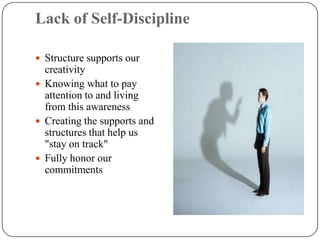
Lack of Self-Discipline

 Structure supports our
  creativity
 Knowing what to pay
  attention to and living
  from this awareness
 Creating the supports and
  structures that help us
  "stay on track"
 Fully honor our
  commitments
Unfinished Projects
 Jumping from project to project
 leaving tasks partly done
 constantly switching priorities
 tie up loose ends
 Review your finances
 If you're desperate to finish these projects to make
  money, fear may be blocking your intuition
 You'll have trouble thinking clearly and setting priorities
 “Idea board" near your desk
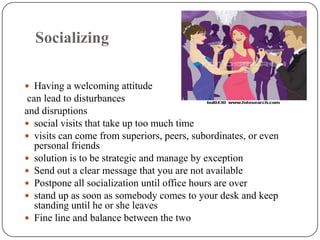
Socializing

 Having a welcoming attitude
 can lead to disturbances
and disruptions
 social visits that take up too much time
 visits can come from superiors, peers, subordinates, or even
   personal friends
 solution is to be strategic and manage by exception
 Send out a clear message that you are not available
 Postpone all socialization until office hours are over
 stand up as soon as somebody comes to your desk and keep
   standing until he or she leaves
 Fine line and balance between the two
Guilt and Shoulds
 "Shoulds" come from the unexamined beliefs that
    unconsciously guide our behavior
   guilt is the outcome of these "shoulds.“
   Identify your pre-existing beliefs
   Unexamined beliefs create guilt
   Explore what's really important to you NOW
Techniques in Time Management
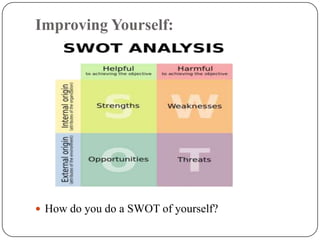
Improving Yourself:


 How do you do a SWOT of yourself?
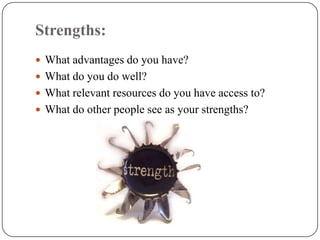
Strengths:
 What advantages do you have?
 What do you do well?
 What relevant resources do you have access to?
 What do other people see as your strengths?
Weaknesses:
 What could you improve?
 What do you do badly?
 What should you avoid?
 Are You not qualified fully for the future
  opportunities?
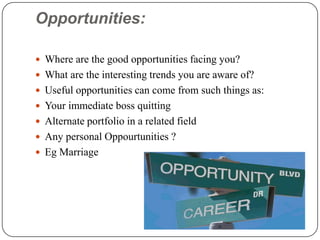
Opportunities:

 Where are the good opportunities facing you?
 What are the interesting trends you are aware of?
 Useful opportunities can come from such things as:
 Your immediate boss quitting
 Alternate portfolio in a related field
 Any personal Oppourtunities ?
 Eg Marriage
Threats
 What obstacles do you face?
 Are the required specifications for your job changing?
 Is changing technology threatening your position?
 Could any of your weaknesses seriously threaten your job?
 Is there any threat to you which will force you not to take
  the “Opportunity” when it comes along?
6 simple Time Management tips
Email
 ‘Ping' goes or the duck pops up
 Stop doing that
 Postman arrived once a day
 Mute or disable whatever 'you have mail' signal you use
 Disable the automatic check and do it manually
 Four times a day
 When you do open up
 Read
 Action
 Delegate
 File or bin immediately, each email in turn
 Be strict - you can do this
Subscriptions
 Mailing lists, blogs, feeds, social networking sites
 Multiply like rabbits
 Take time to read
 Reduce the numbers
 Un-subscribe from ALL of them
 Re-subscribe only to the ones that you absolutely have
  to have
 Between two and three hours a week
TV
 Turn off the TV.
 Turn it on only when you want to watch something
 When you are done watching turn it off again
 Be selective about what you want to watch
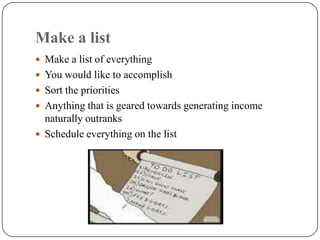
Make a list
 Make a list of everything
 You would like to accomplish
 Sort the priorities
 Anything that is geared towards generating income
  naturally outranks
 Schedule everything on the list
Schedule
 Break the whole day down, from start to finish
 Proven to work
 Try not to allot more than two consecutive time
    chunks
   Finish each task within the allotted time
   Literal two or three minutes
   Re-schedule it
   Download a countdown timer and use it
   You really strive to finish a given task within the
    allotted time
   You become aware of how and on what, your
    time is being spent in general
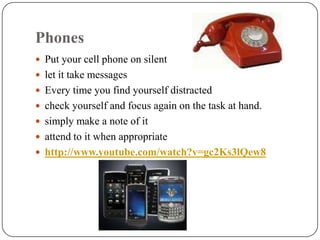
Phones
 Put your cell phone on silent
 let it take messages
 Every time you find yourself distracted
 check yourself and focus again on the task at hand.
 simply make a note of it
 attend to it when appropriate
 http://www.youtube.com/watch?v=gc2Ks3lQew8
Bonus Tip
 Difficult to accept and little tricky to master
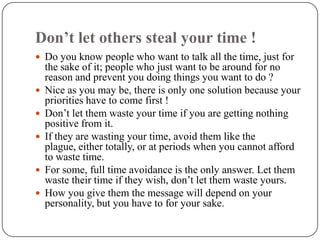
 Power napping
 Comfy chair away from your desk or workspace, sit, relax
    and close your eyes for ten minutes
   Awake enormously refreshed
   Splash your face with cold water
   After Lunch or Early evening
   You will feel energized
   Get a whole lot more done.
   Get seven hours sleep each and every night
Don’t let others steal your time !
 Do you know people who want to talk all the time, just for
    the sake of it; people who just want to be around for no
    reason and prevent you doing things you want to do ?
   Nice as you may be, there is only one solution because your
    priorities have to come first !
   Don’t let them waste your time if you are getting nothing
    positive from it.
   If they are wasting your time, avoid them like the
    plague, either totally, or at periods when you cannot afford
    to waste time.
   For some, full time avoidance is the only answer. Let them
    waste their time if they wish, don’t let them waste yours.
   How you give them the message will depend on your
    personality, but you have to for your sake.
Conclusion
 There's a time for love and romance
 for jubilation, and for sorrow
 Time to relax, and a time to catch up with the running
    moments
   What is important is to be in control of time
   No matter how pressured or tight any situation might be
   To be on time for everything, under the natural conditions
    of things, on a normal flow of moments
   Don’t have paper mountains !
   Blow up the electronics !
Time management, like any other skill, is
not hard to develop
 Don't look upon this training unit as a one-shot deal
 Look at it as only the first step
 Second step should be taken immediately before you toss the
  materials aside
 Schedule time in your planner
 Time should be kept not as an enemy, but as a companion
  towards your destined paths
Thank
You

Time management

  • 1.
  • 2.
  • 3.
    What is Timemanagement ?
  • 4.
    Time is whatwe want most, but... what we use worst. - -William Penn
  • 5.
  • 6.
    Introduction  Range ofskills, tools, and techniques  Accomplishing specific tasks, projects and goals  Business or work activities  Personal activities  Combination of processes, tools, techniques, and methods
  • 7.
    What according toyou is the meaning of time management ?
  • 8.
    Expected Answers  Planning Allocating  Setting goals  Delegation  Analysis of time spent  Monitoring  Organizing  Scheduling  Prioritizing
  • 9.
  • 10.
  • 11.
    Clarity of Priorities  Know your priorities  you'll have a road map to guide your behavior  managing competing priorities  provide a partial, complex compromise  Working smarter is all about clarity of purpose  simplicity of process  Do not overcomplicate it with too many tools
  • 12.
    Investment of Time It's been said that 80% of our results come from 20% of our efforts.  Maximize your efforts by investing 80% of your time  Discover the things that produce the greatest results
  • 13.
    Interruptions  tremendous drainand time waster.  Interruptions, distractions, vistors  close your door  unhook your telephone  get all your work done without any distractions  some of them become opportunities to help increase the productivity and effectiveness of your team
  • 14.
    Conflict • A conflictis an opposition of people, forces, or other entities • Conflict takes up energy and drains us of our ability • To be enthusiastic, focused and productive. • You'll have more energy and focus as a result.
  • 15.
    Personal Concerns DuringBusiness Hours  Personal issues including family problems, life changing situations, emotional difficulties, illness  can impact your job and ultimately your ability to advance your career  Try as you might to keep your private life separate from your work life  Learn how to keep personal issues from negatively affecting your job  Respect the boundaries between personal concerns and business  Stay focused on the present task at hand while also minimizing distractions
  • 16.
    Procrastination  Act ofreplacing high-priority actions or tasks with low- priority actions  Putting off important tasks to a later time  May result in stress, a sense of guilt and crisis, severe loss of personal productivity  Social disapproval for not meeting responsibilities or commitments  Indecision, daydreaming and delay  Working with a professional
  • 17.
    Lack of Self-Discipline Structure supports our creativity  Knowing what to pay attention to and living from this awareness  Creating the supports and structures that help us "stay on track"  Fully honor our commitments
  • 18.
    Unfinished Projects  Jumpingfrom project to project  leaving tasks partly done  constantly switching priorities  tie up loose ends  Review your finances  If you're desperate to finish these projects to make money, fear may be blocking your intuition  You'll have trouble thinking clearly and setting priorities  “Idea board" near your desk
  • 19.
    Socializing  Having awelcoming attitude can lead to disturbances and disruptions  social visits that take up too much time  visits can come from superiors, peers, subordinates, or even personal friends  solution is to be strategic and manage by exception  Send out a clear message that you are not available  Postpone all socialization until office hours are over  stand up as soon as somebody comes to your desk and keep standing until he or she leaves  Fine line and balance between the two
  • 20.
    Guilt and Shoulds "Shoulds" come from the unexamined beliefs that unconsciously guide our behavior  guilt is the outcome of these "shoulds.“  Identify your pre-existing beliefs  Unexamined beliefs create guilt  Explore what's really important to you NOW
  • 21.
  • 23.
    Improving Yourself:  Howdo you do a SWOT of yourself?
  • 24.
    Strengths:  What advantagesdo you have?  What do you do well?  What relevant resources do you have access to?  What do other people see as your strengths?
  • 25.
    Weaknesses:  What couldyou improve?  What do you do badly?  What should you avoid?  Are You not qualified fully for the future opportunities?
  • 26.
    Opportunities:  Where arethe good opportunities facing you?  What are the interesting trends you are aware of?  Useful opportunities can come from such things as:  Your immediate boss quitting  Alternate portfolio in a related field  Any personal Oppourtunities ?  Eg Marriage
  • 27.
    Threats  What obstaclesdo you face?  Are the required specifications for your job changing?  Is changing technology threatening your position?  Could any of your weaknesses seriously threaten your job?  Is there any threat to you which will force you not to take the “Opportunity” when it comes along?
  • 28.
    6 simple TimeManagement tips
  • 29.
    Email  ‘Ping' goesor the duck pops up  Stop doing that  Postman arrived once a day  Mute or disable whatever 'you have mail' signal you use  Disable the automatic check and do it manually  Four times a day  When you do open up  Read  Action  Delegate  File or bin immediately, each email in turn  Be strict - you can do this
  • 30.
    Subscriptions  Mailing lists,blogs, feeds, social networking sites  Multiply like rabbits  Take time to read  Reduce the numbers  Un-subscribe from ALL of them  Re-subscribe only to the ones that you absolutely have to have  Between two and three hours a week
  • 31.
    TV  Turn offthe TV.  Turn it on only when you want to watch something  When you are done watching turn it off again  Be selective about what you want to watch
  • 32.
    Make a list Make a list of everything  You would like to accomplish  Sort the priorities  Anything that is geared towards generating income naturally outranks  Schedule everything on the list
  • 33.
    Schedule  Break thewhole day down, from start to finish  Proven to work  Try not to allot more than two consecutive time chunks  Finish each task within the allotted time  Literal two or three minutes  Re-schedule it  Download a countdown timer and use it  You really strive to finish a given task within the allotted time  You become aware of how and on what, your time is being spent in general
  • 34.
    Phones  Put yourcell phone on silent  let it take messages  Every time you find yourself distracted  check yourself and focus again on the task at hand.  simply make a note of it  attend to it when appropriate  http://www.youtube.com/watch?v=gc2Ks3lQew8
  • 35.
    Bonus Tip  Difficultto accept and little tricky to master  Power napping  Comfy chair away from your desk or workspace, sit, relax and close your eyes for ten minutes  Awake enormously refreshed  Splash your face with cold water  After Lunch or Early evening  You will feel energized  Get a whole lot more done.  Get seven hours sleep each and every night
  • 36.
    Don’t let otherssteal your time !  Do you know people who want to talk all the time, just for the sake of it; people who just want to be around for no reason and prevent you doing things you want to do ?  Nice as you may be, there is only one solution because your priorities have to come first !  Don’t let them waste your time if you are getting nothing positive from it.  If they are wasting your time, avoid them like the plague, either totally, or at periods when you cannot afford to waste time.  For some, full time avoidance is the only answer. Let them waste their time if they wish, don’t let them waste yours.  How you give them the message will depend on your personality, but you have to for your sake.
  • 37.
    Conclusion  There's atime for love and romance  for jubilation, and for sorrow  Time to relax, and a time to catch up with the running moments  What is important is to be in control of time  No matter how pressured or tight any situation might be  To be on time for everything, under the natural conditions of things, on a normal flow of moments  Don’t have paper mountains !  Blow up the electronics !
  • 38.
    Time management, likeany other skill, is not hard to develop  Don't look upon this training unit as a one-shot deal  Look at it as only the first step  Second step should be taken immediately before you toss the materials aside  Schedule time in your planner  Time should be kept not as an enemy, but as a companion towards your destined paths
  • 39.