














6/24/2016www.LTSemaj.com1
to Improve Your
Productivity
Dr. Leahcim Semaj
6/24/2016www.LTSemaj.com2
Managing Your Time
Dr. Leahcim Semaj
Intl. Keynote & Motivational Speaker
Above or Beyond
876-383-5627
Dr. Leahcim Semaj...
Noted among the leading Motivational
Speakers, Creative Thinkers and Problem
Solvers in the Caribbean.
This Psychologist combines ancient
wisdom with contemporary ‘livity’ to
bring fresh insight to old human
problems.
FOOD SAFETY & SECURITY
“It is safer to eat from you own garden”
Dr. Leahcim Semaj
LTSEMAJ.COM
“I can’t feed 5000, but I can
teach everyone who wants
to learn”
Dr. Leahcim Semaj
LTSEMAJ.COM
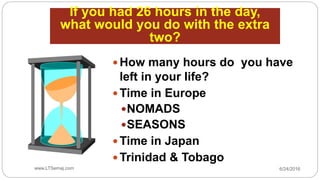
If you had 26 hours in the day,
what would you do with the extra
two?
 How many hours do you have
left in your life?
 Time in Europe
NOMADS
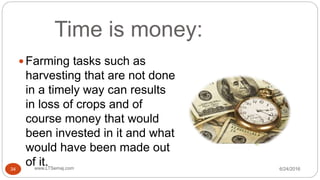
SEASONS
 Time in Japan
 Trinidad & Tobago
6/24/2016www.LTSemaj.com7
THE AFRICAN WORLD VIEW
“Why Jamaicans are consistently
late”
PRESENT
PAST
DISTANT
PAST 6/24/2016www.LTSemaj.com8
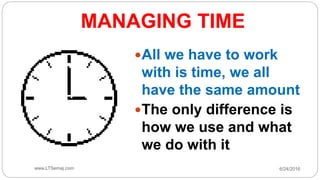
MANAGING TIME
All we have to work
with is time, we all
have the same amount
The only difference is
how we use and what
we do with it
6/24/2016www.LTSemaj.com9
The Future
You create
Someone else
create
Circumstances
create 6/24/2016www.LTSemaj.com10
116/24/2016 116/24/2016 11
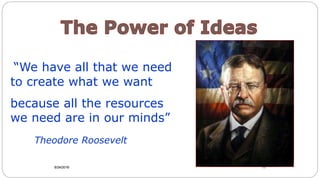
“We have all that we need
to create what we want
because all the resources
we need are in our minds”
Theodore Roosevelt
June 24, 2016
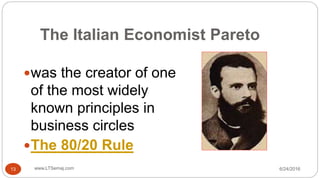
The Italian Economist Pareto
6/24/2016www.LTSemaj.com13
was the creator of one
of the most widely
known principles in
business circles
The 80/20 Rule
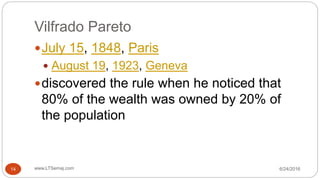
Vilfrado Pareto
6/24/2016www.LTSemaj.com14
July 15, 1848, Paris
 August 19, 1923, Geneva
discovered the rule when he noticed that
80% of the wealth was owned by 20% of
the population
In 1906
6/24/2016www.LTSemaj.com15
he made the famous observation
that 20 percent of the population
owned 80 percent of the property in
Italy
later
6/24/2016www.LTSemaj.com16
 generalized by Joseph M. Juran and others into
the so-called
Pareto principle
also termed the 80-20 rule
 and generalized further to
the concept of a Pareto distribution
Since then
6/24/2016www.LTSemaj.com17
people have realized the principle works
quite accurately for all sorts of things,
from the theory that 80 percent of your
business complaints
come from 20 percent of your customers,
to 80 percent of your revenue
is generated by 20 percent of your sales
items
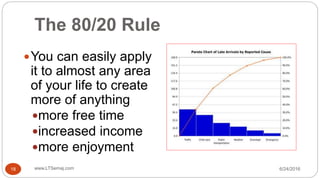
The 80/20 Rule
6/24/2016www.LTSemaj.com18
You can easily apply
it to almost any area
of your life to create
more of anything
more free time
increased income
more enjoyment
The 80/20 Rule
6/24/2016www.LTSemaj.com19
is one of the most
helpful of all concepts
of time and life
management.
For example,
6/24/2016www.LTSemaj.com20
 this rule says that 20% of your activities will
account for 80% of your results
 20% of your customers
 will account for 80% of your sales
 20% of your products or services
 will account for 80% of your profits
 20% of your tasks
 will account for 80% of the value of what you do, and
so on
This means that
6/24/2016www.LTSemaj.com21
if you have a list of 10 items to do
2 of those items will turn out to be
worth as much or more than the
other 8 items put together
The Greatest Payoff
6/24/2016www.LTSemaj.com22
Here is an interesting discovery
Each of these tasks may take the same
amount of time to accomplish
But one or 2 of those tasks
will contribute 5 or 10 times the value as
any of the others
Often,
6/24/2016www.LTSemaj.com23
one item on a list of 10 things that you
have to do
can be worth more than all the other 9
items put together
This task is invariably the one that you
should do first
The Most Valuable Tasks
6/24/2016www.LTSemaj.com24
The most valuable tasks you can
do each day are often the hardest
and most complex
But the payoff and rewards for
completing these tasks efficiently
can be tremendous.
For this reason,
6/24/2016www.LTSemaj.com25
you must adamantly refuse
to work on tasks in the
bottom 80%
while you still have tasks in
the top 20% left to be done
Before you begin work
6/24/2016www.LTSemaj.com26
always ask yourself,
"Is this task in the top 20% of
my activities
or in the bottom 80%?"
Getting Started
6/24/2016www.LTSemaj.com27
The hardest part of any
important task is getting
started on it in the first
place
Once
6/24/2016www.LTSemaj.com28
you actually begin work on a valuable task,
you seem to be naturally motivated to
continue.
There is a part of your mind that loves to be
busy working on significant tasks that can
really make a difference.
Your job is to feed this part of your mind
continually.
What is Your Time Worth
6/24/2016 www.LTSemaj.com 29
Managing Your Time
Time Management
Time Management is a common
problem faced by most persons in all
fields of work.
We can point out many reasons for this,
but often times its because some tasks
are just difficult, new or maybe we lack
the skills needed to accomplish it.
6/24/2016www.LTSemaj.com30
One of the things that lack of time
management skills leads to is
procrastination and procrastination as we
know, is the thief of time- simply put, if
you keep putting something off you will
soon find that there is no more time in
which to get it done.
6/24/2016www.LTSemaj.com31
Therefore time management
skills are necessary in order for
effective progress to take place
on any job anywhere.
6/24/2016www.LTSemaj.com32
No doubt as farmers, you
will need to learn these
skills as well for you control
the bread basket of the
world!
Think of what happens to
you when you are hungry
and can’t get to eat at a 6/24/2016www.LTSemaj.com33
Time is money:
 Farming tasks such as
harvesting that are not done
in a timely way can results
in loss of crops and of
course money that would
been invested in it and what
would have been made out
of it. 6/24/2016www.LTSemaj.com34
Managing Your Time
6/24/2016www.LTSemaj.com35
The Time-Stress Connection
Define Your Job:
How do you spend your time?
Managing Your Time
6/24/2016www.LTSemaj.com36
 Auditing Your Time
 Planning Your Time, Your Priorities
 Work Goals and Personal Goals
 How to Streamline Demands on
Your Time
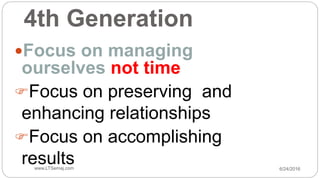
4th Generation
Focus on managing
ourselves not time
Focus on preserving and
enhancing relationships
Focus on accomplishing
results 6/24/2016www.LTSemaj.com37
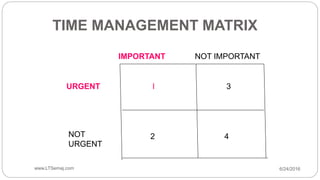
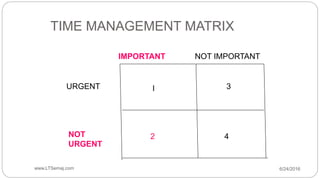
TIME MANAGEMENT MATRIX
6/24/2016www.LTSemaj.com38
IMPORTANT NOT IMPORTANT
URGENT
NOT
URGENT
I 3
42
TIME MANAGEMENT MATRIX
6/24/2016www.LTSemaj.com39
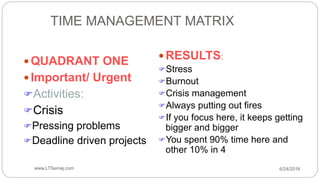
 QUADRANT ONE
 Important/ Urgent
Activities:
Crisis
Pressing problems
Deadline driven projects
 RESULTS:
Stress
Burnout
Crisis management
Always putting out fires
If you focus here, it keeps getting
bigger and bigger
You spent 90% time here and
other 10% in 4
TIME MANAGEMENT MATRIX
6/24/2016www.LTSemaj.com40
IMPORTANT NOT IMPORTANT
URGENT
NOT
URGENT
I 3
42
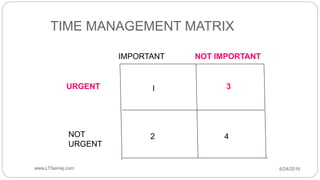
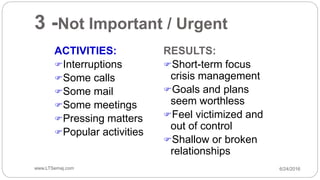
3 -Not Important / Urgent
6/24/2016www.LTSemaj.com41
ACTIVITIES:
Interruptions
Some calls
Some mail
Some meetings
Pressing matters
Popular activities
RESULTS:
Short-term focus
crisis management
Goals and plans
seem worthless
Feel victimized and
out of control
Shallow or broken
relationships
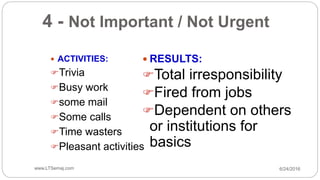
4 - Not Important / Not Urgent
6/24/2016www.LTSemaj.com42
 ACTIVITIES:
Trivia
Busy work
some mail
Some calls
Time wasters
Pleasant activities
 RESULTS:
Total irresponsibility
Fired from jobs
Dependent on others
or institutions for
basics
TIME MANAGEMENT MATRIX
6/24/2016www.LTSemaj.com43
IMPORTANT NOT IMPORTANT
URGENT
NOT
URGENT
I 3
42
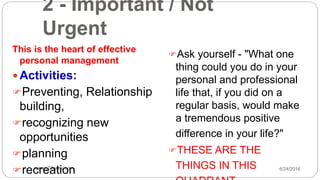
2 - Important / Not
Urgent
6/24/2016www.LTSemaj.com44
This is the heart of effective
personal management
 Activities:
Preventing, Relationship
building,
recognizing new
opportunities
planning
recreation
Ask yourself - "What one
thing could you do in your
personal and professional
life that, if you did on a
regular basis, would make
a tremendous positive
difference in your life?"
THESE ARE THE
THINGS IN THIS
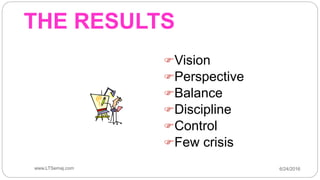
THE RESULTS
Vision
Perspective
Balance
Discipline
Control
Few crisis
6/24/2016www.LTSemaj.com45
Lee Iococca
The ability to
concentrate and to
use time well is
everything
6/24/2016www.LTSemaj.com46
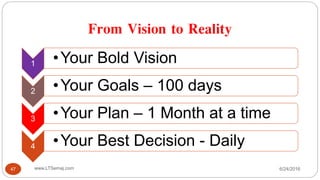
From Vision to Reality
1 •Your Bold Vision
2 •Your Goals – 100 days
3 •Your Plan – 1 Month at a time
4 •Your Best Decision - Daily
6/24/2016www.LTSemaj.com47
What is Your Bold Vision?
June 24, 2016
The
Power of
Intension
and
Desire
June 24, 2016
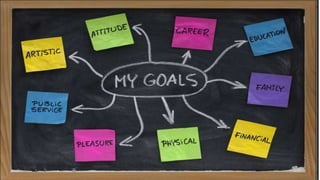
From DREAMS to GOALS
Set Your Goals – 100 Days Away,
defined and
measurable.
“If you have a goal, write it
down.
If you do not write it down,
you do not have a goal June 24, 2016
June 24, 2016
GOALS
June 24, 2016
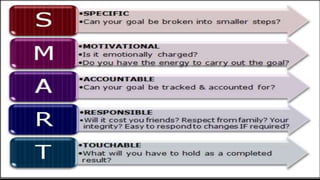
S.M.A.R.T
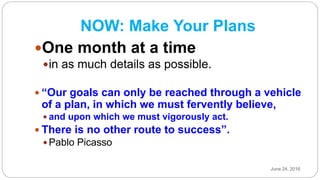
NOW: Make Your Plans
One month at a time
in as much details as possible.
 “Our goals can only be reached through a vehicle
of a plan, in which we must fervently believe,
 and upon which we must vigorously act.
 There is no other route to success”.
 Pablo Picasso
June 24, 2016
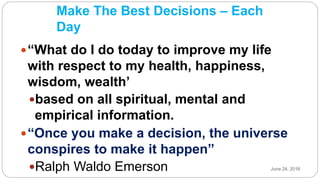
Make The Best Decisions – Each
Day
“What do I do today to improve my life
with respect to my health, happiness,
wisdom, wealth’
based on all spiritual, mental and
empirical information.
“Once you make a decision, the universe
conspires to make it happen”
Ralph Waldo Emerson June 24, 2016
Make the best decisions – each day
If this is not what you are doing,
then we call it wishful thinking.
“Stop the habit of wishful thinking and
start the habit of thoughtful wishes”
Mary Martin
June 24, 2016
June 24, 2016
DECISIONS
Do Sum’n
6/24/2016www.LTSemaj.com60
TIME MANAGEMENT TIPS
 1 Year Vision - THE YEAR, MONTH,
WEEK
Each day can now be
prioritized
The issue is not to prioritize
what's on your schedule,
but to schedule your priorities
6/24/2016www.LTSemaj.com61
2. IDENTIFY ROLES THAT YOU PLAY -
So that no area is
neglected
6/24/2016www.LTSemaj.com62
TIME MANAGEMENT TIPS
3. SELECT GOALS
 list areas that you wish to
spend time in in the next
week
 Identify important result
wished for in the next week
4. MAKE SCHEDULE
 based on the above and
your personal mission
5. DAILY
ADAPTATION
based on situation as
they unfold
6/24/2016www.LTSemaj.com63
Make 5 lists
1.The "Projects" list tracks big-picture
outcomes:
2.The "Next Actions" list itemizes next steps
on all active projects:
6/24/2016www.LTSemaj.com64
Make 5 lists
3. The "Waiting For" list records activities that
depend on someone else
4. The "Calendar" tracks time-specific
appointments and day-specific actions
5. The "Someday/Maybe" list records
discretionary tasks:
Action Exercises
6/24/2016www.LTSemaj.com65
 Make a list of all the key goals,
activities, projects and responsibilities in your
life today
 Which of them are, or could be
in the top 10% or 20% of tasks that represent,
 or could represent,
80% or 90% of your results?
Resolve today
6/24/2016www.LTSemaj.com66
that you are going to spend more and more
of your time working in those few areas
that can really make a difference
in you life and career
and less and less time
on lower value activities.
1. Work Tasks
6/24/2016www.LTSemaj.com67
Write down all the broad categories of tasks
you do at your job.
You can make a little table that shows the
amount of hours spent at each category
on another column
6/24/2016www.LTSemaj.com68
write down a value estimate for
what percentage you believe it
contributes to your productivity.
Eliminate, simplify or delegate
low %’s
and focus on high %’s
2. Daily Time Log
6/24/2016www.LTSemaj.com69
 Do a time log on your activities for an entire day
 Record the stop and start point for any activity
 Then broadly shuffle the different activities into
categories
 Figure out what parts of your day aren’t contributing to
 either productivity, entertainment or personal happiness
 and cut them out.
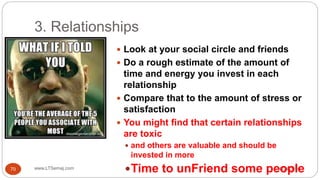
3. Relationships
6/24/2016www.LTSemaj.com70
 Look at your social circle and friends
 Do a rough estimate of the amount of
time and energy you invest in each
relationship
 Compare that to the amount of stress or
satisfaction
 You might find that certain relationships
are toxic
 and others are valuable and should be
invested in more
Time to unFriend some people
4. Clients/Customers
6/24/2016www.LTSemaj.com71
 Figure out which customers contribute the most
complaints and the least revenue
 Notify them that things will need to change and set
down some guidelines
 Then fire the ones that don’t comply
 Goes against the doctrine that the customer is
always right,
 but some people just aren’t worth the trouble they cause.
5. Habits
6/24/2016www.LTSemaj.com72
Figure out which behaviors (or lack thereof)
contribute the most to your life
Exercise?
Rising Early?
Family Dinners?
Use this as a basis for making new habits.
6. Goals
6/24/2016www.LTSemaj.com73
It doesn’t matter whether you have them
written down or just in your head
Look at all your goals and compare the
resources required to accomplish each with
the benefits gained
(time, money, energy, etc.)
Benefits
6/24/2016www.LTSemaj.com74
could be physical rewards,
purposeful work
or emotional quality
Pursue the goals with the
highest value.
Managing Your Life
6/24/2016www.LTSemaj.com75
Time management is really life management,
personal management.
It is really taking control over the sequence of
events.
Time management is control over what you
do next.
And you are always free to choose the task
that you will do next.
Your ability
6/24/2016www.LTSemaj.com76
to choose between the important and the
unimportant is the key determinant of
your success in life and work.
Effective, productive people discipline
themselves
to start on the most important task
that is before them.
As a result,
6/24/2016www.LTSemaj.com77
they accomplish vastly more than
the average person
and are much happier as a result.
This should be your way of
working as well.
“I can’t feed 5000, but I can
teach everyone who wants
to learn”
Dr. Leahcim Semaj
LTSEMAJ.COM
Thank you
6/24/2016www.LTSemaj.com79

Managing your time june2016

  • 1.
  • 2.
    to Improve Your Productivity Dr.Leahcim Semaj 6/24/2016www.LTSemaj.com2 Managing Your Time
  • 3.
    Dr. Leahcim Semaj Intl.Keynote & Motivational Speaker Above or Beyond 876-383-5627
  • 4.
    Dr. Leahcim Semaj... Notedamong the leading Motivational Speakers, Creative Thinkers and Problem Solvers in the Caribbean. This Psychologist combines ancient wisdom with contemporary ‘livity’ to bring fresh insight to old human problems.
  • 5.
    FOOD SAFETY &SECURITY “It is safer to eat from you own garden” Dr. Leahcim Semaj LTSEMAJ.COM
  • 6.
    “I can’t feed5000, but I can teach everyone who wants to learn” Dr. Leahcim Semaj LTSEMAJ.COM
  • 7.
    If you had26 hours in the day, what would you do with the extra two?  How many hours do you have left in your life?  Time in Europe NOMADS SEASONS  Time in Japan  Trinidad & Tobago 6/24/2016www.LTSemaj.com7
  • 8.
    THE AFRICAN WORLDVIEW “Why Jamaicans are consistently late” PRESENT PAST DISTANT PAST 6/24/2016www.LTSemaj.com8
  • 9.
    MANAGING TIME All wehave to work with is time, we all have the same amount The only difference is how we use and what we do with it 6/24/2016www.LTSemaj.com9
  • 10.
    The Future You create Someoneelse create Circumstances create 6/24/2016www.LTSemaj.com10
  • 11.
    116/24/2016 116/24/2016 11 “Wehave all that we need to create what we want because all the resources we need are in our minds” Theodore Roosevelt
  • 12.
  • 13.
    The Italian EconomistPareto 6/24/2016www.LTSemaj.com13 was the creator of one of the most widely known principles in business circles The 80/20 Rule
  • 14.
    Vilfrado Pareto 6/24/2016www.LTSemaj.com14 July 15,1848, Paris  August 19, 1923, Geneva discovered the rule when he noticed that 80% of the wealth was owned by 20% of the population
  • 15.
    In 1906 6/24/2016www.LTSemaj.com15 he madethe famous observation that 20 percent of the population owned 80 percent of the property in Italy
  • 16.
    later 6/24/2016www.LTSemaj.com16  generalized byJoseph M. Juran and others into the so-called Pareto principle also termed the 80-20 rule  and generalized further to the concept of a Pareto distribution
  • 17.
    Since then 6/24/2016www.LTSemaj.com17 people haverealized the principle works quite accurately for all sorts of things, from the theory that 80 percent of your business complaints come from 20 percent of your customers, to 80 percent of your revenue is generated by 20 percent of your sales items
  • 18.
    The 80/20 Rule 6/24/2016www.LTSemaj.com18 Youcan easily apply it to almost any area of your life to create more of anything more free time increased income more enjoyment
  • 19.
    The 80/20 Rule 6/24/2016www.LTSemaj.com19 isone of the most helpful of all concepts of time and life management.
  • 20.
    For example, 6/24/2016www.LTSemaj.com20  thisrule says that 20% of your activities will account for 80% of your results  20% of your customers  will account for 80% of your sales  20% of your products or services  will account for 80% of your profits  20% of your tasks  will account for 80% of the value of what you do, and so on
  • 21.
    This means that 6/24/2016www.LTSemaj.com21 ifyou have a list of 10 items to do 2 of those items will turn out to be worth as much or more than the other 8 items put together
  • 22.
    The Greatest Payoff 6/24/2016www.LTSemaj.com22 Hereis an interesting discovery Each of these tasks may take the same amount of time to accomplish But one or 2 of those tasks will contribute 5 or 10 times the value as any of the others
  • 23.
    Often, 6/24/2016www.LTSemaj.com23 one item ona list of 10 things that you have to do can be worth more than all the other 9 items put together This task is invariably the one that you should do first
  • 24.
    The Most ValuableTasks 6/24/2016www.LTSemaj.com24 The most valuable tasks you can do each day are often the hardest and most complex But the payoff and rewards for completing these tasks efficiently can be tremendous.
  • 25.
    For this reason, 6/24/2016www.LTSemaj.com25 youmust adamantly refuse to work on tasks in the bottom 80% while you still have tasks in the top 20% left to be done
  • 26.
    Before you beginwork 6/24/2016www.LTSemaj.com26 always ask yourself, "Is this task in the top 20% of my activities or in the bottom 80%?"
  • 27.
    Getting Started 6/24/2016www.LTSemaj.com27 The hardestpart of any important task is getting started on it in the first place
  • 28.
    Once 6/24/2016www.LTSemaj.com28 you actually beginwork on a valuable task, you seem to be naturally motivated to continue. There is a part of your mind that loves to be busy working on significant tasks that can really make a difference. Your job is to feed this part of your mind continually.
  • 29.
    What is YourTime Worth 6/24/2016 www.LTSemaj.com 29 Managing Your Time
  • 30.
    Time Management Time Managementis a common problem faced by most persons in all fields of work. We can point out many reasons for this, but often times its because some tasks are just difficult, new or maybe we lack the skills needed to accomplish it. 6/24/2016www.LTSemaj.com30
  • 31.
    One of thethings that lack of time management skills leads to is procrastination and procrastination as we know, is the thief of time- simply put, if you keep putting something off you will soon find that there is no more time in which to get it done. 6/24/2016www.LTSemaj.com31
  • 32.
    Therefore time management skillsare necessary in order for effective progress to take place on any job anywhere. 6/24/2016www.LTSemaj.com32
  • 33.
    No doubt asfarmers, you will need to learn these skills as well for you control the bread basket of the world! Think of what happens to you when you are hungry and can’t get to eat at a 6/24/2016www.LTSemaj.com33
  • 34.
    Time is money: Farming tasks such as harvesting that are not done in a timely way can results in loss of crops and of course money that would been invested in it and what would have been made out of it. 6/24/2016www.LTSemaj.com34
  • 35.
    Managing Your Time 6/24/2016www.LTSemaj.com35 TheTime-Stress Connection Define Your Job: How do you spend your time?
  • 36.
    Managing Your Time 6/24/2016www.LTSemaj.com36 Auditing Your Time  Planning Your Time, Your Priorities  Work Goals and Personal Goals  How to Streamline Demands on Your Time
  • 37.
    4th Generation Focus onmanaging ourselves not time Focus on preserving and enhancing relationships Focus on accomplishing results 6/24/2016www.LTSemaj.com37
  • 38.
  • 39.
    TIME MANAGEMENT MATRIX 6/24/2016www.LTSemaj.com39 QUADRANT ONE  Important/ Urgent Activities: Crisis Pressing problems Deadline driven projects  RESULTS: Stress Burnout Crisis management Always putting out fires If you focus here, it keeps getting bigger and bigger You spent 90% time here and other 10% in 4
  • 40.
  • 41.
    3 -Not Important/ Urgent 6/24/2016www.LTSemaj.com41 ACTIVITIES: Interruptions Some calls Some mail Some meetings Pressing matters Popular activities RESULTS: Short-term focus crisis management Goals and plans seem worthless Feel victimized and out of control Shallow or broken relationships
  • 42.
    4 - NotImportant / Not Urgent 6/24/2016www.LTSemaj.com42  ACTIVITIES: Trivia Busy work some mail Some calls Time wasters Pleasant activities  RESULTS: Total irresponsibility Fired from jobs Dependent on others or institutions for basics
  • 43.
  • 44.
    2 - Important/ Not Urgent 6/24/2016www.LTSemaj.com44 This is the heart of effective personal management  Activities: Preventing, Relationship building, recognizing new opportunities planning recreation Ask yourself - "What one thing could you do in your personal and professional life that, if you did on a regular basis, would make a tremendous positive difference in your life?" THESE ARE THE THINGS IN THIS
  • 45.
  • 46.
    Lee Iococca The abilityto concentrate and to use time well is everything 6/24/2016www.LTSemaj.com46
  • 47.
    From Vision toReality 1 •Your Bold Vision 2 •Your Goals – 100 days 3 •Your Plan – 1 Month at a time 4 •Your Best Decision - Daily 6/24/2016www.LTSemaj.com47
  • 48.
    What is YourBold Vision? June 24, 2016
  • 49.
  • 50.
    June 24, 2016 FromDREAMS to GOALS
  • 51.
    Set Your Goals– 100 Days Away, defined and measurable. “If you have a goal, write it down. If you do not write it down, you do not have a goal June 24, 2016
  • 52.
  • 53.
  • 54.
    NOW: Make YourPlans One month at a time in as much details as possible.  “Our goals can only be reached through a vehicle of a plan, in which we must fervently believe,  and upon which we must vigorously act.  There is no other route to success”.  Pablo Picasso June 24, 2016
  • 56.
    Make The BestDecisions – Each Day “What do I do today to improve my life with respect to my health, happiness, wisdom, wealth’ based on all spiritual, mental and empirical information. “Once you make a decision, the universe conspires to make it happen” Ralph Waldo Emerson June 24, 2016
  • 57.
    Make the bestdecisions – each day If this is not what you are doing, then we call it wishful thinking. “Stop the habit of wishful thinking and start the habit of thoughtful wishes” Mary Martin June 24, 2016
  • 58.
  • 59.
  • 60.
    6/24/2016www.LTSemaj.com60 TIME MANAGEMENT TIPS 1 Year Vision - THE YEAR, MONTH, WEEK Each day can now be prioritized The issue is not to prioritize what's on your schedule, but to schedule your priorities
  • 61.
    6/24/2016www.LTSemaj.com61 2. IDENTIFY ROLESTHAT YOU PLAY - So that no area is neglected
  • 62.
    6/24/2016www.LTSemaj.com62 TIME MANAGEMENT TIPS 3.SELECT GOALS  list areas that you wish to spend time in in the next week  Identify important result wished for in the next week 4. MAKE SCHEDULE  based on the above and your personal mission 5. DAILY ADAPTATION based on situation as they unfold
  • 63.
    6/24/2016www.LTSemaj.com63 Make 5 lists 1.The"Projects" list tracks big-picture outcomes: 2.The "Next Actions" list itemizes next steps on all active projects:
  • 64.
    6/24/2016www.LTSemaj.com64 Make 5 lists 3.The "Waiting For" list records activities that depend on someone else 4. The "Calendar" tracks time-specific appointments and day-specific actions 5. The "Someday/Maybe" list records discretionary tasks:
  • 65.
    Action Exercises 6/24/2016www.LTSemaj.com65  Makea list of all the key goals, activities, projects and responsibilities in your life today  Which of them are, or could be in the top 10% or 20% of tasks that represent,  or could represent, 80% or 90% of your results?
  • 66.
    Resolve today 6/24/2016www.LTSemaj.com66 that youare going to spend more and more of your time working in those few areas that can really make a difference in you life and career and less and less time on lower value activities.
  • 67.
    1. Work Tasks 6/24/2016www.LTSemaj.com67 Writedown all the broad categories of tasks you do at your job. You can make a little table that shows the amount of hours spent at each category
  • 68.
    on another column 6/24/2016www.LTSemaj.com68 writedown a value estimate for what percentage you believe it contributes to your productivity. Eliminate, simplify or delegate low %’s and focus on high %’s
  • 69.
    2. Daily TimeLog 6/24/2016www.LTSemaj.com69  Do a time log on your activities for an entire day  Record the stop and start point for any activity  Then broadly shuffle the different activities into categories  Figure out what parts of your day aren’t contributing to  either productivity, entertainment or personal happiness  and cut them out.
  • 70.
    3. Relationships 6/24/2016www.LTSemaj.com70  Lookat your social circle and friends  Do a rough estimate of the amount of time and energy you invest in each relationship  Compare that to the amount of stress or satisfaction  You might find that certain relationships are toxic  and others are valuable and should be invested in more Time to unFriend some people
  • 71.
    4. Clients/Customers 6/24/2016www.LTSemaj.com71  Figureout which customers contribute the most complaints and the least revenue  Notify them that things will need to change and set down some guidelines  Then fire the ones that don’t comply  Goes against the doctrine that the customer is always right,  but some people just aren’t worth the trouble they cause.
  • 72.
    5. Habits 6/24/2016www.LTSemaj.com72 Figure outwhich behaviors (or lack thereof) contribute the most to your life Exercise? Rising Early? Family Dinners? Use this as a basis for making new habits.
  • 73.
    6. Goals 6/24/2016www.LTSemaj.com73 It doesn’tmatter whether you have them written down or just in your head Look at all your goals and compare the resources required to accomplish each with the benefits gained (time, money, energy, etc.)
  • 74.
    Benefits 6/24/2016www.LTSemaj.com74 could be physicalrewards, purposeful work or emotional quality Pursue the goals with the highest value.
  • 75.
    Managing Your Life 6/24/2016www.LTSemaj.com75 Timemanagement is really life management, personal management. It is really taking control over the sequence of events. Time management is control over what you do next. And you are always free to choose the task that you will do next.
  • 76.
    Your ability 6/24/2016www.LTSemaj.com76 to choosebetween the important and the unimportant is the key determinant of your success in life and work. Effective, productive people discipline themselves to start on the most important task that is before them.
  • 77.
    As a result, 6/24/2016www.LTSemaj.com77 theyaccomplish vastly more than the average person and are much happier as a result. This should be your way of working as well.
  • 78.
    “I can’t feed5000, but I can teach everyone who wants to learn” Dr. Leahcim Semaj LTSEMAJ.COM
  • 79.

Editor's Notes