Jamalee Stone, Rhonda Airheart, Sean Bialas, Jeremy Elsom,
        Jennifer Johnson, Becca Myers, Jinhua Tan
Promoting Reflective Inquiry in Mathematics
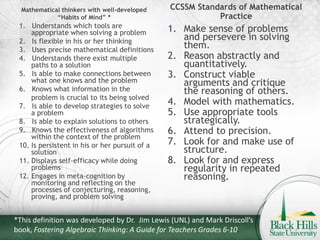
Mathematical thinkers with well-developed     CCSSM Standards of Mathematical
             “Habits of Mind” *                            Practice
 1. Understands which tools are
     appropriate when solving a problem         1. Make sense of problems
 2. Is flexible in his or her thinking             and persevere in solving
 3. Uses precise mathematical definitions
                                                   them.
 4. Understands there exist multiple            2. Reason abstractly and
     paths to a solution                           quantitatively.
 5. Is able to make connections between         3. Construct viable
     what one knows and the problem                arguments and critique
 6. Knows what information in the                  the reasoning of others.
     problem is crucial to its being solved
 7. Is able to develop strategies to solve
                                                4. Model with mathematics.
     a problem                                  5. Use appropriate tools
 8. Is able to explain solutions to others         strategically.
 9. Knows the effectiveness of algorithms       6. Attend to precision.
     within the context of the problem
 10. Is persistent in his or her pursuit of a   7. Look for and make use of
     solution                                      structure.
 11. Displays self‐efficacy while doing         8. Look for and express
     problems                                      regularity in repeated
 12. Engages in meta‐cognition by                  reasoning.
     monitoring and reflecting on the
     processes of conjecturing, reasoning,
     proving, and problem solving


*This definition was developed by Dr. Jim Lewis (UNL) and Mark Driscoll’s
book, Fostering Algebraic Thinking: A Guide for Teachers Grades 6-10.
• On the index isosceles right triangle
  provided, please write down 1-2 of your
  favorite “habits of mind” problems that
  you may have used in your teaching.
• Please share with one of the persons
  sitting in your proximity.
• As a table, share the problems that came
  to mind.
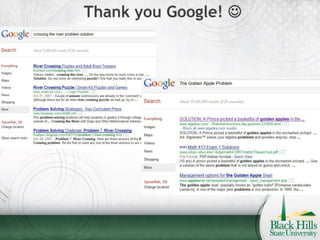
Thank you Google! 
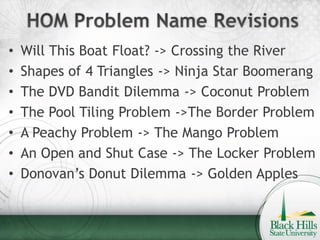
•   Will This Boat Float? -> Crossing the River
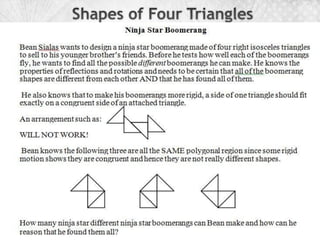
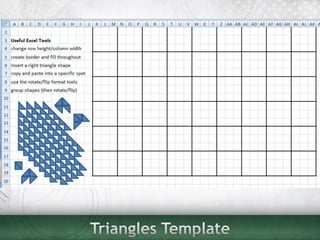
•   Shapes of 4 Triangles -> Ninja Star Boomerang
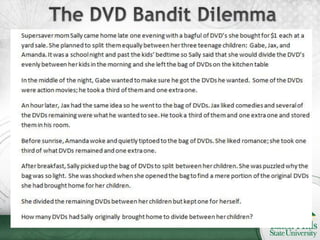
•   The DVD Bandit Dilemma -> Coconut Problem
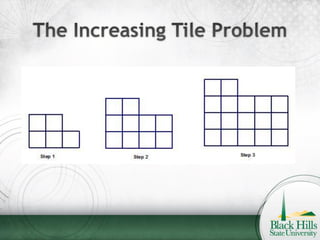
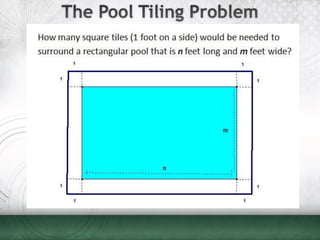
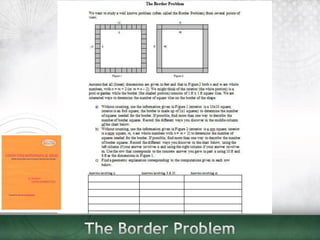
•   The Pool Tiling Problem ->The Border Problem
•   A Peachy Problem -> The Mango Problem
•   An Open and Shut Case -> The Locker Problem
•   Donovan’s Donut Dilemma -> Golden Apples
• To work with material aligned with the age group we
  will teach
• More experience teaching content to others.
• Gives us experience getting up in front of the class and
  practice asking questions.
• Gives us a chance to work the problems and present
  them.
• So we can learn to differentiate instruction.
• Helps us think in different ways
• To get different perspectives on how other people think
  and also teach…
• GoogleDocs spreadsheet used for HOM sign-up.
   – Partner and date
• Problems were posted in D2L content area for
  students to review and select.
• Partners met with me at least four days in
  advance to review the HOM problem, discuss
  the solution(s) found, and provide an overview
  of how they planned to facilitate the lesson.
• HOM lesson was videotaped (by me, not a
  professional )
• Peers used an index card to indicate what went
  well with the lesson, and at least one
  suggestion for improvement. Comments typed
  and shared.
• Students scheduled a time where they could
  both watch the video in my office.
• While watching the video, partners took notes
  of what they noticed while watching
  themselves.
• Between peer reflections and the video
  viewing, noticeable issues are addressed… 
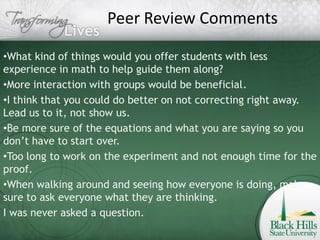
Peer Review Comments

•What kind of things would you offer students with less
experience in math to help guide them along?
•More interaction with groups would be beneficial.
•I think that you could do better on not correcting right away.
Lead us to it, not show us.
•Be more sure of the equations and what you are saying so you
don’t have to start over.
•Too long to work on the experiment and not enough time for the
proof.
•When walking around and seeing how everyone is doing, make
sure to ask everyone what they are thinking.
I was never asked a question.
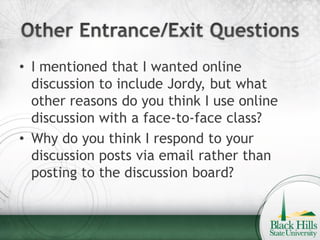
• I mentioned that I wanted online
  discussion to include Jordy, but what
  other reasons do you think I use online
  discussion with a face-to-face class?
• Why do you think I respond to your
  discussion posts via email rather than
  posting to the discussion board?
Jami.Stone@bhsu.edu
   (402) 613-0136

TIME for Lesson Study Jamalee Stone

  • 1.
    Jamalee Stone, RhondaAirheart, Sean Bialas, Jeremy Elsom, Jennifer Johnson, Becca Myers, Jinhua Tan
  • 2.
  • 3.
    Mathematical thinkers withwell-developed CCSSM Standards of Mathematical “Habits of Mind” * Practice 1. Understands which tools are appropriate when solving a problem 1. Make sense of problems 2. Is flexible in his or her thinking and persevere in solving 3. Uses precise mathematical definitions them. 4. Understands there exist multiple 2. Reason abstractly and paths to a solution quantitatively. 5. Is able to make connections between 3. Construct viable what one knows and the problem arguments and critique 6. Knows what information in the the reasoning of others. problem is crucial to its being solved 7. Is able to develop strategies to solve 4. Model with mathematics. a problem 5. Use appropriate tools 8. Is able to explain solutions to others strategically. 9. Knows the effectiveness of algorithms 6. Attend to precision. within the context of the problem 10. Is persistent in his or her pursuit of a 7. Look for and make use of solution structure. 11. Displays self‐efficacy while doing 8. Look for and express problems regularity in repeated 12. Engages in meta‐cognition by reasoning. monitoring and reflecting on the processes of conjecturing, reasoning, proving, and problem solving *This definition was developed by Dr. Jim Lewis (UNL) and Mark Driscoll’s book, Fostering Algebraic Thinking: A Guide for Teachers Grades 6-10.
  • 4.
    • On theindex isosceles right triangle provided, please write down 1-2 of your favorite “habits of mind” problems that you may have used in your teaching. • Please share with one of the persons sitting in your proximity. • As a table, share the problems that came to mind.
  • 5.
  • 6.
    Will This Boat Float? -> Crossing the River • Shapes of 4 Triangles -> Ninja Star Boomerang • The DVD Bandit Dilemma -> Coconut Problem • The Pool Tiling Problem ->The Border Problem • A Peachy Problem -> The Mango Problem • An Open and Shut Case -> The Locker Problem • Donovan’s Donut Dilemma -> Golden Apples
  • 7.
    • To workwith material aligned with the age group we will teach • More experience teaching content to others. • Gives us experience getting up in front of the class and practice asking questions. • Gives us a chance to work the problems and present them. • So we can learn to differentiate instruction. • Helps us think in different ways • To get different perspectives on how other people think and also teach…
  • 8.
    • GoogleDocs spreadsheetused for HOM sign-up. – Partner and date • Problems were posted in D2L content area for students to review and select. • Partners met with me at least four days in advance to review the HOM problem, discuss the solution(s) found, and provide an overview of how they planned to facilitate the lesson. • HOM lesson was videotaped (by me, not a professional )
  • 9.
    • Peers usedan index card to indicate what went well with the lesson, and at least one suggestion for improvement. Comments typed and shared. • Students scheduled a time where they could both watch the video in my office. • While watching the video, partners took notes of what they noticed while watching themselves. • Between peer reflections and the video viewing, noticeable issues are addressed… 
  • 16.
    Peer Review Comments •Whatkind of things would you offer students with less experience in math to help guide them along? •More interaction with groups would be beneficial. •I think that you could do better on not correcting right away. Lead us to it, not show us. •Be more sure of the equations and what you are saying so you don’t have to start over. •Too long to work on the experiment and not enough time for the proof. •When walking around and seeing how everyone is doing, make sure to ask everyone what they are thinking. I was never asked a question.
  • 17.
    • I mentionedthat I wanted online discussion to include Jordy, but what other reasons do you think I use online discussion with a face-to-face class? • Why do you think I respond to your discussion posts via email rather than posting to the discussion board?
  • 20.
    Jami.Stone@bhsu.edu (402) 613-0136